Natural vs Lab-Grown Melee Screening for Jewellers: Process, Equipment, Reports and Quality Control
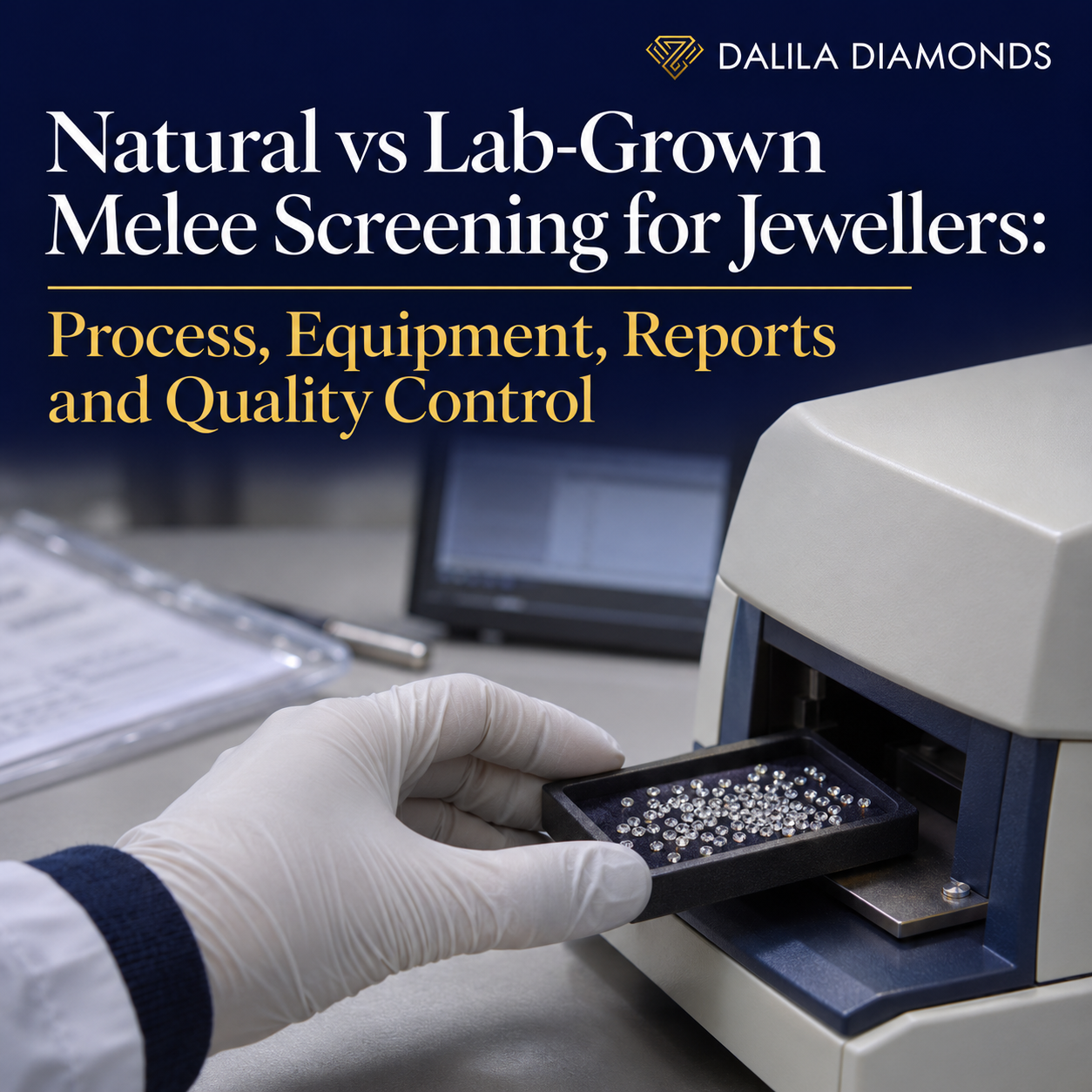
Melee diamond screening is the process of checking small diamonds to distinguish natural diamonds from laboratory-grown diamonds, simulants and stones that require further gemmological examination. For jewellers manufacturing natural-diamond jewellery, it is an important part of material verification and supplier quality control.
A parcel labelled "natural round melee" should not be accepted as independently verified solely because the supplier uses that description.
Natural and laboratory-grown diamonds have essentially the same fundamental diamond material properties. Both can be colourless, transparent and cut into small round brilliants suitable for pavé, halos, eternity rings or tennis bracelets.
They cannot be reliably distinguished using ordinary visual inspection.
This presents a particular challenge when a manufacturer receives hundreds or thousands of small diamonds in a single parcel.
For example, a jeweller may purchase 2,000 natural round melee diamonds measuring approximately 1.50 mm for a repeat jewellery collection.
The supplier may provide a natural-origin declaration.
However, the manufacturer still needs to decide whether its quality assurance policy requires independent screening, what testing system is appropriate, how inconclusive stones will be handled and which documents must be retained before releasing the parcel to production.
A parcel containing even a small number of undisclosed laboratory-grown diamonds could create problems if the finished jewellery is sold as containing exclusively natural diamonds.
A controlled process should connect the purchase specification, parcel identification, appropriate screening, resolution of inconclusive results, laboratory documentation and final production release.
This guide explains that workflow in detail, using the published screening methods of laboratories including GIA and IGI.
It also covers screening limitations, practical receiving procedures, example batch records and the information a professional buyer should request when sourcing natural melee diamonds.
Quick Answer: How Do You Screen Melee Diamonds for Natural or Lab-Grown Origin?
The process generally follows six stages:
Identify and record the incoming parcel.
Confirm that the stones fall within the selected screening service's technical scope.
Use an appropriate professional screening system or qualified laboratory service.
Separate stones classified as natural, laboratory-grown, simulants, outside scope or requiring further testing.
Resolve inconclusive results through an appropriate gemmological laboratory procedure.
Reconcile the tested stones and documentation before approving the parcel for manufacturing.
The exact procedure depends on the equipment or laboratory used.
A rapid screening instrument may identify stones that can be passed as natural within its validated scope while referring others for additional analysis.
A referral does not automatically mean that the diamond is laboratory-grown.
The referred stone must be examined further before its origin can be established.
Why Natural vs Lab-Grown Melee Screening Matters
Melee diamonds are used extensively in modern jewellery.
They appear in:
Pavé engagement rings.
Diamond halos.
Eternity rings.
Tennis bracelets.
Tennis necklaces.
Diamond stud earrings with decorative accents.
Multi-stone jewellery.
Watch and luxury-accessory settings.
Because melee diamonds are small, they are often bought in calibrated parcels rather than as individually graded stones.
A parcel may contain hundreds of diamonds separated by nominal diameter, colour and clarity range.
This purchasing structure creates efficiency, but it also increases the importance of batch-level controls.
Main risks
Risk | Why it matters |
Undisclosed laboratory-grown diamonds | Finished natural-diamond jewellery may be incorrectly described |
Diamond simulants | Parcel may contain material that is not diamond |
Unresolved referred stones | Origin remains unconfirmed |
Mixing of production lots | Screening documents may no longer correspond to the correct parcel |
Incomplete laboratory documentation | Buyer cannot establish what was tested |
Broken custody or packaging records | Screened stones may be confused with untested stock |
Incorrect interpretation of results | Screening outcomes may be overstated |
Uncontrolled supplier substitution | New stones may not have undergone the original screening process |
A reliable programme should control the stones themselves and the documentation attached to them.
Natural Diamond, Lab-Grown Diamond and Simulant: What Is Being Tested?
Before considering screening equipment, distinguish the material categories.
Material | What it is | Screening objective |
Natural diamond | Diamond formed through geological processes | Confirm natural classification |
HPHT laboratory-grown diamond | Diamond produced using high-pressure, high-temperature growth | Identify laboratory-grown origin |
CVD laboratory-grown diamond | Diamond produced using chemical vapour deposition | Identify laboratory-grown origin |
Diamond simulant | Different material that resembles diamond | Separate non-diamond material |
Potentially treated natural diamond | Natural diamond whose properties may have been altered | Refer or identify treatment as appropriate |
Unresolved material | Stone not conclusively classified by the screening stage | Obtain further analysis |
Laboratory-grown diamonds are real diamonds.
They should not be called fake diamonds simply because they were manufactured rather than formed naturally.
Simulants are a different category.
The screening and disclosure procedure should distinguish them accurately.
Why Visual Inspection Cannot Confirm Natural Origin
An experienced jeweller may be able to evaluate melee size, apparent colour, cutting quality and visible defects.
However, a conventional loupe examination cannot reliably establish natural versus laboratory-grown origin.
Both types can have similar outward appearance.
They may also have overlapping inclusion characteristics.
Small diamonds are particularly challenging because they provide limited surface area and often lack individual report numbers or inscriptions.
What visual examination can assess
Characteristic | Visual or dimensional inspection | Establishes natural origin? |
Nominal diameter | Yes | No |
Shape | Yes | No |
Visible chips | Often | No |
Facet arrangement | Yes | No |
Obvious haze | Sometimes | No |
Approximate colour appearance | Yes, with limitations | No |
Apparent clarity characteristics | Yes, with limitations | No |
Natural vs laboratory-grown | Not reliably | Requires appropriate identification |
HPHT vs CVD growth | Not reliably | Requires suitable gemmological analysis |
A stone's attractive appearance, quality or cutting precision is not evidence that it is natural.
How Professional Diamond Screening Works
Different screening devices use different combinations of physical observations and optical or spectroscopic techniques.
These may include responses related to ultraviolet light, fluorescence, phosphorescence and other diagnostic features.
Advanced laboratory examination can involve methods such as infrared spectroscopy, photoluminescence spectroscopy and other specialised techniques.
The purpose is to identify properties associated with the diamond's growth history or treatment.
However, no single observation is universally conclusive for every possible diamond.
GIA has specifically cautioned against relying on one gemmological characteristic, such as phosphorescence, to distinguish all natural and laboratory-grown diamonds.
Three levels of examination
Level | Function | Limitation |
Basic visual and quality examination | Checks physical characteristics and obvious defects | Does not establish origin |
Screening instrument | Separates qualifying stones from those requiring further examination according to its validated rules | May return inconclusive results |
Advanced laboratory identification | Uses appropriate analytical methods to resolve origin or treatment questions | Scope, eligibility and documentation vary by laboratory |
The correct workflow recognises the difference between an initial screening result and a final identification.
What Does Pass, Refer or Fail Mean?
Screening devices do not all use identical result terminology.
A professional should follow the particular manufacturer's validated instructions.
In a common pass/refer workflow:
Pass: The instrument determines that a stone meets its criteria for natural-diamond classification within its stated testing scope.
Refer: The instrument cannot conclusively identify the stone under its screening procedure, so additional testing is required.
Error, unsupported or out of scope: The test cannot provide an accepted result because of a technical issue or an ineligible stone.
Some instruments or laboratory services may use additional output categories.
Screening decision table
Result | What the jeweller should do |
Natural/pass within validated scope | Record result and follow the approved release policy |
Refer/inconclusive | Segregate and arrange further examination |
Laboratory-grown confirmed | Exclude from natural-only inventory |
Simulant confirmed | Exclude from diamond inventory as specified |
Potential treatment | Obtain appropriate identification or disclosure determination |
Outside instrument scope | Use another qualified method |
Test failure/error | Retest according to procedure; do not assume natural origin |
A referred stone is not automatically a laboratory-grown diamond.
It could be natural.
Equally, it should not be released as confirmed natural until the required investigation is complete.
What Equipment Can Identify Lab-Grown Melee?
Several specialist systems have been developed to help the jewellery trade identify laboratory-grown diamonds.
However, their capabilities differ.
Some are designed for individual loose stones.
Others can process batches automatically.
Some support mounted jewellery.
Other systems have restrictions concerning colour, size, shape or treatment.
Equipment-selection questions
Question | Why it matters |
What diamond sizes can it accept? | Melee sizes vary |
Does it test round and fancy shapes? | Parcel suitability |
Does it accept mounted stones? | Finished-jewellery testing |
What colour range is supported? | Technical scope |
Does it detect simulants? | Avoids incomplete material separation |
What happens to referred stones? | Determines follow-up process |
Is the result an initial screening or final identification? | Prevents overstated claims |
Can results be exported by batch? | Audit documentation |
What calibration is required? | Operational reliability |
Is the instrument validated for the intended application? | Testing confidence |
The jeweller should not purchase or rely on a screening machine solely because its marketing describes it as a diamond tester.
Ordinary thermal diamond testers are not sufficient for reliably separating natural diamonds from laboratory-grown diamonds.
GIA Melee Analysis Service: What Does It Actually Do?
GIA offers a specialist Melee Analysis Service for eligible loose melee parcels.
According to GIA's published service description, the service separates natural diamonds from laboratory-grown diamonds, simulants and potentially HPHT-treated natural diamonds.
It supports round and fancy-shaped melee within its specified eligibility limits.
Published GIA submission criteria
Requirement | GIA published specification |
Diamond size | 0.9–4.0 mm |
Approximate carat range | 0.005–0.25 ct |
Colour range | D–Z |
Minimum submission | 250 stones per parcel |
Shapes | Round and fancy shapes |
Stone preparation | Thoroughly cleaned |
Optional colour sorting | Available for eligible round melee |
Returned material | Separated and securely packaged by result category |
These are published service requirements; jewellers should recheck current criteria before submitting a parcel.
GIA result categories
The service separates material into categories including:
Round natural diamonds.
Fancy-shaped natural diamonds.
Laboratory-grown diamonds.
Simulants.
Stones outside service criteria.
Its published description also addresses separation of potentially treated natural material requiring appropriate analysis.
The laboratory's final accompanying documents and packaging should be interpreted according to the actual service performed.
Does GIA issue an individual grading report for every melee diamond?
No.
The Melee Analysis Service is not equivalent to issuing full individual 4Cs grading reports for every submitted stone.
The service primarily addresses material separation and eligibility-based sorting.
It should not be advertised as giving each individual melee diamond a full colour, clarity and cut report.
Optional colour-range sorting also should not be confused with comprehensive individual grading.
IGI Melee Screening: How Does It Work?
IGI publishes professional screening services for loose diamonds and mounted jewellery.
Its screening workflow is intended to identify natural diamonds, laboratory-grown diamonds and simulants.
For loose natural-diamond parcels, IGI describes returning screened stones in tamper-evident packaging with identifying information.
IGI documented parcel information
Item | What IGI describes |
Screening result | Natural diamond identification |
Analysis date | Recorded |
Seal number | Recorded |
Total parcel weight | Recorded |
Customer reference | Recorded |
Packaging | Tamper-evident |
Loose stones | Round and fancy shapes supported |
Mounted jewellery | Screening service offered |
IGI also publishes a sorting service for qualifying small-diamond parcels, including optional quality-range information and additional presentation formats.
The exact output and available fields depend on the service requested.
What should the buyer retain?
The jeweller should preserve the test result or related documentation, seal identification, parcel reference, date and corresponding receiving record.
If the sealed package is opened, the business should document that event.
A screening result on a sealed batch should not be casually applied to other stones introduced into the parcel afterwards.
GIA vs IGI Melee Screening: Trade Comparison
Consideration | GIA Melee Analysis | IGI Screening/Sorting |
Natural vs laboratory-grown identification | Published service | Published service |
Simulant identification | Yes | Yes |
Loose melee support | Yes | Yes |
Round stones | Yes | Yes |
Fancy shapes | Yes | Yes |
Mounted jewellery | Not the same as the loose-parcel Melee Analysis Service | IGI publishes mounted-jewellery screening |
Published eligibility | Specific size, colour and minimum-count criteria | Confirm exact service-specific conditions |
Parcel sealing | Secure separated packaging | Tamper-evident packaging described |
Optional colour/quality sorting | Round colour-range sorting available | Additional sorting options published |
Individual 4Cs reports automatically included | No | No |
These services are not necessarily interchangeable for every parcel.
A buyer should compare the actual submission criteria, required documentation, price, turnaround time and handling arrangements before choosing.
What About HRD Antwerp?
HRD Antwerp is an established diamond laboratory associated with diamond identification and grading services.
However, a buyer should not assume that a particular HRD melee-parcel screening programme, size limit, result category or reporting format is currently offered without confirming the relevant service directly.
For a parcel screening RFQ, ask HRD Antwerp for its current eligible stone sizes, natural/laboratory-grown identification workflow, referral handling and available documentation.
The laboratory name alone does not establish that an individual wholesale parcel has been screened.
For publication, do not describe specific HRD screening outputs or performance metrics unless supported by current official service documentation.
Step 1: Register the Incoming Melee Parcel
Before screening, the parcel should be identified and recorded.
A label reading "natural melee" is not enough.
The receiving team should capture the relevant commercial and physical details.
Parcel intake worksheet
Field | Information |
Internal parcel ID | ______ |
Supplier | ______ |
Purchase order | ______ |
Supplier lot reference | ______ |
Claimed origin | Natural |
Stone shape | ______ |
Nominal size | ______ mm |
Accepted size tolerance | ______ |
Colour range | ______ |
Clarity range | ______ |
Piece count | ______ |
Total carat weight | ______ |
Date received | ______ |
Receiving employee | ______ |
Package/seal condition | ______ |
Invoice reference | ______ |
Screening requirement | ______ |
Each parcel should have a unique identifier.
If several parcels are received on the same day, they should remain separate unless a documented procedure expressly permits consolidation.
Mixing material before screening can undermine traceability.
Step 2: Reconcile Quantity and Weight
The buyer should compare the shipment with the commercial invoice and purchase order.
For example, suppose the supplier invoices 1,000 natural round melee diamonds weighing 15.00 carats in total.
The receiving team records the actual received count and weight.
Illustrative intake
Metric | Supplier record | Receiving record |
Piece count | 1,000 | 1,000 |
Total weight | 15.00 ct | 15.00 ct |
Nominal diameter | 1.50 mm | 1.50 mm stated |
Origin | Natural declared | Not yet independently verified |
Screening | Requested | Pending |
This is a hypothetical example.
Matching piece count and weight does not establish natural origin.
It simply confirms the parcel's commercial and physical reconciliation at that stage.
Step 3: Confirm Eligibility Before Screening
A parcel must fall within the chosen service's specifications.
For GIA Melee Analysis, for example, the published diameter range is 0.9–4.0 mm, with a minimum of 250 stones per parcel.
An individual 0.60 mm stone would therefore fall outside that stated diameter range.
Likewise, submitting only 100 stones would not satisfy the published minimum quantity for that service.
Other laboratories or instruments may have different acceptance criteria.
Eligibility checklist
Requirement | Status |
Diameter within service scope | ______ |
Shape accepted | ______ |
Colour category accepted | ______ |
Stone count satisfies minimum | ______ |
Stones sufficiently cleaned | ______ |
Mounting status acceptable | ______ |
Packaging meets submission rules | ______ |
Laboratory account arranged | ______ |
Shipping and insurance confirmed | ______ |
The business should not conclude that a parcel cannot be screened at all simply because one service is unsuitable.
Instead, it should identify another appropriate qualified route.
Step 4: Decide Whether Every Stone Will Be Screened
This is a critical decision.
A jewellery manufacturer may use random sampling for diameter, colour consistency or other quality measures.
However, screening a small sample for natural origin does not prove that every stone in a parcel is natural.
Consider a hypothetical parcel containing 1,000 stones.
Suppose 10 are laboratory-grown and 990 are natural.
The contamination rate is 1%.
If a buyer tests only a random sample of 50 stones, there is a substantial possibility that none of the laboratory-grown stones will be selected.
A sample that contains only natural stones cannot justify a claim that every stone in the untested parcel has been individually identified.
Screening approaches
Approach | What it can establish | Limitation |
Supplier declaration only | Supplier's contractual representation | No independent technical identification |
Random sample screening | Evidence about sampled stones | Cannot certify every untested stone |
Full-parcel screening | Classification of all eligible tested stones under the selected method | Referred/out-of-scope material still needs resolution |
Laboratory analysis with referral resolution | More complete origin identification | Subject to service scope and correct custody |
Finished-jewellery screening | Assessment of stones already mounted | Mounting and service limitations may apply |
The buyer should choose the procedure based on the level of assurance required.
If the business requires every stone to undergo an appropriate origin-identification workflow, ordinary quality sampling is not an adequate substitute.
Step 5: Segregate Referred and Nonconforming Stones
After testing, every stone should be accounted for.
The results may contain more than one category.
For example, a parcel could produce:
Stones identified as natural.
Stones identified as laboratory-grown.
Simulants.
Referred or inconclusive stones.
Stones outside the screening service's size range.
The exact classification will depend on the laboratory or instrument.
Handling rules
Natural category: Release only when the identification is valid under the approved protocol and other quality checks pass.
Laboratory-grown category: Segregate from natural-only inventory.
Simulant category: Exclude from the natural-diamond parcel and investigate the discrepancy.
Referred category: Hold pending further identification.
Outside-scope category: Use an appropriate additional testing method or keep excluded from natural-only release.
A stone should not be moved from "referred" to "natural" simply because it looks similar to neighbouring diamonds.
Worked Example: Mixed Material Found in a Melee Parcel
The following is an illustrative screening scenario, not a real Dalila order.
A jeweller submits a parcel containing 1,000 stones for origin verification.
Hypothetical result
Classification | Stone count |
Identified natural | 988 |
Identified laboratory-grown | 7 |
Simulants | 2 |
Referred for further identification | 3 |
Total | 1,000 |
The parcel contains 988 stones that have passed the specified natural-identification stage.
Seven laboratory-grown stones must be excluded from a natural-only manufacturing order.
Two simulants must also be excluded.
The three referred stones need further assessment.
What happens next?
The receiving team reconciles the count.
The buyer informs the supplier of the findings under the agreed discrepancy procedure.
The laboratory-grown and simulant stones remain segregated.
The referred stones are submitted for further examination or handled through the approved laboratory process.
The manufacturer does not release the original 1,000-stone parcel as fully natural.
Important commercial distinction
The buyer may have ordered 1,000 natural diamonds.
Identifying 988 natural stones does not necessarily satisfy that order.
The supplier may need to replace missing or nonconforming stones according to the contract.
Any replacement stones should undergo the required verification before joining the approved production inventory.
A Real Documented Example of Mixed Melee Material
GIA published a laboratory case involving a parcel of 1,102 melee stones.
In that case, detailed examination identified 1,092 HPHT laboratory-grown diamonds and one natural diamond among the referred material, with nine stones outside the service criteria.
The case demonstrates that melee parcels can contain mixed-origin material.
It also illustrates why a referral result needs additional analysis rather than being treated as a final diagnosis.
This was a documented GIA laboratory observation, not a Dalila shipment.
The particular composition of that parcel should not be generalised into a typical wholesale contamination rate.
The importance of the case is methodological: origin should be established by appropriate testing, not inferred from a supplier label or the appearance of the batch.
Step 6: Record the Screening Results Correctly
A batch screening record should identify exactly what was tested and what the laboratory concluded.
It should not contain marketing language that exaggerates the service.
Recommended screening register
Field | Value |
Internal parcel reference | ______ |
Supplier lot | ______ |
Laboratory/instrument | ______ |
Service performed | ______ |
Testing date | ______ |
Submitted stone count | ______ |
Submitted total weight | ______ |
Size/shape scope | ______ |
Natural classification count | ______ |
Laboratory-grown classification count | ______ |
Simulant count | ______ |
Referred count | ______ |
Outside-scope count | ______ |
Further examination reference | ______ |
Final resolved natural count | ______ |
Seal number | ______ |
Laboratory reference | ______ |
Report/document received | ______ |
Internal release decision | ______ |
The record should also identify who reviewed the results.
An internal QC statement should not be described as an independent laboratory certificate.
Does Melee Screening Produce a Certificate?
The answer depends on the provider and the service purchased.
A laboratory may return a screening result document, analysis record, sealed parcel or other evidence associated with the tested material.
A supplier may also provide its own origin declaration.
These documents perform different functions.
Documentation comparison
Document | What it establishes | What it does not automatically establish |
Supplier natural-origin declaration | Supplier's representation of the goods | Independent screening |
Laboratory parcel screening result | Outcome for the identified tested material | Full individual 4Cs grading |
Individual diamond grading report | Reported characteristics of a particular stone | Origin of all neighbouring melee |
Seal and parcel record | Packaging and traceability link | Material origin without underlying testing |
Commercial invoice | Transaction description, quantity and price | Independent origin identification |
Internal receiving QC form | Buyer's checks and decision | Accredited laboratory result |
A jeweller should describe the documentation accurately.
For example:
"Parcel screened by [laboratory], reference [number], under [service], with results dated [date]."
That is more meaningful than the vague claim "all diamonds certified" when only a batch screening procedure was performed.
Can a Screening Report Verify Colour and Clarity?
Not automatically.
Some laboratory sorting services offer additional colour or quality-range options.
However, origin screening and grading are different activities.
GIA's Melee Analysis Service includes optional colour-range sorting for eligible round stones.
IGI publishes additional sorting configurations for qualifying parcels.
Those services do not mean that every small diamond receives the same comprehensive grading report used for an individually graded engagement-ring centre stone.
Separate the three tasks
Task | Objective |
Origin screening | Identify natural, laboratory-grown, simulant or referred material |
Size calibration | Sort diamonds within required physical dimensions |
Quality sorting | Group diamonds by agreed colour, clarity or appearance criteria |
A fully usable production parcel may require all three.
But passing one does not automatically prove compliance with the others.
Step 7: Check the Sealed Parcel Against the Received Documents
When an independent laboratory returns screened material, the packaging is part of the traceability process.
IGI describes using tamper-evident packaging with details such as seal number, date, result and parcel weight.
GIA also describes securely packaging separated material by category.
The receiving business should examine the actual package and reconcile the relevant identifiers.
Receiving checklist
Check | Required action |
Package identity | Match internal reference |
Laboratory identity | Confirm |
Seal number | Record and match |
Seal condition | Record |
Analysis date | Confirm |
Parcel weight | Compare |
Stone count, where supplied | Reconcile |
Result classification | Read carefully |
Referred/out-of-scope categories | Confirm separately |
Documents | Retain |
Release status | Record |
Breaking a laboratory seal may be necessary for production.
However, the business should document when and by whom the package was opened.
Once stones are mixed into unrelated stock, the original screening record may no longer provide reliable traceability for the combined material.
Step 8: Link Screened Batches to Jewellery Production
The purpose of screening is not simply to obtain a document.
It is to prevent unverified material from entering jewellery represented as natural.
A manufacturer should therefore link accepted parcels to production work orders.
Example inventory chain
Record | Illustrative reference |
Jewellery collection | Natural Pavé Collection |
Product SKU | NP-R01 |
Supplier parcel | LOT-1001 |
Screening batch | SCR-1001 |
Laboratory result | Reference recorded |
Natural stones released | 988 |
Production work order | WO-210 |
Stones allocated | 480 |
Remaining approved inventory | 508 |
This example assumes the hypothetical screened parcel's 988 natural stones have also passed the required size and quality checks.
The laboratory-grown, simulant and unresolved stones are excluded from released stock.
Why traceability matters
If a quality concern arises later, the business should be able to identify which supplier parcel and screening record correspond to the affected jewellery.
Without that link, a legitimate batch screening result may be difficult to connect to the finished product.
Step 9: Apply Screening Controls to Every New Supply Lot
A previously screened parcel does not establish the origin of the next delivery.
For example, a jeweller may reorder the same 1.50 mm G–H VS melee three months later.
The supplier, nominal specifications and invoice description may remain unchanged.
However, the new stones may come from another upstream parcel.
The new delivery should therefore follow the buyer's approved screening policy.
Repeat-order controls
Requirement | Repeat batch |
Approved sourcing specification | Reuse current version |
Supplier lot identity | New reference |
Natural-origin documentation | Required |
Screening scope | Confirm |
Testing record | New result |
Referred stones | Resolve |
Physical batch separation | Maintain |
Incoming quality inspection | Repeat |
Production release | New approval |
The separate guide /blogs/reorder-melee-consistent-batches covers maintaining size, colour and manufacturing consistency.
This article owns the natural-versus-laboratory-grown identification process.
What If the Melee Is Already Set in Jewellery?
Screening mounted melee can be more complicated than testing loose parcels.
The metal setting can restrict access to certain parts of the stones.
Small diamonds may also be closely spaced.
Some laboratories offer mounted-jewellery screening services, but equipment suitability must be confirmed.
IGI publicly lists diamond jewellery among its screening services.
That does not establish that every finished jewellery design can be examined with the same method or receive the same type of result.
Before submitting finished jewellery
Ask:
Does the laboratory accept the particular jewellery type?
Can every stone be accessed?
What is the minimum diamond size?
Are fancy shapes supported?
Will referred stones require removal?
How will results be linked to the finished item?
Is the jewellery insured during transport and examination?
What documentation will be supplied?
Where manufacturing is still in progress, screening loose melee before setting may offer a simpler route to separating and documenting individual material groups.
How Much Does Melee Screening Cost?
The cost depends on the laboratory, number of stones, total weight, size range, chosen service and shipping arrangements.
The buyer should obtain a current quotation rather than rely on a general per-carat estimate.
Total cost categories
Cost | Possible component |
Laboratory analysis | Screening service fee |
Submission preparation | Counting, cleaning and packaging |
Transport | Delivery to laboratory |
Insurance | Agreed cover during custody and transport |
Referred-stone examination | Additional testing if required |
Internal handling | Staff time for segregation and reconciliation |
Replacement stones | Nonconforming material replaced |
Production delay | Operational consequence |
A low screening fee is not necessarily the lowest total cost if the workflow has a high number of unresolved referrals or requires additional handling.
The business should evaluate overall suitability and traceability rather than choosing solely by advertised throughput.
How Long Does Screening Take?
Turnaround depends on service, parcel quantity, laboratory capacity, location and transport.
High-throughput instruments can analyse large numbers of eligible stones, but the machine's screening rate is not the same as the complete order turnaround time.
A shipment may need intake, preparation, analysis, referral resolution, packaging and return transportation.
For a jewellery manufacturer with a fixed delivery date, laboratory lead time should be included before the planned production start.
Deadline planning
Milestone | Required date |
Supplier dispatch | ______ |
Parcel received | ______ |
Laboratory submission | ______ |
Screening completed | ______ |
Referred stones resolved | ______ |
Final QC approved | ______ |
Production released | ______ |
Finished jewellery due | ______ |
Do not promise a laboratory turnaround until the selected provider confirms it.
Complete Melee Screening SOP for Jewellers
The following standard operating procedure can be adapted into a manufacturing business's quality system.
Stage A: Supplier approval
Confirm the supplier's material declaration, available screening evidence and agreed nonconformity terms.
Stage B: Parcel receipt
Record the lot reference, size, quantity, weight, packaging condition and invoice.
Assign a unique internal batch ID.
Stage C: Quarantine
Keep the parcel physically separated from approved natural melee stock until the required origin controls are completed.
Stage D: Screening eligibility
Determine the relevant size, shape, colour and quantity limitations of the selected laboratory or instrument.
Stage E: Analysis
Submit or screen stones under the approved procedure.
Maintain the batch identity throughout the process.
Stage F: Result reconciliation
Compare received counts and classifications with the submitted population.
Stage G: Referral resolution
Arrange appropriate laboratory analysis for inconclusive or potentially treated stones.
Stage H: Nonconformity handling
Segregate confirmed laboratory-grown diamonds, simulants and material outside the approved specifications.
Follow the supplier agreement.
Stage I: Production release
Authorise only those stones supported by the required identification and manufacturing QC records.
Stage J: Traceability
Link the accepted parcel to jewellery stockkeeping units and manufacturing work orders.
Wholesale Natural Melee Screening Worksheet
A. Purchase specification
Field | Information |
Buyer | ______ |
Supplier | ______ |
Purchase order | ______ |
Parcel ID | ______ |
Diamond origin required | Natural |
Shape | ______ |
Nominal size | ______ |
Dimensional tolerance | ______ |
Colour range | ______ |
Clarity range | ______ |
Cut style | ______ |
Quantity ordered | ______ |
Carat weight | ______ |
Delivery deadline | ______ |
B. Screening requirements
Requirement | Value |
All-stone screening required | Yes / No |
Screening laboratory | ______ |
Service name | ______ |
Accepted size range | ______ |
Shapes accepted | ______ |
Equipment/test method | ______ |
Simulant identification included | ______ |
Potential treatment referrals | ______ |
Referred-stone resolution | ______ |
Documentation required | ______ |
Seal or packaging requirements | ______ |
Responsible person | ______ |
C. Laboratory results
Category | Count |
Submitted | ______ |
Natural identified | ______ |
Laboratory-grown identified | ______ |
Simulants identified | ______ |
Referred/inconclusive | ______ |
Outside scope | ______ |
Other classifications | ______ |
Referred stones resolved as natural | ______ |
Referred stones resolved otherwise | ______ |
Final unresolved | ______ |
Total reconciled | ______ |
D. Documentation control
Field | Status |
Laboratory name | ______ |
Analysis reference | ______ |
Date | ______ |
Parcel reference | ______ |
Seal number | ______ |
Result document retained | ______ |
Supplier declaration retained | ______ |
Invoice retained | ______ |
Screening scope reviewed | ______ |
Exceptions recorded | ______ |
QA approval | ______ |
E. Manufacturing release
Field | Status |
Natural stones approved | ______ |
Non-natural stones segregated | ______ |
Unresolved stones quarantined | ______ |
Size QC passed | ______ |
Colour/clarity QC passed | ______ |
Production SKU | ______ |
Work order | ______ |
Released stone count | ______ |
Final approver | ______ |
Release date | ______ |
The signed screening record should be retained according to the business's document-retention policy.
Copy-Ready Supplier RFQ: Natural Melee With Screening Requirements
Subject: Natural Diamond Melee RFQ — Origin-Screened Wholesale Parcel
Project: Natural diamond jewellery production.
Diamond origin: Natural only.
Shape: Round brilliant.
Cut style: Full-cut.
Nominal diameter: 1.50 mm.
Accepted dimensional tolerance: [manufacturer-approved range].
Colour: G–H.
Clarity: VS range.
Quantity: 2,000 stones.
Carat weight: Quote actual parcel weight.
Natural-origin requirement: Provide the supplier's written origin declaration and the agreed independent or otherwise validated screening evidence.
Screening scope: Confirm which stones are tested and whether all-stone screening is included.
Laboratory/equipment: Identify the screening provider and relevant service.
Referred stones: Must be resolved or segregated; no unresolved stones to be counted as confirmed natural.
Documentation: State the result categories, relevant parcel identifiers and available report or seal references.
Substitutions: No undisclosed laboratory-grown material, simulants or unapproved source substitutions.
Price: State quote basis, currency, VAT treatment and quotation validity.
Delivery: [authorised workshop address].
Deadline: [required delivery date].
Inspection: Confirm acceptance criteria, nonconformity notification period, replacement and return terms.
Approval: Written buyer approval required before dispatch under final terms.
This is a specification template, not a confirmed Dalila service offer.
How Dalila Diamonds Fits Into Natural Melee Sourcing
Dalila Diamonds publicly describes professional natural loose-diamond sourcing, including calibrated melee parcels and quality-control guidance.
Its published resources discuss the importance of verifying natural-origin claims, screening mixed parcels and obtaining appropriate documentation.
A jeweller purchasing natural melee through Dalila can request a sourcing quotation with explicit origin-verification requirements.
What a professional buyer should ask Dalila
The buyer should ask whether the proposed parcel has already been screened, what evidence is available, whether additional laboratory screening can be arranged and who will be responsible for costs, custody and timing.
The enquiry should also identify whether the purchase requires independent all-stone screening rather than sampling.
What has not been verified
Dalila's publicly available educational content does not establish that the company owns or operates a particular melee-screening instrument, performs all origin screening in-house, maintains its own laboratory or includes GIA/IGI screening automatically with every melee purchase.
The buyer should request written confirmation for the particular order.
Dalila should not be described as GIA-certified, IGI-accredited or operating a specific screening machine unless the applicable relationship and equipment are independently verified.
Its verified commercial role remains natural loose-diamond sourcing under agreed transaction terms.
Common Mistakes in Melee Diamond Screening
Assuming a natural-origin invoice proves independent identification
It is a supplier declaration, not necessarily a screening result.
Using an ordinary diamond tester to distinguish natural from lab-grown
Both materials are diamond, so common basic testers cannot reliably establish growth origin.
Treating referred stones as confirmed laboratory-grown
Referral means further examination is needed.
Treating referred stones as natural
That is equally unjustified without suitable follow-up identification.
Sampling a few stones and claiming the whole parcel was individually screened
The claim exceeds the evidence.
Ignoring equipment size restrictions
Stones outside the validated range may produce no reliable result.
Treating screening as individual 4Cs grading
The two services provide different information.
Mixing screened and unscreened stones
This can undermine traceability and origin-assurance claims.
Failing to record laboratory seal numbers
It becomes harder to reconcile the tested parcel with the received goods.
Reusing a previous batch's screening record
New material requires its own controls.
Assuming Dalila performs in-house screening
No specific Dalila-owned equipment or laboratory service has been established.
Frequently Asked Questions
What is melee diamond screening?
It is the use of appropriate gemmological screening or identification methods to distinguish small natural diamonds from laboratory-grown diamonds, simulants and stones needing further investigation.
Can natural and lab-grown melee look identical?
They can look extremely similar to the unaided eye. Appropriate testing is needed to establish their growth origin.
Can a normal diamond tester identify lab-grown diamonds?
Not reliably. Basic testers that distinguish diamond from some simulants are not sufficient to establish natural versus laboratory-grown origin.
What is HPHT melee?
HPHT melee is small diamond material produced using high-pressure, high-temperature laboratory growth. HPHT may also refer to a treatment process applied to natural diamonds, so the context matters.
What is CVD melee?
CVD melee consists of small diamonds produced using chemical vapour deposition growth technology.
How do diamond screening machines work?
They evaluate diagnostic characteristics using instrument-specific methods. Depending on the system, these can involve optical or spectroscopic responses associated with the diamond's growth history.
Can every screening machine identify all lab-grown diamonds?
No. Different instruments have size, colour, shape and identification limitations. Some return referred results that require additional analysis.
What does refer mean during diamond screening?
It means the stone has not been conclusively classified under the screening procedure and requires further testing.
Does a referred diamond mean it is laboratory-grown?
No. Referred stones can include natural or laboratory-grown diamonds and must be examined further.
Can screening detect diamond simulants?
Some systems and laboratory services do. Confirm that capability for the chosen method.
What is GIA Melee Analysis?
It is a GIA laboratory service for sorting eligible small diamonds by natural, laboratory-grown and other relevant material categories.
What sizes does GIA's Melee Analysis Service accept?
Its published criteria specify 0.9–4.0 mm stones. Recheck the current service rules before submission.
What is GIA's minimum melee submission?
Its published minimum is 250 stones per parcel.
Does GIA issue a full grading report for every screened melee diamond?
No. Melee Analysis is not equivalent to an individual full 4Cs report for every stone.
Can GIA sort melee by colour?
GIA publishes optional colour-range sorting for eligible round melee as part of its service.
Does IGI screen natural vs lab-grown melee?
Yes. IGI publishes screening services for loose diamond parcels and mounted jewellery, subject to the relevant service terms.
Does IGI return screened parcels in sealed packaging?
IGI describes using tamper-evident packaging with identifiers including analysis date, seal number, result and parcel weight for relevant loose-parcel services.
Does HRD Antwerp offer melee screening?
The exact currently available parcel-screening service, eligibility and documentation should be confirmed directly with HRD Antwerp rather than assumed.
Is it necessary to screen every diamond in a melee parcel?
That depends on the buyer's assurance requirement. If the business wants every stone to undergo origin screening, sampling alone does not satisfy that requirement.
Can random sampling detect contamination?
It can identify contamination in tested samples, but a clean sample cannot prove that all untested stones are natural.
What happens if lab-grown stones are discovered in a natural parcel?
Segregate them, document the findings, prevent natural-only production release and follow the agreed supplier nonconformity process.
What if a parcel contains simulants?
Keep those stones separate, reconcile the quantity and investigate the discrepancy under the purchase agreement.
Does a screening result prove where a diamond was mined?
No. Natural-origin identification is different from geographic mining-origin provenance.
Is natural-origin screening the same as colour and clarity grading?
No. They answer different questions and may require separate methods.
Can mounted pavé diamonds be screened?
Some laboratories offer mounted-jewellery screening, but suitability depends on the jewellery and selected service.
How should jewellers store screening records?
Link the screening result, batch ID, supplier invoice, parcel identifiers and production work order in a controlled record.
Should every repeat melee batch have its own screening record?
A new batch should be evaluated under the buyer's approved origin-assurance procedure. Previous screening results do not automatically cover later stones.
Does Dalila screen all melee diamonds in-house?
Specific in-house screening equipment and an all-stone screening service have not been independently verified and should not be claimed.
Can Dalila source natural melee with screening requirements?
Dalila's natural loose-diamond sourcing workflow can be used to submit an enquiry with requested origin-verification conditions. Acceptance, testing arrangements and documentation must be confirmed for the individual transaction.
What should I ask for when ordering origin-screened natural melee?
Request the exact specification, batch reference, screening provider and scope, treatment of referred stones, supporting documents, price, delivery date and nonconformity terms.
Final Checklist: Identify the Stones Before Releasing Them to Production
Natural-diamond melee screening is a material-control process.
Its purpose is to establish whether the stones entering a natural jewellery collection meet the required origin specification.
An effective programme begins with supplier declarations and reliable parcel identification.
It then uses screening methods appropriate to the stones being tested.
Referred or unsupported results must be resolved rather than reclassified through assumption.
The laboratory evidence and sealed parcel references should be linked to the actual manufacturing inventory.
Most importantly, the business should distinguish origin screening from ordinary calibration and colour/clarity sorting.
The recommended sequence is: register the incoming parcel → confirm the screening scope → quarantine the material → conduct approved screening → resolve referrals → reconcile every classification → document the results → release conforming stones to production → retain batch traceability.
This gives jewellery manufacturers a defensible, repeatable basis for describing their products as containing natural diamonds without overstating what a screening service or supplier declaration proves.