Single-Cut vs Full-Cut Melee Diamonds: Which Is Better for Your Jewellery Design?
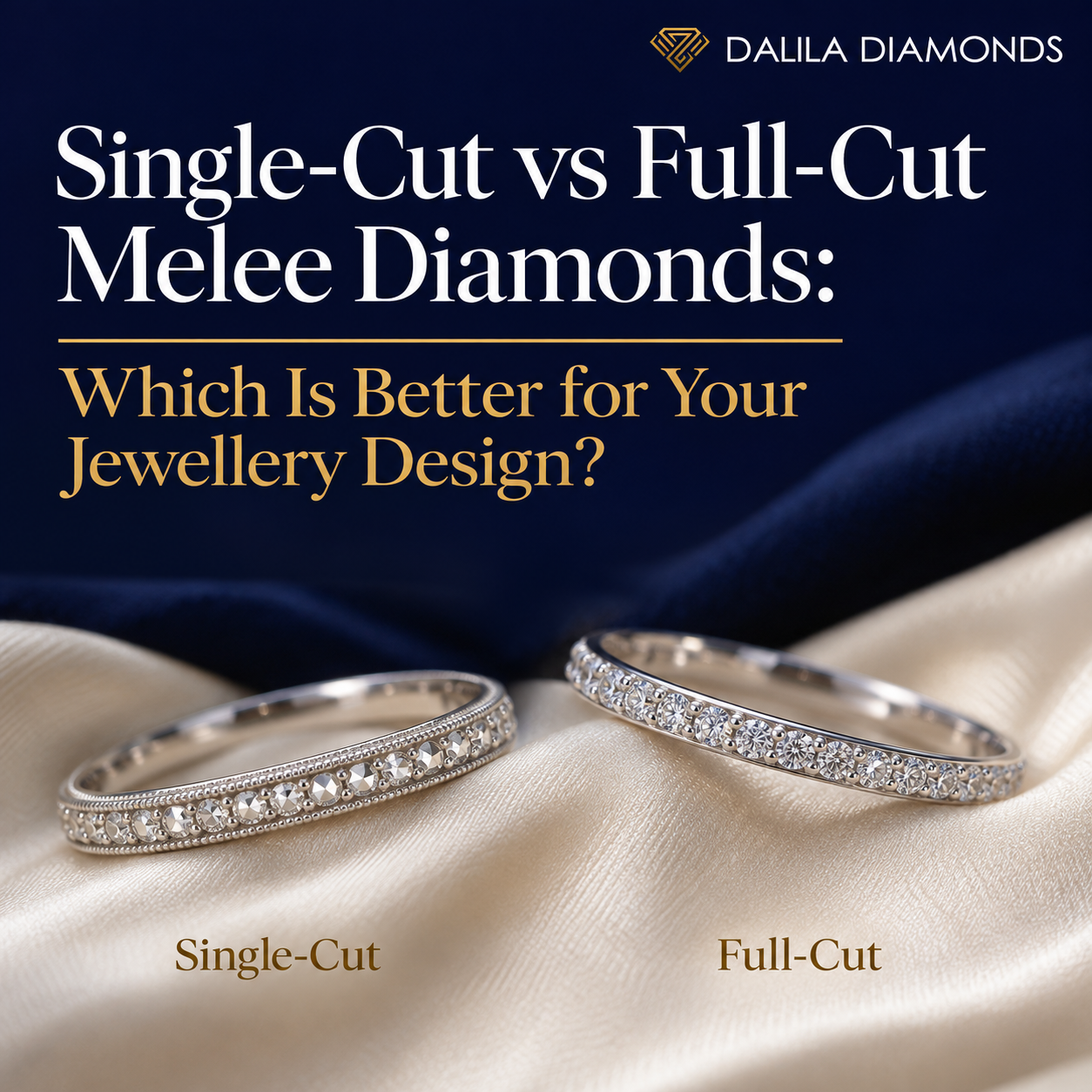
Single-cut melee diamonds have a simpler facet arrangement with 17 or 18 facets, while conventional full-cut round brilliant melee have 57 or 58 facets. This difference affects the pattern of light reflections, the visual character of pavé jewellery and how a jeweller should specify stones for manufacturing.
For most contemporary brilliant-style pavé designs, full-cut melee is a useful starting choice.
For some vintage-inspired rings, antique restorations and designs intended to display broader, calmer flashes, single-cut melee may be more appropriate.
However, full-cut does not automatically mean better diamond quality.
A poorly proportioned full-cut melee diamond can have unattractive light performance. A well-cut single-cut diamond may be ideal for a design requiring its distinctive faceting.
The decision should be based on the intended jewellery appearance, actual stone quality, available sizes, required quantity and manufacturing constraints.
For example, a jeweller designing an 18K white-gold engagement ring with 24 small diamonds along the band may compare two otherwise similar pavé samples:
One set with natural single-cut melee.
One set with natural full-cut round brilliant melee.
The single-cut version may produce relatively broad, individual light flashes.
The full-cut version may produce a more detailed, lively pattern of scintillation.
At very small sizes, differences may be subtle and depend heavily on lighting and viewing distance.
The best way to choose is to compare actual samples in equivalent settings, at the same millimetre size, under the same lighting conditions.
This guide explains the technical differences and provides a practical procurement workflow for jewellers, jewellery brands and manufacturers.
Quick Comparison: Single-Cut vs Full-Cut Melee
Feature | Single-cut melee | Full-cut melee |
Conventional facet count | 17 or 18 | 57 or 58 |
Crown facets excluding table | 8 | 32 |
Pavilion facets excluding optional culet | 8 | 24 |
Traditional name | Eight-cut or huit-huit | Round brilliant |
Light reflection pattern | Often broader, less fragmented flashes | Often finer, more numerous flashes |
Design association | Vintage and understated detailing | Contemporary brilliant-style jewellery |
Modern pavé use | Selective, design-led | Common |
Very small accents | Worth evaluating | Also available, subject to size and make |
Sourcing consideration | Specific cut and available stock | Precision and parcel consistency |
Quality guaranteed by cut name | No | No |
Setting fit guaranteed by cut name | No | No |
Both styles can be manufactured from natural diamonds.
The cutting style should be specified separately from stone origin, size, colour, clarity and quantity.
What Are Single-Cut Melee Diamonds?
A single-cut melee diamond is a small round diamond with a simplified arrangement of facets.
A conventional single cut generally has:
One table facet.
Eight crown facets.
Eight pavilion facets.
An optional culet facet.
That produces 17 facets without a culet or 18 with one.
Single cuts are also known in the trade as eight-cuts or huit-huit, reflecting the eight crown and eight pavilion facets.
They were historically used in jewellery, particularly before modern full-cut melee became widespread.
Today, they remain relevant to certain vintage-style designs and restorations.
How does single-cut melee look?
Its smaller number of comparatively larger facets can create a less fragmented reflection pattern.
In certain settings, individual stones may display distinct flashes rather than the finer scintillation associated with full-cut round brilliants.
However, the exact result depends on:
Diamond proportions.
Facet alignment.
Polish quality.
Transparency.
Size.
Lighting.
Setting construction.
A single cut is not automatically dull or poorly made.
Its facet pattern simply creates a different visual result.
What Are Full-Cut Melee Diamonds?
Full-cut round brilliant melee use the conventional facet architecture of a modern round brilliant diamond.
Typically, the stone has:
One table facet.
Thirty-two additional crown facets.
Twenty-four pavilion facets.
An optional culet facet.
That produces 57 or 58 facets.
Because the pattern contains more facets than a single cut, it can create finer, more numerous reflections as the jewellery moves.
Modern pavé bands, halos and other brilliant-style accent settings commonly use full-cut melee.
Does full cut mean Excellent cut?
No.
Full cut describes facet arrangement, not an independently verified cut-quality grade.
A full-cut melee diamond can have poor proportions, inconsistent symmetry or undesirable transparency.
Likewise, a parcel described as full-cut should not automatically be advertised as GIA Excellent.
The supplier should explain how any cut-quality terminology was determined.
For small diamonds without individual grading reports, the buyer may need to rely on agreed sorting standards, visual inspection and manufacturing acceptance criteria.
Does Full-Cut Melee Sparkle More Than Single-Cut?
Full-cut melee often creates a finer, more active scintillation pattern.
Single-cut melee often creates broader, calmer flashes.
But a higher facet count does not mathematically guarantee superior brightness.
The stone's actual cutting quality and the lighting environment remain important.
Understanding three visual properties
Brightness: The amount and distribution of white light returning to the observer.
Fire: The visible flashes of spectral colour.
Scintillation: The alternating flashes and dark areas seen as a diamond, light source or observer moves.
These properties interact, but they are not identical.
A full-cut diamond may display finer scintillation because of its more complex facet pattern.
A single cut may create fewer but more distinctive flashes.
Neither appearance is universally preferable.
Practical sparkle comparison
Viewing condition | Single cut | Full cut |
Direct showroom lighting | Broader flashes may be noticeable | Numerous fine flashes may be noticeable |
Diffused daylight | Differences can become subtle | Differences can become subtle |
Jewellery in motion | Larger individual flashes may appear | More detailed scintillation may appear |
Close-up macro video | Simpler facet pattern evident | More complex facet pattern evident |
Normal wearing distance | Differences depend on size and design | Differences depend on size and design |
The manufacturing jeweller should evaluate both styles under consistent conditions.
Photo Comparison 1: Loose Single-Cut and Full-Cut Diamonds
<escape>[EDITORIAL IMAGE SLOT 1 — TWO LOOSE DIAMONDS, SIDE BY SIDE]</escape>
Left image: Genuine single-cut round melee diamond showing the simpler facet architecture.
Right image: Genuine full-cut round brilliant melee showing the more complex facet arrangement.
Caption: Single cut vs full cut: fewer broad facets on the left, more numerous brilliant facets on the right.
Recommended reference: The photographic comparison in Victor Canera's Single Cut and Full Cut Melee Explained.
Image-production requirement: Use licensed or permission-cleared original photography. Do not use a generated diagram or photograph as evidence of actual gemmological light performance.
What the reader should examine
The comparison should clearly show the facet structure.
The images should use comparable magnification, orientation and lighting where possible.
If they come from different photography setups, label that limitation.
A fair comparison cannot be established solely from two unrelated marketing photographs with different exposure and lighting.
Photo Comparison 2: Single-Cut vs Full-Cut Pavé Ring
<escape>[EDITORIAL IMAGE SLOT 2 — TWO IDENTICALLY DESIGNED PAVÉ RING SAMPLES]</escape>
Left image: Real pavé band set with natural single-cut melee.
Right image: The same band design set with natural full-cut melee.
Caption: The setting stays the same; the facet pattern changes the character of the pavé.
Required photography conditions
Element | Requirement |
Ring design | Same mounting design |
Metal | Same alloy and finish |
Stone size | Same approved millimetre range |
Stone count | Same |
Colour range | As close as practical |
Clarity range | Comparable |
Camera | Same position and lens |
Lighting | Same exposure and light sources |
Retouching | No selective enhancement of sparkle |
Presentation | Both still photographs and comparable video |
This is the strongest visual test for the article.
An actual controlled side-by-side comparison should be photographed by Dalila or a manufacturing partner.
If that photography is unavailable, leave the image placement pending rather than using misleading images of unrelated jewellery.
Which Cut Is Better for Modern Pavé Jewellery?
For a contemporary pavé ring designed around fine scintillation, full-cut melee is often a suitable first option.
The many facets of round brilliant melee can create a lively field of reflections across the band.
However, the manufacturer should consider whether the setting exposes enough of the diamonds for that difference to be visible.
Very small stones surrounded by substantial metal may not display the same visual difference as larger, more exposed stones.
Modern pavé decision factors
Factor | What to examine |
Melee diameter | Visibility of individual stones |
Setting style | Shared prongs, beads or another construction |
Exposed crown area | How much of the diamond is visible |
Metal coverage | Effect on appearance |
Lighting | How the jewellery will usually be viewed |
Centre diamond style | Optical compatibility |
Collection price position | Cost and aesthetic goals |
Repeat production | Consistency of future parcels |
A jeweller should not assume that more facets automatically compensate for inconsistent stone sizes or poor setting workmanship.
A uniform, well-set single-cut parcel may look more coherent than a badly calibrated full-cut parcel.
Which Cut Is Better for Vintage-Inspired Jewellery?
Single-cut melee can be especially appropriate when the design calls for a quieter or historically influenced appearance.
For example, an antique-style ring containing an old European-cut centre diamond may benefit from small single-cut accents.
The simpler light reflection pattern may visually complement the centre stone's character.
However, not all antique jewellery originally contained single-cut melee.
The existing stones should be inspected before choosing replacements.
Vintage design considerations
Design | Cut to evaluate |
Antique-inspired pavé ring | Single cut |
Old European-cut centre ring | Single cut or visually compatible alternative |
Vintage halo | Match the intended historic character |
Antique jewellery repair | Match the original stones |
Contemporary brilliant halo | Full cut |
Modern micro-pavé band | Full cut, subject to design |
Deliberate mixed-cut design | Both, with client approval |
The purpose is to preserve design consistency.
Using full-cut diamonds in a restoration may change the appearance of the original pavé even when the new stones have the correct diameter.
Can You Mix Single-Cut and Full-Cut Melee in One Ring?
Yes, for certain deliberate designs.
However, mixing the two styles without planning may result in inconsistent appearance.
For example, replacing one lost single-cut diamond in an antique band with a full-cut round brilliant of similar size can create a visibly different reflection pattern.
The replacement may appear brighter or more active than its neighbours.
Conversely, a single-cut replacement in a full-cut pavé row may appear noticeably different under some lighting conditions.
When mixing may be intentional
A jewellery designer might choose one cut for a decorative border and another for a separate section of the ring.
The distinction can create visual hierarchy.
The decision should be approved as part of the design, rather than happen accidentally because of supplier substitutions.
Manufacturing rule
Keep the specified cutting style consistent within each intended stone group unless the design deliberately requires a change.
For repairs, examine the existing stones before placing an RFQ.
Does the Cut Change How Many Melee Diamonds You Need?
Not necessarily.
If two diamond batches have the same approved diameter, are suitable for the same mounting and the design is unchanged, switching between single-cut and full-cut does not inherently change the number of stone positions.
A pavé ring designed for 24 stones still has 24 intended positions.
However, the stones' depth, girdle characteristics and actual dimensions must be reviewed.
Cut style can affect the physical profiles of available stones.
If the manufacturer redesigns the setting around a different size or stone arrangement, the quantity may change.
Example: Same design, different cut
Specification | Single-cut version | Full-cut version |
Ring style | Pavé band | Pavé band |
Intended diamond positions | 24 | 24 |
Nominal diameter | 1.50 mm | 1.50 mm |
Required stones for one ring | 24 | 24 |
Required stones for 50 rings | 1,200 | 1,200 |
Extra stones | Production-dependent | Production-dependent |
Actual setting compatibility | Must be approved | Must be approved |
The stone count is determined by the approved ring layout.
It is not determined directly by whether each diamond has 17 or 57 facets.
How Much Total Carat Weight Will the Melee Add?
Total carat weight depends on the actual weights of the diamonds.
A diameter-to-weight conversion is only an estimate.
For illustrative full-cut round melee, a 1.50 mm stone might weigh approximately 0.015 ct, depending on its proportions.
Example: 24-stone ring
24 × 0.015 ct = 0.36 ctw.
For a production order of 50 rings:
50 × 24 = 1,200 setting stones.
At an assumed 0.015 ct each:
1,200 × 0.015 = 18.00 carats total.
This is a planning example.
Do not automatically assume that single-cut and full-cut melee with the same face-up diameter have identical carat weights.
The supplier should quote the actual parcel piece count, total weight and relevant dimensional distribution.
Planning table
Quantity of 1.50 mm stones | Assumed average 0.015 ct | Estimated total weight |
10 | 0.015 ct | 0.15 ctw |
24 | 0.015 ct | 0.36 ctw |
50 | 0.015 ct | 0.75 ctw |
100 | 0.015 ct | 1.50 ctw |
500 | 0.015 ct | 7.50 ctw |
1,200 | 0.015 ct | 18.00 ctw |
These are arithmetic estimates, not verified parcel weights.
For actual sourcing, use the supplier's measured data.
Can Single-Cut and Full-Cut Melee Use the Same Setting?
Potentially, but not automatically.
A mounting designed for a particular nominal diameter may be able to accommodate diamonds with either facet style.
However, the setter needs to examine their physical profiles.
The relevant considerations include:
Face-up diameter.
Total depth.
Girdle thickness.
Crown and pavilion geometry.
Prong or bead contact.
Seat construction.
Available pavilion clearance.
A change in cut style should not be approved solely because the stones are labelled 1.50 mm.
Setting compatibility worksheet
Requirement | Existing specification | Replacement cut |
Nominal diameter | ______ | ______ |
Accepted diameter tolerance | ______ | ______ |
Depth range | ______ | ______ |
Girdle requirements | ______ | ______ |
Setting type | ______ | ______ |
Seat geometry | ______ | ______ |
Manufacturer approval | ______ | ______ |
Trial setting completed | ______ | ______ |
When switching between cuts for an existing product collection, a setting trial is advisable.
The actual manufacturing jeweller should decide whether the new stones are acceptable.
Single-Cut vs Full-Cut Melee for Halos
A halo contains a group of accent stones arranged around a centre diamond.
The halo's appearance depends on the combined reflections from all the stones and the setting.
Full-cut halo
A full-cut halo may create fine scintillation around a modern round, oval, cushion or radiant centre diamond.
This can reinforce a contemporary brilliant appearance.
Single-cut halo
A single-cut halo may produce a different visual rhythm.
It can be considered for a vintage-inspired design, especially when the centre stone has broader light flashes.
What the jeweller should compare
Feature | Why it matters |
Centre cut style | Desired visual harmony |
Halo diamond diameter | Uniform appearance |
Facet pattern | Character of surrounding reflections |
Colour matching | Prevents unwanted contrast |
Stone count | Controls spacing and total weight |
Halo geometry | Determines physical fit |
Manufacturing quality | Affects final alignment and security |
The decision should be made using comparable samples or an approved design prototype where practical.
Single-Cut vs Full-Cut for Tennis Jewellery
Tennis bracelets and necklaces contain many repeated small diamonds.
The combined appearance therefore depends strongly on parcel consistency.
Full-cut round brilliants are a common option for modern designs with continuous fine scintillation.
Single cuts could be considered for a particular aesthetic, but the buyer should first verify that the intended quantity, size and quality are actually available.
Procurement considerations
Requirement | Why it matters |
Large quantity | Complete-order availability |
Uniform diameter | Consistent setting |
Similar depth | Consistent profile |
Colour and clarity | Uniform appearance |
Cut style | Repeatable sparkle character |
Actual carat weight | Accurate total-weight quotation |
Spare stones | Future repair and replenishment |
Supplier consistency | Reordering |
For repeat jewellery collections, retain an accepted reference batch.
Dalila's separate /blogs/reorder-melee-consistent-batches article covers the process of preserving that specification across multiple production orders.
Does Full-Cut Melee Cost More?
It may, but a higher price is not guaranteed in every sourcing situation.
Full-cut melee involves a more complex facet arrangement.
The cutting labour, supply, precision and sorting requirements can affect the price.
However, actual wholesale pricing also depends on:
Natural origin.
Size and quantity.
Colour and clarity.
Cutting quality.
Parcel calibration.
Availability.
Supplier and sourcing costs.
Screening requirements.
Market conditions.
A high-quality, hard-to-source single-cut parcel could cost more than an ordinary full-cut parcel.
The buyer should compare actual quotations rather than assume that the simpler facet pattern always produces a cheaper stone.
Proper cost comparison
Commercial input | Single cut | Full cut |
Stone count | Actual | Actual |
Diameter specification | Same or approved alternative | Same or approved alternative |
Total carat weight | Actual | Actual |
Price per carat | Supplier quote | Supplier quote |
Price per piece | Calculated or quoted | Calculated or quoted |
Sorting costs | Confirm | Confirm |
Origin-screening cost | Confirm | Confirm |
Manufacturing trial cost | Confirm | Confirm |
Delivery and insurance | Confirm | Confirm |
Total finished-jewellery impact | Calculate | Calculate |
The relevant question is not simply which parcel has a lower price per carat.
It is which option delivers the intended jewellery appearance and acceptable manufacturing performance at the appropriate total cost.
Worked Example: Comparing Two Pavé Production Options
Suppose a jewellery brand is preparing a new collection of 50 pavé rings.
Each ring contains 24 natural melee diamonds.
The team wants to compare single-cut and full-cut diamonds before approving the collection.
Project brief
Requirement | Specification |
Collection | Fine Pavé Ring |
Ring metal | 18K white gold |
Production quantity | 50 rings |
Diamonds per ring | 24 |
Total setting positions | 1,200 |
Nominal size | 1.50 mm |
Origin | Natural |
Colour | G–H |
Clarity | VS range |
Setting | Shared-bead pavé |
Approved tolerance | Manufacturer to establish |
These are hypothetical design inputs, not an actual Dalila production order.
Option A: Single-cut melee
The brand requests a representative single-cut parcel.
The manufacturer prepares a test ring or equivalent controlled setting sample.
The team reviews:
Face-up visual character.
Compatibility with the intended centre stone.
Stone consistency.
Setting fit.
Workshop handling.
Parcel price and availability.
Option B: Full-cut melee
The same process is repeated using full-cut round brilliant melee.
The mounting, size and viewing conditions should be comparable.
Decision worksheet
Evaluation criterion | Single-cut sample | Full-cut sample |
Cut style verified | Pending | Pending |
Actual dimensions approved | Pending | Pending |
Colour matched | Pending | Pending |
Transparency acceptable | Pending | Pending |
Visual sparkle preference | Client to decide | Client to decide |
Setting trial passed | Pending | Pending |
Available quantity confirmed | Pending | Pending |
Natural-origin screening | Pending | Pending |
Supplier quotation | Pending | Pending |
Reorder feasibility | Pending | Pending |
Final decision | Not yet approved | Not yet approved |
The table deliberately contains no invented trial results.
What the manufacturer should decide
If the collection is intended to have a distinctly modern, lively appearance, full cut may be preferred.
If the client wants broader light flashes and a vintage character, single cut may be more suitable.
The final decision should be made after reviewing real samples and manufacturing results.
Wholesale Sourcing: How to Specify the Cutting Style Correctly
An RFQ for natural melee should explicitly identify the cut type.
"Round melee" is not sufficiently precise when the design depends on a particular facet arrangement.
Single-cut RFQ example
Project: Vintage-style diamond pavé ring.
Diamond origin: Natural.
Shape: Round.
Cutting style: Conventional single cut, 17/18-facet architecture.
Nominal diameter: 1.50 mm.
Dimensional tolerance: Approved by manufacturer.
Colour: G–H.
Clarity: VS range.
Quantity: [required number of stones].
Total weight: Quote actual parcel carat weight.
Make: Consistent face-up appearance.
Screening: Natural-origin verification under agreed protocol.
Sample: Physical sample required before bulk approval.
Delivery: [approved workshop address].
Deadline: [date].
Quotation: State price, quantity, availability, delivery and inspection conditions.
Full-cut RFQ example
Project: Contemporary brilliant-style pavé ring.
Diamond origin: Natural.
Shape: Round brilliant.
Cutting style: Full cut, conventional 57/58-facet architecture.
Nominal diameter: 1.50 mm.
Dimensional tolerance: Approved by manufacturer.
Colour: G–H.
Clarity: VS range.
Quantity: [required number of stones].
Total weight: Quote actual parcel carat weight.
Make: Consistent full-cut appearance.
Screening: Natural-origin verification under agreed protocol.
Sample: Representative sample requested.
Delivery: [approved workshop address].
Deadline: [date].
Quotation: State price, quantity, availability, delivery and inspection conditions.
These are sample sourcing specifications.
The availability of particular natural single-cut or full-cut parcels must be confirmed before the order is accepted.
Natural-Origin Verification for Melee Parcels
Natural and laboratory-grown melee diamonds can look very similar.
Facet count does not establish origin.
A full-cut stone is not necessarily natural.
A single-cut stone is not necessarily natural.
If the finished jewellery is represented as containing natural diamonds, the buyer should obtain appropriate origin-assurance documentation.
What to ask
Question | Requirement |
Are all stones represented as natural? | Written supplier declaration |
How is natural origin checked? | Agreed screening protocol |
Is the screening suitable for the sizes? | Confirm |
Are referred stones resolved? | Document |
Are parcels segregated? | Confirm |
Can the documentation be linked to the order? | Yes |
Is a new batch screened separately? | According to agreed protocol |
GIA offers a Melee Analysis Service for eligible diamonds.
However, this is not equivalent to issuing a complete individual 4Cs grading report for every melee stone.
The buyer should use accurate terminology when describing the documentation.
What Happens When Replacing a Lost Pavé Diamond?
A replacement must match the existing jewellery.
The most important step is to identify the original cutting style.
For example, a vintage ring may contain single-cut melee.
A modern full-cut replacement of similar diameter could look different from neighbouring stones.
Before sourcing, the jeweller should record:
Existing cut style.
Actual stone diameter.
Approximate depth and girdle requirements.
Colour and clarity appearance.
Position in the design.
Setting condition.
Number of replacement stones required.
The setter should inspect the damaged seat or prongs before fitting the replacement.
For the wider jewellery-repair process, see the relevant Dalila missing-diamond replacement resources.
Complete Single-Cut vs Full-Cut Sourcing Worksheet
A. Jewellery project
Field | Requirement |
Project reference | ______ |
Jewellery type | ______ |
Product SKU | ______ |
Metal and alloy | ______ |
Setting type | ______ |
Centre stone, if any | ______ |
Client's preferred appearance | ______ |
New production or restoration | ______ |
Manufacturing jeweller | ______ |
Delivery deadline | ______ |
B. Diamond specification
Requirement | Single-cut option | Full-cut option |
Origin | Natural | Natural |
Shape | Round | Round brilliant |
Facet style | 17/18 | 57/58 |
Nominal diameter | ______ | ______ |
Minimum diameter | ______ | ______ |
Maximum diameter | ______ | ______ |
Depth requirements | ______ | ______ |
Girdle requirements | ______ | ______ |
Colour | ______ | ______ |
Clarity | ______ | ______ |
Make | ______ | ______ |
Transparency | ______ | ______ |
Quantity | ______ | ______ |
Actual carat weight | ______ | ______ |
C. Sample comparison
Check | Single cut | Full cut |
Reference parcel received | ______ | ______ |
Cut style verified | ______ | ______ |
Size tolerance passed | ______ | ______ |
Colour consistency passed | ______ | ______ |
Transparency passed | ______ | ______ |
Face-up appearance reviewed | ______ | ______ |
Comparative photographs captured | ______ | ______ |
Setting trial completed | ______ | ______ |
Setter approval | ______ | ______ |
Design approval | ______ | ______ |
D. Wholesale quotation
Cost field | Single cut | Full cut |
Supplier | ______ | ______ |
Parcel reference | ______ | ______ |
Stone count | ______ | ______ |
Actual weight | ______ | ______ |
Price per carat | ______ | ______ |
Price per stone | ______ | ______ |
Total price | ______ | ______ |
Currency | ______ | ______ |
VAT treatment | ______ | ______ |
Origin verification | ______ | ______ |
Shipping and insurance | ______ | ______ |
Current availability | ______ | ______ |
Quotation expiry | ______ | ______ |
Return/inspection terms | ______ | ______ |
E. Manufacturing decision
Decision | Value |
Selected cut style | ______ |
Reason for choice | ______ |
Approved sample | ______ |
Approved specification version | ______ |
CAD/setting approved | ______ |
Quantity confirmed | ______ |
Extra stones allowed | ______ |
Supplier lot reference | ______ |
Production release date | ______ |
Final inspection | ______ |
This worksheet should be retained with the production order.
For repeat orders, the chosen sample and specification should become the accepted reference.
How Dalila Diamonds Fits Into Melee Sourcing
Dalila Diamonds publishes natural loose-diamond sourcing information for jewellers and manufacturers, including calibrated melee, matched parcels and specification-led sourcing.
Its DS4U — Diamond Source For You service supports enquiries with exact diamond requirements, budget and delivery needs.
A professional buyer can prepare an RFQ distinguishing single-cut from full-cut natural melee and ask Dalila whether an appropriate parcel can be sourced.
What to provide
The enquiry should specify the intended jewellery design, natural origin, actual cutting style, nominal size, manufacturer-approved tolerance, colour, clarity, stone count, quality requirements and deadline.
If the decision depends on sparkle pattern, request representative samples and agree how they will be compared.
What must be confirmed
Dalila's public materials support calibrated natural melee sourcing generally.
They do not establish that every single-cut size, full-cut size or required quantity is immediately available.
Nor do they establish that side-by-side sample mounting, photography or production trials are automatically included.
Those arrangements must be confirmed for the individual trade enquiry.
Common Mistakes When Choosing Single-Cut or Full-Cut Melee
Assuming more facets automatically means better quality
Facet count describes architecture, not the precision or optical performance of the actual stones.
Choosing on price alone
The cheapest parcel may not produce the intended appearance or manufacturing quality.
Ignoring the centre diamond
The melee's light-reflection pattern should complement the design objective.
Comparing unrelated jewellery photographs
Differences in lighting, metal and stone sizes may distort the comparison.
Assuming equal diameter means equal weight
Actual depth and proportions can differ.
Assuming the cut changes the stone count
The layout determines the number of positions unless the design itself changes.
Replacing single-cut melee with full-cut stones without approval
The new stone may stand out from the surrounding accents.
Ignoring natural-origin verification
Cutting style does not establish whether a diamond is natural.
Treating full cut as a laboratory Excellent grade
Those terms describe different attributes.
Ordering bulk goods without sample approval
The buyer may discover visual or setting differences after delivery.
Frequently Asked Questions
What is the difference between single-cut and full-cut melee diamonds?
Single-cut round melee typically has 17 or 18 facets, while conventional full-cut round brilliant melee has 57 or 58. This changes the facet architecture and often the visual pattern of reflections.
How many facets does a single-cut diamond have?
A conventional single-cut diamond has 17 facets, or 18 if a culet facet is present.
How many facets does a full-cut melee diamond have?
A conventional full-cut round brilliant has 57 or 58 facets, depending on the culet.
What does huit-huit mean in diamonds?
Huit-huit is a traditional trade name associated with single-cut diamonds, referring to eight crown and eight pavilion facets.
Do full-cut melee diamonds sparkle more?
They often create finer and more numerous light flashes, but actual sparkle depends on cut execution, transparency, lighting and setting design.
Are single-cut diamonds dull?
No. Well-cut single-cut diamonds can display attractive light reflections with a different visual character.
Are single-cut diamonds cheaper?
Not necessarily. Cutting labour, rarity, size, quality and actual availability determine wholesale prices.
Are full-cut diamonds always better quality?
No. Full cut describes the facet arrangement, not a guaranteed quality level.
Which cut is better for modern pavé?
Full-cut melee is a useful starting option for contemporary brilliant-style pavé, subject to actual sample comparison.
Which cut is better for vintage jewellery?
Single-cut melee may complement some vintage styles, but restorations should match the original stones whenever practical.
Should I use single-cut melee with an old European-cut diamond?
It may be worth evaluating because of the intended historic visual character. The complete jewellery design and actual stones should guide the decision.
Can I use full-cut melee in a vintage-inspired ring?
Yes. The right choice depends on the desired appearance rather than an absolute style rule.
Can I mix single and full cuts in one piece?
Yes, when deliberately designed and approved. Accidental mixing may produce inconsistent appearance.
Can full-cut replace a lost single-cut stone?
Potentially, but it may look different. The jeweller should compare the original cutting style and surrounding stones before sourcing.
Is single cut the same as rose cut?
No. Single cut and rose cut use different facet architectures.
Does single-cut melee have fewer carats?
Not inherently. Weight depends on the individual stone's actual volume and proportions.
Can single- and full-cut diamonds have the same diameter?
Yes. However, they may have different depth profiles and actual weights.
Does switching from single to full cut change the number of stones in a pavé ring?
Not automatically. An unchanged design retains the same number of planned setting positions, subject to setting approval.
Which cut is better for halo rings?
Both can work. Full cut often suits modern brilliant-style halos, while single cut may support a selected vintage aesthetic.
Which cut is better for tennis bracelets?
Full-cut melee is a common modern option, but the choice should follow the desired appearance and available consistent parcel specification.
Does full cut mean GIA Excellent?
No. The terms describe different things.
Are single-cut melee diamonds natural?
They can be natural or laboratory-grown. Their cutting style does not establish origin.
How can I verify that melee diamonds are natural?
Use appropriate supplier documentation and a suitable origin-screening protocol, not visual appearance or facet count alone.
Does every melee diamond need its own GIA report?
No. Many melee parcels use sorting and origin-screening documentation rather than individual 4Cs reports.
Should I compare single and full cuts at the same carat weight?
For visual comparison, matching actual diameter and setting conditions is often more useful than matching carat weight alone.
What is the best way to compare sparkle?
Use real diamonds in comparable settings, under consistent lighting and with the same camera or viewing conditions.
Can Dalila source natural single-cut melee?
Dalila publishes specification-led natural-diamond sourcing. Availability of particular single-cut melee parcels must be confirmed directly.
Can Dalila source full-cut melee for pavé?
Dalila describes calibrated natural melee sourcing for professional jewellery production, subject to the actual requirement and availability.
What should I include in a wholesale melee RFQ?
Specify natural origin, single or full cut, diameter, tolerance, colour, clarity, quantity, actual weight requirements, documentation, sample approval, price, destination and deadline.
Final Recommendation: Choose the Facet Style That Fits the Design
Single-cut and full-cut melee are both legitimate diamond cutting styles.
Their main distinction is the number and arrangement of facets.
Full-cut melee often produces finer, more active reflections and is widely used in contemporary brilliant-style jewellery.
Single-cut melee can provide broader flashes and may be particularly suitable for selected vintage-inspired or restoration projects.
Neither cut should be selected on facet count alone.
The jeweller should compare actual diamonds, establish the desired appearance and confirm that the proposed parcel works with the manufacturing design.
For bulk production, availability, calibration, natural-origin assurance and repeat-batch consistency are just as important as sparkle.
The recommended sequence is: establish the intended jewellery appearance → choose single-cut and full-cut samples → compare equivalent sizes and settings → approve the facet style → confirm manufacturing tolerances → request verified natural melee parcels → inspect the goods → release the selected batch to production.
This helps jewellery manufacturers choose melee that supports the finished design rather than simply purchasing the most familiar cutting style.