
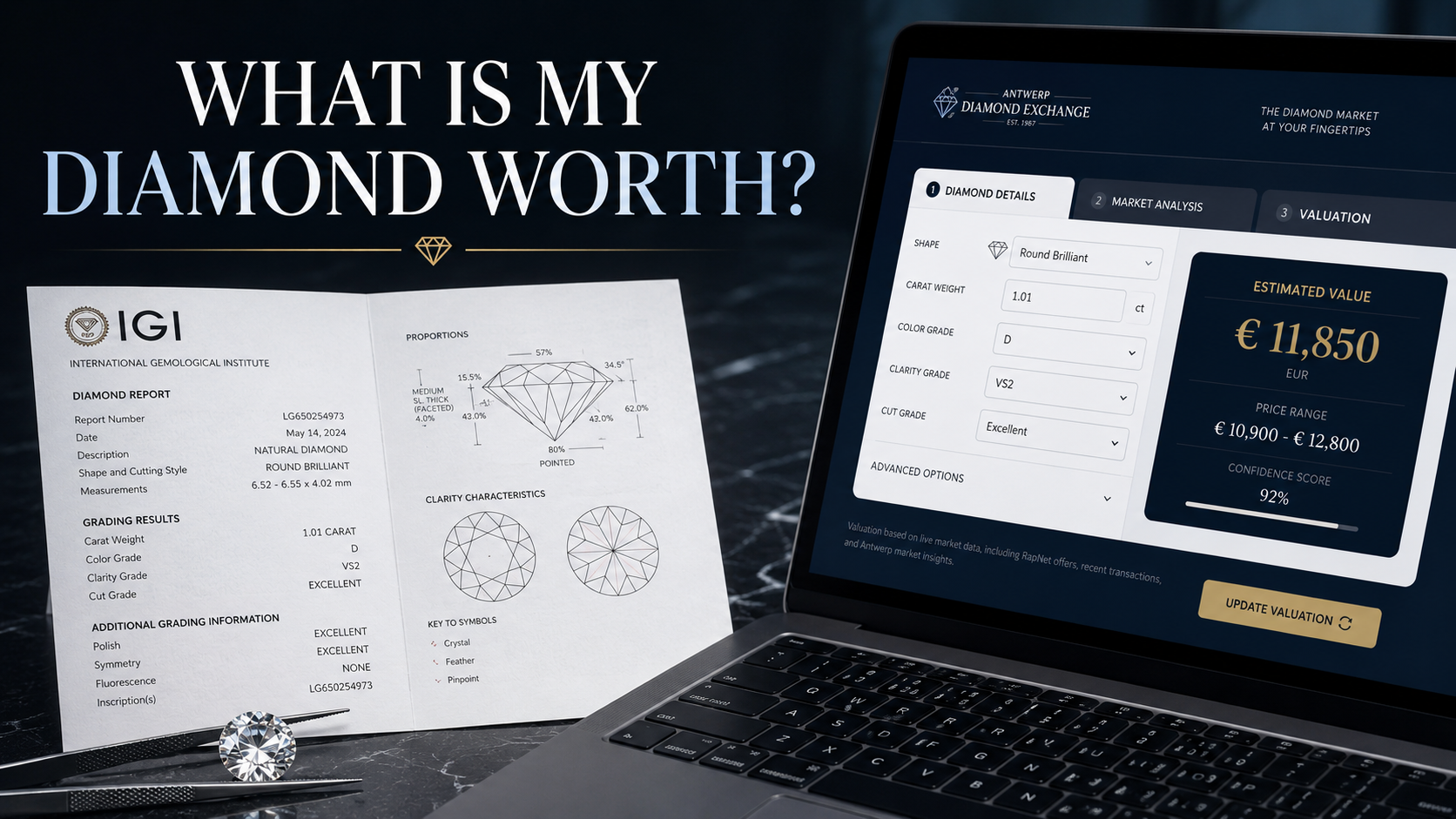
If you own a natural diamond, diamond ring or another piece of diamond jewellery, you may be wondering what it is worth today. The Dalila diamond valuation calculator helps you begin that process by collecting the characteristics that influence a diamond’s potential selling value.
Enter the information shown on your grading report and upload clear photographs of the diamond or jewellery. If you do not have a certificate, you can still submit the details you know. Dalila Diamonds can review the information and explain whether a physical evaluation in Antwerp is required.
An online diamond valuation is an initial assessment rather than a guaranteed purchase offer. A final offer may require verification of the diamond, its grading report, condition, ownership and current market demand.
START MY DIAMOND VALUATIONStart Your Online Diamond Valuation
Tell us as much as you know about your diamond. Accurate report information and clear photographs can help us provide a more useful initial assessment.
Step 1 of 5
What Would You Like to Value?
Select the option that best describes your item.
How Much Is My Diamond Worth?
There is no single price for a diamond based only on its size. A one-carat natural diamond, for example, can have a very different value from another one-carat diamond because of differences in shape, colour, clarity, cut quality, fluorescence, certification and overall condition.
The first question is whether the diamond is natural or laboratory-grown. These diamonds must be valued separately because they have different supply conditions and resale markets. A grading report, when available, should state the diamond’s origin.
After origin has been established, the evaluator considers the diamond’s quality and current demand for comparable stones. The condition of the stone, available documentation and whether it is loose or mounted in jewellery can also affect the assessment.
An online diamond valuation calculator can therefore provide a useful starting point, but a reliable selling price normally requires more than a simple carat-and-grade calculation.
The main information used in an initial diamond valuation includes:
- Natural or laboratory-grown origin
- Shape and carat weight
- Colour and clarity grades
- Cut, polish and symmetry
- Fluorescence
- Grading laboratory
- Treatments, if any
- Current condition
- Current buyer demand
If some of this information is unavailable, submit the details and photographs you have. Dalila can explain what additional verification may be necessary.
FIND OUT WHAT MY DIAMOND MAY BE WORTHDiamond Valuation Is Not the Same as the Original Retail Price
Many sellers expect their diamond’s current value to be close to the amount originally paid. However, the original retail price and the amount a professional buyer may offer serve different purposes.
The retail price may include the jeweller’s operating costs, design work, setting, branding, taxes, customer service and profit margin. An insurance appraisal may be higher because it estimates what it could cost to replace the item through a retail seller. Neither figure automatically represents what the diamond can be sold for today.
| Type of value | What it represents |
|---|---|
| Original retail price | The amount paid when the jewellery was originally purchased |
| Insurance appraisal | An estimated replacement value used for insurance purposes |
| Fair-market value | An opinion of what a willing buyer and seller may agree upon |
| Resale value | The amount the diamond may achieve in the secondary market |
| Purchase offer | The amount a particular buyer is prepared to pay after evaluation |
GIA explains fair-market value as an appraiser’s opinion of what a willing buyer would pay a willing seller. This is different from simply repeating the diamond’s original retail price. See GIA’s guidance about selling jewellery.
A current purchase offer is influenced by the physical diamond, its documentation, its condition and present demand. For that reason, a previous valuation should not be treated as a guaranteed selling price.
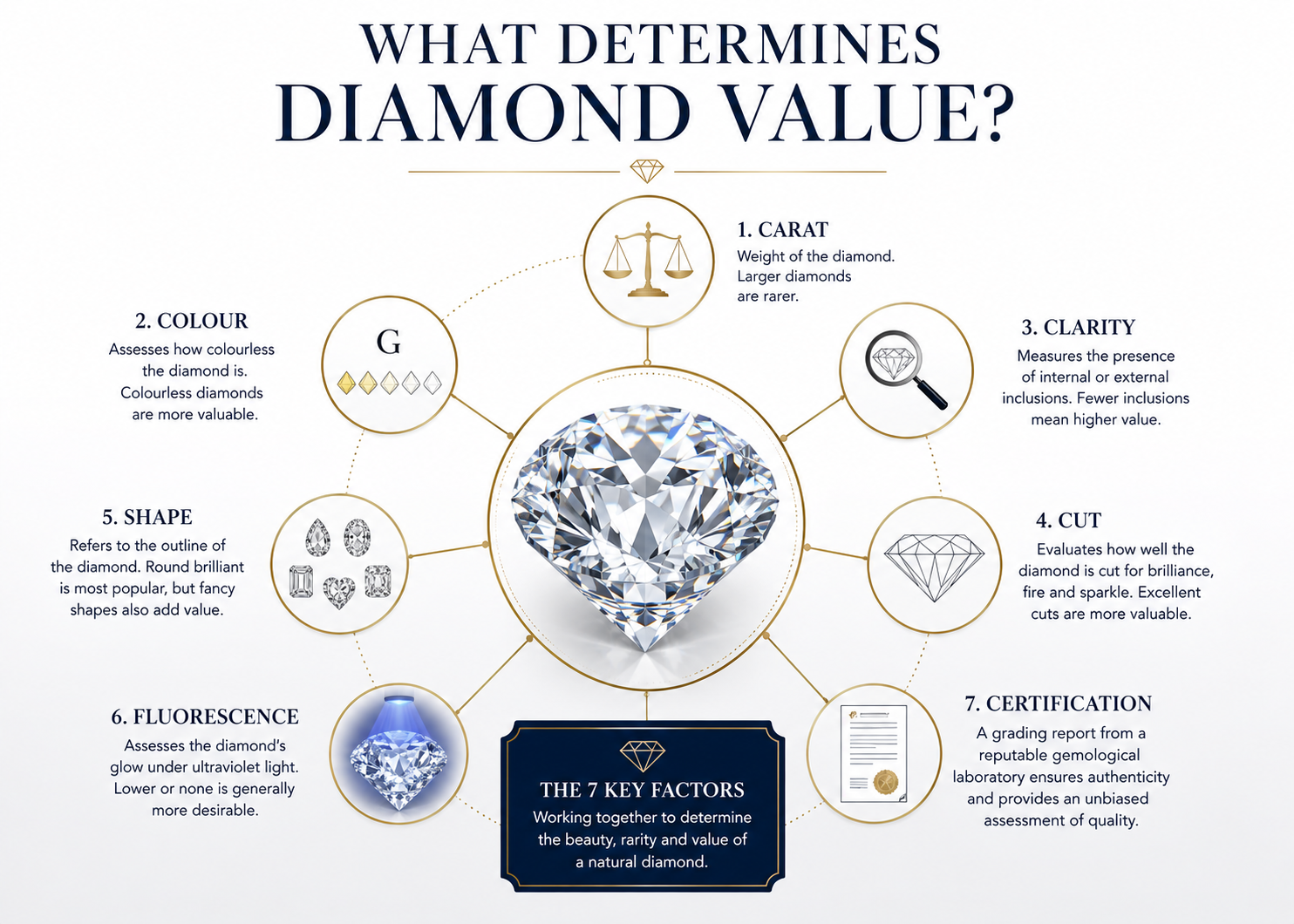
What Determines the Value of a Natural Diamond?
Carat Weight
Carat measures a diamond’s weight rather than its visible width. One carat is equal to 0.20 grams, but the value of a diamond does not increase at a fixed rate for every additional fraction of a carat.
Diamonds that reach recognised thresholds such as 1.00, 1.50 or 2.00 carats may attract a different price per carat from stones just below those weights. GIA notes that prices per carat commonly increase when a diamond passes important weight thresholds.
Nevertheless, a larger diamond is not automatically more valuable than a smaller stone with substantially better colour, clarity and cut. Carat weight must always be assessed alongside the diamond’s other characteristics.
Diamond Shape
The shape of a diamond affects its appearance, cutting yield, demand and the availability of comparable stones. Round brilliant diamonds often follow different pricing patterns from oval, emerald, cushion or pear-shaped diamonds.
- Round
- Oval
- Cushion
- Emerald
- Radiant
- Pear
- Princess
- Marquise
- Asscher
- Heart
Even within the same shape, visual appeal can differ because of proportions, symmetry and the quality of the finished outline. For fancy shapes, an evaluator may consider characteristics such as length-to-width ratio, bow-tie effect, windowing and overall visual balance.
Colour Grade
For diamonds graded on the D-to-Z colour scale, a higher grade generally means that less body colour is visible. Small colour differences can influence value, particularly in larger or higher-clarity diamonds.
Natural fancy-colour diamonds are assessed differently. Pink, blue, green and certain yellow diamonds can be valued for the strength, distribution and rarity of their colour rather than for their closeness to colourless.
The grading report should be reviewed carefully to determine whether the diamond falls on the standard D-to-Z scale or has a natural fancy-colour grade.
Clarity Grade
Clarity describes the inclusions and surface characteristics found in or on a diamond. The grade depends on their size, number, type, position and visibility under magnification.
The recognised clarity scale ranges from Flawless and Internally Flawless through VVS, VS and SI grades to Included grades. However, two diamonds with the same clarity grade may not be equally desirable.
An inclusion near the centre of the diamond, for example, may affect its appearance differently from an inclusion positioned close to the edge. The nature and location of the inclusions can therefore matter alongside the grade printed on the report.
Cut Quality
Cut quality affects how effectively a diamond handles light. In a well-cut diamond, proportions, symmetry and polish work together to support brightness, fire and scintillation.
Round brilliant grading reports may include an overall cut grade. Fancy-shaped diamonds are more complex because they may not receive the same complete cut grade. Their valuation can require closer examination of proportions, outline, symmetry and visual performance.
Two diamonds with similar colour, clarity and carat weight can still have different values when one has noticeably stronger cut quality and visual appeal.
Fluorescence
Fluorescence describes the reaction of a diamond when it is exposed to ultraviolet light. It is commonly reported as none, faint, medium, strong or very strong.
Fluorescence is not automatically good or bad. Its influence depends on the diamond’s colour, fluorescence strength, visual appearance and current market preferences. In some diamonds, fluorescence has little practical effect. In others, particularly when a stone appears hazy or oily, it may influence desirability.
It should therefore be considered in relation to the complete diamond rather than used as an isolated valuation rule.
Certification and Report Verification
A recognised grading report provides an independent description of the diamond. It may include carat weight, measurements, colour, clarity, cut information, fluorescence and identifying characteristics.
The report number should be checked through the relevant laboratory’s verification system. The physical diamond must also be matched to the report before a final valuation is confirmed.
A valid grading report describes a diamond, but it does not establish a guaranteed retail or resale price. If the report is old, the stone may also need to be checked for damage or alterations that occurred after grading.
Treatments and Condition
Some diamonds undergo treatments intended to alter their apparent colour or clarity. Treatments can influence durability, buyer demand and value, so any known treatment should be disclosed during the valuation process.
GIA states that known treatments are recorded on its grading reports and that advanced testing may be required to identify certain treatments.
The condition of the diamond is equally important. Chips, abrasions, cavities or damage around the girdle can affect its value. When a diamond is mounted in jewellery, the setting may conceal part of the stone and make an exact assessment more difficult.
A physical examination helps determine whether the item’s current condition matches the information provided online.
Current Market Demand
Diamond values are also influenced by demand for comparable stones. Certain shapes, sizes, colour-and-clarity combinations and grading reports may be easier to resell than others.
Market conditions can change. A valuation prepared several years ago may no longer represent the current selling environment. A useful valuation should therefore consider present demand rather than relying only on an old document or the original purchase price.
Can a Diamond Be Accurately Valued Online?
An online diamond valuation can be useful when the seller has a detailed grading report and provides accurate information. It allows a specialist to conduct an initial review before asking the seller to travel or send the item for examination.
The strongest online submissions include the complete grading report, a verifiable report number, accurate carat, colour and clarity information, clear photographs and details about any damage or alterations.
However, photographs and certificate details cannot confirm everything. A physical evaluation may still be needed to:
- Confirm that the item contains a diamond
- Determine whether the diamond is natural
- Match the diamond to its grading report
- Inspect for damage or treatments
- Verify its measurements and condition
- Examine the jewellery setting
- Confirm the required ownership information
An online assessment should therefore be viewed as the first stage of the process. It can help determine whether the diamond is suitable for further evaluation, but a final offer may change after the item has been physically inspected.
Can I Value a Diamond Without a Certificate?
Yes. Losing a grading report does not necessarily prevent a diamond from being evaluated.
If you do not have a certificate, provide clear photographs and any available information from the original receipt, insurance documents or previous valuation. Details such as the approximate carat weight, purchase date, jeweller and metal type can help with the initial review.
Depending on the diamond, Dalila may recommend a physical inspection or a new laboratory report before making a final purchase offer. Certification may be particularly useful for larger, higher-quality or potentially fancy-colour diamonds.
The calculator therefore includes a clear “I do not have a grading report” option. The certificate number should never be a compulsory field for every seller.
VALUE MY DIAMOND WITHOUT A CERTIFICATE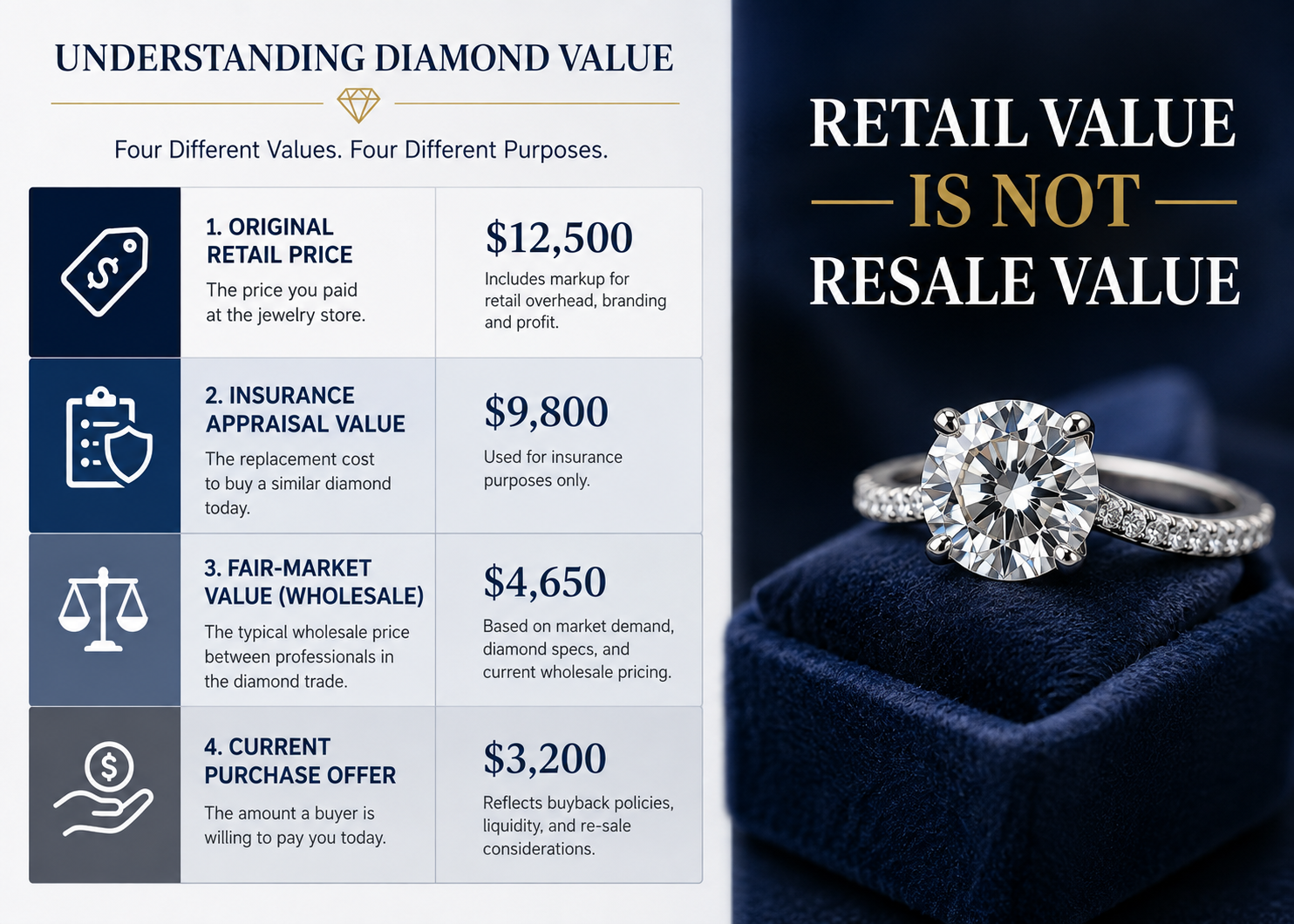
How the Dalila Diamond Valuation Process Works
1. Submit Your Diamond Information
Complete the diamond valuation calculator and provide the details you know. Upload the grading report, photographs, receipt or previous valuation when available.
You do not need to know every grade before starting. The purpose of the first step is to give Dalila enough information to determine how the diamond should be evaluated.
2. Initial Specialist Review
Dalila reviews the submitted characteristics, photographs and documents. If important information is missing, the team may contact you for additional photographs or clarification.
This review is preliminary. It helps identify whether the diamond is suitable for a closer assessment and what checks may still be required.
3. Physical Verification
If the diamond is suitable for further evaluation, a private appointment may be arranged in Antwerp. The diamond can then be examined, matched to its report and checked for condition, treatments or alterations.
The seller should not remove a mounted diamond from its setting before receiving professional guidance.
4. Purchase Offer
After the necessary verification, Dalila may provide a purchase offer based on the diamond’s characteristics, documentation, condition and current demand.
The offer should be clearly distinguished from the original retail price and any insurance appraisal.
5. Your Decision
You can review the offer and decide whether you want to proceed. Submitting the valuation form does not require you to sell your diamond or accept an offer.
Why Have Your Diamond Valued in Antwerp?
Antwerp has a long-established diamond-trading infrastructure and remains an important centre for the professional assessment, buying and selling of diamonds.
Working with a diamond business located in Antwerp gives sellers access to specialists who understand grading reports, natural-diamond characteristics and the commercial factors that influence current buyer demand.
Dalila Diamonds allows sellers to begin online by submitting a report and photographs. If a closer examination is required, the next step can be discussed before arranging a private appointment.
- •A private online submission
- •Grading-report and photograph upload
- •Review of natural-diamond information
- •A private Antwerp evaluation when required
- •A clear explanation of the next step
- •No obligation to accept an offer
What Should I Prepare Before Requesting a Valuation?
You do not need to have every document before starting. Nevertheless, gathering the available information can make the initial assessment more efficient.
If possible, prepare the grading report, original receipt, previous insurance appraisal and any documents relating to the jewellery’s brand or provenance. Take clear photographs in natural light and avoid using filters that change the appearance of the diamond or metal.
If the item contains several diamonds, photograph the complete piece and identify which stone you want to have valued. For a loose diamond, use a clean, secure surface and avoid holding it over a sink, open floor or other area where it could be lost.
Do not attempt to remove a diamond from its setting yourself. If the stone needs to be examined loose, this should be discussed with an appropriate professional after the initial review.