Should You Choose the Diamond or the Ring Setting First?
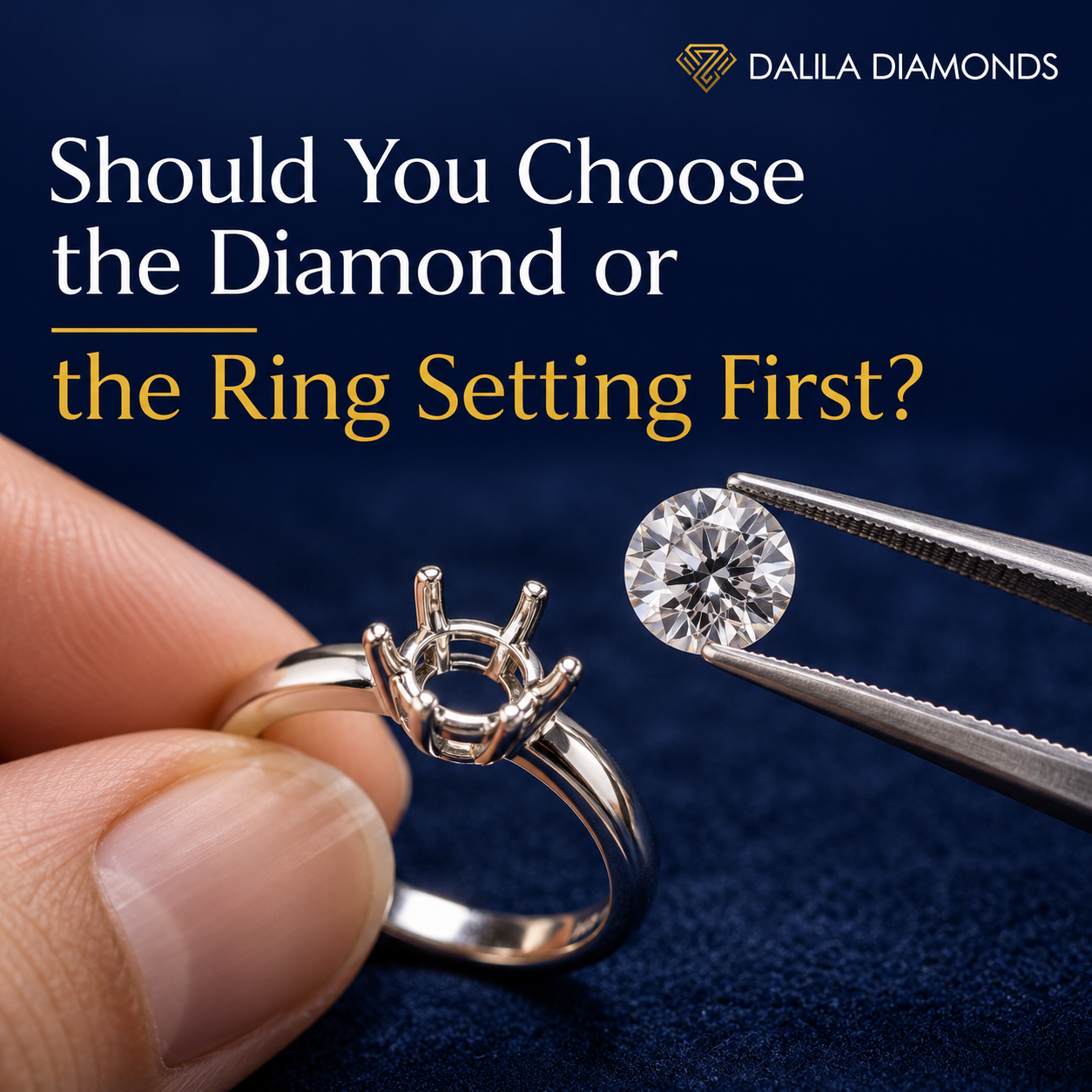
Choose the diamond first when the ring can be made around the stone. Choose the setting first when an existing mounting or a fixed design determines which stone will fit. In both cases, agree on the design direction and total budget before buying, then have the jeweller confirm compatibility before either purchase becomes irreversible.
The order matters because a diamond and a ring setting are not automatically compatible. A mounting described as suitable for a “one-carat diamond” may still be wrong for your chosen stone’s diameter, depth or outline. Likewise, a diamond that looks ideal in a video may require a different ring height or centre-stone holder from the design you had in mind.
The most useful question is therefore: which part of the ring can change? If the mounting is flexible, let the selected diamond determine its final dimensions. If the mounting must stay as it is, let its measured requirements guide the diamond search.
Diamond First or Setting First: Which Path Fits Your Situation?
Your starting point | Better starting order | What must happen before commitment |
You want a loose diamond and a ring made around it | Select the diamond, then finalise the mounting | The jeweller reviews the stone and confirms the proposed design |
You have chosen a style, but its centre-stone holder can be changed | Agree on the style, select the diamond, then choose the matching head | Confirm the correct head is available in the chosen metal and design |
You already own a ring that must retain its existing mounting | Inspect the setting, then search for a compatible diamond | The setter measures the mounting and checks its condition |
You want a particular ready-made setting with a fixed centre opening | Obtain the setting specifications, then shortlist diamonds | Confirm the exact stone against the manufacturer’s requirements |
You want a custom bezel, fitted halo or unusually shaped centre stone | Develop the design first, then select the stone before final manufacture | Use the actual diamond’s outline and measurements to approve the design |
Choosing a style first does not mean purchasing a finished mounting first. You can decide on yellow gold, a solitaire appearance or a low-profile ring before selecting the diamond. Those preferences create a useful brief while leaving the jeweller room to make the centre-stone holder fit properly.
For help with the wider purchase, including budget, lifestyle and documentation, use Dalila’s Natural Diamond Engagement Ring Buying Guide. The decision here is specifically about the order in which the stone and mounting should be selected.
Path One: Choose the Diamond First When the Setting Can Adapt
The diamond-first path suits buyers who care most about the individual stone and have flexibility in the ring’s construction. It is particularly useful when the diamond has an unusual outline, distinctive proportions or dimensions that do not correspond neatly to a standard mounting.
Begin with a preliminary ring brief. Tell the jeweller your preferred style, metal, finger size, desired height and whether a wedding band should sit beside the engagement ring without a gap. Obtain an initial setting estimate so that selecting the diamond does not consume money already needed to complete the ring.
Next, shortlist loose diamonds and send their reports, measurements, images and videos to the jeweller who will make or set the ring. The jeweller can then identify whether the intended design is straightforward, requires another head or needs more substantial changes. This review should happen before committing to a stone under terms that prevent a return.
Once the diamond is approved, the mounting can be specified around it. For a bespoke ring, the actual stone should inform the final design and manufacturing approval. For a ready-made ring with an interchangeable head, the jeweller should identify the correct component rather than assume the original head can be adjusted.
A Dimension Example from a Published GIA Sample Report
GIA’s published sample report lists a round brilliant diamond weighing 0.99 carat, with measurements of 6.40–6.43 × 3.94 mm. This is an educational sample, not a Dalila stock listing or customer order. gia.edu
The numbers give the jeweller a minimum diameter of 6.40 mm, maximum diameter of 6.43 mm and total depth of 3.94 mm. They provide a more useful starting point for mounting selection than “approximately one carat.” See the GIA sample report.
A setting described only as “one carat” still needs further checks. The jeweller must confirm whether its head accommodates that diameter, whether the pavilion has sufficient clearance and whether the diamond can sit securely at the intended height. The grading report supplies information about the stone; it does not approve a particular mounting.
Path Two: Choose the Setting First When Its Dimensions Are Fixed
The setting-first path suits an existing ring, a mounting you cannot redesign or a specific ready-made design whose centre opening is fixed. Here, buying a diamond before understanding the mounting may leave you with a stone that requires an unwanted alteration.
Start by having the jeweller inspect the setting. For an existing ring, the inspection should establish whether the prongs, bezel or other supporting parts remain suitable for use. A worn mounting may need repair or replacement before searching for a new diamond makes sense.
Ask for a written centre-stone specification. It should identify the shape, acceptable millimetre dimensions, relevant depth limits and any outline requirements. For a new setting, request the manufacturer’s specifications for the exact model and centre-stone head. A broad description such as “oval, around one carat” is not a sufficiently precise sourcing brief.
Then shortlist diamonds within those requirements. Keep the setting constraints visible throughout the search, including when comparing a more attractive stone that falls outside them. Ask the jeweller whether changing the mounting is an acceptable alternative before expanding the diamond criteria.
Finally, have the setter approve the actual stone. Matching a stated size range is a screening step, not proof of a secure finished fit. The diamond’s shape at the contact points and its current condition still need inspection.
Why Matching Length Alone Is Not Enough
Consider an illustrative oval comparison: one diamond measures 8.00 × 5.70 × 3.55 mm, while another measures 8.00 × 5.20 × 3.40 mm. These are invented measurements for explaining fit, not product specifications or available stock.
Although both are 8.00 mm long, one is 0.50 mm narrower. That difference changes where the stone meets the mounting. A fitted halo or bezel made for one outline cannot be assumed to suit the other. Differences in depth may also affect clearance beneath the diamond.
This is why a setting-first search should use length, width, depth and outline together. GIA explains that round diamond measurements are recorded as minimum diameter–maximum diameter × depth, while fancy shapes are recorded as length × width × depth in its guide to understanding diamond reports. gia.edu
What Mounting Tolerance Actually Means
Mounting tolerance is the variation a particular mounting can accommodate while still allowing a secure, properly finished setting. Do not assume that every ring accepts a diamond within ±0.10 mm or ±0.20 mm of its advertised size. Any numerical allowance must come from the maker’s specification or the setter’s assessment of that particular construction.
A catalogue size, a diamond’s reported measurements and the finished fit describe different things. A catalogue identifies the intended stone size. The report records the stone’s dimensions. The setter establishes whether the mounting can support that stone correctly.
There are also specific workmanship benchmarks. For round brilliant stones in traditional angled prongs, GIA describes bearings that conform to the stone without gaps and the removal of 40–50% of prong thickness at the bearing. These benchmarks apply to that construction; they are not a universal millimetre allowance for making an oversized or undersized diamond fit. See GIA’s prong-setting quality benchmarks. gia.edu
The practical implication is that adjustment has limits. A jeweller needs sufficient metal to support and retain the diamond after the seat is prepared. Ask whether a different head or a custom mounting would provide a better fit when the proposed adjustment becomes substantial.
For a setting-first purchase, request the accepted minimum and maximum dimensions in writing, along with any depth or outline restrictions. If the seller provides only a carat range, ask the setter to establish the dimensional requirements before ordering the diamond.
Which Measurements Should the Jeweller Check?
For a round diamond, give the jeweller both reported diameters and the total depth. The maximum diameter matters when assessing the mounting, while the difference between the diameters helps describe the outline. An average diameter alone leaves out part of that information.
For an oval, emerald, radiant, cushion or other fancy shape, provide the full length × width × depth measurements together with clear outline images. Two stones can share the same outer dimensions but differ in corner shape, shoulder curvature or the position of their widest points. Those details matter where metal contacts the diamond.
The jeweller should also assess the girdle and any condition concerns near the intended contact points. A laboratory report helps with the review, but current inspection remains necessary. Dalila’s Diamond Grading Report Guide explains how report information and physical identification work together.
For a low-profile ring, ask the jeweller to confirm clearance beneath the pavilion and the resulting finished height. Do not assume that every stone can be lowered to the same height without changing the mounting.
A Practical Checklist to Send to the Setter
Use this handoff before approving the diamond or authorising final manufacture. The setter should complete the compatibility fields for the exact stone and mounting being considered.
Item to confirm | Information to provide or obtain |
Diamond identity | Supplier reference, laboratory, report number and inscription details where present |
Actual dimensions | Both diameters and depth for round stones; length, width and depth for fancy shapes |
Outline | Face-up and side images, with attention to points, corners and shoulders |
Setting identity | Exact model, head or basket reference, metal and finger size |
Permitted size range | Maker- or setter-approved minimum and maximum millimetre dimensions |
Depth and clearance | Confirmed pavilion clearance, any depth restriction and proposed finished height |
Condition at contact points | Inspection of the girdle, existing damage and relevant surface-reaching features |
Work required | Confirmation of direct fit, another head, repairs or a custom mounting |
Approval before commitment | Setter’s decision, any conditions, and the deadline within the diamond’s return terms |
Completion and responsibility | Final quote, setting arrangements, custody cover, inspection and delivery date |
The most useful approval identifies the particular stone: “We have reviewed diamond reference X and report Y for setting model Z, subject to physical inspection.” A general statement that the workshop sets oval diamonds does not confirm this diamond will fit this ring.
Mistakes That Make the Buying Order More Expensive
One common mistake is buying a mounting because its carat label matches the intended diamond. That label may help with browsing, but it does not replace dimensions. Discovering the mismatch after purchase can mean another head, additional labour or a different mounting.
Another is ordering final custom manufacture from a reference photograph before selecting the stone. A photograph can communicate style, but it does not establish the exact diamond outline or depth. Approve the appearance early, then have the jeweller incorporate the selected stone before final production.
A third is assuming that a halo, bezel or existing prong head can always be adjusted. Discuss alteration limits and the effect on the finished design before buying. When keeping the original setting is essential, that requirement should remain a firm constraint in the diamond search.
Timing can create the same problem. If a diamond’s return period ends before the setter can inspect it, a purchase may become difficult to reverse before compatibility is established. Coordinate inspection, availability and workshop scheduling before payment.
How to Brief Dalila When the Setting Comes First
A useful diamond-sourcing request distinguishes firm mounting requirements from flexible preferences. State the required shape, accepted length and width or diameter range, relevant depth limit, budget, grading preferences and deadline. Include the setting specifications and your jeweller’s comments when available.
For example, explain that the existing centre-stone holder must be retained, but that you are flexible on carat weight within the approved dimensions. This gives the supplier a clearer search brief than asking only for “a one-carat oval.”
Dalila’s DS4U custom natural diamond sourcing service describes searches involving precise dimensions and intended jewellery designs. The jeweller responsible for the ring should approve the mounting fit and setting work. Diamond sourcing and approval of the finished mounting are separate responsibilities. DS4U by Dalila
If you are still deciding which quality characteristics to prioritise, use the Diamond Quality Chart alongside the mounting brief. A compatible stone still needs to meet your appearance and quality expectations.
Frequently Asked Questions
Should I Buy the Diamond Before the Setting?
Buy the diamond first when the setting can be made or selected around it. Agree on the ring style and setting budget beforehand, and ask the jeweller to review the diamond before you commit. Finalise the mounting using the approved stone’s measurements.
Can I Buy the Setting First and Add a Diamond Later?
Yes, provided you obtain a precise centre-stone specification first. Search using the approved dimensions and shape, then arrange the setter’s inspection of the selected diamond. A carat description alone is insufficient.
Will Any One-Carat Diamond Fit a One-Carat Setting?
Do not assume so. Carat describes weight, while mounting fit depends on dimensions, outline, depth and construction. Ask the jeweller to approve the particular diamond for the particular head.
How Much Can a Ring Setting Be Adjusted?
The allowable adjustment depends on the mounting’s design, metal, condition and available material. Obtain the maker’s size range and the setter’s assessment. There is no reliable universal ± millimetre figure to apply to every setting.
Should a Bezel or Halo Be Chosen Before the Diamond?
Choose the design direction early. For a custom bezel or fitted halo, select the diamond before approving the final stone-specific manufacture. For an existing fixed bezel or halo, inspect and measure the mounting before sourcing the diamond.
Choose the Order Around the Part That Must Stay Fixed
When the diamond is your priority and the mounting can change, select the stone and let its measurements guide the final setting. When an existing ring or fixed design must remain, establish its requirements and search for the diamond within them.
For jewellers and other professional buyers, Dalila’s natural diamond inventory provides a starting point for the stone search. Where dimensions or other requirements are more specific, send a sourcing brief through DS4U and arrange approval with the jeweller responsible for the ring.