How to Fit a New Diamond to an Existing Ring Setting
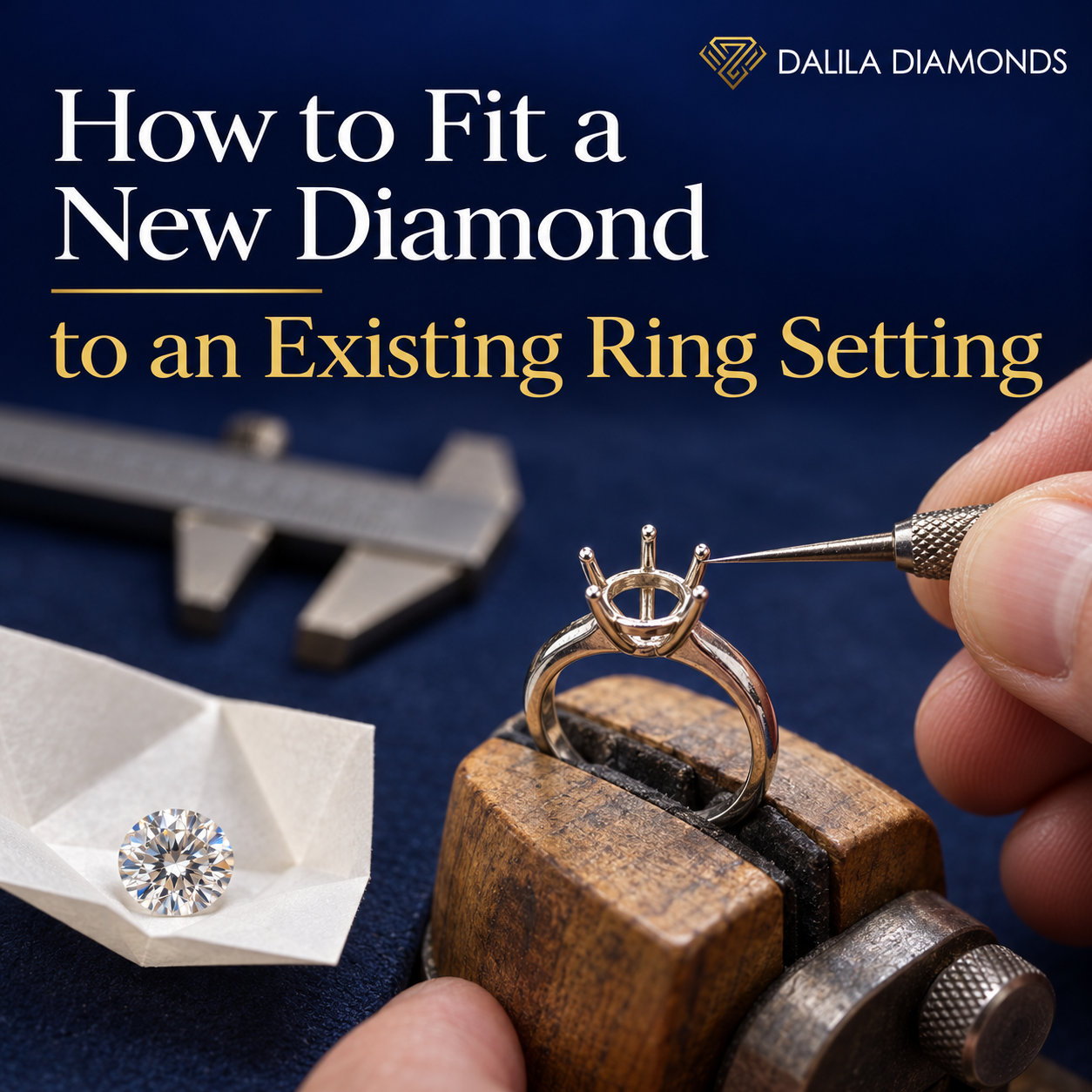
Fitting a new diamond into an existing ring setting requires more than finding a stone with the same shape and carat weight as the original. The replacement must have dimensions, outline characteristics, girdle geometry and depth that the existing mounting can accommodate securely.
A ring originally holding a 1.00-carat round diamond, for example, cannot automatically accept every other one-carat round diamond. Two stones with identical weights may have different diameters, depths and girdle thicknesses. Those differences can affect how the diamond sits in the head and whether the existing prongs can hold it safely.
The first step should therefore be a professional assessment of the mounting, not a diamond inventory search.
The essential rule is that a qualified setter must establish the acceptable replacement-stone specifications before the buyer commits to a new diamond. If the original mounting cannot safely accommodate a suitable candidate, modifying or replacing the head may be necessary.
The inspection should cover five areas: face-up dimensions, exact shape and corner geometry, girdle position and condition, pavilion depth and clearance, and the condition of the existing setting.
Dalila Diamonds' Diamond Size Chart makes the same important distinction: carat weight alone cannot establish whether a diamond will fit an existing mounting. The setting must be assessed using actual millimetre measurements and the proposed stone's geometry.
Dalila
This guide explains how to prepare a setter-approved replacement-diamond specification, evaluate potential stones and separate loose-diamond sourcing from the professional setting work.
Can You Put a New Diamond Into an Existing Ring Setting?
Yes, in many cases, a diamond can be replaced without rebuilding the entire ring. However, whether the original head can be reused depends on its condition and the dimensions of the proposed replacement stone.
A conventional prong setting may permit certain adjustments. For example, a jeweller may be able to repair or replace prongs, adjust stone seats or replace the complete head while preserving the shank.
Other designs are less accommodating. A bezel, flush setting, tension-style mounting or integrated custom head may depend closely on the dimensions of the original stone.
A replacement that appears similar from above might still be incompatible because its pavilion extends too far into the mounting or because its girdle does not sit where the existing supports require it.
The practical question is not simply whether the stone can be physically placed into the ring. It is whether the diamond can be securely set, appropriately supported and safely worn using the existing or approved modified structure.
Three possible outcomes after inspection
Setter's assessment | Meaning | Next decision |
Existing head can be reused | A suitable replacement may fit after professional preparation | Source a stone within the approved specification |
Existing head needs modification | Repairs or alterations may accommodate a candidate | Confirm feasibility, risks and costs first |
New head or mounting required | The original structure cannot safely accept the proposed stone | Compare replacement-head or resetting options |
These decisions should be made after examining the ring, ideally with the original diamond or its measurements available.
There is no universal dimensional tolerance that allows every setting to accommodate a slightly larger or smaller stone.
Why Equal Carat Weight Does Not Guarantee a Fit
Carat measures diamond weight, not a specific physical size.
A one-carat round brilliant commonly measures approximately 6.4–6.5 mm across, but individual stones can differ because of their cutting proportions and the way their weight is distributed.
A diamond may carry more weight in a deeper pavilion or thicker girdle without having the same face-up diameter as another stone of equal weight.
For example, consider these hypothetical stones:
Measurement | Original diamond | Candidate A | Candidate B |
Weight | 1.00 ct | 1.00 ct | 1.00 ct |
Minimum diameter | 6.44 mm | 6.31 mm | 6.46 mm |
Maximum diameter | 6.50 mm | 6.39 mm | 6.52 mm |
Total depth | 3.96 mm | 4.02 mm | 3.98 mm |
Girdle | Medium, illustrative | Slightly thick, illustrative | Medium, illustrative |
These specifications are hypothetical, not live inventory or setting approvals.
Candidate A has the same carat weight but a smaller face-up diameter. Existing seats designed for the original diamond may not contact it correctly.
Candidate B has dimensions closer to the original. However, dimensional similarity alone does not establish a safe fit. Its actual girdle profile, inclusion characteristics and the condition of the head still need inspection.
The appropriate replacement may weigh slightly less or more than the original diamond.
That is why a replacement search should prioritise setter-approved millimetre ranges over an exact carat-weight target.
Measure the Existing Setting Before Searching for a Diamond
A ring-setting inspection should record the dimensions of the opening and the locations where the stone is intended to be supported.
The required measurements vary with the setting style.
For a round prong setting, the setter may need to assess the seat-to-seat dimensions, prong positions, usable head geometry and vertical space available beneath the stone.
For an elongated fancy shape, the mounting's length and width are important, but the exact outline and corner positions also matter.
For a bezel, the setter must assess the internal seat, wall condition and whether sufficient material exists to secure the replacement.
Measurements of an empty ring opening should not be treated as identical to the dimensions of the diamond that will fit it. Prongs, seats and retaining metal occupy space, and the usable geometry is three-dimensional.
Existing-setting measurement checklist
Measurement or inspection | Why it matters |
Opening length and width | Establishes the available face-up space |
Prong or bezel-seat positions | Determines where the stone will be supported |
Existing seat geometry | Shows whether it matches the proposed girdle |
Head height | Limits the available vertical placement |
Pavilion clearance | Determines space beneath the diamond |
Prong thickness and condition | Affects whether secure retention is possible |
Head alignment | Identifies distortion or prior deformation |
Metal condition | Reveals wear, cracks or previous repairs |
Original diamond measurements | Provides the strongest dimensional reference when available |
Setting construction | Determines whether adjustment or head replacement is practical |
The setter should document the approved replacement specifications after this inspection.
An approximate measurement supplied by a buyer is useful for the initial enquiry, but it should not replace bench verification.
What If the Original Diamond Is Still Available?
If the original stone is available, it can provide valuable dimensional information.
The jeweller can inspect and measure it, including the shape, actual girdle outline and total depth.
If the stone has a grading report, that report may also provide useful identification and dimensional data.
However, the original diamond should not be assumed to have been correctly or safely set.
An existing setting may already have worn prongs, damaged seats or previous modifications.
The jeweller should therefore inspect both the stone and the mounting.
When the original is unavailable because it was lost, the replacement specification must be based on the remaining ring structure, any reliable previous documentation and the setter's evaluation.
In such cases, the approved dimensional range may be uncertain until the mounting is inspected more closely.
Round Diamonds: Compare Minimum and Maximum Diameters
Round diamonds are often described using an average diameter. For actual setting compatibility, the minimum and maximum measurements are more useful.
Suppose the original diamond measured 6.44–6.50 mm.
A replacement recorded as 6.36–6.43 mm is not automatically interchangeable simply because the average diameter difference appears small.
The prong positions, seat geometry and available material determine whether those differences can be accommodated.
The setter must also consider out-of-roundness, girdle thickness variation and the positions where the prongs contact the diamond.
The dimensional tolerance that works for one head may be inappropriate for another.
This is why a supplier should receive a measurement range approved by the setter rather than be asked for “any good one-carat round.”
Fancy-Shaped Diamonds: Corner Geometry Matters
Replacing a fancy-shaped diamond can be more complicated than matching its reported length and width.
Two emerald-cut diamonds may share the same 8.0 × 6.0 mm measurements but have different corner truncations. Two cushions can have different shoulder fullness. Two pears can differ in the transition between the rounded end and the point.
These characteristics can affect where the diamond's girdle meets the mounting.
Emerald and Asscher cuts
These shapes have truncated corners that can vary in size and angle.
A setting designed around one corner arrangement may not accept another stone with more pronounced or smaller cut corners.
Even if the reported length and width are identical, the positions of the corners relative to the prongs may be different.
The setter should evaluate the actual outline, corner geometry and girdle.
Princess-cut diamonds
Princess cuts have corners that can be vulnerable to damage.
The replacement must fit the corner-supporting elements of the mounting.
A small difference in corner position or the diamond's actual shape may change how those supports contact the stone.
The setter must assess whether the mounting provides adequate corner protection.
Cushion-cut diamonds
Cushion outlines vary considerably.
Some have rounded corners and fuller shoulders, while others are more rectangular or have different edge curvature.
The term cushion cut does not identify one standard perimeter.
A mounting closely following the original diamond's outline may not accept another cushion of the same weight and reported dimensions.
Pear-shaped diamonds
A pear diamond combines a rounded end with a pointed tip.
The shape of the shoulders, the position of the point and the girdle outline must correspond with the intended supports.
A replacement pear cannot be approved from length and width alone.
Oval diamonds
Two ovals may have similar dimensions but different shoulder profiles and end curvature.
That matters particularly in bezels and other mountings closely following the diamond's perimeter.
The original outline should be compared with the proposed replacement.
Marquise diamonds
The two pointed ends require appropriate protection, and the shoulders must work with the mounting.
Matching nominal length and width does not prove that the tips and girdle will sit correctly within the existing head.
Girdle Thickness and Condition: Why the Edge Must Be Inspected
The girdle is the perimeter between the crown and pavilion.
It is a critical region in many setting designs because prongs and bezels secure the diamond around this boundary.
A replacement diamond with a different girdle thickness may sit differently in seats cut for the original stone.
For example, a stone with a very thin girdle at a particular contact point may require different handling from a stone with a thicker girdle in the same area.
Girdle descriptions on grading reports are useful, but they do not necessarily describe the full local geometry at every planned contact point.
The setter should inspect the specific regions that will be supported.
Girdle-related factors to record
Factor | Question for the setter |
Thickness distribution | Does the girdle suit the existing seats and supports? |
Local thickness at contact points | Is there sufficient appropriate material where the stone will be secured? |
Existing chips or abrasions | Is the stone already damaged near a seating point? |
Surface-reaching characteristics | Could an inclusion or fracture affect setting risk? |
Girdle position | Will the diamond sit at the intended elevation? |
Retaining metal | Can the existing prongs or bezel secure this particular girdle? |
The jeweller should not conceal a vulnerable edge under a prong without assessing the risks.
Dalila's Diamond Inclusions to Avoid guide explains why inclusions near a girdle, point or corner can require special attention when a stone is mounted.
Dalila
For a broader explanation of girdle thickness itself, use Dalila's existing girdle resource rather than duplicating the full topic in this article.
Diamond Depth and Pavilion Clearance
A replacement can appear to match the existing setting from above while being unsuitable in profile.
This happens when the proposed diamond has a different total depth, pavilion shape or seating requirement.
A deeper pavilion may extend too far beneath the girdle, potentially interfering with the head, gallery or underlying metal.
A stone with different crown and girdle proportions may also sit at an unexpected height.
The setter must assess the complete three-dimensional relationship between the diamond and mounting.
Example: similar width, different depth
Suppose an existing head was designed around a round diamond measuring approximately 6.50 mm in diameter and 3.95 mm in total depth.
Two potential replacement diamonds have comparable face-up diameters:
Specification | Candidate A | Candidate B |
Average diameter | 6.49 mm | 6.50 mm |
Total depth | 3.92 mm | 4.12 mm |
Approximate depth percentage | 60.4% | 63.4% |
Face-up width difference | Small | Small |
Setting compatibility | Requires verification | Requires verification |
Both candidates need review.
Candidate B has approximately 0.20 mm more total depth than Candidate A. That difference may affect the required vertical space, but it does not directly establish the finished table height or pavilion clearance.
The additional depth may be distributed differently between crown, girdle and pavilion.
The jeweller must identify where the relevant dimensions occur and whether the mounting can safely accommodate the stone.
Dalila's Diamond Table and Depth Explained guide provides further background on why total depth is a combined measurement rather than a complete description of pavilion geometry.
Dalila
How Much Dimensional Difference Can an Existing Setting Accept?
There is no one-size-fits-all tolerance.
A difference of 0.10 mm might be workable for one setting and unsuitable for another.
The result depends on the mounting style, stone shape, head condition, existing seat positions and available material for adjustment.
Some prong heads can be professionally modified or replaced.
A bezel or tightly fitted integrated setting may offer less flexibility without substantial rebuilding.
Consequently, the supplier should never be given an assumed tolerance without setter approval.
Instead, obtain a specification that explicitly states the acceptable minimum and maximum dimensions for the proposed replacement.
For fancy shapes, those dimensions may need to be accompanied by an outline image, template or CAD reference.
The required tolerance is a property of the actual setting and the planned setting work—not a universal rule derived from diamond weight.
Technical Diagram: Face-Up Fit Versus Pavilion Clearance
Download the original existing-setting diamond fit diagram (PNG)
Original schematic illustrating two separate checks: matching the diamond's face-up outline to the setting's retaining points, and verifying the stone's depth and available clearance beneath it. The drawing is not a scaled representation of a specific ring and does not establish acceptable setting tolerances.
The face-up view demonstrates why the stone must align with the positions of the prongs or bezel seat.
The profile demonstrates why matching diameter alone is insufficient. Pavilion geometry and girdle elevation determine how the diamond interacts with the head and surrounding structure.
Both checks must be completed before the replacement is approved.
Does the Condition of the Existing Ring Matter?
Yes. Even a dimensionally suitable diamond may be unsafe in a damaged or heavily worn mounting.
The setter should inspect the ring for weakened prongs, distorted supports, worn seats, cracks and evidence of previous repairs.
A ring that previously held a diamond securely may no longer be in the same condition.
For example, a prong may have been bent when a stone was lost. Another may have become thin after years of wear or repeated retipping.
Simply installing a new diamond without addressing these conditions may create a risk of losing the replacement.
The mounting should also be inspected for deformation of the head relative to the shank.
A head that is no longer properly aligned may require repair or replacement before a new stone is installed.
Reusing the head versus replacing it
A qualified jeweller may recommend replacing the head while keeping the original ring shank.
This can be appropriate when the original head is damaged or cannot accommodate the intended diamond.
However, head replacement is not automatically straightforward. The new component must integrate properly with the existing ring's metal, dimensions and construction.
The feasibility and cost should be confirmed before buying the diamond.
For a valuable or sentimental ring, the buyer should also discuss the extent of alteration that is acceptable.
What If the Replacement Diamond Is Slightly Larger?
A slightly larger diamond may fit some settings after appropriate professional modifications.
However, it is unsafe to assume that a larger stone can always be accommodated by bending the prongs outward or cutting deeper seats.
Such changes can reduce the available metal or alter the geometry of the head.
For a bezel, a larger outline may require reconstructing the retaining wall or replacing the complete setting.
For fancy shapes, even a small increase in length or width can change the location of points or corners relative to their supports.
The setter should determine whether modification is feasible and whether it provides a satisfactory finished result.
If the existing head cannot accommodate the new stone safely, choose a different diamond or revise the mounting.
What If the Replacement Diamond Is Slightly Smaller?
A smaller diamond is not automatically easier to fit.
In a prong setting, its girdle may sit too far from the original seats.
The prongs may not have appropriate geometry or sufficient usable material to be repositioned correctly.
In a bezel setting, a smaller diamond can leave an unsuitable gap between its outline and the existing metal.
A smaller stone may therefore require new seats, a new head or a different mounting.
Again, the question is whether the final setting can secure the exact stone, not whether the stone will physically pass into the original opening.
How to Replace a Lost Diamond When the Original Measurements Are Unknown
When the original diamond has been lost, the initial inspection becomes more important.
The ring may still contain useful dimensional information, but the setter cannot always reconstruct the exact original specifications from the opening alone.
A grading report, insurance appraisal, purchase documentation or previous detailed photographs may help identify the original stone.
However, an appraisal containing only a weight estimate is not sufficient to establish the necessary replacement dimensions.
The practical process is to obtain the available documents, inspect the mounting and establish a candidate specification that the setter is prepared to evaluate.
Where the original head is significantly damaged or the required measurements cannot be established reliably, replacing the head may be more practical than attempting to reproduce the lost stone's dimensions exactly.
Documents worth collecting
Document or information | How it helps |
Original grading report | May provide exact dimensions, shape and identification |
Previous purchase invoice | May identify the original stone and jeweller |
Insurance appraisal | May provide useful but sometimes approximate specifications |
Clear ring photographs | Help identify the former design and orientation |
Existing mounting | Allows direct inspection and measurement |
Previous repair records | May reveal alterations affecting compatibility |
Documentation supports the investigation. It does not replace the setter's inspection.
Worked Example: Replacing an Emerald-Cut Diamond
Suppose a client owns a ring originally designed for an emerald-cut centre.
The available documentation indicates an original diamond measuring approximately 8.0 × 6.0 mm.
The client finds a replacement natural emerald-cut diamond with the same reported length and width.
At first glance, the new stone appears suitable.
However, the two diamonds have different corner geometries.
The original had relatively small truncated corners, while the candidate has more pronounced corner cuts.
This changes the positions where the diamond's outline meets the setting.
Comparison worksheet
Property | Original stone | Replacement candidate |
Shape | Emerald cut | Emerald cut |
Length | 8.0 mm | 8.0 mm |
Width | 6.0 mm | 6.0 mm |
Corner truncation | Relatively small | More pronounced |
Total depth | 4.1 mm | 4.3 mm |
Girdle profile | Original reference | Requires inspection |
Prong-seat compatibility | Original arrangement | Not established |
Pavilion clearance | Existing reference | Requires reassessment |
This is a hypothetical example, not a real setting measurement or approved replacement.
The face-up dimensions match, but the corner and depth differences require further examination.
The setter must assess whether the existing head can properly support the candidate, whether the prong locations remain suitable and whether sufficient vertical clearance exists.
If those conditions cannot be satisfied, the buyer may need a different emerald-cut diamond or a modified mounting.
The example demonstrates why an inventory search based only on 8.0 × 6.0 mm can still produce unsuitable candidates.
Worked Example: Replacing a Round Brilliant Diamond
Consider an existing four-prong solitaire with an original round brilliant measuring approximately 6.45–6.51 × 3.98 mm.
The owner wants a natural replacement with comparable face-up appearance.
The supplier finds two hypothetical options.
Specification | Candidate A | Candidate B |
Carat | 1.00 ct | 1.03 ct |
Minimum diameter | 6.43 mm | 6.48 mm |
Maximum diameter | 6.49 mm | 6.54 mm |
Depth | 3.96 mm | 4.04 mm |
Girdle information | Requires review | Requires review |
Existing-head fit | Unconfirmed | Unconfirmed |
Candidate A is dimensionally close to the original. Candidate B is slightly larger and deeper.
Neither can be accepted solely from the table.
The setter must inspect the head and decide which dimensions can be accommodated.
Depending on the existing prongs and seats, Candidate A may be acceptable, Candidate B may require modification, both may be suitable after work or neither may be appropriate.
The selection is not determined by the fact that Candidate B is 0.03 carat heavier.
A Setter-Approved Replacement Diamond Checklist
Before ordering the diamond, ask the jeweller to complete the relevant fields in this worksheet.
Specification | Required or approved value |
Existing ring reference | ______ |
Ring metal and alloy | ______ |
Setting type | ______ |
Condition of existing head | ______ |
Prong or bezel repairs required | ______ |
Approved diamond shape | ______ |
Minimum acceptable length/diameter | ______ mm |
Maximum acceptable length/diameter | ______ mm |
Minimum acceptable width | ______ mm |
Maximum acceptable width | ______ mm |
Depth requirement or limit, if applicable | ______ |
Required outline/corner characteristics | ______ |
Girdle requirements | ______ |
Points or corners needing protection | ______ |
Existing seat suitability | ______ |
Pavilion clearance | ______ |
Head modification permitted? | Yes / No / Conditional |
Head replacement required? | Yes / No / Conditional |
Proposed diamond report/reference | ______ |
Final candidate inspected? | Yes / No |
Setter approval | Pending / Approved / Rejected |
The worksheet deliberately contains no universal dimensional tolerance.
The setter should fill in the appropriate values for the actual ring.
A candidate satisfying the written size range may still require physical inspection, particularly when its outline, condition or girdle differs from the original stone.
Replacement-Diamond Sourcing: What to Send to Your Supplier
Once the mounting has been inspected, the buyer can prepare a more precise natural diamond sourcing request.
A useful brief identifies the mandatory measurements separately from characteristics where the buyer has some flexibility.
For example, the shape and approved length/width range may be essential, while colour or clarity can have a broader acceptable range.
Information | What to provide |
Intended application | Replacement diamond for an existing ring |
Approved stone shape | Exact shape |
Dimension range | Setter-approved minimum and maximum measurements |
Depth requirement | Setter's approved requirement or constraint |
Corner or outline requirements | Description, original images or outline template |
Girdle requirements | Setting-relevant restrictions |
Colour and clarity | Preferred grades and acceptable alternatives |
Grading laboratory | Preferred laboratory and report requirements |
Original diamond reference | Report and measurements, if available |
Mounting reference | Photographs or technical drawings |
Modification status | Whether the head can be altered |
Budget and deadline | Purchasing constraints |
Approval condition | Subject to setter's final inspection |
Example sourcing brief
A hypothetical enquiry might read:
Application: Replacement natural diamond for an existing four-prong solitaire.
Diamond shape: Round brilliant.
Approved face-up measurements: To be supplied by the jeweller after measuring the existing head.
Depth and girdle: Must satisfy the setter's approved criteria.
Quality preferences: G–H colour, VS1–VS2 clarity, with suitable cut quality and grading documentation.
Mounting condition: Existing head to be inspected before ordering.
Setting work: To be completed by the client's manufacturing or repair jeweller.
This is more useful than asking for a one-carat diamond without supplying the mounting details.
Dalila Diamonds' DS4U — Diamond Source For You service specifically accepts sourcing briefs for natural loose diamonds intended for existing jewellery designs, including replacement diamonds with specified measurements.
DS4U by Dalila
The supplier can search for stones within the stated requirements, subject to availability.
The setter remains responsible for approving the proposed diamond's compatibility with the actual ring.
Who Is Responsible for the Diamond and Setting?
A replacement project often involves a diamond supplier and a separate jeweller.
Their responsibilities should be clarified before purchasing.
Task | Diamond supplier | Setter / manufacturing jeweller |
Search for suitable natural diamonds | Yes | May advise on specifications |
Provide grading and measurement information | Yes | Review and verify as necessary |
Measure existing ring setting | Not established through a loose-stone quote | Yes |
Establish fit tolerances | Uses approved requirements | Yes |
Inspect prong or bezel condition | No | Yes |
Approve candidate for setting | Provides stone information | Yes |
Modify or replace the head | Separate specialist work | Yes |
Set and secure the diamond | Separate specialist work | Yes |
Perform final jewellery inspection | No, unless separately arranged | Yes |
The price of a loose replacement diamond should not be assumed to include mounting repairs, head replacement, setting labour or other jewellery work.
If the candidate must be physically inspected before approval, agree on the inspection process, purchasing conditions and any applicable return arrangements beforehand.
When Is Replacing the Entire Setting the Better Option?
Preserving the original head may be important for sentimental reasons, but it is not always the most practical solution.
A replacement head may be preferable when the original prongs are heavily worn, the existing seats cannot safely accommodate the new diamond or the desired stone differs significantly in shape or size.
A completely new mounting may also be appropriate when the ring's underlying structure is damaged.
The decision should account for the condition of the original ring, the cost of repairs, the desired final appearance and the potential risks of modifying older metalwork.
For a valuable inherited ring, preservation priorities may be different from those of a recently manufactured commercial mounting.
The jeweller should explain which original components can be retained and which would need alteration or replacement.
Common Mistakes When Buying a Diamond for an Existing Setting
Buying the same carat weight as the original
Carat weight does not guarantee the same dimensions or setting compatibility.
Trusting a generic diamond size chart
Size charts give approximate dimensions. Existing mountings require exact measurements and setter-approved constraints.
Ignoring the shape of corners and shoulders
Fancy-shaped diamonds can differ substantially despite identical length and width measurements.
Assuming a smaller diamond is easier to set
A smaller girdle outline may not reach the original seats or support points.
Checking diameter but ignoring depth
The pavilion may interfere with the setting even when the face-up dimensions appear correct.
Ignoring the condition of the existing prongs
A correctly sized diamond still needs a structurally suitable mounting.
Assuming the head can always be adjusted
Some settings cannot be safely modified to accommodate the proposed stone.
Purchasing before obtaining setter approval
The safest process is to establish acceptable specifications first, then source candidate diamonds and obtain final approval before setting.
Frequently Asked Questions
Can I put any one-carat diamond into a one-carat ring setting?
No. One-carat diamonds can have different diameters, depths, girdle thicknesses and outlines. The replacement must fit the actual mounting and receive approval from a qualified setter.
How do I know what size diamond fits my existing ring?
Have a setter measure the mounting and establish an acceptable replacement-stone specification. For fancy shapes, the specification should include outline and corner characteristics, not just length and width.
Can a slightly larger diamond fit an existing setting?
Possibly. Some heads can be professionally modified, while others cannot accommodate a larger stone safely. The jeweller must assess the specific mounting before approving the change.
Can a smaller diamond fit the same ring?
Sometimes, but a smaller diamond may not contact the existing prongs or bezel seat correctly. A new head or other professional modification may be necessary.
Does the replacement diamond need the same depth as the original?
Not necessarily. However, its pavilion geometry and finished seating position must be compatible with the mounting. Depth differences require setter assessment.
Can two emerald-cut diamonds with the same measurements fit the same setting?
Not automatically. Their corner truncations, girdle outlines and depths may differ. The jeweller must compare the actual stones with the existing supports.
Can a jeweller reuse the original prongs?
Sometimes. Reuse depends on their remaining thickness, condition, position and the proposed replacement stone. Worn or unsuitable prongs may need repair or replacement.
Is it possible to replace a lost diamond without knowing its original size?
Yes, potentially. The jeweller can inspect the remaining mounting and use available documentation to establish a suitable replacement specification. Exact original measurements may not be recoverable.
Is a grading report enough to guarantee a replacement will fit?
No. A report provides important identifying and dimensional information, but it does not certify compatibility with a particular mounting.
Can I replace a round diamond with an oval diamond in the same ring?
It may be possible to retain the ring shank, but a change of shape will commonly require a different head or substantial mounting work. The jeweller must assess the design.
Does girdle thickness affect whether a replacement diamond fits?
Yes. Girdle geometry can affect the seating and contact between the diamond and retaining metal. The setter should inspect the actual girdle at the relevant support points.
Who should approve a replacement diamond before purchase?
The jeweller or setter responsible for the mounting should establish the fit requirements and approve the proposed candidate. The diamond supplier can provide the stone's specifications and documentation.
Can I buy the replacement diamond separately from the jeweller?
Yes. Provide the supplier with the setter-approved specifications, confirm inspection and return arrangements where applicable, and have the actual candidate approved before it is mounted.
When should the ring head be replaced instead of reused?
A new head may be appropriate when the existing structure is worn, damaged, incorrectly sized or unsuitable for the replacement diamond. The jeweller should compare modification and replacement options.
Original technical diagram for B09
Face-up outline and seating positions compared with depth, girdle and pavilion clearance. Original educational schematic; not a scaled engineering specification.
Download original diagram (PNG)
Publishing recommendations: Place this illustration immediately after the depth-and-clearance section. The article should link to Dalila's existing size chart, table-and-depth guide, inclusion guide and DS4U sourcing service. Its central search intent remains fitting a diamond to a mounting that already exists, rather than buying a larger diamond or selecting a new setting.
For stronger first-hand evidence, add a genuine jeweller-verified case study showing the original stone measurements, proposed replacement measurements, head condition and documented approval outcome. No hypothetical example in this article should be represented as a completed Dalila client order.