Buying a Diamond for a Surprise Proposal Without Knowing the Ring Size
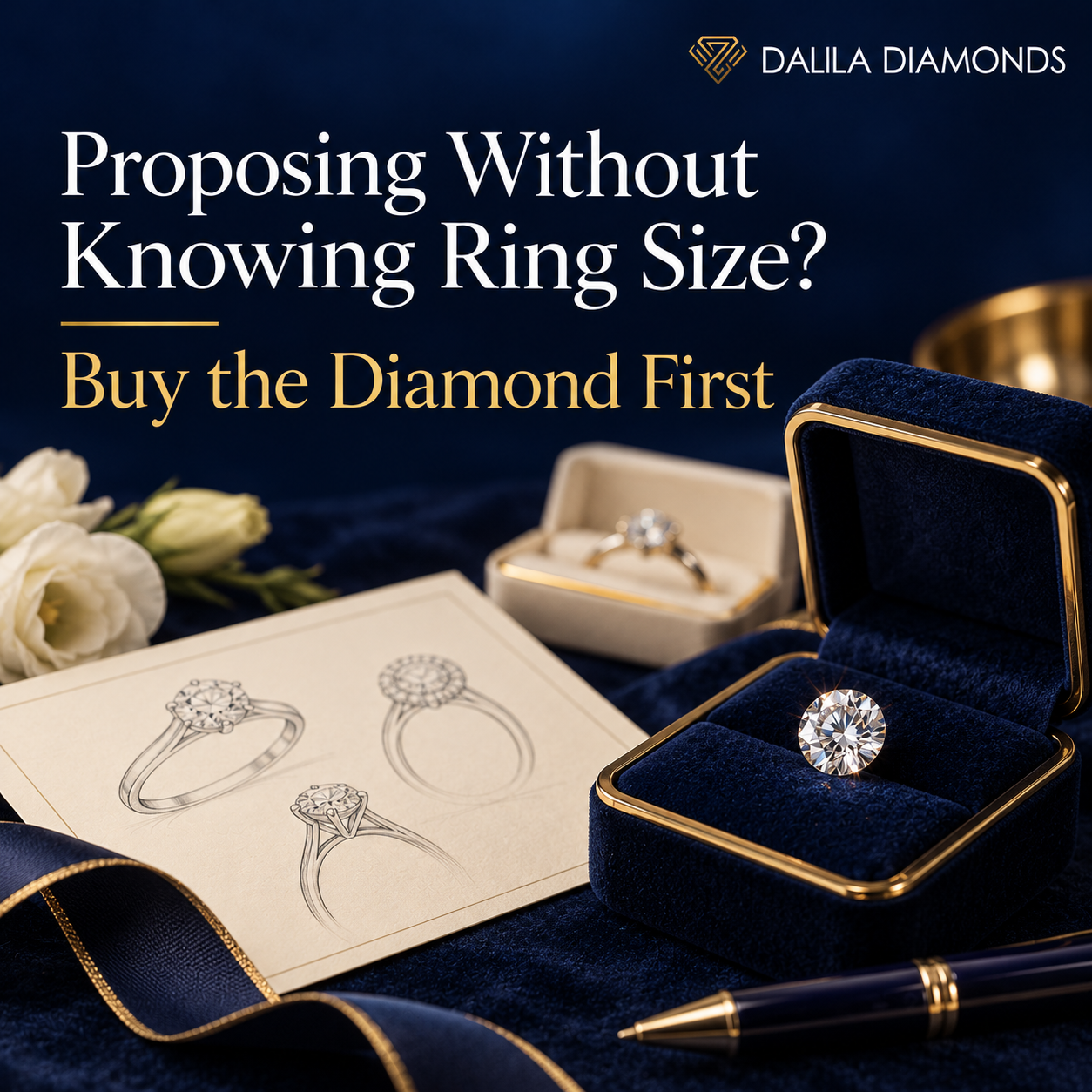
You can propose without knowing your partner's ring size. One practical approach is to choose a natural loose diamond first, present it securely during the proposal and select the permanent engagement-ring setting together afterwards.
This allows the proposal to remain a surprise without requiring the buyer to guess the correct ring size.
For example, someone planning a proposal might purchase a 1.00-carat natural round brilliant diamond with an independent grading report.
Instead of ordering a completed engagement ring in an estimated size, they present the loose diamond in a protective display case.
After the proposal, the couple visits a jeweller, measures the correct finger size and selects the ring's metal, setting style and final design.
The diamond becomes the centrepiece of the future engagement ring, while decisions requiring the recipient's input are postponed.
Another option is to propose with an affordable placeholder ring and choose both the diamond and permanent setting later.
Both approaches can work, but they provide different levels of certainty and flexibility.
If the buyer wants to select the actual natural diamond before proposing but does not know the recipient's ring size, purchasing the loose stone first is often the clearest way to separate the proposal from the ring-fitting process.
This guide explains how to follow that process, what to consider when selecting the diamond, how to present it safely and what to confirm before commissioning the permanent engagement ring.
Can You Propose Without Knowing the Ring Size?
Yes.
An engagement proposal does not require a completed ring in the correct size.
There are several ways to plan the occasion while leaving the permanent ring size unresolved.
The important distinction is between purchasing the diamond and purchasing the finished jewellery.
A loose diamond has its own carat weight, shape, dimensions, colour, clarity and cut characteristics.
It does not have a ring size.
Ring size becomes necessary when a jeweller designs or selects the mounting that will hold the diamond on the recipient's finger.
Therefore, a buyer can select a particular stone without committing to the dimensions of the finished ring.
Four possible proposal approaches
Approach | What you present | When ring size is needed | Main consideration |
Loose diamond first | Identified diamond in a protective holder | Before manufacturing the permanent ring | Preserves setting and sizing choices |
Placeholder ring | Affordable symbolic ring | When the permanent ring is selected | Actual diamond can be chosen later |
Temporary presentation setting | Diamond in an agreed temporary mount | Depends on mount; permanent size later | Must confirm professional fitting and setting arrangements |
Finished ring in estimated size | Completed diamond ring | Before purchase, using an estimate | May not fit; resizing is not guaranteed |
For buyers who want to choose the actual diamond before the proposal, the loose-diamond route avoids guessing the recipient's ring size.
For buyers who are unsure about the diamond shape or budget as well, a placeholder ring may offer greater flexibility.
Why Buying the Diamond First Can Be a Good Idea
The main advantage is separating two decisions that do not have to be made at the same time.
Decision one: Which natural diamond do you want to give?
Decision two: What engagement ring should be made around it?
The buyer may feel confident choosing a diamond shape and quality but be uncertain about the correct finger size, band width, setting style or metal.
By purchasing the loose diamond, those remaining decisions can be made after the proposal.
Benefits of choosing the stone first
The recipient does not need to reveal their ring size before the proposal.
The buyer can select a particular natural diamond with documented characteristics.
The couple can choose the permanent setting together.
The jeweller can measure the recipient's finger professionally.
The final mounting can be designed around the selected stone's actual dimensions.
There is no need to rely on an unconfirmed resizing promise for a finished ring.
However, this approach does not eliminate every risk.
The recipient might prefer another diamond shape, size or colour.
A selected diamond may also have limitations for particular settings.
The buyer should therefore consider preferences, documentation and exchange conditions before purchasing.
Stone-First vs Ring-First: Which Approach Is Safer?
Consider a hypothetical surprise proposal.
The buyer knows their partner likes oval natural diamonds and yellow gold but does not know the ring size.
They are considering two approaches.
Option A: Buy a completed engagement ring
The buyer chooses a finished oval solitaire engagement ring in an estimated size.
If the ring does not fit, they must ask whether resizing is possible.
That depends on the band construction, setting, metal, extent of the adjustment and jeweller's policy.
It cannot be guaranteed in advance for an unidentified design.
Option B: Buy the loose oval diamond
The buyer chooses an identified natural oval diamond.
The stone is presented securely during the proposal.
Afterwards, the couple visits a jeweller to establish the correct size and choose a setting.
The permanent ring is manufactured only after the design is approved.
Comparison
Buying consideration | Finished ring first | Loose diamond first |
Ring size required immediately | Usually yes | No |
Proposal can remain a surprise | Yes | Yes |
Centre diamond selected before proposal | Yes | Yes |
Setting style already fixed | Yes | No |
Need for potential resizing | Possible | Avoided for the unmade ring |
Recipient can choose band metal | Limited after purchase | Yes |
Recipient can choose ring setting | Limited after purchase | Yes |
Ring ready to wear at proposal | Yes, if it fits | No |
Separate manufacturing quote | Usually not required | Required |
Stone exchange terms | Must be reviewed | Must be reviewed |
Neither route is universally better.
But for someone specifically worried about not knowing the ring size, buying the loose diamond first avoids committing to an estimated permanent ring size.
Step 1: Learn the Recipient's Diamond Preferences Without Asking Their Ring Size
Although the ring size may remain unknown, it is useful to understand the recipient's taste.
A buyer should try to determine whether their partner likes round, oval, emerald, cushion, pear or another diamond shape.
The metal preference may also be important, even though it can be finalised later.
For example, someone who regularly wears yellow-gold jewellery may prefer a yellow-gold engagement ring.
Another person may favour platinum or white gold.
These observations are useful, but they are not proof of what the recipient wants.
Preferences worth understanding
Preference | What to consider |
Diamond shape | Round, oval, emerald, cushion or another |
Jewellery style | Classic, minimalist, vintage or contemporary |
Metal colour | Yellow, white or rose |
Centre size | Delicate, moderate or prominent |
Intended wear | Everyday wear, occasional wear or specific lifestyle needs |
Setting preference | Solitaire, bezel, halo or another design |
Ethical or material preference | Natural diamond, laboratory-grown or another gemstone |
Budget expectations | Whether the proposed purchase suits shared financial priorities |
The last two considerations are especially important.
A buyer should not assume that every recipient prefers natural diamonds or wants an expensive engagement ring.
If those preferences are uncertain, a symbolic placeholder proposal may be more appropriate than purchasing a non-returnable stone.
Step 2: Select a Natural Diamond Without Choosing the Ring Size
Once the buyer understands the likely preferences, the loose-diamond search can begin.
The stone can be compared by its independent characteristics.
For example, a buyer might shortlist natural round brilliant diamonds weighing approximately 0.80–1.00 carat.
Another might prefer an elongated oval with a specified length-to-width ratio.
The chosen diamond should be assessed on its own merits.
Example stone-first specification
Characteristic | Illustrative requirement |
Intended use | Future engagement ring |
Diamond origin | Natural |
Shape | Oval brilliant |
Carat range | 0.80–1.00 ct |
Colour | G–H |
Clarity | VS1–VS2, with suitable alternatives considered |
Cut appearance | Attractive brightness and controlled bow-tie appearance |
Length-to-width ratio | Buyer preference to be confirmed |
Grading | GIA, IGI or HRD report, as agreed |
Ring size | Not yet known |
Metal | To be selected later |
Setting style | To be selected later |
Loose-diamond budget | Specified separately |
These are example buying requirements, not a representation of available Dalila inventory.
Why measurements matter even before the ring exists
A one-carat oval is not a single fixed length and width.
Two oval diamonds with similar weight can have different outlines and proportions.
Those measurements influence the eventual setting design.
The buyer should therefore obtain the actual diamond's length, width and depth before purchase.
The manufacturing jeweller will use those measurements when designing the permanent mounting.
Step 3: Check the Diamond's Laboratory Report
A natural loose diamond purchased for an engagement should be supported by appropriate identification and grading documentation.
Independent laboratory reports can provide details such as carat weight, measurements, colour, clarity, cut-related information and other characteristics.
The exact fields depend on the laboratory and report type.
What to check
Report information | Why it matters |
Issuing laboratory | Identifies the grading organisation |
Report number | Allows record verification |
Natural origin | Confirms the reported diamond category |
Shape and cutting style | Identifies the stone |
Carat weight | Records diamond mass |
Measurements | Needed for future setting |
Colour | Supports grade comparison |
Clarity | Describes graded characteristics |
Cut-related information | Supports appearance evaluation |
Polish and symmetry | Additional quality information |
Fluorescence | Requires contextual review |
Comments | May contain important disclosures |
Laser inscription, if present | Can assist physical identity matching |
The laboratory record should be checked through the issuing laboratory's official verification system.
For example, GIA Report Check, IGI's report-verification service and My HRD Antwerp provide ways to review their respective records.
However, a valid report number does not independently prove that the physical diamond offered by a seller is the same stone.
The report, actual measurements and any inscription should be matched appropriately.
A laboratory report is also not a guarantee of the diamond's resale value or suitability for every engagement-ring setting.
Step 4: Decide How to Present the Diamond During the Proposal
A loose diamond should not be handed over without secure protection.
It is small and can easily be misplaced.
For a surprise proposal, the presentation should allow the recipient to appreciate the diamond without unnecessary handling.
Option 1: Present the loose diamond in a protective case
The buyer can use an appropriate secure diamond display holder or presentation container.
A decorative gift box may be used around the protective holder.
However, the stone should remain secured.
Do not assume a diamond supplier automatically provides a luxury proposal box.
Ask what packaging is actually included.
Option 2: Present a placeholder ring alongside the diamond
A low-cost symbolic ring can preserve the familiar proposal gesture.
The buyer can also show the selected loose diamond and explain that the permanent ring will be designed together.
The symbolic ring does not need to contain the valuable diamond.
This approach avoids exposing the natural stone to an unverified temporary mounting.
Option 3: Present the grading-report folder and diamond
The diamond can be shown securely with its grading information.
The recipient can see the selected stone and understand that its permanent mounting will be chosen later.
A report identifies grading characteristics; it should not be represented as a personalised ownership certificate.
Option 4: Present a symbolic ring and choose everything afterwards
If the buyer is not sure about diamond preferences, the safest decision may be not to purchase the final stone before proposing.
A placeholder ring allows the couple to select both the diamond and setting together.
That option provides the most flexibility but does not fulfil a stone-first purchase objective.
Should You Use a Temporary Engagement-Ring Setting?
Possibly, but only under an explicitly agreed professional arrangement.
A temporary setting may allow the recipient to see the actual selected diamond in a ring-like presentation.
However, mounting and later removing the diamond involves handling and setting work.
It can also create avoidable expense or risk.
A temporary ring may still require a ring-size estimate, even when the permanent ring size will be measured later.
Questions to ask before using a temporary setting
Question | What to confirm |
Is the temporary mount designed for the actual diamond? | Correct stone dimensions and seating |
Who will mount the diamond? | Qualified jeweller |
Is it safe for wearing? | Explicit professional approval |
How will the diamond be removed later? | Agreed removal process |
Who is liable for damage? | Written terms |
Can the diamond be inspected afterwards? | Agreed process |
Does mounting affect exchange eligibility? | Seller's written policy |
What does the temporary setting cost? | Separate quote |
Can it be reused or refunded? | Only if expressly agreed |
A temporary presentation setting should not be assumed to be free, universally safe or included in a diamond-sourcing service.
For many surprise proposals, presenting the loose diamond in a protective case or using a separate placeholder ring is simpler.
What Is a Placeholder Engagement Ring?
A placeholder ring is a temporary symbolic ring used during a proposal before the permanent engagement ring has been purchased or completed.
It may be an inexpensive band, a simple decorative ring or another personally meaningful choice.
Its purpose is to support the proposal, not to replace the final jewellery decision.
Why a placeholder can work
The buyer does not need to finalise the permanent ring's diamond, setting and size immediately.
The couple can later select a ring that suits the recipient's preferences.
GIA also discusses placeholder rings as an option when the final engagement ring is not ready or when the couple wants to shop together.
A placeholder is particularly useful when the recipient's ring size and preferred diamond shape are both unknown.
Does a placeholder need to fit perfectly?
No, provided it is not forced onto the finger or worn insecurely.
If the symbolic ring is too small, it should not be pushed over the knuckle.
If it is too large, the recipient should avoid wearing it in circumstances where it could fall off.
The permanent ring size should be measured professionally.
Step 5: Do Not Assume a Finished Ring Can Always Be Resized
Some engagement rings can be resized, but others are difficult or unsuitable for alteration.
The feasibility depends on the design and the size adjustment required.
A simple plain-metal solitaire shank may be easier to modify than a ring with pavé diamonds extending around most of the band.
An eternity-style engagement ring may be particularly difficult because stones occupy the circumference.
A heavily engineered or tension-style ring can have additional structural constraints.
Resizing considerations
Ring construction | Why resizing may be limited |
Plain metal shank | Often more adaptable, subject to metal and design |
Solitaire with plain lower band | May permit adjustment after inspection |
Pavé shank | Stone seats and metal distribution complicate changes |
Full-eternity band | Little or no plain metal available for conventional adjustment |
Intricate vintage-style design | Decorative continuity may be affected |
Tension or structurally specialised setting | Alteration can affect stone retention and design integrity |
Mixed-metal construction | May require specialised work |
No specific resizing allowance should be promised before the jeweller inspects the actual ring.
Statements such as "every engagement ring can be resized two sizes" are too broad for a guaranteed commercial policy.
The stone-first route avoids relying on such an assumption because the permanent ring does not exist yet.
Step 6: Confirm Diamond Return and Exchange Terms Before Proposing
Selecting the loose diamond before the proposal still involves a commitment.
The recipient may later prefer a different shape, size or other characteristic.
Whether the diamond can be exchanged depends on the actual contract and applicable law.
Custom-sourced stones can have different conditions from standard inventory.
What to ask the seller
Is the chosen stone currently available?
Is a reservation possible?
Is the reservation deposit refundable?
Can the diamond be exchanged for a different shape?
Is a preference-based return permitted?
What is the applicable inspection period?
Does the stone need to remain unset?
Does mounting or alteration affect return eligibility?
Who may request a return: the buyer or the recipient?
Who pays insured return shipping?
Are there any special-order restrictions?
The answers should be documented before payment.
Do not purchase a stone on the assumption that the recipient can automatically exchange it after the proposal.
A professional sourcing service is not necessarily equivalent to a consumer jewellery retailer's returns programme.
Step 7: Arrange Secure Delivery Before the Proposal Date
A surprise proposal often has a fixed date.
The buyer should therefore plan the delivery of the loose diamond carefully.
The selected diamond may need to be verified, reserved, paid for and shipped.
If the supplier is arranging an international transaction, the buyer must also consider insurance, customs and applicable taxes.
Delivery checklist
Item | What to confirm |
Identified stone | Stock and grading-report references |
Current availability | Written confirmation |
Expected dispatch date | Agreed estimate |
Destination | Approved delivery address |
Recipient | Authorised person |
Insurance | Scope, exclusions and responsibility |
Courier or shipping method | Suitable for valuable loose diamonds |
Signature | Required recipient verification |
Import duties and VAT | Party responsible |
Delivery delay | Process for changes |
Loss or damage | Claims procedure |
Packaging | Secure protective arrangement |
The buyer should not assume that a supplier provides anonymous delivery or gift-specific packaging.
For a surprise, have the parcel delivered according to the supplier's approved security process.
A shipment should not be scheduled so close to the proposal that an ordinary delay would create a serious problem.
Step 8: Measure the Correct Ring Size After the Proposal
Once the proposal has taken place, the couple can arrange a professional ring-sizing appointment.
This is an important advantage of buying the diamond first.
The jeweller can measure the actual finger rather than relying on an estimate from another ring.
Why another ring may give the wrong size
A ring worn on the middle finger may not match the engagement-ring finger.
Even rings worn on different hands can fit differently.
Finger shape, knuckle size and band width can also influence the preferred fit.
The jeweller should consider the specific finger and intended ring design.
How professional sizing helps
The recipient can try ring sizers and discuss comfort.
The jeweller can check whether the ring passes over the knuckle appropriately and sits securely.
The final band width and profile may also influence the selected size.
The objective is to produce a comfortable, secure permanent ring—not simply use a numerical size estimate from an unrelated piece of jewellery.
Step 9: Choose the Permanent Engagement-Ring Setting Together
After determining ring size, the couple can choose how to mount the selected diamond.
The setting should fit the diamond's actual dimensions and support its shape appropriately.
For example, a round brilliant can work with many conventional prong or bezel designs.
A princess cut requires suitable protection of its corners.
A pear-shaped diamond needs a design that accommodates its pointed end.
An oval diamond requires attention to its outline, proportions and intended orientation.
Common setting choices
Setting | Main design consideration |
Solitaire prongs | Stone security, height and number of support points |
Bezel | Diamond outline, girdle and bezel dimensions |
Hidden halo | Head geometry and additional small diamonds |
Classic halo | Centre outline and surrounding diamond arrangement |
Three-stone | Centre-to-side proportions and matching |
Pavé band | Calibrated small stones and band construction |
Vintage-style ring | Decorative details and mounting compatibility |
The ring should be designed around the actual selected diamond.
Do not order a setting based solely on nominal carat weight.
A one-carat diamond can have different dimensions depending on its shape and proportions.
The jeweller must approve the specific stone before manufacturing or modifying the mounting.
Does Buying the Diamond First Limit Setting Options?
It can.
A loose diamond may be compatible with many designs, but not every setting.
For example, an unusually deep stone may require additional pavilion clearance.
A fancy-shaped diamond with distinctive corners may need a custom head.
A very large centre diamond may not suit a delicate low-profile mounting.
The buyer should therefore avoid promising the recipient that the selected stone can be installed in any design they choose.
If a particular ring style is especially important, consult a manufacturing jeweller before purchasing the diamond.
This allows the buyer to preserve the surprise while reducing the risk of choosing a stone that cannot work in the preferred setting.
Worked Example: Proposing With a One-Carat Natural Round Diamond
Suppose a buyer is planning a surprise proposal.
They know their partner prefers a natural round diamond but do not know the ring size.
The buyer wants the proposal to include an actual diamond rather than only a symbolic ring.
Initial buying brief
Specification | Illustrative requirement |
Occasion | Surprise engagement proposal |
Diamond origin | Natural |
Shape | Round brilliant |
Carat weight | Approximately 1.00 ct |
Colour | G–H |
Clarity | VS1–VS2, with alternatives considered |
Cut | Strong round brilliant cut quality |
Laboratory | GIA, IGI or HRD |
Ring size | Unknown |
Permanent setting | To be selected together |
Presentation | Secure loose-diamond holder |
Proposal date | Fixed |
These are hypothetical preferences, not a current Dalila inventory listing.
Before the proposal
The buyer shortlists natural diamonds with verified grading reports.
They compare actual face-up dimensions, cut appearance, transparency and price.
The chosen stone's availability and commercial terms are confirmed.
A secure delivery arrangement is made, allowing enough time before the proposal.
The diamond is kept in a protective holder.
During the proposal
The buyer presents the diamond in its secure case.
They explain that the permanent ring will be designed together.
No temporary stone mounting or estimated ring size is required.
After the proposal
The couple visits a jeweller.
The recipient's engagement-ring finger is measured.
The jeweller reviews the actual diamond and discusses suitable settings.
The couple chooses the metal, band width, mounting height and design.
The permanent ring is then quoted and manufactured separately.
Main advantage
The buyer is able to present the exact natural diamond while avoiding a guess about the finished ring size.
Main limitation
The recipient has not participated in choosing the stone.
Therefore, preference and exchange terms still matter.
Worked Example: An Oval Diamond With an Unknown Ring Size
Consider another hypothetical buyer.
Their partner prefers oval diamonds and minimalist jewellery.
The buyer wants a natural oval weighing approximately 0.80–1.00 carat.
Proposed requirements
Specification | Preference |
Shape | Oval brilliant |
Natural origin | Required |
Carat weight | 0.80–1.00 ct |
Colour | G–H |
Clarity | VS2, subject to actual appearance |
Length-to-width ratio | To be shortlisted |
Bow-tie appearance | Must be evaluated |
Ring setting | Unknown |
Ring size | Unknown |
The buyer compares actual oval diamonds, including their measurements, outlines and bow-tie patterns.
They select a particular stone and present it securely.
After the proposal, the couple chooses between a traditional solitaire, bezel or another mounting.
The jeweller then checks whether the chosen oval's length, width, depth and girdle are suitable for the selected design.
This example demonstrates why a stone-first purchase can avoid premature ring sizing without eliminating the need for careful stone selection.
Worked Example: Using a Placeholder Ring Instead
Suppose the buyer knows their partner wants an engagement ring but does not know which diamond shape they prefer.
Purchasing a natural loose diamond without that knowledge could be risky.
Instead, the buyer chooses an affordable placeholder ring.
After the proposal, the couple selects both the natural diamond and the final setting together.
Comparison
Decision | Loose-diamond-first proposal | Placeholder-only proposal |
Real centre diamond purchased before proposal | Yes | No |
Partner chooses final diamond | Not unless exchange is arranged | Yes |
Ring size required before proposal | No | No permanent size required |
Setting chosen later | Yes | Yes |
Diamond purchase risk before proposal | Present | Avoided |
Proposal includes the actual final stone | Yes | No |
Both are legitimate approaches.
The better choice depends on how confidently the buyer understands their partner's preferences.
How Much Should You Budget for a Stone-First Proposal?
The loose diamond is only one part of the eventual engagement-ring cost.
The final setting may involve precious metal, side stones, manufacturing labour, finishing and additional services.
A buyer should therefore distinguish the diamond budget from the ring-manufacturing budget.
Budget worksheet
Cost item | Status |
Natural loose diamond | Obtain current individual quote |
Independent grading | Confirm report supplied |
Diamond shipping and insurance | Confirm |
Proposal presentation case | Confirm or arrange separately |
Symbolic placeholder ring, if used | Optional |
Permanent ring design | Jeweller quote required |
Metal and setting | Jeweller quote required |
Side stones or pavé | Additional if chosen |
Stone-setting labour | Confirm |
Finished ring delivery | Confirm |
Taxes | Apply as appropriate |
A loose-diamond price cannot be represented as the cost of a completed engagement ring.
The final total depends on the selected diamond and subsequent setting design.
Buying a Natural Loose Diamond Through Dalila
Dalila Diamonds publishes specification-led natural loose-diamond sourcing services.
Its DS4U — Diamond Source For You service allows professional buyers to submit requirements such as shape, carat range, colour, clarity, preferred grading laboratory, budget and delivery destination.
Its S2S — Secure To Source service focuses on buyers who have already shortlisted a diamond on an external platform and want professional procurement assistance.
These services relate to sourcing natural loose diamonds rather than selling a completed proposal-ring package.
What to provide in a stone-first enquiry
Field | Information |
Intended use | Centre diamond for future engagement ring |
Diamond origin | Natural |
Shape | ______ |
Carat range | ______ |
Colour | ______ |
Clarity | ______ |
Cut preferences | ______ |
Measurements | ______ |
Grading laboratory | ______ |
Budget | ______ |
Delivery destination | ______ |
Required date | ______ |
Future ring size | Unknown |
Setting chosen | Not yet |
Buyer eligibility | Supplier confirmation required |
The buyer should explain that the diamond will be presented before the permanent setting is chosen.
That does not require the supplier to provide ring sizing.
However, Dalila's published S2S and DS4U information primarily describes professional and trade-oriented diamond sourcing.
Private consumer proposal orders, gift presentation and recipient exchanges should not be assumed to be available.
Those arrangements must be confirmed directly before publication of any retail-specific call to action.
What Dalila Can and Cannot Be Assumed to Provide
Service | Publication-safe description |
Natural loose-diamond sourcing | Published sourcing activity |
Specification-led custom search | Described through DS4U |
Professional sourcing of shortlisted diamonds | Described through S2S |
Grading-report review and stone specifications | Part of published sourcing guidance |
Ring-size measurement | Not confirmed |
Proposal boxes or gift wrapping | Not confirmed |
Temporary diamond mountings | Not confirmed |
Placeholder rings | Not confirmed |
Finished engagement-ring manufacture | Not confirmed |
Free resizing | Not confirmed |
Preference-based diamond exchanges | Not confirmed |
Direct delivery to proposal recipient | Requires transaction confirmation |
The distinction matters.
A buyer may be able to acquire a loose natural diamond through a qualifying sourcing arrangement without any accompanying jewellery service.
The permanent setting can then be commissioned from a separate jeweller.
Checklist: Buying the Diamond Before Knowing the Ring Size
Before choosing the diamond
Requirement | Status |
Partner's natural-diamond preference understood | ______ |
Preferred diamond shape identified | ______ |
Approximate stone size preference | ______ |
Budget established | ______ |
Future setting budget considered | ______ |
Supplier eligibility confirmed | ______ |
Exchange conditions reviewed | ______ |
Before purchasing
Requirement | Status |
Exact stone identified | ______ |
Laboratory report reviewed | ______ |
Report number verified | ______ |
Natural origin confirmed | ______ |
Diamond measurements recorded | ______ |
Actual images or videos reviewed | ______ |
Current price confirmed | ______ |
Availability confirmed | ______ |
Invoice details confirmed | ______ |
Payment terms agreed | ______ |
Inspection and return conditions documented | ______ |
Insured delivery confirmed | ______ |
Before the proposal
Requirement | Status |
Diamond securely received | ______ |
Protective holder available | ______ |
Grading documents stored safely | ______ |
Proposal presentation planned | ______ |
Temporary setting avoided or professionally approved | ______ |
Ring size remains optional | ______ |
After the proposal
Requirement | Status |
Recipient's preferences discussed | ______ |
Finger professionally measured | ______ |
Jeweller accepts externally sourced diamond | ______ |
Desired setting selected | ______ |
Diamond compatibility approved | ______ |
Manufacturing quotation received | ______ |
Setting liability terms agreed | ______ |
Finished ring inspected | ______ |
Common Mistakes When Proposing Without Knowing Ring Size
Guessing a permanent ring size unnecessarily
A stone-first proposal avoids the need to commit to a size before the recipient is measured.
Assuming every engagement ring can be resized
Some pavé, eternity and specialised constructions have significant limitations.
Buying the diamond without knowing the recipient's preferences
If shape and other stone choices are uncertain, a placeholder-only proposal may offer greater flexibility.
Using an unsecured diamond presentation box
A loose stone can be misplaced. Use an appropriate protective holder.
Assuming temporary settings are risk-free
Mounting and removing a diamond require professional work and agreed responsibility.
Ignoring exchange terms
The recipient may prefer another diamond, but exchanges are not automatically available.
Forgetting future setting costs
The loose stone price does not include the completed engagement ring unless the seller expressly agrees otherwise.
Ordering a setting based only on carat weight
The actual diamond dimensions must be used.
Assuming Dalila sells finished proposal rings
Dalila's public sourcing services focus on natural loose diamonds and professional procurement, not a confirmed consumer proposal package.
Frequently Asked Questions
Can I propose without knowing my partner's ring size?
Yes. You can present a loose diamond or placeholder ring and choose the permanent engagement ring after the proposal.
Can I buy the engagement diamond before choosing the ring?
Yes. A loose diamond can be selected before the mounting, provided the buyer understands the stone's characteristics and future setting requirements.
Does a loose diamond have a ring size?
No. Ring size is a characteristic of the finished ring, not the diamond.
Can I propose with a loose diamond?
Yes. Present it securely in a protective holder and arrange the permanent setting later.
Is proposing with a loose diamond romantic?
That depends on the recipient. Some people appreciate choosing their setting together, while others prefer a finished ring during the proposal.
What is a placeholder engagement ring?
It is a symbolic ring used for the proposal before the permanent engagement ring is purchased or completed.
Can I use a cheap ring for a proposal?
Yes. An affordable placeholder ring can make the proposal possible without committing to the permanent design or size.
Can the real diamond go into a temporary ring?
Possibly, but a qualified jeweller must approve the mounting, and the buyer should understand the costs, liability and later removal requirements.
Are temporary settings free?
Not necessarily. Do not assume a supplier includes temporary mounting without an explicit agreement.
Should I buy a larger ring size and resize it later?
That approach carries risk. Resizing depends on the specific ring design and cannot be guaranteed. Buying the loose diamond first avoids that uncertainty.
Can every engagement ring be resized?
No. Some ring designs are difficult to resize or unsuitable for the required change.
How do I secretly find my partner's ring size?
You can consult a jeweller using a ring worn on the correct finger as an approximate reference, but measurements from other fingers or hands may be unreliable. Professional sizing after the proposal is preferable for the permanent ring.
What if my partner wants another diamond shape?
Whether the selected stone can be exchanged depends on the supplier's written terms and applicable law. Confirm before purchase.
Can the diamond be returned after proposing?
That depends on the actual transaction. A proposal does not automatically create an exchange or return entitlement.
Can my partner choose the setting after the proposal?
Yes. The jeweller can measure the ring finger and design a compatible mounting around the chosen diamond.
Can I set the diamond at a different jewellery shop?
Many jewellers work with externally sourced diamonds, but their policies vary. Confirm acceptance and liability terms first.
Should I buy a round or oval diamond for a surprise proposal?
Choose according to the recipient's preferences. If those preferences are unknown, consider delaying the diamond purchase until after the proposal.
Is a natural diamond grading report necessary?
An appropriate independent grading report is strongly recommended for an individually traded engagement diamond. Verify the report and the identity of the physical stone.
Does the grading report tell me the ring size?
No. It describes the diamond, not the size of a future ring.
How long does it take to make the ring afterwards?
The timeframe depends on the design, jeweller, materials and production schedule. Obtain a project-specific estimate.
Is it cheaper to buy the diamond first?
Not necessarily. The completed ring requires a separately quoted setting and manufacturing work.
Can Dalila source a natural diamond for a future engagement ring?
Dalila publicly offers specification-led natural loose-diamond sourcing for qualifying buyers. Consumer proposal purchasing must be confirmed directly.
Does Dalila offer temporary proposal rings?
That service has not been verified and should not be advertised without confirmation.
Does Dalila resize engagement rings?
A resizing service has not been verified. Loose-diamond sourcing does not automatically include setting or jewellery repairs.
What should I send Dalila for a stone-first enquiry?
Provide the desired natural diamond shape, carat range, colour, clarity, cut preferences, grading requirements, budget, delivery destination and date. Explain that the permanent ring size and setting have not yet been chosen.
Final Recommendation: Choose the Diamond First, Size the Ring Later
A surprise engagement proposal does not need to depend on guessing the correct ring size.
If the buyer already knows the recipient's diamond preferences, selecting a natural loose diamond first can be an effective approach.
The diamond can be presented securely during the proposal, while the permanent ring design and sizing take place afterwards.
However, a stone-first purchase should not be confused with a fully flexible or risk-free purchase. The buyer should verify the diamond, review exchange conditions and confirm secure delivery before paying.
For couples who are uncertain about the diamond itself, an affordable placeholder ring may be the more appropriate choice.
The recommended sequence is: understand diamond preferences → select and verify the loose stone → confirm purchase terms → propose securely → measure the ring finger → approve the permanent setting → manufacture the ring.
This protects the surprise without relying on an unverified promise that an incorrectly sized engagement ring can always be altered.