Upgrading the Centre Diamond for an Anniversary: Keep the Setting or Start Again?
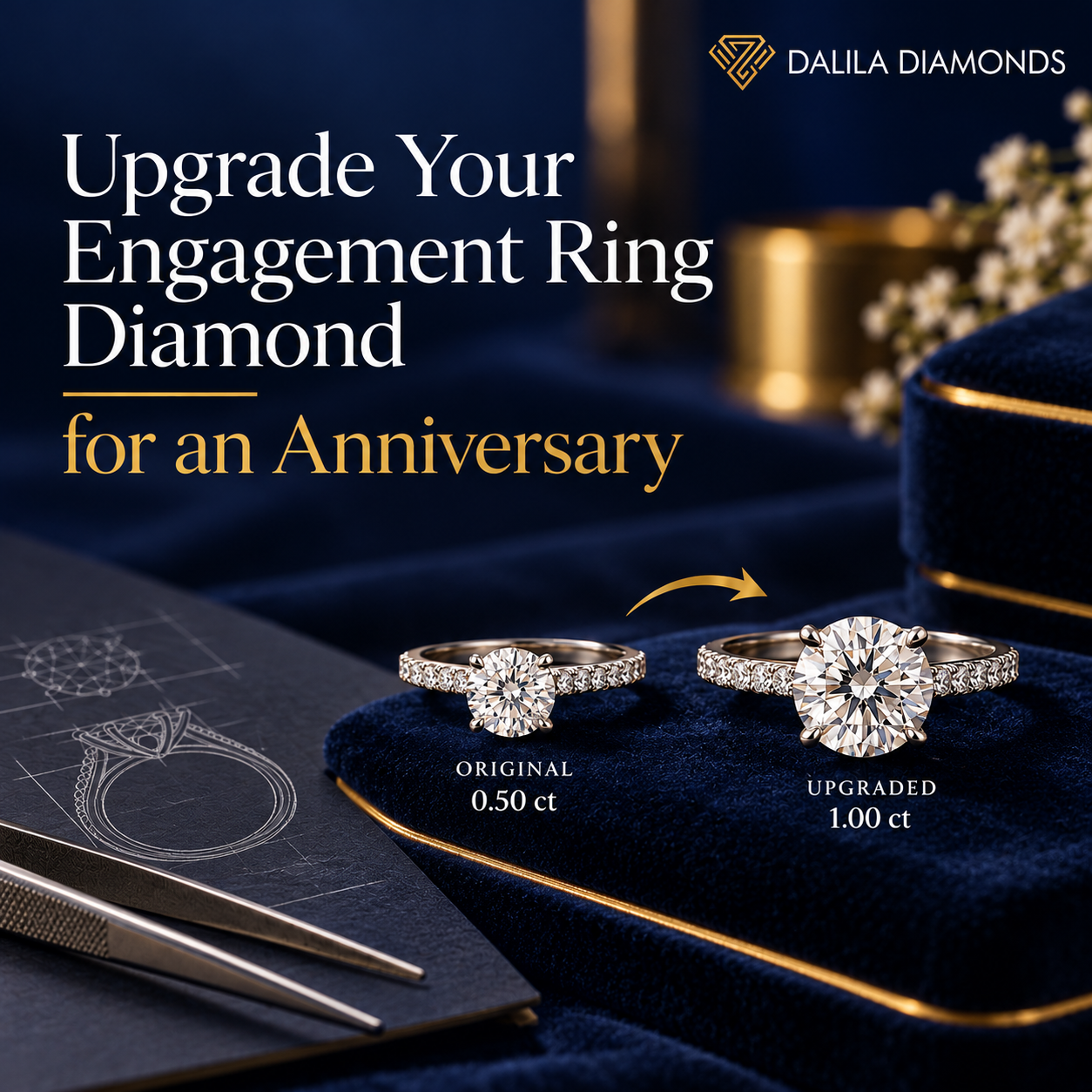
You can often upgrade the centre diamond of an engagement ring for an anniversary, but a larger natural diamond will not necessarily fit the original setting. The right approach depends on the replacement stone's physical dimensions, the condition of the existing ring and whether the original mounting can be safely reused or modified.
An anniversary upgrade can mark ten, twenty or more years together while preserving the significance of the original engagement ring.
For example, someone who originally received a 0.50-carat natural round brilliant diamond may now want a one-carat centre stone.
The new diamond may measure approximately 6.5 mm across, compared with about 5.1 mm for the original.
That represents an increase of approximately 1.4 mm in diameter.
Although the difference sounds small, it can be substantial for a mounting built around the original diamond.
The existing prongs may be too short, the diamond seat may be unsuitable or the new pavilion may need more clearance.
In some cases, a jeweller can replace the ring's head while retaining the original band. In others, manufacturing a new mounting may be the safer or more practical option.
There is also a decision about what happens to the original diamond.
It can be kept, used in another piece of jewellery or potentially sold. A trade-in credit is possible only where a seller has explicitly agreed to provide one.
The safest anniversary upgrade begins with professional measurements of the existing ring, followed by a clearly specified natural-diamond search and an approved setting plan.
This guide compares the main upgrade routes, explains how to select a compatible replacement and includes a detailed measurement worksheet for the manufacturing jeweller.
Can You Upgrade the Diamond in Your Engagement Ring?
Yes, in many cases.
An engagement ring's centre diamond can potentially be replaced with a larger, better-cut or otherwise preferred natural diamond.
However, three separate decisions must be made:
Which diamond do you want? A larger stone, better optical performance, a different shape or another quality improvement?
Which parts of the existing ring can be retained? The complete setting, just the band or none of the original mounting?
What happens to the original diamond? Keep it, reset it into another piece or pursue a separate sale or confirmed trade-in?
A successful upgrade should resolve all three before any stone is removed.
The buyer should not assume that purchasing a larger diamond automatically includes resetting the ring.
A natural loose-diamond supplier and a manufacturing jeweller may have different responsibilities.
Three Ways to Upgrade an Engagement Ring for an Anniversary
The main options are reusing the current setting, replacing the centre head or manufacturing a new ring.
Upgrade route | What happens | Best reason to consider it |
Reuse the original head | A compatible replacement diamond is fitted into the existing structure | Buyer wants to preserve the entire ring |
Replace the head, retain the band | Original centre head is replaced with a correctly sized one | Buyer wants a larger stone but values the original band |
Make a new mounting | Replacement diamond is set into a newly designed ring | Original setting is unsuitable, worn or no longer preferred |
These are separate technical possibilities.
A jeweller must assess the original ring before recommending one.
Option 1: Reuse the original setting
This may be possible if the replacement stone has dimensions and geometry that the existing head can accommodate safely.
For example, a buyer may replace a diamond with another of similar diameter while seeking improved cut quality or transparency.
Even then, matching face-up diameter does not prove compatibility.
The girdle, depth, prongs and stone seat must be inspected.
Option 2: Replace the centre head but keep the band
A new head can sometimes accommodate a larger centre diamond while retaining the original ring shank.
This may help preserve the appearance and sentimental value of the existing band.
However, a new head must be structurally compatible with the ring.
The jeweller must review the connection to the shank, metal condition, setting height and overall balance.
Option 3: Make a completely new mounting
A new ring may be preferable when the original structure cannot safely support the replacement.
It may also be the best option when the recipient wants a different metal, profile or design.
The original engagement ring can potentially be retained separately.
A new mounting should be designed around the actual replacement diamond rather than an approximate carat-weight category.
Is It Better to Upgrade the Diamond or the Entire Ring?
That depends on what the owner wants to preserve.
Some people value the original band because it is the ring they have worn since their engagement.
Others are especially attached to the original diamond.
These lead to different projects.
Main priority | Option worth considering |
Keep the sentimental original band | New diamond with retained band, if structurally suitable |
Keep the original centre diamond | Reset that diamond into a redesigned ring |
Increase visible centre size | Larger replacement diamond with compatible mounting |
Improve sparkle without much size change | Better-cut replacement near original dimensions |
Change diamond shape | New head or mounting, subject to jeweller approval |
Change metal or ring style | Complete redesign |
Preserve original ring intact | Purchase a separate anniversary ring |
An anniversary upgrade does not have to involve disposing of the original ring.
Keeping it intact and purchasing a new piece may be the preferred decision where sentimental value is particularly important.
Step 1: Inspect the Existing Engagement Ring
Before comparing loose diamonds, ask a qualified jeweller to examine the current ring.
The jeweller should assess both the centre mounting and the rest of the structure.
This is especially important for older rings, rings with previous repairs and designs containing small pavé diamonds.
Existing ring inspection checklist
Ring component | What to examine |
Centre diamond | Shape, dimensions, condition and documentation |
Prongs or claws | Wear, cracks, length and remaining metal |
Diamond seat | Girdle bearing and geometry |
Head or basket | Size, depth and structural condition |
Gallery | Pavilion clearance and support |
Cathedral shoulders, if present | Whether a larger head can be accommodated |
Band or shank | Thickness, width, wear and damage |
Pavé diamonds | Security and risk during modification |
Halo, if present | Existing centre opening and surrounding stone alignment |
Metal | Alloy, condition and previous repairs |
Ring size | Current measured size |
Setting height | Existing profile and available clearance |
Ring history | Prior resizing or structural changes |
The jeweller should identify whether the ring can accept a larger diamond or requires reconstruction.
No universal diamond-size increase can be approved without this inspection.
Step 2: Record the Original Centre Diamond's Measurements
The original diamond's carat weight is useful, but its actual dimensions are more important for setting compatibility.
For a round brilliant, record the minimum and maximum diameter.
Also review total depth, girdle characteristics and the actual seat.
For fancy-shaped diamonds, length, width, outline and corner geometry matter.
What information should be recorded?
Diamond information | Why it matters |
Shape | Determines general mounting geometry |
Carat weight | Establishes original diamond mass |
Minimum diameter or width | Helps evaluate face-up size |
Maximum diameter or length | Helps evaluate setting fit |
Total depth | Important for pavilion clearance |
Girdle characteristics | Relevant to retaining-metal contact |
Crown and pavilion profile | Affects seating and setting height |
Colour | Provides appearance reference |
Clarity | Provides quality reference |
Cut characteristics | Supports optical comparison |
Report number | Identifies documented diamond |
Condition | Identifies chips or damage since grading |
If the original diamond has a grading report, use it as a starting reference.
However, the stone should still be examined for any damage or alterations since the report was issued.
Mounted measurements may be incomplete where parts of the diamond are covered by the setting.
The jeweller should distinguish measured information from estimates.
Step 3: Decide What the Anniversary Upgrade Should Improve
A larger diamond is only one type of upgrade.
The recipient may be more interested in improved brightness, a different shape or better overall wearability.
Upgrade for greater carat weight
The buyer wants a larger centre diamond.
Actual face-up dimensions should be compared, because carat weight is a mass measurement rather than a fixed diameter.
Upgrade for better cut quality
The buyer wants more attractive optical performance.
A diamond with similar carat weight but stronger proportions and light performance may create the desired improvement without a substantial size change.
Upgrade for colour
The buyer wants a different face-up colour appearance.
For example, they may prefer a G–H natural diamond over a warmer original stone.
The final choice should account for the ring's metal and any side stones.
Upgrade for clarity
The buyer wants fewer or less visible inclusions.
However, upgrading from VS2 to VVS2 does not guarantee an obvious appearance difference without magnification.
Upgrade for shape
The owner may want to replace a round brilliant with an oval, emerald or cushion cut.
This can produce a more substantial design change because the setting must accommodate a different outline.
Before searching for replacement diamonds, establish which improvement is most important.
Step 4: Compare the Old and New Diamond in Millimetres
Carat weight alone cannot establish whether a replacement will fit.
The following table shows approximate dimensions for natural round brilliant diamonds.
Diamond weight | Approximate diameter | Increase from 0.50 ct |
0.50 ct | 5.1 mm | Reference |
0.60 ct | 5.4 mm | +0.3 mm |
0.75 ct | 5.8 mm | +0.7 mm |
0.90 ct | 6.2 mm | +1.1 mm |
1.00 ct | 6.5 mm | +1.4 mm |
1.25 ct | 6.9 mm | +1.8 mm |
1.50 ct | 7.4 mm | +2.3 mm |
2.00 ct | 8.1 mm | +3.0 mm |
Approximate round-brilliant measurements. Real dimensions depend on the individual diamond's proportions. These figures do not establish setting compatibility.
Moving from 0.50 to 1.00 carat doubles the diamond's mass, but its typical diameter increases by roughly 27%.
That distinction matters when deciding whether the upgrade will create the desired visual difference.
Why actual diameter is more useful than carat weight
Suppose the jeweller determines that the existing head cannot safely accommodate a diamond wider than a specific approved diameter.
A one-carat target is then less useful than that physical limit.
The supplier should search for diamonds using the jeweller's actual requirements.
However, the jeweller should also specify acceptable depth, girdle geometry and other characteristics.
A diameter limit alone is not a complete setting specification.
Step 5: Can the Existing Prongs Hold a Bigger Diamond?
Sometimes, but this should never be assumed.
Prongs are shaped and positioned around the diamond they hold.
A larger stone may require different prong lengths, angles and seating locations.
Previously used prongs may also contain existing bearings that make them unsuitable for another stone.
Illustrative example
An original ring contains a 0.50-carat round brilliant measuring approximately 5.1 mm.
The replacement is a 0.75-carat round measuring approximately 5.8 mm.
The increase is about 0.7 mm.
That may be too much for the original prong head.
The jeweller might recommend replacing the head rather than adjusting the existing prongs.
A different ring with a more adaptable head could lead to another decision.
There is no universal percentage increase in diamond diameter that existing prongs can safely accommodate.
The setter must inspect the actual construction.
Step 6: Check Pavilion Clearance and Setting Height
A new diamond can have a suitable face-up diameter but still be too deep for the existing ring.
The pavilion extends below the girdle and must have sufficient clearance.
If the replacement diamond is deeper, it may come too close to the gallery, band or other components.
It may also sit higher than the original stone.
That can change the ring's profile and how it feels during everyday wear.
Two hypothetical replacement candidates
Specification | Diamond A | Diamond B |
Weight | 0.75 ct | 0.75 ct |
Average diameter | 5.80 mm | 5.78 mm |
Total depth | 3.54 mm | 3.72 mm |
Shape | Round brilliant | Round brilliant |
Colour | G | G |
Clarity | VS2 | VS2 |
Existing head compatibility | Unknown | Unknown |
Both diamonds have similar headline specifications.
However, Diamond B has greater total depth.
That difference may affect the required seating or pavilion clearance.
Neither candidate should be declared suitable until the jeweller reviews its actual profile against the head.
Step 7: Does the Original Setting Style Affect the Upgrade?
Yes.
Different engagement-ring settings place different constraints on replacement stones.
Solitaire prong setting
A simple solitaire head may be replaceable without rebuilding the entire shank.
However, the feasibility depends on how the head attaches to the band and whether the surrounding metal is sound.
Cathedral setting
Cathedral-style shoulders rise towards the centre head.
A substantially larger diamond may require a different head height or shoulder geometry.
The original structure must be checked for clearance and visual balance.
Bezel setting
A bezel surrounds the diamond's perimeter.
Because the retaining metal is fitted around the original outline, a larger or differently shaped stone will commonly require a new bezel.
Halo setting
A halo is designed around a particular centre outline.
Changing the centre's dimensions may create gaps, crowding or an unsuitable relationship with the surrounding diamonds.
A larger centre may require redesigning the halo.
Three-stone ring
A larger centre diamond can change the proportions between the centre and the two side stones.
The buyer may need to review the complete three-stone arrangement.
Tension-style setting
These designs depend on specialised structural conditions.
A replacement must be assessed by a jeweller qualified to work with the original construction.
A larger stone should not be assumed compatible.
Setting comparison
Setting | Main upgrade consideration |
Standard solitaire | Head, prong and seat compatibility |
Cathedral | Shoulder clearance and head proportions |
Bezel | New stone outline and retaining perimeter |
Classic halo | Centre opening and surrounding diamond alignment |
Hidden halo | Gallery geometry and new diamond position |
Three-stone | Centre-to-side proportions |
Pavé band | Head alteration without damaging pavé |
Tension-style | Manufacturer-specific structural suitability |
GIA's engagement-ring upgrade guidance describes replaceable peg-style heads as one potential way to accommodate a different diamond while preserving much of the original ring design.
However, that possibility depends on the individual mounting.
Step 8: Should You Keep the Original Band?
For some couples, the original band carries more sentimental value than the centre diamond's specifications.
It may be the ring worn throughout the marriage.
Keeping that band can make an anniversary upgrade particularly meaningful.
However, sentimental value cannot override structural safety.
A band that has become thin, cracked or heavily repaired may require additional work.
The jeweller should examine whether it can support the proposed replacement head and diamond.
When retaining the band may be reasonable
The band is structurally sound.
The wearer likes its current style and fit.
The new head can be attached securely.
Existing pavé or decorative elements remain stable.
The completed design has acceptable height and balance.
When a new band may be preferable
The original metal is worn or damaged.
The new centre diamond is substantially larger.
The original design cannot accommodate the desired shape.
The owner wants a different ring profile or metal.
Extensive reconstruction would be required.
The buyer should compare the actual repair and remounting quotation with the cost of a new mounting.
Do not assume that keeping the original band is always the cheaper option.
Step 9: What Happens to the Original Engagement-Ring Diamond?
The original diamond does not become worthless or irrelevant when the centre is upgraded.
For many owners, it remains emotionally significant.
There are several possible ways to handle it.
Keep the original diamond
The owner can retain the loose stone after its removal.
Ask the jeweller to document its identity, condition and return arrangements.
Reset it into another piece of jewellery
The original diamond might become a solitaire pendant, a right-hand ring or another suitable piece.
The jeweller must confirm the new setting's compatibility.
Use it in a redesigned anniversary ring
Some designs may incorporate the original stone alongside new diamonds.
This can preserve its personal history.
However, the feasibility depends on the dimensions and proportions of all stones.
Sell the original diamond independently
The owner may request offers from diamond buyers.
A resale value should not be inferred from the original retail purchase price.
Trade in the original diamond
Some jewellery businesses offer upgrade or trade-in arrangements.
However, a trade-in credit exists only when the seller has agreed to one.
Dalila Diamonds does not have a verified public engagement-ring diamond trade-in programme.
Do not assume Dalila will repurchase the original stone or deduct its value from the replacement price.
Can You Trade In Your Original Diamond for a Bigger One?
Possibly, but only under a confirmed arrangement.
A trade-in programme may allow a customer to exchange an existing diamond for credit towards a different stone.
However, the eligibility requirements, valuation method and commercial terms vary.
Some programmes are restricted to diamonds originally purchased from the same retailer.
Others may require a minimum new purchase value or specific documentation.
The buyer should request written conditions.
Trade-in questions
Question | What needs to be confirmed |
Is a trade-in programme offered? | Explicit seller confirmation |
Must the original diamond have been bought there? | Eligibility |
Which diamonds qualify? | Origin, grading and condition |
Is an individual report required? | Documentation |
Who determines the value? | Valuation process |
Is credit based on purchase price or assessed value? | Calculation method |
Is the credit refundable as cash? | Redemption conditions |
Must the new diamond meet a minimum price? | Programme restrictions |
What happens if the stone is chipped? | Condition exclusions |
When does ownership transfer? | Contractual terms |
A trade-in quotation should not be represented as an independent cash resale valuation.
The commercial offer may apply only when purchasing another diamond from the same business.
Does Dalila offer diamond trade-in or buyback for upgrades?
I could verify Dalila's custom sourcing and professional procurement services, but not a dedicated trade-in, buyback or anniversary upgrade-credit programme.
For Dalila, an enquiry should therefore focus on sourcing a new loose natural diamond.
Any repurchase or trade-in discussion requires separate written confirmation.
Worked Example 1: Upgrading a 0.50-Carat Ring to One Carat
Suppose a couple wants to celebrate their tenth anniversary by increasing the centre diamond size.
The original engagement ring contains a natural 0.50-carat round brilliant in an 18K white-gold solitaire setting.
The owner hopes to keep the original band.
Original ring
Specification | Existing ring |
Centre diamond | Natural round brilliant |
Weight | 0.50 ct |
Diameter | Approximately 5.1 mm |
Setting | Four-prong solitaire |
Metal | 18K white gold |
Band | Original engagement band |
Condition | Inspection required |
Proposed diamond
Specification | Target |
Origin | Natural |
Shape | Round brilliant |
Weight | Approximately 1.00 ct |
Diameter | Around 6.4–6.5 mm |
Colour | G–H |
Clarity | VS1–VS2, subject to appearance |
Cut | Attractive round-brilliant cut quality |
Grading | Individual recognised report |
Availability | To be confirmed |
These are hypothetical specifications, not available Dalila inventory.
Route A: Retain the original head
The jeweller compares the original head with the proposed new diamond.
The new stone is approximately 1.4 mm wider.
The original prongs and seat may not be suitable.
Unless the setter expressly approves reuse, this route should not proceed.
Route B: Replace the head and retain the band
The jeweller evaluates whether a new head designed for the one-carat diamond can be attached safely to the original band.
If the shank is sound, this could preserve much of the original ring.
The new head's height and appearance should be approved.
Route C: Manufacture a new mounting
If the original band is unsuitable or the couple wants a different design, a new ring may be commissioned.
The old ring or original stone can be retained separately.
Which route should the couple choose?
The answer depends on the jewellery inspection and written quotations.
A new head may be a reasonable option to investigate, but it is not guaranteed to work.
The chosen diamond should not be purchased for the existing setting until the jeweller has reviewed the physical requirements.
Worked Example 2: Improving Cut Quality Without a Major Size Increase
Suppose an existing engagement ring contains a 0.75-carat round brilliant.
The owner likes its current size but wants a livelier-looking natural diamond.
The proposed upgrade focuses on cut and optical appearance rather than carat weight.
Illustrative comparison
Specification | Original diamond | Replacement target |
Weight | 0.75 ct | Approximately 0.70–0.80 ct |
Diameter | Around 5.8 mm | Near original diameter |
Colour | H | G–H |
Clarity | SI2 | VS2 or visually suitable alternative |
Transparency | Buyer dissatisfied | Clear, attractive appearance |
Cut appearance | Buyer dissatisfied | Improved optical performance |
Existing head | Original | Reuse requires approval |
This is a hypothetical example.
The replacement should be compared visually with the original.
The buyer should not assume that moving up one clarity grade will improve sparkle.
Likewise, two diamonds of similar diameter may have different girdle and depth profiles.
The jeweller must check whether the replacement fits the original head.
If it does, retaining more of the existing ring may be possible.
Worked Example 3: Changing From a Round to an Oval Diamond
A couple decides to mark an anniversary by changing the centre shape.
The original ring has a 1.00-carat round brilliant.
The recipient now prefers an oval diamond.
The new stone may have a similar carat weight but a substantially different outline.
What changes?
Requirement | Original round | Proposed oval |
Shape | Round | Oval |
Face-up dimensions | Diameter | Length and width |
Ring head | Round seat | Oval-specific geometry |
Prong positions | Around circular girdle | Based on oval outline |
Orientation | Not applicable | Length along finger |
Cut assessment | Round-specific | Oval-specific, including bow tie |
Band compatibility | Existing | Jeweller to review |
The round head should not be assumed suitable for the oval.
The jeweller may recommend a new head or a completely new mounting.
The supplier should receive the jeweller-approved oval dimensions and any length-to-width preferences.
This example demonstrates why a shape upgrade is often also a setting-design project.
Worked Example 4: Keeping the Original Diamond as an Anniversary Pendant
Suppose the recipient wants a larger centre diamond but also wants to keep the original stone.
The couple can consider removing the original diamond and commissioning a separate pendant.
The project then involves two distinct pieces of jewellery:
An upgraded engagement ring containing the new natural diamond.
A pendant containing the original engagement diamond.
The original stone's size and condition must be assessed before the pendant is designed.
The finished pendant requires a suitable head, bail, chain and setting labour.
These costs should be quoted separately from the new engagement-ring diamond.
This route can preserve the original diamond's sentimental significance without relying on a trade-in or resale arrangement.
How Much Does an Anniversary Centre-Diamond Upgrade Cost?
The total depends on the new diamond and the amount of jewellery work required.
A larger natural diamond can be the main expense, but the ring may also require a new head, band modifications or a complete mounting.
An accurate quotation should separate the different components.
Anniversary upgrade cost breakdown
Cost component | What to confirm |
New natural loose diamond | Identified stone, report and current price |
Inspection of original ring | Fee and scope |
Removal of original diamond | Labour and risk |
Original head modification | Feasibility and cost |
New head, if required | Metal, design and price |
Band reinforcement | Required or not |
Complete new mounting | Alternative quotation |
Pavé or side-stone adjustments | If relevant |
Diamond-setting labour | Included or separate |
Finishing and polishing | Included or separate |
Original diamond return | Handling and documentation |
Shipping and insurance | Costs and responsibility |
Taxes | Applicable amount |
Trade-in credit | Only if expressly confirmed |
Final upgrade total | Written complete quotation |
There is no reliable universal anniversary upgrade price.
The loose-diamond quotation does not automatically include manufacturing work.
A buyer should compare the completed cost of retaining the existing band against commissioning a new mounting.
Should You Upgrade Before or After the Anniversary?
The timing depends on how much involvement the recipient wants.
A surprise can be meaningful, but an anniversary upgrade affects a piece of jewellery the recipient already owns and wears.
Changing the centre diamond without discussing the design could produce an unwanted result.
Option A: Decide everything together
The couple visits a jeweller before the anniversary.
They inspect the original ring, select the new diamond and approve the setting.
This offers greater control over the finished result.
Option B: Present the replacement diamond on the anniversary
One person purchases an identified loose natural diamond and presents it as the anniversary gift.
The couple then arranges the mounting together.
This preserves the surprise without modifying the original engagement ring prematurely.
However, the stone should be selected with awareness of the recipient's preferences and any potential exchange restrictions.
Option C: Present an upgrade proposal, then select the stone together
If the recipient's preferred diamond size or shape is uncertain, the giver can arrange a jewellery consultation instead of purchasing the stone beforehand.
This avoids committing to an unsuitable diamond.
The correct approach depends on whether the priority is surprise, design flexibility or the finished ring being ready by a particular date.
Setter Measurement Sheet: Anniversary Diamond Upgrade
This is the most important technical worksheet for the project. It should be completed by the jewellery setter or manufacturing jeweller before the final replacement diamond is purchased.
A. Existing engagement ring
Field | Measurement or observation |
Owner/project reference | ______ |
Ring size | ______ |
Metal and alloy | ______ |
Band width at base | ______ mm |
Band thickness at base | ______ mm |
Band width near shoulders | ______ mm |
Existing head type | ______ |
Prong count | ______ |
Setting height | ______ mm |
Gallery clearance | ______ mm |
Existing wear or damage | ______ |
Previous repairs | ______ |
Pavé or side stones present | Yes / No |
Structural inspection completed | Yes / No |
Existing head reusable | Yes / No / Unknown |
B. Original centre diamond
Field | Measurement or observation |
Natural origin | Confirmed / Unconfirmed |
Shape | ______ |
Carat weight | ______ ct |
Minimum diameter or width | ______ mm |
Maximum diameter or length | ______ mm |
Total depth | ______ mm |
Girdle characteristics | ______ |
Crown/pavilion observations | ______ |
Colour | ______ |
Clarity | ______ |
Cut information | ______ |
Laboratory | ______ |
Report number | ______ |
Laser inscription, if present | ______ |
Chips or damage | ______ |
Removal risk assessed | Yes / No |
C. Replacement diamond requirements
Field | Jeweller-approved specification |
Required shape | ______ |
Acceptable carat range | ______ ct |
Minimum face-up dimension | ______ mm |
Maximum face-up dimension | ______ mm |
Acceptable total depth | ______ mm |
Girdle requirements | ______ |
Corner or point requirements | ______ |
Colour range | ______ |
Clarity range | ______ |
Optical appearance requirements | ______ |
Fluorescence preference | ______ |
Grading laboratory | ______ |
Existing head compatibility | Approved / Not approved |
New head required | Yes / No |
Maximum approved setting height | ______ mm |
CAD or head specification reference | ______ |
Setter's name and approval date | ______ |
D. Manufacturing plan
Field | Decision |
Retain original band | Yes / No |
Retain original head | Yes / No |
Replace head | Yes / No |
Manufacture complete new ring | Yes / No |
Adjust cathedral shoulders | Yes / No |
Replace or redesign halo | Yes / No |
Repair existing pavé | Yes / No |
Additional side stones | Yes / No |
Metal compatibility approved | Yes / No |
Final design approved | Yes / No |
Stone-setting liability agreed | Yes / No |
Completed jewellery inspection required | Yes |
Estimated manufacturing date | ______ |
Estimated completion date | ______ |
E. Original diamond handling
Field | Decision |
Original stone to be retained | Yes / No |
Original stone to be reset | Yes / No |
Proposed new jewellery | ______ |
Original stone to be sold separately | Yes / No |
Trade-in offered by selected seller | Confirmed / Not offered |
Written trade-in value | ______ |
Transfer of ownership agreed | Yes / No / Not applicable |
Return of original stone documented | Yes / No |
Insurance during removal and transport | ______ |
This sheet should accompany the replacement-diamond sourcing enquiry.
A supplier should not be expected to infer physical setting requirements from the original diamond's carat weight.
Natural Diamond Upgrade Sourcing Worksheet
Once the setter has approved the dimensions, the buyer can prepare a concise sourcing brief.
Example
Project: Anniversary engagement-ring centre-diamond upgrade.
Existing diamond: Natural round brilliant, approximately 0.50 carat.
New diamond: Natural round brilliant, approximately 1.00 carat.
Desired face-up diameter: Around 6.4–6.5 mm, subject to final setter approval.
Colour: G–H.
Clarity: VS1–VS2, with visually acceptable alternatives considered.
Cut: Strong round-brilliant optical performance.
Grading: GIA, IGI or HRD as agreed.
Setting plan: Replace original head, retain original band if approved.
Original diamond: To be returned to owner.
Trade-in: Not assumed.
Budget: Separate loose-diamond budget.
Delivery destination: Confirmed with supplier.
Required date: Specified in advance.
These are illustrative requirements, not a current Dalila inventory listing.
The supplier should quote actual identified diamonds with their complete measurements and available documentation.
Sourcing an Anniversary Upgrade Diamond Through Dalila
Dalila Diamonds offers natural loose-diamond sourcing through its published inventory and custom sourcing channels.
Its DS4U — Diamond Source For You service is designed for buyers with precise requirements, including particular carat ranges, shapes, colour and clarity combinations, and physical dimensions.
This can be relevant when a manufacturing jeweller needs a replacement diamond meeting an approved specification.
The buyer should provide the intended jewellery use and any setter-approved restrictions.
What DS4U can support
A sourcing enquiry can include:
Preferred natural diamond shape.
Target carat weight or range.
Exact dimensional requirements.
Colour and clarity preferences.
Cut and optical requirements.
Preferred grading laboratory.
Report or reference information.
Budget and currency.
Delivery destination.
Required date.
Relevant setting drawings or reference documents.
Submitting a request does not automatically reserve a stone or guarantee availability.
The final written quotation should confirm the identified diamond, price, availability, payment terms, insurance, delivery and inspection conditions.
What Dalila should not be assumed to provide
A custom loose-diamond sourcing service does not automatically include:
Inspection of the customer's existing engagement ring.
Removal of the original centre diamond.
Manufacture of a replacement head.
Ring remodelling.
Stone setting.
Anniversary gift packaging.
Buyback of the original diamond.
Trade-in credit.
A lifetime upgrade guarantee.
These services require separate confirmation.
The manufacturing jeweller remains responsible for approving and completing the finished ring.
Supplier and Manufacturing Jeweller Responsibilities
Task | Diamond supplier | Manufacturing jeweller |
Source replacement natural diamond | Yes, subject to availability | May advise |
Provide actual stone dimensions | Yes | Review |
Supply grading-report information | Where available | Review |
Quote replacement stone | Yes | Not required |
Inspect original ring | Not assumed | Yes |
Measure existing diamond and mounting | Not assumed | Yes |
Determine head compatibility | No | Yes |
Remove original diamond | Not assumed | Yes |
Repair or replace mounting | Not assumed | Yes |
Approve stone fit | No | Yes |
Set new centre diamond | Not assumed | Yes |
Inspect completed ring | Not assumed | Yes |
Arrange original stone trade-in | Only if expressly agreed | Only if offered |
This division should be documented before the upgrade begins.
Common Mistakes When Upgrading an Engagement Ring for an Anniversary
Buying the larger diamond before inspecting the setting
The replacement may not fit the original head.
Assuming one carat always measures the same diameter
Actual diamond dimensions vary with proportions.
Reusing worn prongs without professional approval
Damaged retaining metal can compromise stone security.
Ignoring pavilion depth
A larger or deeper stone may lack clearance within the existing mounting.
Assuming the original halo can accommodate any bigger diamond
The halo may require substantial redesign.
Choosing higher clarity instead of better appearance
An upgrade in clarity does not necessarily create a visible improvement.
Discarding the original diamond without considering its significance
The owner may prefer to preserve or reuse it.
Assuming trade-in is included
A trade-in arrangement exists only if expressly offered and documented.
Comparing only loose-diamond prices
The complete project can include setting, metalwork, labour, delivery and taxes.
Assuming Dalila manufactures the upgraded ring
Its published sourcing services do not establish a finished jewellery-resetting service.
Frequently Asked Questions
Can I upgrade my engagement-ring diamond for an anniversary?
Yes, in many cases. A qualified jeweller should first determine whether the original mounting can accommodate the new natural diamond or needs modification.
Can I put a bigger diamond in my existing engagement ring?
Potentially, but the larger diamond must fit the setting safely. A new head or mounting may be required.
Can I upgrade from a 0.50-carat diamond to one carat?
Yes, as a jewellery project, but a one-carat round diamond is typically about 1.4 mm wider than a half-carat round. The existing head may need replacement.
Can I upgrade from one carat to two carats?
Potentially. The typical diameter increase is substantial, so a new head or mounting should be evaluated rather than assuming the original setting can be reused.
Can I keep my original engagement-ring band?
Possibly. The jeweller must confirm that the band is structurally suitable for the proposed replacement head and diamond.
Can I keep the original head?
Sometimes, if the replacement diamond has compatible physical dimensions and the head is in suitable condition. Setter approval is essential.
What if the new diamond is a different shape?
Changing shape usually requires reviewing or replacing the centre head because the outline, prong positions and stone seat differ.
Can a halo engagement ring be upgraded?
Potentially. A larger centre diamond may require a new halo or significant redesign.
Can a bezel engagement ring hold a larger diamond?
It depends on the actual bezel. A larger replacement often requires a new bezel designed around the new stone's dimensions.
Is it cheaper to reuse my existing band?
Not always. Extensive modification can sometimes approach or exceed the cost of a new mounting. Compare written quotations.
What happens to my original diamond?
You can request to keep it, reset it into another piece or pursue a separate sale or confirmed trade-in arrangement.
Can I turn my old engagement diamond into a pendant?
Potentially. A jeweller must confirm suitable mounting options for the stone's shape, condition and dimensions.
Does Dalila buy back engagement-ring diamonds?
A dedicated Dalila buyback programme has not been verified. Any repurchase arrangement must be confirmed directly.
Does Dalila offer diamond trade-in credit?
A standard trade-in or upgrade-credit programme has not been verified. Do not assume it is available.
Can I improve cut quality without increasing carat weight?
Yes. A diamond of similar size may have more attractive optical performance, but the actual stone should be evaluated and checked for setting compatibility.
Is VS1 better than VS2 for an anniversary upgrade?
VS1 is a higher clarity grade, but it does not automatically provide a visible improvement. Consider the actual inclusions, transparency, cut and value.
Do I need a new diamond grading report?
The replacement should have appropriate documentation, ideally an individual report from a recognised laboratory where suitable. Verify the report and physical identity.
Can I upgrade the diamond without changing my ring size?
Potentially. Changing the centre diamond does not automatically require resizing the band, but the jeweller should confirm the current fit and finished construction.
How long does an anniversary diamond upgrade take?
The timeline depends on stone availability, jeweller inspection, design changes and manufacturing. Request a project-specific completion estimate.
Can I surprise my partner with an upgrade?
Yes, but consider whether they want to preserve the original diamond or ring. Presenting the replacement stone before modifying the existing jewellery may preserve more choice.
Does Dalila source natural diamonds to specific millimetre measurements?
Dalila's DS4U service accepts detailed sourcing specifications, including physical dimensions, subject to availability and commercial approval.
Does Dalila replace the centre diamond in an existing ring?
Physical ring resetting and repair have not been verified as Dalila services. The manufacturing work should be arranged separately unless expressly confirmed.
What should I send Dalila for an anniversary upgrade enquiry?
Provide the desired natural diamond specifications, grading preferences, exact setter-approved measurements, budget, delivery destination and any relevant jewellery drawings or reports.
Final Checklist: Upgrade the Diamond Without Losing What Matters
An anniversary engagement-ring upgrade should improve the aspects of the ring that matter to its owner while respecting the significance of the original jewellery.
The correct approach is not necessarily to choose the largest natural diamond available.
It is to identify the desired improvement, measure the original ring and select a replacement that can be mounted safely.
For some couples, that means replacing the centre head while retaining the original band.
For others, a completely new setting may be the better option.
The original diamond can be preserved or reused, and any proposed trade-in must be confirmed separately.
The recommended sequence is: inspect the existing ring → measure the centre stone and mounting → choose the upgrade objective → confirm the setting plan → source the replacement natural diamond → approve manufacturing → complete and inspect the finished ring.
Following this process helps preserve the sentimental value of the anniversary upgrade while reducing the risk of selecting a diamond that cannot be fitted into the desired ring.