
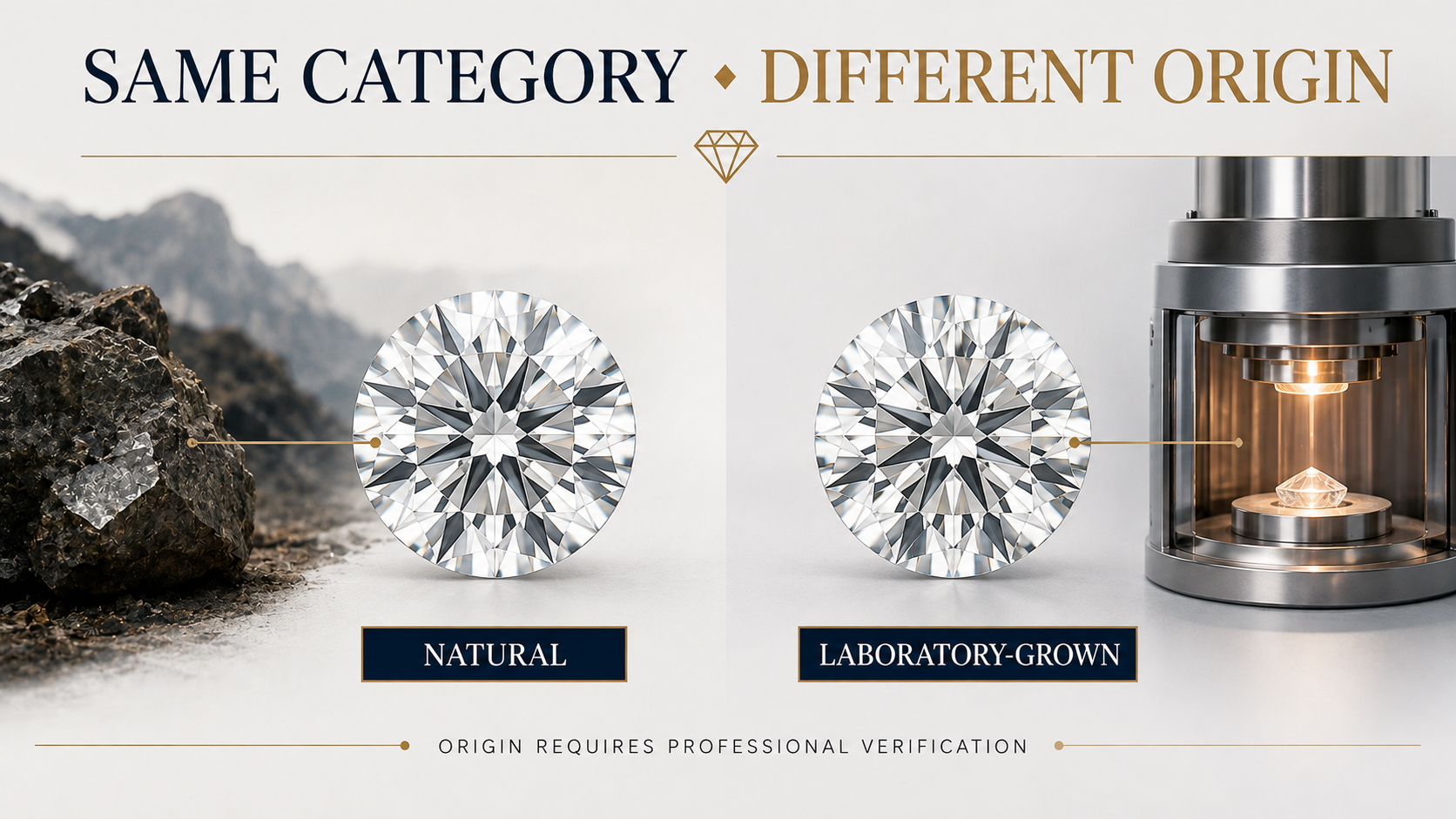
Natural and laboratory-grown diamonds can look extremely similar, but they do not have the same origin, rarity, supply structure, pricing behaviour or secondary-market position.
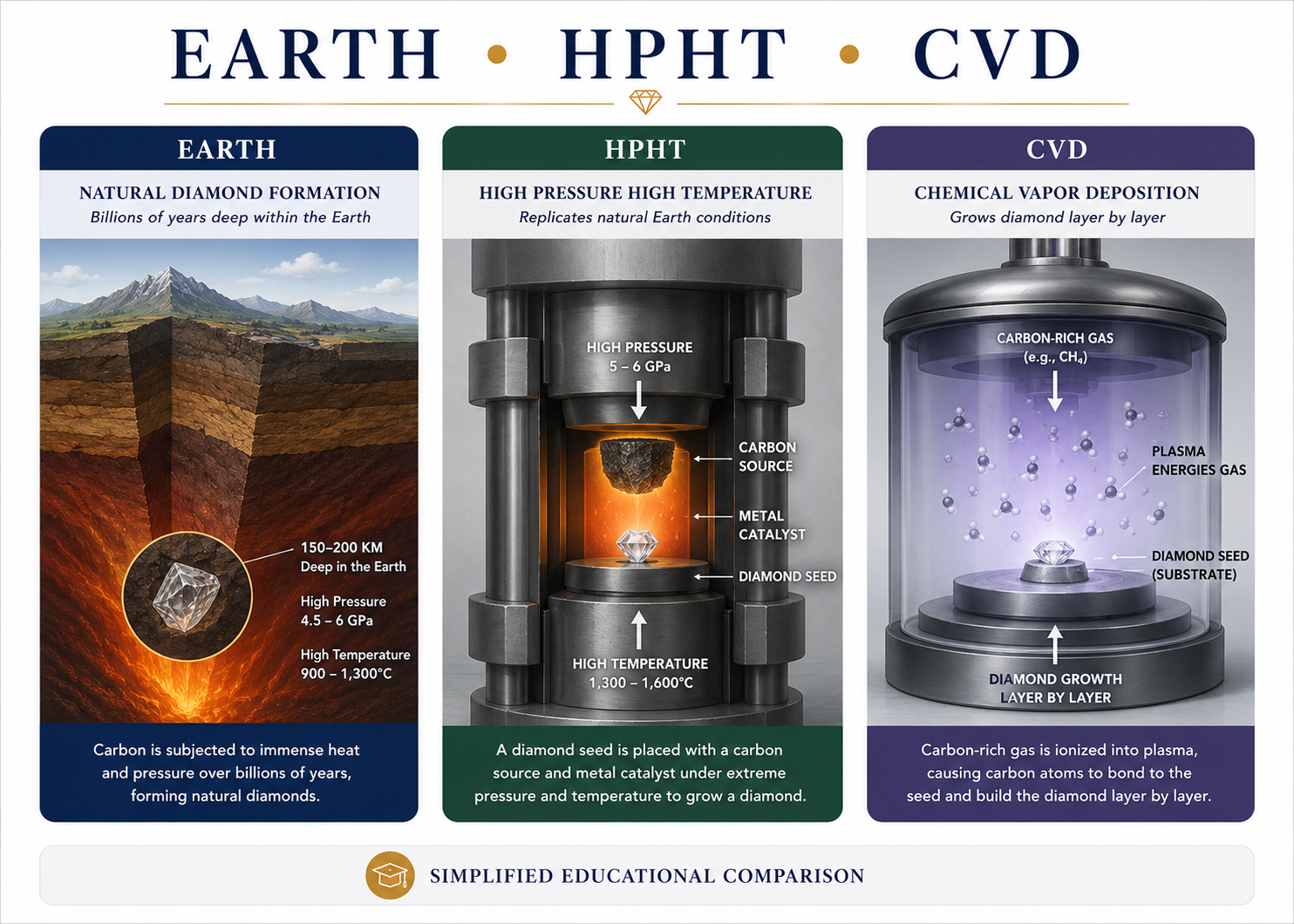
A natural diamond forms through geological processes deep within the Earth. A laboratory-grown diamond is manufactured using either High Pressure High Temperature—HPHT—or Chemical Vapour Deposition—CVD technology.
Both are diamond materials with essentially the same chemical, physical and optical properties. However, specialised testing can identify their different growth histories.
Quick Answer: Natural vs Lab-Grown Diamonds
The main difference between natural and lab-grown diamonds is their origin.
Natural diamonds formed beneath the Earth’s surface over geological timescales and were transported towards the surface by ancient volcanic activity. Laboratory-grown diamonds are produced in manufacturing facilities, usually over a period of weeks, using HPHT or CVD technology.
Laboratory-grown diamonds generally cost less at the initial point of purchase, allowing buyers to choose a larger diamond for the same budget. Natural diamonds are limited by geological supply and have a more established secondary market, although no diamond should be purchased with a guaranteed expectation of profit.
Neither category is automatically ethical, sustainable or fully traceable. Those claims depend on the individual producer, mine, energy source, supply chain and supporting documentation.
Natural vs Lab-Grown Diamonds at a Glance
| Comparison | Natural diamond | Laboratory-grown diamond |
|---|---|---|
| Origin | Formed through geological processes | Manufactured in a controlled facility |
| Formation period | Geological timescale | Usually weeks |
| Main production method | Natural formation and mining | HPHT or CVD |
| Crystal structure | Diamond | Diamond |
| Chemical composition | Primarily carbon | Primarily carbon |
| Appearance | Depends on cut and quality | Depends on cut and quality |
| Durability | Suitable for everyday jewellery | Suitable for everyday jewellery |
| Visual identification | Origin cannot be confirmed by sight alone | Origin cannot be confirmed by sight alone |
| Supply | Limited by natural deposits and recovery | Production capacity can be expanded |
| Initial purchase price | Generally higher for comparable specifications | Generally lower for comparable specifications |
| Secondary market | More established, but resale is not guaranteed | Less established and resale offers may be limited |
| Disclosure | Should be sold as natural where origin is relevant | Must be clearly disclosed as laboratory-grown |
| Environmental claims | Depend on mine and supply chain | Depend on energy, materials and manufacturing |
| Best suited to | Buyers prioritising natural origin, rarity and geological history | Buyers prioritising initial affordability or a larger size for budget |
This table provides a general comparison. Price, quality, documentation and sourcing practices must be evaluated for the individual diamond.
What Is a Natural Diamond?
A natural diamond is a crystal created by geological processes beneath the Earth’s surface.
Most gem-quality natural diamonds formed at great depth under the temperature and pressure conditions required for carbon atoms to crystallise as diamond. Ancient volcanic events then transported some of those crystals closer to the surface.
Natural diamonds are recovered from primary deposits, such as kimberlite pipes, or from secondary deposits where erosion has moved diamond-bearing material.
They are not created from coal, and mining does not manufacture new diamonds. It recovers diamonds that already exist in natural geological deposits.
Natural diamonds can vary in:
- Shape
- Carat weight
- Colour
- Clarity
- Cut quality
- Fluorescence
- Proportions
- Inclusions
- Geographic origin
- Treatment history
A grading report describes the gemmological characteristics of a submitted diamond. A standard grading report does not necessarily confirm the mine or country of origin unless it specifically includes verified origin information.
What Is a Laboratory-Grown Diamond?
A laboratory-grown diamond is manufactured using technology that produces a diamond crystal in a controlled facility.
The two principal growth methods are HPHT and CVD.
HPHT Laboratory-Grown Diamonds
High Pressure High Temperature growth uses a diamond seed, carbon material, high pressure and high temperature inside specialised equipment.
The process recreates some of the conditions under which diamonds can crystallise, but it remains an industrial manufacturing process rather than natural geological formation.
CVD Laboratory-Grown Diamonds
Chemical Vapour Deposition places diamond seed material in a chamber containing carbon-rich gas.
Energy activates the gas, allowing carbon to accumulate on the seed in layers and form diamond material. CVD does not reproduce natural diamond formation in the same way as HPHT.
Some laboratory-grown diamonds receive post-growth treatment to modify their colour. Growth method and detectable treatment information may be included on an independent laboratory report.
The GIA explanation of HPHT and CVD growth provides further technical information about these production methods.
Are Lab-Grown Diamonds Real Diamonds?
Laboratory-grown diamonds are diamond material. They are not the same as cubic zirconia, glass or moissanite.
Natural and laboratory-grown diamonds have substantially the same crystal structure and essentially the same chemical, physical and optical properties. This means both can display diamond hardness, brilliance, fire and scintillation when properly cut.
However, “real diamond” is not always a sufficiently precise product description because it does not disclose origin.
The clearer terms are:
- Natural diamond
- Laboratory-grown diamond
- Laboratory-created diamond
The origin should be stated clearly before purchase and on the invoice or other sales documentation.
The CIBJO diamond nomenclature guidance requires clear terminology that distinguishes laboratory-grown diamonds from natural diamonds.
Do Natural and Lab-Grown Diamonds Look the Same?
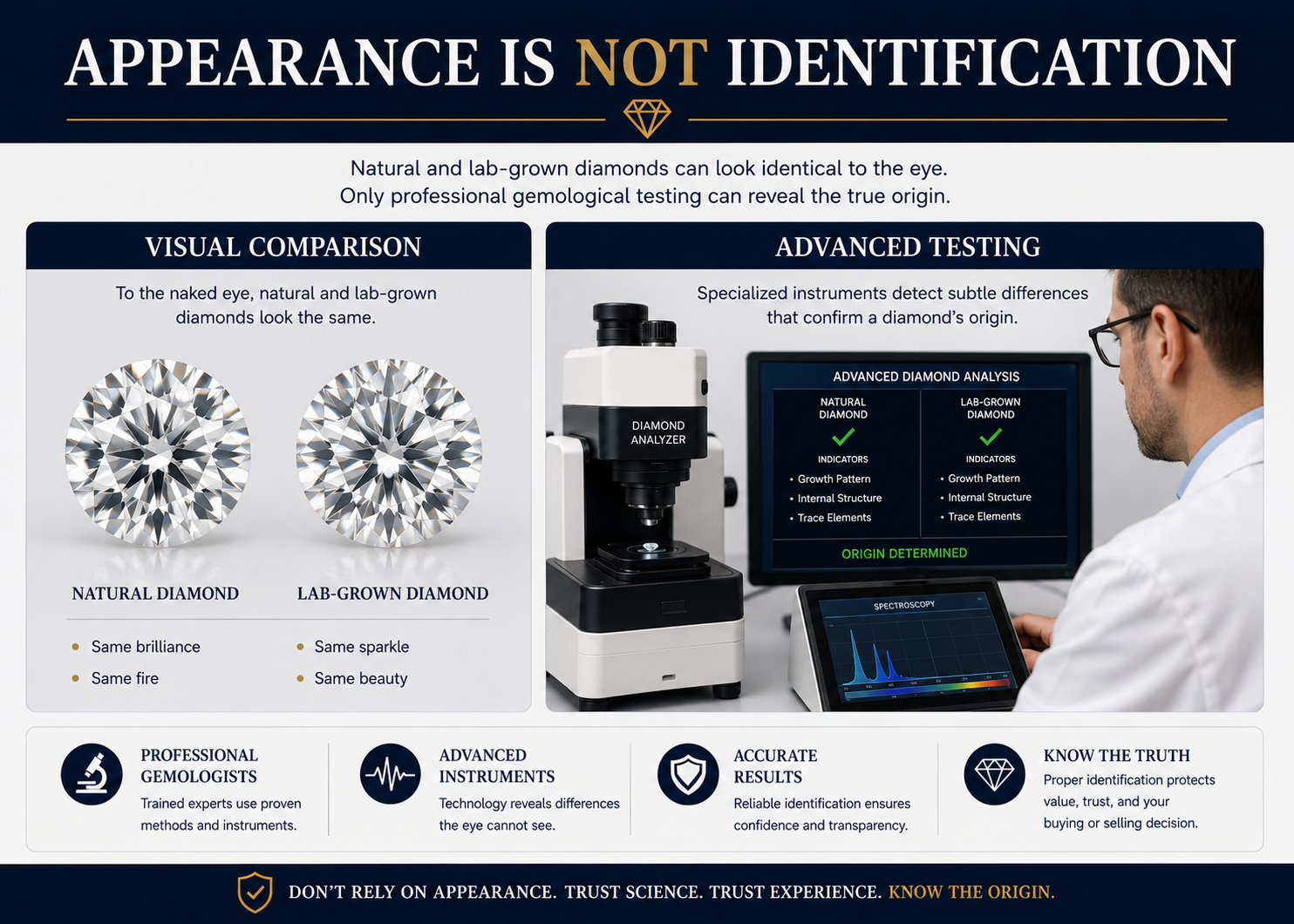
They can look the same to the unaided eye, especially when they have comparable shape, size, colour, clarity and cut quality.
Both categories can include diamonds that are:
- Colourless or visibly tinted
- Internally clean or visibly included
- Well cut or poorly cut
- Bright and lively
- Deep, shallow or poorly proportioned
- Treated or untreated, depending on the individual diamond
A natural diamond is not automatically more brilliant. A laboratory-grown diamond is not automatically flawless. Visible beauty depends heavily on the individual stone’s cut, proportions and quality.
An ordinary photograph is not reliable evidence of origin. Two diamonds may look similar in a jewellery image while having different formation histories, treatments and report information.
Can You Tell Natural and Lab-Grown Diamonds Apart?
Not reliably by sight alone.
Traditional observation and basic diamond-testing instruments may confirm that a stone is diamond material, but they may not determine whether it is natural or laboratory-grown.
Experienced laboratories use advanced instruments and analyse features such as:
- Growth structures
- Fluorescence patterns
- Phosphorescence
- Trace elements
- Spectroscopic responses
- Internal characteristics
- Indicators of post-growth treatment
GIA explains that because the two categories are essentially chemically and optically alike, advanced testing is required to confirm origin.
Do not rely on home tests, online visual tricks or an unverified seller statement to determine whether a diamond is natural.
Do Both Types Come With Grading Reports?
Natural and laboratory-grown diamonds can both receive independent laboratory documentation, but the report format and terminology may differ.
A report may include:
- Natural or laboratory-grown identification
- Shape and cutting style
- Measurements
- Carat weight
- Colour assessment
- Clarity assessment
- Cut or finish information
- Fluorescence
- Growth method
- Detected treatments
- Laser inscription information
Buyers should not assume every laboratory grades both categories using an identical reporting system.
Since October 2025, GIA’s quality assessment for eligible colourless to near-colourless laboratory-grown diamonds uses the descriptive categories Premium and Standard, rather than the colour and clarity nomenclature GIA developed for natural diamonds. Other laboratories may use different systems.
The current GIA Laboratory-Grown Diamond Quality Assessment also identifies the stone as laboratory-grown and includes a corresponding girdle inscription.
Always verify the report through the issuing laboratory’s official report-checking service.
Natural Diamond vs Lab Diamond Price
Laboratory-grown diamonds generally have a lower initial purchase price than natural diamonds with apparently comparable specifications.
This can allow a buyer to prioritise:
- Greater carat weight
- Higher colour or clarity specifications
- A larger-looking shape
- A more elaborate setting
- A lower total purchase budget
Natural diamond pricing reflects a different supply structure. Important factors include:
- Geological availability
- Mining and recovery
- Rough-diamond supply
- Cutting yield
- Shape and carat scarcity
- Colour and clarity combinations
- Market demand
- Grading report
- Traceability documentation
- Wholesale and retail costs
A fair comparison must use genuinely comparable diamonds. Comparing a well-cut natural diamond with a poorly cut laboratory-grown diamond—or vice versa—does not provide a useful price comparison.
The ring setting, metal, craftsmanship, taxes, retailer services and brand positioning can also form a substantial part of the final jewellery price.
How Can Prices Change Over Time?
Natural and laboratory-grown diamond prices can both move. Neither category has a fixed future price.
Natural Diamond Price Behaviour
Natural diamond prices can change with:
- Consumer demand
- Mine production
- Existing inventories
- Economic conditions
- Currency movements
- Sanctions and import restrictions
- Shape and quality trends
- Dealer and retailer stock levels
Scarcity does not mean every natural diamond will increase in price.
Laboratory-Grown Diamond Price Behaviour
Laboratory-grown prices can change with:
- Manufacturing capacity
- Energy and equipment costs
- Production efficiency
- Competition between growers
- Retail margins
- Improvements in technology
- Consumer demand
- Increasing availability
Because production can be expanded and manufacturing technology can improve, buyers should not assume that the future replacement price of a laboratory-grown diamond will remain equal to its original retail price.
Avoid pages or sellers promising guaranteed appreciation for either category.
Natural vs Lab Diamond Resale Value
Natural diamonds have a longer-established wholesale, auction, trade-in and second-hand market. This does not mean a buyer will recover the original retail price.
Retail jewellery prices can include:
- Retail margin
- Brand value
- Setting and metal
- Design
- Manufacturing
- Tax
- Marketing
- Service and warranty costs
These amounts may not be recoverable when the loose diamond or finished jewellery is resold.
Laboratory-grown diamonds can also be resold, but available buyers and offers may be more limited. Any resale offer is likely to consider the current price of newly manufactured laboratory-grown diamonds at the time of resale.
Before buying either type, ask the seller:
- Is there a written trade-in policy?
- Is there a lifetime upgrade programme?
- Does the policy apply to the loose diamond or complete ring?
- Are laboratory-grown diamonds eligible?
- What exclusions and minimum purchase requirements apply?
- Is the buyback value guaranteed or only estimated?
Dalila’s guide to natural diamond value retention explains why resale value and investment profit are not the same thing.
Are Natural Diamonds Rarer?
Natural diamonds are limited by geology. Humans can explore, mine and recover existing deposits, but they cannot create additional natural diamonds on demand.
Rarity still varies significantly within the natural category.
A small commercial-quality natural diamond is not equally rare to:
- A large high-colour diamond
- A diamond with exceptional clarity
- A rare natural fancy-colour diamond
- An unusual shape and specification combination
- A well-matched pair
- A diamond with verified geographic origin
Laboratory-grown diamond production is scalable. Manufacturers can add reactors, improve processes and increase output where economics and infrastructure allow.
This does not mean every laboratory-grown specification is immediately available. Producing and cutting large, high-quality material still requires equipment, energy, skill and time. The fundamental difference is that supply is based on manufacturing capacity rather than natural geological deposits.
Are Lab-Grown Diamonds More Sustainable?
Not automatically.
Laboratory-grown production avoids diamond mining, but it requires electricity, equipment, industrial materials, facilities, seed material, cutting, polishing and transport.
Its environmental impact can vary according to:
- HPHT or CVD growth method
- Electricity source
- Energy efficiency
- Location of the facility
- Material inputs
- Post-growth treatments
- Cutting and polishing location
- Transport
- Waste management
- Scope of the environmental assessment
Claims such as “green”, “carbon neutral”, “eco-friendly” or “zero impact” should be supported by specific, recent and independently verifiable evidence.
CIBJO and consumer-protection guidance caution against broad environmental claims that are not properly substantiated. The category name “laboratory-grown” does not itself prove a lower full-lifecycle impact.
Are Natural Diamonds Ethical or Conflict-Free?
Natural origin alone does not establish responsible sourcing.
Buyers should ask for evidence covering the relevant supply chain, such as:
- Supplier identity
- Invoices and transaction records
- Sanctions screening
- Applicable Kimberley Process documentation for rough diamonds
- Responsible-sourcing policies
- Chain-of-custody records
- Country-of-origin documentation, where available
- Independent audits or recognised standards
- Written disclosures for treatments and grading
A standard 4Cs grading report does not automatically confirm the mine or country where a natural diamond originated.
Specialised services can provide additional origin information. For example, the GIA Diamond Origin Report is available only where the rough diamond entered GIA’s origin programme before polishing and met the required documentation process.
Responsible sourcing must be demonstrated, not assumed.
Traceability: Which Type Is Easier to Trace?
A laboratory-grown diamond may have a shorter production chain if the grower, cutting facility and seller provide complete documentation. However, a claim about the country or facility of growth still needs evidence.
A natural diamond can also have strong traceability when it moves through a documented chain from recovery to cutting, grading and sale.
For either category, ask:
- Who produced or recovered the diamond?
- Where was it grown or mined?
- Where was it cut and polished?
- Which laboratory assessed it?
- Can the report be independently verified?
- Is the laser inscription present and consistent?
- Are environmental or social claims supported?
- Does the invoice state the diamond’s origin category clearly?
Traceability is a documentation question. It should not be decided solely from the words “natural” or “laboratory-grown”.
Natural Diamond vs Lab Diamond for an Engagement Ring
Both natural and laboratory-grown diamonds are durable enough for an engagement ring when properly cut, set and maintained.
The more useful question is: Which origin and purchase structure best matches your priorities?
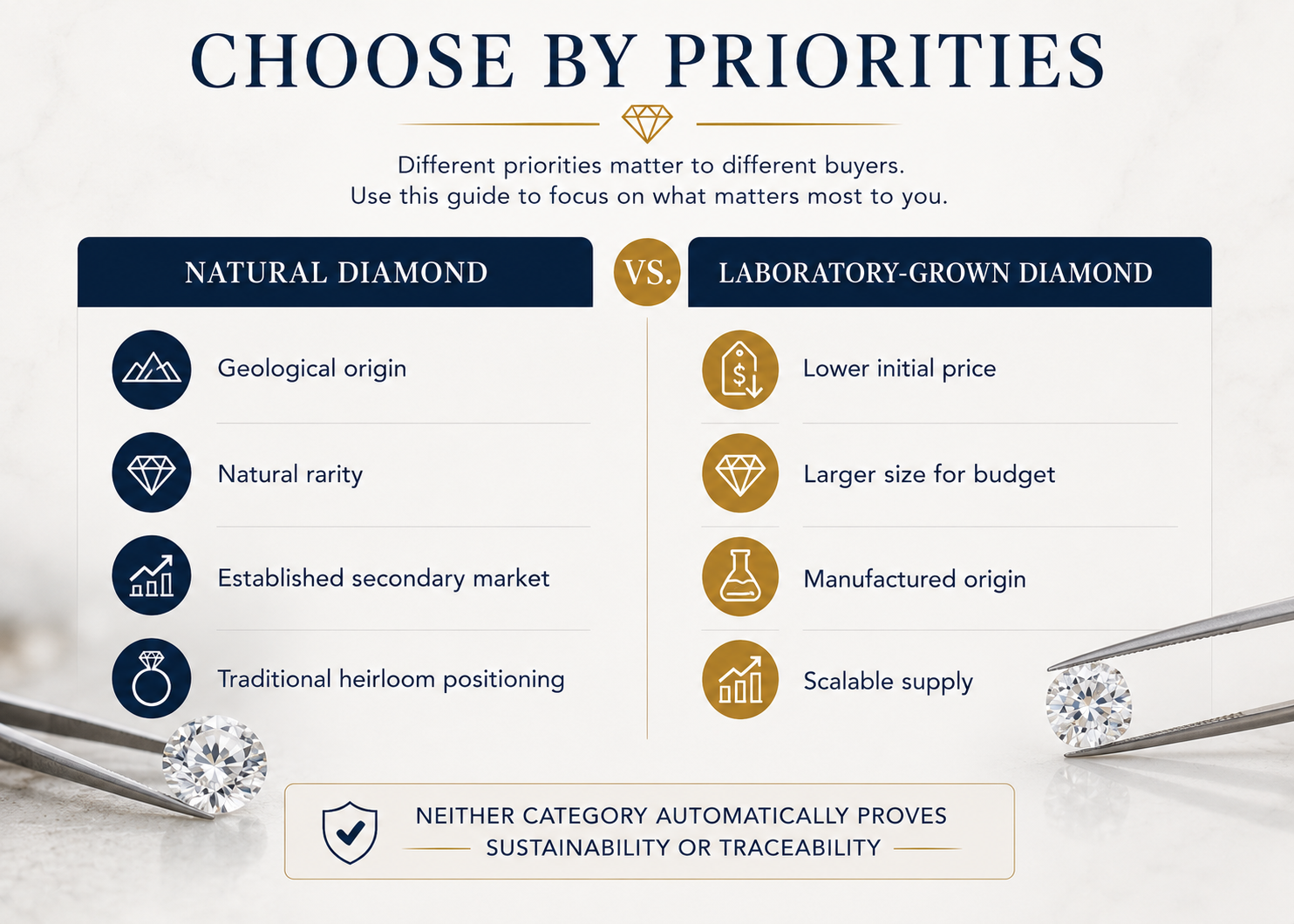
Consider a Natural Diamond If You Prioritise:
- Geological origin
- Natural rarity
- A stone formed independently of manufacturing
- Traditional bridal positioning
- A more established secondary market
- Natural-diamond heirloom symbolism
- Access to rare natural quality combinations
Consider a Laboratory-Grown Diamond If You Prioritise:
- Lower initial purchase cost
- A larger carat weight for budget
- Higher listed specifications within a fixed budget
- Manufactured origin
- Less concern about secondary-market demand
- Flexibility to spend more of the budget on the setting
Neither choice proves the strength or meaning of a relationship. The correct option depends on what the couple wants the diamond to represent and how they expect to use their budget.
For ring-specific considerations, read Dalila’s natural vs lab-grown engagement-ring guide.
Natural Diamonds, Lab-Grown Diamonds and Simulants
Laboratory-grown diamonds must not be confused with diamond simulants.
| Material | Diamond material? | Typical composition | Main purpose |
|---|---|---|---|
| Natural diamond | Yes | Crystalline carbon | Natural gemstone |
| Laboratory-grown diamond | Yes | Crystalline carbon | Manufactured diamond |
| Moissanite | No | Silicon carbide | Diamond alternative |
| Cubic zirconia | No | Zirconium dioxide | Diamond imitation |
| Glass | No | Varies | Low-cost imitation |
A conventional diamond tester may react differently to these materials, but a positive “diamond” result does not necessarily confirm whether the diamond is natural or laboratory-grown.
Which Diamond Should You Choose?
Use your actual priorities instead of broad marketing claims.
| Your main priority | More relevant option |
|---|---|
| Natural geological formation | Natural diamond |
| Lowest initial price for comparable size | Laboratory-grown diamond |
| Larger carat weight within budget | Often laboratory-grown |
| Natural rarity | Natural diamond |
| Established secondary-market participation | Generally natural diamond |
| Diamond durability and potential brilliance | Either |
| Proven geographic or manufacturing origin | Either, with proper documentation |
| Verified lower environmental impact | Compare individual evidence |
| Traditional natural-diamond heirloom story | Natural diamond |
| Modern manufactured origin | Laboratory-grown diamond |
This is not a quality ranking. A poorly selected diamond from either category can be disappointing. Compare cut, proportions, appearance, report information, price and documentation before deciding.
Buying Checklist
Before purchasing a natural or laboratory-grown diamond:
- Confirm the origin category in writing.
- Request the independent grading or quality-assessment report.
- Verify the report through the laboratory’s official website.
- Check the laser inscription where applicable.
- Compare actual measurements, not carat weight alone.
- Review clear images or video.
- Ask whether the diamond has received treatment.
- Request evidence for environmental or origin claims.
- Read the return, upgrade and buyback policies.
- Compare the complete price, including the setting and taxes.
- Do not treat an appraisal value as a guaranteed resale value.
- Keep the invoice, report and supporting documents together.
You can also use Dalila’s diamond size chart to compare carat weight with approximate visible measurements.