Round or Princess-Cut Diamonds for Stud Earrings?
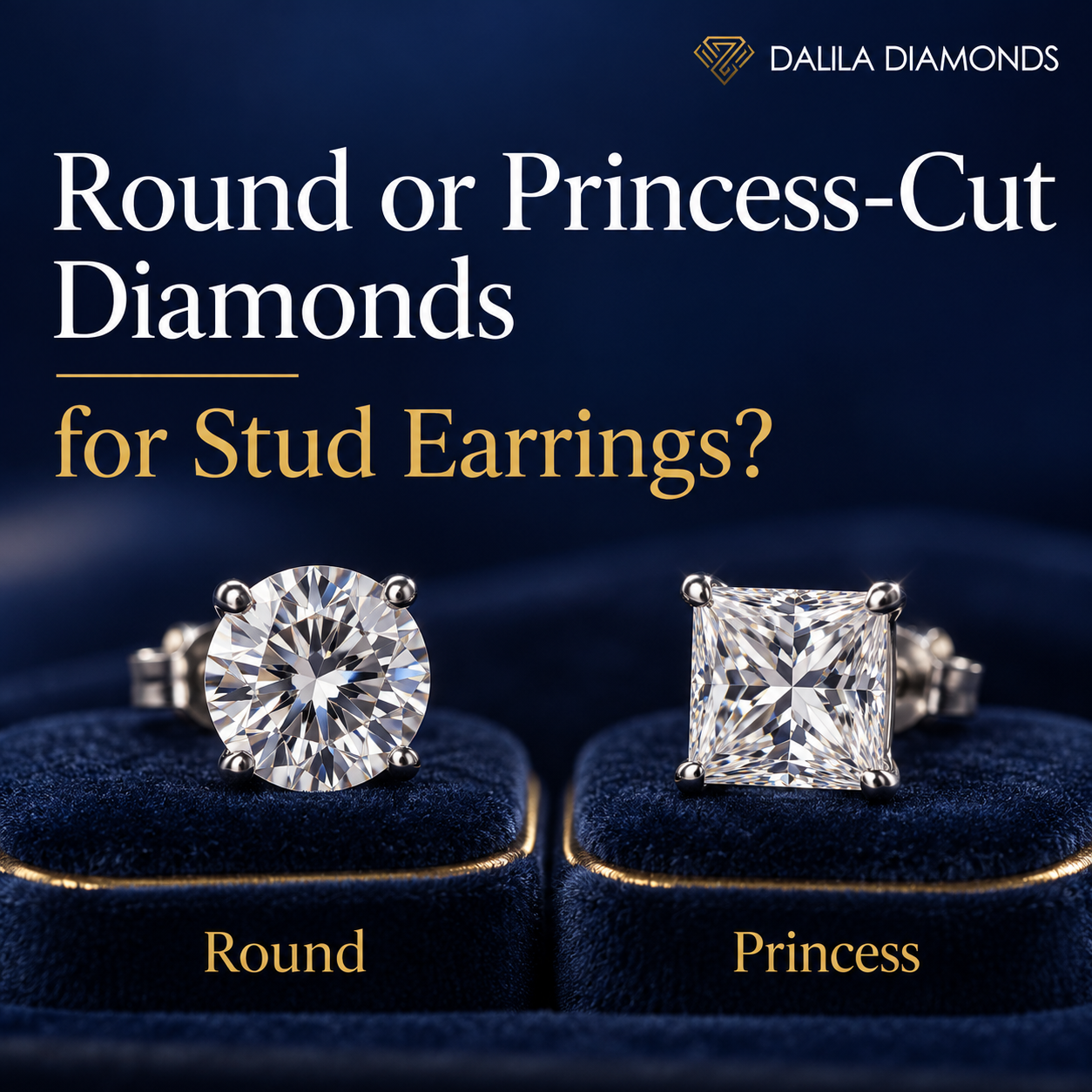
Choosing between round and princess-cut diamond stud earrings comes down to more than whether you prefer a circular or square shape. The two cuts have different face-up dimensions, facet patterns and setting requirements, all of which influence how the finished earrings look and how their diamonds are secured.
A 0.50-carat round brilliant diamond commonly measures approximately 5.1 mm in diameter. A 0.50-carat princess cut might measure around 4.4 × 4.4 mm, depending on its proportions.
Although both stones weigh half a carat, they do not present the same outline or occupy the same dimensions across the ear.
Round brilliant studs create a softer circular appearance and are relatively straightforward to compare by diameter. Princess-cut studs create a geometric square appearance, but their pointed corners require particular attention during setting.
Neither cut is universally better for earrings. Round diamonds are an excellent choice when the buyer wants a classic silhouette and strong, predictable round-brilliant cut assessment. Princess cuts are worth considering when a square outline and angular facet pattern are preferred, provided the individual stones are attractive and their corners are suitably protected.
GIA's diamond stud earrings buying guide identifies both round brilliant and princess cuts as popular stud choices, with different visual characters rather than a single objectively superior option.
GIA 4Cs
This guide compares the actual loose diamonds and the finished earrings. It does not repeat Dalila's general princess-versus-radiant shape comparison or the specialist trade process of selecting matched diamond pairs.
Round vs Princess Diamond Studs: The Main Differences
Buying factor | Round brilliant studs | Princess-cut studs |
Face-up outline | Circular | Usually square; some rectangular |
Main size measurement | Minimum and maximum diameter | Length and width |
Visual character | Soft, symmetrical, classic | Angular, geometric, contemporary |
Facet appearance | Standard round brilliant pattern | Modified brilliant, with variable patterns |
Cut assessment | GIA overall cut grade available for eligible round brilliants | No standard GIA overall cut grade equivalent |
Vulnerable perimeter areas | Girdle, but no sharp external corners | Four pointed corners requiring protection |
Setting options | Prongs or bezel, among others | Protective corner prongs or suitable bezel |
Pair matching | Primarily diameter and visual appearance | Length, width, square outline and visual appearance |
Key buying concern | Attractive cut and balanced pair | Attractive cut, balanced pair and secure corners |
The table is intended as a selection aid, not a durability ranking.
A princess-cut diamond may be highly suitable for earrings when properly mounted. A round diamond can still chip if its exposed girdle receives a hard impact.
The correct comparison considers both the stone and its mounting.
How Round and Princess Diamonds Look at the Same Carat Weight
A useful comparison starts with the face-up dimensions of each diamond rather than its advertised weight.
Round brilliants are measured by diameter. Princess cuts generally require both length and width.
For example, a round measuring 5.1 mm across and a princess cut measuring 4.4 × 4.4 mm may both fall around the half-carat category.
The round extends farther along the horizontal and vertical axes. The princess has a square outline with four corners, so its perceived spread differs from that of the circular stone.
Neither has a universally superior apparent size. The comparison depends on whether the buyer values circular diameter, square side length, corner-to-corner span or the complete visual impression on the ear.
Illustrative diamond size chart
Approx. weight per diamond | Round diameter | Princess face-up dimensions | Pair total if equal weights |
0.25 ct | 4.1 mm | 3.5 × 3.5 mm | 0.50 ctw |
0.50 ct | 5.1 mm | 4.4 × 4.4 mm | 1.00 ctw |
0.75 ct | 5.8 mm | 5.0 × 5.0 mm | 1.50 ctw |
1.00 ct | 6.5 mm | 5.5 × 5.5 mm | 2.00 ctw |
1.50 ct | 7.4 mm | 6.4 × 6.4 mm | 3.00 ctw |
All values are illustrative measurements for reasonably proportioned stones, not actual inventory measurements or size standards. Princess dimensions vary substantially with total depth, pavilion geometry and other cutting proportions.
The table does not mean every half-carat princess measures exactly 4.4 mm.
Some princess cuts carry more of their weight in the pavilion and show a smaller face-up outline than another princess of similar weight.
GIA's guide to selecting princess-cut diamonds specifically discusses how pavilion depth and bulge can affect apparent size and light performance.
GIA 4Cs
For any shortlisted pair, replace these approximate measurements with the individual stones' actual laboratory or measured dimensions.
Original Diagram: Round and Princess Diamond Face-Up Size
Download the Round vs Princess Diamond Stud Comparison (PNG)
Original educational comparison showing an illustrative 0.50-carat round diamond, an illustrative 0.50-carat princess cut and a separate princess-corner protection concept. Face-up outlines are proportionally drawn; facet lines and prongs are schematic. These are not photographs, actual Dalila inventory diamonds or setter-approved mounting designs.
The illustration helps explain three different decisions.
First, a round diamond's diameter and a princess cut's side length are not interchangeable measurements.
Second, the square outline creates visual corners that change the character of the earrings.
Third, the princess cut introduces setting-specific corner protection requirements.
The diagram does not simulate the brightness, fire or scintillation of either diamond. Those characteristics must be assessed from actual stones.
Does a Round or Princess Diamond Look Bigger in Stud Earrings?
The answer depends on the meaning of bigger.
At the same approximate carat weight, a round brilliant may have a greater maximum face-up width than the side length of a princess cut.
But a princess cut's square outline occupies areas around the corners that a round diamond does not.
Consider the two hypothetical half-carat candidates:
Measurement | Round brilliant | Princess cut |
Carat weight | 0.50 ct | 0.50 ct |
Face-up dimension | 5.1 mm diameter | 4.4 × 4.4 mm |
Nominal outline area | 20.4 mm² | 19.4 mm² |
Overall silhouette | Circular | Square |
Longest corner-to-corner dimension | 5.1 mm diameter | Approximately 6.2 mm diagonal |
The area calculations treat the round as a circle and the princess as a perfect square. Actual diamond outlines and exposed surfaces will vary.
The square's longer diagonal does not mean it necessarily looks larger.
Likewise, the round's greater diameter does not establish that it will look more impressive in every setting.
Their visual characters differ.
For consumers, viewing the actual stones or consistently scaled photographs is more useful than comparing a single measurement.
Why setting metal changes apparent size
A four-prong round stud may show most of its circular outline.
A princess cut with protective V-shaped prongs may have its corners partly covered by metal.
A bezel can increase the outside diameter or width of either finished stud while covering part of its perimeter.
Therefore, distinguish the loose diamond's size from the finished earring's total outside dimensions.
A princess stud advertised as 5 mm wide may not contain a princess diamond measuring 5 mm on each side if that measurement includes the metal setting.
Round Brilliant Studs: Why Buyers Choose Them
Round brilliant diamonds are a popular choice for stud earrings because of their familiar circular outline and carefully developed faceting.
Their symmetry creates a balanced appearance when viewed on opposite ears, while their cut can produce strong brightness, fire and scintillation.
GIA's stud-earring guidance notes the round brilliant's popularity and its capacity for substantial sparkle.
GIA 4Cs
However, not every round brilliant performs equally.
Two stones with the same weight, colour and clarity may have different proportions and face-up appearance.
The buyer should assess the actual diameter, cut grade and visual performance.
A matched pair of round brilliant studs
For round studs, matching visible diameter is particularly important.
Imagine two 0.50-carat rounds with average diameters of 5.07 mm and 5.10 mm.
Their dimensions provide a promising starting point for a matched pair.
However, the two diamonds should also be checked for similar colour, cleanliness, brightness and facet appearance.
If one looks significantly darker or hazier, its compatible diameter does not solve the visual mismatch.
What to check on round grading reports
For eligible standard round brilliant diamonds, a GIA grading report may include an overall cut grade along with polish, symmetry and other proportion information.
An overall Excellent grade is a useful buying filter, but two Excellent diamonds can still show different face-up patterns.
The final pair should be compared under consistent lighting.
Princess-Cut Studs: Why Buyers Choose Them
Princess-cut diamond studs create a square or angular appearance that contrasts with the softer outline of round brilliant earrings.
They are especially appealing to buyers who prefer geometric jewellery.
A well-cut princess diamond can show substantial brilliance and an attractive combination of bright and dark reflections.
However, princess cuts have more variation in their facet patterns than buyers may expect from the shape name alone.
GIA explains that princess diamonds can vary in crown and pavilion facet arrangement, which influences scintillation and face-up appearance.
GIA 4Cs
This makes individual visual inspection especially important.
Princess-cut diamonds are not always perfectly square
Some princess cuts are slightly rectangular.
For example, a stone measuring 4.40 × 4.43 mm has an almost square outline.
Another measuring 4.20 × 4.65 mm has a more elongated rectangular form.
Both may be described commercially as princess cuts, but they do not create the same stud silhouette.
For a matching pair, the buyer should compare the actual length, width and corner-to-corner outline of both stones.
Why facet matching matters
Two princess cuts can have very similar measurements and colour grades but different reflection patterns.
One might display crisp, organised bright and dark areas, while the other has a more fragmented appearance.
That difference may become noticeable when the earrings are viewed under the same lighting.
A pair should therefore be examined together where possible, rather than approved from two unrelated product photographs.
Princess-Cut Corners: The Most Important Setting Difference
The most significant technical difference between round and princess-cut studs is the presence of four pointed corners on the princess diamond.
These corners can be vulnerable to chipping if struck.
A round brilliant does not have equivalent sharp external points, although its girdle remains vulnerable to impact damage.
GIA's research on diamond chipping specifically identifies princess-cut corners as vulnerable and recommends appropriate protective settings.
This does not mean princess studs are too fragile for everyday wear.
It means the mounting should be designed around the actual corners of the selected stones.
V-prong protection
V-shaped prongs wrap around a pointed corner and can provide greater coverage than a small conventional prong placed near that corner.
For princess studs, protective prongs are worth discussing with the manufacturing jeweller.
However, simply using the label V-prong does not guarantee safety.
The prongs must be correctly manufactured and fitted to the diamond.
GIA's setting quality benchmark for princess cuts demonstrates that workmanship and support matter, and that even a protected corner can sustain damage under unsuitable conditions.
Bezel settings
A suitable bezel can provide metal coverage around the princess diamond's perimeter, including the corners.
However, a square bezel must be designed for the actual stone.
Slight variations in the length, width and corner geometry can influence how the diamond sits.
The jeweller should inspect the selected pair before finalising the mounting.
Corner inspection before setting
Each princess diamond should be assessed for thin girdle areas, existing chips and potentially significant inclusions near its corners.
A higher clarity grade does not automatically guarantee that all corners are free from setting concerns.
A qualified professional should review the specific stone.
Round vs Princess Stud Settings
Setting style | Round brilliant | Princess cut |
Four-prong | Common option with exposed portions of girdle | Must specifically address four vulnerable corners |
Six-prong | Alternative support arrangement | Not automatically appropriate for the square outline |
Full bezel | Can surround the circular perimeter | Can cover the square perimeter and corners |
Basket | Must accommodate actual diameter and depth | Must accommodate length, width, corners and depth |
Halo | Adds a surrounding framework and accent diamonds | Requires a halo that follows the square outline |
Martini-style stud | May position a round diamond in a compact three-prong head | Design and corner support require individual evaluation |
This table concerns potential mounting arrangements, not guarantees of security.
The exact head design, metal dimensions, prong placement and diamond condition must be reviewed by the jeweller.
For larger or valuable princess-cut stones, corners deserve particular attention even when earrings experience less direct impact than rings.
GIA notes that earrings generally encounter fewer accidental blows than jewellery worn on the hand, but this does not remove the need for appropriate protection.
GIA 4Cs
Matching Two Princess Cuts Is Different From Matching Two Rounds
When selecting round brilliant studs, the buyer can begin by comparing the two diamonds' diameters.
Princess cuts require a more detailed outline comparison.
Consider the following hypothetical loose diamonds:
Specification | Princess A | Princess B | Princess C |
Carat weight | 0.50 ct | 0.51 ct | 0.50 ct |
Length | 4.40 mm | 4.42 mm | 4.28 mm |
Width | 4.42 mm | 4.44 mm | 4.60 mm |
Length-to-width ratio | 1.005 | 1.005 | 1.075 |
Colour | G | G | G |
Clarity | VS2 | VS1 | VS2 |
Facet appearance | To inspect | To inspect | To inspect |
All candidates are hypothetical. They are not current Dalila inventory diamonds.
Princess A and Princess B appear promising from a dimensional perspective.
Their lengths, widths and square proportions are close.
Princess C has a noticeably different length-to-width relationship despite having approximately the same weight.
It may be an attractive diamond individually, but it is less suitable as an initial visual match for A or B.
Does matching the dimensions prove A and B are a good pair?
No.
The two candidates may have different crown and pavilion characteristics, face-up brightness or facet patterns.
Their corners may also differ slightly.
Before purchasing, request side-by-side images or videos of the actual stones.
The pair should be inspected in the same orientation and lighting.
A good princess-cut stud pair must match in both outline and appearance, not simply carat weight.
For professional specifications involving dimensional tolerances, colour consistency, fluorescence and receiving quality control, consult Dalila's existing Matched-Pair Diamonds Buying Guide.
Dalila
This consumer article focuses on the choice between round and princess studs and the practical questions required to approve a pair.
How Sparkle Differs Between Round and Princess Studs
Both round and princess cuts belong to the broader family of brilliant-style diamonds, but their facet structures are different.
A round brilliant has a well-established facet arrangement designed around a circular outline.
Princess cuts use modified brilliant faceting with square or rectangular outlines and may have different crown and pavilion configurations.
As a result, their reflection patterns can look different.
A round may show a familiar pattern of distinct flashes and contrast, while a princess cut may create a more angular or fragmented appearance.
However, it would be misleading to claim that every round sparkles more than every princess.
An attractive princess cut may have stronger visual performance than a poorly cut round brilliant.
The individual stones must be evaluated.
Why photographs can be misleading
One diamond may appear exceptionally bright because it was photographed under strong directional lighting.
Another may appear darker because it was photographed from a different angle.
When comparing round and princess studs, use the same lighting, camera settings and background.
Where possible, film both pairs together while moving them gently through several viewing angles.
This allows the buyer to evaluate how each cut responds to changing light without confusing the result with photographic differences.
Colour and Clarity: Does One Shape Need Higher Grades?
Round and princess cuts do not automatically require different colour or clarity grades for earrings.
However, their facet patterns and geometry can influence how inclusions and body colour appear.
For both shapes, G–H colour and VS2 clarity provide useful starting options for buyers who want near-colourless, visually clean natural diamonds.
Carefully selected I-colour or SI1 stones may also be appropriate, depending on the buyer's expectations and the appearance of the individual pair.
The decision should not be made from grading labels alone.
Round brilliant clarity
A round brilliant's facet pattern may make certain small inclusions difficult to distinguish face-up.
However, a dark crystal under the table or a transparency concern can still affect appearance.
Princess-cut clarity
Princess cuts can contain inclusions near the corners or girdle that deserve particular attention because of their setting requirements.
An inclusion should not be dismissed solely because it is hidden beneath a prong.
The setter must evaluate any characteristic that could affect durability.
GIA's diamond-chipping research describes why surface-reaching feathers and other inclusions near vulnerable corners can sometimes increase the risk of damage.
gia
What about colour?
Two G-colour princess diamonds may still look slightly different face-up, just as two G-colour rounds can.
Compare the intended pair directly.
For a deeper explanation of which grades are worth purchasing for earrings, see Dalila's What Diamond Colour and Clarity Do Stud Earrings Need? guide at /blogs/diamond-colour-clarity-for-stud-earrings.
The present article should remain focused on the round-versus-princess decision.
Round vs Princess Diamond Studs for Everyday Wear
Both shapes can be suitable for everyday earrings when correctly set and maintained.
Round brilliants have no sharp external corners, which avoids the particular corner vulnerability of princess cuts.
Princess cuts can still be practical when their four corners receive appropriate protection.
The setting and backing system also affect how the earrings sit on the ear.
A diamond may be securely held within its head yet produce a heavy or uncomfortable finished stud if the complete design is unsuitable for the wearer.
Important considerations include the mounting's outside dimensions, finished weight, projection from the ear, post position and backing system.
Round studs for everyday wear
A compact round bezel or suitable prong head may create a comfortable and understated design.
However, prongs can still loosen or catch, and the diamond's girdle can still sustain damage.
Princess studs for everyday wear
A princess stud may use protective V-prongs or an appropriately fitted bezel to reduce corner exposure.
The wearer should periodically check for signs of looseness, damaged retaining metal or unintended movement.
A princess cut should not be rejected solely because it has corners, but its head requires deliberate construction.
How Do the Two Shapes Look on the Ear?
A round stud has a continuous circular silhouette.
This can create a soft, familiar appearance that works with many jewellery styles.
A princess stud looks more geometric, with straight edges and visible corners.
The orientation also matters.
A princess cut may be mounted with its sides approximately horizontal and vertical, producing a square appearance.
Alternatively, a 45-degree rotation can produce a diamond-shaped silhouette.
The stone remains the same, but the overall visual character changes.
Square orientation versus rotated orientation
For princess studs, decide whether the buyer wants the four corners oriented diagonally relative to the ear or prefers the square edges to remain visually horizontal and vertical.
The two earrings should have consistent intended orientations.
The jeweller must then position their supports and posts appropriately.
A generic product photograph may not accurately show how the setting will rest when worn.
Ear size and piercing position
The same stud may look different on different ears.
A 4.4 mm princess cut can look substantial on a small earlobe, while a 5.1 mm round may create a different impression on a larger lobe.
Piercing position, earlobe shape and the size of the metal setting affect the final appearance.
Do not choose one shape solely because it appears larger in an unrelated model photograph.
Real Pair Photography: What Buyers Should Compare
The strongest comparison between round and princess studs uses genuine natural diamonds with verified weights and dimensions.
For a useful comparison, photograph a real round pair and a real princess pair that have similar total carat weights.
Both pairs should be mounted in comparable metals and suitable settings.
However, a perfectly identical setting is not always appropriate because princess corners require different protection from round girdles.
The aim is to keep photographic conditions consistent while clearly explaining the differences in mounting construction.
Recommended photography plan
Photograph | What to show | Important information |
1 | Real 0.50 ct round and princess stones face-up | Exact individual dimensions |
2 | Two matched round diamonds side by side | Their actual diameter and appearance |
3 | Two matched princess diamonds side by side | Length, width and corner outline |
4 | Completed round studs on one wearer | Actual setting type and outside dimensions |
5 | Completed princess studs on the same wearer | Corner protection and square orientation |
6 | Magnified princess head | How all four corners are protected |
7 | Side profiles of both finished designs | Head projection, post and backing placement |
All photographs should use the same camera, lens, lighting and white balance where a comparison is intended.
Use identified physical stones, not AI-generated diamonds or digitally altered outlines.
For on-ear photographs, the same wearer and camera scale help isolate differences attributable to the studs rather than ear anatomy.
The illustration supplied with this article is useful for explaining the geometry, but it is not a substitute for real jewellery photography.
Worked Example: Choosing Between Two 1-Carat-Total Stud Pairs
Suppose a buyer wants natural diamond studs with a total weight of approximately 1.00 carat.
The buyer is considering two pairs: round brilliants and princess cuts.
The hypothetical specifications are:
Specification | Round pair | Princess pair |
Number of diamonds | 2 | 2 |
Weight per stone | Approximately 0.50 ct | Approximately 0.50 ct |
Pair total | Approximately 1.00 ctw | Approximately 1.00 ctw |
Example stone dimensions | 5.08–5.12 mm diameter | 4.38–4.44 mm length and width |
Colour | G | G |
Clarity | VS2 | VS2 |
Cut evaluation | Round brilliant grading and inspection | Individual fancy-cut visual evaluation |
Proposed setting | Four-prong round stud | Protective four-corner V-prong stud |
Main preference | Circular outline | Square outline |
The measurements are illustrative. They are not verified pairs available for purchase.
Step 1: Compare actual face-up size
The round diamonds extend approximately 5.1 mm across their diameter.
The princess cuts have shorter individual side lengths, approximately 4.4 mm, but display four corners.
The buyer should compare the pair using scaled photographs rather than assuming the same total weight produces the same appearance.
Step 2: Compare the faceting
Both round diamonds should have attractive, comparable brightness and scintillation.
The princess pair should be evaluated for consistent reflection patterns and any obvious differences in dark areas or uneven appearance.
Do not compare one pair under stronger lighting than the other.
Step 3: Inspect princess corners
The jeweller should review the girdles and all eight princess corners across the two stones.
The proposed protective prongs must suit their actual corner geometry.
If a corner has a chip or concerning surface-reaching inclusion, it should be assessed before approval.
Step 4: Compare finished stud dimensions
A princess stud with protective V-prongs may have more visible metal near its corners than a round stud with narrow prongs.
The completed mounting's outside dimensions should be provided separately from the diamond dimensions.
Step 5: Consider how the studs will be worn
The buyer may prefer the softer circular shape for everyday use or the more geometric princess appearance.
Both could be appropriate if the mounting and backings are suitable.
Final decision
The round pair is a useful default for buyers seeking a classic circular look and straightforward round-diamond grading.
The princess pair is a strong alternative for buyers who prefer square geometry and are prepared to assess the faceting and corner protection carefully.
Neither should be declared the winner without evaluating the actual natural diamonds.
How to Compare Prices Fairly
Round and princess diamonds can differ in pricing even at similar carat weights and laboratory grades.
However, no universal price percentage should be applied to every comparison.
Cut quality, size, colour, clarity, supply, individual demand and other market factors affect the price of a particular stone.
For stud earrings, the finished jewellery price may also vary because the setting construction differs.
A princess head with protective corner supports is not necessarily identical in manufacturing cost to a standard round stud head.
Compare complete quotations.
Cost component | Round stud pair | Princess stud pair |
Two natural loose diamonds | Quote individually | Quote individually |
Grading documentation | Confirm availability | Confirm availability |
Pair matching and inspection | Confirm included services | Confirm included services |
Setting heads | Round-compatible | Corner-protective |
Posts and backings | Specify type | Specify type |
Setting labour | Separate quote where applicable | Separate quote where applicable |
Finished inspection | Jeweller's responsibility | Jeweller's responsibility |
A lower loose-diamond quotation does not necessarily mean the complete earrings will cost less.
The buyer should review the pair's appearance and finished-setting requirements before deciding.
Round and Princess Stud Buying Worksheet
Use this worksheet to compare two actual candidate pairs.
Specification | Round pair | Princess pair |
Natural origin verified | ______ | ______ |
Individual weights | ______ | ______ |
Pair total carat weight | ______ | ______ |
Face-up measurements | ______ | ______ |
Colour grades | ______ | ______ |
Clarity grades | ______ | ______ |
Cut or facet assessment | ______ | ______ |
Face-up brightness matched | ______ | ______ |
Visual colour matched | ______ | ______ |
Transparency acceptable | ______ | ______ |
Girdle inspected | ______ | ______ |
Corner condition | Not applicable to shape | ______ |
Proposed prongs or bezel | ______ | ______ |
Finished outside dimensions | ______ | ______ |
Post and backing system | ______ | ______ |
Grading reports verified | ______ | ______ |
Side-by-side images reviewed | ______ | ______ |
Jeweller's setting approval | ______ | ______ |
Total quoted cost | ______ | ______ |
The worksheet is intended to support a consumer decision between two specific earring options.
The detailed professional matched-pair tolerances remain in Dalila's separate trade resource.
Sourcing Natural Round or Princess Diamonds for Stud Earrings
When requesting natural loose diamonds for stud earrings, specify the chosen shape, intended per-ear size and whether the diamonds must form a matching pair.
For round brilliants, include the preferred individual diameter range.
For princess cuts, include both length and width, desired square proportions and the requirement for suitable corner condition.
A request for “two half-carat diamonds” does not provide enough information to identify the appropriate finished appearance.
Example sourcing brief: Round diamond studs
Field | Requested specification |
Jewellery | Natural diamond solitaire studs |
Quantity | Two diamonds |
Shape | Round brilliant |
Weight | Approximately 0.50 ct each |
Pair total | Approximately 1.00 ctw |
Diameter | Target around 5.0–5.2 mm each |
Colour | G–H |
Clarity | VS1–VS2, subject to visible appearance |
Cut | Strong cut quality, preferably GIA Excellent where applicable |
Matching | Similar diameter, colour and brightness |
Documentation | GIA, IGI or HRD as available and agreed |
Setting | Coordinated round stud heads |
Approval | Side-by-side comparison and jeweller review |
Example sourcing brief: Princess diamond studs
Field | Requested specification |
Jewellery | Natural princess-cut diamond studs |
Quantity | Two diamonds |
Shape | Square modified brilliant |
Weight | Approximately 0.50 ct each |
Pair total | Approximately 1.00 ctw |
Face-up dimensions | Target approximately 4.3–4.5 mm per side |
Outline | Closely matched square proportions |
Colour | G–H |
Clarity | VS1–VS2, subject to corner and girdle review |
Facet pattern | Visually comparable |
Corner condition | No unapproved damage or setting-relevant concerns |
Documentation | Individual reports where required |
Setting | Protective corner-compatible stud heads |
Approval | Direct comparison and qualified setter review |
These are illustrative sourcing specifications, not current stock offers or guaranteed acceptable tolerances.
Dalila Diamonds can receive natural loose-diamond enquiries through its website. When requesting a round or princess stud pair, provide the desired individual dimensions, grading preferences, budget and intended mounting.
For professional sourcing methods and advanced matched-pair requirements, see Dalila's Matched-Pair Diamonds Buying Guide.
Diamond supplier versus manufacturing jeweller
The diamond supplier can identify candidate natural stones, provide individual measurements, grading information and available comparison images.
The manufacturing jeweller must confirm head dimensions, princess-corner protection, diamond seating, post attachment and the suitability of the completed earrings.
A loose diamond's grading report does not certify that a specific earring mounting is secure.
Ask for separate quotations for the two loose diamonds and the setting work unless the supplier explicitly offers a complete finished-earring service.
Common Mistakes When Comparing Round and Princess Diamond Studs
Assuming equal carat weight means equal visible size
Round diameter and princess side length describe different outlines. Always compare real measurements.
Comparing one round against an unmatched princess pair
The decision concerns two finished earrings. Both diamonds within each pair must also be visually coordinated.
Assuming every princess cut has identical sparkle
Princess facet arrangements and proportions vary. Inspect actual stones under consistent lighting.
Using generic prongs without checking princess corners
Princess corners deserve dedicated protective setting assessment.
Treating V-prongs as a damage-proof solution
V-prongs can reduce exposure but do not make diamonds immune to damage. Workmanship and condition matter.
Ignoring the orientation of square studs
The setting should establish whether the diamonds are intended to appear square or diamond-shaped when worn.
Comparing unrelated model photos
Different earlobes, camera scales and lighting conditions can distort the apparent size difference.
Choosing solely by loose-diamond price
Include the matching process, setting heads, backs, setting labour and final inspection when comparing the completed pairs.
Frequently Asked Questions
Are round or princess-cut diamonds better for stud earrings?
Neither is universally better. Round diamonds create a classic circular appearance and have no sharp outer corners. Princess cuts offer a geometric square look but require careful protection of their four corners. The better choice depends on the actual stones, settings and personal preference.
Which looks bigger, round or princess diamond studs?
At the same carat weight, round diamonds may have greater diameter than a princess cut's side length, but the square outline has corners that affect its visual footprint. Compare actual dimensions and scaled photographs rather than assuming one always looks larger.
Do princess-cut diamond earrings sparkle as much as round diamonds?
A well-cut princess diamond can show substantial sparkle. However, its facet pattern differs from that of a round brilliant. Actual light performance depends on the individual stone, not shape alone.
Are princess-cut diamond studs more likely to chip?
Their pointed corners create specific vulnerable areas that round diamonds do not have. Properly designed V-prongs or suitable bezels can reduce corner exposure, although no mounting eliminates all damage risks.
Should princess-cut studs have V-prongs?
V-prongs are a useful protective option for princess-cut corners. The jeweller should confirm the actual prong design and setting workmanship for each stone.
Can princess-cut diamonds be bezel-set in earrings?
Yes. A properly designed bezel can surround the stone and protect its corners. The bezel must accommodate the diamond's actual length, width, corner shape and girdle.
What size is a half-carat round diamond stud?
A 0.50-carat round brilliant commonly measures around 5.1 mm in diameter, although actual measurements vary.
What size is a half-carat princess-cut stud?
A 0.50-carat princess cut might measure approximately 4.4 × 4.4 mm. Actual dimensions depend on its cut proportions and weight distribution.
Is one carat of princess studs the same as one carat of round studs?
If both are advertised as 1.00 ctw, they contain approximately one carat of diamonds in total, typically around 0.50 carat per ear. Their face-up dimensions and appearance will differ by shape.
Are princess-cut studs suitable for everyday wear?
They can be, provided the diamonds and mountings are appropriately selected and maintained. The four corners require particular attention to protection and condition.
Should both princess diamonds have the same length-to-width ratio?
Close proportions are a useful starting point, but identical ratios do not guarantee matching outlines or facet patterns. Compare both stones visually.
Is G colour and VS2 clarity good for round or princess studs?
Yes, G colour and VS2 clarity are useful starting specifications for both shapes. The actual face-up colour, inclusion appearance, transparency and cut quality still need review.
Does GIA give princess cuts an Excellent cut grade?
GIA's standard overall diamond cut-grading framework applies to eligible standard round brilliant diamonds, not princess cuts in the same way. Princess diamonds require careful assessment of their individual proportions and face-up appearance.
Can a princess-cut stud be mounted diagonally?
Yes. Rotating a princess cut approximately 45 degrees creates a diamond-shaped visual orientation. The pair should use consistent orientation, and the jeweller must confirm appropriate corner supports.
Are round diamond studs easier to match?
Round brilliants are generally simpler to compare by diameter and standardised grading information. Princess pairs require additional attention to length, width, outline, corners and facet arrangement.
Can I buy loose princess diamonds and have a jeweller make studs?
Yes. The jeweller should evaluate both diamonds, including corner and girdle condition, before approving the settings. The loose diamonds and manufacturing work can be quoted separately.
What information should I send Dalila to source matching stud diamonds?
Provide the chosen shape, weight per ear, total pair target, preferred face-up dimensions, colour, clarity, grading requirements, intended setting and budget. For princess cuts, include square-outline matching and corner-condition requirements.