What Diamond Colour and Clarity Do Stud Earrings Need?
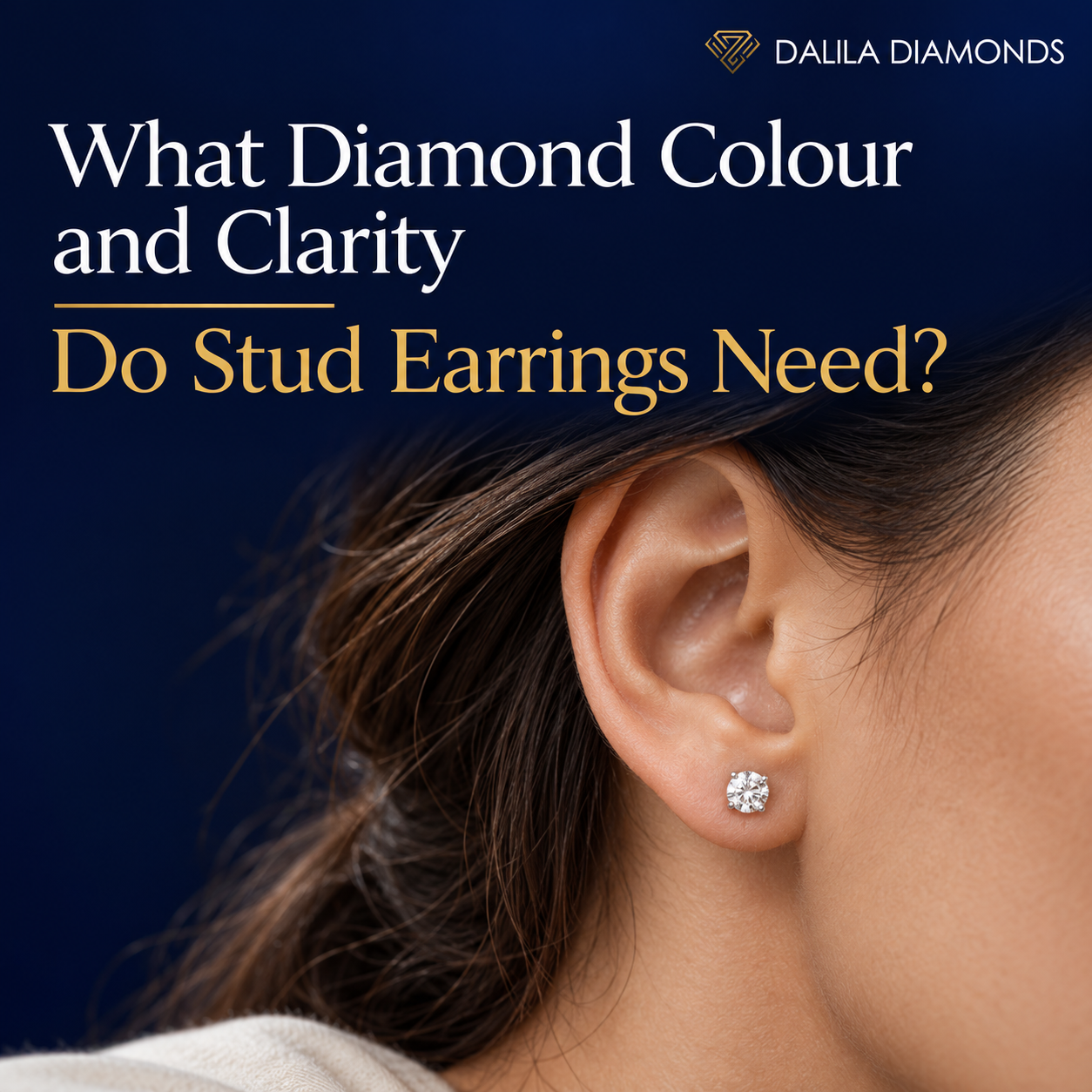
For most buyers choosing natural diamond stud earrings, G–H colour and VS2 or carefully selected SI1 clarity provide a practical starting point. Buyers prioritising value can also compare I–J colour stones, particularly when the diamonds look attractive face-up and work with the intended earring metal.
Higher grades are not automatically necessary to produce bright, attractive studs.
A pair of 0.50-carat G-colour VS2 diamonds may look very similar during normal wear to a more expensive pair graded F-colour VVS2. The higher-grade diamonds may be rarer and cost more, but that does not mean their additional colourlessness or microscopic clarity differences will be noticeable to someone viewing the earrings.
The decision also differs from buying a centre diamond for an engagement ring. Stud earrings are usually viewed from a greater distance, move with the wearer and sit alongside hair, skin and other reflective surfaces. A small inclusion that matters to a buyer examining an engagement-ring diamond close-up may be much less noticeable in an earring.
GIA's diamond stud earrings buying guide specifically explains why buyers can be more flexible with colour and clarity in studs while continuing to prioritise attractive cut quality.
GIA 4Cs
The objective is not to buy the lowest available grade. It is to choose two natural diamonds that look bright, sufficiently white, clean and visually harmonious together, without paying for quality upgrades that do not meaningfully improve the finished earrings.
This guide focuses on colour and clarity as a practical two-diamond purchasing decision. Dalila's existing Best Diamond Clarity for an Engagement Ring remains the dedicated resource for engagement-ring clarity requirements.
What Is the Best Diamond Quality for Stud Earrings?
A sensible diamond stud purchase starts with appearance rather than the highest possible laboratory grades.
For round brilliant studs, evaluate cut quality and visible size first. Then compare colour and clarity grades that produce the desired appearance.
Buying objective | Colour starting point | Clarity starting point | Important condition |
Premium colourless appearance | D–F | VS1–VVS | Suitable when high grades are a priority |
Bright, balanced everyday studs | G–H | VS2 | Confirm consistent appearance |
Value-focused natural diamond studs | H–I | VS2–SI1 | Review both stones for inclusions and transparency |
More flexible budget | I–J | Carefully selected SI1–SI2 | Direct visual assessment especially important |
Larger statement studs | G–I | VS2–SI1 | Reassess visibility for the actual size and cut |
Step-cut studs | Individual colour assessment | Often VS1–VS2 as a conservative starting point | Broad facets may reveal inclusions differently |
These are suggested shopping ranges, not fixed rules or guarantees that any diamond within a grade combination is attractive.
For example, an SI1 diamond with a small, unobtrusive inclusion may be preferable to another SI1 diamond with a noticeable dark crystal under the table.
Likewise, a J-colour round brilliant may look sufficiently white in the intended setting for one buyer but visibly warm to another.
Cut quality, transparency and individual appearance remain essential.
Why Stud Earrings Do Not Need Engagement-Ring-Level Colour and Clarity
Stud earrings and engagement rings are viewed differently.
An engagement ring is frequently examined from close range, sometimes with the hand held directly in front of the face.
Stud earrings are more commonly seen as part of a person's overall appearance. They move when the wearer turns their head and are usually not observed with magnification.
That changes the practical value of some laboratory grade differences.
GIA notes that viewers are unlikely to identify many small clarity characteristics in studs without close inspection under magnification.
GIA 4Cs
However, the difference should not be overstated.
Someone may inspect the earrings while cleaning, setting or purchasing them. A dark inclusion visible through the table of a larger diamond may still be apparent in close-up photographs.
A stone with poor transparency can look less lively even from a distance.
The appropriate standard is therefore not that colour and clarity no longer matter. It is that the buyer should concentrate on differences that affect the appearance of the finished pair.
Which quality factors matter most?
For most round brilliant stud purchases, the following order is useful:
Attractive cut quality and brightness.
Desired visible diameter per ear.
Consistent appearance between the two diamonds.
Sufficiently white face-up colour.
Acceptable clarity and transparency.
Documentation and suitability for the intended setting.
These priorities may change for unusually large stones, step-cut diamonds or buyers seeking premium laboratory grades.
Diamond Colour for Stud Earrings: G, H, I or J?
The GIA D-to-Z colour scale describes the presence of body colour in diamonds that fall within its normal colour range.
D–F diamonds are classified as colourless. G–J diamonds are near-colourless.
The distinction matters commercially because high-colour diamonds can command higher prices.
However, differences between adjacent grades may be subtle when the stones are viewed face-up in completed earrings.
GIA explains that diamond colour is assessed under controlled grading conditions, not by simply looking at a mounted diamond in ordinary room lighting.
GIA 4Cs
D–F colour: When is the premium worthwhile?
D, E and F are useful choices for buyers seeking colourless natural diamonds or matching a particular premium specification.
They may also appeal to someone who is especially sensitive to visible warmth.
However, the higher price does not necessarily produce a noticeable improvement over attractive G–H diamonds during normal stud-earring wear.
A buyer should compare both options before assuming the premium is justified.
G–H colour: A practical starting point
G and H diamonds are often useful for natural diamond studs because they fall in the near-colourless category.
In many round brilliant pairs, these grades can provide an attractive white appearance without requiring the buyer to purchase the highest colour category.
A G-colour pair is not automatically better than an H-colour pair if the H diamonds have better cut quality or appear more consistently matched.
The buyer should compare complete pairs rather than isolated grades.
I–J colour: A possible value opportunity
I and J diamonds can offer an alternative for buyers seeking to allocate more of their budget towards size or cut.
Some appear attractive and relatively white face-up, particularly as round brilliants.
Others display more noticeable warmth, especially in larger stones, certain fancy shapes or cool white-metal settings.
The buyer should request genuine images or a direct comparison under neutral lighting.
Do not assume that every J-colour diamond will look identical or that yellow gold automatically hides unwanted body colour.
The individual stone and intended setting should determine the decision.
What Diamond Clarity Is Best for Stud Earrings?
For many natural diamond stud purchases, VS2 is a practical clarity starting point because inclusions are generally difficult to see without magnification.
Carefully selected SI1 diamonds can also be attractive, particularly when their inclusions are not noticeable during normal viewing and their transparency is satisfactory.
GIA's clarity grading system examines the size, nature, position, relief and quantity of clarity characteristics under 10× magnification.
gia
This is important because a clarity grade is not the same as a guarantee about what an observer will see with the unaided eye.
VVS clarity: Is it worth paying extra?
VVS1 and VVS2 diamonds have very small inclusions that are difficult to identify even under magnification.
These grades are valuable for buyers seeking high clarity as part of a premium specification.
However, a VVS diamond does not necessarily look noticeably more brilliant than a properly cut VS2 diamond during ordinary earring wear.
Clarity and cut quality describe different properties.
VS1 versus VS2 for studs
Both can provide a very clean appearance.
A well-selected VS2 diamond may offer better value if the buyer cannot see any relevant difference between it and a comparable VS1.
For larger studs, a buyer may prefer VS1 for additional selection confidence, but that is a purchasing preference rather than a mandatory requirement.
SI1 clarity for diamond studs
An SI1 diamond may be worth considering when its inclusions are not distracting and its overall transparency is good.
However, SI1 stones vary.
One may contain a small pale inclusion near the perimeter. Another may have a dark crystal beneath the table or extensive clarity characteristics affecting its appearance.
The buyer should not approve an SI1 stone from the grade alone.
Is SI2 acceptable for studs?
Some SI2 diamonds can appear attractive in earrings, particularly in smaller sizes.
GIA's stud-earring guidance acknowledges that SI grades can present value opportunities.
GIA 4Cs
However, SI2 requires more individual scrutiny because visible inclusions and transparency concerns can be more likely than at higher clarity grades.
Reject a diamond if its inclusions, haze or condition undermine the desired appearance or setting suitability.
The objective is not simply to obtain the lowest grade at the lowest price.
Why Eye-Clean Does Not Mean the Same Thing for Every Diamond
Eye-clean is a commercial description, not an official GIA clarity grade.
Its meaning depends on viewing distance, lighting, visual acuity, stone size and how the seller defines the assessment.
A diamond that appears clean from an ordinary social viewing distance may have an inclusion visible when examined face-up at close range.
For stud earrings, ask the supplier to state exactly how the stones were assessed.
A useful request is:
"Please confirm whether either diamond has distracting inclusions visible face-up without magnification at approximately 25–30 cm under neutral lighting, and whether either shows a transparency concern."
That viewing distance is a proposed inspection condition, not an industry-wide guarantee or laboratory definition.
It is also useful to examine larger studs from a normal conversational distance to see whether any difference remains noticeable when worn.
Matching the Colour of Both Earrings
Colour matching should be evaluated at the pair level.
A G-colour diamond beside another G-colour diamond is a sensible starting point, but the two stones may still show slightly different face-up colour.
One may appear warmer or cooler because of its particular optical characteristics.
A G and H pair might also appear harmonious in some circumstances.
The correct choice depends on the actual stones.
For premium pairs, buyers may prefer identical laboratory grades. For budget-conscious purchases, a carefully selected adjacent-grade pair may be acceptable.
The buyer should confirm that the earrings look like a coordinated pair rather than assume that report grades alone prove the match.
Dalila's Matched-Pair Diamonds Buying Guide addresses the detailed trade-matching process, including dimensional tolerances, fluorescence and pair quality control.
Dalila
This article concentrates on whether differences in colour and clarity are worth paying for in the finished consumer earrings.
Matching Clarity: Can One Stud Be VS1 and the Other SI1?
Potentially, yes.
Clarity grades need not be identical when both diamonds look suitably clean and transparent.
For example, a VS1 diamond paired with a carefully selected SI1 diamond may form an attractive pair if the visual appearance remains consistent.
However, their grade difference should not be used to overlook a distracting inclusion.
A pair containing two VS2 diamonds can also look less balanced if one displays a dark inclusion in a prominent position and the other does not.
The correct test is whether the two stones have compatible visible cleanliness and overall optical appearance.
For consumers, matching how the earrings look is generally more useful than matching the clarity labels mechanically, unless the purchase specification requires identical grades.
Why Transparency Matters as Much as the Clarity Grade
Clarity is commonly discussed in terms of whether inclusions can be seen.
However, a diamond's transparency also deserves attention.
Certain combinations of clouds, internal graining or other characteristics may cause a diamond to look less crisp or lively.
A diamond may have no obvious single dark inclusion but still appear slightly hazier than its partner.
This matters for studs because the two diamonds should deliver a reasonably consistent visual impression as the wearer moves.
If one diamond looks bright and crisp while the other looks noticeably dull or milky, purchasing them as a pair may be disappointing even if their clarity grades are similar.
Ask for a direct comparison under consistent lighting.
If the appearance of one stone raises concerns about transparency, seek further professional evaluation or choose another candidate.
Do not automatically assume that a lower clarity grade means poor transparency, or that every VS diamond is free from transparency concerns.
How Diamond Cut Affects the Colour-and-Clarity Budget
Cut quality should not be sacrificed simply to obtain a higher colour or clarity grade.
A diamond's proportions and facet arrangement strongly affect brightness, fire and scintillation.
For round brilliant earrings, GIA recommends seeking Excellent or Very Good cut grades.
GIA 4Cs
Consider two hypothetical diamonds:
Specification | Diamond A | Diamond B |
Colour | F | H |
Clarity | VVS2 | VS2 |
Cut grade | Good | Excellent |
Carat weight | 0.50 ct | 0.50 ct |
Diamond A has higher colour and clarity grades.
Diamond B has a higher overall cut grade.
This does not establish that Diamond B will always look better; actual stones still need evaluation. However, it demonstrates why buyers should not automatically prefer A based only on colour and clarity.
For stud earrings, a bright, attractive diamond with modestly lower colour and clarity can be preferable to a higher-grade stone with less appealing optical performance.
This principle should guide the budget decision before comparing prices.
Does the Best Colour and Clarity Change With Stud Size?
It can.
As diamond size increases, inclusions and body colour may become easier to notice, although the effect depends on shape, cutting style and viewing conditions.
A small 0.25-carat round diamond may conceal certain inclusions effectively through its small face-up dimensions and brilliant facet pattern.
A larger 1.50-carat round diamond may make the same type of inclusion easier to recognise.
However, there is no fixed carat threshold at which a particular clarity grade becomes unacceptable.
Suggested starting points by per-ear size
Diamond per ear | Colour to compare | Clarity to compare | Primary concern |
0.25 ct | G–J | VS2–SI2 | Sufficiently bright, visibly clean pair |
0.50 ct | G–J | VS2–SI1 | Balance size, cut and appearance |
0.75 ct | G–I | VS1–SI1 | Direct comparison of inclusion visibility |
1.00 ct | G–I | VS1–SI1 | Colour and clarity differences may become more noticeable |
1.50 ct or larger | Individual comparison | VS1–VS2 plus inspected alternatives | Larger face-up viewing area |
These are shopping starting points for natural round brilliant studs, not minimum acceptable grades.
An attractive SI1 diamond may outperform a higher-clarity candidate visually in some respects. Conversely, a particular SI1 may be unsuitable because its inclusions are distracting.
For detailed per-ear diameters and pair total weights, see Dalila's stud-size guide at /blogs/diamond-stud-size-per-ear-total-carat.
The purpose of C03 is to decide how much quality is worth purchasing after the size has been selected.
Colour and Clarity in Round, Oval, Princess and Emerald-Cut Studs
Different cutting styles can influence how readily body colour and inclusions are seen.
This is why the same grade combination should not automatically be applied to every shape.
Round brilliant studs
Round brilliants are a practical reference because their many facets create substantial patterns of reflections.
A G–H, VS2 pair can provide a strong starting point, while carefully selected SI1 candidates may offer value.
However, both stones still need consistent brightness and comparable visible appearance.
Oval diamond studs
Oval diamonds can show variation in bow-tie contrast, facet arrangement and the visibility of warmth near their ends.
Two ovals with the same laboratory colour and clarity grades may therefore look different.
Check their actual outlines and face-up appearance together.
Princess-cut studs
Princess cuts have different facet arrangements from standard round brilliants and require appropriate corner protection.
Compare their actual colour and clarity appearance rather than applying round-diamond assumptions without inspection.
The jeweller must also evaluate setting security separately from the diamond's visual quality.
Emerald-cut studs
Emerald cuts use broad step facets that can make some inclusions easier to observe.
For this reason, VS1–VS2 may be a conservative starting point for buyers seeking a clean appearance.
However, the actual placement and visibility of inclusions still matter more than blindly following a grade threshold.
An attractive SI1 emerald cut should not be rejected without individual assessment, but it needs careful inspection.
How Earring Metal Changes Perceived Diamond Colour
The same natural diamond may look different beside yellow, white or rose gold.
Its facets reflect surrounding colours, including those of the setting, skin and hair.
GIA specifically discusses these surrounding-colour effects in its stud-earring buying guide.
GIA 4Cs
This means that buying a more expensive colour grade is not the only way to influence the appearance of the finished studs.
White gold and platinum studs
These metals create a cool-looking surround.
D–H diamonds can appear bright and relatively colourless, while I–J options may also be attractive depending on the individual stones.
A buyer sensitive to warmth should compare actual diamonds against the intended metal.
Yellow-gold studs
Yellow gold creates a warm visual environment.
A G–H diamond may provide a bright contrast with the gold, while some I–J diamonds may create a more harmonious warmer effect.
Do not assume that yellow gold hides every visible colour difference.
Rose-gold studs
Rose gold can introduce pinkish reflections and a warm contrast around the diamonds.
The actual effect depends on the metal alloy, finish, diamond and setting geometry.
For detailed examples of metal-related appearance, refer to Dalila's article at /blogs/diamond-colour-in-different-ring-metals.
Original Comparison Diagram: Three Quality Decisions for the Same Stud Size
The following diagram illustrates three possible purchasing approaches for a pair of natural round brilliant studs.
Original schematic of F/VVS2, G/VS2 and I/SI1 purchasing scenarios. The diamonds are neutral symbols, not actual photographs or simulations of laboratory colour and clarity differences.
Download Diamond Stud Colour & Clarity Comparison (PNG)
The illustration is intentionally not designed to make lower-clarity stones look dirty or lower-colour stones look yellow.
Those effects cannot be reliably represented by assigning colours or artificial inclusions to otherwise identical digital diamond symbols.
For a genuine visual comparison, photograph identified natural diamonds under the same conditions.
Real Side-by-Side Ear Photography: What the Article Needs
To demonstrate how colour and clarity differences appear during actual wear, the ideal photographic series uses verified natural diamond stud pairs on the same wearer.
The images should show diamonds with similar face-up dimensions and setting designs but different laboratory colour or clarity combinations.
The purpose is to illustrate what differences are visible at a realistic viewing distance.
Recommended three-pair photographic comparison
Photography set | Actual stones required | Comparison objective |
Pair A | Two F/VVS2 diamonds | High-colour, high-clarity reference |
Pair B | Two G/VS2 diamonds | Balanced-grade comparison |
Pair C | Two I/SI1 diamonds that pass visual inspection | Value-grade comparison |
All three pairs should use similar face-up diameters and the same mounting style.
For each pair, capture a close view of the physical earrings and an on-ear photograph at a consistent distance. Use the same wearer, camera position, lighting and white-balance settings.
A suitable published sequence would include the diamonds on a calibrated comparison tray, on-ear views at the same scale, and close-up images with corresponding report references.
Photography controls
The photographs should disclose each stone's actual grade and dimensions. Use fixed exposure and white balance, avoid selective colour editing, and identify whether the diamonds were photographed loose or mounted.
For a truly controlled colour comparison, the specimens should be as similar as practical in cut, size, fluorescence and setting; otherwise, those differences may influence the observed result.
These real photographs have not been supplied or captured here. The original diagram can accompany the article, but it must not be presented as first-hand photographic proof.
A real image series should be added before the article claims to demonstrate measured on-ear colour or clarity differences.
Worked Example: Choosing Two Diamonds for a €3,000 Stud Budget
Suppose a buyer has a maximum budget of €3,000 for a pair of natural loose diamonds, with separate mounting costs to be confirmed.
The buyer wants approximately 0.50 carat per ear and prefers round brilliants with attractive cut quality.
Three specification options are being considered.
Decision | Option A | Option B | Option C |
Colour | F | G | I |
Clarity | VVS2 | VS2 | SI1 |
Target weight | 0.50 ct each | 0.50 ct each | 0.50 ct each |
Cut preference | Excellent | Excellent | Excellent |
Pair total | About 1.00 ctw | About 1.00 ctw | About 1.00 ctw |
Purchasing objective | Premium grades | Balanced grades | Value-focused |
Required verification | Both diamonds' appearance | Both diamonds' appearance | Close inspection for inclusions and transparency |
The €3,000 budget is a hypothetical spending limit, not a claim that these exact pairs are currently available at particular prices.
Option A: F/VVS2 pair
The buyer prioritises high colour and clarity grades.
These stones may command a premium compared with otherwise similar lower-grade diamonds.
The advantage is primarily the documented grade specification rather than a guaranteed improvement in visible sparkle.
If Option A consumes most of the available budget, the buyer should ask whether the higher grades provide a visible benefit over Option B.
Option B: G/VS2 pair
This option aims for a bright near-colourless appearance with clarity characteristics that are generally difficult to see without magnification.
If two appropriately cut stones look attractive and similar, this may provide a useful balance between quality and spending.
The buyer should compare the actual pair with Option A before deciding whether the premium is worthwhile.
Option C: I/SI1 pair
This option allows greater flexibility in colour and clarity.
Potential savings may be possible, but only if the actual SI1 stones have acceptable inclusions, transparency and visual appearance.
An I/SI1 label does not guarantee a lower price than every G/VS2 stone because carat weight, cut characteristics, market availability and other factors also affect quotations.
If a proposed I/SI1 pair looks noticeably mismatched, hazy or too warm for the buyer, it should not be chosen solely because of the cost.
How to allocate the budget
For a buyer who wants approximately 0.50-carat diamonds in each ear, an effective process is to hold the target diameter relatively constant while requesting quotations for all three combinations.
For example, ask the supplier to provide the actual total for each identified pair, including any applicable sourcing charges, then compare the remaining allowance for mounting and backs.
If the G/VS2 option looks indistinguishable from the F/VVS2 pair in the intended setting, the difference in price may be better retained or allocated to other priorities.
If the I/SI1 pair fails the visual inspection, it is not automatically better value simply because its laboratory grades are lower.
The best value is the least expensive pair that satisfies the agreed visual, documentary and mounting requirements—not necessarily the pair with the lowest colour and clarity grades.
What If the Two Diamonds Have Different Clarity Grades?
Suppose a supplier identifies two well-cut natural diamonds weighing approximately 0.50 carat each.
The first is G/VS2 and the second is G/SI1.
This pair may be worth considering if both stones appear clean without magnification and have comparable transparency and brightness.
However, the buyer should ask whether either stone has a distracting inclusion under the table or another visible characteristic.
If the SI1 stone looks noticeably different, the fact that both are G colour and have nearly identical diameters does not solve the mismatch.
A balanced pair should be assessed as two actual diamonds, not as a mathematical combination of grading labels.
For the detailed trade pairing process, including dimensional tolerance specifications and advanced quality control, use Dalila's Matched-Pair Diamonds Buying Guide.
Should You Upgrade Clarity or Diamond Size?
This question often arises when a buyer has a fixed budget.
Imagine the choice between two 0.50-carat VS1 diamonds and two 0.60-carat SI1 diamonds.
The second option may provide a visibly larger diameter if the diamonds have suitable proportions.
However, the comparison should account for cut quality, face-up measurements, clarity appearance and total cost.
If the SI1 stones are eye-clean under the agreed viewing conditions and have good transparency, the size increase may provide a more noticeable benefit than the higher clarity grade.
Conversely, if the SI1 diamonds have visible inclusions, the VS1 option may be preferable.
Do not assume that upgrading size always provides better value.
The relevant decision is which combination produces the appearance the buyer actually wants.
A Colour-and-Clarity Worksheet for Two Diamond Studs
Before purchasing, compare each actual candidate separately.
Specification | Left diamond | Right diamond |
Natural origin confirmed | ______ | ______ |
Shape | ______ | ______ |
Carat weight | ______ | ______ |
Face-up dimensions | ______ mm | ______ mm |
Colour grade | ______ | ______ |
Clarity grade | ______ | ______ |
Cut grade, if applicable | ______ | ______ |
Grading laboratory | ______ | ______ |
Report number | ______ | ______ |
Face-up warmth acceptable | Yes / No | Yes / No |
Distracting inclusions visible | Yes / No | Yes / No |
Transparency acceptable | Yes / No | Yes / No |
Brightness and sparkle | ______ | ______ |
Fluorescence, if reported | ______ | ______ |
Girdle or durability concern | ______ | ______ |
Report verified | Yes / Pending | Yes / Pending |
The pair should then be assessed as a single purchase.
Pair-level decision | Result |
Target total carat weight | ______ ctw |
Actual combined carat weight | ______ ctw |
Both diamonds look similar in size | Yes / No |
Face-up colour is harmonious | Yes / No |
Both appear suitably clean | Yes / No |
Brightness and transparency are consistent | Yes / No |
Direct side-by-side comparison completed | Yes / No |
Proposed earring metal | ______ |
Proposed setting | ______ |
Total loose-diamond quotation | €______ |
Mounting and setting quotation | €______ |
Final approval | Pending / Approved |
This worksheet is intended for the consumer buying decision, not as a replacement for Dalila's detailed professional matched-pair specifications.
Natural Diamond Stud Sourcing Brief
When requesting natural loose diamonds for stud earrings, explain the desired quality and the budget decision rather than asking simply for the highest possible grades.
A supplier can then present alternatives that help the buyer compare value.
Example sourcing request
Requirement | Specification |
Jewellery | Natural diamond solitaire studs |
Quantity | Two diamonds |
Shape | Round brilliant |
Weight | Approximately 0.50 ct per stone |
Pair total | Approximately 1.00 ctw |
Colour options | G–H preferred; I also considered |
Clarity options | VS2 preferred; inspected SI1 considered |
Cut | GIA Excellent preferred for round brilliants |
Visible appearance | Bright, clean and consistent pair |
Documentation | GIA, IGI or HRD, according to available candidates |
Matching | Similar diameter, colour appearance and optical character |
Images | Individual images plus a side-by-side view if possible |
Budget | To be confirmed, with loose stones quoted separately |
Manufacturing | Separate jeweller to approve the stud settings |
The requested grades are practical shortlist options rather than a guarantee of availability or value.
Dalila Diamonds provides natural loose-diamond information and sourcing through its website.
When enquiring, provide the desired per-ear size, colour and clarity alternatives, grading preferences and total budget. Ask for identified candidate pairs rather than relying on generic grade-price categories.
The detailed pair-selection process is addressed in Dalila's professional Matched-Pair Diamonds Buying Guide.
Dalila
Separate loose-diamond quality from finished-earring suitability
The diamond supplier can identify candidate stones, supply available grading details and provide comparative images.
The manufacturing jeweller must approve the setting design, diamond seating, post attachment, backs and finished-earring construction.
A natural diamond with suitable colour and clarity grades is not automatically compatible with every stud setting.
Ask for the diamond and manufacturing costs separately so the total purchase can be compared fairly.
Common Mistakes When Choosing Diamond Stud Quality
Paying for VVS clarity without checking whether the difference is visible
Very high clarity may be desirable, but it is not automatically necessary for attractive studs. Compare actual stones.
Choosing the lowest clarity grade simply to save money
A noticeably included or hazy diamond may undermine the desired appearance. Individual inspection is essential.
Assuming same-grade diamonds look identical
Colour and clarity grades document characteristics but do not guarantee identical face-up appearance.
Ignoring cut quality
High colour and clarity do not compensate automatically for poor optical performance.
Comparing photographs taken under different lighting
Changes in lighting, exposure and white balance can make stones appear more or less white, bright or clean.
Using engagement-ring clarity rules for small studs
Studs are commonly viewed differently from engagement rings. The practical visibility of imperfections should guide the decision.
Ignoring the pair as a whole
The buyer needs two visually harmonious diamonds, not merely two individually acceptable stones.
Forgetting the total cost of the earrings
Loose diamonds, mounts, posts, backs and setting labour may be priced separately.
Frequently Asked Questions
What is the best diamond colour and clarity for stud earrings?
G–H colour and VS2 clarity are practical starting points for many natural diamond stud buyers. Carefully selected SI1 diamonds and I–J colour stones may also provide attractive results when their face-up appearance, transparency and pairing are satisfactory.
Is G colour good enough for diamond studs?
Yes. G is in the near-colourless category and can provide an attractive white appearance in stud earrings. The individual stones, cut quality and setting metal should still be assessed.
Is H colour good for diamond earrings?
Yes. H-colour natural diamonds are a sensible option for buyers seeking a near-colourless appearance without necessarily paying for D–F grades. Compare the actual pair under consistent lighting.
Is I colour too yellow for diamond studs?
Not necessarily. Some I-colour diamonds look attractive and relatively white face-up, especially as well-cut round brilliants. Others may show warmth that a particular buyer does not prefer. Inspect the actual stones in the intended metal.
Is J colour acceptable for stud earrings?
It can be. J-colour diamonds fall within GIA's near-colourless range, but some warmth may be noticeable depending on stone size, shape and setting. A direct comparison is preferable to relying only on the grade.
Is VS2 clarity good enough for diamond studs?
Yes. VS2 is a useful starting point because inclusions are typically difficult to observe without magnification. However, every diamond should still be evaluated for its actual appearance.
Is SI1 clarity acceptable for diamond earrings?
Yes, carefully selected SI1 diamonds can be appropriate. Check inclusion location, visible cleanliness, transparency and how both stones look together.
Is SI2 clarity too low for diamond studs?
Not automatically. Some SI2 diamonds may appear attractive in smaller studs, but visible inclusions and transparency deserve closer inspection. The grade alone should not determine approval.
Are VVS diamonds worth buying for earrings?
They may be worthwhile for someone who values high clarity as a documented characteristic. However, the grade premium may not produce a noticeable improvement over an attractive VS2 pair in normal wear.
Should I buy D-colour studs?
D-colour studs are suitable for buyers seeking the highest colourless grade, but they are not necessary for every attractive pair. Compare the visual effect and cost with G–H alternatives.
Can one diamond be VS1 and the other VS2?
Yes. Different clarity grades can still create a visually harmonious pair if both diamonds look suitably clean and transparent. Identical grades are not mandatory unless required by the buyer's specification.
Can one stud be G colour and the other H?
Potentially. An adjacent-grade pair may look harmonious, but the diamonds should be compared directly. Identical colour grades are a useful starting point for buyers seeking consistent appearance.
Is diamond cut more important than clarity for studs?
For many stud purchases, attractive cut quality has a greater visible influence on sparkle than upgrading from an already eye-clean clarity grade. The actual diamonds still need individual evaluation.
Do larger diamond studs need higher clarity?
Larger diamonds can make some inclusions easier to see. However, there is no universal size threshold requiring a particular clarity grade. The actual inclusion appearance should determine the choice.
Does yellow gold let me choose a lower diamond colour grade?
Yellow gold may create a warmer visual environment, making some lower-colour diamonds appealing. However, it does not guarantee that unwanted body colour will disappear.
Can emerald-cut studs use SI1 clarity?
Some may be suitable, but step facets can make certain inclusions more apparent. A careful examination of the actual stone is particularly important.
How can I compare two pairs with different colour and clarity grades?
Hold the desired diameter and setting style as consistent as possible. Review individual grading information and compare the actual pairs under the same lighting. Consider whether the higher grades produce a meaningful visible improvement.
What is the best budget colour and clarity combination for natural diamond studs?
H–I colour with VS2 or carefully inspected SI1 clarity is one practical starting point for value-focused round brilliant studs. However, the best value depends on actual prices, cut quality, appearance and availability.
What information should I send Dalila when sourcing diamond studs?
Provide the target weight and diameter per ear, shape, colour and clarity ranges, cut preferences, grading requirements, intended metal, budget and request for two stones that look visually harmonious.