How to Source Tapered Baguette Diamond Pairs: Measurements, Taper Angles and Mirror Matching
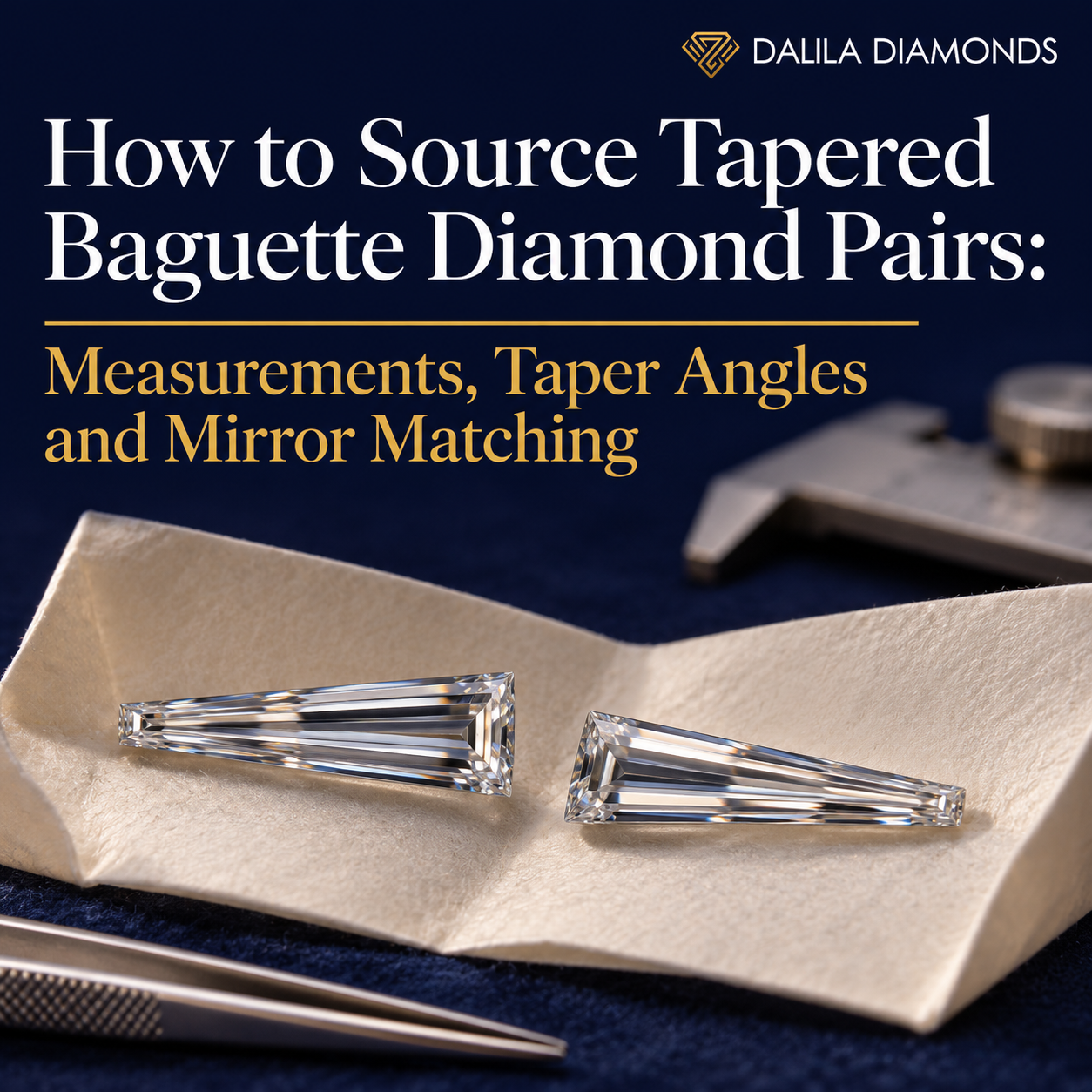
To source a matched pair of tapered baguette diamonds, specify the length, wide-end width, narrow-end width, depth, taper geometry and intended left/right orientation of both stones. Carat weight alone is not sufficient to determine whether the pair will fit a three-stone ring.
Tapered baguettes are often positioned on either side of an emerald-cut, round, oval or other centre diamond.
Their elongated shape creates a transition between the centre stone and the ring's shoulders.
However, these side diamonds are more geometry-sensitive than many buyers expect.
Two natural tapered baguettes can weigh exactly 0.15 carat each and still look noticeably different when mounted.
One may have a stronger taper.
Another may be longer or wider.
Their facet arrangements, depths or end profiles may also differ.
Even when their dimensions are similar, two stones may not create a visually balanced left/right arrangement.
For example, a manufacturing jeweller may require tapered baguettes measuring approximately:
4.00 mm long × 2.00 mm at the wide end × 1.50 mm at the narrow end.
A supplier might offer two baguettes of the correct weight but with a wider 1.80 mm narrow end.
Those stones may not create the desired transition towards the ring band.
The buyer would then face a choice between modifying the mounting, changing the design or sourcing a more suitable pair.
The correct purchasing objective is not two similar tapered baguettes. It is one manufacturer-approved, visually balanced pair made for the specific centre diamond and ring layout.
This guide explains how to create that specification, calculate taper angles, review mirror matching, evaluate actual candidates and prepare a complete natural-diamond sourcing RFQ.
What Is a Tapered Baguette Diamond?
A tapered baguette is an elongated diamond with one end wider than the other.
Its two long sides angle inwards, forming a narrowing outline.
Conventional baguette diamonds typically use step-cut facets that create long, linear reflections.
This makes them visually different from the smaller, more numerous reflections seen in a round brilliant.
A straight baguette has approximately parallel long sides.
A tapered baguette narrows towards one end.
Straight vs tapered baguette
Feature | Straight baguette | Tapered baguette |
Long sides | Approximately parallel | Converge towards narrow end |
End widths | Approximately equal | Different |
Face-up outline | Rectangular | Trapezoidal or wedge-like |
Common visual role | Geometric accents and channels | Centre-to-shoulder transition |
Measurement priority | Length and width | Length, wide end, narrow end and taper |
Pair matching | Dimensions and make | Dimensions, make, taper and mirrored layout |
GIA describes both straight and tapered baguettes as established diamond cutting styles used in engagement rings and other jewellery.
Tapered baguettes should also be distinguished from ordinary trapezoid side stones. The trade names and exact cutting geometry can overlap in some designs, so the RFQ should include a measured outline rather than rely on the shape name alone.
Why Tapered Baguettes Must Be Sourced as a Pair
A three-stone ring is visually symmetrical around its centre.
The left and right side diamonds should therefore appear balanced.
For tapered baguettes, this requires more than matching weight, colour and clarity.
The stones must also have compatible geometries.
Main pair-matching factors
Factor | What must match |
Length | Comparable visual reach along the shoulders |
Wide-end width | Comparable proportions beside centre |
Narrow-end width | Comparable transition into band |
Taper angle | Consistent convergence |
Outline | Similar edges and corner shapes |
Depth | Compatible setting height |
Facet pattern | Comparable step-cut appearance |
Colour | Balanced face-up appearance |
Clarity | Compatible visual cleanliness |
Transparency | No distracting hazy stone |
Orientation | Correct left/right positioning |
A mismatch becomes apparent because the two side stones frame the same centre diamond.
For example, a left baguette with a strong taper may make one shoulder appear narrower than the other.
A right baguette with a different length may create an uneven three-stone composition.
The manufacturer's drawing should define the intended relationship before sourcing begins.
Annotated Layout: How Tapered Baguettes Sit Beside a Centre Diamond
The following simplified layout shows a conventional arrangement with the wide ends beside the centre and narrow ends pointing towards the ring shoulders.
Face-up concept — not to scale
CENTRE DIAMOND
┌────────────────┐
│ │
│ EMERALD │
│ CUT │
│ │
└────────────────┘
WIDE END WIDE END
│ │
╱───────│ │───────╲
╱ │ │ ╲
╱ LEFT │ │ RIGHT ╲
╱ BAGUETTE │ │ BAGUETTE ╲
╱___________│ │___________╲
NARROW END NARROW END
← towards left shoulder towards right shoulder →
This is a conceptual orientation diagram, not a cutter's outline or a fabrication drawing.
The actual baguettes can be angled, rotated or positioned differently depending on the centre diamond and the mounting.
Required dimensions for each stone
WIDE END (W)
2.00 mm
┌────────────┐
/ \
/ \
/ \ Length (L)
/ \ 4.00 mm
└──────────────────────┘
NARROW END
1.50 mm
Depth (D): separately measured
The drawing illustrates the three essential face-up measurements.
It does not establish the actual facet pattern or pavilion profile.
Measurement labels
L — Length: Distance between the wide and narrow ends along the longitudinal axis.
W — Wide-end width: Face-up width across the wider end.
N — Narrow-end width: Face-up width across the narrower end.
D — Total depth: Diamond depth perpendicular to the face-up plane.
θ — Taper angle: Angle between the stone's long axis and a converging side, under the stated geometric convention.
These values should be entered for each stone individually.
Step 1: Measure the Centre Diamond First
The centre diamond determines much of the intended side-stone geometry.
For example, an emerald-cut centre measuring 8.00 × 6.00 mm creates a different layout from an emerald cut measuring 9.00 × 5.50 mm.
Both may appear elongated, but the proportions are different.
The jewellery manufacturer should provide actual centre dimensions.
Centre diamond information
Requirement | Example |
Origin | Natural |
Shape | Emerald cut |
Carat weight | 1.50 ct, illustrative |
Length | 8.00 mm |
Width | 6.00 mm |
Depth | Actual report measurement required |
Corner profile | From stone or technical drawing |
Colour | G |
Clarity | VS2 |
Laboratory | Actual report required |
Intended side arrangement | Two tapered baguettes |
The weight and dimensions above are hypothetical project inputs, not the specifications of a verified available diamond.
The manufacturer should also assess the centre's girdle, pavilion clearance and proposed head construction.
A photograph of the centre diamond alone is not enough to establish final side-stone geometry.
Step 2: Establish the Side-Stone Length
Length affects how far the baguettes extend from the centre towards the ring shoulders.
Longer side stones can create a more elongated three-stone appearance.
Shorter side stones may keep the centre more visually dominant.
However, the suitable length depends on the centre outline, ring size and planned mounting.
Illustrative length options
For a hypothetical centre that is 8.00 mm long, a jeweller might compare:
Side baguette length | Relationship to 8.00 mm centre length |
3.00 mm | 37.5% |
3.50 mm | 43.8% |
4.00 mm | 50.0% |
4.50 mm | 56.3% |
These ratios are useful for discussing design proportion.
They are not universal cutting or setting rules.
Furthermore, the correct reference dimension may depend on how the baguette is oriented beside the centre.
A manufacturing CAD layout should determine the actual length requirement.
Why an exact length matters
Suppose the approved design requires each side stone to be approximately 4.00 mm long.
The supplier offers one at 4.00 mm and the other at 4.35 mm.
The pair may produce unequal shoulder coverage.
Unless the manufacturer has designed the setting to accommodate that difference, the pair should not be accepted merely because both diamonds are described as tapered baguettes.
Step 3: Specify Both End Widths
For tapered baguettes, one width is insufficient.
A supplier who receives an RFQ stating “4.00 × 2.00 mm tapered baguette” cannot reliably determine the intended narrow-end width.
Two stones could share those first two dimensions while tapering very differently.
Example
Specification | Baguette A | Baguette B |
Length | 4.00 mm | 4.00 mm |
Wide-end width | 2.00 mm | 2.00 mm |
Narrow-end width | 1.50 mm | 1.80 mm |
Baguette A narrows by 0.50 mm.
Baguette B narrows by only 0.20 mm.
The visual geometry is different.
Correct trade specification
4.00 × 2.00 × 1.50 mm (L × W × N)
This is more informative than supplying only length and maximum width.
Total depth must also be recorded separately.
The RFQ should define exactly which measurement convention the supplier uses so no dimension is misinterpreted.
Step 4: Calculate the Taper Angle
Taper angle helps quantify the way the stone narrows.
For an approximately symmetrical tapered baguette with straight sides, the half-angle can be estimated from the end-width difference and the length.
Formula
Half-taper angle = arctan[(Wide-end width − Narrow-end width) ÷ (2 × Length)]
Example
Length = 4.00 mm.
Wide-end width = 2.00 mm.
Narrow-end width = 1.50 mm.
Width difference:
2.00 − 1.50 = 0.50 mm.
Half the width difference:
0.50 ÷ 2 = 0.25 mm.
Divide by length:
0.25 ÷ 4.00 = 0.0625.
Half-taper angle:
arctan(0.0625) ≈ 3.58°.
The included angle between the two converging sides is approximately:
3.58° × 2 = 7.16°.
Important geometric limitation
This calculation assumes a symmetrical outline with straight tapering edges.
If one side tapers more strongly than the other, the single half-angle calculation will not describe the complete geometry.
In that situation, the manufacturer should specify the left and right edge angles or supply a properly dimensioned outline.
The RFQ must also state whether an angle refers to the half-angle relative to the length axis or the total included taper angle.
Otherwise, two parties may interpret the same numerical value differently.
Comparing Different Taper Angles
Consider three hypothetical tapered baguettes.
All are 4.00 mm long and 2.00 mm wide at the broad end.
Version | Narrow end | Approx. half-taper angle | Visual character |
A | 1.80 mm | 1.43° | Gentle taper |
B | 1.50 mm | 3.58° | Moderate taper |
C | 1.20 mm | 5.71° | Stronger taper |
These are calculated geometric examples, not available stock or a universal classification of slight, moderate and strong taper.
What changes with taper?
A gentle taper maintains more width towards the ring shoulder.
A stronger taper creates a more pronounced narrowing transition.
The correct option depends on the jewellery design.
A stronger taper is not automatically better.
The chosen angle must work with the intended shoulder geometry, centre stone and mounting.
Step 5: Match the Taper to the Ring Shank
The baguette's narrowing outline should relate to the geometry of the ring band.
If the narrow end remains substantially wider than the adjoining shoulder design, the transition may appear abrupt.
If the narrow end is much narrower than planned, the jeweller may need additional metalwork or a different head.
Manufacturer's layout checklist
Requirement | What to confirm |
Centre setting width | Approved |
Baguette wide-end width | Compatible with centre transition |
Baguette narrow-end width | Compatible with shoulder |
Baguette length | Appropriate coverage |
Taper geometry | Follows intended design |
Metal gap | Manufacturer-approved |
Prong or channel configuration | Suitable |
Diamond depth | Allows intended setting height |
Finger clearance | Safe and comfortable |
Symmetry | Left and right balanced |
The jeweller should not select the stones based solely on a generic carat range.
A CAD drawing or a physical scaled layout is particularly useful for taper-sensitive designs.
Step 6: Understand Mirror Matching
Mirror matching means evaluating the pair as a deliberate left/right arrangement around the centre diamond.
For many conventional symmetrically cut tapered baguettes, turning two similarly shaped stones into opposite positions can create the desired mirrored appearance.
However, matching only the nominal taper angle may not be enough.
Actual stones can differ in edge geometry, table placement, facet organisation and proportions.
What to compare
Characteristic | Mirror-matching requirement |
Wide ends | Visually comparable |
Narrow ends | Visually comparable |
Long edges | Compatible convergence |
Taper | Similar on both sides |
Corners | Corresponding shapes |
Facet junctions | Balanced |
Step pattern | Compatible appearance |
Depth | Appropriate for symmetrical height |
Face-up colour | Harmonious |
Transparency | No distracting mismatch |
For a deliberately asymmetrical or custom-cut baguette, the manufacturer may need genuinely directional stones.
This should be identified in the RFQ.
Two similar diamonds are not automatically a mirrored pair
A supplier may have two diamonds measuring approximately 4.00 × 2.00 × 1.50 mm.
But one may have a slightly curved long edge.
The other may have different corner geometry.
Their measurements are similar, yet they may not frame the centre symmetrically.
Request a properly oriented face-up image of both stones beside the intended centre outline.
Step 7: Define Dimensional Tolerances
Tolerances protect the manufacturing process from unwanted variation.
They should be determined by the ring design and the setter's requirements.
For baguettes, the buyer should not use only one general tolerance across all dimensions without considering its effect on taper.
Illustrative pair-matching tolerances
Characteristic | Example requirement |
Length difference | No more than 0.05 mm |
Wide-end difference | No more than 0.05 mm |
Narrow-end difference | No more than 0.05 mm |
Half-taper-angle difference | Manufacturer-approved limit |
Depth difference | Manufacturer-approved limit |
Corner/outline match | Visual approval |
Setting fit | Mandatory approval |
The 0.05 mm values are illustrative procurement specifications.
They are not universal industry standards.
GIA advises specifying the relevant tapered baguette widths to approximately 0.1 mm for practical matching, while specialist suppliers may offer tighter calibration for particular products.
The appropriate limit depends on actual size, inspection capability and the mounting.
Why angle tolerance matters
Two diamonds can each be within dimensional tolerances but still have visibly different taper angles.
The buyer should therefore calculate or review the resulting geometry rather than accept each individual dimension in isolation.
Step 8: Check Depth and Setting Height
Matching the face-up outlines is not enough.
The stones should also sit appropriately within the mounting.
A deep pavilion may require more clearance.
A shallower stone may produce a different seat position.
Depth comparison example
Requirement | Left | Right |
Length | 4.00 mm | 4.02 mm |
Wide-end width | 2.00 mm | 2.01 mm |
Narrow-end width | 1.50 mm | 1.51 mm |
Depth | 1.60 mm | 1.82 mm |
The face-up dimensions are close.
But the total depths differ by 0.22 mm.
Whether the pair is suitable depends on the manufacturer-approved setting design.
The jeweller may be able to create individual seats, but that must be approved.
A supplier should not claim the pair is ready to set purely because its face-up measurements match.
Step 9: Match Colour to the Centre Diamond
Tapered baguettes commonly have a relatively open step-facet appearance.
Colour differences may therefore be easier to notice than in some more highly faceted diamonds.
For example, a G-colour emerald-cut centre may look visually inconsistent beside noticeably warmer side stones.
Colour specification guide
Centre diamond | Side-stone range to consider |
D–E | D–F |
F | E–G |
G | F–H |
H | G–I |
I | H–J |
These are possible starting ranges, not strict matching laws.
The actual stones should be compared in appropriate lighting.
The final colour requirement should reflect the buyer's expectations, centre diamond appearance and intended metal.
Why identical grades can still look different
A pair of G-colour tapered baguettes may have slightly different face-up appearances.
The differences can result from proportions, facet arrangement or other visual characteristics.
For a premium three-stone design, side-by-side inspection remains important.
Step 10: Match Clarity and Transparency
Long step facets can make some inclusions more noticeable.
A tapered baguette with a highly visible inclusion beneath the table may distract from the otherwise clean geometric appearance.
However, not every inclusion is visible or commercially significant.
Recommended quality controls
Factor | What to assess |
Clarity grade | Meets approved requirement |
Visible inclusions | No unacceptable mismatch |
Transparency | No distracting haze |
Surface condition | No unacceptable chips |
Corner condition | Suitable for setting |
Facet alignment | Visually consistent |
Polish | Appropriate finish |
Treatment disclosure | Accurate |
A buyer might prefer VS1–VS2 for a particular client order.
Another project may accept carefully selected SI1 stones.
The correct specification depends on the size of the diamonds, their actual inclusions, setting design and budget.
Do not assume that a specific clarity grade guarantees every stone will look visually identical.
Step 11: Match the Facet Pattern
Most conventional baguettes have step-cut faceting.
However, cutting variations exist.
GIA documents tapered baguettes that combine brilliant-style pavilion faceting with step-cut crown faceting.
These are sometimes called brilliant baguettes or mixed-cut baguettes.
Such stones can have a different optical appearance from conventional step cuts.
What to specify
Cutting style: Conventional step cut or another expressly approved facet style.
Facet consistency: Left and right should display compatible patterns.
Orientation: Supplier images should show the stones in their intended mounted positions.
Centre relationship: The selected facet style should support the intended design.
An RFQ that asks only for “tapered baguette” may not communicate whether an unusual cutting style is acceptable.
For a restoration, the existing side stone should be examined to determine the original facet type.
Step 12: Check Individual Reports and Natural-Origin Documentation
A tapered baguette pair may contain stones too small for individual grading to be commercially practical or available under the desired transaction.
Other pairs may have individual grading reports.
The buyer should define the documentation requirement before sourcing.
Documentation checklist
Requirement | Left | Right |
Natural origin | Required | Required |
Stock reference | ______ | ______ |
Laboratory report | ______ | ______ |
Report number, if any | ______ | ______ |
Measured dimensions | ______ | ______ |
Actual weight | ______ | ______ |
Colour | ______ | ______ |
Clarity | ______ | ______ |
Treatment information | ______ | ______ |
Supplier identification | ______ | ______ |
Where individual reports are unavailable, ask for appropriate origin and quality documentation.
Do not describe an ungraded pair as individually GIA-certified.
The centre diamond's grading report does not certify the side stones.
Worked Layout: Emerald Centre with Natural Tapered Baguettes
The following is a complete illustrative trade-design example.
It is not a verified Dalila customer order or currently available matched pair.
Project information
Ring: Three-stone engagement ring.
Centre: Natural emerald-cut diamond.
Centre dimensions: 8.00 × 6.00 mm.
Centre colour: G.
Centre clarity: VS2.
Side stones: Two natural tapered baguettes.
Metal: Platinum.
Design: Symmetrical three-stone ring with narrowing side diamonds.
Preliminary CAD-style layout
TOP / FACE-UP VIEW
(not to scale)
Narrow Wide CENTRE Wide Narrow
end end DIAMOND end end
┌───╲ ╱────┐ ┌────────┐ ┌────╲ ╱───┐
│ ╲___╱ │ │ │ │ ╲___╱ │
│ LEFT BAGUETTE│ │ EMERALD│ │RIGHT BAGUETTE│
│ ______ │ │ CUT │ │ ______ │
└───╱ ╲───┘ └────────┘ └───╱ ╲───┘
← shoulder shoulder →
This diagram communicates intended orientation only.
A real manufacturing drawing must show actual stone outlines, positioning, mounting gaps, angles and setting geometry to scale.
Proposed side-stone specification
Characteristic | Left | Right |
Origin | Natural | Natural |
Shape | Tapered baguette | Tapered baguette |
Length | 4.00 mm | 4.02 mm |
Wide-end width | 2.00 mm | 2.01 mm |
Narrow-end width | 1.50 mm | 1.51 mm |
Half-taper angle | Approx. 3.58° | Approx. 3.56° |
Depth | Pending | Pending |
Colour | G | G |
Clarity | VS2 | VS2 |
Facet style | Step cut | Step cut |
The measurements are fictional planning inputs used to demonstrate calculation and comparison.
Pair differences
Measurement | Difference |
Length | 0.02 mm |
Wide-end width | 0.01 mm |
Narrow-end width | 0.01 mm |
Half-taper angle | Approximately 0.02° |
These values indicate promising geometric consistency.
However, they do not establish that the stones exist, have acceptable depth, are suitable for the setting or are visually matched.
A real pair still requires physical inspection and manufacturer approval.
Accepted vs Rejected Tapered Baguette Pair
A useful RFQ should make clear what is unacceptable.
Approved illustrative criteria
Requirement | Acceptance standard |
Shape | Natural tapered baguette |
Length | 3.95–4.05 mm |
Wide-end width | 1.95–2.05 mm |
Narrow-end width | 1.45–1.55 mm |
Maximum pair length difference | 0.05 mm |
Maximum pair wide-end difference | 0.05 mm |
Maximum pair narrow-end difference | 0.05 mm |
Taper geometry | Manufacturer-approved |
Colour | G–H, visually matched |
Clarity | VS2 or better |
Facet pattern | Compatible step cut |
Depth | Must pass setting approval |
Mirror appearance | Mandatory visual approval |
These are project-specific hypothetical criteria.
Pair A: Passes preliminary dimensional screening
Measurement | Left | Right |
Length | 4.00 mm | 4.02 mm |
Wide end | 2.00 mm | 2.01 mm |
Narrow end | 1.50 mm | 1.51 mm |
Colour | G | G |
Clarity | VS2 | VS2 |
Decision: Provisionally acceptable on listed dimensions and grades.
Final approval remains subject to depth, condition, actual mirrored appearance, availability and setting compatibility.
Pair B: Rejected for unequal taper
Measurement | Left | Right |
Length | 4.00 mm | 4.00 mm |
Wide end | 2.00 mm | 2.00 mm |
Narrow end | 1.50 mm | 1.80 mm |
Colour | G | G |
Clarity | VS2 | VS2 |
The left diamond has a half-taper angle of approximately 3.58°.
The right diamond has a half-taper angle of approximately 1.43°.
The narrow-end difference is 0.30 mm.
Decision: Reject under the approved specification.
Even though the stones share the same length, wide-end width, colour and clarity, they are not a suitable pair for this defined layout.
What this demonstrates
A tapered baguette pair cannot be judged by carat weight or a basic two-dimension description.
The narrow end and taper must also be controlled.
What if the Two Baguettes Are Not Perfectly Mirrored?
A small mismatch may be acceptable in certain mounting designs.
But the manufacturer must decide whether it affects the finished jewellery.
Possible approaches include:
Rejecting the pair: When the difference exceeds mandatory tolerances.
Selecting a different counterpart: Retaining one stone and searching for a better match.
Adjusting the design: If the client approves and the structural requirements permit it.
Considering specialist recutting: Only after assessing cost, weight loss and risks.
Recutting should not be promised as an automatic correction.
A cutter must examine the actual stone.
The supplier should not assume a mismatched pair can be made identical through minor polishing.
Can You Source One Replacement Tapered Baguette?
Potentially, but matching one existing side stone can be more challenging than sourcing a new pair.
The existing stone must be identified and measured.
For example, a ring may retain its left tapered baguette but have lost the right one.
The replacement needs to complement the original left stone and the centre diamond.
Replacement checklist
Requirement | Information |
Existing side stone | Left or right |
Shape | Tapered baguette |
Length | Actual |
Wide-end width | Actual |
Narrow-end width | Actual |
Depth | Actual |
Facet pattern | Documented |
Colour | Assessed |
Clarity | Assessed |
Taper geometry | Measured |
Existing setting condition | Inspected |
Required opposite orientation | Confirmed |
A photograph is useful, but actual measurements are essential.
If a sufficiently close single replacement cannot be found, sourcing an entirely new matched pair may be more practical.
How to Specify Wholesale Availability and Pricing
Tapered baguette pairs should be quoted against actual available stones.
A vague statement such as "matched 0.20-carat baguettes in stock" does not establish compatibility.
Required supplier response
Field | What to request |
Left stone reference | Exact ID |
Right stone reference | Exact ID |
Individual weights | Actual |
Total pair weight | Actual |
Length | Each stone |
Wide-end width | Each stone |
Narrow-end width | Each stone |
Depth | Each stone |
Taper/outline images | Both stones |
Natural-origin evidence | Appropriate documentation |
Colour and clarity | Actual specification |
Price | Pair price and currency |
Availability | Confirmed |
Reservation | Written terms |
Shipping and insurance | Agreed |
Inspection and return terms | Written |
The buyer should also establish whether the stones are being offered as one matched pair or as two separately priced diamonds.
If one is rejected, the commercial procedure must be clear.
Complete Tapered Baguette Pair RFQ Worksheet
A. Jewellery project
Field | Information |
Project reference | ______ |
Jewellery type | ______ |
Metal and alloy | ______ |
Centre stone shape | ______ |
Centre carat weight | ______ |
Centre measurements | ______ |
Centre colour | ______ |
Centre clarity | ______ |
Centre report | ______ |
Ring size | ______ |
CAD attached | Yes / No |
Existing setting or new mounting | ______ |
Finished jewellery deadline | ______ |
B. Side-stone dimensions
Specification | Left | Right |
Natural origin | Required | Required |
Shape | Tapered baguette | Tapered baguette |
Length | ______ mm | ______ mm |
Wide-end width | ______ mm | ______ mm |
Narrow-end width | ______ mm | ______ mm |
Total depth | ______ mm | ______ mm |
Half-taper angle | ______° | ______° |
Included angle, if used | ______° | ______° |
Facet style | ______ | ______ |
Corner geometry | ______ | ______ |
Girdle condition | ______ | ______ |
Orientation | Left | Right |
C. Quality requirements
Specification | Left | Right |
Colour | ______ | ______ |
Clarity | ______ | ______ |
Transparency | ______ | ______ |
Facet symmetry | ______ | ______ |
Polish | ______ | ______ |
Fluorescence | ______ | ______ |
Treatment disclosure | ______ | ______ |
Laboratory report required | ______ | ______ |
Origin documentation | ______ | ______ |
D. Pair acceptance
Check | Result |
Length difference | ______ |
Wide-end difference | ______ |
Narrow-end difference | ______ |
Taper-angle difference | ______ |
Depth compatibility | ______ |
Mirrored outline acceptable | ______ |
Facet pattern consistent | ______ |
Colour appearance matched | ______ |
Transparency matched | ______ |
CAD layout passed | ______ |
Setter approved | ______ |
Final pair accepted | ______ |
E. Commercial quotation
Field | Value |
Supplier | ______ |
Pair reference | ______ |
Left stock ID | ______ |
Right stock ID | ______ |
Individual weights | ______ |
Combined weight | ______ |
Quoted price | ______ |
Currency | ______ |
VAT treatment | ______ |
Shipment | ______ |
Insurance | ______ |
Current availability | ______ |
Reservation deadline | ______ |
Inspection period | ______ |
Return terms | ______ |
Required receipt date | ______ |
F. Manufacturing handoff
Requirement | Status |
Actual stones received | ______ |
Physical identity verified | ______ |
Dimensions checked | ______ |
Condition recorded | ______ |
Orientation established | ______ |
CAD reconciled | ______ |
Head/seat dimensions approved | ______ |
Stone-setting authorised | ______ |
Final symmetry inspection | ______ |
Completed jewellery delivered | ______ |
This worksheet should be stored with the approved CAD version and actual stone references.
Copy-Ready Supplier RFQ: Natural Tapered Baguette Pair
Subject: Matched Natural Tapered Baguette Pair — Three-Stone Ring
Project: Custom three-stone engagement ring.
Centre stone: Natural emerald cut, actual measurements and grading report attached.
Side diamonds required: One matched pair, two natural tapered baguettes.
Orientation: Wider ends towards the centre diamond, narrower ends towards the ring shoulders.
Target dimensions per stone: 4.00 × 2.00 × 1.50 mm, length × wide end × narrow end.
Depth: Provide actual depth for both stones; manufacturer approval required.
Preferred pair dimensional difference: No more than 0.05 mm for each of the three face-up measurements.
Taper: Approximately 3.58° half-angle for the target symmetrical outline, subject to actual CAD approval.
Facet style: Conventional step cut.
Colour: G–H, visually compatible with centre.
Clarity: VS2 or better.
Origin: Natural.
Documentation: Provide appropriate origin and quality information; identify any individual grading reports.
Visuals: Face-up photograph or video of both actual stones, oriented as left and right side diamonds.
CAD: Attached manufacturer-approved layout.
Quantity: One complete pair.
Budget: €[approved amount].
Delivery: [authorised workshop address].
Deadline: [required arrival date].
Quote requirements: Actual stock references, individual weights, measurements, combined price, availability, shipping, insurance and inspection terms.
Approval: No purchase or substitution without approval of the complete pair.
This RFQ is a template, not a Dalila inventory offer.
The manufacturer's actual tolerances and deadline should be inserted before sending.
How Dalila Diamonds Can Support Tapered Baguette Sourcing
Dalila Diamonds offers natural loose-diamond sourcing for professional buyers.
Its published DS4U — Diamond Source For You service is relevant when the buyer requires uncommon shapes, matched pairs or tightly controlled dimensions.
For tapered baguettes, the jeweller can submit the approved technical brief rather than simply requesting two side stones of a certain carat weight.
What to provide Dalila
Centre diamond dimensions and available report.
Intended left/right layout.
Actual length and both end widths.
Depth requirements.
Taper-angle convention.
Manufacturer-approved tolerances.
Colour and clarity requirements.
Facet style.
Natural-origin documentation requirements.
Quantity, budget and deadline.
Dalila can then assess the sourcing enquiry against available supply.
What is not guaranteed
Dalila's public service information does not establish that every requested tapered baguette size or mirrored pair is immediately available.
Nor does it guarantee custom cutting, CAD creation, jewellery manufacturing, individual grading reports for every small side diamond or unrestricted returns.
Those services or arrangements must be confirmed for the actual order.
Its existing matched-pair guide explains general diamond-pair matching across different shapes.
This article focuses specifically on the dimensional geometry of tapered baguettes.
Common Mistakes When Sourcing Tapered Baguettes
Ordering by carat weight alone
Two equally heavy stones can have different physical shapes.
Specifying only length and maximum width
The narrow-end dimension is essential.
Forgetting the taper angle
Identical broad dimensions do not guarantee identical convergence.
Confusing half-angle and included angle
A quoted angle without a defined convention may be misinterpreted.
Treating two similar stones as a guaranteed mirrored pair
The actual outlines and facet arrangements should be compared in the intended positions.
Ignoring the centre diamond's geometry
The pair must complement the actual centre, not a generic ring image.
Ignoring total depth
Stones may sit at different heights.
Assuming matching colour grades guarantee identical appearance
Step-cut faceting may make visual differences more noticeable.
Treating small baguettes as automatically individually certified
Documentation requirements must be agreed in advance.
Buying before the manufacturer approves the pair
The stones may not fit the intended mounting.
Frequently Asked Questions
What is a tapered baguette diamond?
It is an elongated diamond whose long sides narrow from a wider end towards a narrower end, typically with step-cut facets.
What is the difference between a straight and tapered baguette?
A straight baguette has approximately parallel long sides. A tapered baguette has converging sides and different end widths.
How do you measure a tapered baguette?
Record its length, wide-end width, narrow-end width and depth, using a clearly defined measurement convention.
Why are three face-up measurements required?
Length and maximum width do not establish how strongly the stone narrows. The narrow-end width is needed to describe the taper.
How do you calculate taper angle?
For a symmetrical straight-edged outline, calculate arctan[(wide width − narrow width) ÷ (2 × length)] to obtain the half-angle.
What is the difference between half-angle and included angle?
The half-angle is measured relative to the longitudinal axis. For a symmetric shape, the included angle is twice the half-angle.
Do two baguettes need exactly the same carat weight?
No. Matching dimensions, taper and visual appearance can be more important than identical weight.
What is mirror matching for tapered baguettes?
It means selecting and orienting the stones so their shapes, edges, facet patterns and proportions frame the centre symmetrically.
Can two baguettes have the same measurements but look different?
Yes. Corner shape, facet arrangement, depth and subtle outline differences can create visual mismatches.
What is a suitable millimetre tolerance?
The appropriate tolerance depends on the stones and mounting. GIA discusses matching relevant baguette widths to approximately 0.1 mm, while some trade suppliers offer tighter requirements.
Is a 0.05 mm tolerance always necessary?
No. It is one possible specification, not a universal requirement.
Which centre shapes work with tapered baguettes?
Emerald, Asscher, round, oval, cushion and other centre shapes can be used where the design supports them.
Are tapered baguettes better than trapezoids?
Neither is universally better. They offer different geometry, and the actual jewellery design should determine the choice.
Why are tapered baguettes popular with emerald cuts?
Their linear step-facet appearance can complement the geometric character of emerald-cut diamonds.
Can tapered baguettes have brilliant facets?
Some variants use mixed faceting, including brilliant-style pavilion facets. The desired cutting style should be specified.
Should tapered baguettes match the centre colour?
For a harmonious three-stone ring, visual colour compatibility is important. Identical grades are not necessarily mandatory.
Can SI1 tapered baguettes be used?
Potentially, if the stones meet the approved appearance and durability requirements. Step-cut inclusions should be reviewed carefully.
Do tapered baguette side stones need GIA reports?
Not always. Individual reporting depends on the stones and transaction. Agree the required documentation before sourcing.
Can I source just one replacement tapered baguette?
Potentially, but it must match the existing opposite side stone and centre layout. A new pair may sometimes be easier to source.
Can a tapered baguette be recut to match?
Sometimes, subject to a specialist cutter's assessment. Recutting can reduce weight and is not guaranteed to produce a suitable pair.
What if my preferred taper is unavailable?
The jeweller may explore another pair, an approved design revision or specialist cutting if offered. Do not assume a particular solution is available.
Can a supplier guarantee two stones are identical?
No two natural diamonds should be assumed physically identical. A supplier can offer a matched pair against agreed measurable and visual acceptance criteria.
Does Dalila source natural tapered baguette pairs?
Dalila's DS4U service supports enquiries for uncommon natural-diamond shapes, matched pairs and precise dimensions. Actual availability must be confirmed.
Does Dalila manufacture three-stone rings?
Finished jewellery manufacturing has not been established as part of its published loose-diamond sourcing service.
What should a tapered baguette RFQ contain?
Include the centre diamond measurements, actual left/right layout, length, both end widths, depth, taper geometry, accepted differences, facet style, colour, clarity, origin, documentation, budget and deadline.
Final Checklist: Source the Geometry, Not Just the Carat Weight
Tapered baguette diamonds create a sophisticated transition between a centre diamond and the shoulders of a ring.
But their apparent simplicity hides an important sourcing challenge.
Two diamonds can be similar in weight and still differ significantly in taper, length, end widths or facet pattern.
The buyer should begin with the actual centre diamond and a manufacturer-approved layout.
The next step is to specify the three face-up dimensions and depth of each side stone.
Taper angles and left/right orientation should then be checked against the CAD design.
Finally, actual proposed stones must be compared for visual consistency, setting compatibility, natural origin and commercial availability.
The recommended sequence is: measure the centre → approve the ring layout → define baguette length and both end widths → calculate and confirm taper → set dimensional tolerances → source a deliberate left/right pair → review actual stones → obtain setter approval → authorise manufacture.
This gives a diamond supplier a precise, commercially useful specification and helps the manufacturing jeweller avoid costly side-stone mismatches.