Sourcing Side Stones for a Three-Stone Client Ring: Wholesale Diamond Specification Guide
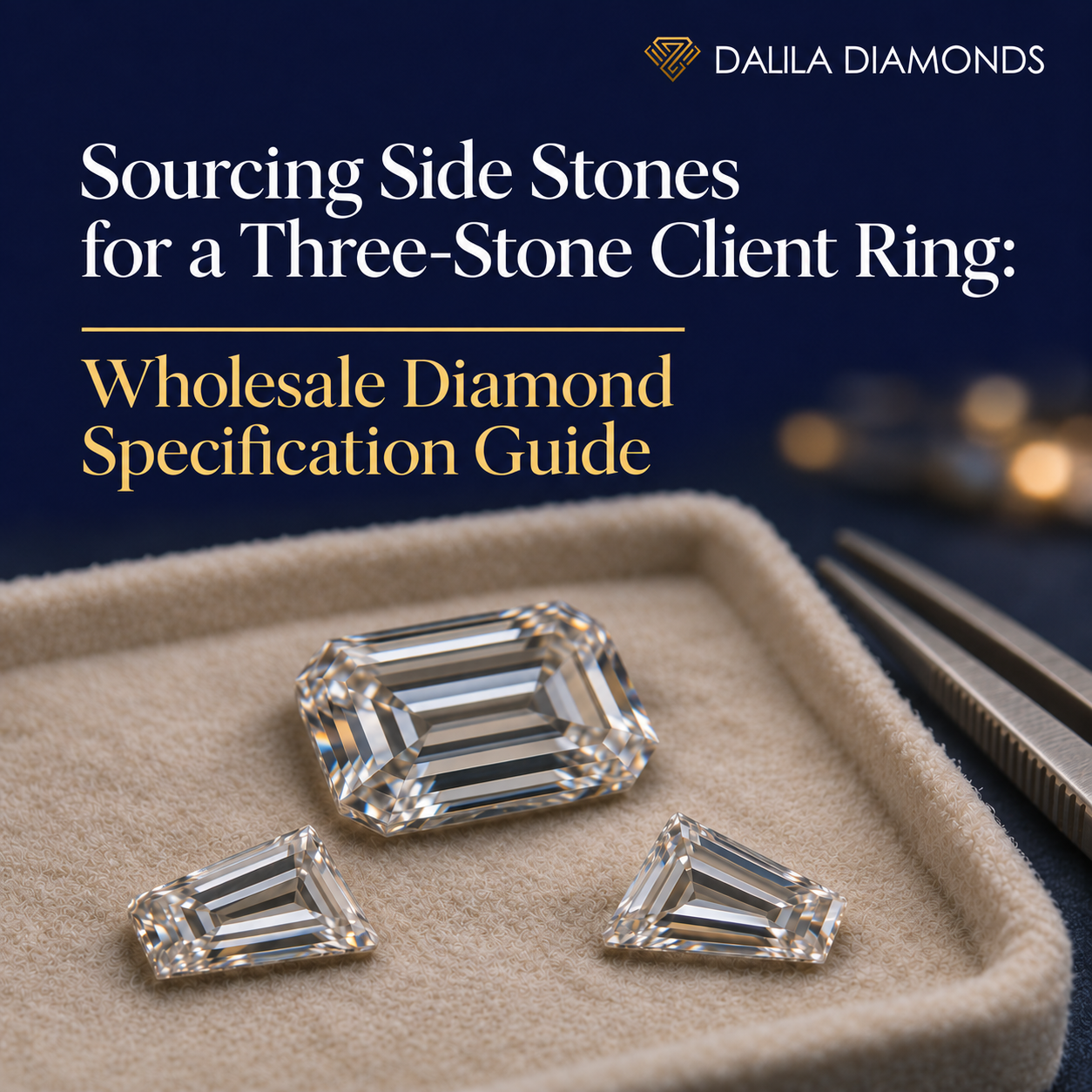
Sourcing side stones for a three-stone diamond ring starts with the actual centre diamond and the approved jewellery design—not with two side diamonds that happen to have matching carat weights.
For a well-proportioned three-stone ring, the two side diamonds must work together as a symmetrical pair while also complementing the centre stone in size, outline, colour, brightness and setting height.
This creates two separate sourcing requirements.
First, the left and right diamonds must be visually compatible with one another.
Second, the complete three-stone arrangement must have the proportions intended by the client and manufacturing jeweller.
For example, suppose a jeweller is making a natural diamond engagement ring around a 1.00-carat round brilliant centre diamond measuring approximately 6.5 mm.
The client wants a classic three-stone appearance with two smaller round brilliants.
The jeweller might initially compare side stones measuring 3.5 mm, 4.0 mm and 4.5 mm.
All three choices could create workable visual concepts.
However, each produces a different centre-to-side relationship, total diamond weight and ring-head layout.
The jeweller must decide which combination fits the client's approved design before asking a supplier for available side-stone pairs.
For mixed-shape rings, the requirements become more specialised.
An emerald-cut centre with tapered baguettes needs suitable side-stone lengths, widths, tapers and facet orientations.
An oval centre with half-moons requires compatible curves and mirrored outlines.
A professional side-stone RFQ should therefore contain the centre diamond's verified dimensions, the intended left/right arrangement, approved side-stone measurement ranges, colour and clarity requirements, grading or origin documentation, budget and deadline.
This guide explains how to build that specification, including real documented design references, technical layout examples and wholesale sourcing worksheets.
What Are Side Stones in a Three-Stone Ring?
A three-stone ring contains a centre gemstone with one stone positioned on each side.
In natural diamond jewellery, the centre may be a round brilliant, oval, emerald cut, cushion or another shape.
The accompanying diamonds may match the centre shape or use contrasting cuts.
Common combinations include:
Centre diamond | Side diamonds | Intended appearance |
Round brilliant | Two smaller rounds | Classic graduated three-stone design |
Oval | Two smaller ovals | Continuous elongated shapes |
Oval | Half-moon pair | Curved side framing |
Emerald cut | Tapered baguettes | Architectural step-cut design |
Emerald cut | Trapezoids | Broad geometric shoulders |
Radiant | Trapezoids | Brilliant centre with geometric sides |
Cushion | Half-moons or trapezoids | Soft or structured framing |
Marquise | Trillion or other approved side shapes | Contrasting geometry |
The manufacturing jeweller should choose the arrangement according to the centre's actual outline and the approved design.
A wholesale supplier should not infer the correct side-stone shape simply from the centre's carat weight.
The Two Measurements Every Three-Stone Supplier Needs
The first is the physical size of the centre diamond.
The second is the required visual size of each side diamond relative to that centre.
For matching shapes, a basic starting calculation is the ratio between the side-stone face-up width and the centre-stone face-up width.
For example:
Side-to-centre width ratio = Side-stone width ÷ Centre-stone width × 100
If the centre diamond measures 6.50 mm and each side diamond measures 4.00 mm:
4.00 ÷ 6.50 × 100 = 61.5%.
This means the side stones have approximately 61.5% of the centre's face-up width.
It does not mean they weigh 61.5% as much.
Nor does it mean that 61.5% is the universally correct design ratio.
The ratio is a visual planning tool.
For fancy shapes, additional measurements and outline comparisons are required.
Centre-to-Side Proportions: A Practical Trade Reference
A jeweller might consider several size relationships before finalising the design.
The following percentages are illustrative design starting points, not universal trade tolerances.
Side width relative to centre | Possible visual effect |
Around 45–50% | More subtle side accents |
Around 55–60% | Clearly visible but centre-dominant |
Around 60–70% | Balanced, substantial three-stone appearance |
Around 70–80% | Prominent side diamonds |
Above approximately 80% | More continuous three-stone coverage; centre distinction may be reduced |
Actual appearance depends on shape, orientation, setting gaps, ring size and finger coverage.
A tapered baguette's visible face-up width should not be treated as directly interchangeable with a round diamond's diameter.
The manufacturer should compare the complete stone outlines.
Why proportions matter
Side stones that are too small for the intended design may appear incidental.
Side stones that are too large may compete visually with the centre diamond.
A pair may also be physically unsuitable for the ring's shoulders.
Therefore, the supplier should receive the manufacturer's intended millimetre dimensions rather than a vague request for "two proportional side diamonds."
Worked Layout 1: Round Centre with Two Round Side Diamonds
Consider an illustrative natural diamond ring using a one-carat round brilliant centre.
Centre specification
Characteristic | Centre diamond |
Origin | Natural |
Shape | Round brilliant |
Weight | Approximately 1.00 ct |
Face-up diameter | Approximately 6.50 mm |
Colour | G |
Clarity | VS2 |
Report | Individual recognised laboratory report |
Side-stone comparison
Layout | Left diameter | Centre diameter | Right diameter | Side/centre ratio |
A — delicate | 3.50 mm | 6.50 mm | 3.50 mm | 53.8% |
B — balanced | 4.00 mm | 6.50 mm | 4.00 mm | 61.5% |
C — prominent | 4.50 mm | 6.50 mm | 4.50 mm | 69.2% |
The side-stone diameters are hypothetical design choices.
They have not been taken from an actual Dalila order or approved CAD design.
Approximate weight comparison
Layout | Approximate weight per side | Pair total | Complete three-stone weight |
A | 0.16 ct | 0.32 ctw | 1.32 ctw |
B | 0.25 ct | 0.50 ctw | 1.50 ctw |
C | 0.35 ct | 0.70 ctw | 1.70 ctw |
These values are approximate for typical round brilliant proportions.
The actual weight depends on each diamond's cut.
Layout B: Technical concept
The preliminary plan is:
Left round: 4.00 mm — Centre round: 6.50 mm — Right round: 4.00 mm
The jeweller can now evaluate the arrangement in CAD or another scale-accurate design environment.
A useful manufacturing drawing should identify the left and right stones, centreline, proposed setting positions and the required spacing between mountings.
The supplier RFQ should specify that the side stones are intended as a symmetrical pair around the same centre.
Real Documented Layout: Oval Centre with Two Oval Side Diamonds
A publicly documented three-stone engagement ring featured in GIA's three-stone buying guide uses:
Centre diamond: 1.70 carat oval.
Two side diamonds: 0.78 carat total.
This represents an actual published jewellery example, credited there to EraGem, rather than an invented customer project.
Documented carat relationship
Component | Published specification |
Centre oval | 1.70 ct |
Side diamonds combined | 0.78 ctw |
Average side weight, if evenly distributed | 0.39 ct |
Total diamond weight | 2.48 ctw |
Pair weight relative to centre | Approximately 45.9% |
The published description does not establish that the two side diamonds weigh exactly 0.39 carat each.
That value is simply half of the documented pair total.
More importantly, GIA's published description does not provide the three stones' actual length, width or depth.
Consequently, this real layout can demonstrate a verified carat-weight relationship, but it cannot be used as a verified millimetre-level matched-pair specification.
How a trade buyer should use this reference
The jeweller can use the documented design as visual inspiration.
The actual sourcing RFQ must then define:
Centre oval length, width and depth.
Preferred side oval length and width.
Required outline relationship.
Desired side-to-centre visual ratio.
Setting height and alignment.
Left/right symmetry.
Colour and clarity requirements.
This is the distinction between a real design reference and a manufacturing-ready diamond specification.
A published ring photograph is useful, but it does not replace measured stone data.
Worked Layout 2: Oval Centre with Two Smaller Ovals
Suppose a manufacturer has already selected an oval centre measuring 8.00 × 5.70 mm.
The ring will have two smaller natural oval diamonds, one on either side.
Preliminary layout
Stone | Shape | Length | Width | L/W ratio |
Left | Oval | 5.20 mm | 3.70 mm | 1.41 |
Centre | Oval | 8.00 mm | 5.70 mm | 1.40 |
Right | Oval | 5.20 mm | 3.70 mm | 1.41 |
These are hypothetical planning measurements, not actual stock stones.
The side-stone width relative to the centre width is:
3.70 ÷ 5.70 × 100 = 64.9%.
Their length relative to the centre length is:
5.20 ÷ 8.00 × 100 = 65%.
The similar ratios create a plausible starting point for a coordinated layout.
However, the jeweller must also inspect the shape of the oval shoulders, the ends, pavilion geometry and the proposed head construction.
Why matching ratios alone is insufficient
Two ovals may both have a length-to-width ratio of 1.41 yet differ in outline.
One might have broad shoulders and rounded ends.
Another may appear narrow through the middle or more pointed at its ends.
When placed symmetrically around a larger oval, those differences can become visible.
The buyer should therefore request face-up photographs or videos of the proposed pair and compare the actual outlines.
The full trade method for selecting two closely matched diamonds belongs in Dalila's existing matched-pair buying guide.
Worked Layout 3: Emerald-Cut Centre with Tapered Baguettes
An emerald-cut centre with tapered baguette side stones is a more geometry-sensitive design.
The side stones must frame the centre without creating an awkward change in width, angle or setting height.
For example, consider an emerald-cut centre measuring 8.00 × 6.00 mm.
A manufacturer may explore tapered baguettes with different widths at their inner and outer ends.
Illustrative geometric brief
Component | Preliminary target |
Centre | Emerald cut, 8.00 × 6.00 mm |
Left side | Tapered baguette |
Right side | Matching mirrored tapered baguette |
Longitudinal dimension | To be derived from CAD |
Inner-end width | CAD-approved measurement |
Outer-end width | CAD-approved measurement |
Taper angles | CAD-approved |
Total depth | Must suit setting |
Facet orientation | Visually compatible |
Pair relationship | Deliberately matched left/right |
A supplier should not receive an arbitrary instruction such as "two 0.20-carat tapered baguettes."
That describes approximate weight, not the geometry required for the mounting.
Measurements required for each baguette
Measurement | Left | Right |
Length | ______ mm | ______ mm |
Wider-end width | ______ mm | ______ mm |
Narrower-end width | ______ mm | ______ mm |
Total depth | ______ mm | ______ mm |
Taper angle | ______ | ______ |
Corner shape | ______ | ______ |
Facet orientation | ______ | ______ |
Girdle condition | ______ | ______ |
The manufacturer should also provide a scaled face-up drawing.
The side-stone pair should be evaluated as a left/right arrangement rather than two unrelated loose diamonds.
Worked Layout 4: Emerald or Radiant Centre with Trapezoid Sides
Trapezoid diamonds are frequently used to create a geometric transition from a rectangular centre towards a ring's shoulders.
For this design, the centre diamond's corner profile and long-side geometry become especially important.
What makes trapezoid matching difficult?
Two trapezoids can have similar weight and overall dimensions but visibly different angles.
One may taper more strongly.
Another may have a broader outer edge.
The arrangement can then look unbalanced even if the diamonds have equivalent colour and clarity grades.
Trapezoid sourcing requirements
Feature | Why it matters |
Inner edge | Relationship to centre stone |
Outer edge | Transition into shoulders |
Length | Side-stone visual coverage |
Width | Overall three-stone balance |
Taper angle | Symmetry of left/right layout |
Corner geometry | Head and prong construction |
Depth | Setting height |
Facet style | Optical compatibility |
Colour | Consistency with centre |
Clarity | Appearance and durability |
Left/right designation | Prevents orientation errors |
The CAD layout should establish the required trapezoid geometry before the final stones are approved.
For unusual combinations, the jeweller may need to adjust the mounting around the actual available matched pair.
Matching Side-Stone Colour to the Centre Diamond
A side pair can match internally but still contrast noticeably with the centre diamond.
For example, a ring may contain an H-colour centre and two D-colour side diamonds.
The sides may look whiter than the centre.
That contrast may be intentional, but for a traditional harmonious design the buyer may prefer a closer colour relationship.
GIA's side-stone guidance recommends generally choosing side stones within roughly one or two colour grades of the centre when colour continuity is the objective.
This is a practical visual guideline, not a mandatory laboratory rule.
Colour planning examples
Centre colour | Side colours worth comparing | Objective |
D–E | D–F | Colourless appearance |
F | E–G | Consistent high-colour look |
G | F–H | Near-colourless harmony |
H | G–I | Balanced near-colourless appearance |
I | H–J | Reduce unintended contrast |
J | I–K, subject to visual review | More compatible warmth |
Fancy-colour centre | Separate deliberate design | Intentional colour contrast |
Actual diamonds must be compared under appropriate lighting.
The buyer should not assume that two identical grading letters guarantee identical face-up appearance.
The metal colour and the stones' facet structures can influence visual perception.
Do Side Stones Need the Same Clarity Grade as the Centre?
Not necessarily.
The side stones should have compatible visible quality, but identical laboratory grades are not universally required.
For example, a VS1 centre could be paired with carefully selected VS2 side diamonds.
A VS2 centre might also work with suitably clean SI1 side stones.
The buyer should examine the actual stones.
Practical clarity requirements
Consideration | Desired outcome |
Face-up inclusions | No unacceptable distracting mismatch |
Transparency | Clear, compatible appearance |
Durability | No unacceptable vulnerable damage or features |
Pair consistency | Similar visual cleanliness |
Centre relationship | Side diamonds should complement the centre |
Reporting | Accurate, verifiable quality description |
Higher clarity does not always produce a visibly better three-stone arrangement.
A well-matched pair at an appropriate grade may be preferable to two higher-graded but visibly different stones.
Matching Facet Style and Brightness
The centre and side stones may use the same or different cutting styles.
A round brilliant centre with round brilliant sides generally offers a relatively consistent facet language.
An emerald-cut centre with tapered baguettes creates a step-cut arrangement.
A radiant centre with step-cut traps may intentionally combine different optical patterns.
These combinations can all be successful when chosen deliberately.
What the manufacturer should evaluate
Optical factor | Evaluation |
Brightness | No distracting imbalance |
Facet pattern | Compatible with design |
Transparency | No hazy or cloudy outlier |
Dark areas | No unwanted persistent dark appearance |
Outline | Correct framing of centre |
Face-up orientation | Left and right visually balanced |
Setting height | Stones aligned as intended |
The goal is not necessarily identical sparkle.
For mixed cuts, differing facet behaviour is expected.
The goal is a coherent final design.
Why Total Depth Matters for Side Stones
Two stones can have similar face-up length and width but different depths.
That difference may affect how high each stone sits.
For a symmetric three-stone ring, inconsistent mounting height can disturb the intended profile.
Illustrative side-stone comparison
Specification | Left stone | Right stone |
Width | 4.00 mm | 4.00 mm |
Depth | 2.45 mm | 2.65 mm |
Colour | G | G |
Clarity | VS2 | VS2 |
Weight | Approximately 0.25 ct | Approximately 0.25 ct |
These are hypothetical figures to illustrate dimensional variation.
The actual stones' weight, cutting style and depth must be verified.
A 0.20 mm depth difference may matter for a tightly constrained mounting, while another design may accommodate it through individual head adjustments.
The acceptable tolerance belongs to the manufacturing jeweller.
The supplier should not assume that the same face-up size guarantees the same setting height.
Setting Tolerances: What Should the Supplier Actually Receive?
The supplier needs a permitted measurement range for each side stone.
The range should distinguish visual preferences from structural limits.
Example round side-stone calibration
Suppose the design targets round side stones of 4.00 mm diameter.
The jeweller might specify:
Requirement | Illustrative value |
Target diameter | 4.00 mm |
Accepted minimum | 3.98 mm |
Accepted maximum | 4.03 mm |
Left/right diameter difference | Jeweller-approved maximum |
Accepted depth range | Jeweller to specify |
Girdle requirements | Jeweller to specify |
Setting type | Approved prong head |
Orientation | Symmetric |
The 3.98–4.03 mm range is only an illustrative contractual specification.
It is not an industry-wide universal tolerance.
A different mounting or stone size may require another range.
Three tolerance categories
Sourcing tolerance: Which stones may enter the shortlist.
Matched-pair tolerance: How closely left and right stones must resemble each other.
Setting tolerance: Which dimensions the physical mounting can safely accept.
These categories are related but not interchangeable.
The manufacturer should approve all mandatory setting constraints.
Does Every Side Diamond Need an Individual GIA, IGI or HRD Report?
Not necessarily.
The documentation required depends on the diamond size, sourcing method, client specification and available laboratory services.
Larger side diamonds may have individual grading reports.
Smaller side stones may be supplied under an agreed parcel or pair specification rather than individual reports.
For a high-value three-stone project, the buyer may want individual laboratory reports for all three diamonds.
However, that should be established in the RFQ before sourcing begins.
Side-stone report specification
Field | Left side | Centre | Right side |
Origin | Natural | Natural | Natural |
Report required | Yes / No | Yes / No | Yes / No |
Laboratory | ______ | ______ | ______ |
Report number | ______ | ______ | ______ |
Stock reference | ______ | ______ | ______ |
Shape | ______ | ______ | ______ |
Carat weight | ______ | ______ | ______ |
Measurements | ______ | ______ | ______ |
Colour | ______ | ______ | ______ |
Clarity | ______ | ______ | ______ |
Fluorescence | ______ | ______ | ______ |
Inscription | ______ | ______ | ______ |
If the side stones are supplied without individual reports, the buyer should understand exactly what origin and quality documentation is available.
A centre diamond's grading report does not certify the side stones.
How to Specify Natural Origin for Wholesale Side Diamonds
A jewellery business selling a ring as containing natural diamonds should obtain appropriate documentation supporting that representation.
Natural and laboratory-grown diamonds can be visually similar.
Therefore, origin should not be established from a photograph alone.
The RFQ should state that natural diamonds are required and identify the supporting evidence expected.
Possible documentation may include individual laboratory reports or suitable supplier and screening documentation for smaller stones.
The buyer should not describe all side stones as individually GIA-certified unless each stone has the relevant individual report.
A pair supplied under a parcel-origin screening arrangement should be represented accurately.
How to Evaluate Real Wholesale Availability
A supplier may have several individual diamonds in inventory without having a suitable matched pair available.
That distinction matters.
For example, the supplier may locate one excellent 4.00 mm natural round brilliant but have difficulty finding a second compatible stone within the required appearance and depth limits.
Availability should be confirmed for the complete pair.
Stock confirmation checklist
Question | Why it matters |
Are both stones available now? | Avoids partial supply |
Are they offered as a matched pair? | Confirms sourcing objective |
Are individual stock references supplied? | Traceability |
Are actual dimensions available? | Manufacturing approval |
Can both stones be viewed together? | Visual match |
Are grading reports available? | Documentation |
What is the pair's combined price? | Quote accuracy |
Can the supplier reserve both? | Inventory control |
What are the delivery terms? | Production scheduling |
What if one stone fails inspection? | Avoids stranded single stone |
For a client ring requiring strict symmetry, ask how the supplier handles a situation in which one side diamond is rejected.
The commercial terms should cover whether the pair can be returned or replaced together.
Trade RFQ Example: Round Three-Stone Ring
The following is a supplier-ready example to be completed with actual project values.
Project: Natural diamond three-stone engagement ring.
Centre diamond: Natural round brilliant, 1.00 ct, approximately 6.50 mm diameter.
Centre report: Attach actual report.
Side stones required: Two natural round brilliant diamonds.
Target diameter: Approximately 4.00 mm each.
Target weight: Approximately 0.25 ct each, subject to real measurements.
Colour: G–H, to complement G-colour centre.
Clarity: VS2 or visually compatible approved alternative.
Cut appearance: Attractive brightness, consistent full-cut round brilliant appearance.
Left/right matching: Pair must be matched in diameter, depth, colour, transparency and optical appearance.
Setting: Custom three-stone prong design.
Approved dimensional tolerance: To be inserted from manufacturer.
Individual reports: Required or optional, as agreed.
Origin documentation: Natural origin required.
Price ceiling: €[approved pair budget].
Delivery destination: [authorised workshop address].
Deadline: [required stone receipt date].
Supplier response: Stock references, actual measurements, reports or documentation, paired visual images and current quotation.
Approval: Both stones subject to manufacturer and buyer approval before purchase.
Do not release this RFQ as final until the actual centre report, tolerance, budget and deadline are provided.
Trade RFQ Example: Emerald Centre with Tapered Baguettes
Project: Natural diamond three-stone ring.
Centre: Emerald cut, exact measurements attached.
Side-stone quantity: Two.
Side-stone shape: Tapered baguette.
Pair orientation: Deliberate left/right arrangement.
Target dimensions: Manufacturer CAD attached.
Length: Approved range to be inserted.
Wide-end width: Approved range to be inserted.
Narrow-end width: Approved range to be inserted.
Depth: Manufacturer-approved.
Taper: Match CAD angles and centre geometry.
Colour: Compatible with centre.
Clarity: Visually appropriate, subject to inspection.
Facet style: Step-cut appearance.
Natural origin: Required.
Documentation: As agreed for actual stone sizes.
Quotation: Combined matched-pair price with stock or parcel references.
Delivery: Confirmed workshop location and date.
Approval: Buyer and setter must approve the actual pair before manufacturing proceeds.
Unlike a simple round-diamond RFQ, this request depends heavily on the CAD drawing.
Without it, the supplier may identify attractive tapered baguettes that cannot be used in the intended mounting.
Complete Side-Stone Wholesale Sourcing Worksheet
A. Client ring project
Field | Information |
Project reference | ______ |
Jewellery type | Three-stone ring |
Ring size | ______ |
Metal and alloy | ______ |
Centre setting design | ______ |
Side setting design | ______ |
CAD or technical drawing | ______ |
Client-approved visual reference | ______ |
Manufacturing jeweller | ______ |
Finished jewellery deadline | ______ |
B. Existing centre diamond
Field | Information |
Natural origin | Confirmed / Pending |
Shape | ______ |
Carat weight | ______ |
Length or minimum diameter | ______ mm |
Width or maximum diameter | ______ mm |
Total depth | ______ mm |
L/W ratio, if relevant | ______ |
Colour | ______ |
Clarity | ______ |
Cut/facet style | ______ |
Fluorescence | ______ |
Laboratory | ______ |
Report number | ______ |
Stock or supplier reference | ______ |
Physical stone available for matching | Yes / No |
C. Side-stone design specification
Requirement | Left side | Right side |
Shape | ______ | ______ |
Target carat weight | ______ | ______ |
Target length/diameter | ______ | ______ |
Minimum accepted dimension | ______ | ______ |
Maximum accepted dimension | ______ | ______ |
Target width | ______ | ______ |
Total depth | ______ | ______ |
L/W ratio | ______ | ______ |
Taper/angle | ______ | ______ |
Outline details | ______ | ______ |
Girdle requirements | ______ | ______ |
Facet style | ______ | ______ |
Colour range | ______ | ______ |
Clarity range | ______ | ______ |
Fluorescence | ______ | ______ |
Grading report | ______ | ______ |
Orientation | ______ | ______ |
Manufacturer approval | ______ | ______ |
D. Matched-pair acceptance
Check | Status |
Both stones natural | ______ |
Left/right outlines compatible | ______ |
Face-up sizes acceptable | ______ |
Depth difference approved | ______ |
Colour consistent | ______ |
Clarity appearance consistent | ______ |
Facet style compatible | ______ |
Brightness/transparency acceptable | ______ |
Fluorescence compatible | ______ |
Setting geometry approved | ______ |
Complete pair approved together | ______ |
E. Wholesale quotation
Field | Information |
Supplier | ______ |
Left stone reference | ______ |
Right stone reference | ______ |
Left price | ______ |
Right price | ______ |
Combined pair price | ______ |
Currency | ______ |
VAT treatment | ______ |
Shipping | ______ |
Insurance | ______ |
Availability | ______ |
Reservation deadline | ______ |
Quotation expiry | ______ |
Inspection terms | ______ |
Return conditions | ______ |
Required delivery date | ______ |
F. Final manufacturing handoff
Requirement | Status |
Centre diamond received and verified | ______ |
Side-stone pair received | ______ |
Reports and origin records checked | ______ |
Actual dimensions reconciled | ______ |
Pair orientation confirmed | ______ |
CAD approved against real stones | ______ |
Stone seats approved | ______ |
Setting height approved | ______ |
Final client design approved | ______ |
Work authorised | ______ |
Completed ring inspected | ______ |
The manufacturing jeweller should retain the approved stone reference, CAD version and final acceptance record together.
How Dalila Diamonds Fits Into Side-Stone Sourcing
Dalila Diamonds publishes natural loose-diamond sourcing services, including custom requirements and matched-pair enquiries.
Its DS4U — Diamond Source For You service allows professional buyers to request diamonds according to specifications such as shape, carat range, dimensions, colour, clarity and intended jewellery use.
Dalila also describes matched pairs for earrings, side stones and three-stone ring layouts.
This is relevant when the manufacturer needs a pair selected specifically for an already identified centre diamond.
What to send Dalila
A professional enquiry should include the centre diamond's report and measurements, the desired side-stone shapes, approved CAD layout, target sizes, pair-matching requirements, budget, quantity and deadline.
For non-round shapes, include outline and taper requirements rather than relying on carat weight.
Ask for an actual available pair with measurements and suitable documentation.
What should not be assumed
Dalila's published natural loose-diamond sourcing service does not automatically establish that the company:
Manufactures the finished three-stone ring.
Designs the client's mounting.
Guarantees every matched pair is available.
Holds stock indefinitely without reservation.
Provides individual grading reports for every small side diamond.
Approves setting fit for a customer-owned mounting.
Accepts returns outside the agreed terms.
The manufacturer must approve the actual stones and take responsibility for the completed jewellery.
How to Avoid Common Three-Stone Sourcing Mistakes
Ordering side stones before confirming the centre diamond
A change in the centre stone may invalidate the original proportion and setting plan.
Matching only carat weight
Similar carat weight does not guarantee similar physical dimensions or appearance.
Choosing two individually attractive stones without comparing them together
The left/right relationship may be visibly inconsistent.
Ignoring the centre's actual outline
A trapezoid or half-moon pair may look wrong even when internally matched.
Failing to define taper or facet orientation
This can be particularly problematic for directional fancy-shaped stones.
Using an arbitrary percentage as a manufacturing tolerance
Visual ratios are design tools, not automatic setting approvals.
Ignoring depth and pavilion clearance
The pair may sit at different heights.
Choosing very white side stones for a warmer centre without approval
That may create unintended colour contrast.
Assuming all side diamonds have individual certificates
Documentation varies by stone size and sourcing arrangement.
Treating a real ring photograph as a complete measured layout
A published design image may omit critical millimetre and manufacturing specifications.
Failing to reserve both stones together
One side diamond could become unavailable before the pair is secured.
Frequently Asked Questions
What are wholesale side-stone diamonds?
They are loose diamonds sourced for placement beside a centre gemstone in jewellery such as three-stone engagement rings.
How big should side diamonds be compared with the centre?
There is no universal correct ratio. Jewellers can compare face-up dimensions and visual proportions, then approve the layout for the intended ring.
Is a 60% side-to-centre width ratio good?
It may provide a balanced starting point for certain matching-shape designs. Actual suitability depends on the shapes, mounting and client preference.
Can two 0.25-carat diamonds flank a one-carat centre?
Yes, potentially. For round brilliants, this creates a common type of centre-dominant design. The actual measurements and setting must be approved.
Do side diamonds need identical carat weights?
Not necessarily. Face-up dimensions, outline, colour and visual appearance may be more important than mathematically identical weights.
Should side diamonds match the centre colour?
For a harmonious design, they should generally look compatible. Closely related grades are a reasonable starting point, subject to actual comparison.
Can side diamonds have lower clarity than the centre?
Yes, if they satisfy the quality specification and look appropriate beside the centre.
Should both side stones have GIA reports?
That depends on stone size, customer requirements and availability. Individual reports may be requested for larger stones but are not universal for all side diamonds.
How do I match two side diamonds?
Compare their dimensions, outlines, colour, clarity appearance, depth and optical performance. Use Dalila's matched-pair guide for the detailed pair-selection method.
What is the best side-stone shape for an oval centre?
Smaller ovals, half-moons and other shapes can work. The best choice depends on the desired visual effect and manufacturing design.
Do tapered baguettes work with emerald-cut centres?
Yes. Their step-cut appearance can complement an emerald cut, but the exact taper and dimensions must be approved.
How do you match trapezoid side diamonds?
Use actual length, width, taper angles, outline, facet pattern and left/right orientation, with manufacturer-approved tolerances.
Why do side-stone depths matter?
Different depths can affect setting height, pavilion clearance and visual symmetry.
Can a side-stone pair look mismatched even with the same grades?
Yes. Shape, facet pattern, dimensions and transparency can differ despite similar report grades.
What is the difference between matching side stones and matching diamond studs?
Three-stone side diamonds are viewed directly beside each other and a centre stone, so the entire ring layout imposes additional matching requirements.
Should I choose the centre stone before sourcing side diamonds?
Usually, yes. The centre's exact dimensions and appearance help define the side-stone specification.
Can side stones be sourced before a CAD design exists?
A preliminary shortlist may be possible, but geometry-sensitive shapes should be approved against a suitable technical layout before final purchase.
Can I use a real ring picture to specify side stones?
It is useful as a visual reference, but a picture alone usually cannot establish the exact physical dimensions or tolerances.
Are all matched side pairs available immediately?
No. A suitable complete pair must be confirmed in actual stock or sourced under the supplier's agreed process.
What happens if only one suitable side diamond is available?
The buyer may need to continue searching, adjust approved requirements or change the layout. Do not purchase an isolated stone without considering complete pair availability.
Can Dalila source natural side diamonds for a client ring?
Dalila's DS4U service includes custom natural-diamond and matched-pair enquiries, subject to actual stock and commercial terms.
Does Dalila manufacture the three-stone ring?
Finished jewellery manufacturing is not established as part of its published loose-diamond sourcing service.
What documents should accompany a wholesale side-stone order?
Provide the approved specifications, actual stone references, available grading or origin documentation, measurements, invoice, delivery terms and inspection conditions.
Can I order different shapes for the centre and side stones?
Yes. Mixed-shape layouts can be attractive when the geometry and visual relationship are designed deliberately.
What should a wholesale three-stone RFQ contain?
Include the centre report, exact dimensions, side-stone shapes, approved size tolerances, outline or CAD requirements, natural-origin specification, colour, clarity, documentation, budget and deadline.
Final Checklist: Source the Pair for the Centre, Not Just Two Diamonds
Successful wholesale sourcing for a three-stone ring begins with the selected centre diamond.
The jeweller must establish the approved design, determine the side-stone proportions and define the physical geometry required for the complete arrangement.
The left and right diamonds must then be sourced as a coordinated pair.
For round stones, diameter and overall visual consistency are important.
For ovals, shape and outline become especially relevant.
For tapered baguettes, trapezoids and half-moons, geometry, orientation and setting height may be decisive.
The supplier should return real, identifiable and currently available diamond candidates rather than generic examples.
The recommended sequence is: verify the centre diamond → approve the three-stone design → establish side-stone proportions → define exact dimensional requirements → specify quality and documentation → request a complete matched pair → approve real candidate stones → confirm the setting and complete the ring.
This transforms a three-stone concept into a technically useful sourcing specification that the supplier and manufacturing jeweller can work from.