How to Choose Two Diamonds for a Toi et Moi Ring
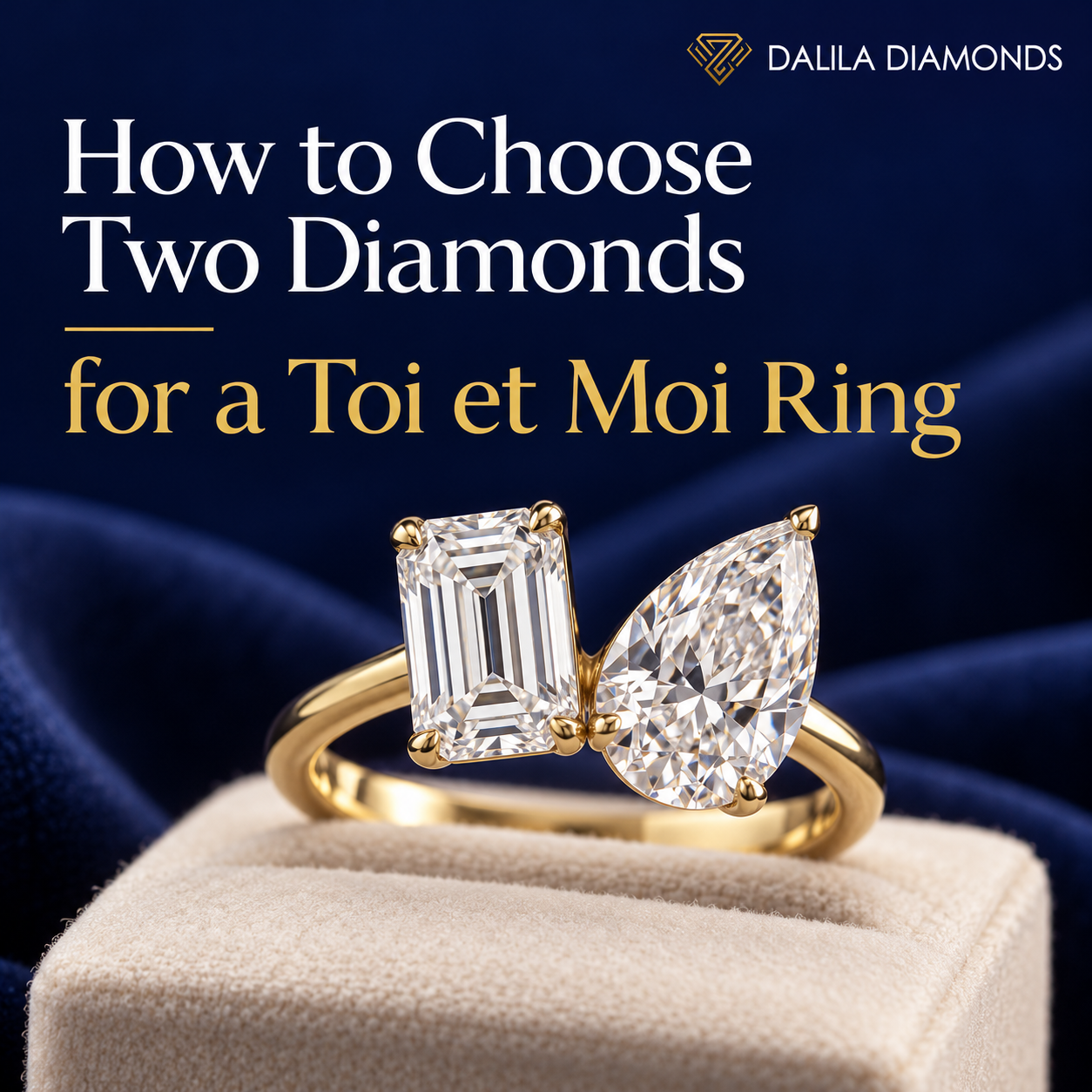
Choosing two diamonds for a Toi et Moi ring means finding stones that create an intentional relationship when placed together. The diamonds do not need to match in shape, carat weight or colour. What matters is how their actual outlines, face-up dimensions, facet patterns and setting heights work within one design.
An oval diamond beside a pear-shaped diamond, for example, can create a flowing, asymmetric arrangement. An emerald cut beside a pear or round brilliant creates a stronger contrast between geometric and curved outlines. Both approaches can work, but neither can be approved using shape names and carat weights alone.
The most useful starting point is a two-stone design brief that records each diamond's length, width, depth, colour, cutting style and intended position. The jeweller can then assess how the selected stones sit together, how their girdles and pavilions interact with the mounting, and whether the proposed design can be manufactured securely.
GIA describes the Toi et Moi ring setting as a two-gemstone arrangement in which the stones may deliberately match or contrast in shape, size and colour. The distinguishing feature is the relationship between the two stones, rather than conventional matching symmetry.
GIA
This guide focuses on choosing a complementary pair of natural diamonds for one Toi et Moi ring. It is separate from Dalila's matched-diamond guide for coordinated stones and from general diamond shape comparisons.
What Diamond Shapes Work Together in a Toi et Moi Ring?
Several pairings can create a balanced Toi et Moi design. The best combination depends on the desired silhouette and the individual diamonds' actual outlines.
Diamond combination | Visual character | Main design consideration |
Oval + pear | Curved, flowing and asymmetrical | Pear tip direction and relative outline widths |
Emerald + pear | Geometric and organic contrast | Rectangular corners beside the pear's rounded shoulder |
Round + pear | Classic brilliance with asymmetry | Apparent size and pear orientation |
Oval + emerald | Soft outline beside straight edges | Relative lengths, widths and visual emphasis |
Round + marquise | Compact circle beside elongated points | Marquise tip protection and orientation |
Radiant + oval | Two distinctive brilliant-style appearances | Face-up proportions and facet contrast |
Two pears | Mirrored or intentionally opposed shapes | Tip direction and negative space |
Two emerald cuts | Architectural, often asymmetric | Stone rotation and relative dimensions |
These combinations are design possibilities, not guarantees of physical compatibility.
A successful pairing should be evaluated in a top-view arrangement using the actual selected stones. If the planned design requires the diamonds to sit close together, the jeweller must also inspect their profiles and supports.
Shape-pairing diagrams
The illustration below compares three conceptually different arrangements: oval with pear, emerald with pear, and round with marquise. The diagrams are schematic rather than representations of specific inventory diamonds.
Start With the Two Diamonds' Actual Measurements
A Toi et Moi ring should not be specified only as "one oval and one pear, both one carat."
Two one-carat diamonds may occupy different amounts of space from above. Their depths may also differ, affecting how high they sit once mounted.
GIA grading reports generally record fancy-shape measurements as length × width × depth, while round-diamond measurements use minimum diameter, maximum diameter and depth. GIA also distinguishes shape from cutting style, which is important when evaluating visual contrast between the two diamonds.
For example, consider this hypothetical pair:
Measurement | Diamond A | Diamond B |
Shape | Oval brilliant | Pear brilliant |
Carat weight | 1.00 ct | 0.80 ct |
Length | 7.80 mm | 7.30 mm |
Width | 5.70 mm | 4.90 mm |
Total depth | 3.50 mm | 3.10 mm |
Colour | G | G |
Clarity | VS2 | VS2 |
The measurements are illustrative, not actual inventory specifications.
Although Diamond B weighs less, it is relatively close to Diamond A in length. Depending on how the stones are rotated, the pair could present two similarly prominent elongated outlines.
If the buyer wants one diamond to dominate, the relevant difference is not automatically the 0.20-carat weight gap. It is how the two outlines appear in their proposed positions.
The jeweller should assess a layout based on both stones' measurements, not generic oval and pear icons.
How to Compare Two Diamonds of Different Shapes
There are three separate questions to answer when comparing the face-up appearance of a Toi et Moi pair.
First, how long does each stone appear? A long pear beside a shorter oval may give the pear greater visual prominence despite its smaller carat weight.
Second, how wide is each stone in its proposed orientation? An emerald cut may have a relatively narrow rectangular outline while an oval with a similar length appears fuller through its shoulders.
Third, what space appears between the stones? The visible gap, or negative space, can be part of the design. It may look intentional in one orientation and awkward in another.
For an oval measuring 7.8 × 5.7 mm and a pear measuring 7.3 × 4.9 mm, simply adding their widths would not establish the finished ring's overall width.
Both stones might be rotated, partly offset or angled toward each other. Their outlines may overlap in a top-view projection without physically touching.
Therefore, request a scaled layout showing the exact shapes and their positions on the proposed band.
Choose the Orientation Before Deciding Whether the Pair Works
Stone orientation can change the appearance of a Toi et Moi ring as much as a change in stone size.
For a pear-shaped diamond, the point may face towards the other stone, away from it or diagonally along the finger. Each arrangement produces a different silhouette.
Two oval diamonds can also produce a distinctly asymmetric design if one is tilted and the other positioned more vertically.
An emerald cut beside a pear can be arranged with the rectangle relatively upright or at a diagonal. This changes the visible relationship between its corners and the pear's shoulders.
When reviewing a proposed pair, request at least two top-view layouts with different orientations. This helps establish whether the stones themselves are suitable before the mounting is finalised.
Why a general shape diagram is not enough
Two diamonds with identical reported lengths and widths can still have different outline characteristics.
An oval may have fuller or narrower shoulders. Pear diamonds can differ in the fullness of their rounded ends and the transition towards the point. Rectangular diamonds may have different corner treatments.
Consequently, an outline drawn only from nominal length and width cannot prove that two particular stones will create the intended relationship.
Use actual face-up photographs, videos or stone outlines where available, and have the jeweller confirm the design.
Check Relative Height, Not Just Face-Up Size
One of the most important technical considerations in a Toi et Moi ring is how the two diamonds sit vertically.
This issue can be overlooked when choosing a pair solely from overhead photographs.
Two stones may have appealing outlines together but quite different depths. If the mounting seats them without accounting for those differences, one table may sit significantly higher than the other.
That is not automatically incorrect. Some Toi et Moi rings deliberately create a staggered arrangement.
However, the difference should be intentional and should not create avoidable problems with comfort, security or the relationship between the two stone settings.
Diamond depth is not the same as finished setting height
A diamond's reported depth describes the distance between its table and culet or lowest point, subject to the measurement conventions of its cutting style.
Finished setting height depends on much more: the stone's position within the head, the girdle level, the structure beneath it and the elevation of the head above the band.
Two diamonds with different depths can sometimes be set with their tables at similar heights. Conversely, stones with similar total depths can be positioned at different heights for design reasons.
The jeweller must determine the actual mounting geometry.
Worked example: two stones with different depths
Consider two hypothetical diamonds:
Specification | Diamond A | Diamond B |
Shape | Oval brilliant | Emerald cut |
Face-up dimensions | 8.0 × 6.0 mm | 7.0 × 5.0 mm |
Total depth | 3.7 mm | 3.2 mm |
Proposed orientation | Slightly diagonal | More upright |
Desired relationship | Shared visual focal area | Complementary geometric contrast |
The 0.5 mm difference in total diamond depth does not necessarily mean the finished tables will be 0.5 mm apart vertically.
The jeweller must establish the proposed girdle levels, pavilion clearances, head construction and finished table elevations.
This is why both top-view and side-view drawings should be requested before approving the setting.
How to Match Colour in a Toi et Moi Diamond Ring
Colour selection depends on whether the buyer wants the two diamonds to appear similar or deliberately different.
For a coordinated white-diamond design, identical or close colour grades are a practical starting point.
A G-colour oval may work well beside an H-colour pear, but the visual result should be checked. Different shapes, facet arrangements and settings can influence perceived colour.
Intended appearance | Colour approach | What to inspect |
Harmonious colourless look | Two stones with identical or close colour grades | Face-up colour consistency |
Subtle contrast | A small difference in colour grade | Whether contrast looks intentional |
Warm-toned composition | Two diamonds selected for compatible warmth | Appearance in the chosen metal |
Strong contrast | White diamond beside a fancy-colour diamond | Hue, tone, saturation and relative visual prominence |
These are approaches rather than fixed colour-matching rules.
A buyer seeking a strongly contrasting arrangement may choose a fancy-colour centre alongside a colourless or near-colourless diamond. Natural fancy-colour diamonds use different grading considerations from the D-to-Z colour scale, including hue, tone and saturation.
GIA 4Cs
The colour appearance should be reviewed under controlled and realistic lighting, particularly when the diamonds have different cutting styles.
How Facet Patterns Affect a Two-Diamond Pair
Two diamonds may have compatible dimensions and colour but very different visual activity because of their facet patterns.
This is particularly noticeable when a brilliant-style diamond is placed beside a step-cut diamond.
Round, oval and pear brilliant diamonds generally show a more fragmented pattern of reflections and flashes. Emerald-cut diamonds use broader step facets that produce a different contrast pattern.
Neither style is automatically better for a Toi et Moi ring.
The important question is whether the contrast contributes to the intended design.
GIA's research into fancy-shaped diamonds explains that facet arrangement, outline variation and movement influence the patterns of brightness and darkness visible in the stone.
gia
Brilliant beside brilliant
An oval and pear brilliant can create a relatively cohesive sparkling appearance, although their individual optical patterns will still differ.
Review them in motion to see whether one consistently appears much darker or less lively.
Step cut beside brilliant
An emerald cut beside a pear or round brilliant creates intentional visual contrast.
The emerald cut's broad facets may produce larger, slower-looking flashes, while the brilliant-style diamond can show more numerous, smaller reflections.
This contrast may be a defining feature of the design rather than something to eliminate.
What to request before approving the pair
Ask for individual face-up videos of both diamonds and, where feasible, a side-by-side view under consistent lighting.
A grading report can identify shape, cutting style and relevant finish information, but it cannot fully establish how two differently cut diamonds will look together.
GIA also notes that its overall cut grade applies to standard round brilliant diamonds in the D-to-Z range, not all fancy shapes. Avoid interpreting a fancy-shape listing without an overall GIA cut grade as automatically inferior.
GIA 4Cs
Inspect the Two Diamonds' Girdles, Corners and Points
A Toi et Moi ring can place the two diamonds closer together than they might be in separate solitaire settings. That makes the relationship between the exposed edges, stone supports and surrounding metal particularly important.
Pay particular attention to pointed shapes such as pear, marquise and princess cuts.
A pear diamond's point requires an appropriate protective setting arrangement. An emerald cut's truncated corners also need to be considered when the stone is tilted beside another diamond.
The fact that two stones appear close together from above does not establish whether their girdles, pavilion sections or supports have adequate separation beneath the visible surface.
For example, an oval and pear might look well spaced in a photograph, but the metal required to secure their adjacent edges could affect the proposed layout. Conversely, two stone outlines that appear to overlap slightly in a top-view drawing may be positioned at different heights and remain physically separate.
Ask the jeweller to show where the two stones will be supported and how their vulnerable edges will be protected.
Do not apply a universal minimum gap measurement from an unrelated ring. The required clearance depends on the exact stones, their orientation and the mounting construction.
An Illustrated Example: Why Face-Up Fit and Setting Height Are Different Decisions
The diagram below shows two separate checks: the relationship between the stones when viewed from above and their relative positions in a simplified side profile.
Download original Toi et Moi diamond diagram
Original concept diagram using hypothetical diamond shapes, approximate outlines and schematic supports. This is not a photograph of Dalila inventory or a mechanically validated setting design. Real stone profiles, contact points and manufacturing tolerances require jeweller assessment.
In the face-up example, the diamonds have different shapes and dimensions but can still form a complementary pair.
In the profile example, their table and girdle positions illustrate that finished setting height is a separate design variable from the reported total depth of each stone.
A jeweller should confirm the final head height, clearance beneath both diamonds, and their relative positions before the mounting is manufactured.
A Practical Pairing Worksheet for a Toi et Moi Ring
Use the following worksheet before requesting stones or approving a mounting. Its purpose is to communicate the two individual diamond specifications and the relationship you want between them.
Specification | Diamond A | Diamond B |
Intended position | Left / Right | Left / Right |
Diamond shape | ______ | ______ |
Cutting style | ______ | ______ |
Carat weight | ______ | ______ |
Length (mm) | ______ | ______ |
Width (mm) | ______ | ______ |
Depth (mm) | ______ | ______ |
Length-to-width ratio | ______ | ______ |
Colour grade | ______ | ______ |
Clarity grade | ______ | ______ |
Grading laboratory | ______ | ______ |
Report number | ______ | ______ |
Facet appearance | ______ | ______ |
Girdle/edge concerns | ______ | ______ |
Intended rotation | ______ | ______ |
Proposed table height | Jeweller to confirm | Jeweller to confirm |
Proposed girdle position | Jeweller to confirm | Jeweller to confirm |
Record the planned relationship between the stones separately.
Design question | Decision to record |
Which stone should dominate visually? | Diamond A / Diamond B / Similar prominence |
Should the outlines contrast? | Yes / No |
Is visible space between the stones intentional? | Yes / No |
Should the colours look similar? | Yes / No / Deliberate contrast |
Should the facet patterns contrast? | Yes / No |
Are the stones intended to sit at similar heights? | Yes / No |
Is a straight wedding band required? | Yes / No |
Has the exact proposed layout been assessed? | Pending / Confirmed by jeweller |
The completed worksheet is a purchasing and design brief, not a substitute for a mounting drawing.
Worked Example: Pairing an Oval and Emerald-Cut Diamond
Suppose a buyer wants a Toi et Moi ring combining a brilliant-style oval and a step-cut emerald diamond.
The proposed stones have these illustrative specifications:
Specification | Diamond A | Diamond B |
Shape | Oval brilliant | Emerald cut |
Carat weight | 1.20 ct | 1.00 ct |
Dimensions | 8.2 × 6.0 × 3.7 mm | 7.0 × 5.0 × 3.3 mm |
Colour | G | G |
Clarity | VS2 | VS1 |
Facet pattern | Brilliant-style | Step-cut |
Initial position | Left, tilted inward | Right, upright |
These are hypothetical specifications, not verified available stones.
Step 1: Compare the outlines
The oval is longer and wider, so it may become the primary visual focus. The emerald cut creates a deliberate contrast through its straighter edges and clipped corners.
The two stones do not need equal carat weights to look cohesive.
Step 2: Compare the facet patterns
The oval's brilliant-style facets can create a different pattern of reflections from the emerald cut's broad step facets.
The buyer should decide whether that visual contrast is desirable. If so, the difference is an intended design characteristic rather than a mismatch.
Step 3: Review colour appearance
Both stones have the same hypothetical G colour grade, but this does not prove they will appear identical from above.
Request a direct visual comparison under consistent lighting.
Step 4: Assess relative height
The two hypothetical depths differ by 0.4 mm.
That difference does not establish their finished table-height relationship. The jeweller must determine the actual seating and mounting geometry.
Step 5: Approve the intended arrangement
Request a top-view drawing using both outlines and a profile showing the actual stone positions.
If the drawings reveal an awkward gap, excessive height or unsuitable support arrangement, revise the layout before committing to manufacture.
The result should be a deliberate two-stone composition rather than two independently chosen diamonds forced into one mounting.
A Toi et Moi Diamond Sourcing Brief for Your Supplier and Jeweller
The most useful sourcing enquiry is tied to one proposed design.
The diamond supplier provides information about potential stones and their grading characteristics. The jeweller responsible for the finished ring confirms whether the proposed pair can be mounted safely and attractively.
Information | What to provide or confirm |
Ring concept | Toi et Moi design reference and intended metal |
Diamond A | Shape, target weight, full dimensions, colour, clarity and preferred cutting style |
Diamond B | Shape, target weight, full dimensions, colour, clarity and preferred cutting style |
Visual relationship | Which stone should dominate, or whether both should appear similarly prominent |
Grading documents | Laboratory, report number and verification information where available |
Face-up appearance | Individual photographs or videos and a comparison where feasible |
Colour relationship | Similar appearance or deliberate contrast |
Facet-pattern preference | Brilliant/brilliant, brilliant/step-cut or another combination |
Actual outlines | Face-up images or scans if needed for mounting design |
Relative stone height | Jeweller's intended table and girdle positions |
Clearance and protection | Jeweller's assessment of points, corners, supports and neighbouring components |
Wedding-band fit | Intended adjacent band and compatibility assessment |
Purchasing sequence | Diamond approval, mounting confirmation and setting-work responsibilities |
For a ring being designed around two loose diamonds, have the exact stones assessed before finalising the mounting.
For an existing two-stone mounting, obtain the jeweller's approval of the stone dimensions before purchasing replacements. A mounting described as suitable for "one-carat oval and pear diamonds" does not guarantee compatibility with every pair carrying those shape and weight labels.
Dalila Diamonds can receive natural loose-diamond sourcing enquiries through its website. Include the proposed shape pairing, measurements and design reference when requesting potential stones. The precise stones' availability must be confirmed, and mounting or setting work should be arranged with the jeweller responsible for the finished ring.
Ask quotations to distinguish the cost of Diamond A, Diamond B and the separate mounting or setting work. The two diamonds' combined carat weight describes their total mass, but it does not establish their compatibility or the price of manufacturing the ring.
Frequently Asked Questions
What are the best diamond shapes for a Toi et Moi ring?
There is no universally best pairing. Oval and pear, emerald and pear, round and marquise, and oval and emerald are all possible combinations. Choose based on the intended outlines, dimensions, facet contrast and mounting arrangement rather than shape names alone.
Do Toi et Moi diamonds need to be the same carat weight?
No. Different carat weights can create a balanced design. Two diamonds with equal weight can also look very different because their shapes, proportions and depths influence their face-up dimensions. Compare the actual outlines and positions before deciding.
Should both diamonds have the same colour grade?
Not necessarily. Identical or close colour grades are useful when a coordinated colourless appearance is the objective. Deliberate colour contrast is also possible. The actual stones should be viewed together where feasible because cutting style and setting can affect perceived colour.
Can I pair an oval diamond with an emerald cut?
Yes. An oval brilliant and an emerald cut create a deliberate contrast between curved and rectangular outlines and between brilliant-style and step-cut facet patterns. Evaluate the actual dimensions, orientation, colour appearance and proposed setting height.
Which diamond should be larger in a Toi et Moi ring?
Either diamond can be larger, or both can have similar visual prominence. The choice is primarily a design decision. A longer or wider outline may appear more prominent even when the stone has a lower carat weight.
Do the two diamonds need to sit at the same height?
No. Some designs intentionally stagger the stones. However, their proposed table heights, girdle positions and pavilion clearances should be reviewed by the jeweller. Similar reported diamond depths do not automatically produce equal finished setting heights.
Is a pear-shaped diamond safe beside another diamond?
A pear diamond can be used in a Toi et Moi ring, provided its point and other vulnerable areas are appropriately accommodated by the mounting. The jeweller must assess the actual orientation, supports and clearance relative to the neighbouring stone.
Can a brilliant-cut diamond be paired with a step-cut diamond?
Yes. An oval brilliant beside an emerald cut is one example. Different facet patterns create intentional visual contrast. Compare the stones under consistent lighting to decide whether their brightness, reflection patterns and overall appearance work together.
Can two diamonds with the same length and width still look different?
Yes. Fancy-shaped diamonds can have different shoulders, curves, corners and facet arrangements despite similar headline measurements. Their depth and profile may also differ. Actual stone images and outlines are needed for a meaningful design assessment.
Can I use an existing Toi et Moi setting for two newly sourced diamonds?
Possibly, but the mounting must be assessed by the jeweller. Shape and carat weight alone do not establish compatibility. The actual dimensions, outlines, depths and setting structure must be checked before the replacement stones are approved.
How should I choose diamonds for a custom Toi et Moi engagement ring?
Start with the intended shape combination and visual relationship. Record each diamond's full measurements, colour, clarity and cutting style. Request individual images or videos, then have the jeweller review a layout that uses the proposed stones before approving the mounting.
What information should I send when sourcing two diamonds for a Toi et Moi ring?
Provide the intended ring reference, preferred shapes, target carat weights, full size ranges, colour and clarity requirements, grading preferences, facet-pattern preferences and intended relative positions. Include a mounting drawing if available and identify which details still require jeweller approval.