Natural Diamond Selection for an Active Wearer's Ring
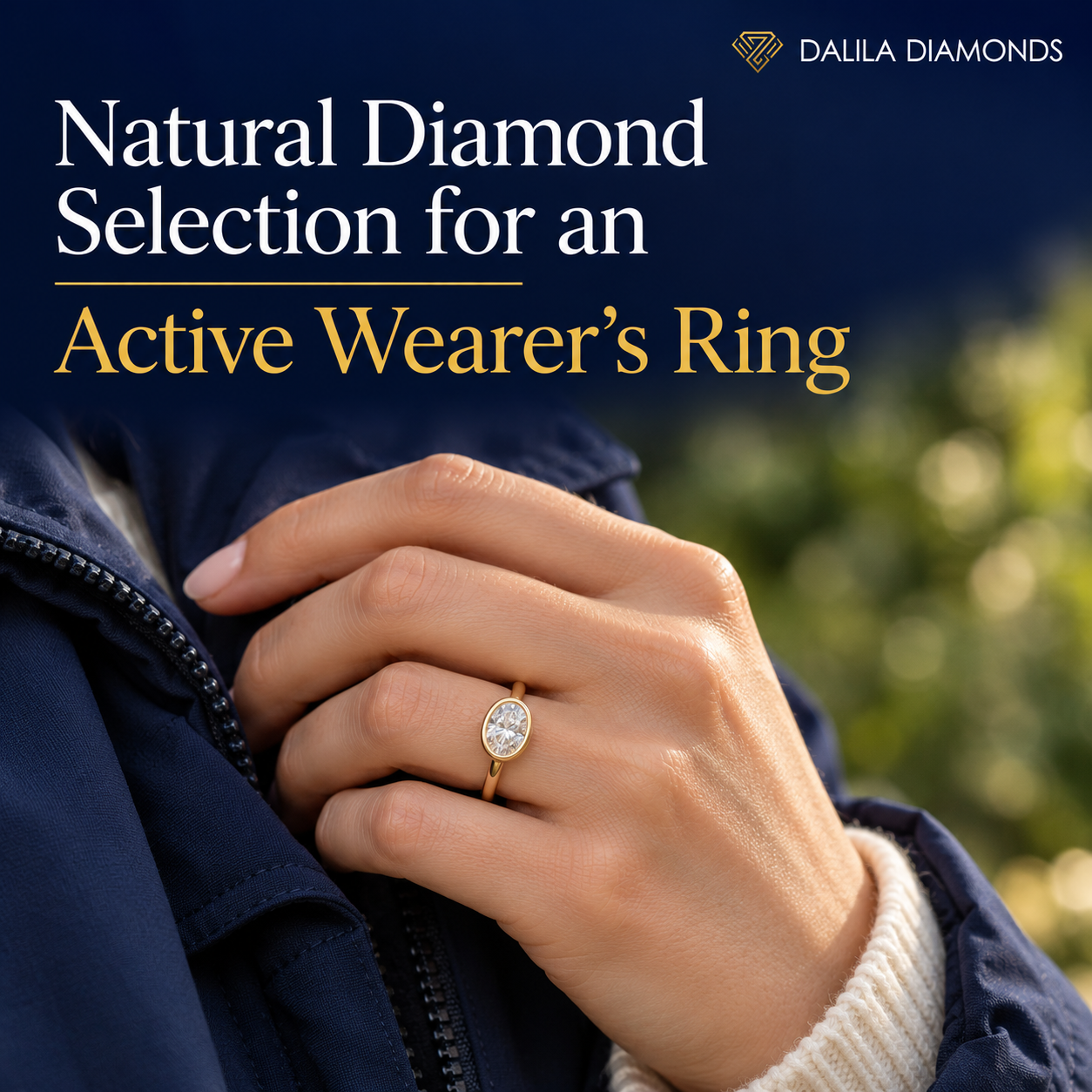
The best diamond shape for an active lifestyle ring is generally one that combines a less vulnerable outline with a setting that protects its edges and reduces the chances of snagging or impact. Round, oval and rounded-corner cushion diamonds are useful starting points because they do not have the sharp external points found on pear, marquise or princess cuts.
However, no diamond shape or ring setting is damage-proof.
A round brilliant with a highly exposed girdle can still chip after striking a hard surface. A pear-shaped diamond with a properly designed protective setting may be more suitable for a particular wearer than a poorly secured round stone.
Diamond selection should therefore consider the complete ring: the stone's shape, girdle condition, mounting construction, setting height, finger size and expected activities.
GIA's research on protecting diamonds from chipping explains that damage commonly occurs when vulnerable diamond edges or points receive hard impacts. Round, oval and rounded-corner cushion shapes avoid some of the specific point-related risks associated with angular or pointed diamonds.
gia
+1
For active wearers, the objective is not simply to choose the hardest gemstone. It is to select a natural diamond and mounting that minimise avoidable exposure while remaining appropriate for the intended use.
This guide focuses on practical diamond selection and setting exposure, rather than offering a generic comparison of diamond shapes or repeating the separate technical analysis of low-profile settings.
What Makes a Diamond Ring Suitable for an Active Lifestyle?
An active lifestyle can involve frequent contact between the hands and surrounding objects.
Examples include healthcare work, frequent glove use, gardening, outdoor activities, working with tools, sports and daily tasks that place the ring near hard surfaces.
These activities create different practical concerns.
For someone who frequently wears medical gloves, the height and smoothness of the mounting may matter more than the diamond's outline alone.
For someone who frequently handles equipment or works near hard surfaces, the exposure of the girdle, prongs and vulnerable corners becomes especially important.
A suitable ring design should therefore address three main risks:
Impact: The diamond or mounting may strike a hard object, potentially damaging the girdle, an exposed point or the metal securing the stone.
Snagging: Elevated prongs, sharp-looking edges or projecting decorative elements may catch on fabric, gloves or other materials.
Setting damage: Pressure, bending or impacts may loosen prongs or distort the mounting, increasing the risk of stone loss.
These are separate risks. A setting that reduces snagging does not necessarily eliminate the possibility of impact damage or metal deformation.
GIA advises buyers to consider their activities when choosing engagement ring settings and identifies bezels as a practical option for wearers who work with their hands.
GIA 4Cs
+1
Which Diamond Shapes Are Better for Everyday Active Wear?
Diamond shapes differ in their outline geometry.
Shapes without pronounced points or sharp corners generally avoid certain locations that are especially susceptible to chipping.
However, the actual durability of a mounted diamond also depends on girdle thickness, existing damage, inclusions and the protection supplied by the setting.
Diamond shape | Main exposure consideration | What to review |
Round brilliant | No sharp outline points, but girdle can be exposed | Girdle condition and setting coverage |
Oval | Smooth outline without sharp points | Girdle protection and shoulder exposure |
Rounded-corner cushion | Corners are less pointed | Actual corner shape and girdle |
Emerald cut | Truncated corners and straight sides | Corner geometry and retaining metal |
Asscher cut | Truncated corners | Corner protection and girdle condition |
Radiant cut | Cut corners, with geometry varying by stone | Corner positions and setting fit |
Princess cut | Four sharp corners | Protective supports at all vulnerable corners |
Pear | One pronounced point | Tip protection and exposed perimeter |
Marquise | Two pronounced points | Protection of both ends |
Heart | Pointed lower tip and shaped upper cleft | Point, cleft and support geometry |
The table describes areas to inspect, not a numerical durability ranking.
A well-designed protective setting may make a pointed shape appropriate for someone who is active, while an exposed setting may be a poor choice even with a round diamond.
Round Brilliant Diamonds for Active Wearers
A round brilliant is a practical starting point when the buyer wants a diamond without exposed external points or sharp corners.
Its circular outline avoids the concentrated tip exposure found in pear and marquise shapes.
That makes the diamond's perimeter relatively straightforward to surround with a protective bezel.
However, the absence of pointed corners does not make a round brilliant immune to damage.
A hard impact against the girdle can still produce a chip.
GIA documents examples of chipped diamonds, including round diamonds, and explains the distinction between hardness and resistance to breaking.
GIA 4Cs
+1
Round brilliant in a bezel setting
A bezel surrounds the diamond's edge with metal.
For an active wearer, this can reduce direct contact with exposed girdle sections and create a smoother exterior than some prong settings.
The bezel must nevertheless be properly designed for the actual diamond.
A poorly constructed bezel can still suffer damage or fail to secure the stone.
Round brilliant in a prong setting
A round diamond can also be worn in a prong setting.
The relevant questions are how far the diamond projects, whether vulnerable girdle areas remain exposed and whether the prongs are suitably positioned and maintained.
A four-prong setting is not automatically unsafe, and a six-prong setting is not automatically damage-proof.
The jeweller should inspect the actual head and explain how the diamond is supported.
Oval Diamonds: A Smooth Outline With Different Proportions
Oval diamonds are another useful option because they do not have the pronounced sharp tips of pear or marquise diamonds.
Their elongated appearance may appeal to buyers who want a different silhouette without introducing pointed ends.
However, the outline is not perfectly uniform between all oval diamonds.
Some have fuller shoulders, while others have narrower ends. These differences affect how a bezel or partial bezel follows the diamond.
A properly designed setting should accommodate the actual stone, not simply a generic oval of the same carat weight.
An oval's girdle can still be damaged if it is exposed to a hard impact.
The buyer should therefore evaluate the stone's girdle condition and the finished mounting together.
Oval versus round for an active wearer
Neither shape is universally safer in every ring.
Both lack sharp exterior points, which can be advantageous compared with more angular shapes.
The better option may depend on the desired setting, the diamond's individual characteristics and how the completed ring will be worn.
A smooth, well-supported oval bezel may be preferable to a highly elevated round prong setting for someone concerned primarily about catching gloves or clothing.
The result comes from the combination of diamond and setting rather than shape alone.
Cushion-Cut Diamonds: Rounded Corners Need Individual Inspection
Cushion-cut diamonds can have relatively soft, rounded outlines.
This makes certain cushions worth considering for an active wearer's ring.
However, cushion cuts vary considerably.
Some have fuller shoulders and broadly rounded corners. Others have more square-looking outlines or relatively defined corner transitions.
A cushion should therefore not be treated as automatically equivalent to a round diamond.
The jeweller should inspect the actual corner shape, girdle and intended support locations.
If a bezel is proposed, the metal should follow the stone's real outline while providing appropriate retention.
A protective mounting can reduce edge exposure, but it does not guarantee immunity from impact.
Princess-Cut Diamonds: Protecting Four Vulnerable Corners
A princess-cut diamond has a square or rectangular outline with sharp corners.
Those corners are particularly relevant to active-wear selection because they can be vulnerable to chipping if struck.
GIA identifies princess-cut corners as significant potential damage locations and discusses the use of protective prongs and suitable corner treatment.
gia
+1
This does not mean a princess-cut diamond should be rejected automatically.
It means its setting must be designed with the corners in mind.
Why V-shaped prongs matter
V-shaped prongs can wrap around and protect a pointed corner.
However, the protection must be evaluated on the actual diamond.
The prongs must be correctly shaped, seated and maintained.
A hard impact may still damage the stone or metal.
For a princess-cut ring intended for regular active wear, the buyer should ask whether all four corners receive appropriate protection and whether the head's geometry suits the actual diamond.
A small standard claw placed near a corner is not necessarily equivalent to a protective V-prong.
Pear-Shaped Diamonds: One Point Requires Special Attention
A pear-shaped diamond combines a rounded end with one pointed tip.
The point creates a distinctive appearance, but it is also an area where setting protection becomes important.
A pear may be mounted with its point facing towards the fingertip, towards the hand or at an angle.
Different orientations can change how the ring interacts with nearby objects.
However, orientation alone does not eliminate the risk of damage.
What to ask the setter
The setter should confirm how the tip will be protected and whether the metal provides suitable support without placing damaging pressure on the vulnerable point.
A properly designed V-shaped prong or appropriate bezel arrangement may provide additional protection.
GIA recommends protecting vulnerable diamond points with suitable setting elements, including bezels, partial bezels and V-prongs.
gia
+1
The rest of the pear's perimeter should also be reviewed.
Protecting the tip does not make every other exposed section of the diamond immune to impact.
Marquise Diamonds: Both Points Need Protection
A marquise diamond has two pointed ends.
This produces an elongated outline, but it also introduces two areas requiring particular attention.
For an active wearer, the jeweller should assess both tips, the surrounding girdle and the intended mounting orientation.
A protective setting may use suitable V-prongs or metal coverage designed around the actual stone.
The presence of two protected tips does not automatically guarantee a secure ring.
Prongs can bend or wear, and impacts can still reach exposed diamond edges.
A marquise can be a reasonable design choice when its appearance is important to the wearer, provided the risks and setting requirements are understood.
Emerald, Asscher and Radiant Cuts: Why Corner Geometry Matters
Emerald, Asscher and many radiant-cut diamonds have truncated or cut corners rather than the sharp square corners typical of princess cuts.
These corner shapes can reduce certain point-related vulnerabilities.
However, the exact geometry varies between individual stones.
An emerald-cut diamond with a relatively thin girdle near its corners may require special attention, even though those corners are truncated.
A radiant cut may also have different corner proportions from another radiant of similar weight and dimensions.
For these shapes, request the actual length, width and depth, then have the jeweller review the outline and girdle.
Do not assume that a truncated corner is automatically protected by any prong design.
The metal must contact and retain the actual diamond appropriately.
Why Diamond Hardness Does Not Mean Damage-Proof
Diamond ranks 10 on the Mohs hardness scale, making it extremely resistant to scratching.
However, hardness is not the same as toughness.
Hardness describes resistance to scratching, while toughness concerns resistance to breaking or chipping under mechanical force.
Diamonds can fracture along certain crystallographic directions and can be chipped by sufficiently hard impacts.
GIA's research on diamond chipping explains that impacts near edges, thin girdles and pointed corners can cause damage.
gia
+1
For active wearers, this distinction is essential.
Choosing a natural diamond does not remove the need for a protective setting.
A diamond can resist everyday scratching yet still sustain an edge chip after striking a countertop or another hard surface.
How Setting Style Changes Diamond Exposure
Choosing an appropriate shape is only one part of the decision.
The surrounding setting influences how much of the stone's perimeter remains exposed and how far the ring projects above the finger.
Setting style | Practical advantage | Important limitation |
Full bezel | Surrounds the diamond's perimeter and can create a smooth profile | Must be fitted correctly; the ring can still be damaged |
Partial bezel | Protects selected parts of the edge | Other girdle sections remain exposed |
Prong setting | Allows greater visibility of the diamond | Exposed edges and prongs require inspection |
V-prong setting | Can protect points and corners | Does not eliminate impact or metal-damage risks |
Flush setting | Can create a smooth exterior | Requires adequate band structure for the stone |
Raised solitaire | Greater visibility of diamond profile | May have more projection and potential snagging |
Tension-style setting | Distinctive open appearance | Requires specialist design and girdle assessment |
GIA's current engagement-ring setting guide describes the protective benefits of bezels and V-shaped prongs, alongside the trade-offs of more exposed mounting styles.
GIA
A finished ring should be judged by its actual geometry, not simply by its marketing label.
A low-looking bezel with inadequate support is not necessarily preferable to a professionally designed and maintained prong setting.
Technical Diagram: Exposed Points Versus Protected Diamond Edges
The diagram below compares three conceptual arrangements.
Original conceptual illustration. Left: round stone with perimeter coverage. Centre: pear with an exposed point. Right: pear with a protective V-prong. The drawings are not manufacturing specifications or validated security assessments.
Download original diamond exposure diagram (PNG)
The comparison highlights why exposure must be considered alongside shape.
A pear-shaped diamond with suitable tip protection may reduce a specific vulnerability that would remain in an exposed-point arrangement.
However, the illustrated V-prong does not protect the entire diamond. The girdle and other parts of the mounting still require assessment.
Similarly, a round diamond surrounded by metal has reduced exposed perimeter, but the setting and band can still suffer impact or deformation.
The diagram explains design considerations; it is not a durability test.
Choosing a Diamond With a Suitable Girdle for Everyday Wear
The girdle is the perimeter between the diamond's crown and pavilion. It is particularly important because many settings support and secure the stone around this region.
For an active wearer, an extremely thin girdle can be a concern, especially where the stone remains exposed.
However, there is no universally acceptable girdle thickness that applies to every diamond and ring design.
Girdle thickness may vary around the stone. A grading report's overall description does not necessarily reveal every local thin section.
The jeweller should inspect the actual points where the stone will be supported and any sections likely to remain exposed.
Practical girdle considerations
Characteristic | Why the setter should assess it |
Extremely thin sections | May be more vulnerable to edge damage |
Uneven thickness | Some areas may require different protection |
Chips or abrasions | Existing damage may affect setting suitability |
Thin corners or tips | Can increase vulnerability at concentrated points |
Inclusion near the girdle | May require closer examination before setting |
Girdle-to-prong contact | Determines how the metal engages the stone |
GIA warns that very thin girdles can increase susceptibility to chipping and recommends protecting vulnerable areas with appropriate settings.
gia
The buyer should not automatically reject every diamond with some variation in girdle thickness. Instead, the actual stone and mounting should be evaluated together.
For the broader interpretation of girdle measurements, consult Dalila's existing diamond girdle guide. This article focuses on how those measurements affect active wear.
Do Diamond Inclusions Matter for an Active Lifestyle Ring?
They can, but the effect depends on the type, size and location of the inclusion.
An inclusion inside the diamond does not automatically mean the stone is likely to break.
However, certain characteristics near a vulnerable edge, point or cleavage-related area may require additional attention.
GIA explains that some inclusions near susceptible locations can contribute to chipping risk, while many other inclusions have little practical effect on durability.
GIA 4Cs
For an active wearer's ring, the supplier should provide available grading documentation and visual information.
The setter or qualified gemmologist can then assess any potentially relevant clarity characteristics before the stone is mounted.
A blanket requirement to buy only VVS or flawless diamonds would not be justified.
A diamond with a lower clarity grade may still be suitable if its characteristics are acceptable for the intended setting.
Equally, a high clarity grade is not proof that every edge or point is protected against impact.
How Ring Height Affects Everyday Wear
A ring with a centre diamond positioned relatively high above the finger may project farther into surrounding objects.
For wearers who frequently use gloves, handle equipment or perform manual tasks, that projection may be undesirable.
A lower-profile design can reduce some snagging concerns, particularly when combined with smooth external surfaces.
However, height alone does not determine security.
The jeweller must account for the stone's pavilion, setting supports, metal thickness and the clearance needed to accommodate the diamond.
A deeper diamond does not automatically make an otherwise attractive low setting unsafe, and a shallow diamond does not guarantee a suitable low-profile ring.
For the detailed measurement process, see Dalila's Selecting a Diamond for a Low-Profile Ring.
The active-wear decision should focus on how the finished design will interact with everyday activities, while the low-profile guide addresses the separate technical measurement problem.
Prong Settings, Pavé Bands and Exposed Decorative Diamonds
The centre diamond is not always the only vulnerable part of a ring.
A design with small diamonds along the band, a hidden halo or side stones may introduce additional settings that require attention.
Small pavé diamonds depend on the surrounding metal and their individual seats.
On a ring frequently exposed to impacts or friction, the condition of those small settings can become an important maintenance issue.
GIA cautions against placing pavé diamonds on the underside of a shank where they may experience substantial friction.
GIA 4Cs
A plain band may be worth considering when the wearer prioritises simpler maintenance and fewer exposed settings.
This does not mean that every pavé design is unsuitable for daily wear.
The jeweller should assess the construction and explain the likely maintenance requirements.
Practical Examples: Matching Diamond and Setting to Different Activities
Different lifestyles produce different design priorities. The following examples are hypothetical buying scenarios, not real Dalila customer orders or guarantees of suitability.
Example 1: Healthcare worker who frequently wears gloves
Initial preference: Natural oval or round brilliant diamond in a smooth, relatively compact setting.
The main concern is reducing projections that may catch on disposable gloves.
A full bezel may be worth comparing with a compact prong setting because it offers more continuous metal coverage around the stone.
However, the buyer should also discuss infection-control requirements and workplace jewellery policies. Certain clinical activities may require rings to be removed regardless of their design.
A smooth setting is not automatically compatible with every glove, hand-hygiene procedure or professional environment.
Example 2: Buyer who frequently gardens
Initial preference: Natural round brilliant or rounded-corner cushion diamond.
The main concerns are accidental impacts, contact with hard objects and the possibility of soil or debris collecting around the mounting.
A protective bezel and relatively uncomplicated band may be useful design options.
However, gardening with the ring on can still expose the metal and stone to damage. Removing the ring before higher-risk tasks may be the more appropriate precaution.
Example 3: Buyer who prefers a princess-cut diamond
Initial preference: Natural princess-cut diamond with protective corner treatment.
The buyer wants a square brilliant appearance and does not wish to change shape solely because of lifestyle.
The jeweller should inspect all four corners, assess girdle characteristics and design the prongs or bezel around the actual diamond.
V-shaped prongs may provide valuable protection, but do not make the corners invulnerable.
The ring should be inspected periodically for loose or damaged supports.
Example 4: Buyer who wants a pear-shaped diamond for daily wear
Initial preference: Natural pear brilliant with a protected point.
The main issue is the pear's vulnerable tip.
The jeweller should assess a V-prong or appropriately designed bezel, as well as the remainder of the exposed perimeter.
A practical design may be achievable without changing to a round diamond.
The decision depends on the actual stone, the wearer and the completed ring design.
Example 5: Buyer who regularly lifts weights or plays contact sports
Initial preference: Natural diamond selected for an attractive everyday ring, with a plan to remove it during higher-risk activities.
For weightlifting and contact sports, the most important risk-control decision may be not wearing the ring during the activity.
Hard equipment, impacts and the possibility of finger injury cannot be eliminated through diamond shape selection.
A bezel-set round diamond may reduce certain exposure risks during ordinary wear, but it does not make lifting heavy equipment or contact sport safe while wearing a rigid metal ring.
Why Removing the Ring Can Be More Important Than Its Diamond Shape
Ring design can reduce certain risks, but it cannot eliminate them.
When working with heavy machinery, lifting weights, participating in contact sports or performing tasks involving strong impacts, removing the ring is often the more appropriate precaution.
This is important for both the jewellery and the wearer.
A ring can become caught on an object or equipment, potentially causing serious finger injury. Such risks are not addressed by choosing a round diamond over a princess cut.
Even in a protective bezel, a diamond may still be damaged by a significant impact, and the mounting itself may bend or break.
Therefore, an active-lifestyle ring should be viewed as a design intended to manage ordinary wear risks, not as jewellery that is safe for every activity.
What the Jeweller Must Check Before Approving an Active-Wear Ring
A supplier can provide suitable natural diamond options, but the manufacturing jeweller must evaluate the actual proposed setting.
Measurement or assessment | Why it matters |
Diamond outline | Identifies points, corners and exposed edges |
Girdle condition | Reveals thin areas, abrasions and existing damage |
Clarity characteristics near edges | Identifies locations requiring closer inspection |
Stone length, width and depth | Determines the setting geometry |
Protective tip or corner coverage | Confirms support at vulnerable locations |
Prong or bezel construction | Establishes how the diamond is held |
Finished setting height | Indicates how far the ring projects |
Head-to-band connection | Assesses the support of the centre setting |
Band width and thickness | Contributes to structural suitability |
Ring metal and alloy | Affects construction and maintenance planning |
Additional stones | Identifies other potentially exposed settings |
Intended activities | Helps evaluate practical wear and removal precautions |
Inspection access | Determines whether the mounting can be maintained effectively |
A generic recommendation such as “choose a six-prong setting” does not replace these checks.
The setter should approve the combination of the actual diamond, mounting design and intended use.
Natural Diamond Selection Worksheet for an Active Wearer
Use this worksheet to record the requirements before requesting a diamond.
Selection field | Requirement |
Intended jewellery | Engagement ring / Everyday diamond ring |
Typical activities | ______ |
Frequent glove use | Yes / No |
Regular contact with hard surfaces | Yes / No |
Diamond shape | ______ |
Carat-weight range | ______ |
Actual dimensions | ______ mm |
Colour | ______ |
Clarity | ______ |
Grading laboratory | ______ |
Girdle thickness and condition | ______ |
Vulnerable tips or corners | ______ |
Preferred setting | ______ |
Protective prongs or bezel | ______ |
Desired finished height | ______ |
Band construction | ______ |
Additional pavé or side stones | ______ |
Ring-removal precautions discussed | Yes / No |
Jeweller approval | Pending / Approved |
The worksheet helps distinguish individual diamond preferences from manufacturing and wearability requirements.
It is not a substitute for a professional setting assessment.
A Diamond Sourcing Brief for Your Supplier and Jeweller
A well-prepared natural diamond sourcing brief should identify the desired visual appearance while explaining the intended use.
The supplier can provide candidate stones and available documentation. The setter must then determine whether a selected diamond can be mounted suitably.
Information | What to provide or confirm |
Diamond shape | Preferred outline and acceptable alternatives |
Carat range | Target weight, with flexibility for suitable dimensions |
Actual measurements | Length, width and depth |
Girdle requirements | Request assessment of potentially vulnerable areas |
Clarity concerns | Note any edge-related or surface-reaching characteristics requiring review |
Quality preferences | Colour, clarity and appropriate cut characteristics |
Setting preference | Bezel, partial bezel, prong or another style |
Point/corner protection | Setter's required design |
Desired profile | Intended finished setting height |
Ring metal | Proposed metal and alloy |
Intended wear | Relevant work and everyday activities |
Setting approval | Jeweller's confirmation before manufacture |
Maintenance expectations | Inspection and care requirements |
Quotation | Diamond price separated from ring production and setting labour |
Example sourcing request
A hypothetical client might provide this specification:
Jewellery: Natural diamond engagement ring for frequent everyday wear.
Diamond preference: Round brilliant or oval.
Carat range: Approximately 0.90–1.20 carats.
Quality: G–H colour, VS1–VS2 clarity, with suitable cutting characteristics.
Grading preference: GIA, IGI or HRD.
Setting concept: Smooth bezel or another suitably protective mounting.
Wearability: Minimise unnecessary edge exposure and snagging during ordinary daily activities.
Girdle and clarity: Actual candidate to be reviewed for vulnerable characteristics before setting.
Manufacturing: Separate jeweller to confirm the finished setting, clearances, metal construction and security.
These specifications are illustrative, not a claim about current available stones.
At Dalila Diamonds, natural loose-diamond sourcing enquiries can begin with a clear description of the intended jewellery and diamond specifications.
Buyers can also include the proposed setting and lifestyle requirements when enquiring about natural diamonds through Dalila's Diamond Source For You service. Candidate availability and suitability must be confirmed.
The loose-diamond supplier and manufacturing jeweller should have clearly defined responsibilities.
A diamond grading report does not certify that a particular ring is suitable for active wear. That determination requires assessment of the finished mounting and realistic expectations about when the jewellery should be removed.
Common Mistakes When Choosing an Active-Lifestyle Diamond Ring
Assuming diamonds cannot chip
Diamonds have exceptional scratch resistance but can still chip or fracture after hard impacts.
Selecting shape without reviewing the setting
A round diamond with a vulnerable exposed girdle may be less appropriate for a particular wearer than a properly protected fancy shape.
Ignoring pointed corners
Pear, marquise, heart and princess diamonds require particular attention to their vulnerable points and corners.
Assuming every bezel offers identical protection
Bezel geometry and construction differ. The actual stone and mounting must be reviewed.
Choosing the lowest setting without considering fit
A compact design still requires adequate pavilion clearance, secure supports and suitable metal structure.
Ignoring small accent diamonds
Pavé and additional settings can introduce maintenance requirements, even if the centre diamond is well protected.
Confusing clarity grade with durability
A high clarity grade does not guarantee damage resistance. Inclusion location, girdle condition and setting exposure also matter.
Wearing the ring during every activity
No setting makes a diamond ring appropriate for every sport, occupation or manual task. Ring removal remains important where impact, entanglement or finger-injury risks exist.
Frequently Asked Questions
What is the best diamond shape for an active lifestyle ring?
Round brilliant, oval and rounded-corner cushion diamonds are useful starting points because they lack pronounced sharp external points. However, the finished setting, girdle condition and expected activities are just as important as the shape.
Is a round diamond the safest shape for everyday wear?
A round diamond avoids certain point-related chipping risks, but it is not damage-proof. An exposed girdle can still chip after a hard impact. A suitable protective setting and appropriate care remain important.
Are oval diamonds suitable for active wearers?
Yes, an oval may be suitable. Its smooth outline does not have the sharp tips of a pear or marquise. However, the actual girdle and mounting must still be assessed.
Can I wear a princess-cut diamond every day?
Yes, depending on the setting and intended activities. Princess-cut corners are vulnerable to chipping and should have appropriate protection, such as correctly designed V-shaped prongs or a suitable bezel.
Is a pear-shaped diamond too fragile for an active lifestyle?
Not necessarily. The pointed end requires particular attention, but protective setting options may reduce its exposure. The rest of the diamond and the mounting must also be evaluated.
Are bezel settings better for active people?
Bezels often provide practical advantages by surrounding the diamond's edge and reducing exposed projections. However, their effectiveness depends on the actual design and construction. They cannot eliminate all damage risks.
Can a diamond chip even if it is in a bezel?
Yes. A bezel can protect much of the girdle, but sufficiently strong impacts may still damage the diamond or its mounting. No setting is completely impact-proof.
Should I avoid diamonds with very thin girdles?
Very thin girdle sections deserve careful attention, particularly near points, corners or exposed areas. The stone's actual condition and setting should be assessed rather than relying on a blanket rule for every diamond.
Do inclusions make a diamond less durable?
Some inclusions near vulnerable locations may influence durability, but many inclusions do not create a significant practical concern. A qualified professional should inspect potentially relevant characteristics.
Is a low-profile engagement ring better for nurses?
A smooth, low-profile design may help reduce snagging on gloves. However, workplace infection-control and jewellery policies remain decisive, and the ring may need to be removed during certain activities.
Should I wear my diamond ring while lifting weights?
Removing a rigid metal ring before weightlifting is generally the safer choice because equipment can damage the jewellery or cause finger injuries. Diamond shape and setting style do not eliminate those risks.
Are four-prong or six-prong rings better for active wear?
A six-prong design may provide some retention redundancy, but prong number alone does not determine security. Prong condition, positioning, thickness, the diamond's shape and overall head construction must also be assessed.
Are pavé engagement rings suitable for active lifestyles?
They can be, but small diamonds introduce additional settings that require care. The jeweller should assess the pavé construction, especially in areas exposed to repeated friction or impacts.
Which natural diamond should I choose if I work with my hands?
Begin with a suitable shape and carefully evaluate protective settings such as bezels. Provide the jeweller with details about your actual activities and accept that some tasks may require removing the ring entirely.
What should I tell a diamond supplier when buying for an active wearer?
Share the preferred shape, carat and quality range, intended setting style, desired dimensions and any particular point, corner or girdle concerns. Explain that the selected stone will be reviewed by a jeweller for an everyday-wear design.
Original educational diagram: Download Active-Lifestyle Diamond Setting and Edge Exposure (PNG)
For publication, this diagram can accompany the setting-exposure section. To meet the content brief's requirement for real examples, add verified photographs of actual natural diamond rings showing a round bezel, a protected pear or marquise point, and a princess-cut corner setting. The current diagram demonstrates the concepts but is not evidence of a tested finished ring.
SEO distinction: B10 owns the practical choice of diamond shape, vulnerable edges and protective setting for an active wearer. The separate low-profile, bezel and girdle articles should retain their detailed technical topics.