Selecting a Diamond for a Low-Profile Ring
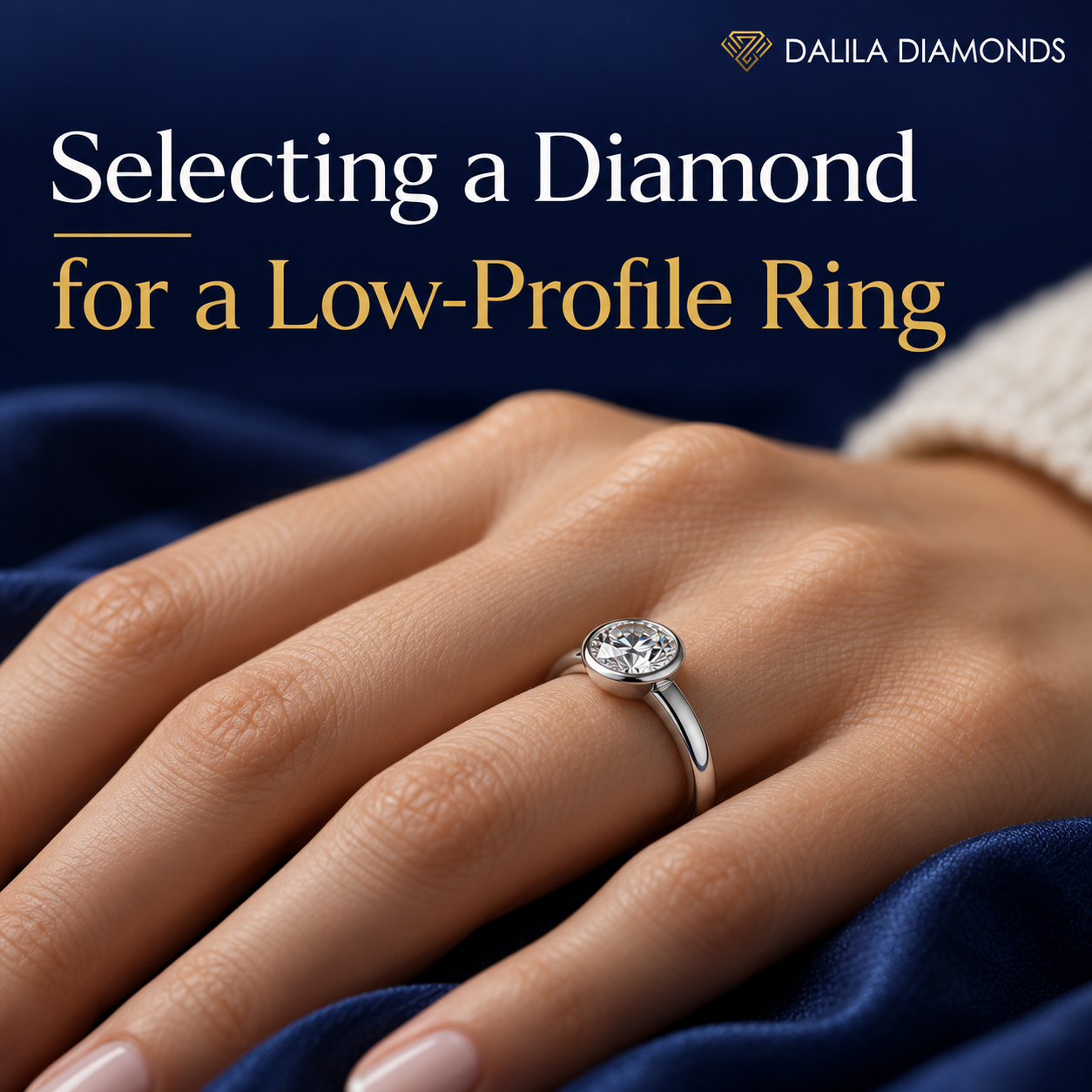
Choosing a diamond for a low-profile engagement ring means selecting a stone that can sit close to the finger without compromising its appearance, secure setting or practical wearability. The most important distinction is between the diamond's own depth and the finished height of the ring.
A diamond with a relatively shallow total depth does not automatically create a low-profile ring. The finished height also depends on where the girdle sits, how the pavilion fits within the mounting, the supports beneath the diamond and the amount of metal required to secure it.
Equally, a diamond with greater depth is not automatically unsuitable. A jeweller may be able to accommodate its profile through a different setting construction, although that design may have consequences for the band's thickness, appearance or comfort.
The best approach is to obtain the diamond's full measurements, identify the desired finished profile and have the jeweller assess whether the two are compatible.
GIA identifies bezel settings as one practical option for buyers who want a smooth, low-profile engagement ring that is less likely to catch on clothing or gloves. However, the setting's actual construction remains important.
This guide explains how to evaluate a natural diamond for a low-profile ring, including stone-depth examples, setting-height measurements, wearability considerations and a specification worksheet for the diamond supplier and jeweller.
What Makes a Diamond Ring Low Profile?
A low-profile engagement ring is generally one in which the diamond and its mounting project relatively little above the finger.
The term describes the finished ring's physical profile, not a formal diamond quality grade.
Two rings can contain diamonds of similar carat weight and still have considerably different overall heights.
For example, one ring may hold its centre diamond in a raised prong head with visible space beneath the pavilion. Another may position the diamond closer to the band within a lower bezel or integrated mounting.
Both may be secure when correctly designed, but they will have different physical profiles.
There is no universally accepted millimetre measurement that defines every low-profile engagement ring. The appropriate height depends on the selected diamond, its mounting and the wearer's preferences.
Low-profile versus high-profile ring construction
Feature | Lower-profile arrangement | Higher-profile arrangement |
Diamond position | Closer to the band | More elevated above the band |
Head construction | Compact or integrated | May use an elevated head |
Exposed setting | Often less prominent | May project farther above the finger |
Clothing contact | Potentially less snagging | More projection can increase snagging |
Wedding-band fit | Flush fit may be difficult | Some raised heads allow more clearance |
Main design check | Pavilion space and setting thickness | Head stability and finished height |
These are common design differences, not guarantees. A well-designed low-profile setting can still have exposed prongs, and a raised setting does not necessarily snag in ordinary use.
Diamond Depth and Ring Height Are Not the Same Measurement
One of the most common mistakes when selecting a diamond for a low-profile engagement ring is treating the diamond's total depth as the finished setting height.
These measurements describe different things.
Diamond depth is the distance from the table at the top of the diamond to the culet or lowest point.
Finished ring height is the vertical distance from a defined reference on the ring, usually the finger-facing surface or the intended finger-contact plane, to the highest point of the completed ring.
The distance between these points depends on how the diamond is positioned within the setting.
Consider a diamond with a measured total depth of 3.9 mm.
That figure alone does not reveal whether the completed ring will measure 5 mm, 6 mm or another height above the finger.
The jeweller must account for the stone's seating position, the metal beneath it and the overall geometry of the mounting.
The parts of a diamond that affect fitting
A diamond's vertical profile includes the crown above the girdle, the girdle itself and the pavilion below it.
The crown determines how far the table sits above the girdle. The pavilion determines how far the stone extends beneath the girdle towards the culet.
For a low-profile setting, the pavilion is particularly important because it occupies space below the diamond's widest outline.
The jeweller must determine whether that pavilion can be accommodated without touching the finger, interfering with the mounting or requiring an unacceptably thick band.
This is also why a diamond's depth percentage is not enough to approve a setting. It describes a relationship within the diamond, not the finished clearance beneath it.
How to Read Diamond Depth Measurements
For a round brilliant diamond, a grading report typically includes the minimum and maximum diameter and the total depth in millimetres.
The depth percentage is generally calculated using the total depth divided by the average diameter.
For example, consider a hypothetical round diamond measuring:
6.45–6.55 × 3.95 mm
Its average diameter is 6.50 mm.
The depth percentage is approximately:
3.95 ÷ 6.50 × 100 = 60.8%
This is useful information about the diamond's proportions.
However, it does not establish how low the stone can sit in a particular ring.
Two diamonds with similar depth percentages may have different girdle thicknesses, crown heights and pavilion dimensions. Their mounting requirements can therefore differ.
Three illustrative diamond measurements
Diamond | Average diameter | Total depth | Approx. depth percentage |
A | 6.50 mm | 3.80 mm | 58.5% |
B | 6.50 mm | 3.95 mm | 60.8% |
C | 6.50 mm | 4.10 mm | 63.1% |
These are hypothetical dimensional comparisons, not recommendations for particular diamond depth percentages.
All three stones have the same illustrative face-up diameter, but their overall depths differ.
Diamond A is 0.30 mm shallower than Diamond C. That difference may be relevant when designing a compact mounting, but it does not prove that Diamond A is better cut, more attractive or suitable for a specific setting.
A diamond's cut quality must be assessed separately.
GIA explains that increasing apparent face-up size by choosing a shallower diamond can negatively affect its light performance. Shallow proportions should therefore not be pursued solely to reduce finished ring height.
GIA 4Cs
Why a Shallower Diamond Is Not Always the Best Choice
A shallow diamond can appear attractive on paper when low setting height is the primary concern.
However, selecting a diamond solely because it has less depth can create other compromises.
For a round brilliant, overly shallow proportions may negatively affect the balance of light return, brightness and contrast. A diamond can also appear larger across its diameter without delivering equally strong visual performance.
GIA notes that diamond weight can be distributed differently between the girdle and pavilion, and that greater face-up spread does not automatically mean better appearance.
GIA 4Cs
+1
Instead of targeting the shallowest available diamond, begin with stones that meet the intended optical and quality requirements.
Then compare their actual depths and profiles against the mounting.
A useful selection sequence is to approve the diamond's appearance first, identify acceptable candidates, and ask the jeweller to assess their fitting requirements.
A slightly deeper but well-performing diamond may be preferable to a shallower alternative if the setting can accommodate it without undermining the design.
The goal is not to minimise depth at any cost. It is to find a suitable diamond whose physical dimensions are compatible with a lower-profile mounting.
How Setting Construction Changes the Finished Height
A diamond does not sit directly on the surface of the finger. It is supported by a mounting whose construction influences the overall height.
The jeweller must establish the relationship between the diamond's girdle, its pavilion, the metal supporting it and the finger-facing surface of the ring.
Different settings may use that space differently.
Low-set prong settings
A prong-set diamond can sometimes be positioned relatively close to the band.
However, the prongs must securely engage the diamond and the pavilion needs sufficient clearance from the underlying metal and finger.
The term low-set prongs is not a guarantee that every diamond of the advertised weight will fit.
A mounting designed around one diamond's proportions may need adjustment for another stone with a different depth or girdle profile.
Bezel settings
A bezel surrounds the diamond's edge with metal, creating a relatively smooth external profile.
This can be advantageous when reducing snagging is a priority.
GIA describes bezel settings as a practical choice for active wear because they offer protection around the girdle and reduce exposed projections.
GIA 4Cs
+1
However, a bezel does not eliminate the space required for the diamond's pavilion.
A deep diamond may still need a substantial bezel structure or an elevated seat.
The outside height of the finished bezel must be evaluated from the actual stone and design.
For centre-stone outline and girdle considerations specific to this setting, see Dalila's guide to Choosing a Diamond for a Bezel Engagement Ring.
Flush settings
In a flush setting, the gemstone sits within the body of the ring, often with its upper surface close to the surrounding metal.
This can create a particularly smooth exterior.
However, the diamond must fit within a band that has enough material to accommodate and secure it.
A deep centre stone may require a thicker or wider band than the buyer expects.
GIA's guide to engagement ring settings identifies band thickness as an important consideration for flush-set stones.
GIA
A flush setting is therefore not simply a universal solution for fitting any diamond at a lower height.
Cathedral and raised settings
Cathedral designs incorporate shoulders that rise towards the centre stone.
Depending on the construction, they may support the diamond in a raised position or create a more integrated appearance.
The term cathedral alone does not provide a reliable measurement of the finished height.
Some raised designs may also leave additional room for a wedding band beside the engagement ring.
The buyer should request an actual profile drawing rather than infer height from a setting-style name.
An Illustrated Example: The Same Diamond at Two Different Setting Heights
The diagram below shows why a diamond's measurements cannot independently establish the height of the finished ring.
Download original diamond depth and setting-height diagram (PNG)
Original schematic using a hypothetical diamond. The two panels show the same diamond positioned at different elevations. It is not a manufacturing drawing, and the illustrated supports, metal thicknesses and clearances are not validated engineering specifications.
In the first arrangement, the diamond sits closer to the band. In the second, the mounting elevates it farther above the finger.
The stone's own total depth is unchanged. The difference arises from its seating position and the construction beneath it.
In a real setting, the jeweller must also ensure that the pavilion has adequate clearance from the surrounding metal and finger. The first position cannot simply be lowered indefinitely.
Worked Example: Comparing Two Diamonds for a Low-Profile Ring
Suppose a buyer wants a natural round brilliant diamond of approximately one carat for a relatively low engagement ring.
Two candidates meet the initial colour, clarity and carat-weight requirements.
Specification | Diamond A | Diamond B |
Shape | Round brilliant | Round brilliant |
Weight | 1.00 ct | 1.00 ct |
Minimum diameter | 6.45 mm | 6.40 mm |
Maximum diameter | 6.55 mm | 6.50 mm |
Total depth | 3.90 mm | 4.05 mm |
Approx. depth percentage | 60.0% | 62.8% |
Intended setting | Low-set bezel | Low-set bezel |
These are hypothetical measurement examples, not actual Dalila inventory diamonds.
Diamond A has a total depth 0.15 mm less than Diamond B. At first glance, this may make A appear more suitable for a compact ring.
However, the depth difference is not enough to approve either stone.
The jeweller must assess the pavilion geometry, girdle position, seat construction and metal thickness required to accommodate each candidate.
The diamond buyer must also evaluate whether both stones meet the intended optical and quality requirements.
What happens if the desired finished height is 5.5 mm?
Assume, purely for illustration, that the buyer wants the highest point of the ring to sit approximately 5.5 mm above its defined finger-contact reference.
That desired height must be communicated to the jeweller.
A hypothetical mounting in which the diamond's table is the highest point, with the stone entirely above the reference plane, would need a total height at least equal to the diamond's total depth. The actual mounting also needs whatever vertical positioning and structural clearance its design requires.
The 5.5 mm target may or may not be feasible for either proposed diamond, depending on the entire construction.
The jeweller should prepare a scaled side view for both options and establish the necessary finished height. The buyer should not assume that a 3.90 mm deep diamond will automatically result in a 5.5 mm high ring.
What the example demonstrates
The correct selection is not necessarily the stone with the smaller depth measurement.
It is the diamond that combines acceptable visual quality with a mounting geometry that meets the wearer's practical requirements.
If neither candidate can meet the desired profile without unacceptable compromises, the design or diamond specifications should be revised.
What the Setter Must Measure Before Approving the Diamond
A low-profile diamond selection should be connected to a specific mounting, not treated as an isolated search for shallow stones.
The setter or manufacturing jeweller needs enough information to determine where the diamond can sit and whether the structure can hold it securely.
Measurement or assessment | Why it matters | Responsible party |
Exact diamond dimensions | Establishes the stone's size and vertical profile | Supplier provides; jeweller verifies |
Crown height | Helps establish table position relative to girdle | Jeweller assesses |
Pavilion depth and geometry | Determines the space required beneath the girdle | Jeweller assesses |
Girdle thickness and condition | Influences seating, edge protection and stone security | Supplier information; jeweller inspects |
Proposed girdle elevation | Defines where the diamond sits within the head | Jeweller |
Pavilion clearance | Checks separation from underlying metal and finger | Jeweller |
Metal thickness | Establishes whether adequate structural material remains | Jeweller |
Head and support construction | Determines how the diamond is secured | Jeweller |
Finished ring height | Confirms the highest point relative to an agreed reference | Jeweller |
Adjacent wedding-band clearance | Determines whether the intended band will sit alongside | Jeweller |
Finished profile and comfort | Confirms that the ring suits its intended everyday use | Jeweller and wearer |
The jeweller should assess the exact proposed stone, not only a generic one-carat diamond represented in a catalogue.
For a bespoke ring, this assessment should occur before the final mounting is manufactured.
For an existing mounting, measurements must be checked against its actual construction before committing to a replacement or centre diamond.
Why the Girdle and Pavilion Deserve Particular Attention
The girdle is the boundary between the crown and pavilion and is also a critical region for securing many mounted diamonds.
For a lower-profile design, the available mounting space can encourage a more compact arrangement around the girdle.
However, reducing height should not mean removing necessary support or leaving vulnerable edges inadequately protected.
A very thin girdle area, existing chip or certain inclusions near the edge may create concerns that require attention before setting.
GIA's engagement-ring protection guide discusses girdle damage, vulnerable corners and the protective role of appropriate settings.
GIA 4Cs
Pointed shapes such as pear, marquise and princess cuts need particular attention to their tips or corners.
A low-profile design does not automatically protect those vulnerable areas.
The jeweller must decide how the stone's actual outline, girdle and potential points of weakness can be accommodated.
For a more detailed examination of this topic, see Dalila's existing Diamond Girdle Thickness Guide rather than treating girdle durability as simply another depth percentage.
Which Diamond Shapes Work in Low-Profile Engagement Rings?
The term low profile applies to the finished ring, not to a specific diamond shape.
Round, oval, cushion, emerald, radiant, pear and other shapes can potentially be used in lower-set designs.
However, they do not all create the same mounting requirements.
Round brilliant diamonds
Round brilliant diamonds have a familiar, rotationally symmetrical outline that can be accommodated in many setting styles.
Their measured diameter, crown height, pavilion geometry and girdle characteristics remain important.
The jeweller should use the exact stone dimensions rather than assume that all one-carat rounds have equivalent depth or fitting requirements.
Oval diamonds
Oval diamonds may offer an elongated face-up appearance, but their length, width and depth do not fully describe the outline.
The shape of the shoulders and ends can affect how a bezel or compact prong arrangement follows the stone.
An oval intended for a low-profile ring should be evaluated using the actual outline and profile, particularly when the mounting is being made to closely follow the diamond.
Emerald-cut diamonds
Emerald cuts use step faceting and a rectangular outline with truncated corners.
Their shape can suit a geometric, low-profile design, but the pavilion still requires adequate room beneath the girdle.
A broad, shallow-looking face-up outline does not guarantee a low total depth or easy mounting.
Cushion and radiant diamonds
Both cushion and radiant diamonds can vary in length-to-width ratio, outline and pavilion structure.
Two stones of the same advertised shape and weight may have different seating requirements.
Ask for the full measurements and an assessment of the particular stone.
Pear and marquise diamonds
These shapes introduce pointed ends and elongated outlines.
Their mounting must provide suitable protection to the points, regardless of whether the ring is low or high profile.
The intended direction and orientation of the diamond can also influence the surrounding metal and the position of the setting on the finger.
There is no single shape that is automatically the best low-profile diamond. The right selection depends on the entire stone and mounting.
Does a Low-Profile Engagement Ring Work for Everyday Wear?
A lower setting can be appealing for people who prefer jewellery that sits close to the hand.
Reduced projection may make the ring less likely to catch on clothing or gloves, although the exact result depends on the finished design.
Smooth bezels and suitably constructed flush settings can be especially useful when snagging is a concern.
GIA discusses bezel settings as a practical option for wearers who work with their hands, including those who frequently use gloves.
GIA 4Cs
However, lower does not mean indestructible.
A diamond can still receive an impact, and the metal securing it can still wear or become damaged.
A low-profile ring may also require compromises in band thickness or design to accommodate the pavilion.
For someone who frequently performs manual work, wears protective gloves or handles heavy equipment, the most practical decision may also include removing the ring during particular activities.
Wearability should be assessed in terms of how the complete ring will actually be used, rather than the height measurement alone.
Can a Low-Profile Ring Sit Flush With a Wedding Band?
Not always.
A low-profile engagement ring may position its centre stone and head close to the band, leaving insufficient space for a straight wedding band to sit directly alongside it.
This can create a visible gap between the two rings.
A raised engagement-ring head may sometimes provide more room for an adjacent wedding band, although this depends on the actual design.
If a flush-fitting wedding band is important, that requirement should be included before the diamond and setting are finalised.
The jeweller may recommend a different head arrangement, a shaped wedding band or a coordinated ring set.
The priority should be to establish how the two completed rings fit together, not assume that a lower engagement ring will automatically produce a better stack.
Common Mistakes When Choosing a Diamond for a Low-Profile Ring
Choosing the shallowest diamond available
A smaller total depth is not automatically evidence of better proportions or optical performance.
Evaluate the diamond's quality before assessing its suitability for the mounting.
Assuming a bezel guarantees a low setting
A bezel can create a smooth exterior, but the stone's pavilion still occupies space. The finished height depends on the diamond and bezel construction together.
Confusing depth percentage with millimetres
A diamond's depth percentage is a proportion. For the mounting, the jeweller also needs the actual total depth and three-dimensional profile.
Ignoring the space beneath the pavilion
A ring cannot simply be lowered until its stone reaches the desired visual height. The mounting must preserve the required clearance and structural support.
Buying a diamond before checking an existing setting
A nominal one-carat specification does not establish compatibility with a mounting designed for another diamond.
Forgetting the wedding band
A low-set centre can affect the fit of an adjacent wedding band. Review the two rings together if they will be worn as a set.
A Low-Profile Diamond Sourcing Brief for Your Supplier and Jeweller
When requesting a natural diamond for a low-profile engagement ring, the brief should include the desired design and its physical constraints.
The supplier can identify diamonds matching the required specifications, while the jeweller determines whether those stones can be mounted at the intended height.
Information | What to provide or confirm |
Intended jewellery | Low-profile engagement ring |
Design reference | Setting photographs, drawing or mounting model |
Diamond shape | Preferred shape and outline |
Carat weight | Desired range |
Face-up dimensions | Required or preferred diameter, length and width |
Total depth | Actual millimetre measurement |
Proportions | Relevant report measurements, including depth percentage |
Quality requirements | Colour, clarity, cut characteristics and laboratory preference |
Girdle condition | Report information and current inspection |
Desired finished height | Buyer's preference, subject to jeweller approval |
Pavilion and setting clearance | Jeweller's measured assessment |
Mounting material | Planned metal and structural requirements |
Wedding-band requirement | Flush fit, shaped band or no preference |
Purchasing sequence | Stone selection, fit approval and separate mounting work |
Example sourcing request
A buyer could submit the following hypothetical requirement:
Specification | Requested information |
Diamond | Natural round brilliant |
Carat range | Approximately 0.90–1.10 ct |
Diameter | Preference around 6.4–6.6 mm, subject to proportions |
Colour | G–H |
Clarity | VS1–VS2, subject to individual assessment |
Grading preference | GIA, IGI or HRD |
Setting concept | Low-profile bezel engagement ring |
Finished height | As low as safely practical; target to be reviewed with jeweller |
Priority | Strong visual performance with manageable overall projection |
Manufacturing | Separate jeweller to confirm fit and setting design |
These are illustrative specifications, not a claim about available stock.
The brief deliberately does not impose a universal maximum diamond depth.
Instead, the buyer can request suitable candidates and provide their measurements to the jeweller for assessment.
Dalila's DS4U — Diamond Source For You service accepts natural diamond sourcing requests involving exact measurements, intended jewellery designs and specific grading requirements.
DS4U by Dalila
For a low-profile project, include the intended setting drawing and any proposed height constraint. Dalila can search for candidate loose diamonds, while the jeweller responsible for mounting and setting confirms whether each option can be used safely.
Ask quotations to distinguish the loose diamond from any separate design, mounting or setting costs. A diamond quotation alone does not establish the cost or feasibility of producing the complete low-profile ring.
Frequently Asked Questions
What is the best diamond depth for a low-profile engagement ring?
There is no universal ideal depth. The suitable measurement depends on diamond shape, cutting proportions and the mounting. Choose a diamond with acceptable visual performance and have the jeweller confirm whether its actual depth and pavilion geometry can fit the intended low-profile design.
How many millimetres high should a low-profile engagement ring be?
There is no universally accepted maximum height. Different designs may be described as low profile despite having different finished measurements. Ask the jeweller for the height from a clearly defined finger-contact reference to the highest point of the completed ring.
Does a shallow diamond make an engagement ring sit lower?
Not necessarily. A shallower diamond may require less vertical space, but finished height also depends on its seating position, pavilion clearance and metal supports. Its optical performance must be evaluated separately.
Is a bezel setting better for a low-profile diamond ring?
A bezel can be a practical choice because its smooth exterior can reduce snagging and protect the girdle. However, the diamond must still fit within the structure. A bezel does not guarantee a particular finished height.
Can a one-carat diamond be set low?
Yes, depending on the actual diamond dimensions and mounting. Carat weight alone cannot establish the lowest practical position. Ask the jeweller to assess the stone's full measurements and the intended setting.
Which diamond shape is best for a low-profile ring?
No single shape is universally best. Round, oval, emerald, cushion and other diamonds may work in compact settings. The important factors are actual depth, outline, pavilion geometry, edge protection and the mounting.
Can a deep diamond work in a low-profile engagement ring?
Possibly. The jeweller may be able to accommodate the pavilion through an appropriate mounting design, but the required structural depth may increase the finished height or band thickness. A scaled assessment is needed.
Is a low-profile ring more comfortable?
It may be, particularly when the wearer prefers less projection above the hand. However, comfort also depends on band shape, width, thickness, weight and how the head interacts with the finger. A lower setting is not automatically more comfortable.
Will a low-profile engagement ring snag less?
A compact design with smooth external surfaces may reduce snagging. However, exposed prongs, sharp edges or other projecting details can still catch on clothing and gloves. Judge the finished design rather than the low-profile label alone.
Can a low-profile ring sit flush with a straight wedding band?
Sometimes, but not always. A low head may prevent a straight band from sitting closely beside the engagement ring. Confirm the intended wedding-band fit before approving the setting.
What should I ask my jeweller to measure?
Request the finished ring height, proposed girdle position, pavilion clearance, available metal thickness, head construction and wedding-band compatibility. These should be assessed using the exact selected diamond.
Can I source the diamond before making the low-profile setting?
Yes. In a bespoke project, choosing the diamond before finalising the mounting can allow the jeweller to design around its actual measurements. However, the jeweller should confirm compatibility before the stone purchase becomes final.
Original technical diagram for publication
Download Low-Profile Diamond Depth vs Setting Height (PNG)
The diagram illustrates why identical stone depth can produce different finished ring heights. All measurement examples in this article are hypothetical; setting suitability must be verified by the jeweller working with the actual stone.