Replacing a Lost Centre Diamond in an Engagement Ring: How to Find the Right Replacement?
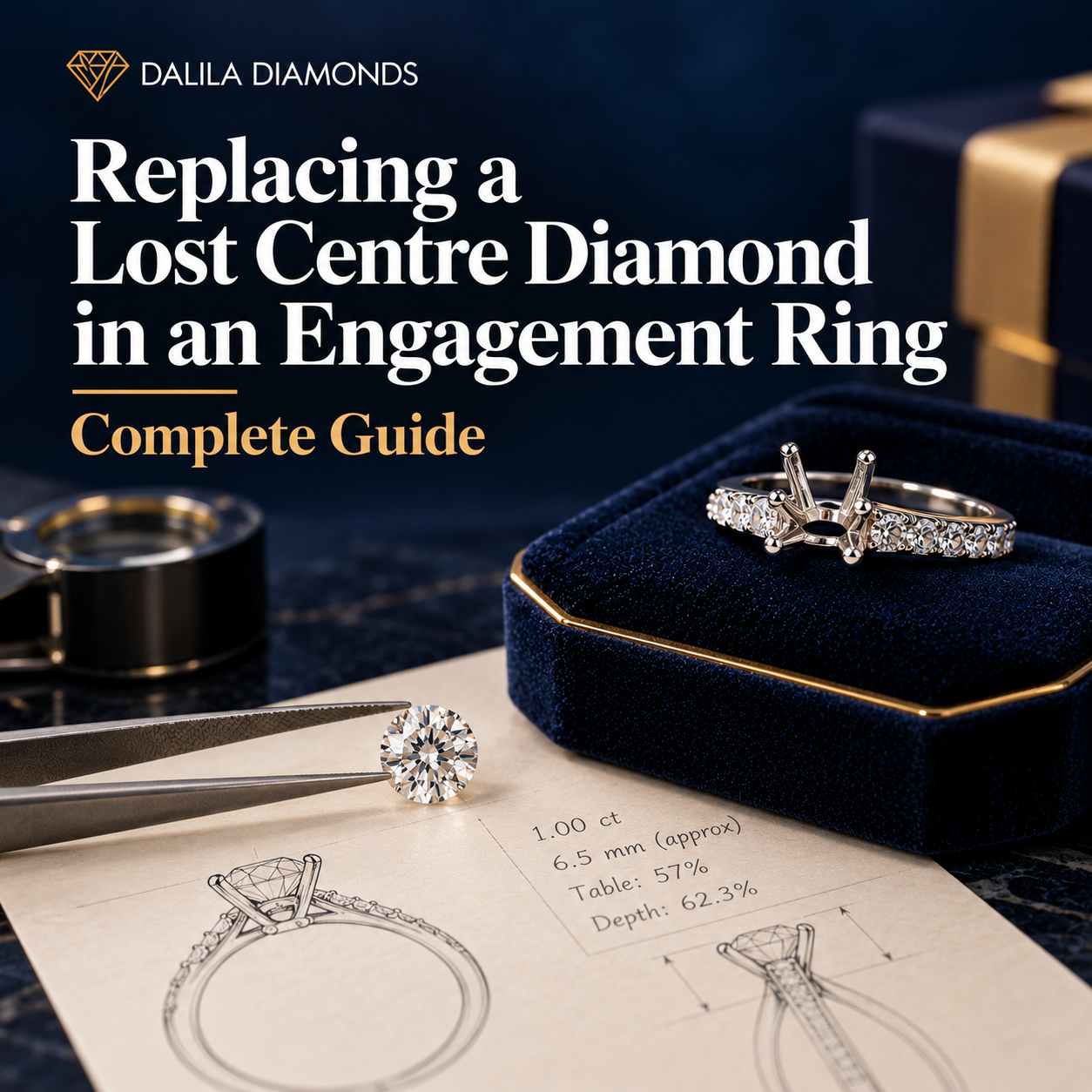
A lost centre diamond can often be replaced without purchasing an entirely new engagement ring. However, the replacement must suit the original mounting, match the intended diamond specifications and be approved by a qualified jewellery setter.
The first step is not to buy another diamond.
It is to inspect the ring, investigate why the original stone fell out and recover as much information as possible about the missing diamond.
For example, suppose an engagement ring originally contained a 1.00-carat natural round brilliant diamond.
The original stone may have measured approximately 6.5 mm in diameter.
A buyer might assume that any other one-carat round brilliant diamond will fit.
That assumption can be incorrect.
Two one-carat diamonds can have different face-up diameters, total depths and girdle characteristics. Even a stone with similar measurements may not be compatible with the original prongs or seat.
The setting may also be damaged.
A bent prong, worn retaining metal or distorted head could explain why the diamond disappeared. Replacing the stone without correcting the underlying problem may lead to another loss.
If the ring was insured, there is an additional step: the replacement process may need to follow the insurer's authorisation requirements.
The safest process is to document the loss, inspect the mounting, recover the original diamond specifications, obtain an approved replacement shortlist and have the setter confirm compatibility before purchase.
This guide covers those steps in detail, including insurance paperwork, replacement-diamond measurements, quality matching, realistic availability and the final jeweller handoff.
Can You Replace a Lost Centre Diamond Without Replacing the Ring?
Yes, in many cases.
A jeweller can sometimes install a replacement centre diamond while preserving the original engagement-ring band.
However, that depends on the setting's condition and the dimensions of the new stone.
There are three main outcomes.
Ring condition | Possible solution | What must be approved |
Centre missing, original head usable | Fit a compatible replacement diamond | Stone dimensions, seat and retaining metal |
Centre missing, head damaged | Repair or replace the head, retain the band | New head, structural connection and stone fit |
Significant mounting damage | Rebuild or manufacture a new mounting | Complete ring design and security |
The original band may have sentimental significance.
Preserving it can be an important part of the project.
But the jeweller must confirm that reuse is technically appropriate.
A loose-diamond supplier cannot approve an existing mounting solely from its original carat-weight description.
What Should You Do Immediately After Losing the Centre Diamond?
Stop wearing the ring until it has been inspected.
If the centre stone has fallen out, the prongs or head may have been damaged.
Continuing to wear the ring could worsen the damage or put other stones at risk.
Immediate action checklist
Safely remove and store the ring.
Check whether the missing diamond may still be recoverable.
Photograph the empty setting from several angles.
Preserve any loose or broken metal components.
Locate the original purchase invoice and grading report.
Find the latest insurance appraisal, if available.
Contact your insurer promptly if you intend to make a claim.
Arrange a qualified jeweller's inspection.
Do not authorise permanent repairs until any required insurer inspection or approval is complete.
If the diamond was stolen, a police report may be necessary, depending on the circumstances and insurer.
Do not bend the prongs back into place or try to insert another stone yourself.
What if you find the original diamond?
Keep it in a secure container.
A recovered diamond may be reusable, but it should be inspected for chips, fractures or other damage.
If the original stone is intact, resetting it may be preferable to sourcing a replacement.
However, the original setting still requires inspection.
Step 1: Have the Empty Ring Mounting Professionally Inspected
An empty centre head can provide important information about the lost diamond, but it does not necessarily preserve the original geometry.
A prong may have moved.
A head may be distorted.
The stone seat may be damaged or partially missing.
The jeweller should establish both the original intended design and the current condition of the mounting.
Mounting inspection checklist
Component | Inspection requirement |
Prongs or claws | Check wear, bending, cracks and missing metal |
Stone seat | Assess bearing surfaces and original fit |
Head or basket | Check shape and structural integrity |
Gallery | Examine space for the replacement pavilion |
Girdle contact positions | Establish intended support points |
Head attachment | Check connection to the shank |
Band | Examine wear, cracks and previous repairs |
Side stones | Confirm security |
Pavé diamonds | Check for looseness or damage |
Halo, if present | Check centre opening and surrounding stones |
Metal and alloy | Identify repair requirements |
Ring size | Record current size |
Previous modifications | Identify any earlier work |
The inspection should conclude with a clear recommendation.
For example:
Existing head condition: Not suitable for reuse.
Recommended repair: Replace centre head while retaining the original 18K gold shank.
Replacement diamond: Natural round brilliant within jeweller-approved dimensional limits.
These are example conclusions, not an inspection of an actual ring.
The jeweller must document the real findings.
Step 2: Find the Original Diamond's Grading Report
If the missing diamond had an individual grading report, that document may be the best source of information about its original characteristics.
For example, a GIA report may include the diamond's shape, carat weight, colour, clarity, measurements, cut grade, polish, symmetry and fluorescence.
The available details depend on the laboratory and report type.
Where to find the report details
Look through:
Original engagement-ring purchase records.
Emails from the jeweller or diamond seller.
The original loose-diamond invoice.
Insurance appraisal documents.
Previous ring repair records.
Photographs of the report.
The grading laboratory's online verification system.
If you know the original report number, check the relevant laboratory's official records.
GIA, IGI and HRD Antwerp provide report-verification services for eligible reports.
The original record may help reconstruct the diamond specification even when the physical stone is no longer available.
What to extract from the report
Original diamond information | Why it matters |
Laboratory | Identifies the report source |
Report number | Allows verification |
Natural or laboratory-grown origin | Establishes the original material |
Shape and cutting style | Determines replacement category |
Carat weight | Helps establish equivalent mass |
Length, width or diameter | Crucial for mounting compatibility |
Total depth | Important for seating |
Colour | Supports equivalent-quality comparison |
Clarity | Supports equivalent-quality comparison |
Cut grade or proportions | Supports optical comparison |
Polish and symmetry | Additional quality characteristics |
Fluorescence | Part of the original specification |
Comments | May contain important information |
A report is not an insurance policy or monetary valuation.
It identifies graded diamond characteristics.
The replacement still needs its own verified identity and appropriate documentation.
Step 3: What if the Original Diamond Had No Certificate?
A replacement can still be sourced.
However, the original quality may be less certain.
The buyer and jeweller may need to rely on other available records.
For example, the original appraisal might describe the centre diamond as an approximately one-carat natural round brilliant with an estimated colour and clarity range.
The original sales invoice may also contain useful information.
Evidence hierarchy
Available evidence | Main value | Limitation |
Original independent grading report | Detailed diamond characteristics | Does not prove current value |
Original invoice with stone reference | Purchase identity and commercial description | May omit measurements |
Detailed independent appraisal | Estimated characteristics and replacement value | Some grades may be estimates |
Manufacturer's setting records | Original head and stone dimensions | May not describe optical quality |
Clear original photographs | Helps establish outline and appearance | Cannot reliably determine grading |
Family or owner recollection | Provides context | Not sufficient for exact specification |
If no reliable records exist, the jeweller should document the uncertainty.
It would be misleading to describe a replacement as an exact quality match to a lost diamond whose characteristics were never established.
The goal should instead be to select a suitable, agreed natural diamond that fits the ring and meets the buyer's preferences.
Step 4: Measure the Empty Head and Original Setting
This is the most important step for technical compatibility.
The jeweller should measure the existing mounting and determine whether it can safely accommodate a replacement.
Measurements to record
Setting characteristic | Required observation |
Original head shape | Round, oval, cushion or other |
Approximate seat width | Measured in millimetres |
Approximate seat length | Measured in millimetres |
Prong positions | Number and spacing |
Girdle-bearing locations | Existing contact points |
Available pavilion clearance | Depth below intended girdle position |
Head height | Distance above band |
Head condition | Usable, repairable or replacement required |
Gallery geometry | Relevant clearances |
Metal thickness | Structural suitability |
Head-to-shank attachment | Condition and modification options |
The empty opening should not automatically be treated as the exact diameter of the missing stone.
The mount may have deformed after the loss.
The jeweller should compare the measured setting with any original report or manufacturing record.
If the head requires replacement, the new head can be designed around the chosen replacement diamond instead of trying to force a new stone into damaged dimensions.
Step 5: Compare Replacement Diamonds by Millimetres, Not Carat Alone
Carat weight measures mass.
It does not guarantee a specific face-up size.
For example, a typical one-carat round brilliant measures approximately 6.5 mm in diameter.
But individual diamonds may be slightly wider or narrower depending on depth and cutting proportions.
Round diamond planning chart
Diamond weight | Approximate diameter |
0.50 ct | 5.1 mm |
0.60 ct | 5.4 mm |
0.75 ct | 5.8 mm |
0.90 ct | 6.2 mm |
1.00 ct | 6.5 mm |
1.20 ct | 6.8 mm |
1.50 ct | 7.4 mm |
2.00 ct | 8.1 mm |
These are broad round-brilliant planning values, not exact conversions or guarantees of mounting compatibility.
Example: Original one-carat round brilliant
Suppose the original grading report records:
Carat weight: 1.01 ct.
Measurements: 6.42 × 6.48 × 3.96 mm.
Shape: Round brilliant.
A replacement candidate may weigh 1.00 ct but measure 6.30 × 6.35 mm.
Another candidate may weigh 0.98 ct but measure 6.42 × 6.46 mm.
The second stone might be closer in face-up size even though it weighs less.
However, the jeweller must also consider total depth, girdle and head geometry.
The actual stone chosen should be approved for the intended setting before purchase.
Step 6: Match the Original Diamond's Quality
An equivalent replacement is not necessarily an identical stone.
Two natural diamonds can share the same four main grading characteristics yet look different.
The buyer should therefore compare both documented quality and appearance.
Equivalent-stone checklist
Characteristic | Replacement objective |
Natural origin | Same material category if original was natural |
Shape | Same unless redesign is approved |
Carat weight | Appropriate to original specification and claim |
Face-up measurements | Compatible with the mounting and desired appearance |
Colour | Comparable or intentionally changed |
Clarity | Comparable or intentionally changed |
Cut quality | Suitable optical performance |
Transparency | No unacceptable haze |
Fluorescence | Consider relative to original and actual appearance |
Girdle condition | Suitable for safe setting |
Report | Appropriate independent documentation |
Price | Within agreed commercial or insurer-approved terms |
For an insured replacement, the insurer's definition of comparable quality may govern the authorised purchase.
For a privately funded replacement, the buyer can decide whether to match the previous stone closely or change the specification.
These are different projects.
Step 7: Understand What “Equivalent Diamond” Means
An equivalent diamond is selected against a defined group of characteristics.
It does not mean an identical copy of the lost stone.
Every natural diamond has its own combination of physical and optical features.
Even stones with the same carat weight, colour, clarity and grading laboratory can differ in appearance.
For insurance purposes, the policy may refer to replacement with an item of similar or equivalent kind and quality.
The exact meaning depends on the policy and claims decision.
Example equivalent shortlist
Suppose the lost centre diamond was documented as:
Characteristic | Original |
Origin | Natural |
Shape | Round brilliant |
Carat | 1.00 ct |
Colour | G |
Clarity | VS2 |
Cut | Excellent |
Diameter | Approximately 6.45 mm |
Report | GIA |
A replacement shortlist might look like this:
Characteristic | Candidate A | Candidate B | Candidate C |
Origin | Natural | Natural | Natural |
Shape | Round | Round | Round |
Carat | 1.00 ct | 0.97 ct | 1.03 ct |
Colour | G | G | H |
Clarity | VS2 | VS2 | VS1 |
Cut | Excellent | Excellent | Excellent |
Illustrative diameter | 6.44 mm | 6.42 mm | 6.52 mm |
Mounting approval | Pending | Pending | Pending |
Insurer approval | Pending | Pending | Pending |
These are fictional candidates created to demonstrate comparison. They are not live Dalila inventory or actual quotations.
Candidate A may look closest on paper.
Candidate B may offer a suitable face-up size despite a slightly lower weight.
Candidate C may be worth reviewing if a small colour difference is acceptable and its dimensions can be accommodated.
No candidate should be described as approved until the real stone, mounting and applicable insurance requirements have been evaluated.
Step 8: What if an Exact Replacement Is Unavailable?
An exact replacement may not be available.
For example, a missing diamond may have an unusual shape, rare combination of characteristics or older cutting style.
The same report specifications may not appear in current inventory.
This does not mean the ring cannot be restored.
It means the buyer, jeweller and, where applicable, insurer must agree on which differences are acceptable.
Possible approaches
Find the closest available natural diamond
Compare the shape, measurements, quality and appearance.
Consider a different carat weight
A slightly lighter or heavier diamond may offer a more suitable physical match.
Replace the centre head
A different head may accommodate an otherwise suitable diamond.
Change the mounting
If the original setting cannot support the preferred replacement, redesign may be necessary.
Wait for another candidate
For an unusual specification, the buyer may choose to continue searching.
Realistic availability questions
Question | Why it matters |
Is the stone physically available or only listed? | Listings can change |
Has the supplier confirmed current stock? | Avoids reliance on stale data |
Is the grading report available? | Supports quality review |
Are actual measurements confirmed? | Supports mounting compatibility |
Can images or video be reviewed? | Helps assess appearance |
Can the diamond be reserved? | Determines whether availability can be held |
What is the confirmed price? | Supports quote or insurance approval |
Can it be delivered by the required date? | Sets realistic timing |
Can the jeweller inspect it before setting? | Supports final acceptance |
A supplier should not promise an identical replacement or guaranteed availability without locating an actual suitable diamond.
Step 9: Check the Insurance Policy Before Buying
If the lost centre diamond was insured, contact the insurer before commissioning a replacement.
The insurer may require the original appraisal, purchase records, a statement describing the loss, photographs and a jeweller's repair estimate.
Depending on the circumstances, additional documentation may be necessary.
The policy may specify a repair-or-replacement process rather than simply providing cash to the policyholder.
Insurance documents to gather
Document | What it establishes |
Insurance policy | Coverage, exclusions and limits |
Policy number | Claim identification |
Original appraisal | Description and insured replacement valuation |
Grading report | Original diamond specifications |
Purchase invoice | Purchase and ownership information |
Photographs | Evidence of the original ring |
Loss statement | Circumstances of disappearance |
Police report, if required | Supporting evidence |
Jeweller's damage inspection | Current mounting condition |
Repair or replacement quotation | Proposed cost |
Replacement diamond shortlist | Comparable stone specifications |
Different insurers may have different procedures.
The buyer should use the actual policy and written instructions rather than relying on generic statements about insurance coverage.
Step 10: What Will an Insurer Pay for a Lost Centre Diamond?
There is no universal answer.
The amount and form of settlement depend on the applicable policy, coverage limit, valuation and claim approval.
Some insurance arrangements focus on repairing or replacing the item with one of comparable kind and quality.
Others may have different settlement provisions.
A current insurance appraisal is useful for establishing the described jewellery and its estimated replacement value.
However, an appraisal is not the same as an unconditional cash payment.
Questions for the insurer
Question | Why it matters |
Does the policy cover this type of loss? | Establishes eligibility |
Is the missing centre stone covered separately? | Clarifies scope |
Must a specific jeweller be used? | Determines repair options |
Is pre-approval required? | Avoids unapproved expenditure |
What constitutes equivalent quality? | Defines replacement search |
Is a deductible applicable? | Determines buyer contribution |
Will the head repair be covered? | Addresses mounting damage |
Can the existing ring be retained? | Preserves sentimental value |
Can the buyer pay extra for an upgrade? | Clarifies optional changes |
What documents must be submitted? | Enables claim assessment |
How is payment made? | Insurer-to-jeweller or other arrangement |
Is an updated appraisal required afterwards? | Supports future coverage |
Jewelers Mutual, for example, publicly describes a repair-or-replacement claims model in which comparable quality, supporting ownership documents and jeweller participation are important.
That is one insurer's process, not a guarantee that another insurer will follow the same rules.
Step 11: Separate the Diamond Quotation From the Setting Repair
A centre-diamond replacement project has at least two possible cost components.
The first is the loose natural diamond.
The second is the physical work needed to restore the ring.
Those should be itemised.
Example quotation structure
Cost item | Responsible provider |
Replacement natural diamond | Diamond supplier or jeweller |
Grading documentation | Included or specified separately |
Stone inspection | As agreed |
Existing ring assessment | Jeweller |
Prong repair | Jeweller |
Head replacement | Jeweller |
Band repair | Jeweller |
Setting labour | Jeweller |
Finishing and polishing | Jeweller |
Shipping and insurance | As agreed |
Taxes | As applicable |
Insurer-approved allowance | Insurer, if claim accepted |
Customer contribution | According to final agreement |
A diamond supplier's loose-stone quote should not be treated as the full ring restoration cost.
Likewise, a jeweller's repair quotation should clearly state whether the new diamond is included.
Worked Example 1: Replacing a Lost One-Carat Round Centre Diamond
Suppose a ring originally contained a one-carat natural round brilliant.
The owner still has the original GIA report.
The centre diamond has fallen out, but the engagement-ring band remains.
Original diamond information
Specification | Illustrative original |
Origin | Natural |
Shape | Round brilliant |
Weight | 1.00 ct |
Colour | G |
Clarity | VS2 |
Cut | Excellent |
Diameter | Approximately 6.45 mm |
Setting | Four-prong solitaire |
Metal | 18K white gold |
Report | Available |
This is a hypothetical repair case, not a completed Dalila replacement.
Stage 1: Mounting inspection
The jeweller examines the empty setting and discovers a damaged prong.
The ring cannot safely accept a replacement without repair.
The jeweller considers whether the prongs can be rebuilt or a new head is required.
Stage 2: Replacement specification
The original report is used to establish the desired quality range.
The jeweller also defines the permitted replacement dimensions.
Stage 3: Diamond shortlist
The sourcing specialist identifies actual available natural round brilliants with comparable specifications.
The shortlist should contain verified measurements, grading reports and current quotations.
Stage 4: Approval
The buyer and jeweller review the candidates.
If insurance is involved, the insurer's required approval is obtained before purchasing or setting the diamond.
Stage 5: Restoration
The mounting is repaired or rebuilt.
The replacement is set by a qualified jeweller.
The finished ring is inspected for stone retention, alignment and condition.
The buyer receives the replacement diamond's report and completed repair documentation.
Worked Example 2: A Lost Oval Centre Diamond With No Original Report
Suppose a customer owns an oval engagement ring.
The centre diamond is missing.
The original receipt describes an approximately 0.90-carat natural oval diamond but does not include a laboratory report.
Available records
Information | Status |
Original invoice | Available |
Original grading report | Missing |
Original diamond measurements | Not recorded |
Original photographs | Available |
Ring mounting | Available |
Diamond origin | Described as natural |
Original colour | Not reliably documented |
Original clarity | Not reliably documented |
The jeweller measures the remaining oval head.
However, the prongs may have been distorted when the stone fell out.
The jeweller should not assume the original diamond's exact dimensions can be reconstructed from the empty opening alone.
Replacement process
The jeweller prepares a mounting assessment.
A reasonable replacement range is established based on the existing head, original receipt, photographs and owner's preferences.
The supplier searches for natural ovals within the approved dimensions and budget.
The buyer reviews the shortlisted stones' outlines, brightness and bow-tie appearance.
If the original head cannot accommodate an approved candidate, a new head may be required.
Important limitation
The replacement can be described as compatible or comparable to the documented requirements.
It should not be advertised as an exact match to the original diamond's unknown colour, clarity or optical appearance.
Worked Example 3: Replacing a Lost Diamond While Keeping the Original Ring
A customer wants to preserve the original engagement band because of its sentimental value.
The old head is damaged.
A jeweller determines that a replacement head can potentially be attached to the existing band.
Proposed plan
Component | Action |
Original band | Retain |
Damaged centre head | Remove and replace |
New natural diamond | Source to approved specifications |
Side stones | Retain and inspect |
Metalwork | Match or appropriately integrate |
Ring size | Verify |
Final setting height | Approve |
Finished inspection | Required |
The replacement diamond should be selected with the new head design in mind.
This approach may preserve most of the original jewellery while avoiding reliance on a damaged head.
However, the feasibility must be confirmed for the actual ring.
What if the Lost Diamond Was a Different Shape?
The replacement method changes with the diamond shape.
Round brilliant
Compare average diameter, depth, girdle and optical appearance.
Oval
Check length, width, outline, length-to-width ratio and bow-tie appearance.
Emerald cut
Compare rectangular outline, corner shape, proportions and step-facet appearance.
Cushion
Confirm whether the original stone had a square or elongated outline and whether the replacement has compatible corners.
Princess cut
Check square dimensions and protect vulnerable corners.
Pear
Confirm length, width, asymmetry and suitable protection for the pointed end.
Marquise
Check outline and both pointed ends.
Fancy-shaped replacement requirements
Shape | Important measurements |
Round | Minimum/maximum diameter, depth |
Oval | Length, width, depth, outline |
Emerald | Length, width, depth, corners |
Cushion | Length, width, depth, outline |
Princess | Length, width, depth, corners |
Pear | Length, width, depth, point |
Marquise | Length, width, depth, points |
The shape should be included in both the sourcing specification and setting approval.
What if the Missing Diamond Was in a Halo Ring?
Halo engagement rings require particular care.
The surrounding small diamonds form a design around the original centre opening.
A replacement centre diamond may be the correct carat weight but have an incompatible outline.
For example, a slightly wider oval may crowd the halo.
A narrower oval may leave an unattractive gap.
The centre may also sit at the wrong height.
Halo replacement checks
Centre opening dimensions.
Head or basket condition.
Clearance from surrounding halo stones.
New diamond outline.
Girdle support.
Pavilion clearance.
Centre alignment.
Existing halo-stone security.
Metalwork needed for adaptation.
In some cases, the centre head can be replaced.
In others, the halo itself may require modification.
The manufacturer must assess the actual design.
This guide focuses on replacement after a lost stone. Dalila's separate halo-selection guide should retain the broader topic of choosing centre diamonds for new halo rings.
How Long Does It Take to Source a Replacement Engagement Diamond?
The timeline depends on the specification and current availability.
A relatively common natural round brilliant may be easier to shortlist than an unusual old-cut or fancy-shaped diamond with tightly defined dimensions.
However, no exact timeline should be promised without checking current inventory and the necessary repair work.
What affects availability?
Factor | Potential impact |
Shape | Some shapes may have fewer suitable candidates |
Carat range | Availability varies by weight |
Required dimensions | Tight limits can reduce options |
Colour and clarity | Restrictive specifications may reduce suitable stock |
Cut preferences | Additional optical requirements narrow shortlist |
Grading laboratory | Restricting report sources may reduce choices |
Budget | May eliminate otherwise suitable stones |
Existing head geometry | Can require unusually specific proportions |
Insurance approval | May add processing time |
International delivery | Requires shipping and clearance planning |
A supplier should identify actual candidates before presenting an availability claim.
If no suitable candidate is found, the jeweller can review whether changing the head would allow a more practical replacement selection.
Should You Choose an Upgrade Instead of an Equivalent Replacement?
Some buyers may want to replace the lost diamond with a larger or higher-quality one.
This is possible as a separate design objective.
However, it may require a new mounting and additional expense.
If an insurance claim is involved, the insurer may only authorise an equivalent replacement under the policy.
Any upgrade cost would need to be handled according to the insurer's approved terms.
Equivalent replacement vs upgrade
Factor | Equivalent replacement | Upgrade |
Primary goal | Restore original ring specification | Change diamond size or quality |
Carat weight | Comparable to original | May increase |
Shape | Usually same | Could change |
Colour and clarity | Comparable | May change |
Existing head | May be reusable | More likely to require review |
Insurance approval | Based on claim terms | Additional authorisation may be needed |
Customer budget | Depends on policy and repair | May include additional payment |
If the buyer wants a deliberate anniversary-style upgrade, that decision should be documented separately from the loss replacement.
Can Dalila Diamonds Source a Replacement Centre Diamond?
Dalila Diamonds publicly provides natural loose-diamond sourcing through its stock and sourcing services.
Its DS4U — Diamond Source For You service is designed for buyers who need a diamond sourced according to particular specifications.
Its S2S — Secure To Source service supports professional buyers who have already shortlisted an identified natural diamond.
These services are relevant to finding a suitable loose natural diamond for a jewellery project.
However, a dedicated consumer engagement-ring replacement, insurance claims administration or ring-resetting service has not been verified for Dalila.
Any commercial enquiry should therefore be limited to services Dalila has agreed to provide.
Example replacement sourcing brief
Project: Replace lost natural centre diamond in an existing engagement ring.
Original diamond: Natural round brilliant.
Original weight: 1.00 carat.
Original colour: G.
Original clarity: VS2.
Original cut: Excellent.
Original report: Available.
Replacement dimensions: According to setter-approved range.
Mounting: Existing 18K white-gold ring.
Required documentation: Individual recognised grading report.
Insurance: Insurer approval required before purchase, if applicable.
Budget: According to written quotation or approved claim.
Delivery destination: Qualified manufacturing jeweller or other approved address.
Setting responsibility: Separate qualified jeweller.
This is a hypothetical enquiry, not an available Dalila stock offer.
What Dalila should not be assumed to provide
Physical inspection of the customer's ring.
Prong or head repair.
Setting the replacement stone.
Direct processing of an insurance claim.
Preparing an insurance appraisal.
Insurer billing.
Guaranteed exact replacement inventory.
A fixed replacement timeline.
A lifetime replacement warranty.
These services should only be advertised after express confirmation.
Detailed Setter Measurement Sheet
Use this worksheet before ordering a replacement diamond.
A. Ring identification
Field | Information |
Owner or project reference | ______ |
Ring type | ______ |
Ring size | ______ |
Metal and purity | ______ |
Setting type | ______ |
Original purchase date | ______ |
Original jeweller | ______ |
Existing appraisal | Yes / No |
Insurance claim number, if applicable | ______ |
Photos recorded | Yes / No |
B. Original lost diamond
Field | Information |
Natural origin documented | Yes / No |
Shape | ______ |
Carat weight | ______ ct |
Minimum diameter or width | ______ mm |
Maximum diameter or length | ______ mm |
Total depth | ______ mm |
Girdle characteristics | ______ |
Colour | ______ |
Clarity | ______ |
Cut information | ______ |
Polish | ______ |
Symmetry | ______ |
Fluorescence | ______ |
Laboratory | ______ |
Report number | ______ |
Original stock number | ______ |
Documentation reliability | Confirmed / Estimated / Unknown |
C. Empty mounting assessment
Field | Jeweller's findings |
Head type | ______ |
Prong count | ______ |
Prong condition | ______ |
Seat dimensions | ______ |
Head opening dimensions | ______ |
Pavilion clearance | ______ |
Head height | ______ |
Girdle support | ______ |
Gallery condition | ______ |
Shank condition | ______ |
Side-stone condition | ______ |
Pavé/halo condition | ______ |
Repair required | Yes / No |
Head reusable | Yes / No / Pending |
New head required | Yes / No / Pending |
Inspection date | ______ |
Setter approval | ______ |
D. Approved replacement specifications
Field | Requirement |
Natural origin | Required |
Shape | ______ |
Acceptable carat range | ______ |
Minimum diameter or width | ______ mm |
Maximum diameter or length | ______ mm |
Depth limitations | ______ mm |
Girdle requirements | ______ |
Colour range | ______ |
Clarity range | ______ |
Cut requirements | ______ |
Transparency | ______ |
Fluorescence criteria | ______ |
Grading report requirements | ______ |
Budget or insurer allowance | ______ |
Replacement head permitted | Yes / No |
Setter sign-off | ______ |
E. Insurance and repair handoff
Item | Status |
Loss report submitted | ______ |
Insurer contacted | ______ |
Coverage confirmed | ______ |
Original documents supplied | ______ |
Jeweller repair estimate prepared | ______ |
Equivalent diamond shortlist prepared | ______ |
Insurer approved replacement | ______ |
Diamond quotation approved | ______ |
Stone received and inspected | ______ |
Setting repair completed | ______ |
Replacement securely set | ______ |
Side-stone inspection completed | ______ |
Final jewellery inspection completed | ______ |
Replacement report supplied | ______ |
Updated appraisal considered | ______ |
Insurance schedule updated, if required | ______ |
The owner, jeweller and insurer should use the same approved diamond specifications to avoid conflicting instructions.
Replacement Diamond Shortlist Worksheet
Once the mounting and original quality are documented, compare actual available stones.
Specification | Original | Candidate A | Candidate B | Candidate C |
Natural origin | ______ | ______ | ______ | ______ |
Shape | ______ | ______ | ______ | ______ |
Carat weight | ______ | ______ | ______ | ______ |
Minimum diameter/width | ______ | ______ | ______ | ______ |
Maximum diameter/length | ______ | ______ | ______ | ______ |
Depth | ______ | ______ | ______ | ______ |
Colour | ______ | ______ | ______ | ______ |
Clarity | ______ | ______ | ______ | ______ |
Cut grade/details | ______ | ______ | ______ | ______ |
Fluorescence | ______ | ______ | ______ | ______ |
Laboratory | ______ | ______ | ______ | ______ |
Report number | ______ | ______ | ______ | ______ |
Current availability | — | ______ | ______ | ______ |
Actual quotation | — | ______ | ______ | ______ |
Setter approval | — | ______ | ______ | ______ |
Insurer approval, if needed | — | ______ | ______ | ______ |
Only shortlisted stones that are currently confirmed as available should be represented as purchasable candidates.
Common Mistakes When Replacing a Lost Engagement-Ring Diamond
Purchasing a new stone before inspecting the head
The setting may be damaged and unsuitable for the proposed replacement.
Assuming any diamond with the same carat weight will fit
Actual measurements and setting geometry matter.
Ignoring the original grading report
It can provide useful evidence of the lost diamond's characteristics.
Treating an old appraisal as an exact grading report
Appraisal grades may be estimated, particularly for mounted stones.
Assuming an exact replacement is always available
Natural diamonds are individual stones, and current stock must be verified.
Repairing the ring before obtaining insurer approval
The insurer may require documentation or inspection first.
Confusing replacement value with resale value
An insurance replacement valuation is not the amount a dealer would pay to buy the original diamond.
Ignoring the cost of mounting repair
The new loose diamond is only one part of the finished restoration.
Claiming an upgrade is included in insurance coverage
Any upgrade depends on the policy and approval.
Assuming Dalila repairs rings or manages insurance claims
Its published sourcing services do not establish those additional activities.
Frequently Asked Questions
Can you replace a lost centre diamond in an engagement ring?
Yes, in many cases. A jeweller must inspect the mounting, identify suitable replacement dimensions and approve the stone before setting.
Can I keep my original engagement-ring setting?
Possibly. If the existing head is sound and compatible, it may be reusable. Otherwise, a replacement head or mounting may be needed.
What should I do when the centre diamond falls out?
Stop wearing the ring, photograph the empty setting, preserve your documentation, contact your insurer if applicable and arrange a jeweller's inspection.
Why did my engagement-ring diamond fall out?
Possible causes include worn prongs, impacts, distorted metal or setting defects. A jeweller must inspect the ring to determine the likely cause.
Can I buy another one-carat diamond for my one-carat ring?
Potentially, but the new stone's dimensions and profile must be checked. Equal carat weight does not guarantee a suitable fit.
Can a jeweller measure the original diamond size from the empty setting?
The empty setting provides useful information, but the result may be approximate if the head is damaged. Original reports and manufacturing records can help.
What if I lost the original diamond certificate?
Look for the report number in emails, invoices, appraisal files or other purchase records. The issuing laboratory's verification system may help locate the report details.
Can the original diamond's colour and clarity be reconstructed?
Only to the extent supported by existing documentation. An empty mounting does not establish the exact colour or clarity of a lost stone.
Do I need a GIA report for the replacement diamond?
An appropriate independent grading report is strongly recommended for an individually traded engagement-ring centre diamond. The exact reporting requirements depend on the stone and transaction.
Can I replace a natural diamond with a laboratory-grown diamond?
That is a different material choice and should be expressly agreed by the owner and, where relevant, the insurer. Do not represent it as a like-for-like natural-diamond replacement.
What does an equivalent replacement diamond mean?
It means a stone selected against agreed characteristics such as origin, shape, size, quality and appearance. Exact policy definitions may vary.
Can a replacement diamond be slightly smaller?
Possibly, if the jeweller approves the setting and the buyer or insurer accepts the specification. A smaller stone should not simply be forced into the original head.
What if a replacement diamond is too deep?
It may not have enough pavilion clearance. The jeweller must evaluate a different stone or mounting.
Can a lost oval diamond be replaced?
Yes, potentially. Oval replacements require attention to length, width, outline, depth and setting compatibility.
Can I replace the centre diamond in a halo engagement ring?
Potentially. The centre opening, halo geometry and surrounding stones must be inspected.
Will insurance cover a lost engagement-ring diamond?
It depends on the policy, cause of loss, exclusions and coverage limits. Contact the insurer and follow its claims process.
Does insurance pay cash for a missing diamond?
Not always. Some policies provide repair or replacement rather than an unrestricted cash payment.
Can I choose my own jeweller for an insurance replacement?
That depends on the insurer. Some permit a preferred jeweller; others impose provider or authorisation requirements.
Can I upgrade to a bigger diamond through insurance?
Possibly, with insurer approval and an additional payment where required. The policy does not automatically fund an upgrade.
What if no exact replacement diamond is available?
Consider the closest acceptable candidate, a different approved size or modifying the head. Any insurer-dependent change should be authorised.
How much does it cost to replace a missing centre diamond?
The total depends on the specific natural diamond, repair work, setting labour, shipping, taxes and any insurance arrangements. A written itemised quotation is needed.
How long does replacing a centre diamond take?
The timeframe depends on sourcing availability, ring condition, insurer approval and the jeweller's schedule. No universal timeline applies.
Can Dalila source a natural replacement centre diamond?
Dalila publishes specification-led natural loose-diamond sourcing services. Individual availability, buyer eligibility and the scope of a replacement enquiry must be confirmed.
Does Dalila process engagement-ring insurance claims?
A dedicated claims-handling or direct insurer-billing service has not been verified.
Does Dalila repair the existing ring?
Ring repair, head replacement and stone-setting services have not been verified as Dalila services. Those tasks should be arranged with a qualified jeweller.
What should I send to request a replacement diamond?
Provide the original grading report or appraisal, approved replacement specifications, setting measurements, budget, required date and any insurer-authorised requirements.
Final Checklist: Restore the Ring Safely and Choose an Equivalent Diamond
Losing the centre diamond from an engagement ring can be distressing, especially when the original band has sentimental importance.
But a missing centre stone does not always mean the entire ring must be replaced.
The right approach is to start with the surviving jewellery.
Have the mounting inspected, identify any damage and recover the original diamond's documented specifications.
If the ring was insured, confirm the claims process before committing to a replacement purchase or repair.
Then compare actual natural diamonds using their independent reports, physical measurements, appearance and current availability.
The replacement should not be ordered until the setter has approved its compatibility with the existing or proposed head.
The recommended sequence is: protect the ring → document the loss → inspect the mounting → recover the original diamond specifications → confirm insurance requirements → shortlist real replacement stones → obtain setter approval → complete and inspect the repair.
This process gives the best opportunity to preserve the original ring while restoring a secure, properly documented natural centre diamond.