Choosing a Diamond for a Solitaire Engagement Ring
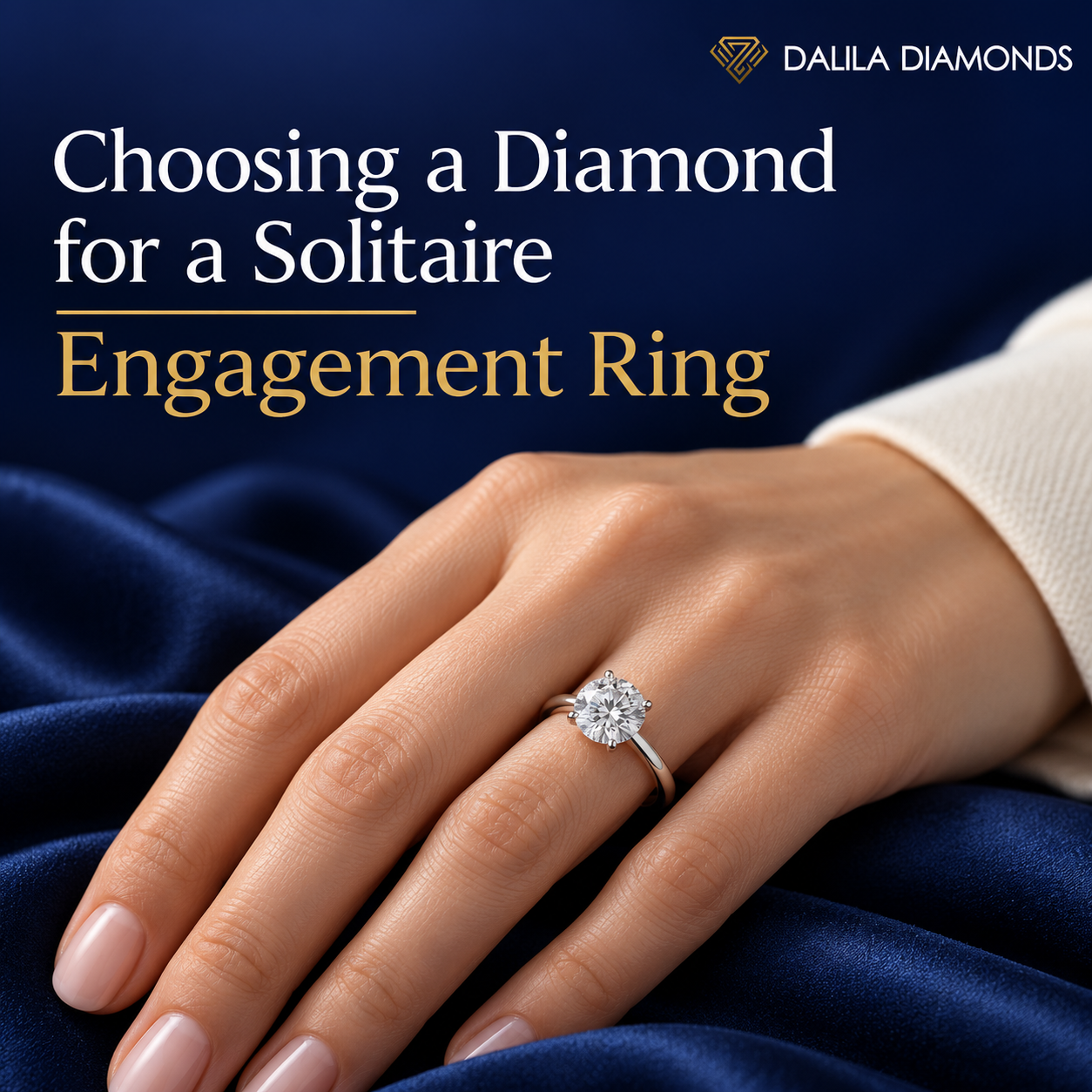
The best diamond for a solitaire ring is one whose appearance, dimensions and condition suit the ring you want to wear. Start with the visible size you prefer, compare individual stones for appearance, and have the setter confirm the mounting before you buy.
A solitaire puts one centre stone in focus. That makes the diamond’s outline and face-up appearance especially useful to compare. A carat target helps organise a search, but it does not tell you exactly how wide the diamond will look or whether it fits a particular mounting.
This guide focuses on choosing that centre stone. For the wider purchase decisions, including budget, certification and ring styles, use our natural diamond engagement ring guide.
Start With Millimetres, Then Set a Carat Range
For a round diamond, the report gives the minimum diameter, maximum diameter and depth. In a measurement such as 6.48–6.51 × 4.07 mm, the first two figures describe its width across the girdle, the edge separating the upper and lower parts of the diamond. The last figure is its total depth.
The diameter is a useful starting point for comparing the centre stone’s footprint. Depth also matters to the setter because the mounting must accommodate the stone below the surface. Neither measurement establishes how bright or attractive the diamond will appear.
Ask to see different centre sizes against the same band design before deciding that you need a particular carat weight. If you like a centre around 6.5 mm across, make that preference part of the sourcing brief. Let the supplier show which individual stones meet it within your budget.
This gives your search a practical direction: a diamond that creates the balance you want in the ring, with its weight considered alongside its appearance.
Three Real Diamonds Compared in the Same Solitaire Design
The following round brilliant diamonds have publicly accessible GIA report records. They provide real measurements for a size comparison. They are educational examples, and their current availability as Dalila stock has not been established.
Report detail | Stone A | Stone B | Stone C |
GIA report number | |||
Report date | 1 August 2023 | 15 August 2016 | 11 July 2025 |
Carat weight | 0.82 ct | 1.06 ct | 1.43 ct |
Reported measurements | 5.81–5.89 × 3.65 mm | 6.48–6.51 × 4.07 mm | 7.08–7.28 × 4.54 mm |
Calculated average diameter | 5.85 mm | 6.50 mm, rounded | 7.18 mm |
Colour / clarity | G / I1 | I / SI1 | H / VS2 |
Cut grade | Good | Excellent | Very Good |
Polish / symmetry | Very Good / Fair | Very Good / Very Good | Good / Good |
Fluorescence | None | None | None |
These specifications come from the individual GIA records. myapps.gia.edu
solitaire-diamond-size-comparison.png
Dimension schematic using real report measurements. All three views use the same illustrative four-prong solitaire design and 2.0 mm band width, with head symbols resized for each stone. This is not a photograph or a physical mounting trial. Colour, sparkle, inclusions and exact outlines are not represented.
The average diameter is calculated as (minimum diameter + maximum diameter) ÷ 2. Stone B’s unrounded result is 6.495 mm. Compared with Stone A, it is about 0.65 mm wider. Stone C is about 0.69 mm wider than Stone B.
Those differences give you something concrete to compare. Descriptions such as “under one carat”, “one carat” and “nearly one and a half carats” do not communicate the visible size as precisely.
Keeping the solitaire design consistent also helps you judge the balance between the centre and the band. It does not establish that one existing head can safely accept all three stones. The head—the part of the mounting that holds the diamond—requires a separate fit assessment.
Each report records an examination on its stated date. Before purchasing an offered stone, have its identity and current condition checked, including whether it has been damaged or altered since grading.
Why the Largest Diamond Is Not Automatically the Best Choice
Stone A has the smallest measured footprint and an I1 clarity grade. Its report does not establish whether its characteristics are acceptable to you at normal viewing distance. Request an individual visibility assessment rather than treating the grade as a complete purchase verdict.
Stone B has an Excellent cut grade, making its cut a useful starting point for further review. Its report lists crystal and cloud characteristics. You would still need to examine the particular stone for appearance and decide whether its colour and clarity suit your preferences. myapps.gia.edu
Stone C has the largest measured footprint and a VS2 clarity grade, but its report lists a chip, crystal and cavity. Ask a qualified professional to assess the location, extent and condition of those features, including any implications for setting. A higher clarity grade does not remove the need for that assessment. myapps.gia.edu
No physical inspection or comparable current media was available for this comparison. We therefore cannot name a visual winner, confirm that any stone is eye-clean, or rank their value without current quotations.
The useful lesson is how to evaluate a shortlist. One diamond may offer your preferred dimensions but need further condition checks. Another may have a stronger cut grade but require a closer look at colour or inclusion visibility. The best choice emerges from those individual assessments.
Prioritise Appearance Before Paying for Extra Weight
For a standard round brilliant diamond, GIA’s cut grade considers face-up appearance, design and craftsmanship. An Excellent cut grade is a practical starting filter when requesting a shortlist, followed by examination of the individual stone. GIA explains these components in its guide to diamond cut grades. 4cs.gia.edu
Ask for comparable face-up images and video under the same stated lighting and camera conditions. Include gentle tilting so you can follow the changing pattern of light and dark. Compare a normal-distance view as well as magnified details.
Avoid choosing a stone solely because it gives the widest diameter for the quoted weight. Spread needs to be considered alongside cut, condition and the appearance you enjoy.
Lighting also changes what you see. A recording made under strong spotlights can show a different effect from a view under diffuse light. GIA’s explanation of lighting and diamond appearance describes how the surroundings and observer affect a diamond’s visible appearance. www.gia.edu
For colour and clarity, tell the supplier what you want to see rather than asking for a universal “best” grade. If you want no noticeable inclusions face-up, request an assessment that states the viewing distance and lighting. If you are comparing colour grades, ask for consistent views and consider them with your intended metal.
A solitaire exposes much of the centre stone, so a clear explanation of the individual diamond is more useful than a promise based only on its grading letters.
Check the Diamond Against the Solitaire Mounting
Send the setter the exact report and stone measurements, together with the mounting reference or design drawing. Ask whether the head suits the diamond’s diameter, depth, girdle and condition, and whether changes to the head or seats are needed.
A mounting described as suitable for “a one-carat round diamond” still needs to be checked against the particular stone. The setter needs its measurements and profile to assess how it will be supported and secured.
Keep the band width and prong arrangement consistent while comparing centre sizes. GIA notes that four prongs can give a round stone a more square-looking outline, while six can emphasise its roundness. Its four-prong versus six-prong guide provides useful background; the setter should assess the actual design. 4cs.gia.edu
The 2.0 mm band in our illustration is a comparison reference. It is not a recommendation for every metal, finger size or ring design. Ask your jeweller to confirm the finished band dimensions, head height and wedding-band clearance as part of the ring specification.
If you prefer an oval, pear, emerald cut or another shape, make a separate comparison using its length, width and orientation. The round-stone dimensions above cannot establish how a different shape will fit or look in the same design.
A Diamond Specification You Can Send for a Quote
Use the brief below as an example for a buyer who prefers a round centre around 6.5 mm across. Adjust the appearance preferences and fill in the budget, destination and timing before sending it.
These are example search criteria. They do not constitute a Dalila offer or a recommendation to buy one of the three comparison stones.
Item | Example sourcing brief |
Centre stone | Loose natural round brilliant diamond |
Preferred visible size | Approximately 6.4–6.6 mm average diameter; provide full minimum–maximum diameter and depth |
Carat weight | Flexible; quote the actual weight of each candidate |
Grading report | GIA report preferred; provide the exact report number and verification link |
Cut | Excellent as the initial shortlist filter |
Colour | Compare G–I candidates using consistent media; confirm my preference before narrowing the range |
Clarity | Begin with VS2 and SI1 candidates; provide an individual visibility and condition assessment |
Other report details | State polish, symmetry, fluorescence, comments and clarity characteristics |
Intended ring | Plain solitaire; illustrative 2.0 mm band and four-prong design, subject to my setter’s approval; attach mounting reference and intended metal |
Stone identification and evidence | Exact stock reference, current availability, matching photographs/video and disclosure of condition concerns |
Budget and destination | [Maximum loose-stone total and currency]; [delivery country/postcode]; state tax, shipping and any separately payable charges |
Timing and purchase terms | [Required date]; confirm quote validity, any hold, inspection/return terms and payment conditions in writing |
Request a small shortlist so you can compare actual candidates at the same scale. Ask the supplier to explain the trade-off between each diamond’s dimensions, appearance and total quoted cost. Give the setter the shortlisted reports before committing to a purchase.
If a candidate falls outside your preferred dimensions, ask why it has been included. It may offer an appearance or price advantage worth considering, but the difference should be clear before you make your decision.
Dalila’s DS4U diamond sourcing service accepts specific requirements, including measurements, budget and intended jewellery. Send the centre-stone brief with your mounting reference and ask for available options. Arrange the mounting and setting assessment with the jeweller who will make or set your ring. www.daliladiamonds.com
Frequently Asked Questions
What carat size is best for a solitaire engagement ring?
There is no single best weight. Begin with the visible dimensions you prefer against your chosen band, then compare individual stones within your budget. The three real records above show different measured footprints, but none establishes a universal ideal.
Is a round diamond the best shape for a solitaire ring?
A round brilliant is a useful option when you want a round outline and a diamond with a GIA overall cut grade. Other shapes can also suit a solitaire. Choose the outline you enjoy, compare its actual measurements and have the setter confirm a suitable mounting.
Can a solitaire setting make a diamond sparkle more?
The setting affects how the stone is framed and exposed. Cut quality remains central to sparkle; GIA cautions against the idea that four prongs automatically create more sparkle than six. Choose the mounting for the look and protection you want, and assess the diamond itself. 4cs.gia.edu
Should I choose a larger diamond or a higher clarity grade?
Compare the individual stones before deciding. Consider whether the extra size creates the look you want, whether inclusions are noticeable under agreed viewing conditions, and whether any characteristics affect condition or setting suitability. Weight and clarity grade alone cannot settle the choice.
Can I buy the diamond before the solitaire mounting?
Yes, when the ring will be designed around it, but involve the setter before purchase. If you already have a mounting, obtain confirmation for the exact stone and head. A generic label such as “one-carat solitaire” is insufficient to establish fit.
Editorial note — remove before publication: The comparison uses genuine report measurements in an illustrative solitaire design. To complete the audit’s physical “three actual centre stones in one mounting” requirement, obtain authorised photographs and a jeweller’s documented assessment of the mounting and each stone. Retain the schematic caption unless that verified physical comparison replaces it.