Choosing a Diamond for a Vintage-Style Setting
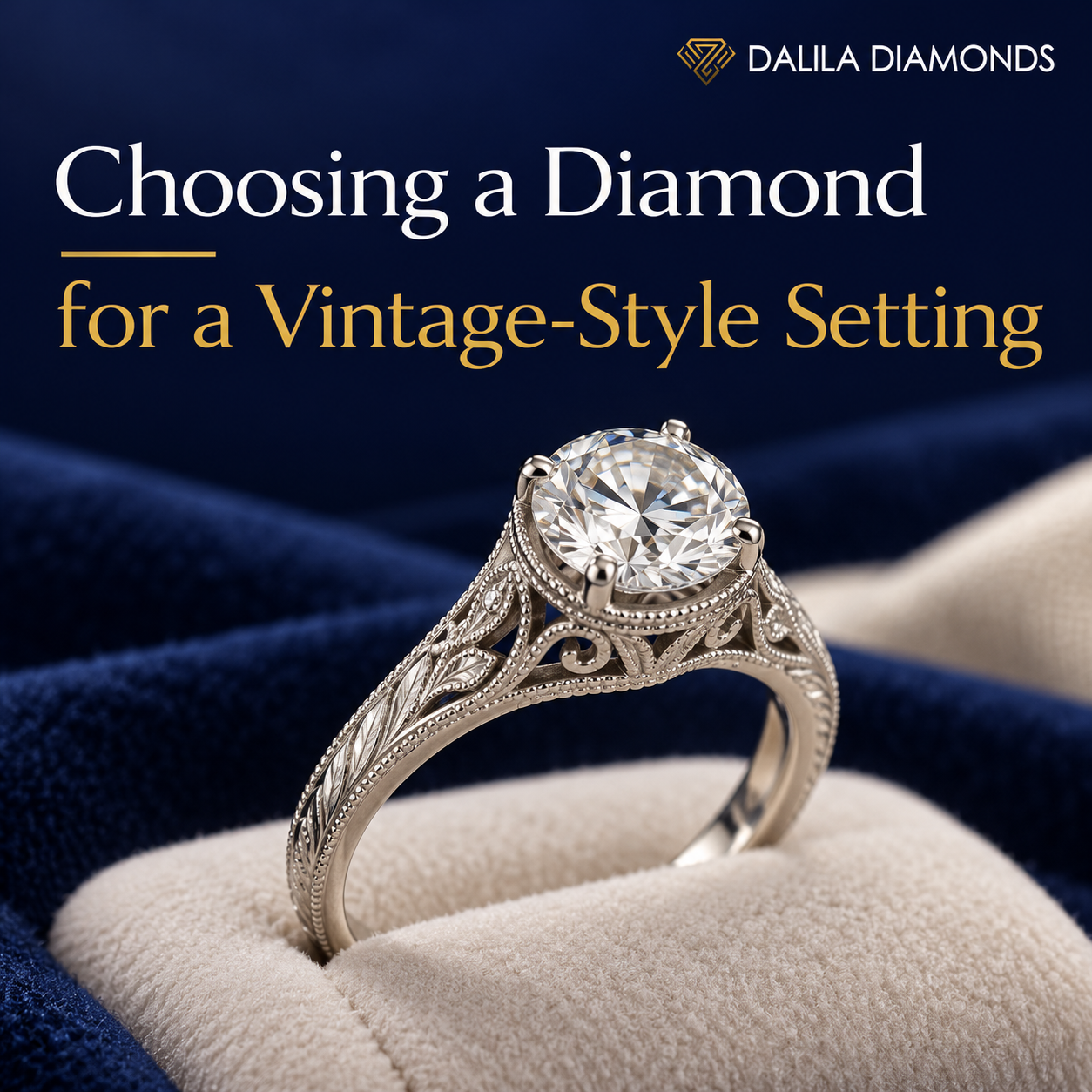
Choosing a diamond for a vintage engagement ring setting requires two separate decisions: finding a stone that complements the intended period-inspired design and confirming that its actual dimensions and physical condition are suitable for the mounting.
An Old European Cut diamond may complement an Edwardian-inspired ring with milgrain and delicate metalwork. An Old Mine Cut may suit a Victorian-inspired design featuring an ornate bezel or decorative prongs. A modern round brilliant or cushion can also work in a vintage-style setting when the buyer prefers contemporary optical performance.
However, visual compatibility does not establish physical fit.
A mounting designed for a 1.00-carat modern round brilliant cannot automatically accommodate a one-carat Old European Cut. The two diamonds may differ in diameter, crown height, total depth, girdle shape and culet geometry.
Similarly, an Old Mine Cut and a modern cushion may share broadly rounded-square outlines while having significantly different corner shapes and pavilion profiles.
The correct approach is to select the desired facet appearance, obtain the diamond's exact measurements and condition information, and have the mounting approved by the jeweller responsible for setting it.
GIA's guide to antique and vintage engagement rings explains how historical diamond cuts differ in crown height, girdle outline, proportions and faceting, all of which can affect their suitability for particular designs.
GIA 4Cs
This article focuses on choosing a diamond for a vintage-style mounting. The separate vintage-cut sourcing guide should retain the detailed history of antique diamonds, their availability and how to source genuine period stones.
What Is a Vintage-Style Engagement Ring Setting?
A vintage-style engagement ring is a modern or restored design that incorporates visual elements associated with jewellery from earlier periods.
These elements may include milgrain, filigree, engraving, geometric shoulders, decorative bezels, cluster arrangements or distinctive prong designs.
The term does not necessarily mean the ring or its diamond is genuinely antique.
A newly manufactured engagement ring can combine a modern GIA-graded round brilliant with Edwardian-inspired platinum metalwork.
A genuine antique diamond can also be mounted in a newly designed ring.
That distinction matters because the age of the diamond, its cutting style and the age of the mounting are three separate characteristics.
Vintage-style design versus antique construction
Feature | Vintage-inspired ring | Genuine antique ring |
Manufacturing period | Usually modern | Earlier historical period |
Decorative appearance | Inspired by older jewellery styles | Reflects original period design |
Centre diamond | Antique or modern cut | Original or subsequently replaced stone |
Mounting condition | New, or based on modern manufacture | May have wear or previous repairs |
Stone compatibility | Can be designed around a selected diamond | Requires examination of existing structure |
Documentation | Modern ring and stone records may be available | Original provenance and repair records may be incomplete |
An attractive antique-inspired design should not be confused with evidence that a particular diamond is old.
Likewise, genuine antique construction should not automatically be assumed secure simply because it previously held a stone.
Which Diamond Cuts Suit a Vintage-Style Ring?
Old Mine, Old European and transitional cuts are often considered for historically inspired jewellery because their facet patterns differ from those of many modern brilliant cuts.
However, buyers do not necessarily need an antique-cut diamond to create a convincing vintage aesthetic.
A modern cushion or round brilliant may also complement the mounting, depending on the intended appearance.
Diamond style | Typical visual characteristics | Main setting consideration |
Old Mine Cut | Cushion-like outline, broad facets, often visible culet | Irregular outline, crown height and girdle |
Old European Cut | Roundish outline, smaller table, higher crown, broad reflections | Actual diameter, crown and pavilion proportions |
Transitional Cut | Faceting between older and modern round brilliant styles | Individual measurements and facet appearance |
Modern round brilliant | More standardised round outline and contemporary brilliant faceting | Existing head compatibility and desired period appearance |
Antique-style cushion | Rounded-square or rectangular outline with chunky facets | Actual corners, shoulders and pavilion |
Modern emerald cut | Geometric outline and step facets | Truncated corners, width and seating |
Rose cut | Faceted dome with flat or relatively flat base | Very different setting geometry from a conventional brilliant |
GIA's recently published guide to antique diamond shapes describes how older cutting styles vary in outline, crown, pavilion and facet appearance.
GIA 4Cs
These categories are visual starting points, not interchangeable dimensional specifications.
A jeweller must assess the particular diamond.
Old Mine Cut Diamonds in Victorian-Inspired Settings
An Old Mine Cut can create a strong vintage impression because of its rounded-square or cushion-like outline and distinctive broad facet pattern.
Historically cut examples commonly have relatively high crowns, smaller tables, deeper pavilions and visible culets.
GIA also notes that many older stones were cut with less standardised outlines than modern diamonds.
GIA 4Cs
These characteristics can be appealing in a Victorian-inspired ring, especially where the design includes ornate metalwork or decorative stone surrounds.
However, the unusual outline is also a practical mounting consideration.
Why a modern cushion mounting may not fit
Consider a modern cushion-cut head designed for a stone measuring approximately 7.0 × 6.5 mm.
An Old Mine Cut with similar nominal measurements may still have different shoulder curvature, corner positions and girdle geometry.
The existing prongs or bezel may not follow those differences.
A high crown can also change how the diamond appears above the metal, while a deeper pavilion may require additional clearance underneath.
The jeweller should therefore use actual stone measurements and a face-up outline, rather than rely on the description one-carat cushion.
Check the girdle carefully
Some genuine Old Mine Cut diamonds have very thin girdle sections.
These may be vulnerable to chipping, particularly where the mounting leaves the perimeter exposed.
GIA recommends appropriate girdle protection for antique-cut diamonds with vulnerable edges.
GIA 4Cs
A vintage appearance should not take priority over securely accommodating the stone.
Old European Cut Diamonds in Edwardian-Inspired Settings
Old European Cut diamonds are commonly associated with jewellery from the late Victorian, Edwardian and early twentieth-century periods.
Their appearance is often characterised by a relatively small table, high crown, broad facets and a visible culet.
Although their outlines are generally round, they should not be assumed to share the dimensional consistency of modern round brilliant diamonds.
For a ring with fine milgrain, engraved shoulders or a delicate platinum head, an Old European Cut may create a cohesive period-inspired appearance.
However, the mounting must accommodate its actual crown, girdle and pavilion.
Worked dimension comparison
Suppose a jeweller is evaluating two hypothetical diamonds:
Specification | Old European-style diamond | Modern round brilliant |
Intended weight | Approximately 1.00 ct | Approximately 1.00 ct |
Diameter | 6.3–6.5 mm | 6.4–6.5 mm |
Total depth | 4.2 mm | 3.9 mm |
Crown | Relatively high | Different, more contemporary proportions |
Culet | Visible | Usually pointed or very small |
Girdle | May be irregular | More uniform in many modern examples |
These are illustrative measurements, not actual Dalila inventory diamonds or standard measurements for every cut.
The older-style stone may require more vertical space within the setting.
Its crown may also change the visual relationship between the diamond and surrounding decorative metalwork.
If an existing mounting was designed around the modern brilliant, the Old European-style diamond should not be accepted solely because its average diameter appears similar.
The setter must confirm whether the head can accommodate the full profile.
Transitional Cuts: A Different Facet Character Without a Fixed Size Rule
Transitional diamonds are generally associated with the development between Old European cutting styles and the modern round brilliant.
Their faceting and proportions can vary.
Some display broad reflections reminiscent of older cuts, while others have characteristics closer to contemporary brilliant cutting.
This makes them worth considering for buyers who want a vintage appearance without necessarily choosing a strongly irregular Old Mine Cut.
However, the word transitional does not guarantee a particular diameter, crown height or depth.
Individual stones should be compared through measurements and visual inspection.
A transitional cut may be suitable for a vintage-style mounting, but fit must still be approved in the same way as any other diamond.
Can a Modern Diamond Look Appropriate in a Vintage Ring?
Yes.
The overall ring design plays a significant role in creating a vintage-inspired appearance.
Milgrain, engraving, decorative shoulders and geometric settings can establish a period influence even when the centre stone is a modern brilliant.
For example, a modern round brilliant can be placed in an Edwardian-inspired solitaire with fine milgrain and engraved platinum shoulders.
A modern emerald cut can complement an Art Deco-inspired geometric mounting.
A modern cushion with broad, chunky faceting can work in a Victorian-inspired design.
Modern brilliant versus antique-style faceting
The choice is primarily about the visual result.
Modern round brilliants are generally evaluated for contemporary brightness, fire and scintillation characteristics.
Older cutting styles often display different patterns of reflections because of their facet arrangements, crown proportions and culet treatment.
An antique-cut diamond should not automatically be rejected because it lacks the same appearance as a modern Excellent-cut round brilliant.
Equally, the label antique style should not excuse poor transparency, damage or an unattractive optical appearance.
GIA's engagement ring diamond shape guide explains how Old European and Old Mine diamonds differ visually from modern cuts.
GIA 4Cs
The buyer should compare actual stones rather than rely solely on the name of the cutting style.
Why Actual Diamond Outline Matters More Than Shape Labels
Vintage-inspired mountings often contain decorative details positioned close to the centre stone.
This makes the actual perimeter of the diamond especially important.
For example, a ring with a cushion-shaped bezel may be designed around a relatively symmetrical rounded-square outline.
A genuine Old Mine Cut with uneven shoulders may require a differently shaped bezel seat.
An emerald-cut diamond can also have corner truncations that differ from the shape represented in the mounting's CAD model.
Two diamonds with identical reported lengths and widths are not necessarily interchangeable.
Illustrative outline comparison
Characteristic | Stone A | Stone B | Potential mounting issue |
Described shape | Cushion | Cushion | Same label does not prove fit |
Length | 7.2 mm | 7.2 mm | Nominal match |
Width | 6.7 mm | 6.7 mm | Nominal match |
Shoulder outline | Full and rounded | More irregular | Different bezel or prong contact |
Corners | Broadly rounded | Unequal curvature | Potential misalignment |
Crown height | Relatively low | Higher | Different table elevation |
Pavilion depth | Shallower | Deeper | Different clearance needs |
Hypothetical design comparison; not measured physical diamonds.
The table demonstrates why a setter needs more than a grading report's headline measurements.
A stone outline, detailed image, scan or physical inspection can establish how the diamond will interact with the mounting.
Technical Diagram: Outline and Profile Fit
The following original diagram illustrates three separate issues: cushion outline variation, round diameter and the vertical profile that must fit within the mounting.
Download original vintage diamond fit diagram (PNG)
Original educational diagram using hypothetical stone outlines and a simplified setting profile. The stated dimensions are illustrative and do not represent real Dalila inventory, a verified antique diamond or a setter-approved manufacturing design.
In the first panel, the cushion-shaped outline illustrates why the corners and shoulders should be reviewed individually.
The second panel shows why a broadly round Old European-style stone still needs its actual minimum and maximum diameters recorded.
The profile panel demonstrates the relationship between the crown, girdle and pavilion.
The diamond's total depth does not independently establish the finished height of the ring. The jeweller must determine the girdle seat, available pavilion space and metal structure.
Crown Height, Pavilion Depth and Visible Culet
Historical cutting styles can have very different vertical proportions from modern stones.
An Old Mine or Old European Cut may have a higher crown and deeper pavilion than a modern diamond of similar weight.
This affects two separate aspects of the ring.
First, the crown can influence how prominently the diamond rises above surrounding decorative metalwork.
Second, the pavilion may require different space beneath the girdle.
A vintage-style mounting designed for one stone cannot be assumed suitable for another simply because their face-up outlines appear compatible.
Culet appearance is not the same as damage
Some antique diamonds have an open or visible culet.
This may appear as a small facet or visible area near the centre of the stone when viewed from above.
In the context of an antique cutting style, a visible culet is not automatically a defect.
However, a polished culet facet should not be confused with accidental damage.
Dalila's Diamond Culet Guide explains the distinction between traditional culet characteristics and damage that requires evaluation.
For an existing closed-back or shallow mounting, culet and pavilion position may be especially relevant because the lower portion of the stone needs sufficient space.
The setter must confirm whether the proposed stone can be accommodated without unintended contact with the mounting.
Girdle Condition: A Critical Check for Antique Diamonds
The girdle is the boundary between the crown and pavilion.
Many historic cutting styles have less uniform girdles than modern precision-cut diamonds.
Some antique stones also have very thin sections or previously sustained edge damage.
These characteristics matter because prongs and bezels often secure the stone at or near the girdle.
A vintage-style ring may have delicate-looking prongs or decorative metalwork, but those features must still provide suitable mechanical support.
Girdle assessment checklist
Feature | Why it must be checked |
Minimum girdle thickness | Very thin areas may be vulnerable |
Variation around perimeter | Support points may encounter different thicknesses |
Existing chips | Could affect retention or setting risk |
Surface-reaching feathers | May require examination near exposed edges |
Abrasions | May indicate previous wear or damage |
Irregular outline | Can alter the position of retaining metal |
Previous setting marks | May influence the jeweller's assessment |
Planned prong locations | Need to align with suitable areas of the stone |
No general statement that a particular girdle grade is always acceptable can replace examination of the actual diamond.
GIA's Old Mine Cut Diamond Guide specifically highlights the need for protective settings when antique stones have exceptionally thin girdles.
GIA 4Cs
A secure vintage-inspired design may therefore require stronger or more carefully positioned retaining metal than its delicate appearance initially suggests.
Does a Vintage-Style Setting Need a Bezel?
Not necessarily.
Vintage-inspired settings can use bezels, prongs, decorative collets or other historically influenced mounting forms.
A bezel may provide extensive coverage around the girdle, which can be useful for some antique cuts.
However, it must fit the actual stone.
A modern bezel designed from a generic cushion outline may be unsuitable for an irregular Old Mine Cut without modification.
Prong settings offer a different appearance and can also be appropriate when correctly designed.
The important question is whether the stone is supported and protected by the finished structure.
Comparing mounting choices
Setting style | Vintage visual character | Technical consideration |
Decorative bezel | Continuous metal border | Must follow actual outline and girdle |
Prong solitaire | Open centre with historical styling | Contact points and prong condition |
Cut-down collet-inspired setting | Ornamental edge detail | Requires specialist construction |
Closed-back-inspired mounting | Historic enclosed appearance | Pavilion space and access for inspection |
Cluster setting | Centre with surrounding smaller stones | Centre fit plus neighbouring-stone geometry |
Geometric bezel | Art Deco-inspired appearance | Corner alignment and exact dimensions |
Do not assume that a historic visual style automatically reproduces the engineering of an original antique setting.
Modern manufacture may use different techniques and structural details.
For bezel-specific tolerances and outline requirements, Dalila's separate Choosing a Diamond for a Bezel Engagement Ring guide should remain the detailed resource.
Choosing a Diamond for Victorian, Edwardian and Art Deco-Inspired Settings
Different historical design references create different expectations for the centre diamond.
These are aesthetic associations rather than compulsory rules. Jewellery from each period included considerable variation, and modern vintage-inspired pieces often combine elements from several eras.
Victorian-inspired rings
Victorian-inspired designs may include decorative goldwork, floral details, clusters and ornate bezels.
An Old Mine Cut or antique-style cushion can create a harmonious appearance because its softer outline and broad facets complement elaborate metalwork.
A modern cushion may also work if its outline and facet character suit the design.
The practical check is whether the centre diamond fits the decorative head without interfering with the surrounding metal or stones.
Edwardian-inspired rings
Edwardian-inspired settings often feature fine metalwork, platinum, milgrain and intricate openwork details.
An Old European Cut can suit this style, particularly when the buyer wants a round centre with broad vintage-style reflections.
A modern round brilliant can also work.
Because the metalwork may be intricate, the jeweller should pay special attention to the head's supports and the condition of any existing setting.
Delicate appearance should not be confused with sufficient structural support.
Art Deco-inspired rings
Art Deco-inspired settings often incorporate geometry, symmetry and strong architectural lines.
Emerald cuts, Asscher cuts and other geometric diamonds can complement these designs.
However, the diamond's actual corners and proportions matter.
An emerald cut with more pronounced cut corners may interact differently with a geometric bezel or decorative side structure than another emerald cut of the same length and width.
For custom manufacture, the exact stone should be used to finalise the setting drawing.
Comparing the three approaches
Design inspiration | Diamond possibilities | Important fit check |
Victorian | Old Mine, antique-style cushion, modern cushion | Irregular shoulders, corners and pavilion |
Edwardian | Old European, transitional, modern round | Crown, girdle and head support |
Art Deco | Emerald, Asscher, geometric step cuts | Rectangular proportions and cut corners |
The selected diamond does not need to have been cut during the historical period that inspired the ring.
A modern natural diamond can achieve the intended appearance if the buyer prefers its optical characteristics and the jeweller approves the design.
Vintage Diamond Colour: Should the Stone Look Warm?
Some genuine antique diamonds have warmer body colour than the colourless diamonds frequently promoted in modern engagement-ring advertising.
That warmth may complement yellow gold, rose gold or an historically inspired mounting.
However, a vintage-style setting does not require a low-colour-grade diamond.
A D-colour Old European-style diamond may create a deliberate contrast with warm gold, while an I- or J-colour stone may produce a softer relationship between stone and metal.
The buyer should evaluate the individual diamond in the intended metal environment.
For example, compare the same candidate beside yellow gold and platinum under consistent lighting.
The stone's laboratory colour grade remains unchanged, but reflections from the surrounding metal can influence its apparent colour.
This specific setting-appearance decision is covered more fully in Dalila's Diamond Colour in Yellow, White and Rose Gold guide.
The central question for a vintage-style ring is whether the stone's appearance supports the intended design—not whether a particular historical-looking ring must use a particular colour grade.
Should Vintage Diamonds Have the Same Clarity Standards as Modern Diamonds?
Clarity grading remains relevant, but the buyer should consider how the diamond's facets influence the visibility of inclusions.
Old Mine and Old European cuts can display broad reflections that differ from modern brilliant faceting.
Some inclusions may therefore be more apparent in one diamond than in another with a similar laboratory clarity grade.
More importantly, the setter must evaluate any characteristics that could affect durability or stone retention.
An inclusion near a thin girdle section, a pre-existing chip or a surface-reaching feather may require closer inspection.
This does not mean all antique diamonds with inclusions are unsuitable.
The importance depends on the actual characteristic, its location and the intended mounting.
The buyer should distinguish three questions:
Is the inclusion visible and aesthetically acceptable?
Does it affect the stone's condition or durability?
Does its location influence where the setter can safely secure the diamond?
The first is primarily a visual preference.
The second and third require appropriate professional evaluation.
How to Read a Diamond Report for a Vintage-Style Setting
A diamond grading report can provide important information about the proposed stone.
However, not every antique diamond will have a modern report, and not every report includes the same information or grading fields.
The buyer should confirm exactly what is documented rather than assume that the absence of a particular grade indicates a problem.
Report and documentation checklist
Information | What to verify | Why it matters |
Laboratory | GIA, IGI, HRD or another identified issuer | Establishes the source of grading information |
Report number | Corresponds to the actual diamond | Supports identification |
Natural origin | Confirmed where applicable | Distinguishes natural from laboratory-grown material |
Shape/cutting style | Actual report description | Avoids relying on seller terminology alone |
Carat weight | Recorded diamond mass | Useful for valuation, not proof of fit |
Measurements | Length, width and total depth | Essential mounting information |
Colour | Laboratory assessment | Helps evaluate appearance in intended metal |
Clarity | Laboratory assessment | Identifies characteristics requiring further inspection |
Polish and symmetry | Where reported | Supports evaluation of finish and cutting characteristics |
Culet | Where reported or visible | Helps interpret antique-style faceting |
Girdle | Where reported | May indicate setting-relevant concerns |
Clarity plot/comments | Where included | Helps locate inclusions and other characteristics |
Treatment disclosure | Confirm status where applicable | Important for purchasing and setting decisions |
Current physical condition | Requires inspection | A report may not reflect damage sustained afterward |
GIA's antique diamond education explains why historical cutting styles can have proportions and symmetry characteristics different from contemporary stones.
GIA 4Cs
A report should be interpreted within the correct cutting style.
For example, a grading document for an Old Mine Cut should not automatically be expected to contain the same overall cut-grade assessment as a modern standard round brilliant.
The buyer should verify the actual grading service and report format.
Does a GIA Report Prove a Diamond Is Genuinely Antique?
No. A grading report can identify and describe the diamond's characteristics, but a cutting style associated with an earlier era does not, by itself, establish the diamond's date of manufacture.
A newly fashioned stone can reproduce characteristics associated with Old Mine or Old European cuts.
Likewise, an older diamond may have been repolished or modified.
If the claim that a stone is genuinely antique materially affects the purchase, the buyer should request appropriate provenance and supporting evidence.
An inscription, sales description or cut-style designation should not automatically be interpreted as proof of historical origin.
The issue of verifying and sourcing genuinely old stones belongs principally in Dalila's separate vintage-cut sourcing resource.
For B12, the key question is whether the proposed stone has the intended appearance, documented characteristics and appropriate condition for the mounting.
Inspecting a Genuine Antique Diamond Before Resetting
A genuine antique diamond may have experienced decades or centuries of wear, previous repairs or resetting.
Before incorporating it into a newly manufactured vintage-style ring, the jeweller should inspect the stone carefully.
The condition assessment should consider the girdle, culet, corners, existing chips and potentially significant clarity characteristics.
Where practical, the diamond should also be checked under magnification by a qualified professional.
Condition assessment
Area | Inspection question |
Girdle | Are any sections extremely thin, chipped or abraded? |
Corners | Are there vulnerable areas requiring special protection? |
Culet | Is the visible feature an intentional facet or possible damage? |
Crown | Are there abrasions, chips or prior polishing changes? |
Pavilion | Is there damage or geometry affecting mounting clearance? |
Clarity characteristics | Could any affect setting or durability? |
Previous repairs | Is there evidence of earlier intervention? |
Grading documentation | Does it correspond with the actual stone? |
Treatment status | Is any treatment disclosed or suspected? |
The jeweller should discuss any risks associated with mounting or resetting the particular diamond.
GIA notes that antique diamonds can have very thin girdles, making protective setting choices especially important.
GIA 4Cs
If the condition of the diamond makes a proposed delicate mounting unsuitable, the design should be changed rather than forcing the stone into an inappropriate setting.
Fitting a Diamond Into an Existing Vintage Ring
Replacing a diamond in an existing vintage or antique ring is a different task from designing a new vintage-inspired mounting.
With a new setting, the jeweller can often design the head around the selected stone.
With an existing ring, the head may have already been shaped around a particular diamond's outline, depth and girdle.
This is especially important with historic hand-fabricated settings.
A replacement diamond cannot be approved simply because its carat weight or broad shape matches the original.
Example: replacing an Old European Cut
Suppose an existing ring originally contained a roundish Old European Cut measuring approximately 6.6–6.8 mm in diameter.
The owner is considering a modern round brilliant measuring 6.5–6.6 mm.
The modern stone may be similar in face-up size, but its crown height, pavilion and girdle characteristics could differ.
The original prong seats may also have worn or been altered.
Before purchasing, the setter should determine whether the modern candidate can be accommodated securely.
The possible outcomes include reusing the original head after professional preparation, modifying it or replacing it while preserving other parts of the ring.
For detailed replacement-stone tolerances and setting inspection, use Dalila's How to Fit a New Diamond to an Existing Ring Setting guide.
This vintage article concentrates on the additional considerations created by antique cutting characteristics and older mounting construction.
Worked Example: Two Diamonds for a Victorian-Inspired Ring
Suppose a buyer wants a natural diamond for a newly manufactured Victorian-inspired yellow-gold ring with decorative shoulders and a bezel-style centre.
The buyer is comparing two hypothetical candidates.
Specification | Diamond A | Diamond B |
Style | Old Mine-style cushion | Modern cushion brilliant |
Carat weight | 1.20 ct | 1.20 ct |
Length | 7.2 mm | 7.0 mm |
Width | 6.7 mm | 6.5 mm |
Total depth | 4.8 mm | 4.3 mm |
Outline | Slightly irregular rounded-square | More regular rounded-square |
Facet appearance | Broad, chunky pattern | Modern brilliant-style pattern |
Culet | Visible | Small or pointed |
Girdle condition | Requires individual assessment | Requires individual assessment |
Intended setting | Bespoke bezel | Bespoke bezel |
These are illustrative specifications, not verified stones available through Dalila.
Step 1: Choose the preferred facet appearance
Diamond A offers a more explicitly antique-inspired visual character through its broad facets and visible culet.
Diamond B may provide a more contemporary brilliant appearance while still complementing the decorative ring design.
Neither is automatically superior.
The buyer should compare their actual appearance in motion under suitable lighting.
Step 2: Compare the outlines
Diamond A is slightly longer and wider.
However, its more irregular outline may require a bezel shaped precisely for the selected stone.
Diamond B may have a more regular perimeter, but its suitability still depends on the actual corners, girdle and dimensions.
Step 3: Compare the vertical profiles
Diamond A has a total depth of 4.8 mm, compared with 4.3 mm for Diamond B.
That difference may affect pavilion clearance and the height of the centre setting.
The jeweller must assess the proposed girdle seat and the structure beneath the diamond.
Total depth alone does not establish the finished ring height.
Step 4: Review the condition and documentation
If Diamond A is represented as a genuine antique stone, the buyer should distinguish the claim of historical origin from the visual description of its cutting style.
The diamond's actual condition and documentation should be reviewed.
If either candidate has a vulnerable girdle or existing damage, the jeweller must establish whether the proposed bezel adequately protects it.
Step 5: Approve the complete ring design
The jeweller should prepare a scaled setting drawing using the selected diamond's dimensions and outline.
The buyer can then decide whether the intended decorative bezel, shoulder details and finished profile create the desired vintage appearance.
The appropriate diamond is the one whose visual character, condition and mounting requirements work together.
The fact that one stone has a more historically recognisable facet pattern does not automatically make it the better choice for the finished ring.
Vintage-Style Ring Diamond Selection Worksheet
Use this worksheet when comparing candidate natural diamonds for an antique-inspired ring.
Specification | Requirement or finding |
Ring design inspiration | Victorian / Edwardian / Art Deco / Other |
New or existing mounting | ______ |
Centre diamond shape | ______ |
Cutting style | ______ |
Carat range | ______ |
Length | ______ mm |
Width or minimum/maximum diameter | ______ mm |
Total depth | ______ mm |
Crown characteristics | ______ |
Pavilion characteristics | ______ |
Culet description | ______ |
Girdle thickness and condition | ______ |
Corner or shoulder geometry | ______ |
Desired facet appearance | ______ |
Colour range | ______ |
Clarity range | ______ |
Grading laboratory | ______ |
Report number | ______ |
Natural-origin documentation | ______ |
Antique provenance claimed? | Yes / No |
Provenance evidence available? | ______ |
Existing damage noted? | ______ |
Intended setting style | ______ |
Metal and alloy | ______ |
Finished profile requirement | ______ |
Setter approval | Pending / Approved |
This worksheet separates aesthetic decisions from physical compatibility and documentary verification.
An attractive facet pattern does not replace a condition assessment.
Likewise, a grading report does not replace approval of the mounting.
A Sourcing Brief for a Vintage-Style Diamond Ring
A useful sourcing request should identify both the intended diamond appearance and the mounting constraints.
For example, a buyer planning an Edwardian-inspired ring should not simply ask for a one-carat vintage diamond.
The supplier needs to know whether the buyer wants a genuinely antique stone, a modern antique-style cut or a contemporary brilliant in a vintage-inspired setting.
The request should also include any known dimensional requirements.
Information | What to provide |
Intended jewellery | Vintage-inspired engagement ring |
Design reference | Photograph, drawing or CAD model |
Preferred period aesthetic | Victorian, Edwardian, Art Deco or another style |
Diamond cutting style | Old Mine, Old European, transitional or modern |
Historical origin requirement | Genuine antique or antique-inspired appearance |
Carat range | Target weight |
Face-up dimensions | Preferred length and width |
Total depth | Candidate-specific, subject to setting approval |
Facet preference | Broad antique-style reflections or modern brilliance |
Colour and clarity | Preferred ranges |
Grading documentation | Laboratory preference and identification details |
Condition requirements | No unapproved chips or setting-relevant damage |
Girdle considerations | Setter-approved characteristics |
Mounting status | New design or existing head |
Finished setting requirements | Bezel, prongs, profile and relevant constraints |
Approval | Jeweller's inspection before final setting |
Example sourcing request
A hypothetical buyer could use the following brief:
Jewellery: Edwardian-inspired natural diamond engagement ring.
Diamond appearance: Old European Cut or a modern diamond with a comparable vintage-inspired facet character.
Carat range: Approximately 1.00–1.50 ct.
Face-up dimensions: To be selected in coordination with the jeweller.
Colour: G–J, subject to the desired appearance.
Clarity: VS–SI options may be considered, subject to inclusion location, visibility and durability assessment.
Grading preference: Recognised laboratory documentation where available.
Mounting: New platinum setting with decorative shoulders and milgrain.
Condition: Any girdle damage, chips or relevant surface-reaching characteristics must be reviewed before purchase.
Approval: The jeweller must confirm the stone's dimensions, support positions and mounting suitability.
These are illustrative preferences, not an offer of available inventory.
Dalila Diamonds supports natural loose-diamond sourcing through its Antwerp diamond business. A detailed enquiry can identify the required shape, dimensions, grading characteristics and unusual cutting preferences.
Dalila's existing sourcing content also discusses the specialist nature of vintage cuts and other less-standard diamond requests.
Dalila Diamonds
The supplier can help identify candidate natural diamonds and provide available documentation.
The manufacturing jeweller remains responsible for confirming whether the actual diamond can be securely accommodated within the proposed vintage-style mounting.
If the buyer wants an original antique diamond with historical provenance, that requirement should be stated separately from the desired facet appearance.
Availability, documentary evidence and stone condition must be confirmed individually.
Quotations should distinguish the loose diamond from any separate mounting design, restoration, manufacture and setting work.
Common Mistakes When Choosing a Diamond for a Vintage-Style Setting
Assuming every vintage-style ring needs an antique diamond
A modern natural diamond can work in a Victorian-, Edwardian- or Art Deco-inspired design.
The appropriate cut depends on the intended appearance.
Treating Old Mine and modern cushion diamonds as interchangeable
They can differ substantially in outline, depth, crown and girdle geometry.
Selecting a stone by carat weight instead of dimensions
The mounting must accommodate actual millimetre measurements and the full stone profile.
Ignoring unusually thin girdles
Some historic stones have vulnerable edge sections that require appropriate protection.
Assuming a visible culet means damage
An open culet can be an intentional characteristic of an older cutting style.
It should nevertheless be inspected to distinguish a polished facet from accidental damage.
Expecting every antique-style diamond to receive a modern overall cut grade
Laboratory reporting varies by diamond shape, cutting style and report type.
Not every historical cut is evaluated using the same grading framework as a modern standard round brilliant.
Confusing cutting style with historical provenance
A diamond can be newly cut to resemble an older style.
The age of the actual stone requires separate evidence.
Fitting a new diamond into an old head without inspection
Worn prongs, irregular seats and existing repairs can affect compatibility.
Prioritising delicate metalwork over setting security
A vintage-inspired design still needs sufficient structural support and appropriate protection for the diamond.
Frequently Asked Questions
What diamond cut is best for a vintage engagement ring?
Old Mine, Old European and transitional cuts are popular choices for vintage-inspired rings because of their distinctive facet patterns. Modern round brilliants, cushions and emerald cuts can also work. The best choice depends on the intended appearance and actual mounting compatibility.
Can a modern diamond be used in a vintage-style setting?
Yes. A newly cut natural diamond can be mounted in a design incorporating milgrain, engraving, filigree or other period-inspired details. The diamond does not need to be antique to create a vintage aesthetic.
What is the best diamond for a Victorian-style engagement ring?
An Old Mine Cut or antique-style cushion is a useful starting point because its rounded-square outline and broad facets can complement ornate Victorian-inspired metalwork. A modern cushion may also be appropriate if the buyer prefers its appearance.
What diamond works best in an Edwardian-style ring?
Old European Cuts are often associated with Edwardian-inspired designs, particularly those featuring platinum and intricate detailing. Transitional or modern round brilliant diamonds may also complement the setting.
Are emerald cuts suitable for Art Deco-style rings?
Yes. Their rectangular geometry and step faceting can work well with Art Deco-inspired designs. The jeweller must assess the actual dimensions, corner truncations and head construction.
Can an Old Mine Cut fit a modern cushion setting?
Possibly, but not automatically. Old Mine Cuts may have irregular shoulders, different corner geometry, higher crowns and deeper pavilions. The jeweller must approve the fit using the actual stone.
Can an Old European Cut replace a modern round brilliant?
Sometimes, but equal carat weight or similar diameter does not guarantee compatibility. Crown height, total depth, girdle characteristics and existing prong seats must be evaluated.
Does a visible culet reduce the quality of an antique diamond?
Not necessarily. Visible culets are characteristic of several older cutting styles. Their appearance should be assessed in the context of the stone's faceting, and any suspected damage should be checked separately.
Are antique diamonds more likely to have thin girdles?
Some genuine antique cuts, particularly older hand-cut stones, have very thin girdle sections. However, this varies by individual diamond. The actual girdle must be inspected.
Do vintage diamonds need GIA certificates?
A GIA, IGI or HRD report can provide valuable grading and identification information, but some genuine antique diamonds may not have current laboratory documentation. The buyer should evaluate what is available and arrange appropriate professional verification where needed.
Does a GIA report prove that a diamond is antique?
No. A report may describe an antique cutting style but does not necessarily establish the date when the diamond was cut. Claims of historical origin require separate supporting evidence.
Can a vintage-style diamond have an Excellent cut grade?
Some modern diamonds used in vintage-style settings may receive an overall Excellent cut grade under applicable laboratory grading systems. Many antique and fancy-cut diamonds are not evaluated under the same overall cut-grading criteria. The exact report and cutting style matter.
Are antique-cut diamonds suitable for everyday wear?
They can be, but the actual stone condition and setting must be assessed. Thin girdles, previous chips and vulnerable corners may require additional protection. No diamond is damage-proof.
Should a vintage engagement ring use yellow gold or platinum?
Either may be appropriate. Yellow gold can complement a warm, traditional appearance, while platinum can support Edwardian- or Art Deco-inspired aesthetics. The chosen diamond should be evaluated beside the intended metal, and the jeweller should confirm the setting construction.
Can I reuse an inherited vintage mounting with a new diamond?
Possibly. The mounting should first be inspected for wear, deformation, damaged seats and previous repairs. The setter must establish the compatible dimensions and approve the actual replacement diamond.
What should I send a diamond supplier for a vintage-style ring?
Provide the intended design, preferred cut style, desired dimensions, colour and clarity ranges, grading requirements and whether genuine historical provenance is important. Include the jeweller's mounting constraints and request a professional condition assessment before setting.