Diamond Pendant Carat Size Guide: How Big Will the Diamond Look on Your Neck?
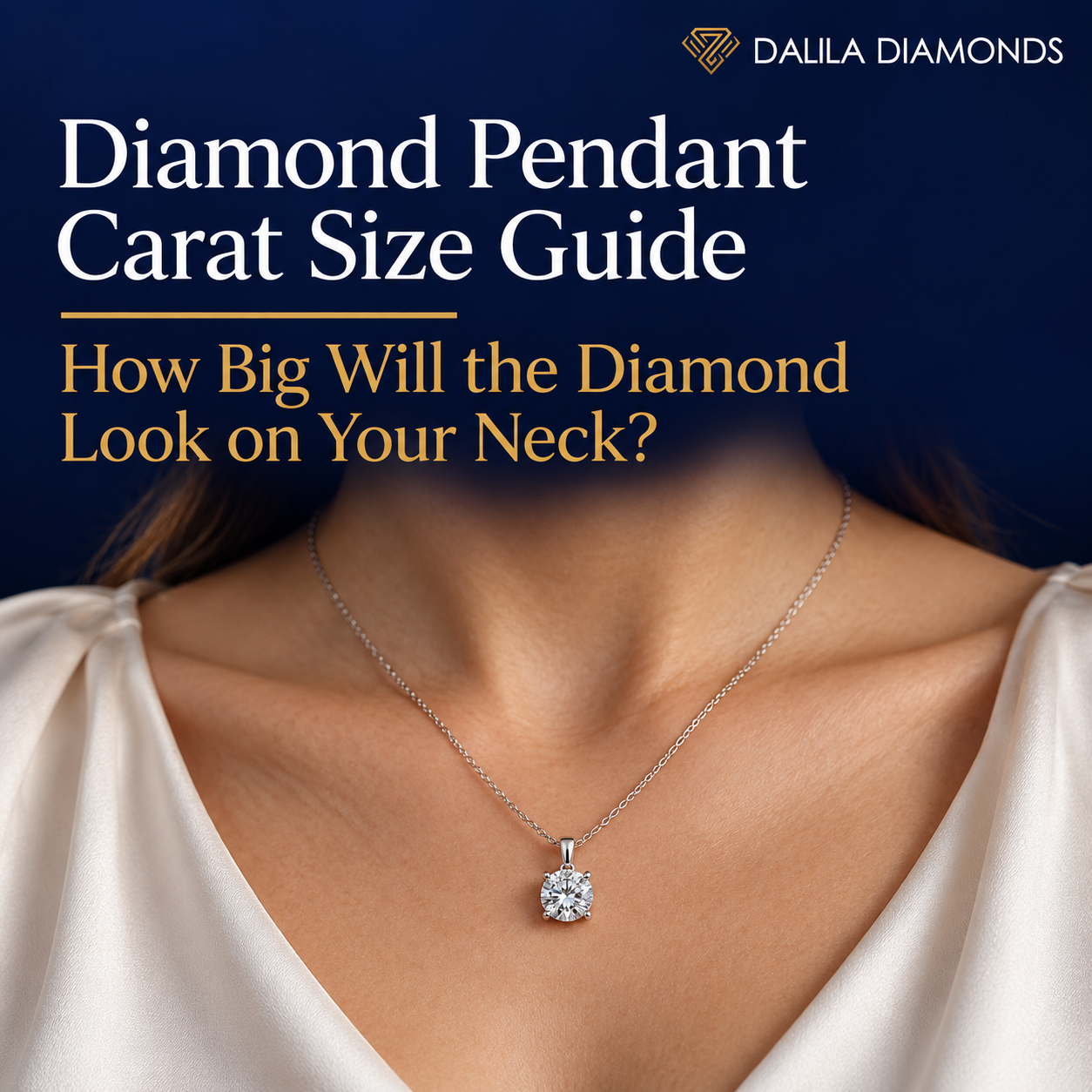
Choosing the right diamond pendant size is easier when you compare the stone's actual dimensions with how it will appear on the neckline. Carat weight tells you how much a diamond weighs, but its diameter in millimetres gives a clearer indication of how prominent it may look when worn.
For example, a 0.50-carat round brilliant diamond typically measures approximately 5.1 mm across. A 1.00-carat round diamond commonly measures around 6.4–6.5 mm.
The one-carat diamond weighs twice as much, but its face-up diameter is only about 27% greater.
That difference can still be noticeable in a solitaire pendant. However, the visual result also depends on the setting, chain length, wearer's proportions and the position of the diamond relative to the neckline.
A 0.50-carat diamond may create a delicate everyday pendant, while a 1.00-carat diamond may produce a more prominent centrepiece. Neither size is inherently better.
The most useful way to choose a natural diamond pendant is to select the desired face-up size in millimetres, compare it at a consistent neckline position and then confirm that the selected stone works with the intended setting.
This guide focuses specifically on how diamond size translates into the appearance of a pendant when worn. Dalila's general Diamond Size Chart remains the broader carat-to-millimetre reference for loose diamonds of different shapes.
Diamond Pendant Size Chart: Carat Weight to Millimetres
The following chart shows approximate diameters for natural round brilliant diamonds commonly considered for solitaire pendants.
Diamond weight | Approximate diameter | Pendant appearance |
0.10 ct | 3.0 mm | Very delicate accent |
0.15 ct | 3.4 mm | Small, understated solitaire |
0.20 ct | 3.8 mm | Delicate visible centre |
0.25 ct | 4.1 mm | Small everyday pendant |
0.30 ct | 4.3 mm | Subtle solitaire |
0.40 ct | 4.8 mm | Moderate everyday presence |
0.50 ct | 5.1 mm | Noticeable but compact |
0.75 ct | 5.8 mm | More prominent solitaire |
1.00 ct | 6.5 mm | Substantial centre diamond |
1.25 ct | 6.9 mm | Larger statement presence |
1.50 ct | 7.4 mm | Strong visual prominence |
2.00 ct | 8.1 mm | Large solitaire pendant |
These dimensions are approximate, not measurements of identified available stones. Actual diameters depend on diamond proportions, girdle thickness and total depth. The appearance descriptions are subjective rather than standard jewellery classifications.
A buyer should not use this chart to order a finished pendant head without obtaining the actual diamond measurements.
For example, two one-carat round diamonds may have different minimum and maximum diameters.
The jeweller must design or approve the setting for the selected stone rather than assume that every one-carat diamond fits a standard opening.
How Different Diamond Sizes Look at the Same Neckline
When comparing pendant sizes, keep the neckline, chain position and viewing scale consistent.
A 4.1 mm diamond may appear small when photographed against a wide neckline but quite prominent in a heavily cropped product image.
Similarly, a 6.5 mm diamond can appear much larger when the photograph has been digitally enlarged.
A reliable comparison therefore uses the same reference geometry.
The original illustration accompanying this guide compares five round diamond diameters at one consistent neckline position.
It demonstrates the relative diameter change from 0.25 to 1.50 carats.
The illustration is not a photograph of actual diamonds, nor is it intended to display at true physical size on every screen.
What changes as diamond size increases?
Comparison | Diamond A | Diamond B | Difference |
0.25 ct vs 0.50 ct | 4.1 mm | 5.1 mm | 1.0 mm diameter |
0.50 ct vs 0.75 ct | 5.1 mm | 5.8 mm | 0.7 mm diameter |
0.50 ct vs 1.00 ct | 5.1 mm | 6.5 mm | 1.4 mm diameter |
1.00 ct vs 1.50 ct | 6.5 mm | 7.4 mm | 0.9 mm diameter |
1.00 ct vs 2.00 ct | 6.5 mm | 8.1 mm | 1.6 mm diameter |
A relatively small change in diameter may have a noticeable effect on the visible area of the stone.
This is why carat weight alone does not accurately describe how substantial a pendant will appear.
Does a 1-Carat Pendant Look Twice as Big as a 0.50-Carat Pendant?
No.
A one-carat diamond has twice the mass of a half-carat diamond, but it does not have twice the diameter.
Consider typical round brilliant dimensions:
0.50 ct: approximately 5.1 mm.
1.00 ct: approximately 6.5 mm.
The diameter increases by approximately 27%.
However, the nominal circular face-up area increases more substantially.
The visible geometric area of a round outline can be estimated using:
Area = π × (diameter ÷ 2)²
Diamond | Approximate diameter | Nominal circular area |
0.25 ct | 4.1 mm | 13.2 mm² |
0.50 ct | 5.1 mm | 20.4 mm² |
0.75 ct | 5.8 mm | 26.4 mm² |
1.00 ct | 6.5 mm | 33.2 mm² |
1.50 ct | 7.4 mm | 43.0 mm² |
2.00 ct | 8.1 mm | 51.5 mm² |
These are geometric approximations of the face-up circular outline, not measured light performance or the visible area after setting.
Moving from a 0.50-carat to a 1.00-carat round increases the nominal area by approximately 63%.
That helps explain why the visual difference can be significant even though the diameter does not double.
The actual apparent prominence still depends on cut, lighting, the setting and viewing conditions.
Is a 0.25-Carat Diamond Too Small for a Pendant?
A 0.25-carat round brilliant typically measures approximately 4.1 mm in diameter.
This can create a delicate solitaire pendant, particularly on a fine chain.
Whether that looks too small depends on the intended style.
A buyer seeking a barely-there everyday pendant may prefer a 0.25-carat diamond.
Someone wanting a strong centrepiece may prefer a larger stone.
The finished pendant's outside dimensions can also affect the result.
A bezel around a 4.1 mm diamond may create a larger overall visual footprint than a minimal prong setting holding the same diamond.
However, the diamond itself remains 4.1 mm.
The metal should not be included when describing the stone's actual size.
Is a 0.50-Carat Diamond a Good Pendant Size?
A half-carat round brilliant is a useful starting point for a noticeable everyday solitaire pendant.
With an approximate diameter of 5.1 mm, it can provide visible diamond presence without necessarily creating a large statement piece.
However, a half-carat diamond may appear different depending on where it sits.
A shorter chain may position it near the collarbone.
A longer chain may place it lower on the chest, against clothing or within a particular neckline.
That change of position can alter the overall styling impression without changing the diamond's dimensions.
When choosing a 0.50-carat stone, review its actual diameter and optical appearance.
A diamond with excess depth may carry weight that does not contribute equally to its face-up size.
Is a 0.75-Carat Diamond a Good Pendant Size?
A 0.75-carat round brilliant commonly measures approximately 5.8 mm.
It sits between the familiar half-carat and one-carat visual categories.
This can be a useful option for buyers who want more prominence than a 0.50-carat pendant but do not want to move to a full carat.
The approximate 0.7 mm diameter increase over a typical 0.50-carat round may look modest on paper.
However, the nominal face-up area increases from around 20.4 mm² to 26.4 mm².
That is a meaningful difference in visible circular area.
For someone comparing actual loose diamonds, a 0.70–0.80-carat search range may provide useful candidates, subject to their real measurements and appearance.
Is a 1-Carat Diamond Too Big for an Everyday Pendant?
Not necessarily.
A one-carat round diamond, approximately 6.5 mm across, can produce a prominent solitaire while remaining suitable for many everyday jewellery designs.
The key considerations are the finished setting, chain and wearer preferences.
A relatively low-profile bezel may create a different overall appearance from a high-set decorative pendant head.
The weight of the diamond alone is not a reliable measure of comfort.
A one-carat diamond weighs 0.20 gram, but the complete pendant also includes its metal setting, bail or chain attachment and the chain itself.
The jeweller should assess the complete necklace construction.
A substantial centre diamond should be supported by an appropriate setting and a compatible chain, not simply attached to the finest available chain for aesthetic reasons.
Is a 2-Carat Diamond Pendant Too Large?
A two-carat round brilliant commonly measures approximately 8.1 mm in diameter.
This produces a noticeably larger face-up outline than a one-carat diamond.
The diamond alone weighs approximately 0.40 gram, but the finished pendant's weight depends on the mounting.
A two-carat pendant may be attractive for someone who wants a statement piece.
It is not automatically impractical, but the jeweller should review stone security, head construction, chain attachment and wearability.
The larger size may also make the setting more visible from the side.
For buyers seeking a substantial stone, the complete pendant profile is as important as the face-up diameter.
How Chain Length Changes the Appearance of Diamond Size
Chain length changes where the diamond sits on the body.
A pendant positioned high near the collarbone creates a different composition from one resting lower on the chest.
This affects styling and visual prominence, even when the actual diamond is unchanged.
For example, the same 0.75-carat diamond could be worn on a relatively short chain or a longer chain.
The buyer should compare how both positions work with their normal clothing and necklines.
Chain position and pendant appearance
Chain position | Visual consideration |
Higher near the neck | Diamond is positioned close to the neck and collarbone area |
Around the upper chest | Often works as a conventional solitaire focal point |
Lower on the chest | Diamond interacts more with clothing and neckline shape |
Adjustable positioning | Allows the same pendant to work with multiple outfits |
Chain lengths such as 40, 45 and 50 cm can provide useful trial options, but they do not place the pendant at identical positions on every wearer.
Neck circumference, torso proportions, chain construction and bail length can change the result.
For this reason, actual on-neck photographs should use the same wearer and measured pendant position, not merely the same chain length.
The purpose of the size comparison is to isolate the diamond's dimensions.
Changing the chain length in every image introduces another variable.
Diamond Size and Neckline: Why the Background Matters
A diamond pendant can appear different against bare skin, a dark top or a highly patterned fabric.
The contrast surrounding the stone affects how clearly its outline can be seen.
A small diamond against a dark, plain background may appear especially noticeable.
A larger diamond against textured or reflective clothing may create a different impression.
The neckline shape also changes the composition.
A V-neck can visually direct attention towards a central pendant.
A crew neck may place the diamond against fabric, depending on chain length.
A scoop neck may provide more open space around the pendant.
For an accurate carat-size comparison, use one neckline style, one background and one pendant position.
Neckline styling advice can be addressed in a separate jewellery styling resource; the goal of this page is to compare diamond size reliably.
Does Diamond Shape Change How Large a Pendant Looks?
Yes.
A round brilliant is measured primarily by diameter, while an oval or pear-shaped diamond has different length and width measurements.
At a similar carat weight, an elongated diamond may extend farther vertically on the chest than a round.
That does not necessarily mean it has a larger face-up area.
For example, consider three hypothetical one-carat natural diamonds:
Shape | Illustrative face-up dimensions | Main visual feature |
Round brilliant | 6.5 mm diameter | Balanced circular centre |
Oval brilliant | 8.0 × 5.6 mm | Greater vertical length |
Pear brilliant | 8.8 × 5.6 mm | Elongated directional outline |
These dimensions are illustrative, not measurements of real inventory candidates.
A pear-shaped pendant may be worn with the point facing upward or downward, depending on the design.
An oval pendant may be vertical or horizontal.
Such orientation decisions affect how the stone relates to the chain and neckline.
For exact carat-to-millimetre comparisons across shapes, use Dalila's general Diamond Size Chart rather than repeating the entire universal conversion table here.
Why Two Diamonds of the Same Carat Can Look Different
Two one-carat round brilliants do not necessarily have the same face-up diameter.
One may have relatively efficient spread, while another carries more weight in its total depth or girdle.
Consider these hypothetical candidate stones:
Specification | Diamond A | Diamond B |
Carat weight | 1.00 ct | 1.00 ct |
Average diameter | 6.50 mm | 6.32 mm |
Total depth | 3.98 mm | 4.10 mm |
Intended jewellery | Solitaire pendant | Solitaire pendant |
Although their weights are identical, Diamond A has a greater face-up diameter.
However, it would be wrong to select Diamond A solely because it is wider.
The buyer should still evaluate cut proportions, brightness, fire, scintillation and other relevant characteristics.
A diamond with a large diameter but poor light performance may not deliver the desired result.
The best choice balances actual size with attractive optical performance.
Dalila's Diamond Table and Depth Explained discusses how diamond weight distribution can affect face-up spread.
Prong-Set Versus Bezel-Set Diamond Pendants
The setting influences the outside dimensions of the finished pendant.
A prong setting exposes much of the diamond's perimeter while securing it at selected contact points.
A bezel surrounds the diamond's outline with metal.
The bezel may therefore increase the total outside width of the finished pendant.
For example, a 5.1 mm diamond in a bezel could produce an outside head width greater than 5.1 mm.
The exact amount depends on the metal thickness and setting construction.
That additional width should not be described as additional diamond size.
What to compare
Measurement | Why it matters |
Diamond face-up diameter | Establishes the actual stone size |
Setting outside width | Determines the complete visual footprint |
Setting height | Affects side-profile appearance |
Bail dimensions | Affects how the pendant connects to the chain |
Total finished pendant length | Includes the head and any attachment |
Chain attachment position | Influences how the diamond hangs |
Total pendant weight | Important for selecting an appropriate chain |
The jeweller should approve the head, bail and chain arrangement for the actual diamond.
A loose-diamond supplier's grading information cannot establish whether a particular pendant will hang correctly.
How Pendant Weight Relates to Chain Choice
Carat weight measures the mass of the diamond.
One metric carat equals 0.20 gram.
A 0.50-carat diamond therefore weighs 0.10 gram, while a 2.00-carat diamond weighs 0.40 gram.
However, those numbers do not represent the weight of the complete pendant.
The mounting may contribute substantially to the total.
The chain must be selected according to the finished piece, including the pendant's weight, attachment construction and intended wear.
A fine chain is not necessarily unsafe, and a thick chain is not automatically suitable.
The jeweller should confirm an appropriate combination.
The buyer should also consider whether the pendant can move freely along the chain and whether the attachment allows the stone to face forward as intended.
Worked Example: Selecting a Diamond for an Everyday Solitaire Pendant
Suppose a buyer wants a natural round brilliant pendant to wear near the upper chest.
The buyer is considering three hypothetical loose diamonds.
Specification | Diamond A | Diamond B | Diamond C |
Carat weight | 0.50 ct | 0.75 ct | 1.00 ct |
Approximate diameter | 5.1 mm | 5.8 mm | 6.5 mm |
Preferred style | Understated | Balanced prominence | Strong centrepiece |
Intended setting | Simple prongs | Simple prongs | Simple prongs |
Chain position | Same | Same | Same |
The values are illustrative size references, not real Dalila inventory.
Candidate A: 0.50 carat
The 5.1 mm diameter produces a compact solitaire.
It may appeal to someone who wants a noticeable but restrained everyday pendant.
Candidate B: 0.75 carat
The approximate 5.8 mm diameter creates more face-up presence.
It can be a useful middle option for a buyer who finds the half-carat stone too subtle but does not want a one-carat centre.
Candidate C: 1.00 carat
The approximate 6.5 mm diameter produces a more substantial visual focal point.
The buyer should evaluate the complete pendant head and chain rather than the loose diamond alone.
Which size should the buyer choose?
The correct decision is the diamond diameter that provides the desired appearance at the intended neckline position, subject to budget and jewellery design approval.
A controlled photograph of actual stones at the same scale can make this decision substantially easier.
The buyer should also request the exact measurements of whichever diamond is selected, rather than relying on the generic chart.
Diamond Pendant Selection Worksheet
Use the following worksheet to compare actual natural diamonds.
Specification | Requirement |
Intended jewellery | Natural diamond solitaire pendant |
Preferred shape | ______ |
Carat-weight range | ______ |
Desired face-up diameter | ______ mm |
Length and width, if fancy shape | ______ mm |
Colour range | ______ |
Clarity range | ______ |
Grading laboratory | ______ |
Report number | ______ |
Actual diamond dimensions | ______ |
Cut or optical appearance | ______ |
Preferred setting | Prongs / Bezel / Other |
Metal and alloy | ______ |
Finished head width | Jeweller to confirm |
Finished head height | Jeweller to confirm |
Bail or attachment type | Jeweller to confirm |
Chain length | ______ cm |
Intended wearing position | ______ |
Finished pendant weight | Jeweller to confirm |
Jeweller approval | Pending / Approved |
For a specific project, complete the worksheet using real candidate stones.
A diamond should not be approved for a custom pendant head solely because it matches an approximate carat-size category.
Sourcing a Natural Loose Diamond for a Pendant
A clear sourcing brief helps distinguish the desired visible size from the preferred carat weight.
For example, a buyer who wants a diamond around 6 mm across may not need to insist on an exact one-carat stone.
A well-proportioned diamond in a slightly lower weight category may offer the desired appearance, depending on its actual dimensions.
The supplier should therefore receive both a carat range and a desired face-up size.
Example sourcing request
Field | Requested specification |
Jewellery | Natural diamond solitaire pendant |
Shape | Round brilliant |
Preferred weight | Approximately 0.70–0.90 ct |
Face-up diameter | Preference around 5.7–6.1 mm |
Colour | G–H |
Clarity | VS1–VS2, subject to appearance |
Cut | Strong brightness and appropriate round brilliant cut quality |
Documentation | GIA, IGI or HRD, according to the agreed specification |
Intended metal | 18K white gold |
Setting concept | Simple pendant head |
Chain position | Upper chest |
Manufacturing | Separate jeweller to approve setting and chain |
These are illustrative requirements, not a statement that particular stones are currently available.
Dalila Diamonds offers natural loose-diamond sourcing through its website.
A pendant-related enquiry should specify the intended jewellery, preferred stone dimensions, quality requirements and proposed setting.
Diamond supplier versus manufacturing jeweller
Task | Diamond supplier | Jeweller |
Identify natural loose diamonds | Yes | May advise |
Provide individual dimensions | Yes | Review |
Provide grading documentation | Where available | Review |
Help compare stone sizes | Yes | May assist |
Approve pendant-head dimensions | No | Yes |
Confirm bail and chain compatibility | No | Yes |
Manufacture the pendant | Separate service if agreed | Yes |
Set and secure the stone | Separate service if agreed | Yes |
Inspect the finished necklace | Not automatically included | Yes |
The loose-diamond quotation should be distinguished from the jewellery design, setting, chain and manufacturing costs.
If Dalila supplies the diamond only, the buyer's jeweller remains responsible for approving the final pendant construction.
Real To-Scale Pendant Photography: Publication Requirements
A pendant size guide is most useful when readers can compare real stones at one neckline.
However, photographs must be taken carefully.
Images of different models, different chain lengths and different camera scales do not establish a reliable comparison.
To fulfil this guide's original-photo requirement, photograph the actual natural diamonds in a controlled series.
Recommended real-stone photo set
Photo | Natural diamond | Approximate starting size |
1 | 0.25 ct round | 4.1 mm |
2 | 0.50 ct round | 5.1 mm |
3 | 0.75 ct round | 5.8 mm |
4 | 1.00 ct round | 6.5 mm |
5 | 1.50 ct round | 7.4 mm |
The exact recorded dimensions should replace the approximations in the final captions.
Use the same wearer, neckline, chain position, camera, focal length, lighting and image scale.
Where different stones need different temporary heads, make those differences clear.
The images should not be digitally enlarged or reduced independently to simulate different carat sizes.
An additional image showing all five identified loose stones beside a calibrated millimetre ruler can substantiate their measurements.
What each photograph should disclose
Each photograph should identify the diamond's individual weight, exact face-up dimensions and whether it is loose or mounted.
If the pendant includes a bezel or other metal border, the setting's outside width should be distinguished from the diamond's diameter.
The publication should also indicate that images shown online may not render at exact life size on different devices.
Original real-diamond photography has not been supplied for this draft. Until it is available, any schematic should be clearly labelled as an illustration, not as a real on-neck size demonstration.
Common Mistakes When Choosing Diamond Pendant Size
Buying by carat weight without checking the diameter
Carat measures weight. Actual millimetre dimensions establish face-up size.
Assuming twice the carat means twice the visible diameter
A one-carat round is not twice as wide as a half-carat round.
Comparing photographs from different models
Differences in anatomy, crop and scale can distort perceived size.
Confusing diamond diameter with finished pendant width
A bezel, decorative frame or prongs can change the outside dimensions of the pendant.
Choosing an elongated shape from a round diamond chart
Oval, pear and other fancy shapes require actual length and width measurements.
Ignoring the wearing position
The same diamond may create a different visual impression depending on chain length and neckline.
Assuming a larger diamond automatically has better brilliance
Cut quality and optical performance must be assessed separately from weight.
Forgetting the complete pendant weight
The head, attachment and chain contribute to the finished jewellery.
Ordering a standard head before choosing the actual diamond
The jeweller should approve the setting using the selected stone's precise dimensions.
Frequently Asked Questions
What is the best carat size for a diamond pendant?
There is no universal best size. A 0.25–0.50-carat round may provide a delicate everyday appearance, while 0.75–1.00 carat offers greater prominence. Larger stones can create a statement pendant. Choose by actual diameter and intended neckline position.
How big is a 0.25-carat diamond pendant?
A typical 0.25-carat round brilliant measures approximately 4.1 mm in diameter. The finished pendant may be wider if the mounting includes a bezel or decorative border.
How big is a 0.50-carat diamond pendant?
A conventionally proportioned 0.50-carat round brilliant measures around 5.1 mm across. Actual dimensions vary with cutting proportions.
How big is a 0.75-carat diamond pendant?
A 0.75-carat round brilliant commonly measures approximately 5.8 mm in diameter.
How big is a 1-carat diamond pendant?
A one-carat round brilliant generally measures approximately 6.4–6.5 mm across. The total outside width depends on the setting.
How big is a 1.5-carat diamond pendant?
A typical 1.50-carat round brilliant measures around 7.4 mm in diameter, although exact dimensions vary.
How big is a 2-carat diamond pendant?
A two-carat round brilliant commonly measures around 8.0–8.2 mm in diameter. Confirm the actual stone dimensions before choosing a setting.
Is a half-carat diamond pendant too small?
Not necessarily. A half-carat diamond can provide a noticeable solitaire appearance, particularly in a relatively minimal setting. The result depends on styling preferences and wearing position.
Is one carat too large for everyday pendant jewellery?
Not automatically. A one-carat diamond can work in an everyday pendant when the jeweller approves the mounting, attachment and chain. Wearability depends on the complete piece.
Does a bigger diamond pendant sparkle more?
A larger diamond may produce more substantial visible flashes, but bigger does not automatically mean better sparkle. Cut quality, lighting and optical performance remain important.
Does a bezel make a diamond pendant look bigger?
A bezel adds a metal border around the diamond, which may increase the finished pendant's outside width. It does not increase the diamond's actual carat weight or diameter.
What diamond size works with a 40 cm chain?
The appropriate size depends on the wearer and intended style. A 40 cm chain does not place the pendant at the same position on every person, so compare actual wearing height and stone dimensions.
Is a 45 cm chain suitable for a one-carat pendant?
It can be. The jeweller should confirm the chain's construction and compatibility with the completed pendant. The final visual position also depends on the wearer.
Do oval diamonds look bigger than round diamonds in pendants?
An oval of similar weight may have greater length and create a more elongated appearance. However, this does not automatically mean it has a larger face-up area. Compare actual length and width.
Are pear-shaped diamonds suitable for solitaire pendants?
Yes. Pear shapes can create an elongated and directional appearance. The jeweller should confirm point protection, orientation and how the finished pendant will hang.
Can two one-carat diamonds have different pendant sizes?
Yes. Two stones with identical weight may have different diameters or outlines because of their cut proportions and depth.
Can I choose a diamond pendant using photographs alone?
Photographs are useful when they show actual measured diamonds at consistent scale. They should be considered alongside the stone's stated dimensions, not used as the only size reference.
Should I buy a loose diamond before the pendant setting?
You can. Selecting the stone first allows the jeweller to design or approve the head around its actual dimensions. Confirm manufacturing responsibilities and costs before purchasing.
What should I send Dalila when sourcing a diamond for a pendant?
Provide the intended pendant design, preferred shape, carat range, desired diameter or length and width, colour, clarity, grading preferences, budget and proposed setting.