Matching a Diamond Pendant to Existing Studs: Size, Colour and Appearance
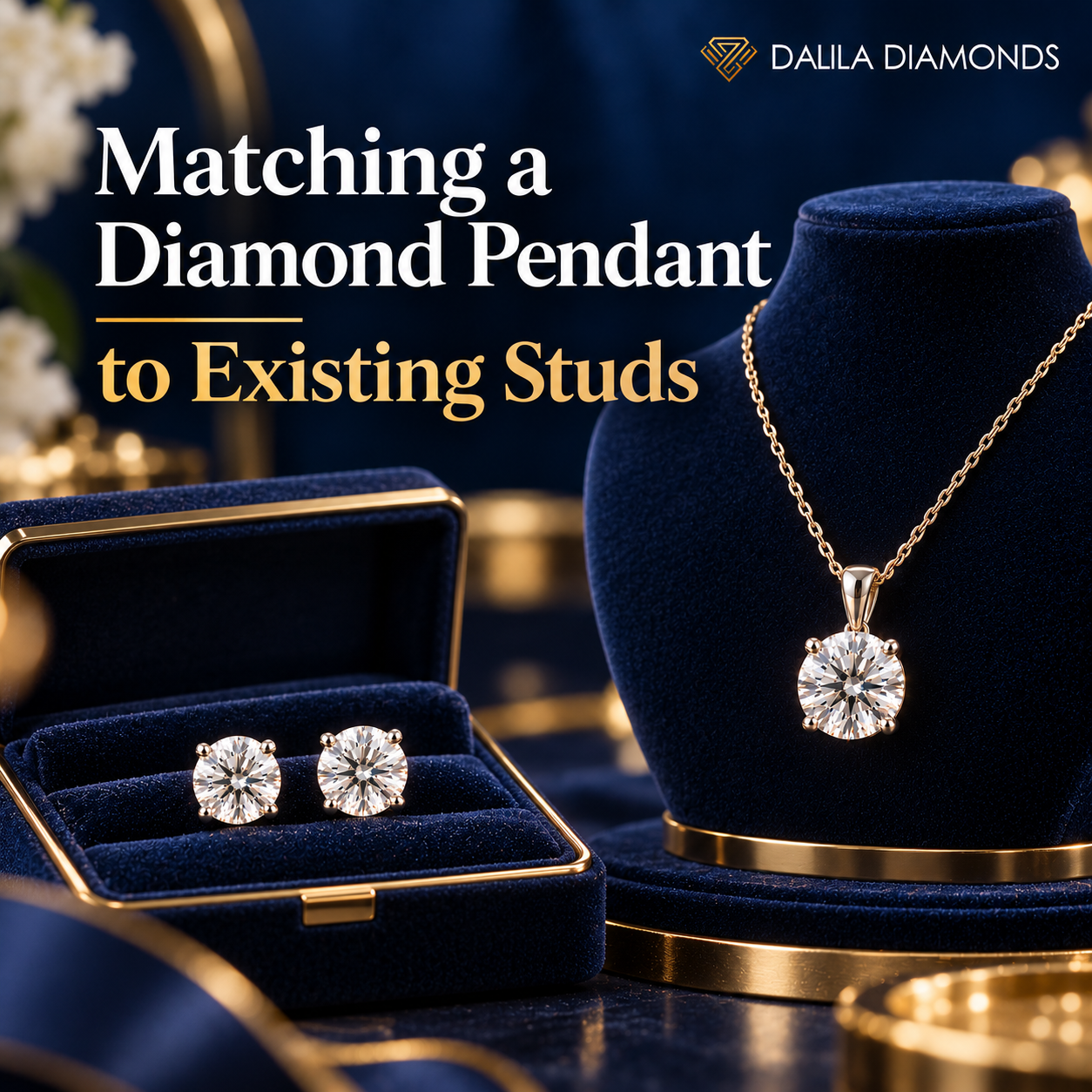
Matching a new natural diamond pendant to an existing pair of stud earrings requires more than choosing the same diamond shape or colour grade. The pendant should complement the earrings in visible size, colour and overall appearance while still looking balanced when worn at the neckline.
For example, if the existing studs contain two 0.50-carat round brilliant diamonds, each measuring approximately 5.1 mm, a pendant containing a one-carat round brilliant measuring around 6.5 mm could create a harmonious combination.
The pendant diamond would be approximately 27% wider than either stud. Its nominal face-up circular area would be about 62% greater.
That creates a larger central focal point without requiring all three diamonds to have the same carat weight.
However, there is no universal rule that a pendant must be larger than its matching earrings.
Some buyers prefer three similarly sized diamonds, while others want the necklace to be noticeably more prominent.
The most useful starting point is to measure the diamonds already in the earrings, decide how prominent the new pendant should be, and shortlist natural loose diamonds using their actual face-up dimensions.
The selected diamond should then be compared with the studs for colour, clarity appearance and light performance.
This guide focuses on matching one new solitaire pendant to a pair of already-owned diamond studs. It is not a general guide to styling jewellery sets or choosing coordinated outfits.
How Do You Match a Diamond Pendant to Stud Earrings?
Begin with the existing earrings rather than searching for a pendant independently.
The studs establish the reference size, cutting style and general appearance.
A practical comparison should cover five characteristics.
Matching factor | What to compare | Why it matters |
Diamond shape | Round, oval, princess or another outline | Creates a coordinated visual character |
Face-up dimensions | Actual diameter or length and width | Determines relative size |
Colour appearance | How white or warm the stones look | Prevents an unintended mismatch |
Clarity and transparency | Visible inclusions and overall crispness | Helps the diamonds look harmonious |
Cut and sparkle | Brightness, contrast and facet pattern | Avoids one stone looking unusually dark or dull |
The final pendant's metal and setting should also be considered.
A bezel can create a larger outside footprint than a minimal prong setting holding the same diamond.
Similarly, yellow-gold prongs may create warmer reflections around a diamond than white-metal prongs.
The intention is visual coordination, not necessarily identical laboratory specifications.
Start by Measuring the Diamonds in Your Existing Studs
The first measurement to establish is the face-up size of each existing diamond.
For round brilliant studs, record the minimum and maximum diameters if available.
For fancy-shaped earrings, record length and width, together with the outline.
A pair described as 1.00 carat total weight usually contains approximately 0.50 carat per ear.
However, the exact diameter of each stone cannot be established from that retail weight description alone.
Example: Studs weighing one carat in total
Suppose the earrings contain the following hypothetical natural diamonds.
Specification | Left stud | Right stud |
Carat weight | 0.49 ct | 0.51 ct |
Minimum diameter | 5.05 mm | 5.07 mm |
Maximum diameter | 5.11 mm | 5.13 mm |
Average diameter | 5.08 mm | 5.10 mm |
Colour | G | G |
Clarity | VS2 | VS1 |
Shape | Round brilliant | Round brilliant |
These are illustrative examples, not verified Dalila inventory.
The two diamonds have slightly different weights and clarity grades but similar diameters.
The buyer could use approximately 5.1 mm as the starting reference for the pendant-to-earring size comparison.
However, the actual stones should still be examined for compatible brightness, colour and visual appearance.
What if the earrings have no grading reports?
A qualified jeweller or gemmologist may be able to measure the visible portions of the stones while mounted.
Some information may remain uncertain because the prongs or bezels obscure parts of the diamond.
An estimated carat weight should not be treated as an independently verified measurement.
For matching a pendant, a reliable face-up diameter and professional visual assessment may be more useful than an uncertain weight estimate.
What Size Pendant Matches 0.25, 0.50 or 1.00-Carat Studs?
The best pendant size depends on the desired relationship between the earrings and the necklace.
Some buyers prefer a relatively subtle pendant that complements the studs without dominating them.
Others want a larger necklace diamond that becomes the central focal point.
The following combinations provide practical starting points.
Existing diamond per ear | Approx. stud diameter | Pendant diamond | Approx. pendant diameter | Visual relationship |
0.25 ct | 4.1 mm | 0.25 ct | 4.1 mm | Similar-size stones |
0.25 ct | 4.1 mm | 0.50 ct | 5.1 mm | Moderately larger pendant |
0.25 ct | 4.1 mm | 0.75 ct | 5.8 mm | Prominent pendant |
0.50 ct | 5.1 mm | 0.50 ct | 5.1 mm | Similar-size stones |
0.50 ct | 5.1 mm | 0.75 ct | 5.8 mm | Slightly larger pendant |
0.50 ct | 5.1 mm | 1.00 ct | 6.5 mm | Distinct central focal point |
0.50 ct | 5.1 mm | 1.50 ct | 7.4 mm | Strong pendant emphasis |
1.00 ct | 6.5 mm | 1.00 ct | 6.5 mm | Similar-size stones |
1.00 ct | 6.5 mm | 1.50 ct | 7.4 mm | Moderately larger pendant |
1.00 ct | 6.5 mm | 2.00 ct | 8.1 mm | Prominent pendant |
Approximate dimensions for round brilliant diamonds. These are possible combinations, not mandatory size pairings or verified available stones.
The table should be used to establish a preferred visual direction.
Once the buyer identifies the desired pendant size, the search should use the actual millimetre measurements of candidate diamonds.
How to Calculate the Pendant-to-Stud Size Ratio
A useful planning measurement is the relationship between the pendant diamond's diameter and the diameter of one existing stud.
For round diamonds:
Pendant-to-stud diameter ratio = pendant diamond diameter ÷ stud diamond diameter
For example, consider studs measuring 5.1 mm and a proposed pendant measuring 6.5 mm.
6.5 ÷ 5.1 = approximately 1.27
The pendant is therefore approximately 1.27 times as wide as each stud.
This is a mathematical proportion, not an industry-standard rule for jewellery matching.
Three illustrative size relationships
Design direction | Stud diameter | Pendant diameter | Ratio |
Similar-size appearance | 5.1 mm | 5.1 mm | 1.00:1 |
Modestly larger pendant | 5.1 mm | 5.8 mm | 1.14:1 |
Stronger centrepiece | 5.1 mm | 6.5 mm | 1.27:1 |
Statement pendant | 5.1 mm | 7.4 mm | 1.45:1 |
These labels describe possible visual choices, not tested preference categories.
The right ratio depends on the recipient, setting styles and intended visual balance.
A 1.45:1 ratio is not automatically excessive, and a 1.00:1 ratio is not automatically too small.
The buyer should compare the alternatives in the same scaled visual arrangement.
Original Size Diagram: Matching Studs and a Pendant
The accompanying original illustration shows three different pendant sizes relative to an existing pair of round diamond studs.
All diamond circles use one consistent proportional scale.
The scenarios demonstrate how the visible balance changes when the pendant becomes moderately or substantially larger than each earring.
This is a schematic comparison rather than a photograph of real jewellery. The neckline and ear positions are stylised and do not reproduce actual human anatomy.
For a true visual comparison, photograph identified physical diamond studs and pendant candidates on the same wearer under the same conditions.
Should the Pendant Diamond Be Larger Than the Stud Diamonds?
Not necessarily.
A larger pendant may be desirable when the buyer wants the necklace to provide the main visual emphasis.
However, a diamond matching the studs in diameter can create a coordinated, understated appearance.
Consider a pair of 0.50-carat round studs, each around 5.1 mm.
Three pendant choices illustrate the difference.
A 0.50-carat pendant
A round pendant around 5.1 mm creates a similar individual diamond size across all three pieces.
The result may appeal to someone seeking a subtle matched set.
However, the finished pendant can still look larger if it has a bezel or decorative head.
A 0.75-carat pendant
A round pendant around 5.8 mm creates slightly greater central emphasis.
The diameter difference from the studs is approximately 0.7 mm.
This can be a useful middle ground for buyers who want the pendant to stand out without moving to a much larger stone.
A 1.00-carat pendant
A round pendant around 6.5 mm creates a stronger central focal point.
Although it weighs twice as much as either half-carat stud, it is only about 27% greater in diameter.
The pendant's nominal face-up area is approximately 62% greater than each stud's circular area.
That difference may be noticeable when worn, but the final appearance depends on the settings and viewing conditions.
Choose the relationship you like visually, rather than matching or doubling carat weights automatically.
Why Total Carat Weight Can Be Misleading
A pair of 1.00 ctw diamond studs contains approximately one carat of diamonds in total.
A one-carat pendant contains one diamond of that weight.
Those two quantities should not be treated as equivalent visible sizes.
For example:
Jewellery | Number of diamonds | Weight per diamond | Combined diamond weight |
Stud earrings | 2 | 0.50 ct | 1.00 ctw |
Solitaire pendant | 1 | 1.00 ct | 1.00 ct |
Complete set | 3 | Two 0.50 ct + one 1.00 ct | 2.00 ctw |
The complete set contains two carats of diamond mass, but the individual stones have different diameters.
The buyer should compare the diameter of each stud with the diameter of the pendant.
Dalila's Diamond Size Chart explains the relationship between carat weight and approximate physical dimensions.
For the dedicated earring calculation, see the existing article at /blogs/diamond-stud-size-per-ear-total-carat.
Does the Pendant Need the Same Diamond Shape as the Earrings?
No.
Matching the shape can create a cohesive visual relationship, but a different shape may also work when the buyer deliberately wants contrast.
For example, round studs can be paired with a pear or oval pendant.
However, the buyer should recognise that their outlines and optical behaviour will differ.
The decision should be made intentionally rather than assuming every same-carat stone will look coordinated.
Round studs with a round pendant
This is generally the most straightforward combination to compare.
The shapes share a circular outline, so diameter provides a useful size reference.
The buyer should still compare colour, brightness and cutting character.
Round studs with an oval pendant
An oval creates greater vertical length and a different outline.
For example, a hypothetical oval measuring 8.0 × 5.6 mm may appear substantially longer than a 5.1 mm round stud.
However, this does not mean the oval has an equivalent circular diameter of 8.0 mm.
The length and width must be evaluated together.
Round studs with a pear pendant
A pear adds a directional teardrop silhouette.
The buyer should establish the intended orientation, usually point-up or point-down, before the pendant is manufactured.
The diamond's point and girdle also require professional setting assessment.
Round studs with an emerald-cut pendant
An emerald cut produces a different facet character from round brilliants.
It may create an attractive deliberate contrast, but the buyer should not expect identical sparkle patterns.
The overall set can still look coordinated through metal, colour appearance and deliberate size proportions.
The detailed grading of oval, pear and emerald cuts belongs in Dalila's individual shape guides.
This page focuses on the size and appearance relationship to existing studs.
Colour Matching: Must the Pendant Have the Same Colour Grade?
Not necessarily, but the pendant should look visually compatible with the existing earrings.
A buyer who owns G-colour round studs may begin by searching for a G-colour pendant diamond.
However, identical laboratory colour grades do not guarantee identical face-up appearance.
A G-colour round brilliant and a G-colour emerald cut may display body colour differently due to their cutting styles.
An H-colour round may also look sufficiently harmonious beside G-colour studs.
The actual stones should be compared.
Example: G-colour studs and three pendant options
Existing studs | Pendant candidate | Initial assessment |
G colour | G colour | Straightforward same-grade shortlist |
G colour | H colour | May be suitable after visual comparison |
G colour | I colour | Individual warmth and metal context require closer review |
These are possible comparisons, not guarantees.
A candidate should not be rejected simply because its letter grade differs by one step.
Equally, a same-grade diamond should not be approved when it looks noticeably different from the studs.
The objective is a harmonious finished set.
How Metal Colour Affects the Match
The metal used in the studs and pendant can influence the finished jewellery's appearance.
Yellow gold, white gold, rose gold and platinum contribute different surrounding reflections.
If the existing studs are white gold and the new pendant is yellow gold, the diamonds may look somewhat different even when their laboratory colour grades match.
That does not automatically create an unattractive combination.
Some people deliberately mix metal colours.
However, if the objective is a closely coordinated diamond set, the buyer should compare both stones in their intended metal environments.
Same metal versus mixed metal
Existing studs | New pendant | What to consider |
White gold | White gold | Consistent cool metal appearance |
Yellow gold | Yellow gold | Consistent warm metal appearance |
Platinum | Platinum | Similar metal colour, with design differences possible |
White gold | Yellow gold | Intentional mixed-metal contrast |
Rose gold | White gold | Different reflections and visual temperature |
Metal matching is only one design variable.
The setting's dimensions, prong style and surface finish also influence how the finished pieces relate.
Should the Pendant and Studs Have the Same Clarity Grade?
No.
A solitaire pendant can be visually harmonious with the earrings even when its clarity grade differs.
For example, a pendant diamond graded VS1 may look compatible with VS2 studs.
A carefully selected SI1 pendant may also be suitable if its inclusions are not distracting and its transparency is satisfactory.
The main concern is whether one stone appears visibly less clean or less lively than the others.
The pendant is a single focal point at the neckline, while the studs are separated on opposite ears.
The diamonds are usually not viewed immediately beside one another.
This may make some small differences less noticeable in normal wear, although close inspection can still reveal them.
The buyer should not pay automatically for a higher clarity grade solely to match the labels on the existing earring reports.
Instead, inspect the pendant's actual inclusion characteristics, transparency and appearance.
Matching Sparkle: Why Cut and Facet Pattern Matter
A diamond's brilliance, fire and scintillation depend on its cutting characteristics and the lighting environment.
Two diamonds can have the same colour and clarity but produce visibly different patterns of light.
When the studs and pendant are all round brilliant diamonds, comparable cut quality provides a useful starting point.
However, even diamonds with the same overall cut grade may have different proportions and reflection patterns.
For fancy-shaped pendants, the difference can be greater.
A pear or oval may show bow-tie contrast.
An emerald cut produces broader step-facet reflections.
The buyer does not need every diamond in the set to sparkle identically.
However, the result should look intentional.
A pendant that appears persistently cloudy or unusually dark may not complement a pair of bright, crisp studs.
Practical visual-comparison method
Start by checking each stone's actual report and dimensions.
Then compare the pendant candidate with the surviving earrings under similar lighting.
If possible, view the jewellery on the same wearer, with the studs in place and the pendant at the intended chain position.
Observe the complete set from a normal viewing distance.
Next, inspect the pendant diamond more closely for brightness, transparency and any distracting features.
The objective is not perfect photometric equivalence.
It is a pleasing visual relationship in the finished jewellery.
Why a Real Worn Comparison Is Better Than Matching Reports Alone
A pair of grading reports can establish that the diamonds have similar colour and quality characteristics.
It cannot show how three stones will look together against the face and neckline.
The earrings are positioned beside the face, while the pendant may sit several centimetres lower.
Their viewing angles and reflected surroundings differ.
The buyer should therefore avoid assuming that identical grades guarantee an identical visible effect.
A controlled photograph can help evaluate whether the combination looks balanced when worn.
However, the photograph must show actual jewellery at a consistent camera scale.
Unrelated studio images are less reliable because one diamond may be photographed closer, under brighter lighting or with different image processing.
Real Photograph Examples Needed for This Comparison
To make a credible real-world comparison, use one existing, identified pair of natural diamond studs and several identified pendant candidates.
A useful photographic series could show 0.50-carat-per-ear round studs with three different round solitaire pendant sizes.
Worn photograph | Existing studs | Pendant | Purpose |
Photo A | Approx. 0.50 ct per ear | Approx. 0.50 ct | Similar-diameter comparison |
Photo B | Same physical studs | Approx. 0.75 ct | Slightly larger pendant |
Photo C | Same physical studs | Approx. 1.00 ct | More prominent centrepiece |
The exact stone dimensions should appear in the final captions.
All photographs should use the same model, neckline, chain position, camera distance, lighting and exposure.
The physical earrings should remain unchanged throughout the series.
Only the pendant should change.
Why the same model matters
Different ear sizes, neck lengths and torso proportions alter the perceived relationship between the earrings and pendant.
Using the same wearer reduces those variables.
The photographs should not be digitally manipulated to make the diamond sizes appear more dramatic.
If the pendant stones require different temporary heads, those setting differences should be disclosed.
What evidence should accompany the images?
For each diamond, record its supplier or grading reference, actual measurements and whether it was loose or mounted for the photograph.
For the existing studs, record the individual stone dimensions where available.
A real photographic comparison should demonstrate the actual relationship between the selected diamonds, rather than merely approximate that relationship using a graphic.
Worked Example: Matching a Pendant to 1.00 ctw Studs
Suppose a buyer owns natural round brilliant studs with a combined weight of approximately 1.00 carat.
The two existing stones are assumed to have the following characteristics.
Specification | Left stud | Right stud |
Weight | 0.49 ct | 0.51 ct |
Average diameter | 5.08 mm | 5.10 mm |
Colour | G | G |
Clarity | VS2 | VS1 |
Cut grade | Excellent | Excellent |
Setting | White-gold four-prong | White-gold four-prong |
These are hypothetical measurements, not a documented customer set.
The buyer wants a matching natural round brilliant pendant and is considering three candidates.
Specification | Pendant A | Pendant B | Pendant C |
Carat weight | 0.50 ct | 0.75 ct | 1.00 ct |
Approximate diameter | 5.1 mm | 5.8 mm | 6.5 mm |
Colour | G | G | H |
Clarity | VS2 | VS2 | VS1 |
Cut preference | Excellent | Excellent | Excellent |
Intended setting | White-gold prongs | White-gold prongs | White-gold prongs |
The values are illustrative, not verified live inventory.
Pendant A: Similar size to the studs
At approximately 5.1 mm, Pendant A would have nearly the same diameter as each earring diamond.
This provides the most directly coordinated size relationship.
The overall result may appear subtle because no single stone is substantially larger than the others.
Pendant B: Moderately larger centre diamond
At approximately 5.8 mm, Pendant B would be about 14% wider than each stud.
This creates a modest increase in central emphasis.
Because the hypothetical colour and clarity are close to those of the studs, it is a promising specification to evaluate visually.
However, a final decision requires inspection of the actual diamond.
Pendant C: A larger pendant with an adjacent colour grade
At approximately 6.5 mm, Pendant C would be about 27% wider than the studs.
Its H colour differs from the hypothetical G-colour earrings.
That difference is not automatically disqualifying.
The buyer should compare its face-up colour and brightness with the existing studs in the intended metal setting.
If the larger size and colour appearance are acceptable, it may create the desired focal point.
Which pendant should be selected?
For a subtle matching set, Pendant A is a useful starting point.
For a balanced increase in pendant prominence, Pendant B offers a middle option.
For a more noticeable centrepiece, Pendant C provides greater diameter.
The correct choice depends on the wearer's preferences and the physical appearance of identified candidates.
No final selection should be claimed from hypothetical specifications.
Worked Example: Round Studs With an Oval Pendant
Not every matching diamond set needs three round stones.
Suppose the buyer owns two round studs measuring approximately 4.1 mm each.
The buyer is considering a natural oval pendant measuring approximately 7.0 × 5.0 mm.
The oval is longer than either stud's diameter but only modestly wider across its short axis.
This creates a different visual relationship from a 7.0 mm round pendant.
The diamond's orientation also matters.
Mounted vertically, the oval creates a longer hanging silhouette.
Mounted horizontally, it creates a wider centrepiece.
The buyer should not use the oval's length alone as though it were directly equivalent to a round diamond's diameter.
For mixed-shape combinations, compare actual silhouettes at a consistent scale.
The manufacturing jeweller should also confirm the proposed oval's outline, pavilion clearance and mounting orientation.
Does Chain Length Affect How the Pendant Matches the Earrings?
Yes.
Chain length changes where the pendant sits in relation to the face and earrings.
A short chain may position the diamond near the collarbone, while a longer chain may place it farther down the chest.
The visual relationship can change even when the diamond sizes remain identical.
For a controlled comparison, choose one intended wearing position and keep it constant.
A 40 cm chain does not place every pendant at precisely the same height on every wearer.
Neck circumference, body proportions, chain construction and attachment length all contribute.
For an identified wearer, the actual pendant position is a better reference than chain length alone.
The manufacturing jeweller should also confirm that the chosen pendant and chain work together structurally.
Prong or Bezel: Should the Settings Match?
The stud earrings and pendant do not necessarily need identical settings.
However, coordinated metal and similar visual construction can make the set appear more cohesive.
For example, four-prong round studs could be combined with a four-prong round pendant.
Alternatively, bezel-set studs may be paired with a bezel pendant.
A mixed setting combination can also work when chosen intentionally.
Why setting width matters
A bezel adds metal around the diamond's perimeter.
This may increase the complete pendant head's outside width.
A prong setting generally leaves more of the diamond's outline exposed.
Consequently, a 5.8 mm diamond in a bezel can have a larger total head width than a 5.8 mm diamond in a minimal prong setting.
When comparing a pendant with existing studs, record the actual diamond dimensions and the finished setting dimensions separately.
The new pendant should be approved by the jeweller using the actual stone rather than a generic carat-size description.
What If the Existing Stud Diamonds Are Older Cuts?
Some existing studs contain Old European, transitional or other antique-style diamonds.
Their facet patterns may differ from those of a modern round brilliant.
If a buyer wants a very consistent visual character, that difference may matter.
For example, a pair of older round diamonds with broad reflections and visible culets may look intentionally different from a modern brilliant pendant with a more contemporary facet pattern.
Neither option is inherently wrong.
The buyer must decide whether they want closely related facet characters or a contrast between old and modern styles.
A report description alone may not establish the historical origin of the diamond.
If authenticity or antique provenance is important, obtain appropriate evidence separately.
Dalila's existing vintage-cut sourcing guide should retain the detailed history and procurement considerations.
This article focuses only on whether the new pendant visually complements the existing earrings.
Matching a Pendant to Fancy-Shaped Diamond Studs
If the existing studs contain ovals, princess cuts, cushions or emerald cuts, the pendant search should include an outline comparison.
A matching shape name alone is not enough.
Oval studs with an oval pendant
Compare the length-to-width ratios, shoulder fullness and bow-tie appearance.
The pendant may intentionally be larger, but the proportions should create a cohesive design.
Princess studs with a princess pendant
Compare square proportions and corner geometry.
The pendant setting must provide appropriate support for the pointed corners.
Cushion studs with a cushion pendant
Cushion diamonds can vary in corner shape and facet pattern.
A modern brilliant-style cushion pendant may look different from antique-style cushion studs.
Emerald-cut studs with an emerald pendant
Compare rectangular proportions, truncated corners and step-facet character.
A longer pendant emerald cut can create an attractive centrepiece, but its facets may produce reflections different from those of the smaller studs.
No shape-specific universal ratio is necessary.
The selected stones should be compared visually, with the intended size difference agreed in advance.
A Worksheet for Matching a Pendant to Existing Diamond Studs
Record the existing diamonds first.
Existing jewellery | Left stud | Right stud |
Natural origin verified | ______ | ______ |
Shape | ______ | ______ |
Carat weight | ______ | ______ |
Face-up dimensions | ______ mm | ______ mm |
Colour grade | ______ | ______ |
Clarity grade | ______ | ______ |
Cut or facet style | ______ | ______ |
Grading laboratory | ______ | ______ |
Report number | ______ | ______ |
Setting metal | ______ | ______ |
Visible appearance | ______ | ______ |
Then evaluate the proposed pendant.
Pendant requirement | Specification |
Diamond shape | ______ |
Desired diameter or dimensions | ______ mm |
Preferred pendant-to-stud size ratio | ______ |
Carat-weight range | ______ |
Colour preference | ______ |
Clarity preference | ______ |
Cut or facet character | ______ |
Proposed setting metal | ______ |
Setting style | ______ |
Chain length | ______ cm |
Intended neckline position | ______ |
Actual pendant candidate reference | ______ |
Grading report | ______ |
Face-up appearance compared | Yes / No |
Worn comparison reviewed | Yes / No |
Setting approved by jeweller | Pending / Approved |
The worksheet should be completed using the actual existing earrings and identified pendant candidates.
A ratio is only a planning aid.
The final decision should reflect the actual appearance of the three diamonds together.
Sourcing a Natural Diamond Pendant to Match Existing Studs
A useful sourcing brief begins with information about the existing jewellery.
For example, the buyer may provide the two stud diamonds' grading reports, actual diameters and photographs.
The new pendant diamond can then be selected within a desired size range.
Example sourcing brief
Existing jewellery: Natural round brilliant diamond studs.
Stud size: Approximately 0.50 ct per ear, with measured diameters around 5.1 mm.
Stud colour and clarity: G colour, VS range, subject to report confirmation.
New jewellery: Natural diamond solitaire pendant.
Preferred shape: Round brilliant.
Target weight: Approximately 0.75–1.00 carat.
Desired visible diameter: Approximately 5.8–6.5 mm.
Colour: G–H, subject to compatible face-up appearance.
Clarity: VS1–VS2, with suitable inspected alternatives.
Cut: Attractive round brilliant with appropriate cut quality.
Setting: White-gold solitaire head, to be designed or approved by a manufacturing jeweller.
Visual comparison: Candidate to be assessed for compatibility with the existing studs.
Budget: To be confirmed.
These are illustrative requirements, not current Dalila inventory offers.
A diamond supplier can search for stones meeting the size and quality requirements.
Where practical, the buyer should obtain actual images or videos of the candidate and compare them with the existing jewellery.
The manufacturing jeweller is responsible for confirming the pendant head, chain attachment, stone security and finished construction.
What to Send to Dalila Diamonds
For a natural loose-diamond enquiry, provide:
The existing stud shape, weights and measurements.
Grading reports or professional assessments where available.
Clear photographs of the existing earrings.
The desired pendant shape and visual-size relationship.
Preferred colour, clarity and cut characteristics.
The intended pendant setting and metal.
The budget and required date.
Dalila Diamonds offers natural loose-diamond inventory and specification-driven sourcing through DS4U — Diamond Source For You.
The service can be used to enquire about a suitable pendant stone, subject to current availability and confirmed service scope.
Do not assume that a loose-diamond sourcing quotation includes the pendant head, chain, setting labour or completed necklace.
Those components require separate confirmation.
Diamond supplier versus manufacturing jeweller
Task | Loose-diamond supplier | Manufacturing jeweller |
Source natural pendant candidates | Yes | May advise |
Provide measurements and reports | Where available | Review |
Compare specifications with the studs | Where information is provided | May assist |
Arrange direct physical appearance comparison | Only if expressly agreed | May assist |
Select mounting dimensions | No | Yes |
Approve pendant setting | No | Yes |
Confirm chain and bail compatibility | No | Yes |
Manufacture the pendant | Not assumed | Yes |
Set the diamond | Not assumed | Yes |
Inspect the completed necklace | Not assumed | Yes |
The buyer should confirm the scope of each provider before ordering.
Common Mistakes When Matching a Pendant to Existing Studs
Matching total carat weight instead of individual diameter
A 1.00 ctw stud pair usually contains two diamonds around 0.50 ct each, not two one-carat diamonds.
Assuming the pendant must weigh twice as much as each stud
There is no universal carat-weight rule for coordinated diamond jewellery.
Using a generic size chart as proof of an exact match
Actual diamond measurements may differ from approximate chart values.
Comparing diamond grades without comparing appearance
Identical colour and clarity grades do not guarantee the same face-up visual character.
Choosing a different shape without checking its outline
An oval's length is not directly equivalent to a round diamond's diameter.
Ignoring the finished settings
Bezels, prongs and decorative heads can change the visual proportions.
Comparing photographs from different models
Changes in neckline, scale, lighting and camera distance can distort size relationships.
Assuming a matching loose diamond means a completed necklace is available
The pendant head, chain, labour and delivery must be confirmed separately.
Frequently Asked Questions
How do I match a diamond pendant to existing stud earrings?
Begin by measuring the diamonds in the studs, then select a pendant diamond with the desired relative size. Compare shape, colour, clarity appearance, sparkle and metal before approving the finished pendant.
Should a diamond pendant be bigger than the stud diamonds?
Not necessarily. A similar-sized pendant creates an understated matching set, while a larger pendant creates a stronger central focal point. There is no universal size-ratio rule.
What pendant size matches 0.50-carat diamond studs?
For studs containing approximately 0.50 carat per ear, a round pendant around 0.75–1.00 carat can create a moderately to noticeably larger centre. Actual diameters, generally around 5.8–6.5 mm for these pendant weights, should be compared.
Does one-carat-total earrings mean the pendant should be one carat?
No. One-carat-total studs usually contain around 0.50 carat in each ear. A one-carat pendant would therefore contain a larger individual diamond, which may be desirable but is not mandatory.
What is a good pendant-to-stud diamond size ratio?
There is no universal best ratio. A pendant approximately 1.1–1.3 times the diameter of each stud may be a useful visual comparison for someone wanting a slightly more prominent centrepiece, but this is a design preference rather than a standard.
Can a 0.50-carat pendant match 0.50-carat studs?
Yes. Stones with similar face-up diameters can create a coordinated, understated appearance. The actual dimensions and settings should still be compared.
Do the pendant and studs need the same diamond colour?
Not necessarily. Similar face-up colour is more important than mechanically matching letter grades. A carefully selected adjacent-grade diamond may be suitable.
Can G-colour studs match an H-colour pendant?
Potentially. The actual stones should be compared under consistent lighting and in their intended metal environments.
Does the pendant need the same clarity grade?
No. Different clarity grades may look harmonious when the individual diamonds have acceptable visible cleanliness and transparency.
Does the diamond shape need to match?
No. Round studs can be worn with an oval, pear or emerald-cut pendant. The outlines and sparkle patterns will differ, so the combination should be chosen intentionally.
Are round studs with an oval pendant a good combination?
They can be. A vertical oval creates an elongated central silhouette, while the round studs remain compact and circular. Compare actual dimensions rather than carat alone.
Can princess-cut studs match a round pendant?
Yes. The combination produces contrasting square and circular outlines. Colour, metal and the intended size relationship can help create visual coherence.
Should the pendant and earrings use the same setting metal?
They do not have to, but using the same metal may simplify the visual match. Mixed metals can also work when deliberately chosen.
Does a bezel change how the pendant matches the studs?
Yes. A bezel adds metal around the stone and can increase the finished pendant's outside dimensions. Compare diamond measurements and setting measurements separately.
Does chain length affect the match?
Yes. Chain length changes the pendant's position relative to the face and earrings. Compare the set at the intended wearing position rather than using chain length alone.
What if my existing studs do not have grading reports?
A qualified jeweller or gemmologist may be able to measure and assess the surviving stones while mounted. Some grades or dimensions may remain estimates.
Can Dalila source a single natural diamond for a matching pendant?
Dalila's natural loose-diamond sourcing service can receive a specification-led enquiry. The buyer should provide the existing earrings' dimensions and desired pendant characteristics. Availability and the precise scope of any appearance-matching service require confirmation.
What should I send when requesting a matching pendant diamond?
Provide the stud diamonds' measurements, shape, colour and clarity information, any reports, clear photographs, the desired pendant-to-stud size relationship, preferred setting and budget.