Tennis Bracelet Total Carat Weight Explained: How Big Are the Individual Diamonds?
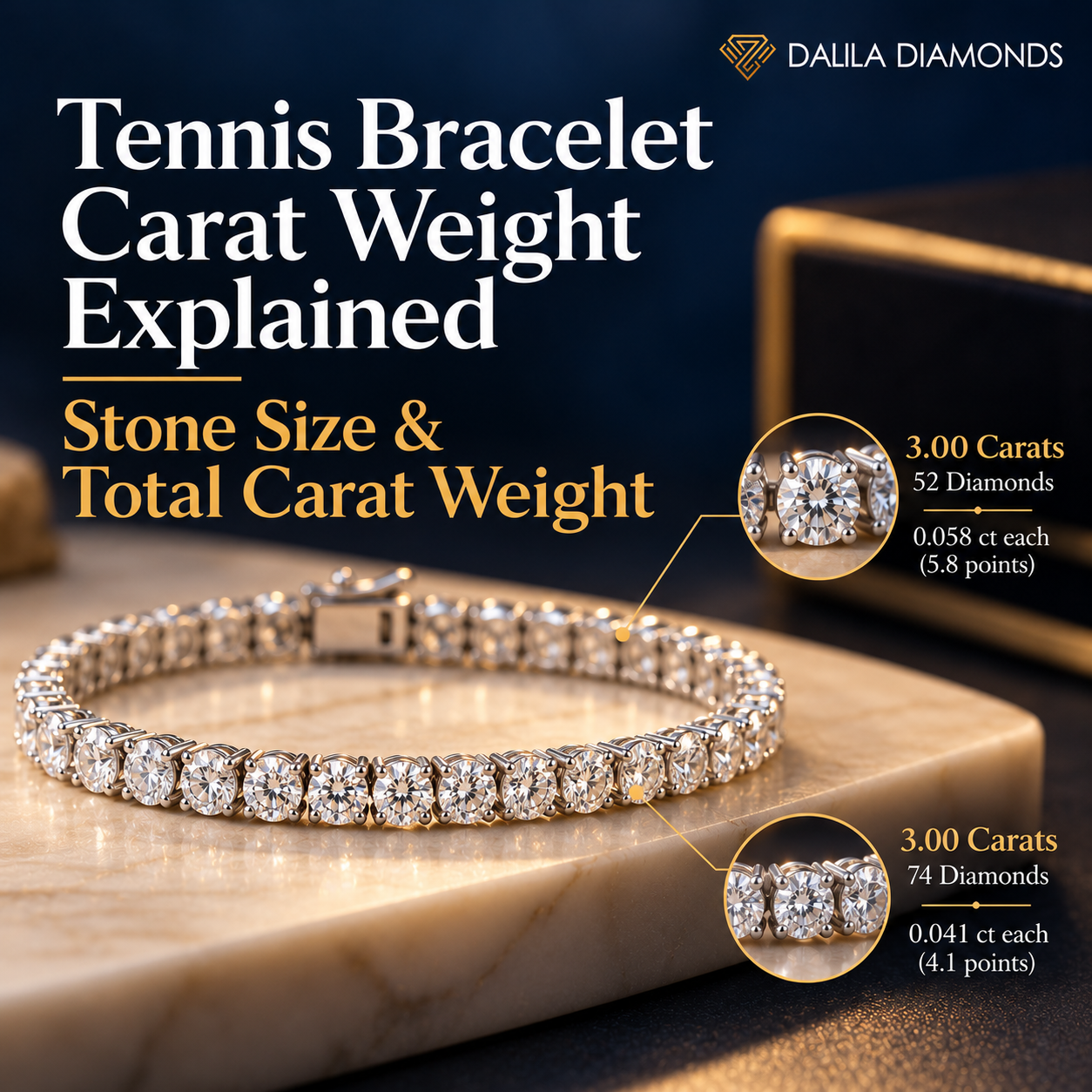
A 3-carat diamond tennis bracelet does not contain one 3-carat diamond. Its total carat weight is distributed across many smaller stones arranged along the bracelet.
For example, a tennis bracelet containing 52 natural diamonds with a combined weight of 3.00 carats has an average diamond weight of approximately 0.058 carat, or 5.8 points, per stone.
Another 3.00-carat tennis bracelet containing 74 natural diamonds averages approximately 0.041 carat, or 4.1 points, per stone.
Both bracelets contain the same total diamond weight, but their individual stones can have noticeably different sizes.
The first design distributes the weight across fewer, larger diamonds. The second distributes it across more, smaller diamonds.
This difference matters because the appearance of a tennis bracelet depends on the diameter of the individual diamonds, the number of stones, their spacing and the setting construction, not simply the total weight printed on a product label.
For buyers comparing 2, 3, 5 or 7-carat natural diamond tennis bracelets, total carat weight is a useful starting specification—but it cannot fully describe how the bracelet will look on the wrist.
This guide explains how the numbers work using real published bracelet specifications, practical calculations and a sourcing worksheet.
What Does Total Carat Weight Mean for a Tennis Bracelet?
Total carat weight, often abbreviated as TCW, CTW or ct tw, is the combined weight of the diamonds in a jewellery piece.
For a conventional single-row tennis bracelet, it normally refers to all the diamonds set along the bracelet.
For example:
A bracelet containing 50 diamonds averaging 0.04 carat each has approximately 2.00 carats total.
A bracelet containing 50 diamonds averaging 0.06 carat each has approximately 3.00 carats total.
A bracelet containing 50 diamonds averaging 0.10 carat each has approximately 5.00 carats total.
These examples are arithmetic calculations rather than specifications of identified finished bracelets.
They demonstrate the distinction between total diamond weight and the weight of any one stone.
A bracelet described as 5.00 ctw should not be interpreted as having five-carat individual diamonds.
The number of diamonds and their individual measurements are essential to understanding the finished appearance.
Tennis Bracelet Carat Weight: Quick Comparison Chart
The following table shows hypothetical single-row bracelet configurations.
Total diamond weight | Number of diamonds | Average weight per diamond | Approximate round diameter |
1.00 ctw | 50 | 0.020 ct / 2 points | 1.7 mm |
2.00 ctw | 50 | 0.040 ct / 4 points | 2.2 mm |
3.00 ctw | 50 | 0.060 ct / 6 points | 2.5 mm |
4.00 ctw | 50 | 0.080 ct / 8 points | 2.8 mm |
5.00 ctw | 50 | 0.100 ct / 10 points | 3.0 mm |
7.00 ctw | 50 | 0.140 ct / 14 points | 3.4 mm |
All six rows are illustrative calculations using 50 equal-weight round diamonds. Diameters are approximate planning references and will vary with cutting proportions. They are not confirmed physical bracelet designs, and the stone count and settings must be checked against the intended bracelet length.
The table is useful for visualising how total weight changes when stone count stays constant.
Real tennis bracelets do not all contain 50 diamonds.
The count depends on the size of each stone, the length of the bracelet and the dimensions of the individual links or settings.
Therefore, a real 3-carat bracelet may contain considerably more than 50 stones.
How to Calculate the Average Carat Weight per Diamond
The basic calculation is:
Average weight per diamond = Total diamond carat weight ÷ Number of diamonds
For example, consider a natural diamond tennis bracelet with:
Total diamond weight: 3.00 carats.
Number of diamonds: 52.
The calculation is:
3.00 ÷ 52 = 0.05769 carat.
Each diamond therefore weighs approximately 0.058 carat on average.
Since one carat equals 100 points, the average is approximately 5.8 points per diamond.
This does not mean every diamond weighs exactly 0.05769 carat.
Natural diamonds within a matched bracelet may have slightly different individual weights while being selected for consistent physical dimensions and appearance.
The calculation gives an average.
It does not prove the individual weights, diameters or tolerances.
Real Bracelet Examples: Same Total Weight, Different Diamond Sizes
Published finished-bracelet specifications show why the total carat figure is not enough.
The examples below involve natural diamond tennis bracelets advertised by different jewellery retailers.
Example A: 3.00 ctw with 52 diamonds
A Treasured & Co 14K yellow-gold tennis bracelet is specified with 52 natural round diamonds totalling 3.00 carats, with G–H colour, SI1–SI2 clarity and a finished length of 7.5 inches.
Average diamond weight:
3.00 ÷ 52 = 0.0577 carat, or about 5.77 points per stone.
This is a real published design specification, not a Dalila product.
Example B: 3.00 ctw with 74 diamonds
A Rare Carat 18K rose-gold natural diamond tennis bracelet is listed with 74 diamonds weighing a combined 3.00 carats.
Average diamond weight:
3.00 ÷ 74 = 0.0405 carat, or approximately 4.05 points per stone.
Again, the total is three carats, but the average weight of each diamond is smaller.
Side-by-side comparison
Specification | Design A | Design B |
Retailer | Treasured & Co | Rare Carat |
Diamond type | Natural | Natural |
Total diamond weight | 3.00 ctw | 3.00 ctw |
Diamond count | 52 | 74 |
Calculated average per stone | 0.0577 ct | 0.0405 ct |
Approximate points per stone | 5.77 points | 4.05 points |
Metal | 14K yellow gold | 18K rose gold |
Published length | 7.5 inches | Not established from the cited specification |
Actual individual stone diameters | Not disclosed | Not disclosed |
The two designs have the same advertised total diamond weight but different stone counts.
Design A's average stone is approximately 42% heavier than Design B's average stone.
That does not mean its diameter is 42% greater. Diamond mass and diameter do not scale proportionally.
It also does not establish which bracelet looks wider or better. The actual diamond measurements, link construction, setting and bracelet dimensions would need to be compared.
These published examples demonstrate the core buying issue: total carat weight alone does not establish individual diamond size.
Real Bracelet Example With Actual Millimetre Size
An additional published natural diamond tennis bracelet offers a more complete specification.
Dorian Webb lists a 3.00-carat-total natural diamond tennis bracelet with:
Specification | Published detail |
Diamond type | Natural |
Total diamond weight | 3.00 ctw |
Diamond cut | Brilliant |
Individual stone diameter | 2.43 mm |
Colour | H–I |
Clarity | VS2–SI1 |
Bracelet length | 7 inches |
Metal | 14K yellow gold |
Setting | Three-prong |
This is useful because the listing gives the actual intended stone diameter rather than only total weight.
It shows how a 3.00-carat natural diamond bracelet can be constructed as a relatively continuous line of small, calibrated diamonds around the wrist.
The exact number of diamonds is not established by the cited listing, so an average individual carat weight should not be invented from it.
The buyer can nevertheless compare its reported 2.43 mm stone size with another retailer's explicitly measured diamonds.
Why a 3-Carat Tennis Bracelet Does Not Always Look the Same
Imagine two natural diamond bracelets, each advertised as 3.00 ctw.
One contains a relatively small number of diamonds with larger individual diameters.
The other contains more diamonds with smaller individual diameters.
The completed pieces may have different widths and visual textures.
A design with larger individual diamonds may show more distinct separated stones.
A design with smaller diamonds packed closely together may create a finer continuous line.
Neither result is universally better.
The important point is that the buyer should not expect every 3-carat bracelet to have the same appearance.
What determines the visible diamond line?
Factor | Effect on appearance |
Total carat weight | Combined diamond mass |
Stone count | How many diamonds share that weight |
Individual diameter | Visible size of each stone |
Diamond cut proportions | Relationship between weight and face-up spread |
Setting design | Amount of metal and spacing around each stone |
Bracelet length | Number of links required around the wrist |
Colour matching | Consistency along the line |
Cut and brightness consistency | Whether the bracelet has alternating bright and dull areas |
A useful product specification should describe more than a total carat figure.
How Bracelet Length Changes Total Carat Weight
Bracelet length is one of the most important variables.
Suppose a jeweller makes two tennis bracelets using the same calibrated round diamonds and a comparable setting design.
One bracelet measures 16.5 cm.
The other measures 19 cm.
The longer bracelet will generally require more diamond-set links, assuming comparable construction and coverage.
As a result, it may contain more diamonds and a greater total diamond weight, even when the individual stone size is unchanged.
Illustrative length comparison
Feature | Shorter bracelet | Longer bracelet |
Intended length | 16.5 cm | 19.0 cm |
Individual diamonds | 0.06 ct average | 0.06 ct average |
Hypothetical count | 46 | 54 |
Calculated TCW | 2.76 ct | 3.24 ct |
Diamond diameter | Similar | Similar |
Visual line width | Similar | Similar |
Overall length | Shorter | Longer |
This is a hypothetical pair of constructions. The counts are not a verified manufacturing layout; an actual jeweller must determine link pitch, clasp length, fitting allowance and the achievable count.
The longer example contains more total diamond weight.
However, both use diamonds with the same assumed individual weight.
Therefore, the longer bracelet is not automatically visually thicker.
This distinction is essential when comparing tennis bracelets listed in different lengths.
Why Bracelet Length Must Be Included in a Quote
A buyer comparing a 3-carat, 17 cm bracelet with a 3-carat, 19 cm bracelet may not be comparing identical individual stone sizes.
A shorter bracelet can achieve a given total carat weight with fewer, potentially larger diamonds.
A longer bracelet may need more stones to achieve the same total.
The setting construction also influences this relationship.
For an accurate comparison, request:
Finished bracelet length.
Number of diamonds.
Total natural diamond carat weight.
Average or calibrated individual stone size.
Actual diamond diameter range.
Setting style.
Link or head dimensions.
Clasp specifications.
The combination of those fields gives a much clearer picture than total carat weight alone.
Stone Size Versus Bracelet Width
The diamond's diameter and the finished bracelet's width are not necessarily identical.
A tennis bracelet with 2.5 mm round diamonds may have a finished outside width greater than 2.5 mm.
That is because the mounting contains metal around or beside the diamonds.
Prongs, bezels and link components add to the visible structure.
Example
Dimension | Illustrative value |
Diamond diameter | 2.5 mm |
Finished setting width | 2.8 mm |
Added outside width | 0.3 mm |
These numbers illustrate the difference between stone size and setting size.
They are not a universal design tolerance.
A manufacturing jeweller must confirm the finished measurements for the actual setting.
A listing stating that a bracelet is 3 mm wide does not necessarily mean every diamond measures 3 mm.
The buyer should ask whether the figure describes the diamonds or the complete metal-and-diamond structure.
Does Setting Style Change the Carat Weight?
The setting does not change the weight of the diamonds that have already been selected.
However, the setting design affects how many diamonds can fit within a given bracelet length.
For example, a shared-prong design and a full-bezel design may have different link dimensions and spacing requirements.
As a result, two bracelets of the same length and individual diamond size may require different stone counts.
That changes the resulting total carat weight.
Setting comparison
Setting construction | What to check |
Shared prongs | Stone-to-stone spacing and link dimensions |
Four-prong individual heads | Outside width and link pitch |
Three-prong heads | Diamond support and centre-to-centre spacing |
Bezel links | Metal perimeter and outside link size |
Decorative links | Amount of non-diamond length between stones |
A bezel can increase the visible outside width by adding surrounding metal.
However, it should not be claimed that every bezel bracelet requires fewer diamonds than every prong bracelet.
The result depends on the specific designs being compared.
The jeweller should provide the proposed stone count and CAD or technical dimensions.
Can Two 5-Carat Tennis Bracelets Look Different?
Yes.
Suppose two hypothetical bracelets both contain 5.00 carats of natural diamonds.
Bracelet A contains 50 stones.
Bracelet B contains 60 stones.
Specification | Bracelet A | Bracelet B |
Total diamond weight | 5.00 ct | 5.00 ct |
Diamond count | 50 | 60 |
Average weight per diamond | 0.100 ct | 0.083 ct |
Approximate points | 10.0 | 8.3 |
Individual diameter | Must be measured | Must be measured |
Bracelet length | Must be specified | Must be specified |
The individual diamonds in Bracelet A are heavier on average.
But the exact diameter difference cannot be established from average carat weight alone.
The two designs could also have different setting widths, link spacing and bracelet lengths.
Therefore, a buyer comparing 5-carat tennis bracelets should request their individual diamond measurements.
The total alone does not determine whether one bracelet will look heavier, wider or more substantial on the wrist.
What Is a Good Total Carat Weight for a Natural Diamond Tennis Bracelet?
There is no universally correct total carat weight.
A buyer seeking a delicate line may prefer smaller stones, while someone wanting more individually visible diamonds may prefer larger ones.
However, the desired appearance should ideally be described through the individual diamond size and finished bracelet dimensions.
For example, requesting a bracelet with approximately 2.5 mm natural round brilliant diamonds gives the supplier a more specific visual target than requesting "a 3-carat bracelet" without stating the length.
The supplier can then calculate the likely stone count and resulting total carat weight from the proposed design.
Design-first versus carat-first buying
A buyer can begin with a desired total carat weight or a desired individual stone diameter.
Both approaches are valid.
However, for a custom bracelet, the stone-diameter-first approach may better communicate the desired appearance.
The final carat weight should follow from the selected stone size, count and design.
Why Diamond Matching Matters in Tennis Bracelets
A tennis bracelet repeats similar stones along a continuous visible line.
This makes inconsistent diamonds potentially noticeable.
For example, one undersized stone can interrupt the visual pattern.
A warmer stone may stand out among near-colourless diamonds.
A diamond with weak light performance may appear darker than its neighbours.
The supplier and jeweller should therefore review the parcel for appropriate matching.
Key matching requirements
Quality attribute | Why it matters |
Diamond diameter | Supports a consistent line and setting fit |
Carat-weight distribution | Helps achieve the intended total |
Colour | Reduces unwanted warm or cool outliers |
Clarity appearance | Avoids distracting inclusions |
Cut consistency | Supports balanced light performance |
Girdle condition | Important for secure setting |
Count | Must match the agreed manufacturing layout |
Overall parcel quality | Reduces visible variation across the bracelet |
A bracelet can meet its total carat specification and still have inconsistent individual stone appearance.
For professional sourcing requirements, see Dalila's existing Diamond Parcel Quality-Control Checklist.
The purpose of this article is to explain total weight and visible stone size, not reproduce the full trade inspection procedure.
Why Natural Diamond Melee Sizes Matter
Many tennis bracelets use small natural diamonds commonly referred to as melee.
These stones may be specified in millimetres, carat points or calibrated size groups.
For example, a supplier may be asked for stones of approximately 2.5 mm diameter.
That request is more directly useful for the jeweller's setting layout than an approximate total carat target without a count.
However, carat weight remains important because the final bracelet's advertised total must be calculated from the actual parcel.
The approximate conversion between a millimetre size and a carat weight is not exact.
Small differences in cut proportions and girdle thickness can change the individual weights.
For detailed size conversion and sieve specifications, the appropriate reference is Dalila's Melee Diamond Size Chart, not a generic engagement-ring carat chart.
Worked Example: Designing a Natural Diamond Tennis Bracelet
Suppose a jeweller is planning a natural round brilliant tennis bracelet with these hypothetical requirements:
Design requirement | Specification |
Finished length | 18 cm |
Diamond type | Natural round brilliant |
Preferred stone diameter | Approximately 2.5 mm |
Proposed count | 54 |
Average individual weight | Approximately 0.06 ct |
Target colour | G–H |
Target clarity | VS–SI, with inspected appearance |
Metal | 18K white gold |
Setting | Prong-set links |
Clasp | Jeweller to specify |
The total diamond weight would be:
54 × 0.06 = 3.24 carats.
This is a calculation based on the illustrative proposed count.
It is not a manufactured bracelet or verified parcel.
What if the buyer wants exactly 3.00 carats?
The jeweller could review the selected stone size, count and spacing.
However, simply reducing the number of diamonds may change the bracelet's finished length or require different link construction.
Alternatively, a slightly lower average individual stone weight may be suitable if the resulting diameters still meet the design target.
The jeweller should recalculate using an actual layout rather than modifying the number on the product description.
What if the buyer wants a wider bracelet?
The jeweller may suggest larger individual diamonds.
However, larger stones affect the design's link dimensions and the count that fits within the specified length.
The final total carat weight may increase or decrease depending on how the layout changes.
The buyer should review the proposed dimensions and total cost before approval.
What Should a Tennis Bracelet Product Page Show?
A product page should make it possible for the buyer to understand the visible size of the diamonds.
At minimum, the specification should include:
Product specification | Example of a clear disclosure |
Diamond origin | Natural diamond |
Total diamond weight | 3.00 ctw |
Diamond count | 52 |
Average weight per diamond | Approximately 0.058 ct |
Individual diamond dimensions | Actual size or calibrated range |
Colour | Defined grading range |
Clarity | Defined grading range |
Finished bracelet length | 18 cm, for example |
Finished bracelet width | Actual measured width |
Metal | Alloy and purity |
Setting | Prong, bezel or other |
Clasp | Type and safety features |
Carat-weight tolerance | Seller's documented tolerance, if applicable |
The product page should distinguish measured characteristics from approximate values.
If the stone count or total carat weight changes with bracelet length, that should be explained.
A buyer should not have to guess whether an 18 cm version and a 20 cm version contain the same diamond count.
Natural Diamond Tennis Bracelet Sourcing Worksheet
Requirement | Specification |
Jewellery | Natural diamond tennis bracelet |
Finished bracelet length | ______ cm |
Desired finished width | ______ mm |
Preferred diamond shape | ______ |
Diamond origin | Natural |
Target individual stone diameter | ______ mm |
Calibrated diameter range | ______ |
Estimated diamond count | ______ |
Target total diamond weight | ______ ctw |
Average weight per diamond | ______ ct |
Colour range | ______ |
Clarity range | ______ |
Cut-quality requirements | ______ |
Diamond parcel matching | Required |
Metal and purity | ______ |
Setting style | ______ |
Clasp | ______ |
Manufacturer's layout approved | Yes / No |
Stone count confirmed | Yes / No |
Actual parcel weight confirmed | Yes / No |
Jewellery manufacturing cost | Separately quoted |
Delivery requirements | ______ |
This worksheet provides a more precise buying specification than total carat weight alone.
A jewellery manufacturer should approve the proposed stone count and individual dimensions before the natural diamonds are ordered.
Sourcing Natural Diamonds for a Tennis Bracelet Through Dalila
Dalila Diamonds supplies natural loose diamonds and publishes sourcing guidance covering calibrated parcels for multi-stone jewellery.
For a tennis bracelet enquiry, the most useful starting information is the intended bracelet length, diamond diameter, stone count and quality range.
A request such as "3 carats of natural diamonds for a tennis bracelet" is incomplete if the jeweller has not established how many stones the design requires.
Example sourcing brief
Jewellery: Natural diamond tennis bracelet.
Bracelet length: 18 cm.
Diamond shape: Round brilliant.
Preferred size: Approximately 2.4–2.5 mm diameter.
Count: To be confirmed from the manufacturer's layout.
Total weight: Target approximately 2.5–3.5 ctw, subject to final stone count.
Colour: G–H.
Clarity: Defined VS–SI range with acceptable face-up appearance.
Matching: Calibrated diameters and reasonably consistent colour, clarity and cut appearance.
Documentation: Supplier's grading, parcel and origin information as agreed.
Manufacturing: Separate jeweller to confirm link geometry, setting fit, clasp and finished bracelet.
These are illustrative requirements rather than current inventory or a confirmed Dalila parcel.
A loose-diamond sourcing quotation should identify the actual quantity, dimensions, carat weight and commercial conditions.
The buyer should not assume that Dalila manufactures a finished bracelet unless that service has been expressly confirmed.
Supplier and Jeweller Responsibilities
Task | Diamond supplier | Manufacturing jeweller |
Source natural diamond melee | Yes | May advise |
Confirm available size ranges | Yes | Define required range |
Quote calibrated diamond parcel | Subject to availability | May assist |
Verify actual diamond count | Supplier confirms parcel quantity | Confirms design quantity |
Provide actual parcel carat weight | Yes | Review |
Assess visual consistency | According to agreed quality control | Verify before setting |
Design bracelet links | Not assumed | Yes |
Confirm stone-seat compatibility | No | Yes |
Select metal and clasp | Not assumed | Yes |
Manufacture bracelet | Not assumed | Yes |
Inspect completed bracelet | Not assumed | Yes |
The supplier's parcel weight does not independently confirm the finished bracelet length or fit.
Both must be coordinated before ordering.
Common Mistakes When Comparing Tennis Bracelet Carat Weight
Assuming total carat weight describes one diamond
The total is distributed across all the diamonds in the bracelet.
Comparing 3-carat bracelets without checking stone count
One may contain 52 stones and another 74.
Assuming equal carat weight creates equal bracelet width
Individual diameter and setting dimensions determine the visible line.
Ignoring finished bracelet length
Longer bracelets may contain more diamonds at the same individual size.
Treating average weight as the exact weight of every stone
An average does not establish the parcel's individual weight distribution.
Confusing setting width with diamond diameter
The metal head can extend beyond the diamond.
Ordering by total weight without a manufacturing layout
The stone count and dimensions must work with the intended bracelet length.
Ignoring diamond-to-diamond matching
A bracelet can reach its total carat target while still having inconsistent colour, diameter or brightness.
Frequently Asked Questions
What does total carat weight mean on a tennis bracelet?
It is the combined weight of all diamonds in the bracelet, not the weight of one individual stone.
Does a 3-carat tennis bracelet contain a 3-carat diamond?
No, not in a conventional multi-stone tennis bracelet. The 3.00 ctw is distributed across the stones.
How big are the diamonds in a 3-carat tennis bracelet?
It depends on the number of stones and their proportions. For example, a 3.00 ctw bracelet with 52 diamonds averages approximately 0.058 ct per stone, while one with 74 diamonds averages about 0.041 ct.
How many diamonds are in a 3-carat tennis bracelet?
There is no fixed number. The count depends on individual stone size, bracelet length and setting construction. Published natural diamond examples include designs with 52 and 74 stones.
How many diamonds are in a 5-carat tennis bracelet?
The count varies. A hypothetical 5.00 ctw bracelet with 50 equal-weight stones would average 0.10 carat per diamond. The actual count must be established from the finished design.
What is the difference between CTW and carat?
Carat is a unit of diamond weight. CTW refers to the combined carat weight of multiple diamonds in a piece of jewellery.
Is a 5-carat tennis bracelet twice as wide as a 2.5-carat bracelet?
Not necessarily. Total carat weight does not scale directly with visible width. Stone count, individual diameter and setting design matter.
Does a longer tennis bracelet have more carats?
If it uses the same stone size and setting construction, it generally requires more stones and can have a greater total weight. However, product designs may adjust stone count or size differently.
Does a shorter bracelet have bigger diamonds at the same total weight?
It may if it contains fewer stones, but the actual result depends on the design. Check the number and dimensions of the diamonds.
What does 5 points per diamond mean?
Five points means 0.05 carat. A diamond described as five points weighs one-twentieth of a carat.
Is a 2.5 mm diamond equal to 0.05 carat?
A 2.5 mm round brilliant may be near that weight range, but there is no exact universal conversion. Actual weight depends on cut proportions.
How do I calculate individual diamond weight in a tennis bracelet?
Divide total diamond carat weight by the number of stones. The result is the average individual carat weight.
Can two tennis bracelets have the same TCW but different widths?
Yes. Different diamond counts, stone diameters and settings can produce different finished widths at the same total weight.
Does bezel setting affect tennis bracelet carat weight?
The bezel does not change the diamonds' physical weights, but its link dimensions can affect the number of stones required for a given bracelet length.
Is a 3-carat tennis bracelet suitable for everyday wear?
Potentially, depending on the design, fit, setting, clasp and wearer's preferences. Carat weight alone does not establish suitability for everyday use.
How do I know whether a tennis bracelet has natural diamonds?
Request a clear declaration of natural origin and appropriate supplier documentation. For multi-stone jewellery, establish the available parcel or product-level evidence rather than assuming every small diamond has an individual laboratory report.
Do all diamonds in a tennis bracelet need the same weight?
Not necessarily. A consistent face-up diameter and appearance may be more important than identical individual weights. The final parcel should meet the jeweller's specified tolerances.
Does Dalila sell finished tennis bracelets?
Its published resources describe natural loose-diamond sourcing and calibrated diamond requirements. Finished bracelet manufacturing or retail availability should be confirmed directly rather than assumed.
Can Dalila source natural diamonds for a tennis bracelet?
Dalila can receive natural loose-diamond sourcing enquiries. Specify the required calibrated sizes, quantity, colour, clarity, total weight and manufacturing requirements, subject to available inventory and agreed service scope.