Selecting Pear or Oval Diamonds for Drop Earrings
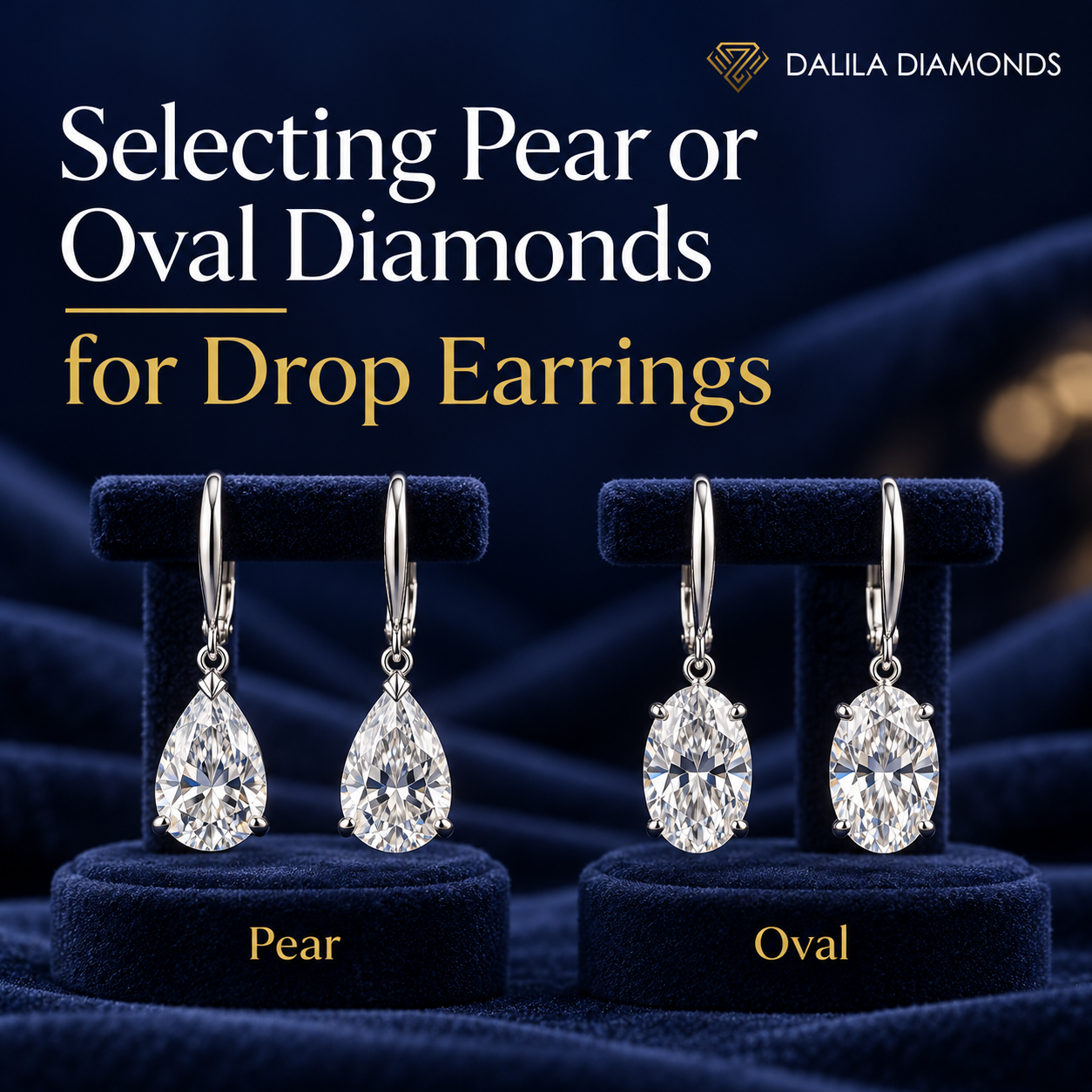
Choosing natural diamonds for drop earrings requires more than finding two attractive stones of the same shape and carat weight. The diamonds must look balanced as a pair, hang in the intended direction and work with the movement and weight of the finished earrings.
Pear and oval diamonds are particularly suitable for elongated drop-earring designs, but they create different visual and setting requirements.
An oval diamond has two rounded ends and a relatively symmetrical outline. This creates a soft, continuous appearance that works well in vertical drops, articulated earrings and designs with several linked components.
A pear-shaped diamond has one rounded end and one pointed tip. Its directional outline creates the recognisable teardrop appearance, but the jeweller must establish whether the point faces up or down and how that point will be protected.
For example, two natural pear diamonds weighing approximately 0.75 carat each may have similar reported dimensions but noticeably different shoulders or tip alignment. When suspended at the same height, those differences can become more apparent.
The best diamond pair for drop earrings is one whose actual dimensions, outlines, colour and light performance are compatible—and whose weight, orientation and settings have been approved for the proposed earring design.
The decision is not simply pear versus oval. It is whether the selected stones will form balanced, attractive and wearable finished earrings.
This guide covers both shapes in one practical buying process. Dalila's existing Oval vs Pear Diamond Guide remains the reference for their broader differences in outline, bow tie and appearance. The separate Matched-Pair Diamonds Buying Guide covers detailed trade procurement and tolerance specifications.
Which Diamond Shape Is Better for Drop Earrings: Pear or Oval?
Both shapes can work well. The better choice depends on the desired silhouette and how the diamond will hang.
A pear produces a distinctly directional drop. Its rounded end and pointed tip allow the jeweller to create a classic teardrop arrangement, often with the point towards the ear and the wider part lower down.
An oval produces a balanced elongated silhouette. Its rounded ends create a softer transition between the diamond and the earring's connecting components.
Buying factor | Pear-shaped diamond | Oval diamond |
Outline | Rounded head tapering to one point | Smooth outline with two rounded ends |
Visual effect | Distinctive teardrop | Balanced elongated shape |
Orientation | Point-up or point-down must be specified | Long axis usually vertical for classic drops |
Symmetry check | Point, shoulders, wings and both sides | Both ends, shoulders and left/right balance |
Main vulnerable area | Point and surrounding girdle | Girdle, especially exposed sections |
Pair matching | Tip position and outline essential | Length, width and overall fullness essential |
Optical consideration | Bow tie and brightness through the pointed end | Bow tie and brightness through both ends |
Setting consideration | Point protection and secure suspension | Secure seating and balanced suspension |
Neither shape is inherently more brilliant, and neither guarantees that the finished earrings will hang correctly.
A beautifully cut oval can look disappointing in an unsuitable mounting. A pear with excellent symmetry may still hang at an unwanted angle if the suspension point and earring construction are poorly positioned.
The appropriate choice must account for both the loose diamonds and the finished design.
Begin With the Intended Drop-Earring Design
Before searching for loose diamonds, establish how the stones will be used.
A single pear suspended directly beneath a small stud has different design requirements from a pair of articulated drop earrings with several connected components.
The jeweller should confirm the proposed arrangement before the supplier finalises the stone search.
Three common drop-earring constructions
Design | How the diamond is used | Main approval requirement |
Single-stone drop | One diamond suspended beneath the ear fitting | Orientation, weight and hang |
Articulated drop | Diamond connected through a moving link | Controlled movement and suitable clearance |
Multi-stone drop | Two or more stones arranged vertically in each earring | Combined weight, spacing, outline and overall balance |
For a single-diamond drop, the central question is how the pear or oval will hang.
For an articulated design, the interaction between the diamond setting and the moving joint becomes important.
For a multi-stone arrangement, the total length, distribution of weight and relationship between the different stones must also be assessed.
A matching pair of loose diamonds does not automatically produce a matching pair of completed drop earrings.
The jeweller must evaluate the entire construction.
Pear Diamond Drop Earrings: Choosing the Right Outline
The pear-shaped diamond combines a rounded end, two shoulders, tapering wings and one pointed tip.
These features make pear diamonds particularly distinctive, but they also create several matching requirements.
Two pears with identical carat weights may have different lengths, widths or outlines.
One may have broad, rounded shoulders and a relatively short point. Another may be longer and narrower, with straighter wings.
When worn side by side as earrings, these differences can be visible even if the grading reports look similar.
What good pear symmetry looks like
A pear selected for drop earrings should have a point aligned with its intended central axis, reasonably balanced wings and an attractive transition from the rounded end to the tip.
Inspect the following:
Alignment of the point with the centre of the rounded head.
Similar curvature on the left and right shoulders.
Balanced tapering of both wings.
A pleasing relationship between length and width.
No distracting outline irregularities.
Suitable girdle and point condition.
A report's symmetry grade is useful information, but it does not substitute for inspecting the actual outline.
Dalila's Pear-Shaped Diamond Guide covers shape-specific symmetry, point condition and bow-tie appearance in greater detail.
Two pears with the same ratio can still look different
Consider two hypothetical natural pear diamonds:
Specification | Pear A | Pear B |
Weight | 0.75 ct | 0.76 ct |
Length | 7.80 mm | 7.85 mm |
Width | 5.00 mm | 5.03 mm |
L/W ratio | 1.56 | 1.56 |
Shoulder outline | Broad and rounded | Narrower transition |
Point alignment | To inspect | To inspect |
Bow-tie appearance | To inspect | To inspect |
These are illustrative measurement combinations, not live Dalila inventory stones.
The diamonds have very similar ratios and face-up dimensions.
However, they should not be accepted as a matched pair until their outlines are examined together.
In drop earrings, the upper and lower portions of the stones are particularly noticeable because their silhouettes contribute directly to the hanging design.
Pear Point-Up or Point-Down: Which Orientation Should You Choose?
Pear-shaped drop earrings can be designed with either end facing towards the ear.
In a common teardrop arrangement, the pointed tip faces upward and the wider rounded end hangs below it.
The alternative places the rounded end towards the ear and the point facing downward.
Both orientations can be intentional design choices.
However, they should not be left to the setter to decide after the diamonds have been purchased.
Point-up pear drops
With the point facing upwards, the rounded end forms the lower part of the drop.
This creates a familiar teardrop silhouette.
The upper setting component may also incorporate the protective structure around the pointed tip, depending on the head design.
Point-down pear drops
With the point facing downward, the earring creates a sharper visual termination.
The lower point requires careful protection from knocks and accidental contact.
The suspension and setting must be designed to hold the stone securely in the intended orientation.
Must the two earrings be mirror images?
For a conventional vertical pear drop, the two stones may both have their points facing upward or downward.
That does not necessarily require a true left- and right-handed mirror-image cutting arrangement.
However, asymmetric design details, angled mounting positions or deliberately tilted pears may require mirrored orientations.
The jeweller should prepare a left-ear and right-ear drawing before approving the stones.
If a supplier offers a matched pair described as mirrored, confirm exactly what is meant.
Oval Diamond Drop Earrings: Matching Length and Fullness
Oval diamonds can create a soft, elongated drop without the pointed-end considerations of pear cuts.
However, an oval shape should not be treated as a completely standardised outline.
Some ovals have broader shoulders and fuller ends. Others are relatively narrow and elongated.
Two stones measuring nearly the same length and width can still have different visual shapes.
For matching drop earrings, examine both ovals side by side.
Illustrative oval pair
Specification | Oval A | Oval B |
Weight | 0.75 ct | 0.76 ct |
Length | 7.00 mm | 7.05 mm |
Width | 5.00 mm | 5.03 mm |
L/W ratio | 1.40 | 1.40 |
Outline fullness | To compare | To compare |
Bow-tie behaviour | To compare | To compare |
Colour appearance | To compare | To compare |
These are hypothetical candidates.
On paper, their dimensions suggest a promising match.
However, one oval could have fuller ends while the other appears pointed or relatively narrow at its tips.
A face-up comparison is therefore essential.
Should the oval hang vertically?
Vertical mounting is a common choice for classic oval drops because it emphasises the diamond's length.
However, an oval can also be mounted horizontally in a contemporary design.
For a vertical drop, the long axis should normally align with the planned hanging direction.
For an east-west arrangement, the shorter axis may align vertically instead.
The jeweller should consider whether the resulting width and mounting position are comfortable and visually balanced.
Actual Diamond Dimensions for Pear and Oval Drop Earrings
Carat weight alone cannot determine the visible size of a pear or oval diamond.
Both shapes should be evaluated using actual length and width in millimetres.
The following examples show realistic dimensional targets for an initial search.
Example diamond | Approximate weight per stone | Illustrative face-up dimensions | Pair total weight |
Smaller oval | 0.50 ct | 6.0 × 4.2 mm | 1.00 ctw |
Smaller pear | 0.50 ct | 6.6 × 4.4 mm | 1.00 ctw |
Medium oval | 0.75 ct | 7.0 × 5.0 mm | 1.50 ctw |
Medium pear | 0.75 ct | 7.8 × 5.0 mm | 1.50 ctw |
Larger oval | 1.00 ct | 8.0 × 5.6 mm | 2.00 ctw |
Larger pear | 1.00 ct | 8.8 × 5.6 mm | 2.00 ctw |
These dimensions are illustrative planning examples, not fixed carat-to-size equivalences or verified available stock. Individual stones may be shorter, longer, deeper, narrower or wider.
A pear may provide greater end-to-end length than an oval of similar weight, but that does not establish that it has a greater face-up area.
The pear's pointed end changes how its weight is distributed across the outline.
For a finished drop earring, the jeweller should also assess the setting's outside dimensions.
A bezel or decorative frame can add noticeable metal beyond the stone's reported length and width.
Matching Two Diamonds: Which Measurements Matter Most?
When choosing pear or oval diamonds for drop earrings, compare the individual dimensions and the visual appearance of both stones.
A good pair should look intentionally matched when presented at the same scale and orientation.
Matching factor | Why it matters for drop earrings |
Length | Determines the visible diamond drop length |
Width | Influences perceived fullness |
L/W ratio | Describes elongation |
Shoulder shape | Affects outline consistency |
Rounded-end shape | Particularly important for oval and pear |
Pear point alignment | Determines directional symmetry |
Colour | Prevents an unintended difference in warmth |
Clarity appearance | Avoids one diamond looking visibly included |
Brightness | Helps the pair sparkle consistently |
Bow tie | Can create different central contrast patterns |
Depth | Affects the head, seating and possible finished profile |
Girdle condition | Important for secure setting |
Total weight | Important for the combined earring design |
A minor difference in carat weight can be acceptable when the stones look similar in size and appearance.
For example, a 0.74-carat pear and a 0.77-carat pear may create a convincing pair if their actual dimensions and optical appearance align.
By contrast, two diamonds both weighing exactly 0.75 carat can look different if one has a longer, narrower outline.
Detailed trade matching tolerances should be agreed with the supplier and jeweller. For a consumer, the decisive step remains direct comparison of the intended pair.
Bow-Tie Appearance in Pear and Oval Drops
Pear and oval brilliant diamonds can exhibit a bow-tie pattern across part of the centre.
The appearance varies among stones.
A mild bow tie can form part of the diamond's natural contrast pattern.
A broad, persistently dark bow tie may be distracting, particularly when one earring has a strong dark area and the other appears considerably brighter.
For drop earrings, examine how each stone behaves as it moves.
This is particularly useful because dangling earrings do not remain at one fixed viewing angle.
The wearer turns their head, walks and changes position, altering how light enters and reflects from the diamonds.
A practical movement-video test
Ask for the two actual diamonds to be filmed together under identical conditions.
The video should begin with both stones face-up.
Then the stones should be tilted gently through similar angles.
Look for comparable brightness through the centres and ends, rather than requiring identical flashes at every instant.
If one oval consistently appears much darker than the other, further comparison may be warranted.
For pear diamonds, check the rounded head, wings and region towards the point.
A certificate cannot establish identical bow-tie behaviour.
Diamond Colour and Clarity for Pear or Oval Drop Earrings
G–H colour and VS2 clarity are useful starting preferences for many buyers seeking near-colourless, visually clean natural diamonds.
Carefully selected I-colour or SI1 stones may also work, depending on the actual size, shape, appearance and budget.
However, the two diamonds must look compatible.
A pair containing one visibly warmer diamond may appear unbalanced even when the reported grades are close.
The buyer should also examine the visibility of inclusions.
An SI1 with an unobtrusive inclusion may be perfectly attractive for an earring.
A stone with a dark inclusion beneath the table or a transparency concern may not meet the same requirement.
Special clarity consideration for pear diamonds
The pear's pointed tip deserves attention.
A feather, chip or other characteristic near the point may require professional assessment because that area can be vulnerable during setting and wear.
The jeweller should inspect the tip and determine appropriate protection.
Ovals lack the pronounced pear point, but their girdles can still be damaged.
A higher clarity grade does not automatically replace the need to inspect the stone's physical condition.
Why the Two Earrings Must Hang at the Same Height
Matching the loose diamonds is only part of the process.
When the finished earrings are worn, the left and right drops should have the intended relationship in length and alignment.
A pair may contain two well-matched natural diamonds but still appear uneven if one earring's connecting link is longer, the mounting head sits at a different position or the suspension geometry differs.
For example, suppose two oval diamonds each measure approximately 7.0 mm in length.
If one diamond begins 8 mm below its earring post while the other begins 10 mm below, the visible drops will not align as intended.
The problem does not originate in the diamonds.
It originates in the construction of the earrings.
Drop-length checklist
Measurement | Left earring | Right earring |
Post or hook reference position | ______ | ______ |
Connector length | ______ mm | ______ mm |
Diamond length | ______ mm | ______ mm |
Setting outside length | ______ mm | ______ mm |
Overall finished drop | ______ mm | ______ mm |
Intended orientation | ______ | ______ |
Suspension point | ______ | ______ |
Jeweller approval | ______ | ______ |
The jeweller should compare the completed earrings in a consistent hanging position.
How Weight Affects Drop-Earring Comfort
A larger diamond may contribute more weight to the finished earring, but carat weight is only one part of the total.
The metal head, connector, decorative components, earring post and backing also contribute.
Two diamonds weighing 0.75 carat each produce a combined diamond mass of 1.50 carats.
Because one metric carat equals 0.20 gram, each 0.75-carat stone weighs 0.15 gram.
Therefore, the two diamonds together weigh 0.30 gram.
That does not mean the finished pair weighs only 0.30 gram. The metalwork can contribute additional mass.
Weight example
Component | Illustrative mass per earring |
0.75 ct diamond | 0.15 g |
Setting and connector | 0.65 g |
Post or ear-fitting component | 0.25 g |
Total illustrated earring | 1.05 g |
Illustrative component masses only. Actual weight depends on the selected metal, dimensions and construction.
For a pair, the same example would produce a combined finished weight of 2.10 grams.
The actual comfort of the earrings depends on more than the total mass.
The distance between the centre of mass and the ear, the ear fitting, movement and the wearer's sensitivity all matter.
The jeweller should assess the completed design rather than using diamond carat weight as a standalone comfort criterion.
Movement: Why Drop Earrings Need a Different Approval Process
Stud earrings are mounted close to the ear.
Drop earrings may include moving links and a suspended centre of mass, so they can swing, rotate or turn as the wearer moves.
This motion is part of their visual appeal.
However, the movement should be consistent with the intended design.
An oval drop may rotate and briefly show its side profile.
A pear drop may turn away from its intended point-up orientation if the setting and suspension arrangement allow unwanted rotation.
The effect depends on the location of the suspension point, the centre of mass, joint construction and surrounding components.
The loose diamond supplier cannot determine the finished movement from a grading report.
That requires the manufacturing jeweller's design and physical testing of the mounting.
Three movement checks
Static hang: Suspend both finished earrings and confirm they settle into the intended orientation.
Gentle swing: Move the earrings through a small, controlled motion and confirm the links operate freely without unintended collisions.
Return position: Observe whether both earrings settle consistently after movement, including whether the diamonds face forward or tend to twist sideways.
These are practical design checks rather than universal laboratory acceptance standards.
For a substantial or complex articulated design, the jeweller may need to revise the link geometry or component weights.
Original Technical Diagram: Pear, Oval and Hanging Balance
The original diagram below illustrates the distinction between stone outline, intended vertical orientation and suspension geometry.
Original educational schematic. The diamond outlines are conceptual, and the drawing does not represent actual available Dalila stones, measured finished earrings or a validated suspension mechanism.
The pear panel identifies the importance of point direction, shoulders and wings.
The oval panel illustrates the need to match length, width and the fullness of both ends.
The paired-drop panel highlights the separate task of confirming consistent hang and movement.
A technical diagram can identify what needs to be checked, but it cannot demonstrate how actual finished earrings behave in motion.
Pear Tip Protection in Drop Earrings
A pear's pointed end can be vulnerable to chipping.
Although earrings typically experience different contact conditions from rings, their diamonds can still strike hard objects or be damaged during setting, cleaning, storage or handling.
The point therefore needs appropriate protection.
Depending on the proposed design, the jeweller may use a V-shaped prong or a bezel component.
The exact arrangement should be selected for the actual stone.
A V-prong label alone does not guarantee suitable workmanship or safety.
The jeweller should inspect the girdle, point condition and any relevant surface-reaching characteristics before mounting.
The rest of the pear's perimeter also needs appropriate support.
Protecting the point does not make the diamond damage-proof.
Bezel or Prongs for Pear and Oval Drop Earrings?
Both styles can be appropriate.
The choice depends on the desired appearance, how the diamond will be suspended and what protection and metal coverage are required.
Setting | Pear diamond | Oval diamond |
Full bezel | Can surround the outline and protect the point | Creates continuous coverage around rounded outline |
Partial bezel | Must specifically address the pear point and exposed areas | Leaves selected portions of the oval girdle exposed |
Prong setting | Requires suitable point protection | Requires appropriate girdle supports |
Decorative halo | Must follow the actual pear outline | Must follow the actual oval outline |
Articulated head | Requires suitable suspension and orientation | Requires suitable suspension and orientation |
A decorative halo should not be assumed to provide adequate structural protection for a pear point.
Similarly, a bezel must be shaped and manufactured for the actual diamond.
The jeweller should inspect both stones before the heads are finalised.
Worked Example 1: Two Pear Diamonds for Classic Teardrop Earrings
Consider a buyer commissioning 18K yellow-gold drop earrings with one natural pear-shaped diamond in each earring.
The intended design has the pointed ends facing the ear and the rounded portions hanging below.
The buyer is considering the following hypothetical stones.
Specification | Pear A | Pear B |
Weight | 0.75 ct | 0.76 ct |
Length | 7.80 mm | 7.85 mm |
Width | 5.00 mm | 5.03 mm |
L/W ratio | 1.56 | 1.56 |
Colour | G | G |
Clarity | VS2 | VS2 |
Bow-tie appearance | Requires review | Requires review |
Point condition | Requires review | Requires review |
Shoulder shape | Requires review | Requires review |
The combined diamond weight would be 1.51 ctw.
These are hypothetical comparison figures, not verified inventory.
Step 1: Confirm the pear orientation
The jewellery brief specifies point-up teardrops.
Both stones must be mounted consistently, subject to any intentionally mirrored design details.
Step 2: Compare the outlines
The lengths and widths are close.
However, the supplier should provide a direct comparison to confirm that the shoulders, wings and points create compatible silhouettes.
Step 3: Inspect point condition
The jeweller or qualified professional should examine both points for damage or setting-relevant characteristics.
Protective setting construction must be confirmed.
Step 4: Review brightness and bow ties
Both stones should be filmed together under consistent lighting.
If one has a much stronger, persistently dark bow tie, the pair may not create the intended visual balance.
Step 5: Confirm finished hanging length
The jeweller should prepare drawings showing both diamonds in their actual heads, with matching connector lengths and intended drop positions.
Step 6: Approve the complete pair
Approval should follow a review of the diamonds and the proposed jewellery construction.
Similar carat weights and dimensions are not sufficient on their own.
Worked Example 2: Two Oval Diamonds for Articulated Drop Earrings
Now consider a buyer commissioning white-gold earrings with a small upper stud and one suspended oval diamond beneath each.
The intended ovals will hang with their long axes vertically.
Specification | Oval A | Oval B |
Weight | 0.74 ct | 0.76 ct |
Length | 7.02 mm | 7.08 mm |
Width | 5.01 mm | 5.04 mm |
L/W ratio | 1.40 | 1.40 |
Colour | H | H |
Clarity | VS1 | VS2 |
Overall outline | To compare | To compare |
Face-up brightness | To compare | To compare |
Total depth | Setter to assess | Setter to assess |
The two stones weigh 1.50 ctw together.
The difference between VS1 and VS2 does not automatically make the diamonds unsuitable as a pair.
The buyer should first establish whether both stones look comparably clean and transparent.
The jeweller must then assess their actual depths and determine whether the earring heads can be made to look and hang consistently.
Why different depths can matter
Two ovals may match closely face-up but require different seating arrangements.
If one diamond has a substantially deeper pavilion, an identical basket may not accommodate both stones in exactly the same way.
The jeweller may need to adapt the head construction while preserving a coordinated finished appearance.
Approving movement
Once the stones have been selected, the jeweller should evaluate the articulated links.
Both earrings should move according to the intended design without one persistently turning sideways or hanging at a different height.
This is a jewellery-construction decision, not a diamond grading characteristic.
Buying Two Natural Diamonds: Consumer Shortlist Checklist
For a buyer selecting loose stones for a pair of drop earrings, a practical shortlist should contain enough information to make a visual decision.
Comparison | Left diamond | Right diamond |
Supplier reference | ______ | ______ |
Natural origin confirmed | ______ | ______ |
Shape | Pear / Oval | Pear / Oval |
Carat weight | ______ | ______ |
Length | ______ mm | ______ mm |
Width | ______ mm | ______ mm |
Total depth | ______ mm | ______ mm |
L/W ratio | ______ | ______ |
Colour | ______ | ______ |
Clarity | ______ | ______ |
Grading laboratory | ______ | ______ |
Report number | ______ | ______ |
Outline match approved | ______ | ______ |
Face-up colour approved | ______ | ______ |
Bow-tie appearance approved | ______ | ______ |
Girdle and point condition | ______ | ______ |
Side-by-side imagery reviewed | ______ | ______ |
For the finished earrings, record the design requirements separately.
Design requirement | Agreed specification |
Pear orientation, if applicable | Point up / Point down |
Oval orientation, if applicable | Vertical / Horizontal |
Intended left-right relationship | Same orientation / Mirrored design |
Setting type | ______ |
Earring metal | ______ |
Connector or link type | ______ |
Finished drop length | ______ mm |
Weight per finished earring | Jeweller to confirm |
Ear-fitting type | ______ |
Static hanging position approved | Pending / Approved |
Movement test completed | Pending / Approved |
Manufacturing jeweller approval | Pending / Approved |
This worksheet separates the diamond-pair decision from the jewellery-engineering requirements.
Sourcing Pear or Oval Diamonds for Drop Earrings
A useful sourcing enquiry should state that the stones are intended for hanging earrings.
This gives the supplier context for the relative importance of shape, outline and dimensions.
For example, a request for two 0.75-carat pear diamonds is less useful than a request that specifies the desired length, width, outline, colour, clarity and intended point orientation.
Example sourcing brief: Pear drops
Field | Requested specification |
Jewellery | Natural pear diamond drop earrings |
Quantity | Two diamonds |
Target carat weight | Approximately 0.70–0.80 ct each |
Preferred length | Approximately 7.5–8.0 mm |
Preferred width | Approximately 4.8–5.2 mm |
Outline | Similar shoulders, wings and point alignment |
Orientation | Point-up teardrop |
Colour | G–H |
Clarity | VS1–VS2, subject to actual appearance |
Optical performance | Comparable brightness and acceptable bow-tie contrast |
Point condition | No unapproved vulnerabilities |
Documentation | GIA, IGI or HRD reports where required |
Images | Side-by-side face-up images or video |
Setting | Jeweller-approved protective prong or bezel |
Final decision | Pair approved together |
Example sourcing brief: Oval drops
Field | Requested specification |
Jewellery | Natural oval diamond articulated drop earrings |
Quantity | Two diamonds |
Target carat weight | Approximately 0.70–0.80 ct each |
Preferred length | Approximately 6.8–7.2 mm |
Preferred width | Approximately 4.9–5.2 mm |
Outline | Similar rounded ends and shoulders |
Orientation | Vertical |
Colour | G–H |
Clarity | VS1–VS2, subject to appearance |
Optical performance | Balanced brightness and bow-tie behaviour |
Documentation | Individual reports where available |
Setting | Coordinated articulated heads |
Movement | Manufacturing jeweller to approve |
Final decision | Both diamonds reviewed as one pair |
These are hypothetical sourcing targets and not claims of current available inventory.
Natural loose-diamond enquiries can be made through Dalila Diamonds. Include the intended earring design, desired pair measurements and the requirement for matched visual appearance.
For detailed professional tolerance and fulfilment considerations, consult Dalila's Matched-Pair Diamonds Buying Guide.
Who approves which part?
The diamond supplier can provide available stones, individual dimensions, reports and comparative visual information.
The manufacturing jeweller is responsible for approving the head, suspension point, connector, setting security, finished earring weight and movement.
A grading report does not certify that a diamond will hang correctly in a finished drop earring.
The buyer should request separate quotations for the loose diamonds and any jewellery design, manufacturing or setting work.
Common Mistakes When Selecting Diamonds for Drop Earrings
Buying two stones of identical carat weight without comparing outlines
Equal weight does not guarantee matching length, width or shape.
Ignoring pear point alignment
A slightly misaligned point or uneven shoulder can become noticeable when the diamond hangs vertically.
Matching only the length-to-width ratio
Two diamonds can share the same ratio but have different actual sizes and outlines.
Forgetting the intended pear orientation
Point-up and point-down designs need different visual and setting decisions.
Approving the stones without a movement check
Well-matched loose diamonds can still hang inconsistently when mounted.
Ignoring the weight of the complete earrings
Metal heads, links and fittings contribute to the total mass.
Comparing unrelated diamond videos
Differences in lighting and camera settings can create artificial differences in brightness.
Assuming the setting automatically protects the pear tip
The actual point, girdle and retaining metal must be inspected.
Treating a grading report as a finished-earring specification
Reports describe diamonds. The jeweller must confirm the construction and behaviour of the earrings.
Frequently Asked Questions
Are pear or oval diamonds better for drop earrings?
Both are suitable. Pear diamonds create a distinctive directional teardrop, while ovals offer a softer, balanced elongated appearance. The choice depends on the intended design and the actual diamonds' matching appearance.
What is the best diamond shape for drop earrings?
There is no universal best shape. Pear and oval diamonds are useful candidates because of their elongated outlines. The best option is the pair that meets the desired dimensions, visual balance and setting requirements.
Should pear diamonds point up or down in earrings?
Either orientation is possible. Point-up produces a familiar teardrop arrangement, while point-down creates a different silhouette. The orientation should be specified before the mountings are designed.
Do pear diamond earrings have to be mirror images?
Not necessarily. Two vertically mounted pears can have matching point orientation without requiring specially mirrored cuts. Angled or asymmetric earring designs may need more deliberate left-right mirroring.
What size pear diamonds work for drop earrings?
That depends on the intended drop length, weight and appearance. A pair of approximately 0.75-carat pears might measure around 7.8 × 5.0 mm each, but actual dimensions must be checked.
What size oval diamonds work for drop earrings?
A natural oval around 0.75 carat might measure approximately 7.0 × 5.0 mm, although individual stones vary. The intended finished earring length and construction should determine the preferred size.
Do matched pear diamonds need identical carat weights?
No. Slightly different weights can still produce a balanced pair if the length, width, outline, colour and optical appearance are sufficiently similar.
How closely should oval diamonds match for earrings?
Compare their actual length, width, ratio, shoulder shape, end curvature, colour and brightness. There is no universal dimensional tolerance that guarantees an attractive pair.
Can pear or oval diamonds have bow ties?
Yes. Both shapes can show bow-tie contrast. The important consideration is whether the pattern is attractive and reasonably consistent across the pair during movement.
Do pear diamond points need protection in earrings?
Yes. The point should be evaluated for damage or setting-relevant characteristics, and the jeweller should provide appropriate support, such as a suitable V-prong or bezel.
Are oval diamonds easier to set than pear diamonds?
Ovals do not have a sharp point, which removes one particular protection concern. However, setting suitability still depends on the diamond's actual outline, girdle, depth and mounting design.
Can two diamonds with different clarity grades make matched drops?
Yes, potentially. A VS1 and VS2 may appear suitably coordinated. The actual visibility of inclusions, transparency and overall appearance should guide the selection.
Does depth matter in drop earrings?
Yes. Two stones with similar face-up dimensions but different depths may require different basket geometry or seating positions. The setter must approve the final construction.
How do I stop drop earrings from turning sideways?
The manufacturing jeweller must assess the suspension geometry, centre of mass, connector design and setting orientation. The diamond's shape alone cannot guarantee that the earring always faces forward.
Are heavier diamond drop earrings uncomfortable?
They can be, but comfort depends on the complete earring weight, fitting, geometry and wearer. Diamond carat weight alone does not establish comfort.
Should drop earrings swing freely?
They may be designed for articulated movement, but the intended motion should be controlled and tested. Excessive twisting or inconsistent hanging may require construction changes.
Can I buy loose pear or oval diamonds and have earrings made separately?
Yes. The supplier can provide candidate stones and documentation, while a jeweller designs and approves the mountings, connections and finished earrings.
What should I send Dalila when sourcing diamonds for drop earrings?
Provide the preferred shape, two-stone carat range, length and width, colour and clarity requirements, intended orientation, setting concept, budget and a request for coordinated face-up appearance.