Matching Pavé Diamonds to an Engagement-Ring Centre Stone: Colour, Size and Sparkle
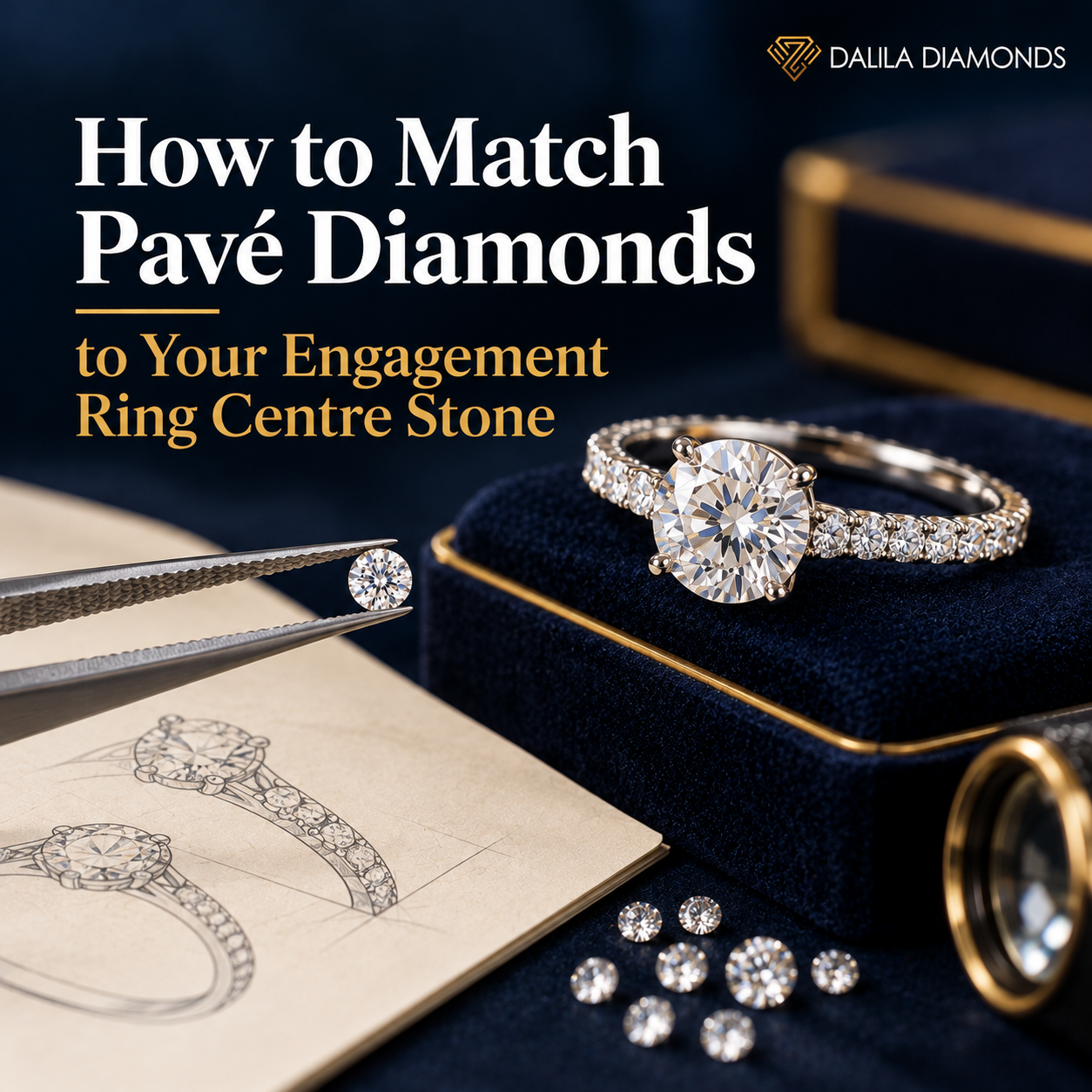
Choosing an engagement-ring centre diamond is only part of creating a well-balanced ring. If the design includes a pavé diamond band, the smaller diamonds must also work visually with the centre stone.
For example, a G-colour natural round brilliant diamond surrounded by small G–H pavé diamonds may create a relatively consistent near-colourless appearance.
But what happens when the centre is J colour and the pavé diamonds are D–F?
The smaller diamonds may appear noticeably whiter than the centre, making the centre diamond's warmer colour more obvious.
That contrast may be intentional. However, if the buyer expects a uniform white appearance, it could be disappointing.
Colour is not the only consideration.
A pavé band may contain 20, 30 or more small diamonds. Their individual diameters, transparency, cut appearance and setting compatibility also influence the finished ring.
Even when every diamond is natural and meets the agreed quality range, one noticeably different stone can interrupt the visual consistency of the band.
The best approach is to match the pavé diamonds to the centre stone's actual appearance, not simply select the highest possible colour and clarity grades.
This guide explains how to compare centre-stone and pavé colour, when contrast can work, how to specify the smaller diamonds and what a jewellery manufacturer should confirm before setting.
Should Pavé Diamonds Match the Centre Stone?
For a traditional engagement ring intended to have a consistent near-colourless appearance, the pavé diamonds should generally complement the centre diamond's visible colour.
They do not always need identical laboratory grades.
For example, an H-colour centre diamond may look attractive with G–H pavé diamonds.
A G-colour centre diamond may also look harmonious with H-colour melee if the stones are carefully selected.
However, the relationship is not guaranteed simply because two grades sit next to one another on the colour scale.
Small pavé diamonds and larger centre diamonds interact with light differently. Their cut proportions, dimensions and the surrounding metal can influence perceived colour.
The most reliable decision comes from comparing the actual centre diamond and representative pavé stones under controlled, consistent viewing conditions.
Quick colour-matching comparison
Centre diamond colour | Pavé colour to compare | Intended visual result |
D | D–F | Very white, consistent appearance |
E–F | D–F or F–G | Near-colourless visual continuity |
G | F–H | Balanced near-colourless appearance |
H | G–I | Compatible appearance, subject to visual inspection |
I | H–J | Potentially harmonious slight warmth |
J | I–J or H–I | Reduce unexpected white-versus-warm contrast |
K–L | Similar warmer ranges, or deliberately whiter pavé | Choose between blending and intentional contrast |
Fancy-colour centre | Colourless or near-colourless pavé may be deliberate | Highlight the centre's colour |
These are illustrative comparison starting points, not universal grading requirements or guarantees of visual matching. The finished appearance must be evaluated using the actual stones and metal.
A buyer should not automatically reject a combination because the pavé and centre diamond have different colour grades.
The more important question is whether the difference creates the intended appearance.
Why Centre-Stone Colour Can Look Different Beside Pavé
Diamond colour grades describe body colour under controlled grading conditions.
However, the appearance of a diamond in jewellery depends on additional factors.
A one-carat centre diamond is much larger than the small diamonds in a pavé band.
Because the centre stone has greater depth and a different optical presentation, its body colour may be perceived differently from the smaller stones.
The surrounding metal also influences the way colours appear.
A yellow-gold band creates a different visual environment from white gold or platinum.
Factors affecting perceived colour
Factor | Why it matters |
Centre diamond colour grade | Establishes the centre stone's graded body colour |
Pavé colour range | Influences how white or warm the surrounding diamonds appear |
Diamond size | Larger and smaller stones can show colour differently |
Cut and facet arrangement | Affects light reflections and colour perception |
Metal colour | Alters surrounding reflections and apparent contrast |
Setting position | Determines how closely the diamonds are compared visually |
Lighting | Changes perceived warmth, brightness and scintillation |
Transparency | Influences the clarity and liveliness of the appearance |
The pavé diamonds are not necessarily poor matches simply because their laboratory grades differ from the centre diamond.
But the buyer should examine whether their combined appearance is balanced.
Actual Colour-Contrast Scenarios: Which Combinations Work?
The following cases demonstrate practical choices that can arise when selecting natural pavé melee for a centre diamond.
These are illustrative grading combinations, not photographs or measured observations of identified Dalila stones. The expected appearance must be verified using actual diamonds.
Example 1: G-colour centre with G–H pavé
Suppose the centre diamond is a natural round brilliant with these specifications:
Characteristic | Centre diamond | Pavé diamonds |
Colour | G | G–H |
Clarity | VS2 | VS–SI |
Shape | Round brilliant | Round brilliant |
Carat weight | 1.00 ct | Small calibrated melee |
Metal | 18K white gold | Same ring |
Intended appearance | Near-colourless | Consistent near-colourless band |
This is a reasonable starting specification for a ring designed to have a relatively white appearance.
The pavé may appear visually coordinated with the centre.
However, the supplier should still assess the actual stones.
A few pavé diamonds that appear warmer or duller than the others could disrupt the band even though the stated range is G–H.
Key lesson: Compatible grades are a good starting point, but consistency within the pavé parcel also matters.
Example 2: J-colour centre with D–F pavé
Consider a J-colour natural centre diamond in a platinum engagement ring.
The pavé band contains very white D–F melee.
Characteristic | Centre diamond | Pavé diamonds |
Colour | J | D–F |
General colour category | Near-colourless, towards its warmer end | Colourless |
Metal | Platinum | Platinum |
Intended effect | Not specified | Strong possibility of visible contrast |
The pavé diamonds may look noticeably whiter than the centre.
This could emphasise the centre diamond's warmth.
For some buyers, the difference may be attractive.
For others, it may conflict with the expectation that the centre appears as white as the pavé.
A more closely matched H–J pavé selection could be worth comparing if a harmonious colour relationship is the priority.
Key lesson: Buying the whitest available melee is not always the best approach for a warmer centre diamond.
Example 3: H-colour centre with I–J pavé in yellow gold
Suppose the ring uses an H-colour natural diamond and an 18K yellow-gold band.
The pavé stones are selected from an I–J range.
This combination may provide a harmonious appearance, particularly when the buyer likes the warmer visual character of yellow gold.
However, yellow gold does not erase differences between diamonds.
The actual pavé still needs to be checked for obvious warm outliers.
Key lesson: Metal colour is part of the visual design, but it cannot replace diamond matching.
Example 4: K-colour centre with F–G pavé
A buyer chooses a K-colour natural diamond for a vintage-inspired engagement ring.
The setting contains F–G pavé stones.
The pavé diamonds may look comparatively white, creating a visible contrast.
That difference could be intentional, particularly in a design where the centre stone's warmth is part of the aesthetic.
If the buyer wants a softer, more integrated appearance, the jeweller may propose a different pavé colour range.
Key lesson: A contrast is not automatically a defect. It becomes a problem when it is unintended.
Example 5: Fancy yellow centre diamond with colourless pavé
A natural fancy yellow centre diamond may be surrounded by colourless or near-colourless pavé diamonds.
In this situation, visual contrast may be central to the design.
The white pavé can help distinguish the centre diamond's yellow colour.
However, grading terms must be used carefully.
A naturally fancy-coloured diamond is not equivalent to a near-colourless diamond with a warm K, L or M grade.
Fancy-colour selection requires separate colour-intensity and appearance considerations.
Key lesson: For intentionally contrasting designs, colour matching means achieving the planned relationship—not making every diamond appear identical.
When Does Pavé Colour Contrast Become a Problem?
Colour differences become a concern when they create an unintended visual effect.
For example, suppose an engagement ring is marketed as having a cohesive near-colourless appearance.
The centre is H colour, while the pavé parcel contains stones that vary noticeably from relatively white to distinctly warm.
The issue may be the inconsistent pavé parcel rather than the centre-to-pavé grade relationship alone.
Look for three types of contrast
1. Centre-to-band contrast
The centre diamond looks noticeably warmer or cooler than the pavé band.
2. Pavé-to-pavé contrast
One small diamond appears distinctly different from its immediate neighbours.
3. Section-to-section contrast
The pavé near the head looks different from the stones farther down the band.
These differences should be evaluated under consistent lighting.
A jeweller should also inspect the ring under ordinary viewing conditions, because not every difference visible under specialised inspection will be apparent when the ring is worn.
Should Pavé Colour Match the Centre in White Gold, Yellow Gold and Rose Gold?
The same centre and pavé diamonds can appear different in different metals.
White gold and platinum
White metals often support a relatively neutral surrounding appearance.
This may make differences between very white pavé and warmer centre diamonds more apparent.
For a near-colourless centre, comparing similar near-colourless pavé is a sensible starting point.
Yellow gold
Yellow gold introduces warm reflections into the design.
Some buyers prefer a slightly warmer diamond appearance in yellow-gold settings.
However, selecting a wider or lower pavé colour range still requires visual inspection.
A conspicuous colour outlier may remain noticeable.
Rose gold
Rose gold introduces warm pinkish reflections.
Its effect on diamond appearance depends on the actual alloy, setting geometry and stone characteristics.
A G–H centre with G–H pavé may produce a coordinated result, but other combinations may also be appropriate.
Metal comparison
Ring metal | Main colour-matching consideration |
Platinum | Compare visible centre-to-pavé warmth carefully |
White gold | Check colour harmony in a bright metal environment |
Yellow gold | Consider warm reflections without assuming differences disappear |
Rose gold | Evaluate pinkish metal reflections and intended overall warmth |
Mixed metals | Review each diamond group in its immediate metal environment |
For broader centre-stone colour selection across metals, see Dalila's article at /blogs/diamond-colour-in-different-ring-metals.
This article focuses on the additional decision introduced by pavé diamonds.
How Small Should Pavé Diamonds Be Compared With the Centre Stone?
The centre diamond normally remains the focal point of a conventional pavé engagement ring.
The smaller pavé diamonds provide additional sparkle along the band.
They should not overwhelm the intended central design.
For example, a one-carat round brilliant centre diamond commonly measures approximately 6.5 mm across.
A pavé band might use small natural round diamonds measuring between approximately 1.0 and 1.8 mm.
The exact dimensions depend on the band width and setting construction.
Illustrative centre-to-pavé size comparisons
Centre diamond | Approximate centre diameter | Pavé diameter | Intended visual relationship |
0.50 ct round | 5.1 mm | 1.0 mm | Very fine pavé accents |
0.75 ct round | 5.8 mm | 1.2 mm | Delicate diamond band |
1.00 ct round | 6.5 mm | 1.3 mm | Fine pavé relative to centre |
1.00 ct round | 6.5 mm | 1.8 mm | More prominent pavé |
1.50 ct round | 7.4 mm | 1.5 mm | Centre-forward design |
2.00 ct round | 8.1 mm | 2.0 mm | More substantial pavé band |
These are hypothetical design combinations, not verified finished rings or manufacturer-approved setting specifications.
The correct pavé size depends on the desired appearance and the physical construction of the shank.
Larger pavé does not automatically make the ring better.
The design should preserve appropriate metal support and structural integrity.
Why Pavé Stone-Size Matching Matters
Pavé diamonds are small and usually sit close to one another.
Because the arrangement is repetitive, even relatively small size differences can become noticeable.
For example, consider a row intended to contain diamonds measuring 1.5 mm.
If one diamond measures only 1.3 mm, it may appear smaller than its neighbours.
It may also be unsuitable for a seat designed around a larger diamond.
Likewise, an oversized stone may sit incorrectly or require a different seat.
The jeweller must specify the required dimensions rather than relying only on nominal carat weight.
Pavé diameter example
Stone position | Illustrative measured diameter |
1 | 1.50 mm |
2 | 1.49 mm |
3 | 1.51 mm |
4 | 1.50 mm |
5 | 1.30 mm |
6 | 1.49 mm |
7 | 1.50 mm |
Stone 5 is noticeably smaller in this hypothetical group.
That difference could interrupt the visual line or affect setting suitability.
However, the actual acceptable diameter range depends on the manufacturing specification.
There is no single universal pavé tolerance for every ring.
What Diameter Tolerance Is Acceptable for Pavé Diamonds?
The manufacturing jeweller must establish the acceptable tolerance for the particular setting.
The correct range depends on:
Nominal diamond diameter.
Prepared seat dimensions.
Metal thickness.
Bead or prong construction.
Diamond girdle characteristics.
Required visual consistency.
Manufacturing method.
Stone-setting process.
For example, a jeweller might request calibrated 1.50 mm diamonds within a contractual range of 1.48–1.52 mm.
That is an illustrative specification, not an industry-wide requirement.
Another design may permit a different range.
Example calibration worksheet
Specification | Illustrative requirement |
Jewellery | Natural diamond pavé engagement ring |
Pavé shape | Round brilliant |
Nominal diameter | 1.50 mm |
Example diameter range | 1.48–1.52 mm |
Number of diamonds | 28 |
Colour | G–H |
Clarity | VS–SI |
Girdle condition | Suitable for setting |
Cut appearance | Visually consistent |
Natural origin | Required |
Final tolerance approval | Manufacturing jeweller |
The supplier should not substitute an average diameter for the approved minimum and maximum measurements.
A parcel averaging 1.50 mm could still contain outliers outside the required range.
Does Carat Weight Matter for Pavé Matching?
Yes, but it does not replace dimensional matching.
A small round brilliant measuring approximately 1.5 mm may weigh around 0.015 carat.
However, individual diamonds with that weight can vary slightly in diameter and depth.
For pavé setting, the actual physical dimensions are especially important because the diamonds must fit prepared seats.
Approximate pavé size and weight chart
Round diameter | Approximate carat weight | Approximate points |
1.0 mm | 0.005 ct | 0.5 |
1.2 mm | 0.008 ct | 0.8 |
1.3 mm | 0.010 ct | 1.0 |
1.5 mm | 0.015 ct | 1.5 |
1.7 mm | 0.020 ct | 2.0 |
1.8 mm | 0.025 ct | 2.5 |
2.0 mm | 0.030 ct | 3.0 |
The weights are approximate planning references, not exact size-to-weight conversions.
For detailed trade specifications, use Dalila's Melee Diamond Size Chart.
What Clarity Should Pavé Diamonds Have?
Pavé diamonds do not automatically need the same clarity grade as the centre stone.
For example, a centre diamond with VS1 clarity may be paired with carefully selected VS–SI pavé.
The smaller stones can still create an attractive, consistent diamond line.
However, clarity should not be ignored.
A dark inclusion or transparency problem may make an individual pavé diamond look different from its neighbours.
Practical comparison
Centre diamond | Possible pavé quality | What to inspect |
VS1 | VS–SI | Face-up cleanliness and consistency |
VS2 | VS–SI | Inclusions and transparency |
SI1 | Carefully selected VS–SI | Appearance rather than grade matching alone |
VVS | VS or better, if desired | Whether higher grade creates meaningful benefit |
These are illustrative combinations, not mandatory grading rules.
The buyer should prioritise visually compatible pavé diamonds and appropriate physical condition.
Very high clarity grades may be desirable for some commercial specifications, but they are not universally necessary for attractive pavé jewellery.
Matching Pavé Sparkle and Cut Appearance
A well-matched pavé band should have reasonably consistent brightness and facet appearance.
A parcel with uneven cutting quality can produce a visibly irregular line.
For example, some stones might look bright and crisp while others appear dark or hazy.
Even when the parcel has consistent colour and clarity descriptions, those differences can affect the overall appearance.
What to check
Characteristic | Matching requirement |
Diamond outline | Consistent roundness or intended shape |
Diameter | Within jeweller-approved tolerance |
Cut proportions | Suitable, consistent overall make |
Brightness | No distracting dull stones |
Transparency | No unacceptable haze |
Facet appearance | Compatible sparkle pattern |
Girdle condition | No unacceptable chips or damage |
Colour | Harmonious with centre and neighbouring pavé |
Pavé diamonds do not necessarily have individual laboratory cut grades.
The supplier may instead sort the stones according to physical dimensions, overall make and agreed commercial quality standards.
Single-Cut vs Full-Cut Pavé Diamonds
Small round diamonds can be manufactured using different facet arrangements.
Full-cut round brilliant melee generally has a more complex facet pattern than single-cut melee.
The two can produce different optical appearances.
A ring's intended style should determine whether one type or a deliberate combination is appropriate.
Example
Suppose the centre is a modern round brilliant with a lively, relatively fine sparkle pattern.
The jeweller may prefer full-cut pavé to produce a coordinated modern appearance.
However, an antique-inspired design may intentionally use single-cut diamonds.
The important point is that the pavé should match the design.
Mixing single-cut and full-cut stones unintentionally along the same pavé row may create inconsistent appearance.
The manufacturer should define the required cutting style before ordering the parcel.
For a detailed comparison, use Dalila's existing article on single-cut versus full-cut melee diamonds.
How to Match Pavé to an Oval Centre Diamond
An oval centre diamond has a different face-up shape and facet appearance from a round brilliant.
The surrounding pavé may still use small round diamonds.
The main matching considerations remain colour, brightness and the desired contrast.
For example, an H-colour oval centre could be paired with carefully selected G–H or H–I pavé.
The buyer should inspect the actual centre for face-up warmth and bow-tie appearance.
The pavé should not be chosen solely by the oval's grading report.
However, the detailed optical evaluation of an oval's bow tie belongs in Dalila's dedicated diamond bow-tie guide.
This page addresses how the pavé relates to the chosen centre stone after its quality has been assessed.
How to Match Pavé to Emerald-Cut or Step-Cut Centres
Emerald-cut diamonds typically display broader flashes and a different facet pattern from round brilliant pavé.
This creates an intentional contrast in optical appearance even when their colours are closely matched.
For example, a G-colour emerald-cut centre with G–H round pavé may have a harmonious colour relationship, despite differences in sparkle character.
A buyer should not interpret every difference in scintillation as a quality defect.
The cutting styles are fundamentally different.
However, an emerald cut may reveal body colour and clarity characteristics differently from a round brilliant of similar grade.
The actual centre should therefore be compared with the intended pavé.
The goal is a coordinated design, not identical light behaviour between different cuts.
What About Pavé in a Halo Engagement Ring?
Halo pavé sits immediately beside the centre diamond.
Because the stones are closely adjacent, colour differences can become particularly noticeable.
A pavé band positioned farther down the shank may create less direct side-by-side comparison with the centre.
For a halo, the jeweller should pay careful attention to the centre-to-halo colour relationship.
However, detailed selection of a centre diamond for classic or hidden-halo settings belongs in Dalila's halo-specific guide at /blogs/centre-diamond-for-halo-engagement-ring.
The same general principle applies here: the small diamonds should create the desired visual relationship with the centre, whether harmonious or deliberately contrasting.
Can Pavé Diamonds Be Whiter Than the Centre Diamond?
Yes.
There is no rule that pavé must have an equal or lower colour grade.
A buyer may intentionally select very white pavé to frame a warmer centre.
This can be particularly effective when the contrast is part of the design.
However, the choice should be deliberate.
If the objective is to make a warmer near-colourless centre appear as white as possible, very white surrounding pavé may have the opposite perceptual effect by making the centre's warmth more noticeable.
Before ordering, review the proposed combination under realistic lighting.
Do not assume that paying for D–F melee always improves the appearance of an H, I or J centre.
How Many Pavé Diamonds Are Needed?
The quantity depends on the length of the pavé section, diamond diameter, setting pitch and band design.
A half-pavé engagement ring places diamonds along part of the shank.
A more extensively pavé-set band may contain additional stones.
Illustrative count example
Suppose the jeweller plans a pavé section using 1.5 mm round diamonds.
The design has 24 diamond positions.
If each stone averages 0.015 carat:
24 × 0.015 = 0.36 carat total pavé weight.
Now consider 30 positions using the same nominal stones:
30 × 0.015 = 0.45 carat total pavé weight.
These examples show how the total pavé weight changes with the number of stones.
They are not approved designs.
The manufacturer must determine the actual stone count from the ring size, shank geometry and setting.
Important distinction
Centre diamond weight: The individual centre stone's weight.
Pavé diamond weight: The combined weight of the smaller diamonds.
Ring total diamond weight: Centre plus all other diamonds, where the seller defines total weight that way.
For example, a ring with a 1.00-carat centre and 0.36 carat of pavé contains approximately 1.36 carats of diamonds in total.
Product descriptions should make the distinction clear.
Does Ring Size Change Pavé Diamond Count?
It can.
A larger ring may require additional pavé diamonds if the same size stones and coverage design are maintained.
However, jewellers may handle ring-size differences in different ways.
Some designs change the diamond count.
Others adjust the plain-metal portion or extent of pavé coverage.
The buyer should ask how ring size affects the finished diamond specifications.
A ring advertised with 0.30 carat of pavé should not automatically be assumed to contain the same count at every finger size.
The product or manufacturing quote should state whether the pavé quantity and total weight vary.
How to Inspect a Pavé Diamond Parcel Before Setting
A jewellery manufacturer should inspect the actual parcel rather than relying only on its average specifications.
For example, a parcel described as 1.5 mm G–H VS–SI might contain some diamonds that fall outside the intended physical tolerance or have noticeably different face-up appearance.
The inspection should identify such outliers before setting begins.
Parcel matching checklist
Check | What must be confirmed |
Quantity | Correct number of diamonds |
Shape | Required pavé shape |
Diameter | Within approved calibration |
Colour | Agreed range and visual consistency |
Clarity | Agreed range and acceptable appearance |
Transparency | No unacceptable haze |
Cut appearance | Consistent overall brightness |
Girdle condition | Suitable for setting |
Natural origin | Supported by agreed verification |
Individual grading reports | Only claimed where actually supplied |
Spare stones | Separately identified, if included |
Supplier reference | Recorded for traceability |
The full professional receiving, screening and rejection process belongs in Dalila's separate Diamond Parcel Quality-Control Checklist.
This guide focuses on whether the selected pavé visually complements the engagement-ring centre diamond.
Are Pavé Diamonds Individually Certified?
Not necessarily.
Pavé diamonds are often small enough to be traded as melee.
Many commercial melee parcels do not contain a separate GIA, IGI or HRD grading report for every diamond.
Instead, the supplier may provide an agreed colour, clarity, diameter and origin specification.
If the engagement ring contains natural diamonds, the supplier should provide appropriate evidence supporting the natural-origin declaration.
Why natural-origin screening matters
Natural and laboratory-grown diamonds can be visually similar.
Small melee diamonds can therefore require specialist screening to establish origin reliably.
GIA offers a Melee Analysis Service for eligible diamond parcels.
That is not equivalent to individual 4Cs grading reports for every small diamond.
The buyer should establish what verification was actually performed and which stones the documentation covers.
A natural centre diamond's laboratory report does not independently verify the origin of the pavé diamonds.
Worked Example: Matching Pavé to a G-Colour Natural Centre Diamond
Suppose a customer has selected a 1.00-carat natural round brilliant centre diamond.
The ring will be made in 18K white gold with a fine pavé shank.
Centre diamond
Specification | Requirement |
Shape | Round brilliant |
Origin | Natural |
Weight | 1.00 ct |
Colour | G |
Clarity | VS2 |
Approximate diameter | 6.5 mm |
Grading | Individual report |
Setting | Four- or six-prong head, to be approved |
Pavé design
Specification | Requirement |
Diamond shape | Round brilliant |
Origin | Natural |
Nominal diameter | 1.5 mm |
Quantity | 24, illustrative |
Colour | G–H |
Clarity | VS–SI |
Transparency | Clear, consistent appearance |
Cut style | Full cut |
Diameter tolerance | Set by manufacturer |
Total pavé weight | Approximately 0.36 ctw |
Setting construction | Pavé shank |
The pavé specification is hypothetical and does not represent a currently available parcel.
Step 1: Approve the centre diamond
The buyer selects the identified natural centre stone.
Its face-up colour, brilliance and transparency are evaluated.
Step 2: Review pavé colour candidates
The manufacturer compares representative G–H pavé stones with the actual centre diamond.
The buyer should review whether the combined appearance meets the intended near-colourless design.
Step 3: Approve the pavé dimensions
The jeweller establishes the required calibrated diameter range for the shank.
The nominal 1.5 mm reference is replaced with the approved manufacturing tolerance.
Step 4: Confirm the actual quantity
The jeweller calculates the number of stones needed for the finished ring size and pavé coverage.
The count may differ from the preliminary 24-stone example.
Step 5: Source and inspect the parcel
The supplier identifies natural melee meeting the required dimensions, colour and appearance specifications.
Any nonconforming stones should be resolved before manufacturing.
Step 6: Complete setting and inspection
The qualified setter fits the centre and pavé diamonds.
The completed ring is checked for security, surface condition, spacing, visual consistency and workmanship.
This is an illustrative workflow, not a documented Dalila customer order.
Worked Example: Matching a J-Colour Centre Without Unwanted Contrast
Suppose another customer chooses a natural J-colour oval diamond.
The ring will have a platinum shank with pavé diamonds.
The buyer wants a soft, harmonious overall appearance rather than a strong white-versus-warm contrast.
Comparison options
Option | Centre | Pavé range | Reason to compare |
A | J | D–F | Very white pavé may emphasise centre warmth |
B | J | G–H | Intermediate colour relationship |
C | J | I–J | Potentially closer colour harmony |
These are illustrative design options, not guaranteed visual outcomes.
The jeweller should compare real examples of the proposed combinations.
Option C may better suit the intended harmony, but the actual stones could alter that conclusion.
Likewise, Option A may be attractive if the customer likes a deliberate contrast.
What the buyer should avoid
Do not automatically purchase the highest-colour pavé merely because the grading letters are considered more premium.
The appropriate selection is the one that creates the desired relationship with the actual centre diamond.
Pavé Diamond Matching Worksheet
Use this worksheet before ordering natural diamond melee for a new engagement ring.
Centre diamond information
Field | Specification |
Diamond origin | Natural |
Shape | ______ |
Carat weight | ______ |
Colour grade | ______ |
Clarity grade | ______ |
Cut information | ______ |
Minimum diameter or width | ______ mm |
Maximum diameter or length | ______ mm |
Total depth | ______ mm |
Grading laboratory | ______ |
Report number | ______ |
Face-up colour appearance | ______ |
Transparency | ______ |
Supplier reference | ______ |
Pavé diamond requirements
Field | Specification |
Pavé location | Band / Halo / Other |
Diamond origin | Natural |
Shape | ______ |
Cutting style | Full cut / Single cut |
Nominal diameter | ______ mm |
Minimum acceptable diameter | ______ mm |
Maximum acceptable diameter | ______ mm |
Required count | ______ |
Additional spare stones | ______ |
Colour range | ______ |
Clarity range | ______ |
Transparency requirement | ______ |
Cut appearance requirement | ______ |
Girdle condition | ______ |
Natural-origin screening | ______ |
Parcel reference | ______ |
Actual parcel weight | ______ ctw |
Visual matching approval
Requirement | Status |
Centre-to-pavé colour compared | Pending / Approved |
Metal colour considered | Pending / Approved |
Pavé-to-pavé consistency checked | Pending / Approved |
No unacceptable colour outliers | Pending / Approved |
No unacceptable transparency outliers | Pending / Approved |
Diameter calibration confirmed | Pending / Approved |
Pavé count confirmed | Pending / Approved |
Setting compatibility approved | Pending / Approved |
Natural-origin evidence reviewed | Pending / Complete |
Final ring appearance approved | Pending / Approved |
Sourcing Natural Pavé Diamonds for an Engagement Ring
A request for "G-colour pavé diamonds" is not a complete manufacturing specification.
The supplier also needs the required diamond size, quantity, clarity, cutting style and dimensional tolerance.
Most importantly, the buyer should explain what centre diamond the pavé is intended to complement.
Example natural diamond sourcing brief
Jewellery: Natural diamond engagement ring with pavé shank.
Centre diamond: Natural round brilliant, 1.00 carat, G colour, VS2 clarity.
Centre report: Identified grading report.
Pavé shape: Round brilliant.
Pavé size: Approximately 1.5 mm, subject to manufacturer-approved tolerance.
Quantity: 24 stones, preliminary.
Colour: G–H.
Clarity: VS–SI, visually acceptable.
Cut: Full-cut melee with consistent face-up appearance.
Transparency: No unacceptable haze.
Natural origin: Required, with agreed screening documentation.
Metal: 18K white gold.
Manufacturing: Separate jeweller to confirm setting design, count and dimensions.
Budget: To be specified.
This is an illustrative sourcing request, not a current Dalila stock listing.
How Dalila can support a specification-led enquiry
Dalila Diamonds supplies natural loose diamonds and accepts enquiries based on particular diamond requirements.
For a pavé engagement-ring project, a useful request should include the selected centre diamond's specifications and the calibrated pavé requirements approved by the jeweller.
The availability of a matched natural melee parcel, the offered origin documentation and any visual matching service must be confirmed directly.
Do not assume that sourcing loose diamonds includes manufacturing or setting the finished engagement ring.
Responsibility breakdown
Task | Diamond supplier | Manufacturing jeweller |
Supply centre diamond candidates | Yes | |
Source natural pavé melee | Subject to availability | |
Provide available stone measurements | Yes | |
Provide grading or screening evidence | As agreed | |
Confirm pavé seat dimensions | — | Yes |
Approve diameter tolerance | — | Yes |
Confirm stone count | — | Yes |
Approve centre-to-pavé visual relationship | Buyer and jeweller, with supplier assistance if agreed | |
Manufacture ring | — | Yes |
Set diamonds | — | Yes |
Inspect finished ring | — | Yes |
The buyer should arrange compatibility approval before finalising a loose-diamond order.
Common Mistakes When Matching Pavé Diamonds
Assuming the whitest pavé is always best
Very white melee may emphasise the warmth of a lower-colour centre diamond.
Choosing colour grades without visual comparison
Two diamonds with adjacent grades do not necessarily look identical in the completed ring.
Ignoring pavé-to-pavé matching
A visually inconsistent parcel can make the band look uneven.
Using carat weight instead of actual diameter
A pavé diamond must fit the prepared seat.
Accepting an unspecified size tolerance
The jeweller should define minimum and maximum dimensions.
Overlooking cloudy or dull stones
Transparency and cut appearance influence the finished band's sparkle.
Assuming every pavé stone has an individual certificate
Small diamonds are often supplied under parcel specifications.
Confusing a centre diamond certificate with pavé origin verification
The centre report does not certify the surrounding diamonds.
Choosing pavé before finalising the ring design
The manufacturer must first establish the physical requirements.
Ignoring metal colour
White, yellow and rose metals can change the perceived relationship between the centre and pavé.
Frequently Asked Questions
Should pavé diamonds match the centre diamond colour?
For a harmonious near-colourless design, they should generally look compatible. Identical grading letters are not always necessary, but noticeable unintended contrast should be avoided.
Can pavé diamonds be a lower colour grade than the centre?
Yes. A G-colour centre may look attractive with carefully matched G–H or H-colour pavé. The actual combination should be inspected.
Can pavé diamonds be whiter than the centre?
Yes. However, much whiter pavé may make a warmer centre diamond look more yellow by comparison.
What pavé colour should I choose for a G-colour centre?
G–H or nearby near-colourless grades are useful starting points. Inspect actual stones and the intended ring metal before deciding.
What pavé colour works with an H-colour centre?
G–H or H–I may be worth comparing, depending on the desired appearance and available melee.
What pavé colour should I choose for a J-colour diamond?
H–J is one range worth comparing for a harmonious appearance. Whiter pavé may also work if the buyer prefers intentional contrast.
Should pavé diamonds be D–F colour?
Not necessarily. D–F pavé may suit a high-colour centre, but it is not automatically the best choice for every engagement ring.
Does yellow gold hide differences in diamond colour?
Not reliably. Yellow gold introduces warm reflections, but visibly mismatched stones can still stand out.
Do pavé diamonds need the same clarity as the centre?
No. Small pavé diamonds can have different clarity requirements, provided they meet the agreed appearance and quality specifications.
Is VS2 clarity good for pavé diamonds?
Yes. VS2 can be a suitable specification, while carefully selected SI diamonds may also be appropriate depending on their appearance.
Do pavé diamonds need excellent cut grades?
Individual small diamonds do not always have laboratory cut grades. Their actual brightness, proportions and consistency should be evaluated.
What size are pavé diamonds in engagement rings?
Many pavé engagement-ring designs use small diamonds measuring approximately 1.0–2.0 mm, although larger or smaller stones may be used depending on the construction.
Is 1.5 mm a good pavé diamond size?
It may be appropriate for a fine pavé band, subject to the ring's dimensions and the manufacturing jeweller's approval.
What is an acceptable pavé diamond diameter tolerance?
There is no universal tolerance. The setter must specify the acceptable range for the actual head or pavé seat.
Can one slightly smaller pavé diamond be noticeable?
Yes. In a closely repeated row, a size difference may interrupt the visual pattern.
Does a one-carat centre diamond need larger pavé?
No. Pavé size depends on the desired visual balance and band design, not only centre carat weight.
Can oval diamonds be matched with round pavé?
Yes. An oval centre can work with round brilliant melee. Compare their face-up colour and overall visual relationship.
Can emerald-cut diamonds be used with round pavé?
Yes. Different facet styles may create different sparkle patterns, but their colour and overall appearance can still be coordinated.
Are pavé diamonds individually certified by GIA?
Not necessarily. Many pavé diamonds are small melee supplied under commercial parcel specifications rather than individual laboratory reports.
How do I verify natural pavé diamonds?
Request an appropriate natural-origin declaration and information about any applicable screening or laboratory evidence.
Does the centre stone's GIA certificate cover the pavé diamonds?
No. A grading report for the centre diamond does not independently certify the origin or quality of the pavé.
Can Dalila source natural pavé diamonds to match a centre stone?
Dalila can receive specification-led natural loose-diamond enquiries. Availability, calibrated sizing, visual matching and origin documentation should be confirmed for the particular order.
What should I provide when requesting natural pavé diamonds?
Provide the centre stone's colour and measurements, desired pavé size, approved tolerance, count, colour, clarity, cutting style, natural-origin requirements and manufacturing specifications.
Final Checklist: Match the Centre, Then Match the Pavé
A well-designed pavé engagement ring should have a deliberate visual relationship between its centre diamond and the surrounding smaller stones.
For a harmonious near-colourless design, compare the actual centre colour with the proposed pavé rather than automatically choosing the highest grade.
Make sure the pavé stones are consistent with one another in diameter, colour, transparency and brightness.
Finally, confirm that every stone meets the jeweller's required dimensions and that the manufacturing design provides secure support.
The correct selection sequence is: choose the centre diamond → approve the visual colour relationship → define calibrated pavé sizes → inspect the natural melee parcel → obtain setter approval.
This approach makes diamond matching part of the design process rather than an afterthought.