How to Buy Two Loose Diamonds for Matching Studs
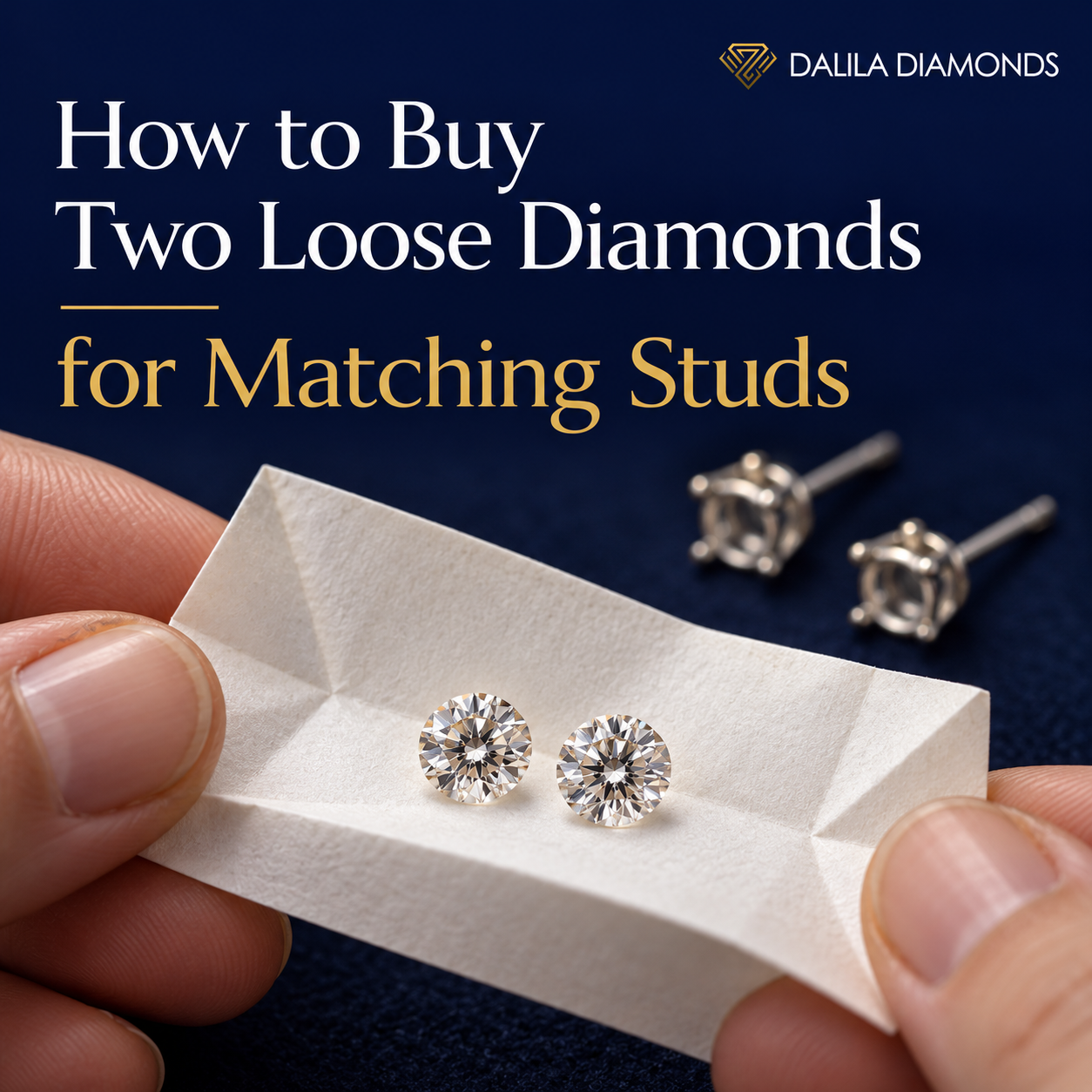
Buying two loose diamonds for matching stud earrings requires a different approach from choosing a single diamond for a ring. Both stones must look like they belong together when worn, even if their exact carat weights, clarity grades or individual measurements are not identical.
For example, two natural round brilliant diamonds weighing 0.49 and 0.51 carats may create a more balanced pair than two diamonds weighing exactly 0.50 carats if their visible diameters, colour and brilliance are better matched.
A buyer should therefore begin with the diamond size desired for each ear, shortlist two stones with compatible face-up measurements, and compare their appearance before committing to the pair.
The essential checks are straightforward: do the diamonds look the same size, do they show comparable colour, are their shapes and facet patterns consistent, and does one appear noticeably darker or less lively than the other?
Carat weight and laboratory reports help document the choice, but they cannot replace visual comparison.
Dalila's existing Matched-Pair Diamonds Buying Guide explains the detailed professional purchasing method, including trade tolerances, fluorescence, quality control and matched-pair fulfilment.
Dalila
This guide focuses on the consumer buying decision: how to select two natural loose diamonds for everyday or special-occasion stud earrings, compare a practical shortlist and work with a jeweller to turn the pair into finished studs.
What Makes Two Loose Diamonds a Good Pair for Stud Earrings?
Two diamonds do not need identical characteristics on paper to create an attractive pair.
When worn as earrings, the stones are separated by the wearer's face. Small differences may therefore be less noticeable than in a three-stone ring, where the diamonds sit immediately beside one another.
However, significant differences in size, outline, colour or brightness can still make the earrings look unbalanced.
A good consumer shortlist should prioritise the following.
Characteristic | What to compare | Why it matters |
Face-up dimensions | Diameter for rounds; length and width for fancy shapes | Determines visible size |
Diamond shape | Round, oval, cushion, princess or another chosen shape | Establishes the intended silhouette |
Outline | Roundness, shoulders, corners and overall shape | Two same-shape diamonds may still look different |
Colour appearance | How white or warm the stones look together | Avoids an unintended colour mismatch |
Brightness and sparkle | Face-up appearance in consistent lighting | One stone should not visually dominate because it performs much better |
Clarity appearance | Whether inclusions are distracting | Helps the pair look similarly clean |
Carat weight | Individual weights and combined pair weight | Documents size category and purchasing cost |
Depth and girdle | Actual three-dimensional measurements | Helps the jeweller design compatible settings |
Grading documents | Report details for each diamond, where available | Supports identification and informed purchasing |
These are buying considerations, not a guarantee that two stones are a suitable matched pair.
The final comparison should use actual candidates, preferably viewed together in the same lighting.
Start With the Size You Want in Each Ear
Before searching for two diamonds, decide how large each finished stud should appear.
Many earrings are advertised by total carat weight, but consumers often underestimate the difference between a diamond's individual weight and the weight of the complete pair.
A pair described as 1.00 carat total weight usually contains approximately 0.50 carat in each ear.
For round brilliants, half-carat diamonds typically measure around 5.1 mm across.
Target diamond per ear | Approximate round diameter | Pair total weight |
0.25 ct | 4.1 mm | 0.50 ctw |
0.30 ct | 4.3 mm | 0.60 ctw |
0.50 ct | 5.1 mm | 1.00 ctw |
0.75 ct | 5.8 mm | 1.50 ctw |
1.00 ct | 6.5 mm | 2.00 ctw |
1.50 ct | 7.4 mm | 3.00 ctw |
Approximate dimensions for round brilliant diamonds; actual diameters depend on the stones' proportions.
A buyer who wants approximately 5 mm of visible diamond diameter per ear should therefore begin around the half-carat category rather than assume a one-carat diamond is needed for each stud.
If the desired diameter is closer to 6.5 mm, the appropriate starting point may be approximately one carat per ear.
For a more detailed comparison of sizes and total weights, see Dalila's Diamond Stud Size Guide: Per Ear Versus Total Carat Weight.
Once the desired per-ear size is established, the next task is identifying two stones that look sufficiently alike.
Why Identical Carat Weight Does Not Guarantee Matching Studs
Carat weight measures a diamond's mass, not its visible diameter.
Two round diamonds both weighing 0.50 carat may have different face-up dimensions because one carries more weight in its depth or girdle.
Consider these hypothetical options:
Characteristic | Diamond A | Diamond B |
Weight | 0.50 ct | 0.50 ct |
Average face-up diameter | 5.08 mm | 4.95 mm |
Total depth | 3.10 mm | 3.24 mm |
Shape | Round brilliant | Round brilliant |
Colour | G | G |
Clarity | VS2 | VS2 |
The weights and headline grades match, but the face-up diameters differ by 0.13 mm.
Whether that difference is noticeable in the finished earrings depends on the actual stones, the settings and normal viewing conditions.
A different 0.49-carat diamond might measure closer to 5.08 mm and appear more compatible with Diamond A.
This is why buying two diamonds with exactly the same weight is not always the best starting objective.
GIA confirms that carat weight is only one element of a diamond's value and appearance, alongside cut, colour and clarity.
Diamond Stone – GIA C
For consumers purchasing loose diamonds for earrings, compare the visible millimetre measurements before concentrating on tiny weight differences.
Consumer Shortlist: Comparing Three Candidate Loose Diamonds
A buyer does not need to examine dozens of diamonds indefinitely. Once the desired size and quality range have been established, a shortlist of two or three credible candidates can make the decision manageable.
Imagine a buyer wants a pair of approximately 1.00 carat total natural diamond studs.
Three hypothetical round brilliant diamonds are available for consideration.
Specification | Diamond A | Diamond B | Diamond C |
Carat weight | 0.49 ct | 0.51 ct | 0.50 ct |
Average diameter | 5.06 mm | 5.09 mm | 4.89 mm |
Total depth | 3.11 mm | 3.14 mm | 3.23 mm |
Colour | G | G | G |
Clarity | VS2 | VS1 | VS2 |
Cut grade | Excellent | Excellent | Excellent |
Face-up appearance | Requires comparison | Requires comparison | Requires comparison |
Grading report | Must be verified | Must be verified | Must be verified |
The three candidates are illustrative, not verified live Dalila inventory. The measurements are realistic examples selected to demonstrate a buying decision.
Which two would you shortlist?
Diamonds A and B provide a promising starting combination.
Their average diameters differ by approximately 0.03 mm, while their combined carat weight is 1.00 carat.
Diamond C has a weight close to both but a smaller face-up diameter.
That does not make C an inferior diamond; it simply means that it may not be the most suitable visible-size match for A or B.
A and B should proceed to a side-by-side appearance check, not receive automatic purchase approval.
Their reported measurements cannot reveal whether one looks warmer, hazier or noticeably different in brightness.
The buyer should request photographs or videos made under the same lighting and, if possible, showing both actual diamonds together.
Original Diagram: Why Two Different Carat Weights May Match Better
Download the original diamond shortlist comparison diagram
Original educational diagram drawn from the hypothetical measurements in the shortlist. The diamonds are proportionally scaled to their stated diameters within the illustration. This is not a photograph, an optical simulation or evidence that these particular stones are available for purchase.
The diagram makes the main consumer decision easier to understand: Diamonds A and B have slightly different weights but similar visible diameters.
Diamond C demonstrates how a stone of almost the same weight can have a smaller face-up outline.
For the actual buying decision, the shortlisted stones must be assessed for visual appearance and condition.
How Closely Should Two Stud Diamonds Match in Millimetres?
There is no universal maximum diameter difference that guarantees a successful pair.
The appropriate difference depends on diamond size, setting style, individual appearance and how noticeable the result will be when worn.
For example, two half-carat rounds measuring approximately 5.06 mm and 5.09 mm have very close diameters.
A pair measuring 5.00 mm and 5.20 mm would have a more obvious dimensional difference on paper, but even then the final visual judgement depends on the actual stones and finished studs.
Consumers do not need to specify an arbitrary tolerance to three decimal places.
They should ask the supplier to recommend a pair that looks balanced in the intended earring size.
For professional jewellery manufacturing, specific millimetre tolerances may be required. Dalila's Matched-Pair Diamonds Buying Guide covers those purchasing specifications in detail.
Dalila
For an individual buying a pair of studs, the more practical rule is to reject a visibly mismatched pair even when the specifications appear close.
Should Both Diamonds Have the Same Colour Grade?
Choosing two diamonds with the same laboratory colour grade is a useful starting point.
For example, two G-colour round brilliants may be easier to shortlist than diamonds with widely different colour grades.
However, identical letter grades do not guarantee identical face-up appearances.
The colour grade describes the diamond's assessed body colour under controlled grading conditions. The way the stone appears when viewed from above can also be influenced by its cutting style, lighting and setting.
GIA explains that diamond colour is evaluated using a standardised D-to-Z grading system.
Diamond Stone – GIA C
A consumer should therefore compare both the reported colour and the actual stones.
Can G and H diamonds make matching earrings?
Potentially, yes.
An individual G-colour diamond and an H-colour diamond may look sufficiently harmonious as a pair, depending on the actual stones.
For a buyer who wants a strongly coordinated colourless appearance, same-grade candidates may provide a simpler purchasing decision.
For someone more flexible about subtle warmth, a carefully assessed adjacent-grade pair might be acceptable.
The important question is whether one finished stud looks noticeably warmer than the other under comparable lighting.
Does the earring metal affect colour matching?
It can.
Yellow-gold settings can contribute warm reflections, while white-metal settings can create a cooler surrounding appearance.
Using the same metal and setting style for both diamonds reduces unnecessary variables.
Do not compare one candidate in yellow-gold prongs with another in white-gold prongs and assume any apparent colour difference comes solely from the diamonds.
For the detailed setting-colour question, see Dalila's Diamond Colour in Yellow, White and Rose Gold guide.
Matching Diamond Clarity Without Paying for Unnecessary Grades
Two diamonds do not necessarily need identical clarity grades to make attractive stud earrings.
A VS1 and VS2 can potentially work together if both have acceptable inclusion visibility and transparency.
Similarly, two VS2 diamonds may look different if one has a dark inclusion visible beneath the table and the other has less noticeable characteristics nearer the edge.
The buyer should examine the inclusion appearance of each diamond rather than assume identical clarity grades guarantee identical results.
For studs, an appropriate objective is to choose stones whose inclusions are not distracting in normal wear and whose overall appearance is harmonious.
A higher clarity grade does not automatically make a diamond brighter.
Cutting quality, transparency and the behaviour of light through the stone remain important.
What to ask about clarity
For each candidate, ask whether any inclusions are noticeable face-up under agreed viewing conditions.
Also ask whether clouds, internal graining or other characteristics materially affect the stone's transparency.
For a large or valuable pair, magnified inspection and grading documentation may help identify significant features.
However, a consumer should avoid treating every plotted inclusion as a visible defect.
An inclusion visible under ten-times magnification may be difficult or impossible to distinguish without magnification.
The final purchasing decision should consider the actual appearance of both diamonds together.
Matching Brightness and Sparkle
Two diamonds can match in weight, diameter, colour and clarity yet differ noticeably in their visual performance.
One might show attractive brightness and crisp flashes while the other appears darker or less lively.
This is why two separate grading reports cannot completely establish whether the stones look like a pair.
For round brilliant diamonds, cut grade provides useful information about the quality of the individual stone.
GIA's diamond buying guide identifies cut as an important factor affecting brilliance, fire and scintillation.
Diamond Stone – GIA C
However, even two diamonds with the same overall cut grade may show different patterns of reflections.
Request a direct comparison
Ideally, obtain a short video showing both actual diamonds beside each other under the same lighting.
The video should include small changes in viewing angle.
This allows the buyer to examine whether both stones become bright and dark in a comparable way as the viewing conditions change.
Do not judge one stone from a brightly illuminated studio video and another from a poorly lit photograph.
Differences in lighting can create the impression of a difference in diamond quality.
Does both having Excellent cut guarantee matching sparkle?
No.
Two GIA Excellent round brilliant diamonds have met the laboratory's criteria for that grade, but their individual proportions and resulting appearance can still differ.
Excellent grades are useful for shortlisting, not proof that two diamonds are visually identical.
Where available, compare actual videos or view the stones together.
Fancy-Shaped Diamond Studs: Why Outline Matters
Buying two matching round brilliants is generally more straightforward than pairing fancy-shaped diamonds.
Round stones can be compared primarily by their diameters and overall visual performance.
Fancy shapes require more attention to their outlines.
For example, two oval diamonds may have similar weights, lengths and widths yet different shoulder shapes.
One could appear narrow and elongated, while the other looks fuller through the middle.
A pair of matching studs should look intentional, not like two different interpretations of the same shape.
Oval diamond studs
Compare the length and width of both stones, along with their overall outlines.
A pair containing ovals measuring 7.0 × 5.0 mm and 7.1 × 5.0 mm might be worth shortlisting, but the buyer should also compare the shoulders, ends and bow-tie appearance.
The ratio alone cannot establish a match.
Cushion-cut diamond studs
Cushions vary considerably in corner shape and shoulder fullness.
Two diamonds described as cushion cuts may look unlike one another when placed side by side.
Request a matched face-up photograph or comparison video.
Princess-cut diamond studs
For princess cuts, compare the length, width, corner geometry and visual appearance.
The jeweller should also confirm that the intended stud settings provide appropriate protection for the corners.
Emerald-cut diamond studs
Step-cut diamonds can show broad facet patterns and differences in transparency.
Two emerald cuts with nearly identical measurements may still look different if their step faceting produces noticeably different reflection patterns.
The actual corner outlines should also be compared.
Pear-shaped diamond studs
Pears require particular attention to the fullness of the rounded end, the shape of the shoulders and the alignment of the point.
Their intended orientation on opposite ears should be communicated to the jeweller.
The buyer may prefer the pointed ends to face the same direction relative to each ear or to be arranged as a mirrored pair.
This is a design decision that should be agreed before the settings are made.
Should Both Diamonds Have Grading Reports?
For a substantial pair of natural loose diamonds, individual laboratory reports can help the buyer understand exactly what is being purchased.
They may record weight, dimensions, colour, clarity, cutting style and other characteristics, depending on the laboratory and report type.
GIA provides natural diamond grading services for qualifying loose diamonds, including reports documenting the 4Cs and additional information relevant to the stone.
gia
However, not every small diamond is supplied with an individual full grading report.
Smaller commercial stones may be sold with supplier documentation and quality specifications.
The appropriate level of documentation depends on stone size, value and purchasing requirements.
For certified pairs, each diamond should have its own identifiable report or record.
Verify both diamonds separately
Do not verify only one stone because the two are being sold together.
If the diamonds have GIA reports, use GIA Report Check to compare the supplied report information with GIA's archived records.
Report Check
Where the diamonds have eligible laser inscriptions, the inscriptions can provide additional identification information.
Ask the seller to reconcile each stone's report number with its physical identity.
That helps ensure the buyer receives the same two diamonds that were reviewed and approved.
Should Both Diamonds Be Graded by the Same Laboratory?
Using reports from the same laboratory can make a consumer comparison more straightforward.
For example, if both diamonds have GIA reports, their grades have been assigned under GIA's grading framework.
This removes one potential source of uncertainty when comparing their colour and clarity descriptions.
However, using the same laboratory does not guarantee an attractive pair.
The stones must still be examined for size, colour and appearance.
Diamonds with reports from different recognised laboratories may also be considered, but the buyer should avoid assuming that identical grade labels from different issuers necessarily represent perfectly equivalent appearances.
The final selection should combine documentary review with visual comparison.
Worked Example: Choosing Two Diamonds for 1-Carat Total Studs
Suppose a buyer wants natural round brilliant studs with a combined weight of approximately one carat.
The buyer prefers G-colour diamonds and would like each stud to measure approximately 5.1 mm across.
The supplier presents three hypothetical candidates.
Specification | Diamond A | Diamond B | Diamond C |
Carat weight | 0.49 ct | 0.51 ct | 0.50 ct |
Average diameter | 5.06 mm | 5.09 mm | 4.89 mm |
Colour | G | G | G |
Clarity | VS2 | VS1 | VS2 |
Cut grade | Excellent | Excellent | Excellent |
Intended jewellery | Solitaire stud | Solitaire stud | Solitaire stud |
These are illustrative comparison candidates, not verified inventory.
Step 1: Compare the diameter
Diamonds A and B are very close in face-up size.
Candidate C has a smaller diameter despite weighing approximately the same amount.
The initial shortlist therefore favours A and B.
Step 2: Compare colour
All three candidates have hypothetical G colour grades.
This makes the paper comparison straightforward, but the buyer should still request a direct visual assessment.
Step 3: Compare clarity
Diamond A is VS2 while Diamond B is VS1.
The difference does not automatically prevent the two from making an attractive pair.
The buyer should confirm that both stones have acceptable visible inclusion characteristics and transparency.
Step 4: Compare the sparkle
Both candidates have Excellent cut grades.
The buyer should request consistent-light photographs or a side-by-side video to determine whether their actual brightness and facet patterns look harmonious.
If Diamond B appears noticeably different, another candidate may be preferable despite its similar measurements.
Step 5: Confirm total weight
Together, A and B weigh 1.00 carat.
This meets the desired total-weight category without requiring two mathematically identical 0.50-carat diamonds.
Step 6: Obtain mounting approval
Before purchasing, the jeweller should review their full dimensions, including depth and girdle characteristics.
The intended stud heads should be suitable for both diamonds.
The jeweller should also confirm the post and backing arrangement and any requirements for the finished earrings.
Final decision
Diamonds A and B are the strongest provisional shortlist based on the supplied hypothetical dimensions.
They would become an approved pair only after their identity, condition, visual appearance and mounting compatibility had been checked.
This sequence avoids buying two independently attractive diamonds that later prove visibly mismatched when worn together.
What If One Diamond Looks Better Than the Other?
If one diamond is clearly brighter, whiter or more visually attractive than its proposed partner, do not assume the difference will disappear after setting.
The buyer has several options.
The supplier may be able to identify another stone that better complements the preferred diamond.
Alternatively, both candidates may need to be reconsidered if neither creates a satisfactory pair.
It is useful to identify the reason for the mismatch before searching again.
If the problem is visible size, prioritise a better diameter match.
If the problem is colour, reconsider the actual face-up appearance.
If one stone consistently appears dark or hazy, review its optical characteristics and transparency.
The objective is not to make both grading reports look identical. It is to choose two stones whose finished appearance meets the buyer's expectations.
Does the Earring Setting Affect How Well the Diamonds Match?
Yes.
Two loose diamonds may look similar when viewed face-up but appear different in the finished earrings if their settings are inconsistent.
For example, one diamond may sit higher in its basket than the other, changing its visible profile.
A difference in prong thickness, metal coverage or head shape can also affect the appearance of the finished pair.
For matching studs, the jeweller should normally aim for a coordinated setting style and consistent finished presentation.
Four-prong versus six-prong studs
Both styles can be used for natural diamond studs.
The number, position and shape of the prongs affect how much metal appears around each diamond.
The choice should be made for the pair as a whole.
Bezel-set studs
A bezel surrounds the diamond's perimeter with metal.
It may create a slightly larger finished outside diameter than the diamond alone.
If the two diamonds have noticeably different face-up dimensions, matching bezel designs will not automatically make their visible diamond areas identical.
Stud baskets and depth
Two diamonds with similar diameters may have different depths.
The jeweller should confirm that both can be accommodated without creating an unintended difference in finished height or appearance.
Posts and backings
The positioning of the posts and selection of suitable backs also matter.
Larger or heavier earrings may need particular attention to comfort and forward tilting.
The manufacturing jeweller should evaluate these requirements using the complete proposed earrings rather than diamond weight alone.
Questions to Ask Before Paying for Two Loose Diamonds
A consumer should receive clear answers before purchasing a pair.
Question | Why it matters |
Are both diamonds natural? | Confirms the requested material |
What is each diamond's individual weight? | Prevents confusion with total carat weight |
What are the actual measurements? | Establishes face-up size |
Are both stones available now? | Avoids purchasing an incomplete pair |
Can I see them together? | Helps confirm visual balance |
Are the colour and clarity grades documented? | Supports the purchasing decision |
Are there independent grading reports? | Provides additional verification where available |
Can the report numbers be checked? | Supports stone identification |
Does either stone have visible damage? | Important for condition and setting |
Can my jeweller review the pair? | Confirms compatibility with the planned mounting |
What happens if the pair is rejected? | Clarifies inspection and return arrangements |
Are the setting and backings included? | Distinguishes loose-stone and finished-earring costs |
A supplier who cannot provide immediate side-by-side imagery may still be able to arrange a comparison or inspection.
The buyer should agree on how final approval will work before making a non-refundable purchase.
Consumer Worksheet: Comparing Two Loose Diamonds for Studs
Complete this worksheet using the actual candidate stones.
Specification | Left-ear diamond | Right-ear diamond |
Supplier reference | ______ | ______ |
Natural diamond confirmed | ______ | ______ |
Shape | ______ | ______ |
Carat weight | ______ | ______ |
Minimum diameter / length | ______ mm | ______ mm |
Maximum diameter / width | ______ mm | ______ mm |
Total depth | ______ mm | ______ mm |
Colour grade | ______ | ______ |
Clarity grade | ______ | ______ |
Cut grade, if applicable | ______ | ______ |
Grading laboratory | ______ | ______ |
Report number | ______ | ______ |
Report verified | ______ | ______ |
Face-up colour checked | ______ | ______ |
Visible inclusions acceptable | ______ | ______ |
Brightness checked | ______ | ______ |
Girdle and condition reviewed | ______ | ______ |
Suitable for intended setting | ______ | ______ |
Record the final pair-level information separately.
Pair requirement | Finding |
Combined carat weight | ______ ctw |
Desired size per ear | ______ mm |
Actual face-up size difference | ______ mm |
Colour appearance harmonious | Yes / No / Pending |
Brightness appearance harmonious | Yes / No / Pending |
Direct comparison completed | Yes / No |
Intended metal | ______ |
Intended setting | ______ |
Earring back style | ______ |
Jeweller approval | Pending / Approved |
Purchase conditions confirmed | Yes / No |
The worksheet is designed for an individual buyer who needs confidence in a specific pair.
It is not intended to replace a professional matched-pair procurement specification for high-volume manufacturing.
Buying Two Loose Diamonds Versus Finished Diamond Studs
A consumer can purchase two already-mounted diamond studs or select two loose diamonds and commission the earrings separately.
The loose-diamond route provides greater involvement in the individual stone selection.
However, it also requires coordination between the diamond supplier and manufacturing jeweller.
Buying consideration | Loose diamonds for custom studs | Finished diamond studs |
Choice of individual stones | Greater potential control | Depends on seller's selection |
Individual dimensions | Can be reviewed before mounting | May or may not be supplied separately |
Grading documentation | Depends on selected stones and reports | Depends on the finished pair |
Choice of setting | Selected or commissioned separately | Generally already determined |
Manufacturing coordination | Required | Usually completed |
Total cost | Diamonds plus separate jewellery work | Usually quoted as finished earrings |
Final suitability | Must be confirmed before setting | Finished pair should be inspected |
Neither route is automatically better.
For a buyer who wants very specific natural diamonds, the loose-stone route can provide more control over the shortlist.
For someone who prioritises convenience, a finished pair with adequate documentation and a clear inspection policy may be more suitable.
Sourcing Two Natural Loose Diamonds Through Dalila
A useful sourcing enquiry should identify the desired finished studs rather than only asking for two similar diamonds.
For example, a buyer might request two natural round brilliants of approximately 0.50 carat each, with similar 5.1 mm diameters, G–H colour, suitable clarity and attractive cut quality.
The supplier can then look for a coordinated pair rather than treating the request as two unrelated purchases.
Example consumer sourcing brief
Requirement | Requested specification |
Jewellery | Natural diamond solitaire stud earrings |
Number of diamonds | Two |
Shape | Round brilliant |
Target weight | Approximately 0.50 ct each |
Pair total | Approximately 1.00 ctw |
Diameter preference | Approximately 5.0–5.2 mm each |
Colour | G–H, with a harmonious appearance |
Clarity | VS1–VS2, subject to appearance |
Cut | Strong cut quality and comparable brightness |
Documentation | Individual grading reports where available |
Images | Face-up images or video of both stones together |
Setting | Matching four-prong stud heads |
Metal | 18K white gold, subject to jeweller confirmation |
Final approval | Both diamonds reviewed as a single proposed pair |
These are illustrative specifications, not a claim that specific stones are currently available.
Dalila Diamonds' DS4U — Diamond Source For You sourcing approach can be used for specification-driven natural diamond enquiries.
For matching studs, the enquiry should include the preferred per-ear weight, actual dimensions, colour and clarity range, desired documentation and intended mounting.
Availability and final matching suitability must be confirmed for the individual stones.
The detailed trade procedure for selecting, documenting and supplying matched pairs is covered separately in Dalila's Matched-Pair Diamonds Buying Guide.
Separate the diamond quotation from the jewellery work
A loose-diamond quotation should identify the two stones individually.
The manufacturing jeweller's quotation should identify the settings, metal, posts, backs and setting labour.
This helps the buyer understand the complete cost without assuming that purchasing the diamonds includes finished earrings.
It also establishes who is responsible for approving the stones for the intended mounting.
Common Mistakes When Buying Matching Loose Diamonds
Buying two diamonds with identical carat weights without checking diameters
Equal weights can produce different visible sizes.
Assuming identical GIA grades guarantee identical appearance
Two stones with the same colour, clarity and cut grades can still look different.
Comparing unrelated product photographs
Lighting, magnification and image processing can distort the apparent match.
Ignoring fancy-shape outlines
Two ovals or cushions with similar length and width may have noticeably different shapes.
Choosing one excellent diamond and compromising on the second
Both stones should be evaluated as a pair, not simply purchased individually because they appear attractive.
Overlooking the finished setting
Different head heights, metal coverage or basket construction can make the finished studs appear inconsistent.
Failing to verify each report
Both stones should be identified and their documentation verified individually where reports are supplied.
Buying before agreeing on approval and return conditions
The buyer should understand what happens if the two diamonds do not meet the agreed visual or technical requirements.
Frequently Asked Questions
How do I buy two matching loose diamonds for earrings?
Start by choosing the desired size per ear, then shortlist diamonds with similar face-up dimensions, colour and visual appearance. Request individual grading information and, where possible, side-by-side photographs or videos before obtaining jeweller approval.
Do matching diamond studs need exactly the same carat weight?
No. A 0.49-carat and 0.51-carat diamond may make an attractive one-carat-total pair if their visible dimensions and appearances are compatible.
How closely should two diamond stud diameters match?
There is no universal tolerance. The desired precision depends on stone size, setting and visual expectations. Consumers should ask for an appropriately matched pair and approve its actual appearance rather than rely on a generic millimetre limit.
Can two diamonds with the same colour grade look different?
Yes. Colour grades are standardised assessments, but face-up appearance also depends on cutting style, lighting and individual stone characteristics. Compare the actual diamonds together.
Can I pair a G-colour diamond with an H-colour diamond?
Potentially. Some adjacent-grade stones may appear harmonious, but the buyer should evaluate them directly. Identical colour grades can simplify the shortlist without guaranteeing a perfect visual match.
Do both earrings need the same clarity grade?
Not necessarily. Comparable visual cleanliness and transparency are more important than identical grade labels unless the purchase specification requires the same grade.
Should both diamonds have Excellent cut grades?
For GIA-graded standard round brilliants, choosing strong and comparable cut grades is a useful starting point. The actual brightness and reflection patterns should still be compared.
What size diamonds do I need for one-carat-total earrings?
A conventional one-carat-total solitaire pair usually contains approximately 0.50 carat per ear. Typical round brilliant diameters are around 5.1 mm each, although individual dimensions vary.
Can two oval diamonds with the same length and width look different?
Yes. Their shoulder fullness, end curvature, symmetry and facet patterns may differ. Request actual face-up images before approving the pair.
Is it better to buy individually certified diamonds for studs?
Individual grading reports can provide useful information and verification for more substantial or valuable pairs. Smaller stones may be sold with supplier documentation. The appropriate documentation depends on the purchase and buyer's requirements.
How do I verify two loose diamonds?
Check each available report against the issuing laboratory's official verification service. For GIA reports, use GIA Report Check. Confirm the physical stones correspond to their documented identities.
Does fluorescence need to match?
Fluorescence can be relevant to appearance in certain lighting conditions. Consumers should review any significant difference between the stones, but identical fluorescence descriptions are not automatically required for every visually harmonious pair.
Can I buy the diamonds from one supplier and have a different jeweller set them?
Yes. The jeweller should review both stones and confirm their suitability for the planned stud mountings. Clarify setting costs, responsibilities and purchasing conditions before ordering.
What if one of the diamonds looks noticeably darker?
Ask the supplier to review the pair or propose a replacement candidate. Similar grading reports do not justify accepting a visibly mismatched result.
Is buying loose diamonds cheaper than buying finished studs?
Not necessarily. The cost depends on the individual diamonds, setting materials, manufacturing work and seller pricing. Compare complete quotations rather than only the loose-stone prices.
What should I send to Dalila when sourcing a matched pair for studs?
Provide the shape, target weight per ear, preferred diameter or dimensions, colour and clarity range, grading preference, setting style, budget and request for a coordinated visual pair.