Diamond Colour in Yellow, White and Rose Gold: How the Same Stone Looks Different
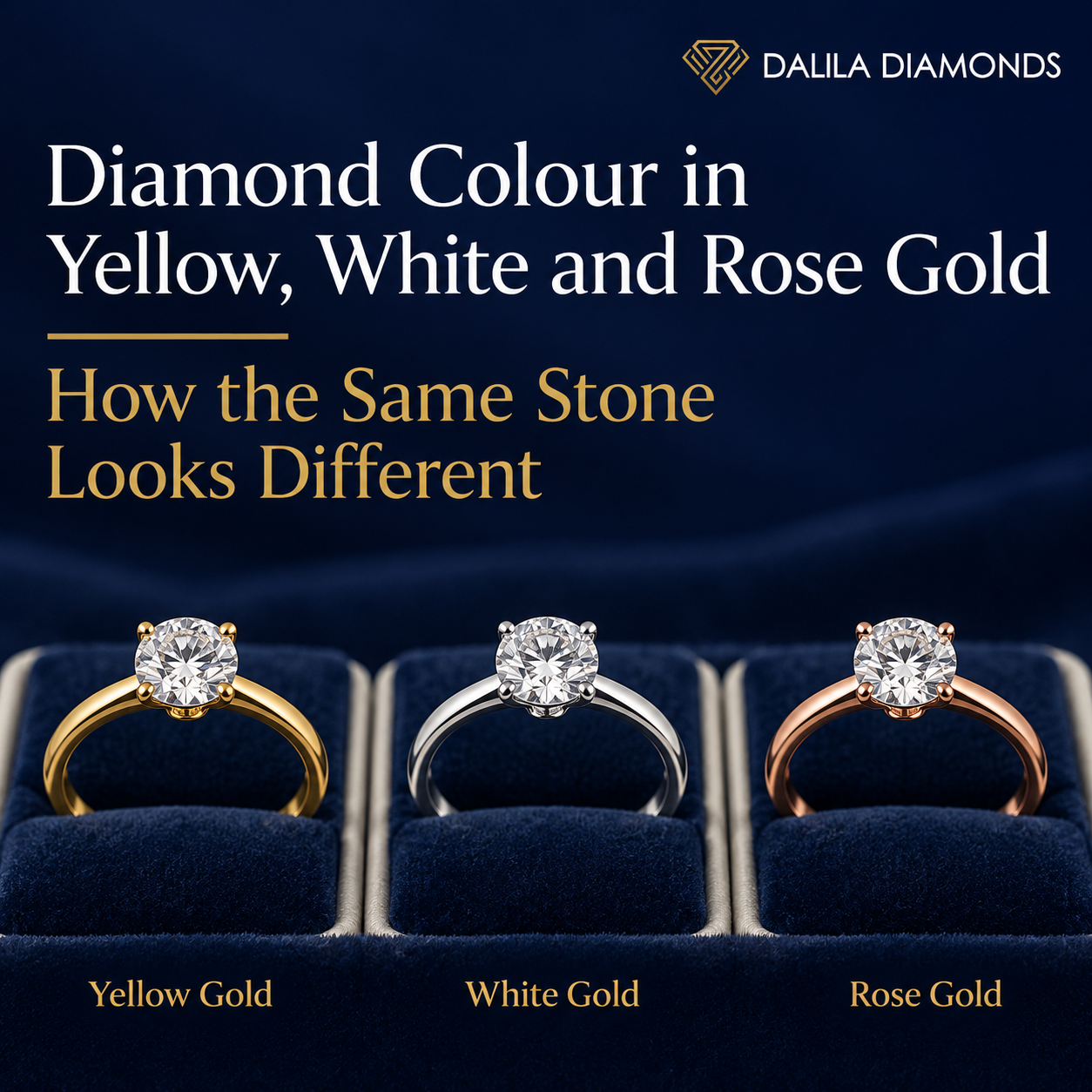
The colour of a diamond can appear different in yellow gold, white gold and rose gold, even when the diamond itself has not changed. Its facets reflect the surrounding metal, while the contrast between the stone and the ring can make slight warmth more or less noticeable.
For a buyer considering a natural diamond engagement ring, this creates an important distinction: the diamond's laboratory colour grade remains the same, but its appearance can change in the finished setting.
A G-colour diamond, for example, may look bright and relatively neutral beside white gold. The same stone can pick up warmer-looking reflections near yellow-gold prongs or a subtle pinkish cast from rose-gold surroundings.
Neither effect means the diamond has changed colour grade. It means the stone is interacting optically with its environment.
GIA's guide to white, yellow and rose gold engagement rings explains how a diamond's facets reflect nearby mounting colours and why the choice of prongs can affect its apparent colour.
GIA 4Cs
The best way to make this decision is to compare the same physical diamond against the intended metals under controlled lighting. Changing diamonds between photographs introduces differences in cut, body colour and light performance that can be mistaken for setting effects.
This guide concentrates on that practical comparison. For broader advice on buying diamonds according to colour and clarity grades, see Dalila's Best Diamond Colour and Clarity for Value guide.
lect and refract light, creating patterns of brightness, contrast and colour. When the diamond is positioned close to a coloured metal, some of that metal can become visible through reflections in the stone.
The effect depends on the actual geometry of the diamond and setting.
A yellow-gold prong touching the girdle can create a different visual effect from a yellow-gold band positioned farther away. A broad bezel surrounds more of the diamond than four narrow prongs and may therefore contribute more colour to its immediate visual environment.
The surrounding metal also creates a background against which the diamond's body colour is judged.
These are two related but distinct effects:
Effect | What happens | What the buyer may notice |
Metal reflection | Diamond facets reflect nearby coloured metal | Yellowish, whitish or pinkish reflections |
Visual contrast | Stone is viewed against a differently coloured background | Existing warmth appears more or less noticeable |
Setting coverage | More or less metal is visible immediately around the diamond | Different overall visual impression |
Surrounding lighting | The environment changes reflected light and colour balance | Appearance changes between photographs or rooms |
For these reasons, a diamond should not be described as becoming a different colour grade after mounting.
The grading report still describes the diamond's assessed characteristics, whereas the finished jewellery shows how that diamond appears in a particular setting.
The Same Natural Diamond in Three Gold Surrounds
The most informative comparison uses one identified natural diamond, with the only intended change being the metal immediately surrounding it.
For example, select one G-colour round brilliant diamond and compare it beside matching yellow-gold, white-gold and rose-gold sample surrounds.
All three comparisons should use the same stone, camera position, lighting setup and exposure settings.
The following diagram identifies the three metal environments that should be tested. It is deliberately schematic; it does not simulate or claim to document their actual optical effects.
Download the three-metal comparison diagram
Original concept illustration. The neutral diamond symbol is repeated in each panel. This is not a photograph of natural diamonds, an optical rendering or evidence that a particular G-colour stone will look exactly as illustrated.
What the photographic comparison should show
A real comparison should answer three questions.
First, does the metal produce noticeable coloured reflections within the diamond?
Second, does the surrounding metal make the diamond's existing body colour look stronger or less noticeable?
Third, does the buyer prefer a cooler contrast, a warmer harmonious appearance or a deliberately two-tone effect?
The answer should come from the actual stone viewed alongside actual metal samples, not from digitally recolouring the band in an image editor.
Diamond Colour in Yellow Gold Rings
Yellow gold introduces a warm visual environment around a diamond.
For natural diamonds with slight yellow body colour, this can create a more harmonious overall appearance. The diamond's warmth may feel less distinct because its colour is closer to the surrounding metal.
However, yellow gold can also produce visible yellow reflections within an otherwise colourless diamond, particularly when the metal immediately holding the stone is yellow.
These two effects should not be confused.
A buyer choosing a D-colour diamond for a yellow-gold ring may want its colourless appearance to remain prominent. In that case, white-metal prongs or a white-metal bezel can be worth comparing against an entirely yellow-gold setting.
Someone choosing an I- or J-colour natural diamond may prefer a yellow-gold mounting because the warmer overall appearance is intentional.
GIA explains that yellow gold can accentuate warmth in diamonds with more noticeable yellow colour, while also contributing yellowish reflections to the centre stone.
GIA 4Cs
+1
Should you choose a lower diamond colour grade for yellow gold?
Not automatically.
The widespread recommendation to choose a lower colour grade for yellow gold can be a useful starting point for budget comparisons, but it should not become a fixed purchasing rule.
A well-cut H-colour diamond may look attractive in a yellow-gold ring, while a particular J-colour diamond may still show more warmth than the buyer wants.
Shape, stone size, cut and personal colour sensitivity all affect that decision.
A practical approach is to compare two or three shortlisted diamonds against the intended yellow gold before paying more for a higher grade.
The correct choice is the stone that delivers the desired appearance, not simply the lowest colour grade considered acceptable for warm metal.
Diamond Colour in White Gold Rings
White gold provides a relatively cool, neutral-looking surround for natural diamonds.
It is often chosen when the buyer wants the stone to appear bright and colourless.
Against white metal, a diamond with relatively little body colour can create a continuous white appearance. This is one reason GIA commonly recommends white metals for colourless and near-colourless diamonds.
GIA 4Cs
However, the contrast can also make existing warmth easier to recognise in some diamonds.
For example, a J- or K-colour stone that appears softly harmonious beside yellow gold may look warmer when surrounded by a bright white-metal setting.
This does not necessarily make white gold a poor choice.
Some buyers deliberately prefer the contrast between a warmer natural diamond and a cool metal.
The important consideration is whether that contrast is desired.
White gold is not always the same visual colour
The composition and finish of the metal also matter.
Many white-gold rings are rhodium plated to produce a brighter, whiter surface. Unplated white-gold alloys may have a slightly different appearance.
Therefore, a comparison using a highly reflective plated sample may not precisely represent an unplated finished ring.
When making a buying decision, use metal samples that match the proposed final finish.
A generic silver-coloured computer rendering is not sufficient evidence of how a particular diamond will look in the completed ring.
Diamond Colour in Rose Gold Rings
Rose gold introduces a pinkish or copper-influenced warmth to the setting.
This can create attractive contrast with a relatively colourless diamond or a softer relationship with a diamond that already displays some body colour.
A colourless or near-colourless stone may stand out against the warm metal while also reflecting pinkish tones from nearby prongs or bezel surfaces.
For diamonds with visible warmth, the ring may produce a more harmonious overall impression.
GIA discusses rose gold as an option for creating either contrast or a softer relationship between diamond and metal colour.
GIA 4Cs
+1
Will rose gold make a white diamond look pink?
Not necessarily.
Nearby rose-gold metal may create pinkish reflections, but this does not change a colourless or near-colourless natural diamond into a pink diamond.
The apparent effect can vary across facets and viewing angles.
A round brilliant with multiple small reflections may display the surrounding metal differently from an emerald cut with broader step facets.
The buyer should evaluate the actual diamond beside rose gold rather than expect a uniform pink appearance across the entire stone.
Does every rose-gold ring have the same colour?
No.
The visible colour of rose gold can vary with alloy composition, metal purity and surface finish.
Two samples both described as rose gold may not produce exactly the same visual contrast beside a diamond.
Use a sample representative of the actual intended jewellery, ideally matching its specified alloy and finish.
Yellow Gold vs White Gold vs Rose Gold: Appearance Comparison
The table below summarises how each metal can influence a natural diamond's appearance.
Setting metal | Potential visual influence | Particularly useful comparison |
Yellow gold | Warm reflections and visual harmony with some warmer diamonds | Entirely yellow-gold head versus white-metal prongs |
White gold | Cool surround that emphasises a bright white appearance or contrasts with warmth | High-colour versus slightly warmer diamond |
Rose gold | Pinkish reflections and warm contrast | White-metal head versus rose-gold head |
Yellow-gold band with white-metal prongs | Warm band with a more neutral immediate stone surround | Same diamond in all-yellow and two-tone designs |
Rose-gold band with white-metal prongs | Rose-coloured band with reduced rose-metal contact at the girdle | All-rose versus two-tone setting |
These are possible appearance effects, not guaranteed results for every diamond.
The amount of visible metal, the diamond's cutting style, the light source and the viewing angle all influence what the wearer sees.
Why Prong Colour Can Matter More Than Band Colour
When evaluating diamond colour in different ring metals, buyers often focus on the shank or band.
Yet the metal in closest contact with the diamond can have a particularly noticeable effect.
The prongs sit directly against the diamond near its girdle. Their colour can appear in neighbouring reflections, especially when viewed from certain angles.
A yellow-gold band with white-gold or platinum prongs may therefore preserve more of a neutral-looking immediate environment around the diamond than an entirely yellow-gold head.
This does not guarantee that the diamond will appear completely free from warm reflections. The surrounding band, gallery, lighting and other nearby objects can still influence its appearance.
Compare three versions of the same yellow-gold ring
Version | Band | Prongs or centre surround | Purpose |
A | Yellow gold | Yellow gold | Fully warm design |
B | Yellow gold | White gold | Warm band with neutral-looking stone supports |
C | Yellow gold | Platinum | Warm band with contrasting white-metal supports |
The metal combination should also be reviewed by the jeweller for structural suitability and manufacturing requirements.
GIA specifically discusses white-metal prongs with yellow- or rose-gold bands as a way to emphasise the colourless appearance of the diamond while retaining the preferred warm band colour.
GIA 4Cs
Does a Bezel Influence Diamond Colour More Than Prongs?
A bezel generally places more visible metal around the perimeter of the diamond than a conventional four- or six-prong setting.
That can make the colour of the metal an especially important design consideration.
A yellow-gold bezel may create a strong warm frame around the stone. A white-gold bezel can provide a cooler visual boundary.
However, the exact appearance depends on how much metal is visible, the diamond's outline and its reflective pattern.
It would be inaccurate to claim that every bezel makes a diamond appear more yellow or that a white bezel always improves its apparent whiteness.
The decision requires a comparison of the proposed construction.
For information about whether a particular centre diamond's outline and girdle can work within a bezel, see Dalila's existing article, Choosing a Diamond for a Bezel Engagement Ring. That fit decision is separate from the colour-appearance comparison covered here.
How Diamond Shape Changes the Effect of Metal Colour
Even when two diamonds have the same colour grade, their cut and shape can influence how their body colour and surroundings appear.
Brilliant-style diamonds generally create numerous reflections. Step-cut diamonds have broader facets and a different pattern of light and dark areas.
Consequently, a round brilliant and an emerald cut may respond visually differently to yellow-gold or rose-gold surroundings.
GIA explains that shape and cutting style affect how readily body colour can be noticed, with step cuts often requiring particularly careful examination.
GIA 4Cs
Round brilliant diamonds
A round brilliant can show many small reflected areas, potentially mixing neutral-looking and metal-coloured reflections as the stone moves.
A yellow-gold surround may contribute warm reflections, but the effect should be evaluated alongside the stone's brightness and cut quality.
Oval, pear and marquise diamonds
Elongated diamonds can show differences in brightness and colour distribution across their length.
The pointed ends of pear and marquise diamonds may display body colour differently from their broader portions.
Inspect the complete outline in the intended metal rather than judging only the central facets.
Emerald and Asscher cuts
Step-cut diamonds often show broader reflections, so the relationship between the diamond's body colour and metal surround can be especially important.
For an emerald-cut diamond in rose gold, inspect whether warm reflections enhance the intended design or distract from the stone's geometric appearance.
Radiant and cushion cuts
These shapes can have different faceting styles and reflection patterns.
Do not assume that a radiant and a cushion of the same colour grade will look equally white beside yellow gold.
Compare their actual face-up appearance.
Same Diamond, Different Light: Why Photography Must Be Controlled
Photographs can help buyers compare metals, but only when the conditions are consistent.
An image of one diamond photographed in a warm showroom beside yellow gold cannot be reliably compared with a different diamond photographed in cool daylight beside white gold.
Differences in lighting and image processing may dominate the apparent metal effect.
For this article, the strongest original evidence would be a controlled series of photographs using the same identified natural diamond.
Controlled Photography Protocol
Variable | Required approach |
Diamond | Exactly the same physical stone in every image |
Identification | Record grading report or inventory reference |
Metal surrounds | Actual yellow, white and rose gold samples |
Metal specification | Record alloy, fineness and surface finish |
Lighting | Same fixed lights, position and diffusion |
Camera | Fixed position, lens and focal length |
Exposure | Manual settings held constant |
White balance | Fixed using a neutral reference |
Background | Same neutral, non-coloured surface |
Diamond orientation | Keep tilt, rotation and viewing angle consistent |
Image editing | No selective recolouring or changes to individual diamond hues |
Presentation | Same crop, scale and image-processing settings |
If the stone is not actually mounted in three different rings, use removable metal surrounds or representative metal components.
These comparisons should be identified as simulated mounting environments using real physical samples, not photographs of completed rings.
A true finished-setting comparison would require appropriately mounted designs and confirmation of any mounting or remounting procedures by a professional.
The three-photo layout to publish
01 · Yellow gold
Same physical diamond; yellow-gold sample
02 · White gold
Same physical diamond; white-gold sample
03 · Rose gold
Same physical diamond; rose-gold sample
Photography placeholders, not diamond photographs. Replace all three with a genuine controlled image series before claiming that the article visually demonstrates the same stone in different metals.
For credibility, the finished comparison should identify the diamond's grade, shape, carat weight, the three metal specifications and the lighting setup.
A Worked Example: One G-Colour Diamond, Three Metal Choices
Consider a buyer who has already selected a hypothetical natural round brilliant diamond with the following specifications.
Property | Specification |
Shape | Round brilliant |
Carat weight | 1.20 ct |
Colour | G |
Clarity | VS2 |
Grading report | Recognised laboratory report |
Appearance objective | Bright centre diamond in an everyday engagement ring |
The specifications are illustrative and do not refer to a particular Dalila inventory stone.
The buyer is considering a yellow-gold, white-gold or rose-gold engagement ring.
Option A: Yellow gold
The buyer compares the loose diamond with an actual yellow-gold surround.
The questions are whether warm metal reflections are noticeable and whether they contribute positively to the intended appearance.
If the diamond looks too warm in an all-yellow setting, a yellow-gold band with white-metal prongs could be considered.
Option B: White gold
The same diamond is compared with a white-gold sample under unchanged lighting.
The buyer assesses whether the cool surround gives the preferred bright appearance or whether the overall ring feels less warm than intended.
No change in the diamond's grading report is implied.
Option C: Rose gold
The same diamond is evaluated beside a rose-gold sample.
The buyer checks whether pinkish reflections or contrast from the surrounding metal create the preferred appearance.
A comparison should be made against the actual proposed finish, because the colour of rose-gold alloys can vary.
How should the buyer decide?
The decision should be based on the preferred appearance of the specific stone beside the actual metals.
There is no need to change the diamond's colour grade simply because a different metal has been selected.
If none of the three combinations creates the desired appearance, the buyer can reconsider the diamond or the colour of the prongs and centre setting.
Comparing an H-Colour and J-Colour Diamond in Yellow Gold
A second useful buying comparison involves two candidate diamonds being considered for the same yellow-gold mounting.
Suppose one is H colour and the other is J colour.
A laboratory colour grade indicates an assessed characteristic of the stone, but it does not fully predict how the diamond will appear face-up in the intended jewellery.
To evaluate the options fairly, the buyer should compare diamonds with similar shapes, sizes and suitable cut characteristics under consistent conditions.
First, view each diamond in a neutral surround. Then compare each beside the same yellow-gold sample.
This allows the buyer to distinguish the intrinsic difference between the two stones from the influence of the gold.
A buyer might find that the J-colour diamond looks attractively warm in yellow gold and meets the desired appearance at a lower price.
Another buyer may still prefer the H-colour diamond because they are more sensitive to warmth or intend to use white-metal prongs.
Neither outcome should be assumed before examining the stones.
Dalila's colour and clarity value guide covers how grade differences can influence budget decisions. This article's focus is the separate question of how the chosen stone behaves visually beside the setting metal.
Should You Choose the Diamond or Ring Metal First?
Either sequence can work, but the final decision should consider both together.
If the buyer already knows they want yellow gold, the diamond shortlist can be reviewed with that metal in mind from the beginning.
If a particular natural diamond has already been selected, compare it against several metal samples before approving the ring design.
The important point is to avoid evaluating a stone's apparent colour only in a generic photograph and assuming it will look identical after setting.
For a custom ring, the ideal sequence is:
Establish the preferred metal appearance and overall ring design.
Shortlist natural diamonds based on grading, dimensions, cut and individual appearance.
Compare the strongest candidates beside representative metal surrounds.
Decide whether the prongs or bezel should match or contrast with the band.
Ask the jeweller to confirm the final mounting specification.
Approve the diamond and setting as separate purchasing decisions.
This method keeps the diamond's intrinsic properties distinct from the finished jewellery's appearance.
A Diamond and Ring-Metal Comparison Worksheet
Before committing to a diamond and mounting, record how the actual stone appears beside the proposed metals.
Comparison field | Yellow gold | White gold | Rose gold |
Same diamond reference | ______ | ______ | ______ |
Metal fineness and alloy | ______ | ______ | ______ |
Surface finish | ______ | ______ | ______ |
Prong or bezel colour | ______ | ______ | ______ |
Warm reflections noticeable? | ______ | ______ | ______ |
Body colour more noticeable? | ______ | ______ | ______ |
Face-up appearance preferred? | ______ | ______ | ______ |
Side-view appearance preferred? | ______ | ______ | ______ |
Lighting conditions identical? | ______ | ______ | ______ |
Overall design preference | ______ | ______ | ______ |
For a comparison using more than one diamond, complete a separate worksheet for each stone.
Do not mix photographs taken with different cameras, automatic white balance or unrelated lighting conditions and treat them as a controlled colour comparison.
A Sourcing Brief for a Diamond and Its Intended Ring Metal
The sourcing request should tell the supplier what natural diamond is required and how the buyer intends to evaluate its appearance.
The diamond supplier provides candidate stones, grading information and available visual material. The jeweller responsible for the finished ring confirms the mounting, prong construction, alloy and setting requirements.
Information | What to provide or confirm |
Diamond identity | Supplier reference and grading report |
Shape and carat weight | Preferred range and actual specifications |
Colour requirements | Target grade or acceptable comparison range |
Cut and appearance | Intended quality and face-up appearance |
Metal preference | Yellow, white or rose gold |
Metal specification | Alloy fineness and finish |
Prong or bezel choice | Same colour as band or contrasting white metal |
Comparison material | Actual stone images and available metal samples |
Photography conditions | Fixed lighting and colour controls where a formal comparison is required |
Side diamonds | Whether surrounding stones will affect visible colour contrast |
Manufacturing responsibility | Jeweller's approval of the proposed mounting |
Quotation | Loose diamond and ring-manufacturing costs identified separately |
For an existing ring, provide the actual metal specification and setting reference.
For a custom ring, include photographs or a drawing showing the proposed relationship between the diamond, centre head and band.
Dalila Diamonds' natural diamond sourcing services can be used to enquire about diamonds with particular colour, shape, size and grading requirements. Dalila also identifies DS4U — Diamond Source For You as its customised sourcing route in its diamond quality resource.
Dalila Diamonds
When submitting an enquiry, mention the intended metal and whether a cooler white appearance or a warmer overall result is preferred.
The supplier can provide information about candidate loose diamonds. The comparison with the actual metal and approval of the completed setting remain separate decisions.
Request separate quotations for the natural diamond and any mounting or setting work rather than assuming the loose-diamond price includes production of the finished ring.
Frequently Asked Questions
What diamond colour looks best in a yellow-gold ring?
There is no single best grade. G–J diamonds are useful candidates to compare, depending on whether the buyer prefers a bright contrast or a warmer appearance. The same stone should be viewed beside the intended yellow-gold sample before the final decision.
Does yellow gold make a diamond look yellow?
Yellow gold can produce yellowish reflections in a diamond's facets, especially when the prongs or bezel are yellow. It can also make some warmer diamonds appear more harmonious with their surroundings. It does not change the diamond's laboratory colour grade.
Is H or I colour better for yellow gold?
Neither grade is automatically better. An H-colour diamond may appeal to buyers who want a whiter appearance, while an I-colour stone may provide attractive value when its warmth is acceptable. Compare actual stones with the same yellow-gold surround.
Will a D-colour diamond look different in yellow gold?
It can. A D-colour diamond remains D colour, but yellow-gold reflections may influence its visible appearance. White-metal prongs or a white-metal bezel can be considered if preserving a neutral-looking immediate surround is important.
Does white gold make a diamond look whiter?
White gold can emphasise a bright, relatively colourless appearance, particularly for colourless or near-colourless diamonds. However, the contrast with white metal can also make existing warmth more noticeable in some stones. It cannot change their intrinsic colour grade.
Does rose gold make a diamond look pink?
Rose gold can contribute pinkish reflections, but it does not convert a colourless diamond into a pink diamond. The amount and position of visible colour depend on the diamond, the surrounding metal and the lighting.
Should I use white-gold prongs on a yellow-gold ring?
White-gold or platinum prongs are worth comparing when the goal is a warmer band with a more neutral-looking setting around the diamond. The jeweller must confirm the appropriate construction and metal combination.
Is an I-colour diamond suitable for white gold?
It can be. An I-colour diamond may appear bright and attractive in white gold, but its warmth may be more noticeable than in yellow gold, depending on the individual stone. Evaluate its face-up appearance rather than reject it solely by grade.
Can an emerald-cut diamond look warmer than a round diamond in the same setting?
Yes. Different cutting styles create different reflection patterns, and step-cut diamonds may reveal body colour differently from brilliant cuts. Compare actual stones rather than assuming identical colour grades guarantee identical visual results.
Does a bezel setting affect diamond colour?
It can. A bezel places metal around much of the diamond's perimeter, potentially influencing the reflections and visual contrast around the stone. The effect depends on the exact bezel geometry, metal colour and diamond.
Can photographs accurately show the effect of different gold colours?
Photographs can provide useful comparisons when the same physical diamond, actual metal samples and controlled lighting are used. Images taken with changing exposure, white balance or colour editing cannot reliably isolate the effect of the metal.
Can I change the ring metal without changing the diamond?
In a new custom jewellery design, the same selected diamond can be evaluated with different mounting metals. Changing an already completed ring may require replacing or reconstructing components, and the jeweller must assess whether that is appropriate.
Should side diamonds match the centre diamond's colour?
For an intentionally harmonious appearance, similar colour grades and direct visual comparison are useful starting points. Surrounding diamonds with markedly different face-up colour can make the centre's warmth more noticeable.
What should I ask for when sourcing a natural diamond for a yellow-gold ring?
Provide the desired shape, carat range, colour and clarity preferences, grading requirements, intended yellow-gold alloy and whether the prongs will be yellow or white metal. Request actual diamond images and compare promising stones in the proposed metal environment.