Chipped Diamond: Should You Repair, Recut or Replace It?
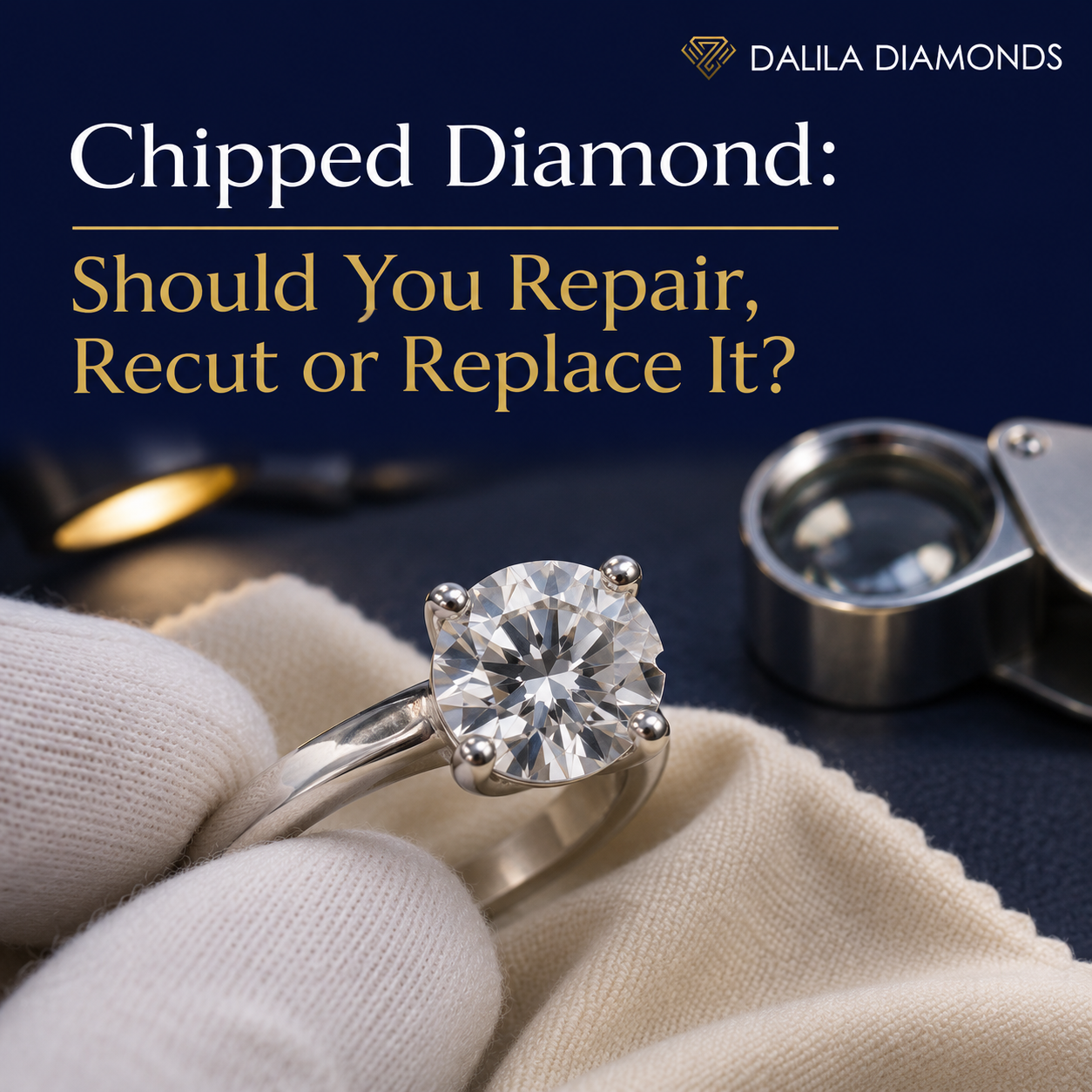
A chipped diamond may be repairable through professional repolishing or recutting, but not every damaged diamond is suitable for either treatment. In some situations, changing the setting or replacing the stone may be the safer and more practical option.
The correct decision depends on the location, depth and extent of the damage, the diamond's internal characteristics and whether removing material would significantly change its weight or appearance.
For example, a natural round brilliant diamond may develop a small chip along the girdle after being struck against a hard surface.
A specialist diamond cutter might be able to remove that chip through limited polishing.
However, if the damage extends deeply into the stone, a more substantial recut may be necessary.
That could reduce the diamond's carat weight, face-up dimensions and potentially its value.
An emerald-cut diamond with a chipped corner presents another situation. Its geometric outline and facet arrangement may require more extensive reshaping than a relatively minor surface blemish.
The first step is to stop wearing the damaged jewellery and arrange an expert assessment before removing, polishing, recutting or replacing the diamond.
A photograph can help document the damage, but it cannot reliably establish the chip's depth, its relationship to internal features or whether recutting will be technically feasible.
This guide explains the available options, what a specialist should inspect, how carat loss affects the decision and when sourcing a replacement natural diamond may be more appropriate.
Can a Chipped Diamond Be Fixed?
Sometimes.
There are several possible approaches, but they do not accomplish the same thing.
Option | What it involves | When it may be considered |
Minor repolishing | Removing a limited amount of material to improve a damaged surface | Small, accessible damage that a cutter determines can be treated |
Recutting | Reshaping and repolishing part or all of the diamond | Damage that requires changing facets or overall geometry |
Protective resetting | Changing or repairing the mounting to protect vulnerable areas | Stone is assessed as suitable for continued use |
Replacement | Selecting another diamond for the jewellery | Repair is impractical, risky or commercially unattractive |
No immediate alteration | Preserving the stone after professional inspection and keeping it unworn or appropriately protected | Damage assessment, insurance or sentimental considerations favour delaying intervention |
A setting change is not the same as repairing the diamond.
A bezel or prong may help protect an appropriately assessed stone, but it does not eliminate an existing fracture or restore removed diamond material.
Similarly, cleaning or ordinary jewellery polishing cannot repair a chip in the diamond itself.
Can Diamonds Really Chip?
Yes.
Diamond is exceptionally hard, but hardness and toughness are different material properties.
Hardness describes resistance to scratching.
Toughness describes resistance to fracture, chipping and breakage.
A diamond can resist abrasion extremely well and still suffer damage after an impact.
This is particularly relevant at vulnerable parts of the stone, including thin girdles, exposed points and corners.
Areas where damage may occur
Diamond area | Possible concern |
Girdle | Exposed edge may chip during impact |
Princess-cut corner | Pointed corner may be vulnerable |
Pear-shaped point | Requires suitable protection |
Marquise tips | Both pointed ends need attention |
Culet | An exposed pointed culet may be vulnerable |
Existing feather near the surface | May influence fracture behaviour |
Previously chipped edge | Can present further durability concerns |
The location of the damage matters just as much as its apparent size.
A small chip next to a vulnerable internal feature may require greater caution than a superficial-looking mark in a less critical position.
What Should You Do Immediately After Discovering a Chip?
Stop wearing the diamond jewellery until a qualified jeweller has inspected it.
Continuing to wear a damaged diamond may expose the affected area to further impacts.
It can also worsen a problem if the original impact damaged the mounting.
Immediate steps
Remove the jewellery and store it securely.
Avoid touching or pressing the chipped area.
Photograph the jewellery and visible damage.
Keep any detached fragments if recovered.
Locate the original diamond grading report and purchase documents.
Check whether the jewellery is insured.
Arrange a professional gemmological and setting inspection.
Avoid authorising polishing or recutting until the proposed outcome is documented.
Do not attempt to file, sand, glue or polish the chipped diamond at home.
Diamond cutting requires specialised equipment and expertise.
A home repair attempt may cause additional damage and complicate any insurance claim.
Step 1: Confirm Whether the Diamond Is Actually Chipped
Not every visible line, mark or irregularity is a chip.
A customer may notice something near the diamond's edge and assume that the stone has broken.
However, several characteristics can create superficially similar appearances.
These include:
A genuine surface chip.
A natural characteristic at the girdle.
A cavity.
An indented natural.
An internal feather.
A reflection from a facet junction.
Residue or another issue on the surface.
A jeweller or gemmologist should examine the stone with appropriate magnification and lighting.
The purpose is to identify the feature correctly before deciding whether any treatment is needed.
Why a photograph is insufficient
A close-up photograph may document a visible irregularity.
However, it generally cannot establish the complete three-dimensional extent of damage.
It may not reveal whether a fracture extends below the surface or intersects another internal feature.
The mounting may also conceal part of the diamond.
Do not use a photo alone to decide that a chipped diamond can safely be repolished, recut or reset.
A photograph is supporting documentation, not a final durability assessment.
Step 2: Locate the Damage
Once a professional confirms that the feature is a chip, the next question is where it is located.
The position influences the repair options.
Girdle chip
The girdle separates the crown and pavilion and serves as an important setting area.
A chip at the girdle may affect prong contact or leave a vulnerable edge.
A specialist cutter may consider local repolishing or recutting, depending on the damage.
Chip near a prong
Damage beside a prong requires examination of both the diamond and the metal.
The prong may have moved during the impact.
If so, simply repairing the diamond would not correct the entire problem.
Chipped point or corner
Princess, pear and marquise diamonds have pointed features that require suitable protection.
A chip at a point may affect the outline and limit the available recutting options.
Chip on a crown facet
A chip on the upper portion of the diamond can affect its visible appearance.
Removing it may require modifying neighbouring facets to preserve acceptable geometry.
Pavilion damage
Damage below the girdle may not be visible from directly above, but it can affect structural suitability, setting clearance or optical performance.
A specialist should evaluate the actual location and extent.
Step 3: Assess Whether the Diamond Has Existing Durability Risks
A chip does not always occur in isolation.
The diamond may also have a thin girdle, an internal feature near the damage or another vulnerability.
For example, a surface-reaching feather near a pointed corner can be relevant to the setter's assessment.
The professional should examine whether the proposed repair would remove the vulnerable area, leave it unchanged or create a new durability concern.
Technical inspection checklist
Characteristic | What should be assessed |
Chip location | Exact position on the stone |
Chip dimensions | Surface extent and depth, where measurable |
Internal fractures | Whether damage extends into the diamond |
Surface-reaching feathers | Proximity to affected area |
Girdle thickness | Thin or vulnerable sections |
Original cut | Facet layout and geometry |
Carat weight | Existing actual weight |
Original proportions | Length, width, depth and angles as relevant |
Stone symmetry | Potential effect of material removal |
Setting contact points | Whether retaining metal presses on damage |
Previous damage | Other chips, cavities or repairs |
Proposed outcome | Feasibility of polishing, recutting or setting |
A cutter's assessment should explain not only what can be removed but also what condition the diamond is expected to have afterwards.
Option 1: Can a Small Diamond Chip Be Repolished?
Potentially.
Repolishing means removing a relatively limited amount of diamond material to improve a damaged surface or facet.
In some cases, a minor chip may be treated without completely redesigning the stone.
However, the process is not universally simple.
The affected facet, surrounding geometry and amount of material to be removed all matter.
When repolishing may be worth evaluating
A specialist may consider it when:
Damage is limited and accessible.
The proposed material removal is relatively small.
Existing diamond proportions can remain acceptable.
The repair does not create an unacceptable thin or vulnerable edge.
The cutter expects an appropriate finish and symmetry.
The owner accepts the projected weight loss and cost.
These are factors for professional assessment, not a checklist proving that a particular stone can be repaired.
What repolishing cannot guarantee
Repolishing cannot necessarily remove a deep fracture.
It cannot restore the original material once the diamond has chipped.
It may also change the diamond's dimensions or facet arrangement.
A cutter should explain the expected outcome before work begins.
Option 2: When Does a Diamond Need Recutting?
Recutting involves more substantial changes to the diamond's geometry.
The cutter may need to modify multiple facets, alter the outline or reduce the stone's dimensions to remove the affected area.
In some cases, recutting can improve the appearance of a damaged diamond.
But it can also cause a meaningful loss of carat weight.
For a diamond with important sentimental or historical characteristics, the change may be undesirable.
What recutting can change
Characteristic | Potential change |
Carat weight | Usually decreases when material is removed |
Face-up dimensions | May decrease |
Total depth | May change |
Shape | May be adjusted |
Cut proportions | Can change |
Symmetry | May improve or change |
Polish | New finish after cutting |
Clarity assessment | May change because of removed or newly exposed characteristics |
Cut grade | May change |
Setting compatibility | Original head may no longer fit |
Laboratory report | May need updating or replacement |
A professional recut proposal should identify the target outcome and associated uncertainty.
Recutting is not guaranteed to preserve a diamond's original weight, grading or market value.
Does Recutting a Chipped Diamond Reduce Carat Weight?
Yes, removing diamond material reduces weight.
The amount of weight lost depends on the original stone and the extent of cutting.
A relatively minor correction may involve a small reduction.
A larger chip or more extensive reshaping may require considerably more material to be removed.
There is no dependable universal weight-loss percentage for chipped diamonds.
Illustrative weight-loss scenarios
Suppose an original diamond weighs 1.00 carat.
Hypothetical result | Weight after work | Weight lost | Percentage loss |
Scenario A | 0.98 ct | 0.02 ct | 2% |
Scenario B | 0.94 ct | 0.06 ct | 6% |
Scenario C | 0.85 ct | 0.15 ct | 15% |
Scenario D | 0.72 ct | 0.28 ct | 28% |
These are arithmetic examples only, not predicted results, typical recutting percentages or guarantees of feasibility.
A one-carat diamond becoming 0.94 carat may still be visually appealing.
However, the owner must consider the resulting dimensions, final quality and financial implications.
A diamond falling below a commercially important carat-weight threshold may have a different market valuation.
The cutter's estimate should be evaluated before work begins.
What Happens to a Diamond's Value After Recutting?
The commercial effect can be positive, negative or uncertain.
A successful recut may remove a chip and improve the diamond's visual appearance.
However, the stone also loses weight.
Its proportions and laboratory grading may change.
For example, a lower-weight diamond with improved condition may be more desirable than the damaged original.
But it cannot be assumed to be worth more.
Factors affecting the final value
New carat weight.
Final shape and dimensions.
Colour grade.
Clarity characteristics after cutting.
Cut quality and proportions.
Remaining durability concerns.
Laboratory grading documentation.
Market demand for the resulting stone.
Professional cutting costs.
A prospective cutter should not promise an increase in value merely because the chip will be removed.
The owner should obtain an independent assessment where the financial stakes are significant.
Can Recutting Improve a Diamond's Clarity Grade?
Sometimes, but not automatically.
If recutting removes the characteristic responsible for a clarity assessment, a different grade may result.
However, a diamond may have several inclusions or other features.
Removing one chipped area does not guarantee that the overall clarity grade will improve.
The new diamond must be assessed according to its post-recut condition.
Similarly, the cut grade may improve, remain similar or worsen depending on the final proportions and workmanship.
Only an appropriate laboratory assessment can establish the new report characteristics.
Will the Original GIA Certificate Still Be Valid After Recutting?
The original report describes the diamond as it existed when graded.
After recutting, the stone's carat weight, dimensions, polish, symmetry and other characteristics may have changed.
The original report should therefore not be presented as an accurate description of the modified diamond.
The owner should discuss obtaining new or updated grading documentation.
Documentation before and after recutting
Before recutting | After recutting |
Original laboratory report | Appropriate new or updated report, where obtained |
Original measurements | New actual measurements |
Original carat weight | New weight |
Original photographs | New photographs |
Original condition record | Final condition assessment |
Cutter's proposed plan | Cutter's completed work record |
Insurance appraisal | Review and update if appropriate |
The original documentation should still be retained as part of the diamond's history.
However, it should not be used to misrepresent the final stone's specifications.
Option 3: Can You Reset a Chipped Diamond Without Recutting It?
Sometimes.
A qualified jeweller may determine that a damaged diamond can continue to be used in an appropriately designed setting.
For example, a different prong arrangement or protective bezel may reduce exposure at a vulnerable location.
However, resetting does not actually repair the chip.
The jeweller must assess whether the diamond is suitable for continued wear and whether the new setting can support it safely.
Protective setting considerations
Setting option | Possible advantage | Important limitation |
Bezel | Surrounds much of the diamond perimeter | May still be unsuitable for a vulnerable chipped girdle |
Partial bezel | Provides local coverage | Exposed areas remain |
V-prongs | Can protect pointed shapes | Metal pressure and exact damage location matter |
Conventional prongs | Familiar design with multiple contact points | Must not place unsafe pressure on damaged area |
Redesigned custom head | Can be tailored to assessed geometry | Requires professional approval and manufacturing |
A bezel does not make a fractured diamond structurally sound.
A prong covering a chip does not prove the area is safe.
The professional must evaluate the risk before approving continued use.
Can a Jeweller Hide a Chip Under a Prong?
A prong may conceal a small defect from certain viewing angles, but hiding the chip is not equivalent to repairing it.
The chipped area may still be vulnerable to pressure or further damage.
In some situations, moving a prong over an existing chip could be unsuitable.
The jeweller should not use the mounting to conceal a potentially significant durability issue without informing the owner.
Questions to ask
Is the damage superficial or structurally significant?
Will a prong contact the chipped area?
Could setting pressure increase the fracture?
Is a different orientation possible?
Would a bezel be safer?
Is repolishing needed before resetting?
What risks remain after the stone is mounted?
If the answer is uncertain, obtain a specialist gemmological or cutting assessment before authorising the setting.
Option 4: When Is Replacing the Diamond Better?
Replacement may be preferable when the damage is substantial, recutting would remove too much weight or the diamond cannot be mounted safely.
Replacement can also make sense when the owner wants to preserve the damaged stone rather than alter it.
For example, someone may keep a chipped family diamond as an heirloom and purchase a new natural diamond for the ring they wear daily.
Reasons to consider replacement
Situation | Why replacement may be appropriate |
Deep chip or fracture | Repair feasibility may be limited |
Significant projected carat loss | Recutting may no longer meet the owner's goals |
Unfavourable recut economics | Total cost may outweigh benefits |
Very vulnerable point or girdle | Long-term wearability may be problematic |
Historically important stone | Owner may prefer preservation over alteration |
Existing setting requires rebuilding | New stone and new head may be practical |
Insurance replacement approved | Policy may provide a suitable route |
The final choice depends on professional assessment, cost and the owner's priorities.
A damaged natural diamond should not automatically be discarded.
Even when it is unsuitable for everyday jewellery, it may retain sentimental or material value.
Repair vs Recut vs Replace: Decision Matrix
Assessment result | Repolishing | Recutting | Resetting | Replacement |
Minor localised chip | May be considered | Sometimes unnecessary | Only if approved | Alternative |
Moderate girdle damage | Requires assessment | May be considered | Must assess risk | Alternative |
Chipped pointed corner | May be difficult | Requires specialist assessment | Point protection alone may not suffice | Alternative |
Deep fracture | Often inadequate | May be impractical | May be unsuitable | Strong consideration |
Major carat loss projected | Limited benefit | Financial comparison needed | Depends on remaining condition | Worth comparing |
Valuable antique diamond | Preservation concerns | May alter historic cut | Requires specialist assessment | Could preserve original separately |
Original head damaged | Does not repair metal | Does not repair metal | Head repair/replacement needed | New stone still needs safe setting |
This matrix identifies questions for professional decision-making. It is not a remote diagnosis.
Expert-Assessment Examples: Four Different Damage Scenarios
The following examples illustrate how a qualified professional might approach different situations.
They are hypothetical teaching cases, not diagnoses, verified customer cases or guaranteed repair outcomes.
Case 1: Small chip on the girdle of a round brilliant
A one-carat natural round brilliant has a small chip near the girdle.
The diamond remains mounted in a solitaire ring.
Initial questions
The jeweller checks whether the prong near the chip is damaged.
A gemmologist evaluates whether the chip is confined to the surface or relates to a deeper feature.
The diamond's original report is reviewed.
Possible decisions
If the chip is limited and accessible, a cutter may evaluate a minor repolish.
If removal would require extensive reshaping, replacement may deserve comparison.
If the remaining diamond is structurally suitable, a revised setting may also be considered.
What cannot be assumed
The chip cannot be declared harmless from a photograph.
The cutter cannot promise negligible weight loss before evaluating the actual stone.
Case 2: Chipped corner of a princess-cut diamond
An inherited princess-cut diamond has damage at one corner.
Princess-cut diamonds have pointed corners that can be vulnerable to impact.
Initial questions
The specialist examines the location of the chip, any associated feather and the condition of the original prong.
The exact square outline and depth are measured.
Possible decisions
The cutter may assess whether recutting can remove the damaged corner without creating unacceptable proportions.
The jeweller may evaluate a setting with suitable corner protection if continued use is approved.
Alternatively, the owner may choose a replacement and preserve the damaged original.
What cannot be assumed
A V-prong alone does not guarantee safety.
A princess-cut diamond cannot automatically be reshaped without material weight loss and potential appearance changes.
Case 3: Large chip extending from girdle towards pavilion
A natural round brilliant has a visibly significant damaged area extending below the girdle.
Initial questions
The specialist determines the full extent of the damage and whether additional internal features are present.
A cutter evaluates the feasibility of removing the damaged material.
Possible decisions
A substantial recut may be considered if a desirable finished diamond is achievable.
If projected weight loss is excessive or the resulting geometry would be unattractive, replacement may be preferable.
What cannot be assumed
The diamond cannot be described as repairable simply because it is a round brilliant.
A commercially worthwhile recut cannot be guaranteed.
Case 4: Small chip on a sentimental old European-cut diamond
An older natural diamond has a chip near the girdle.
The owner wants to preserve its original cutting style.
Initial questions
A specialist identifies the cut and records its historic facet arrangement.
The condition of the chip and mounting is assessed.
The owner explains that preserving the original appearance is important.
Possible decisions
A minimal intervention may be considered if technically appropriate.
A custom protective setting may be evaluated.
The owner might also leave the diamond unaltered and preserve it securely.
What cannot be assumed
Modern recutting is not automatically the preferred solution.
Removing the chip may also remove historical characteristics the owner wishes to retain.
Step 4: Ask a Diamond Cutter for a Written Feasibility Assessment
If recutting is being considered, obtain a proper specialist assessment before authorising the work.
An initial jeweller inspection may identify the need for a cutter's opinion, but the final material-removal plan should come from someone qualified to evaluate diamond cutting.
Cutter assessment worksheet
Field | Required information |
Diamond reference | ______ |
Natural origin | Confirmed / Unconfirmed |
Original report number | ______ |
Original shape | ______ |
Original carat weight | ______ ct |
Original dimensions | ______ mm |
Chip location | ______ |
Chip size and depth | ______ |
Internal features near damage | ______ |
Other durability concerns | ______ |
Proposed work | Repolish / Recut / Other |
Target finished shape | ______ |
Estimated finished weight | ______ ct |
Estimated weight loss | ______ ct |
Projected dimensions | ______ mm |
Projected quality limitations | ______ |
Estimated cutting fee | ______ |
Risk of unsuccessful outcome | ______ |
Estimated completion time | ______ |
Grading after work | Required / Recommended / Not requested |
Final feasibility decision | ______ |
Any estimated finished weight is a projection rather than a guarantee.
The written proposal should make clear what happens if the diamond cannot be completed as initially expected.
Step 5: Check Insurance Before Authorising Repairs
If the diamond is insured, contact the insurer before recutting or replacing it.
The insurer may require:
A statement describing the damage.
Photographs.
The original grading report.
Purchase documentation.
A current jewellery inspection.
A specialist repair assessment.
A replacement quotation.
A proposed repair cost.
Confirmation of the stone's current condition.
The policy may contain exclusions for ordinary wear, particular types of damage or unauthorised work.
The correct procedure depends on the insurer.
Important insurance questions
Question | Why it matters |
Is accidental diamond damage covered? | Establishes claim eligibility |
Does the policy cover repair or replacement? | Determines possible remedy |
Is a specialist inspection required? | Documents damage |
Is recutting permitted? | Requires authorisation |
Who pays if recutting is unsuccessful? | Clarifies liability |
Are associated mounting repairs covered? | Addresses the entire jewellery item |
Can the owner select a replacement supplier? | Defines sourcing options |
Is a deductible payable? | Determines owner contribution |
Is updated grading required? | Documents the repaired stone |
Is a new appraisal required? | Supports continued coverage |
An appraisal is not the same as an insurance settlement.
The insurer's written policy and decision govern the claim.
Step 6: Compare Repair Economics Before Deciding
A recut quote should be compared against a replacement quote.
The financial comparison should include more than the specialist cutting fee.
Cost comparison worksheet
Cost item | Repolish or recut | Replacement |
Initial inspection | Possible | Possible |
Diamond removal | May be required | Required if stone remains mounted |
Cutter assessment | Required for recut | Usually not needed |
Specialist cutting labour | Yes | No |
Expected weight loss | Must be assessed | Not applicable |
New grading report | May be appropriate | Usually supplied if individually graded |
New diamond cost | No | Yes |
Head or mounting changes | Possibly | Possibly |
Stone-setting labour | Usually required | Required |
Insurance and transport | Confirm | Confirm |
Taxes | As applicable | As applicable |
Total project cost | Written estimate | Written estimate |
Suppose a cutter believes a damaged one-carat diamond might finish at approximately 0.82 carat.
The owner should compare the projected final stone, cutting cost, new grading and resetting expense against the cost of a suitable replacement natural diamond.
The original diamond's sentimental significance may influence the decision.
A lower-cost approach is not necessarily the preferred approach when the stone has family history.
Step 7: If Replacing the Diamond, Match the New Stone to the Ring
A replacement natural diamond should be selected according to the existing or redesigned mounting.
The jeweller should approve the replacement dimensions.
A one-carat diamond does not have one fixed diameter or depth.
The supplier should receive the actual acceptable ranges.
Example replacement specification
Characteristic | Illustrative requirement |
Existing jewellery | Natural diamond engagement ring |
Original shape | Round brilliant |
Original carat weight | 1.00 ct |
New origin | Natural |
Replacement weight | Approximately 0.90–1.05 ct |
Colour | G–H |
Clarity | VS1–VS2, with alternatives considered |
Cut | Appropriate high-quality round brilliant |
Measurements | Setter-approved range |
Grading | Independent report |
Metal | Existing ring or new head |
Condition | No unacceptable damage |
Budget | To be confirmed |
These are hypothetical sourcing parameters, not live stock.
If the damaged diamond was an old-cut or unusual shape, finding a visually similar modern replacement may require a different specification.
The buyer should agree whether the goal is close equivalence or a redesigned ring.
Step 8: Can Dalila Source a Replacement Natural Diamond?
Dalila Diamonds publishes a custom natural loose-diamond sourcing service called DS4U — Diamond Source For You.
The service supports requests based on shape, carat range, colour, clarity, measurements, grading laboratory, budget and intended jewellery use.
This can be relevant when a jeweller determines that the damaged stone should be replaced.
Dalila also publishes S2S — Secure To Source for professional buyers sourcing diamonds already identified through external listings.
However, these services should not be interpreted as evidence that Dalila cuts, repolishes, repairs or resets customer-owned diamonds.
What can be requested
A buyer or manufacturing jeweller can prepare a replacement-diamond brief covering:
Natural diamond origin.
Required shape.
Carat range.
Actual face-up measurements.
Total-depth limitations.
Colour and clarity.
Cut requirements.
Grading laboratory.
Budget.
Delivery destination.
Required date.
Intended ring or pendant design.
The supplier can then evaluate sourcing possibilities under the agreed commercial terms.
No exact stone or delivery date should be promised before availability is confirmed.
What is not a verified Dalila service
Dalila has not been verified as offering:
Chipped-diamond polishing.
Diamond recutting.
Structural damage diagnosis for customer-owned stones.
Customer jewellery repair.
Removal and resetting of a damaged diamond.
Insurance claims administration.
A guaranteed replacement or trade-in programme.
Guaranteed carat-weight retention after recutting.
These activities require confirmation from Dalila or a separate qualified specialist.
Worked Example: Recutting Versus Replacing a One-Carat Diamond
Suppose a customer owns a natural round brilliant diamond with a visible girdle chip.
The diamond was previously graded as follows:
Specification | Original diamond |
Shape | Round brilliant |
Natural origin | Confirmed |
Weight | 1.00 ct |
Colour | G |
Clarity | VS2 |
Original cut grade | Excellent |
Mounting | Solitaire |
Damage | Suspected girdle chip |
Repair feasibility | Not yet established |
This is a hypothetical case, not an actual examined diamond.
Route A: Specialist recutting assessment
The owner obtains a condition report and a cutter's proposal.
The cutter examines whether the chip can be removed while retaining acceptable proportions.
Suppose the cutter projects a possible finished weight of 0.90–0.95 carat.
That is an illustrative estimate, not a standard expected yield.
The owner would need to approve the uncertainty and possible grading changes.
Route B: Replacement sourcing
The jeweller determines the required replacement dimensions.
The buyer searches for a natural round brilliant with the agreed colour, clarity, cut and size.
The selected diamond is evaluated for appearance and mounting fit.
Route C: Preserve original diamond and make a new ring
The owner may decide not to recut the chipped stone.
Instead, the original can be preserved securely while a separate natural diamond is purchased.
This approach may appeal to someone who wants to retain the original diamond's sentimental identity.
Which route is best?
There is no universal answer.
The decision depends on the actual extent of damage, projected cutting outcome, budget, original stone's significance and availability of a suitable replacement.
Can a Chipped Diamond Still Be Valuable?
Yes.
A chipped diamond can retain material and sentimental value.
However, damage may affect its attractiveness, durability and commercial desirability.
The impact depends on the specific stone.
A minor chip on a valuable natural diamond is not equivalent to a large fracture compromising a much smaller stone.
A buyer or insurer should not establish the loss in value using a generic percentage.
Important distinctions
Original retail price: The price paid when the jewellery was purchased.
Insurance replacement value: An appraisal or policy-based estimate for replacement purposes.
Resale value: What a buyer is willing to pay in the relevant market.
Post-recut value: The potential value of the finished diamond after cutting and grading, if recutting succeeds.
These values are not interchangeable.
The owner should obtain qualified valuation advice if the financial implications are significant.
How to Prevent a Diamond From Chipping Again
No diamond is completely immune to impact damage.
However, some risks can be reduced.
Practical precautions
Inspect prongs regularly. Worn or bent prongs may expose vulnerable portions of the diamond.
Protect pointed shapes. Appropriate V-prongs, bezels or other suitable structures may be considered for pears, marquises and princess cuts.
Avoid high-impact activities while wearing diamond rings. Hard impacts can damage even well-cut stones.
Review girdle condition. Extremely thin girdle areas may be more vulnerable to chipping.
Do not wear a known damaged diamond without professional approval. An existing chip can create a point of vulnerability.
Use qualified setters. Mounting design and workmanship are important to long-term security.
The goal is risk reduction, not a guarantee that the diamond will never chip.
Diamond Condition and Repair Assessment Worksheet
This worksheet can be used with a qualified gemmologist, cutter and jeweller.
A. Diamond identification
Field | Information |
Owner/project reference | ______ |
Diamond origin | Natural / Unconfirmed |
Shape | ______ |
Carat weight | ______ |
Measurements | ______ mm |
Colour | ______ |
Clarity | ______ |
Cut details | ______ |
Laboratory | ______ |
Report number | ______ |
Inscription, if applicable | ______ |
Original photographs | Available / Unavailable |
B. Damage record
Field | Assessment |
Damage confirmed as chip | Yes / No / Pending |
Chip location | ______ |
Chip dimensions | ______ |
Chip depth | ______ |
Internal features near chip | ______ |
Girdle condition | ______ |
Additional surface damage | ______ |
Previous repairs | ______ |
Mounting damage | ______ |
Photomicrographs taken | Yes / No |
Professional assessment date | ______ |
C. Repair feasibility
Question | Professional finding |
Minor repolishing feasible? | ______ |
Recutting feasible? | ______ |
Expected finished weight | ______ ct |
Expected weight-loss range | ______ |
Final shape change required? | ______ |
Possible grading changes | ______ |
New mounting required? | ______ |
Estimated specialist fee | ______ |
Risks explained to owner | Yes / No |
Work authorised | Yes / No |
D. Replacement alternative
Field | Specification |
Replacement origin | Natural |
Shape | ______ |
Carat range | ______ |
Required measurements | ______ |
Colour range | ______ |
Clarity range | ______ |
Cut requirements | ______ |
Laboratory requirement | ______ |
Budget | ______ |
Setter-approved dimensions | ______ |
Current availability confirmed | Yes / No |
Written quote obtained | Yes / No |
E. Insurance and handoff
Requirement | Status |
Insurance policy reviewed | ______ |
Insurer notified | ______ |
Claim approval obtained, if needed | ______ |
Original condition documented | ______ |
Stone removal authorised | ______ |
Cutter custody arranged | ______ |
Transport insurance confirmed | ______ |
Responsibility for loss/damage agreed | ______ |
Completed work inspected | ______ |
New grading considered | ______ |
Ring setting approved | ______ |
Updated appraisal considered | ______ |
Final documentation delivered | ______ |
The worksheet should be completed before irreversible cutting work begins.
Common Mistakes When Dealing With a Chipped Diamond
Continuing to wear the ring
An existing chip or damaged prong may leave the stone vulnerable to further damage.
Diagnosing the chip from a photograph
A photograph cannot establish full depth or fracture relationships.
Assuming every chip can be polished out
Some damage requires more extensive work or may be impractical to remove.
Assuming recutting preserves carat weight
Material removal reduces the diamond's weight.
Confusing protective resetting with repairing the stone
A new mounting can change exposure but does not eliminate existing damage.
Assuming the diamond retains its old grading report characteristics
Recutting can change weight, dimensions, polish, symmetry and other assessments.
Ignoring insurance before work begins
Unauthorised repairs may complicate a claim.
Comparing only the recutting fee
The total project may include grading, resetting, shipping and insurance.
Hiding damage under a prong without assessment
This does not establish that the diamond is structurally suitable for continued wear.
Assuming Dalila performs recutting
Its verified services relate to natural loose-diamond sourcing, not customer-owned stone repair.
Frequently Asked Questions
Can a chipped diamond be repaired?
Sometimes. Minor damage may be suitable for professional repolishing, while other chips require recutting or make replacement preferable. An expert must inspect the stone.
Can a chipped diamond be polished smooth?
Potentially. A qualified diamond cutter may be able to remove certain minor chips through polishing, but the process removes diamond material.
Can a badly chipped diamond be recut?
Possibly, depending on the extent of damage and the diamond's internal characteristics. Some damage makes recutting impractical.
Can a chipped diamond crack further?
Yes. Depending on its condition, a damaged area may be vulnerable to further fracture or chipping.
Should I stop wearing a chipped diamond?
Yes, until a qualified jeweller has inspected it and advised whether it is safe to wear.
Can you fix a chip on the girdle?
Sometimes. A specialist must assess its depth, position and any related internal features.
Can you repair a chipped princess-cut corner?
Potentially, but the cutter must examine the corner and determine whether reshaping is feasible. The final diamond may have different dimensions.
Can a bezel hide a chipped diamond?
A bezel may conceal an area visually, but it does not repair the damage or automatically make the stone safe.
Is it safe to put a prong over a chip?
Not without professional approval. Prong pressure near a vulnerable area may create additional risk.
Can a diamond chip from hitting a countertop?
Yes. A sufficiently hard impact at a vulnerable girdle, point or corner can cause damage.
Does a diamond's hardness prevent chipping?
No. Hardness describes scratch resistance, whereas toughness relates to resistance to fracture.
Does diamond recutting reduce carat weight?
Yes. Removing diamond material reduces weight, but the amount depends on the proposed work.
How much weight will my diamond lose during recutting?
There is no universal percentage. Only a cutter examining the specific diamond can provide a meaningful estimate.
Can a recut diamond lose its original cut grade?
Yes. Recutting changes proportions or finish and may change the grade assigned after laboratory evaluation.
Can recutting improve clarity?
Sometimes, if relevant features are removed, but no improved grade can be guaranteed.
Will my GIA report remain accurate after recutting?
It documents the stone's earlier condition. Changes in weight and measurements can make a new grading assessment appropriate.
Is a chipped diamond worthless?
No. It may retain financial and sentimental value, although damage can affect market desirability.
Is it cheaper to recut or replace a diamond?
That depends on the original diamond, projected weight loss, cutting fee and replacement price. Compare complete written quotations.
Can you recut a natural diamond into a different shape?
Sometimes, but feasibility and weight loss require specialist evaluation.
Can a chipped heirloom diamond be reset?
Potentially. The jeweller must assess its condition and suitability for the proposed setting.
Should I insure a chipped diamond before repair?
Review your existing insurance and the applicable terms before authorising work. Coverage cannot be assumed.
Will insurance cover a chipped engagement-ring diamond?
It depends on the policy and circumstances of damage. Contact the insurer before commissioning repairs.
Does Dalila Diamonds repair chipped stones?
A professional diamond repair, polishing or recutting service has not been verified as part of Dalila's published offering.
Can Dalila source a natural replacement diamond?
Dalila publishes specification-led natural loose-diamond sourcing through DS4U, subject to availability and agreed transaction conditions.
What should I send when requesting a replacement diamond?
Provide the jeweller-approved shape, carat range, dimensions, colour, clarity, grading requirements, budget, required date and relevant original diamond records.
Final Recommendation: Assess the Damage Before Choosing a Repair
A chipped diamond does not automatically need to be replaced.
Some damage may be suitable for limited repolishing. Other cases may require substantial recutting or a different setting.
If the proposed repair creates excessive weight loss, leaves durability concerns or costs more than an acceptable alternative, replacing the diamond may be preferable.
For sentimental or antique diamonds, preservation may be more important than changing the stone.
The final decision should be based on an expert examination and a written explanation of the available options.
The recommended sequence is: stop wearing the jewellery → document the damage → obtain a professional condition assessment → compare repolishing, recutting and setting options → review costs and insurance → choose repair or replacement → complete the work and obtain updated documentation where appropriate.
The objective is not simply to make the chip less visible. It is to reach a technically suitable, well-documented decision about the diamond's future use.