Replacing a Missing Tennis Bracelet Diamond: How to Find the Right Stone
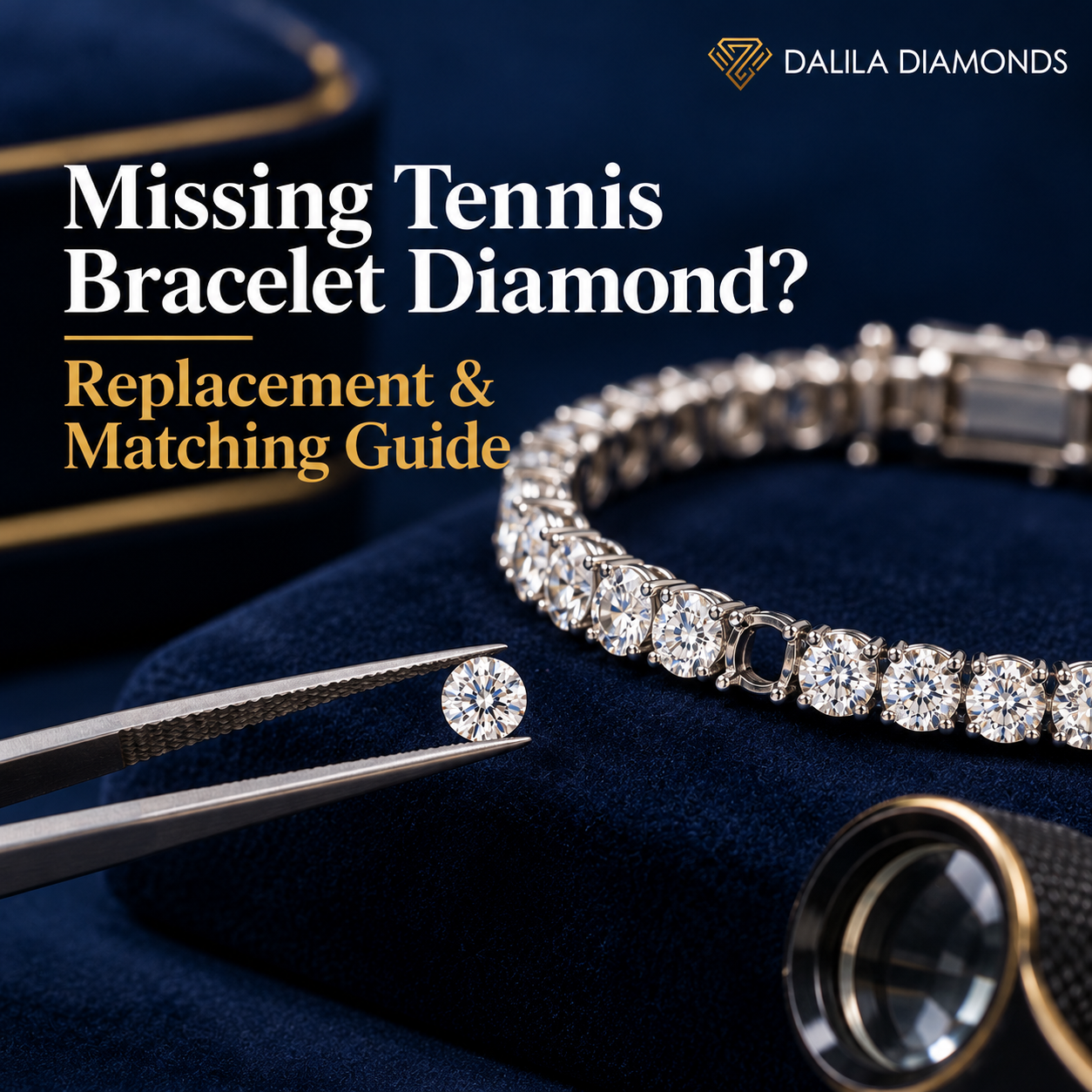
A missing diamond in a tennis bracelet can often be replaced without replacing the entire bracelet. However, a successful repair requires more than finding a loose diamond with approximately the same carat weight.
The replacement must match the neighbouring diamonds in size, colour, transparency and overall appearance. It must also fit securely in the original or repaired setting.
For example, if a natural diamond tennis bracelet contains round brilliant diamonds measuring approximately 2.5 mm, a missing stone may need to be replaced with another diamond of similar face-up dimensions.
But a diamond weighing approximately 0.06 carat does not automatically measure exactly 2.5 mm. Its actual diameter and depth depend on its cutting proportions.
There is also the question of why the original stone fell out.
A worn prong, damaged setting or distorted link may have caused the loss. Unless that problem is addressed, simply inserting a new diamond may not produce a secure repair.
The correct process is to inspect the bracelet, measure the surrounding stones, source a compatible replacement and have a qualified setter approve the finished work.
This guide explains each step, including how to prepare a replacement-diamond specification for a professional jeweller or natural diamond supplier.
Can a Missing Diamond in a Tennis Bracelet Be Replaced?
Yes. In many cases, a missing diamond can be replaced by a qualified jeweller.
The repair may involve sourcing one loose diamond, restoring the original mounting and setting the new stone.
However, the complexity depends on the condition of the bracelet.
Bracelet condition | Likely work required |
One diamond missing; setting undamaged | Confirm fit, source and set a replacement |
Missing stone with a bent prong | Repair prong, then fit the replacement |
Missing stone with broken retaining metal | Rebuild or replace the affected setting |
Several missing diamonds | Measure and source replacements for each position |
Damaged or distorted links | Repair bracelet structure before setting |
Graduated bracelet | Match the intended size for the specific position |
The jeweller should inspect the existing mounting before the customer purchases a replacement stone.
Not every missing diamond indicates the same repair problem.
What to Do Immediately When a Tennis Bracelet Diamond Falls Out
Stop wearing the bracelet until it has been examined.
The diamond may have fallen out because part of the setting was damaged. If the bracelet continues to be worn, adjacent stones may also be at risk.
If the missing diamond has been recovered, store it securely and take it to the jeweller.
Do not attempt to glue the diamond into place or bend the prongs at home.
Before arranging the repair:
Photograph the empty diamond setting.
Check whether the missing stone has been recovered.
Locate the original bracelet invoice or diamond specifications.
Identify whether the original diamonds are natural or laboratory-grown.
Ask a jeweller to inspect the empty setting and adjacent links.
Obtain the required replacement-diamond measurements.
These details will make the replacement search more accurate.
Step 1: Inspect the Empty Setting Before Selecting a Diamond
The first task is to understand the condition of the mounting.
A tennis bracelet consists of connected diamond-set elements. Each diamond must be retained securely while the bracelet remains flexible.
Depending on the design, the stones may be held by individual prongs, shared prongs, bezels or another type of setting.
If a prong has broken or worn away, the original seat may no longer hold a diamond safely.
The setter should determine whether the existing head can be reused or whether additional metalwork is required.
Setting inspection checklist
Component | What the jeweller should check |
Empty stone seat | Shape, dimensions and deformation |
Prongs | Broken, bent or worn metal |
Girdle support | Whether the diamond can be retained securely |
Adjacent diamonds | Loose or damaged neighbouring stones |
Bracelet links | Cracks, distortion or excess movement |
Metal condition | Wear and previous repairs |
Bezel, if applicable | Whether the retaining edge can be restored |
Setting height | Alignment with the surrounding diamonds |
Clasp and safety catch | General condition during repair inspection |
A replacement diamond should never be forced into an unsuitable mounting.
If the setting is damaged, the repair may require a new head or reconstruction of the original seat.
Step 2: Measure the Diamonds Beside the Missing Stone
For a conventional uniform tennis bracelet, the diamonds directly beside the empty setting provide useful size references.
Suppose the missing stone is position 24 in a bracelet containing 60 round brilliant diamonds.
The jeweller can examine stones 23 and 25 to establish the approximate intended size.
However, measuring one adjacent diamond is not always enough.
The two neighbouring stones may differ slightly. One might also have been replaced during an earlier repair.
Where appropriate, additional stones from the same section should be checked.
Illustrative measurement example
Measurement | Left diamond | Missing position | Right diamond |
Shape | Round | Round required | Round |
Minimum diameter | 2.48 mm | Unknown | 2.47 mm |
Maximum diameter | 2.52 mm | Unknown | 2.51 mm |
Average diameter | 2.50 mm | Approximately 2.5 mm target | 2.49 mm |
Colour appearance | Near-colourless | Must match | Near-colourless |
Transparency | Clear | Must match | Clear |
Girdle condition | Inspected | Replacement to be inspected | Inspected |
These measurements are hypothetical examples, not a completed repair or actual Dalila inventory.
The figures suggest that a replacement around 2.5 mm may be appropriate.
But the setter must establish the acceptable dimensional tolerance for the repaired head.
A nominal 2.5 mm stone is not automatically compatible.
What if the surrounding diamonds are already mounted?
A jeweller can measure some visible dimensions while stones remain set.
However, prongs or bezels may prevent direct access to the full girdle.
Total depth may also be difficult to measure accurately.
The professional should document which measurements are directly observed and which are estimates.
This is particularly important for a tight-fitting setting.
Step 3: Match Diamond Diameter Rather Than Carat Weight Alone
Small diamonds are commonly traded by millimetre size, carat points or calibrated size groups.
For a tennis bracelet repair, physical dimensions are particularly important.
A replacement must fit the specific opening while maintaining a consistent visible line.
Approximate small round diamond size chart
Round diamond diameter | Approximate carat weight | Approximate points |
1.5 mm | 0.015 ct | 1.5 |
1.8 mm | 0.025 ct | 2.5 |
2.0 mm | 0.030 ct | 3 |
2.2 mm | 0.040 ct | 4 |
2.5 mm | 0.060 ct | 6 |
2.8 mm | 0.080 ct | 8 |
3.0 mm | 0.100 ct | 10 |
3.5 mm | 0.160 ct | 16 |
These are approximate values for round brilliants. They are not exact conversion rules.
Two diamonds of identical carat weight may have slightly different diameters because of differences in total depth and cutting proportions.
Example: Comparing three six-point diamonds
Suppose the bracelet requires a replacement near 2.5 mm.
Candidate | Carat weight | Average diameter | Initial assessment |
A | 0.060 ct | 2.50 mm | Possible match |
B | 0.060 ct | 2.43 mm | May appear or fit smaller |
C | 0.060 ct | 2.56 mm | May be too large for original seat |
These are illustrative candidates, not measured commercial stock.
All three have the same weight.
But they do not have the same face-up dimensions.
The setter must determine which diameter and depth are acceptable.
For a broader technical reference, consult Dalila's existing Melee Diamond Size Chart: Sieve Sizes, Millimetres and Points.
Step 4: Match the Diamond's Colour
A tennis bracelet usually contains many diamonds placed close together.
A replacement that is noticeably warmer or cooler than its neighbours may stand out, even if it is correctly sized.
For example, a bracelet made with natural diamonds in the G–H colour range might look inconsistent if one replacement appears distinctly more yellow.
However, matching does not always require identical individual laboratory grades.
Small melee diamonds are often supplied according to commercial colour ranges rather than individual grading certificates.
The important consideration is whether the replacement looks compatible with the bracelet.
How to assess colour matching
The jeweller should compare the proposed replacement with the existing stones under suitable lighting.
The assessment should consider:
Face-up colour appearance.
Colour consistency with immediate neighbours.
The appearance of the broader diamond line.
Reflections from the surrounding metal.
Whether the stone appears different under ordinary viewing conditions.
A well-matched replacement should not create an unintended visible interruption.
Should the replacement always be G colour?
No.
If the original bracelet contains H–I natural diamonds, a visually compatible H or I stone may be more appropriate than selecting G colour automatically.
Likewise, choosing a higher colour grade does not guarantee that the replacement will blend better.
The objective is to match the existing bracelet.
Step 5: Match Clarity and Transparency
Clarity describes internal and external diamond characteristics, but its grading label does not completely describe visual appearance.
For a small tennis bracelet diamond, a carefully selected SI1 stone may look suitable beside VS diamonds.
Conversely, a stone with a higher clarity grade may still be a poor match if its cutting appearance or colour is inconsistent.
The replacement should not contain visually distracting characteristics or unacceptable damage.
Transparency is particularly important.
One cloudy or hazy diamond can interrupt the bright appearance of an otherwise well-matched bracelet.
Practical clarity comparison
Quality | What to look for |
VS1–VS2 | Useful conservative quality range |
SI1 | May be suitable when visually clean |
SI2 | Requires greater scrutiny of inclusions and transparency |
VVS | High clarity but not necessarily needed for visual matching |
Any grade | Reject unacceptable haze, damage or visible mismatch |
There is no universal clarity grade required for replacing one tennis bracelet stone.
The correct selection depends on the original bracelet's appearance and the agreed quality specification.
Step 6: Match Cut Quality and Sparkle
A replacement diamond can match the required diameter and colour yet still look different from neighbouring stones.
For example, it may have noticeably weaker brightness or a different facet pattern.
Small round brilliant diamonds vary in cutting proportions and optical performance.
In a tennis bracelet, those differences can be apparent because many stones repeat in a continuous line.
The selected replacement should be compared under the same viewing conditions as its neighbours.
What should be checked?
Property | Desired result |
Shape | Same intended outline |
Face-up size | Consistent with adjacent diamonds |
Brightness | No obvious dull area |
Transparency | No unacceptable haze |
Facet appearance | Compatible with surrounding stones |
Colour | No distracting difference |
Condition | No unacceptable chips or damage |
Mounting fit | Approved by the setter |
A grading label alone does not establish a good match.
The diamond's actual appearance is essential.
Step 7: Confirm the Replacement Is a Natural Diamond
If the bracelet was sold as a natural diamond tennis bracelet, the customer should request a natural replacement.
Natural and laboratory-grown diamonds can be visually similar.
In small melee sizes, ordinary visual examination alone may not reliably establish origin.
A supplier should therefore provide an appropriate declaration and explain what origin-verification evidence supports it.
Does a tiny replacement diamond need its own GIA certificate?
Not necessarily.
Many small diamonds used in tennis bracelets are supplied as calibrated melee without individual laboratory grading reports.
GIA, IGI and HRD offer various grading, analysis or identification services, but the available documentation depends on the particular stone, size and service.
For example, GIA's Melee Analysis Service screens eligible parcels of small diamonds for natural origin and related identification purposes.
That is different from an individual 4Cs grading report.
The buyer should not assume every tennis bracelet diamond has its own certificate.
Replacement documentation checklist
Document or information | Purpose |
Supplier stone reference | Identifies the supplied candidate |
Natural-origin declaration | Documents the material represented |
Actual diamond measurements | Confirms physical specifications |
Carat weight | Records the replacement's weight |
Colour and clarity description | Supports matching |
Screening evidence, if available | Supports natural-origin verification |
Supplier invoice | Provides transaction record |
Setter completion report | Documents the finished repair |
Any claim of laboratory verification should describe the actual service performed and the stone or parcel covered.
Step 8: Obtain Approval From the Jewellery Setter
A diamond supplier may identify a stone matching the requested specifications.
However, the supplier's selection does not automatically mean the stone can be safely fitted into the existing bracelet.
The setter must make that decision.
The jeweller should review the actual candidate against the original or repaired head.
Setter approval questions
Does the replacement fit the prepared seat?
The jeweller should assess the diamond's diameter, depth and girdle geometry.
Is the retaining metal sufficient?
Prongs or bezels must provide appropriate support.
Does the stone sit at the right height?
A replacement that sits noticeably higher or lower may interrupt the appearance of the bracelet.
Are neighbouring diamonds secure?
An isolated replacement should not ignore adjacent mounting problems.
Does the bracelet remain flexible?
The repaired link must articulate as intended.
Only after those checks should the jewellery repair be completed.
Step 9: Prepare a Complete Setter Handoff Document
A precise handoff helps avoid misunderstandings between the diamond supplier, customer and repair jeweller.
The document should identify the missing position, the proposed replacement and the approval requirements.
Example replacement-diamond handoff
Field | Specification |
Jewellery | Natural diamond tennis bracelet |
Missing stone position | 24 |
Shape | Round brilliant |
Target diameter | Approximately 2.50 mm |
Approved diameter tolerance | Setter to confirm |
Target carat weight | Approximately 0.06 ct |
Colour | Match existing near-colourless diamonds |
Clarity | VS–SI, subject to appearance |
Transparency | Clear, no unacceptable haze |
Natural origin | Required |
Girdle condition | Suitable for mounting |
Setting type | Prong |
Existing seat condition | To be documented |
Prong repair | To be confirmed |
Replacement candidate reference | ______ |
Setter approval | Pending |
Final visual inspection | Pending |
This is an illustrative repair handoff, not a completed Dalila service record.
The precise tolerance and replacement selection must be confirmed by the jeweller.
Worked Example: Replacing a Missing 2.5 mm Diamond
Consider a hypothetical natural diamond tennis bracelet made in 18K white gold.
The bracelet contains 58 round brilliant diamonds with an average diameter near 2.5 mm.
One diamond is missing near the middle of the bracelet.
Original bracelet specifications
Characteristic | Information |
Metal | 18K white gold |
Diamond type | Natural |
Number originally set | 58 |
Shape | Round brilliant |
Approximate diamond diameter | 2.5 mm |
Colour | G–H |
Clarity | VS–SI |
Setting | Four-prong |
Missing diamonds | One |
Initial inspection
The jeweller measures the adjacent stones.
One measures approximately 2.48–2.52 mm.
The other measures approximately 2.47–2.51 mm.
The missing seat is inspected, and one worn prong is identified.
The jeweller concludes that the prong needs repair before a replacement can be set.
Replacement specification
The supplier is asked to identify one natural round brilliant diamond within the dimensions approved by the setter.
The stone should have colour and brightness consistent with the surrounding diamonds.
A candidate is inspected for transparency, girdle condition and actual measurements.
Final repair
Once the setter approves the candidate, the jeweller repairs the retaining metal and sets the stone.
The repaired bracelet is inspected to confirm:
The diamond is secure.
Its height and alignment are appropriate.
The colour and brightness match sufficiently.
Adjacent stones remain secure.
The bracelet's links move normally.
The customer receives the completed bracelet and appropriate repair documentation.
This example demonstrates the workflow only. It is not a claim that Dalila has completed such a repair.
What if the Bracelet Has Graduated Diamonds?
A graduated tennis bracelet contains deliberately different diamond sizes.
The largest stones may sit near the centre, with smaller diamonds towards the ends.
In this situation, the missing stone may not match either immediate neighbour exactly.
For example, consider this hypothetical sequence:
2.3 mm → 2.5 mm → 2.7 mm → missing → 3.1 mm.
The missing stone might originally have measured approximately 2.9 mm, but the correct size cannot be confirmed by averaging alone.
The jeweller should inspect the full progression.
If the design is symmetrical, the corresponding position on the opposite side may provide a useful reference.
The replacement should preserve the planned size transition.
Graduated replacement checklist
Question | Why it matters |
What is the missing position? | Identifies the design group |
Is the bracelet symmetrical? | May provide a corresponding reference |
What are the neighbouring sizes? | Helps establish intended progression |
What size is the opposite stone? | May clarify the original specification |
Does the setting differ at this position? | Determines actual fit |
What is the intended visual transition? | Avoids an obvious mismatch |
A graduated design should not be repaired using a generic uniform-bracelet size assumption.
What if Two or More Tennis Bracelet Diamonds Are Missing?
The process becomes more involved because each empty position must be assessed.
If the bracelet is uniform, similar replacement stones may be appropriate.
If the bracelet is graduated, each position may require a different size.
The jeweller should also investigate whether the missing stones resulted from related structural problems.
Multiple replacement example
Missing position | Shape | Required diameter | Setting condition |
12 | Round brilliant | 2.50 mm target | Inspection required |
24 | Round brilliant | 2.50 mm target | Prong repair required |
25 | Round brilliant | 2.50 mm target | Inspection required |
These are hypothetical specifications.
A replacement parcel should not be ordered until the jeweller confirms each position's requirements.
How Much Does Replacing a Tennis Bracelet Diamond Cost?
The total price depends on the replacement diamond and the jewellery repair work.
The loose diamond price is only one component.
The jeweller may need to repair a prong, rebuild a head or fix a damaged link.
There may also be sourcing charges, shipping, insurance or taxes.
Repair cost breakdown
Cost component | Description |
Replacement natural diamond | Price of the identified stone |
Sourcing charge | If applicable |
Origin-screening or documentation cost | If separately charged |
Bracelet inspection | Jeweller's assessment |
Prong repair | Repair of worn or damaged retaining metal |
Head replacement | If original setting cannot be reused |
Stone-setting labour | Professional setting service |
Adjacent stone inspection | Security checks |
Finishing and cleaning | As agreed |
Shipping and insurance | Where required |
Taxes | Applicable amount |
There is no reliable universal repair price without knowing the actual stone and the condition of the setting.
A supplier quotation for one loose diamond is not an all-inclusive bracelet repair quotation.
Can You Buy Only One Natural Diamond for a Bracelet Repair?
Possibly.
However, many smaller natural diamonds are traded in calibrated parcels, and some suppliers impose minimum quantities or order values.
A supplier may not always offer single-stone orders.
The availability of a precise size and colour match may also depend on current inventory.
Before purchasing, confirm:
Whether a single natural melee diamond can be supplied.
The minimum order quantity or value.
The available calibrated diameter range.
The natural-origin documentation.
The supplier's return and inspection conditions.
Whether your jeweller accepts an externally sourced diamond.
For some customers, sourcing through the repairing jeweller may be simpler because the jeweller can assess fit and appearance directly.
Can Dalila Diamonds Source a Missing Tennis Bracelet Diamond?
Dalila Diamonds specialises in natural loose-diamond sourcing and publishes guidance about melee diamond sizes and calibrated stones.
However, the availability of a single-stone tennis bracelet replacement service has not been confirmed.
Before describing this as a Dalila service, the company should confirm whether it accepts individual replacement enquiries and what minimum order conditions apply.
Dalila should also confirm whether it can provide a suitable natural-origin declaration and any available screening evidence for the stone.
A separate qualified jeweller should be responsible for inspecting and repairing the bracelet unless Dalila expressly confirms it provides that work.
Example sourcing enquiry
Required diamond: One natural round brilliant.
Intended use: Replacement for a missing stone in an existing tennis bracelet.
Target diameter: Approximately 2.50 mm, subject to setter-approved tolerance.
Target weight: Approximately 0.06 carat.
Colour: Compatible with existing G–H diamonds.
Clarity: VS–SI, subject to actual transparency and visual appearance.
Girdle condition: Suitable for setting.
Documentation: Natural-origin declaration and agreed supporting evidence.
Quantity: One, subject to supplier terms.
Setting work: To be completed by an independent qualified jeweller.
Budget: To be confirmed.
This is a sample specification, not an offer of available inventory.
Replacement Stone Sourcing Worksheet
Existing bracelet information
Field | Details |
Original seller | ______ |
Metal and purity | ______ |
Diamond origin | Natural / Unconfirmed |
Diamond shape | ______ |
Bracelet length | ______ |
Original diamond count | ______ |
Missing position | ______ |
Uniform or graduated layout | ______ |
Setting style | ______ |
Existing colour range | ______ |
Existing clarity range | ______ |
Original documentation | ______ |
Measurement details
Field | Details |
Left adjacent diamond | ______ mm |
Right adjacent diamond | ______ mm |
Other reference stones | ______ mm |
Opposite stone in graduated design | ______ mm |
Target replacement diameter | ______ mm |
Accepted tolerance | ______ mm |
Required depth/girdle details | ______ |
Empty-seat condition | ______ |
Prong repair required | Yes / No |
Setter name | ______ |
Replacement candidate details
Field | Details |
Supplier | ______ |
Stock reference | ______ |
Natural-origin declaration | ______ |
Shape | ______ |
Minimum diameter | ______ mm |
Maximum diameter | ______ mm |
Carat weight | ______ |
Colour appearance | ______ |
Clarity appearance | ______ |
Transparency | ______ |
Cut appearance | ______ |
Girdle condition | ______ |
Price | ______ |
Availability | ______ |
Return conditions | ______ |
Final setter handoff
Check | Status |
Empty seat inspected | Pending / Complete |
Prongs or bezel repaired if needed | Pending / Complete |
Replacement dimensions approved | Pending / Approved |
Replacement appearance approved | Pending / Approved |
Natural-origin evidence reviewed | Pending / Complete |
Diamond securely set | Pending / Complete |
Adjacent diamonds inspected | Pending / Complete |
Link movement checked | Pending / Complete |
Final visual match accepted | Pending / Approved |
Repair documentation issued | Pending / Complete |
The supplier and setter should use the same approved measurements to avoid ordering a stone that cannot be fitted.
Common Mistakes When Replacing a Missing Tennis Bracelet Diamond
Choosing by carat weight alone
The replacement may have the wrong diameter or depth even when its weight is correct.
Measuring only the empty setting
The seat may be damaged and no longer represent the original dimensions.
Ignoring neighbouring diamonds
Their measurements and appearance provide important matching references.
Choosing the highest clarity grade regardless of appearance
The new diamond should blend into the bracelet, not simply have the highest grade.
Ignoring transparency
A hazy diamond can appear noticeably dull compared with adjacent stones.
Assuming the replacement is natural based on appearance
Appropriate origin documentation should be obtained.
Skipping the prong or bezel inspection
The original setting may have caused the diamond to fall out.
Using a replacement outside the jeweller's approved tolerance
An incorrectly sized stone can create setting-security problems.
Assuming a diamond supplier will complete the repair
Loose-diamond sourcing and finished-jewellery repair are separate services.
Wearing the bracelet before the replacement is secured
The empty or damaged setting may put neighbouring stones at risk.
Frequently Asked Questions
Can a missing diamond in a tennis bracelet be replaced?
Yes, in many cases. A jeweller should first inspect the empty setting and then approve a suitable replacement diamond.
Can I replace just one tennis bracelet diamond?
Potentially. A single stone can be replaced if a suitable diamond is available and the setting can be repaired or reused safely.
How do I find the right size replacement?
Ask a jeweller to measure the neighbouring stones and inspect the empty head. Use the setter's approved dimensions.
Is a 2.5 mm diamond the same as 0.06 carat?
Not exactly. Around 0.06 carat is a useful round-brilliant reference, but actual millimetre dimensions vary.
What if the new diamond is slightly smaller?
A smaller stone may create a visible gap or unsuitable setting fit. The jeweller must determine whether it can be used safely.
What if the replacement diamond is too large?
It may fail to seat correctly or require a new setting. It should not be forced into the existing head.
Does the replacement need the same clarity grade?
Not necessarily an identical grade, but the diamond should have a compatible appearance, transparency and quality.
Can an SI1 diamond replace a VS2 diamond?
Possibly, if the SI1 diamond looks appropriate and satisfies the agreed quality and setting requirements.
Does the replacement need to be the same colour?
It should appear consistent with adjacent stones. Identical colour-grade letters are not always essential.
Why might a replacement diamond sparkle differently?
Cut proportions, transparency, facet appearance and other characteristics may affect its visible brightness.
Do small replacement diamonds come with GIA reports?
Not always. Many small diamonds are sold as calibrated melee without individual grading reports.
How do I verify that the replacement is natural?
Request a natural-origin declaration and information about any relevant screening or testing evidence.
Can a jeweller replace a diamond in a bezel tennis bracelet?
Potentially. The bezel must be inspected and may require repair or reconstruction.
Why did my tennis bracelet diamond fall out?
Possible reasons include worn prongs, damaged settings, impacts or manufacturing issues. Only a professional inspection can identify the likely cause.
Should the entire bracelet be inspected?
Yes. A qualified jeweller should examine neighbouring settings and the bracelet's general condition.
What if several diamonds are missing?
Each position should be measured and assessed. A uniform or graduated layout may require different replacement specifications.
How much does replacing a tennis bracelet diamond cost?
It depends on the diamond and the repair work. Request separate quotations for the replacement stone, setting repair, labour and additional charges.
Can I supply my own diamond to the jeweller?
Some jewellers accept externally sourced stones, while others have specific restrictions or liability terms. Confirm before purchasing.
Does Dalila sell single natural diamonds for bracelet repairs?
This service has not been confirmed. Dalila should verify single-stone availability, minimum order requirements and documentation before accepting enquiries.
Does Dalila repair tennis bracelets?
Finished bracelet repair has not been verified as a Dalila service. Do not assume a loose-diamond supplier will perform the setting work.
What should I send when requesting a replacement natural diamond?
Provide the jeweller-approved dimensions, shape, quality requirements, photographs, missing position, natural-origin requirements, quantity and budget.
Final Checklist: Replace the Stone, Restore the Setting, Verify the Bracelet
A tennis bracelet repair should restore both appearance and security.
The replacement needs to fit the prepared seat, blend with the neighbouring diamonds and satisfy the original jewellery's natural-diamond specification.
The setting must be inspected and repaired where necessary.
The final bracelet should be checked for secure stones, consistent appearance and normal movement.
The safest sequence is: inspect the setting → measure neighbouring diamonds → select a compatible natural replacement → obtain setter approval → complete and inspect the repair.
For a sourcing enquiry, begin with the actual millimetre measurements rather than a carat-weight estimate alone.