What Diamond Quality Matters in a Tennis Bracelet? Colour, Clarity and Matching Explained
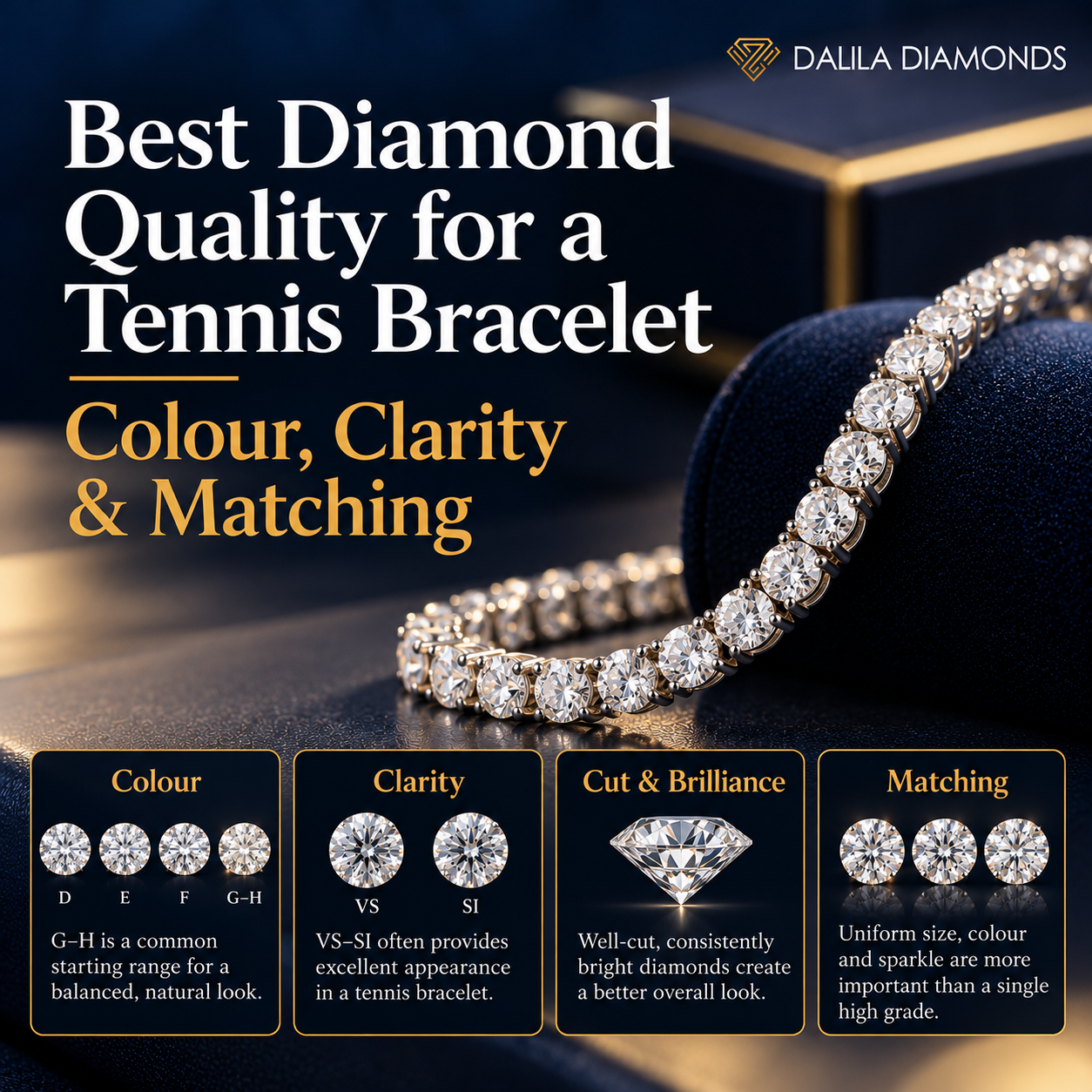
The best diamond quality for a natural diamond tennis bracelet is not necessarily the highest colour and clarity grade available. What matters most is how consistently the diamonds look together across the entire bracelet.
A tennis bracelet may contain 40, 50, 60 or more small diamonds arranged in a continuous line. Because the stones sit next to one another, differences in diameter, colour, brightness and transparency can become noticeable.
For example, a bracelet made with 55 natural round brilliant diamonds in the G–H colour and VS–SI clarity ranges may look more balanced than another bracelet advertised with a higher average grade but containing visibly different diamond sizes or poorly matched stones.
The important distinction is between the quality of one diamond and the consistency of the complete group.
For many natural diamond tennis bracelets, G–H colour and carefully selected VS–SI clarity provide useful starting specifications, but diameter matching, attractive cut appearance, transparency and verified natural origin are equally important.
A buyer should not assume that every small diamond needs its own GIA, IGI or HRD laboratory report. In commercial tennis-bracelet production, the diamonds are often sourced as calibrated parcels, with grading ranges, quality checks and origin documentation agreed at parcel or product level.
This guide explains how to assess natural diamond quality specifically for tennis bracelets, what buyers should ask about and which specifications are worth prioritising.
What Is the Best Diamond Quality for a Tennis Bracelet?
For a conventional single-row natural round brilliant tennis bracelet, a practical starting specification is:
Characteristic | Useful starting requirement | Why it matters |
Diamond origin | Natural, supported by an appropriate verification process | Establishes what is being purchased |
Colour | G–H, with other ranges considered according to budget | Helps create a consistent face-up appearance |
Clarity | VS–SI, with no unacceptable visible inclusions or haze | Balances appearance and cost |
Diamond shape | Round brilliant for a classic design | Supports a consistent repeating outline |
Diameter | Calibrated to the manufacturer's setting requirements | Maintains an even diamond line |
Cut appearance | Similar brightness and facet appearance | Reduces alternating bright and dull stones |
Transparency | No unacceptable cloudy or milky stones | Preserves a crisp appearance |
Girdle and condition | Suitable for the intended mounting | Supports setting security |
Documentation | Clear parcel or product-level specification | Makes the purchase verifiable |
These are starting points rather than universal minimum grades.
A well-matched I–J colour bracelet may be attractive, particularly if the buyer prefers a warmer appearance or a particular yellow-gold design.
Similarly, an SI2 diamond may be acceptable in some smaller-stone bracelets if its clarity characteristics do not compromise appearance, transparency or setting suitability.
However, an average colour or clarity description does not guarantee that every individual stone meets the same standard.
The buyer should ask how the supplier defines the grade range and how outliers are identified.
Why Quality Works Differently in a Tennis Bracelet
A solitaire pendant has one centre diamond.
Diamond stud earrings usually contain two stones that must look compatible as a pair.
A tennis bracelet may contain dozens of diamonds that repeat around the wrist.
That repetition changes the buying decision.
A slight difference in one diamond's diameter can interrupt the line.
One noticeably warm stone can stand out among near-colourless neighbours.
A cloudy diamond can create a dull patch in an otherwise bright bracelet.
A diamond with a chipped girdle may be difficult to set securely.
This means the bracelet needs both acceptable individual diamonds and a consistent collection of stones.
GIA's educational material on melee diamonds emphasises how size calibration, colour consistency and setting workmanship influence jewellery containing many small diamonds.
Individual grade versus group appearance
Quality question | One solitaire diamond | Tennis bracelet |
Is the colour attractive? | Assess one stone | Assess consistency across all stones |
Are inclusions acceptable? | Inspect one stone | Check for visible outliers and transparency problems |
Is the cut attractive? | Evaluate one cutting pattern | Compare brightness and facet appearance across the line |
Are the dimensions suitable? | Match one mounting | Match many repeated seats and links |
Is the origin documented? | Check the stone's evidence | Establish an appropriate parcel or product-level verification process |
Is the setting secure? | Inspect one head | Inspect every diamond-set link |
The highest reported grade is not necessarily the most useful buying criterion.
The finished bracelet should be visually consistent, physically sound and accurately represented.
Diamond Colour: Is G–H Good for a Tennis Bracelet?
Yes. G–H colour is a useful starting range for a natural diamond tennis bracelet.
Both grades fall within GIA's near-colourless category and can create a relatively white-looking diamond line.
However, consistency may matter more than choosing the highest possible average colour grade.
Suppose a bracelet contains 55 stones.
Fifty-four appear relatively white, but one is noticeably warmer.
That single stone may create an obvious colour interruption when viewed beside the others.
By contrast, a bracelet containing consistently matched H–I diamonds may have a more harmonious overall appearance.
Comparing colour ranges
Colour specification | General buying consideration |
D–F | Premium colourless grades, potentially more expensive |
G–H | Strong starting point for a near-colourless appearance |
H–I | May offer good value when visually consistent |
I–J | Worth considering if the warmth suits the buyer and design |
Wider mixed ranges | Require particular attention to visible colour outliers |
These categories describe possible buying strategies, not a guarantee about the appearance of particular parcels.
Different cutting proportions and lighting conditions can influence face-up colour appearance.
Does yellow gold allow lower diamond colour grades?
Yellow gold may create warmer surrounding reflections than white gold or platinum.
Some buyers therefore find H–J stones attractive in yellow-gold bracelets.
However, the metal does not change the diamond's intrinsic colour.
A visibly warm outlier can still stand out among more colourless neighbours.
The correct objective is a consistent diamond line in the intended metal rather than assuming yellow gold hides every colour difference.
How to Check Colour Matching Across a Bracelet
A useful colour assessment should examine the stones together, not only their individual descriptions.
The jeweller or supplier should compare the diamonds under controlled lighting, using an appropriate neutral background before they are set where practical.
For a finished bracelet, inspect the complete line under more than one lighting environment.
The reviewer should look for abrupt changes in perceived body colour.
For example, a bracelet described as G–H colour should not contain an unexplained stone that appears distinctly yellow compared with its neighbours.
Recommended visual checks
Whole-line comparison: Inspect the entire bracelet rather than only a small section.
Adjacent-stone comparison: Look for stones that appear noticeably warmer or cooler than their immediate neighbours.
Alternate lighting: Compare the bracelet under suitable neutral and ordinary viewing conditions.
Metal-context check: Review the stones in the intended finished metal where possible.
The goal is not to eliminate every microscopic difference.
Natural diamonds are individual stones, and minor variations may be acceptable.
The goal is to avoid unintended differences that disrupt the bracelet's appearance.
What Clarity Grade Is Best for a Diamond Tennis Bracelet?
VS1–VS2 and carefully selected SI1 diamonds are useful starting points.
SI2 diamonds may also be considered in some designs, but they require closer attention to actual clarity characteristics and transparency.
For small diamonds, some inclusions may be difficult to recognise with the unaided eye.
However, the size of a diamond does not automatically make every inclusion unimportant.
A dark crystal can still be visually distracting.
Clouds or other characteristics may affect transparency.
A feather or damage near the girdle can require special setting assessment.
Clarity comparison for tennis bracelets
Clarity range | Buying consideration |
VVS | Very high laboratory clarity; often unnecessary purely for unaided-eye appearance |
VS1–VS2 | Useful conservative starting point for visually clean stones |
SI1 | Can offer good value when appearance and transparency are acceptable |
SI2 | Requires careful assessment of inclusions and transparency |
Lower clarity ranges | Must be judged against the actual quality, size and design requirements |
A higher clarity grade may be desirable for commercial positioning, gifting or personal preference.
But buyers should not assume that a VVS bracelet automatically looks more brilliant than a well-cut, consistently matched VS–SI bracelet.
Eye-clean is not an official clarity grade
The term eye-clean describes appearance under stated viewing conditions.
It is not a substitute for a formal laboratory clarity grade.
For a tennis bracelet, the supplier should explain what level of inclusion visibility is considered acceptable.
That could include checking for distracting inclusions at normal viewing distance as well as a professional inspection of the loose stones.
No universal eye-clean distance or SI clarity threshold applies to every bracelet.
Transparency: The Quality Problem Buyers Often Overlook
Two diamonds with similar carat, colour and clarity descriptions can look different in brightness.
One may appear clear and lively.
Another may seem hazy, dull or milky.
The cause can vary, and should not be assumed from a single photograph or grade label.
For tennis bracelets, transparency concerns are particularly important because one dull stone may create an interruption in an otherwise bright line.
Example: Two hypothetical 2.5 mm diamonds
Characteristic | Diamond A | Diamond B |
Approximate diameter | 2.5 mm | 2.5 mm |
Stated colour range | G–H | G–H |
Stated clarity range | SI | SI |
Face-up transparency | Crisp appearance | Noticeably hazy appearance |
Bracelet suitability | Candidate for inspection | Needs further evaluation |
The example is illustrative, not an assessment of actual Dalila inventory.
Matching the grade labels does not settle whether the two stones belong in the same finished bracelet.
The actual appearance should be reviewed.
Cut Quality: Why Some Tennis Bracelets Look Brighter Than Others
A classic tennis bracelet contains a repeating line of diamonds, often round brilliants.
Ideally, the stones show reasonably consistent brightness and facet appearance.
However, small natural diamonds are not always accompanied by individual cut-grade reports.
Suppliers and manufacturers often evaluate their general make, proportions, face-up brightness and parcel consistency instead.
What poor cut matching can look like
Suppose a bracelet contains 60 round brilliant diamonds.
Most show an attractive, consistent pattern of reflections.
However, several stones are noticeably darker or have much smaller face-up diameters despite similar weight.
The bracelet may appear less uniform.
This is not necessarily caused by differences in colour or clarity.
The problem may involve proportions, transparency, facet arrangement or other stone characteristics.
What should be checked?
Cut-related factor | Why it matters |
Face-up diameter | Determines the apparent size of each stone |
General cut proportions | Influence how weight is distributed |
Symmetry and outline | Help create a consistent row |
Brightness | Reduces dull-looking interruptions |
Facet pattern | Supports coordinated visual character |
Polish condition | Can affect surface appearance |
Girdle profile | Influences setting fit and potential vulnerability |
Do not assume that every small diamond has a GIA Excellent cut grade.
An appropriate quality specification for a melee parcel may instead describe calibrated dimensions, acceptable make, face-up appearance and the supplier's agreed inspection criteria.
Diamond Diameter Matching: Why Millimetres Matter
The individual diamond diameter is one of the most important practical quality characteristics in a tennis bracelet.
Carat weight measures mass.
Diameter determines how the diamond fits a prepared setting and how large it looks face-up.
Two diamonds with similar carat weights may have different face-up diameters because of their cutting proportions.
For example, a jeweller manufacturing a bracelet with nominally 2.5 mm diamonds needs the actual stones to fit the designed seats.
A 2.3 mm diamond may create a visible interruption or unsuitable fit.
A 2.7 mm diamond may require a different setting dimension.
The allowable size range must be specified by the manufacturer.
Calibrated parcel example
Specification | Hypothetical order |
Jewellery | Natural round diamond tennis bracelet |
Target diameter | 2.50 mm |
Illustrative acceptance range | 2.45–2.55 mm |
Diamond count | 58 |
Colour | G–H |
Clarity | VS–SI |
Cut appearance | Consistent, attractive make |
Girdle condition | Suitable for setting |
Origin | Natural, verified under agreed protocol |
The 2.45–2.55 mm range is an example contractual tolerance, not a universal standard.
Another manufacturing design may require a narrower or wider range.
The supplier and jeweller should agree on tolerances before placing the order.
GIA has explained that differences as small as 0.20 mm in melee size can be noticeable in jewellery intended to have a uniform appearance.
Does Total Carat Weight Prove Diamond Quality?
No.
Total carat weight describes the combined diamond mass, not the quality of the individual stones.
For example, two bracelets may both contain 3.00 carats of natural diamonds.
One might have carefully matched G–H stones with consistent brightness.
The other might have visible colour outliers, irregular diameter matching or dull stones.
Both could still satisfy the same total carat weight description.
The specifications should be separated
Information | What it establishes |
Total carat weight | Total diamond mass |
Stone count | Number of diamonds |
Average individual carat weight | Average mass per diamond |
Individual diameter range | Physical size consistency |
Colour range | Colour specification |
Clarity range | Inclusion-related specification |
Visual matching | How consistently the stones appear |
Origin verification | Support for the natural-diamond claim |
Setting inspection | Suitability of the manufactured bracelet |
A buyer should not treat a larger total weight as evidence of higher diamond quality.
For a full explanation, see Dalila's Tennis Bracelet Total Carat Weight guide at /blogs/tennis-bracelet-total-carat-weight.
For how the number of stones is calculated, see /blogs/how-many-diamonds-tennis-bracelet.
Natural Diamond Verification: Can Every Bracelet Stone Be Certified?
A natural diamond tennis bracelet may contain dozens of small diamonds.
It is not realistic to assume that every stone necessarily comes with a separate GIA, IGI or HRD diamond grading report.
Instead, many commercial melee parcels are supplied with agreed colour, clarity, diameter and origin specifications.
Individual laboratory reports are more common for larger separately traded diamonds.
For smaller stones, parcel-level documentation and screening processes may be used.
However, a supplier's statement that the parcel is natural should be supported by an appropriate verification process.
Why natural-origin screening matters
Natural and laboratory-grown diamonds can have the same fundamental chemical composition and crystal structure.
For small diamonds, visual inspection alone may not establish origin reliably.
GIA offers a Melee Analysis Service designed to screen small diamonds and separate natural diamonds from laboratory-grown diamonds, simulants and stones requiring further examination.
The service applies to specified sizes and submission conditions.
It is not the same as receiving an individual 4Cs grading report for every bracelet diamond.
What to request from a supplier
Ask for:
A clear declaration that the supplied diamonds are natural.
Parcel identity and supplier reference.
Confirmed quantity and combined weight.
Diameter or calibrated size range.
Agreed colour and clarity ranges.
Description of the origin-screening protocol used.
Screening or laboratory documentation where available.
A defined process for referred or inconclusive stones.
Commercial acceptance and replacement terms.
A general product description should not imply individual certified grading when no individual grading reports exist.
Natural-origin verification, diamond grading and manufacturing quality control are three different processes.
Each answers a different question.
Real-World Reference: Why Melee Matching Matters
GIA's educational article Melee: Building Blocks of Contemporary Design provides an example of an 18K white-gold bracelet containing approximately 791 round melee diamonds with a combined weight of about 9.50 carats.
The example demonstrates how a design can rely on hundreds of small stones to create a continuous sparkling surface.
GIA specifically highlights the importance of colour matching and consistent sizing when many melee diamonds appear together.
That bracelet is not a conventional single-row tennis bracelet, but the same visual principle applies.
The more often a stone size, colour or light-performance characteristic repeats, the more important the group's consistency becomes.
A buyer should therefore assess the bracelet as a continuous line, not simply as a collection of independent stones.
Worked Example: Two Parcels for a 3-Carat Tennis Bracelet
Suppose a jeweller needs approximately 60 natural round brilliant diamonds for a new tennis bracelet.
The jeweller has established an intended 2.5 mm stone size and confirmed the final count from the bracelet design.
Two hypothetical parcels are offered.
Specification | Parcel A | Parcel B |
Diamond count | 60 | 60 |
Total carat weight | Approximately 3.00 ct | Approximately 3.00 ct |
Target diameter | 2.5 mm | 2.5 mm |
Actual diameter matching | Tight, consistent range | Several obvious outliers |
Colour specification | G–H | F–H average |
Visible colour consistency | Good | Some noticeably warmer stones |
Clarity specification | VS–SI | VS |
Transparency | Consistent | Several hazy stones |
Face-up brightness | Relatively consistent | Uneven appearance |
Natural origin documentation | To verify | To verify |
Final approval | Pending | Pending |
Both parcels are hypothetical, not real inventory or laboratory-assessed samples.
On headline grades alone, Parcel B might appear attractive because it includes a higher colour category and VS clarity.
However, its visible inconsistencies could make it a weaker production choice.
Parcel A may provide the more uniform bracelet if the stones meet the jeweller's actual dimensional, appearance and origin-verification requirements.
The lesson is not that G–H/VS–SI always beats F–H/VS.
The lesson is that a broad average grade does not replace actual parcel matching.
What should the buyer do?
The buyer should request a representative visual comparison of the two parcels and review the manufacturer's acceptance criteria.
If a parcel contains identifiable outliers, ask whether they can be replaced or whether the parcel should be rejected.
The commercial terms should establish what happens when a parcel fails inspection.
The detailed receiving and rejection procedure belongs in Dalila's existing Diamond Parcel Quality-Control Checklist.
How to Inspect the Quality of a Finished Tennis Bracelet
A completed bracelet should be examined both visually and structurally.
The buyer can make an initial appearance comparison, while a qualified jeweller checks the diamond settings and clasp.
Face-up appearance
Inspect the bracelet in a straightened position under suitable lighting.
Look for abrupt changes in stone size, apparent colour or brightness.
The stones should create the intended continuous appearance.
Normal viewing distance
Examine the bracelet as it would be worn.
This helps determine whether differences noticeable under magnification are important to the overall appearance.
Close inspection
A qualified professional should check for chips, broken or loose stones, unsuitable prong contact and other setting-related concerns.
Movement and flexibility
The articulated links should move as intended without binding.
The jeweller should also examine the clasp and safety mechanism.
The diamond quality and the bracelet's manufacturing quality are separate considerations, but both influence the value and usability of the finished piece.
Quality Requirements for Different Bracelet Budgets
A higher budget can allow stricter grading preferences, but it does not automatically produce better overall matching.
The buyer should first establish the desired stone size and finished construction.
Then compare the quality specifications.
Buying approach | Colour | Clarity | Main priority |
Premium grade-focused | D–F | VS–VVS | Higher documented quality ranges |
Balanced natural diamond | G–H | VS–SI | Good overall appearance and consistency |
Value-oriented | H–J | Selected SI | Acceptable visual warmth and transparency |
Custom production-focused | Agreed range | Agreed range | Tight calibration and consistent make |
These are illustrative purchase strategies, not defined industry categories.
A value-oriented bracelet should still meet acceptable setting, transparency and origin-verification requirements.
A premium bracelet should still be checked for diameter and brightness consistency.
Paying for high nominal grades does not excuse poor matching.
What to Ask Before Buying a Natural Diamond Tennis Bracelet
A useful product listing or quotation should provide enough information to assess the entire bracelet.
Question | Required information |
Are the diamonds natural? | Clear origin declaration and supporting process |
How many diamonds are included? | Exact count |
What is the total diamond weight? | Actual or stated TCW with any tolerance |
How large are the individual stones? | Calibrated diameter or size range |
What colour are the diamonds? | Defined range, not vague promotional wording |
What clarity are the diamonds? | Defined range and applicable inspection basis |
Are the diamonds visually matched? | Supplier's quality-control criteria |
Are they individually certified? | Clarify whether reports exist for any individual stones |
How was origin checked? | Screening method and supporting documentation |
What is the bracelet length? | Finished length |
What is the setting? | Prong, bezel or other |
What metal is used? | Alloy and purity |
How is the clasp secured? | Clasp and safety specification |
What happens if quality differs? | Acceptance, return or remedy terms |
The buyer should not accept an unsupported claim that every diamond is of identical quality.
Instead, ask how consistency is checked and what variation is allowed.
Sourcing Natural Diamonds for a Tennis Bracelet
When sourcing loose natural diamonds for tennis-bracelet production, the manufacturer should provide the required calibrated size, quantity and acceptable quality variation.
A request for "three carats of G–H diamonds" is incomplete if the setting requires a specific number of stones of a specific diameter.
For example, a manufacturing order may call for 58 round brilliant diamonds between agreed diameters.
The combined weight should then be verified from the stones actually supplied.
Example sourcing specification
Field | Requirement |
Jewellery | Natural diamond tennis bracelet |
Diamond shape | Round brilliant |
Origin | Natural, with agreed verification |
Target diameter | 2.50 mm |
Acceptance tolerance | Jeweller to specify |
Required count | 58, illustrative |
Spare stones | Separately agreed |
Colour | G–H |
Clarity | VS–SI |
Transparency | No unacceptable haze |
Cut appearance | Consistent face-up make and brightness |
Girdle condition | Suitable for the intended seats |
Total carat weight | Actual parcel weight to be confirmed |
Screening | Agreed natural-origin protocol |
Documentation | Parcel and screening evidence as available |
Inspection | Defined acceptance process |
This is a hypothetical production brief, not a claim of current Dalila stock.
What Dalila can help source
Dalila Diamonds accepts enquiries for natural loose diamonds and specification-driven supply.
For a tennis bracelet, a qualified enquiry should specify calibrated dimensions, diamond count, colour, clarity, cut appearance, natural origin and manufacturing requirements.
Whether a particular matched melee parcel is currently available, and which screening services or documentation can be supplied, must be confirmed in the quotation.
A loose-diamond enquiry should not be described as a promise to manufacture a complete tennis bracelet.
The jewellery manufacturer remains responsible for final setting compatibility, workmanship, clasp construction and the finished bracelet.
A Practical Tennis Bracelet Quality Worksheet
Quality check | Requirement | Result |
Natural origin | Verified under agreed protocol | ______ |
Diamond count | Manufacturer-approved count | ______ |
Total weight | Reconciled with supplied stones | ______ |
Calibrated diameter | Within specified tolerance | ______ |
Colour continuity | No unacceptable outliers | ______ |
Clarity appearance | No distracting stones | ______ |
Transparency | No unacceptable haze | ______ |
Cut appearance | Consistent brightness and make | ______ |
Shape and outline | Consistent with design | ______ |
Girdle condition | Suitable for setting | ______ |
Screening documentation | Received where agreed | ______ |
Parcel identity | Reconciled with order | ______ |
Setting compatibility | Approved by manufacturer | ______ |
Finished visual consistency | Approved | ______ |
This worksheet helps buyers assess overall bracelet quality without assuming that every stone comes with an individual laboratory report.
Common Mistakes When Choosing Tennis Bracelet Diamond Quality
Paying only for higher clarity grades
VS or VVS clarity does not automatically guarantee more attractive light performance.
Ignoring colour outliers
One visibly warm stone can interrupt the appearance of a near-colourless bracelet.
Comparing total carat weight as though it were quality
TCW describes mass, not matching, cut or clarity.
Assuming each diamond has a separate certificate
Small diamonds are often supplied under parcel-level quality specifications and screening arrangements.
Ignoring the diameter tolerance
Incorrectly sized stones can affect both appearance and setting compatibility.
Accepting cloudy stones because they have an acceptable clarity label
Transparency should be evaluated directly.
Confusing natural origin with visual quality
A natural diamond still requires assessment for cut, appearance and physical condition.
Relying solely on supplier averages
A broad colour or clarity range may conceal unsuitable outliers.
Ignoring setting quality
An attractive diamond parcel can still produce a poorly manufactured bracelet if the stones are not secured correctly.
Frequently Asked Questions
What is the best diamond quality for a tennis bracelet?
For many natural diamond tennis bracelets, G–H colour and carefully selected VS–SI clarity are useful starting points. The stones should also be consistent in diameter, brightness, transparency and appearance, with appropriate natural-origin verification.
Is VS clarity good for a tennis bracelet?
Yes. VS diamonds can provide a clean visual appearance, but the entire parcel should still be checked for size, colour and brightness matching.
Is SI1 clarity good enough for a diamond tennis bracelet?
It can be. Many small SI1 diamonds may look attractive without magnification. However, inclusion visibility, transparency and physical condition must be evaluated.
Is SI2 clarity acceptable for a tennis bracelet?
Some SI2 diamonds may be suitable, depending on their size, inclusions and transparency. A supplier should not assume that every SI2 stone is acceptable.
Do tennis bracelets need VVS diamonds?
No. VVS grades may be desirable for premium specifications, but they are not automatically necessary for a bracelet with attractive visual cleanliness and consistent appearance.
Is G–H colour good for a natural diamond tennis bracelet?
Yes. G–H is a useful near-colourless range, provided the stones are visually well matched.
Can H–I diamonds look good in yellow gold?
Yes. Consistently matched H–I diamonds can create an attractive bracelet. The buyer should assess the actual face-up warmth against the chosen metal.
What matters more: Colour or clarity?
Neither should be considered in isolation. For many smaller-stone bracelets, colour continuity, transparency, diameter and brightness consistency can be more important to the visible result than moving up one nominal clarity grade.
Does diamond cut matter in a tennis bracelet?
Yes. Cut proportions and facet appearance influence how stones reflect light. Consistency helps prevent the bracelet from showing noticeably bright and dull sections.
Can two tennis bracelets have the same grades but look different?
Yes. Stone size matching, optical performance, transparency, settings and manufacturing can differ even when average colour and clarity ranges are similar.
Are tennis bracelet diamonds individually certified?
Not necessarily. Many bracelets contain small diamonds supplied as calibrated parcels rather than individually graded stones. Ask what documentation exists for the specific product.
How can I verify that tennis bracelet diamonds are natural?
Request an origin declaration and information about the screening or verification process. Specialist melee analysis services can help separate natural diamonds from laboratory-grown diamonds and simulants.
Does a GIA certificate cover an entire tennis bracelet?
Not automatically. GIA offers different grading and screening services with different scopes. Do not interpret a melee-screening result as an individual 4Cs report for every diamond.
Do all diamonds in a tennis bracelet need to be the same colour grade?
Not necessarily identical, but they should appear sufficiently consistent for the intended design. Small differences may be acceptable; conspicuous outliers may not be.
Do all the diamonds need identical carat weights?
No. A consistent face-up diameter and suitable setting fit may matter more than perfectly identical individual weights.
What does calibrated melee mean?
It refers to small diamonds sorted to agreed physical dimensions for jewellery manufacture. The acceptable tolerance should be specified by the jeweller.
Can cloudy diamonds reduce the appearance of a tennis bracelet?
Yes. A noticeably hazy diamond may interrupt the bright, consistent appearance of neighbouring stones.
Does setting quality matter as much as diamond quality?
Both matter. Even attractive diamonds require correctly manufactured seats, secure retaining metal and a suitable clasp.
What should I ask a supplier before purchasing diamonds for a tennis bracelet?
Ask for the natural-origin specification, diamond count, calibrated measurements, total weight, colour, clarity, cut appearance, transparency requirements, screening evidence and acceptance terms.
Can Dalila source natural diamonds for tennis bracelet manufacturing?
Dalila can receive specification-led natural loose-diamond enquiries. The availability of a particular calibrated parcel, natural-origin screening documentation and detailed matching services should be confirmed before purchase.