East-West Diamond Rings: Choosing the Right Loose Stone
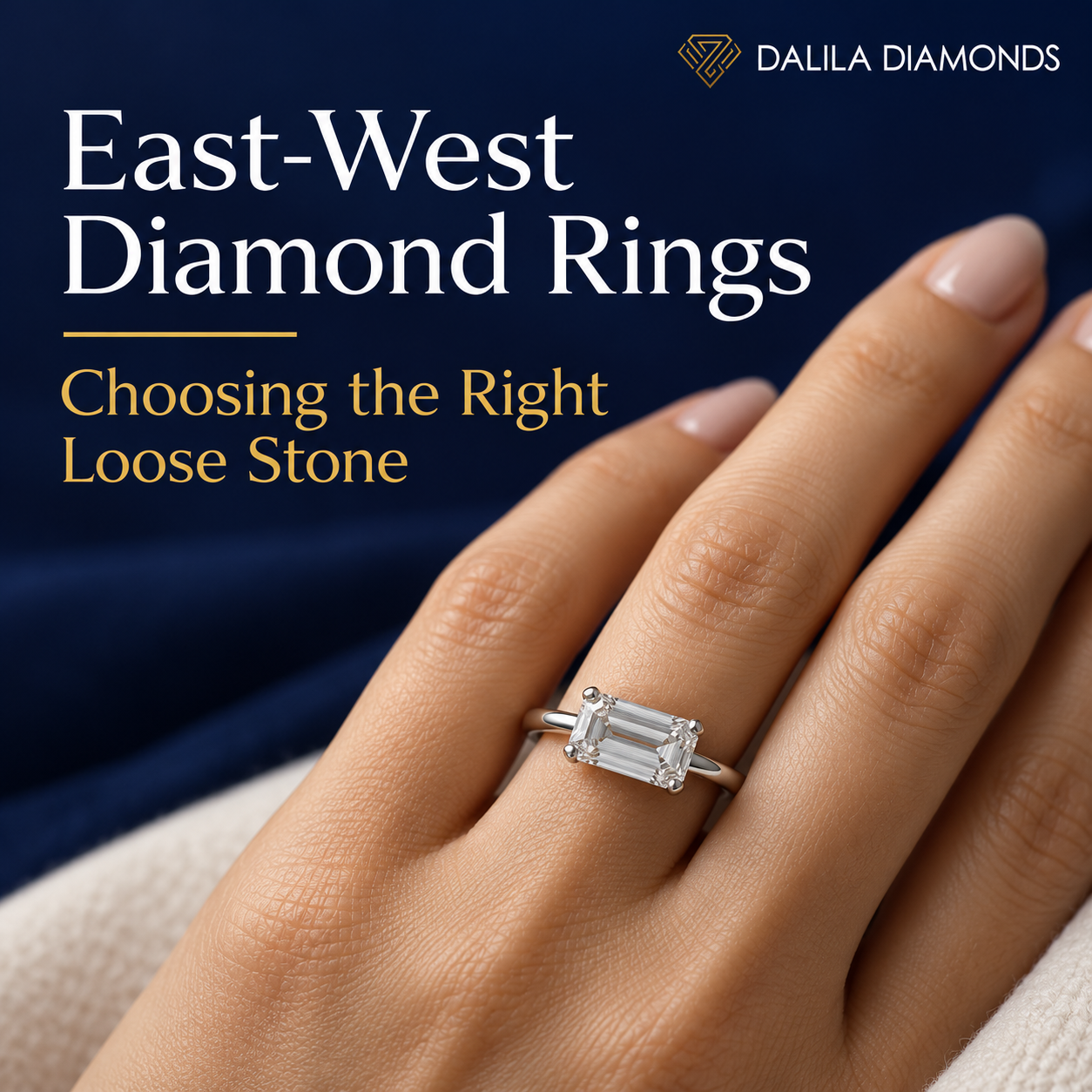
Choosing a diamond for an east-west setting requires more than selecting an attractive elongated shape. The diamond's length runs horizontally across the finger instead of vertically towards the knuckle, changing how much of the finger the stone covers and how its outline interacts with the ring's shoulders.
A natural oval diamond measuring 9.0 × 6.2 mm, for example, spans approximately 9.0 mm across the finger when positioned east-west. Turn the same stone north-south, and its nominal horizontal span becomes approximately 6.2 mm.
The diamond has not become larger. Its weight, surface area and optical characteristics are unchanged. What changes is the orientation of its face-up dimensions.
This is especially important for oval, emerald-cut and marquise diamonds, where the length can be substantially greater than the width.
The key to choosing an east-west diamond is to compare actual length and width with the space available across the finger, then have the jeweller confirm the setting geometry. Carat weight alone cannot establish whether a stone will look balanced or fit comfortably.
GIA's fancy-shaped diamond buying guide explains why a diamond's outline, symmetry, length-to-width ratio and proportions matter when assessing fancy shapes.
GIA 4Cs
This guide focuses specifically on the implications of rotating a natural diamond horizontally. It does not repeat a general comparison of oval, emerald and marquise cuts.
What Is an East-West Diamond Setting?
An east-west setting positions an elongated diamond with its long axis running across the finger, generally parallel to the direction of the ring band as seen from above.
A traditional north-south setting positions that long axis along the finger, towards the knuckle and fingertip.
For an oval, emerald or marquise diamond, this 90-degree rotation produces a noticeably different composition.
The east-west arrangement emphasises horizontal width rather than vertical length. Depending on the selected stone, the diamond may cover a substantial part of the visible top of the finger.
The setting itself can take several forms, including a bezel, partial bezel, prong setting or integrated band design.
However, rotating a diamond does not automatically produce a lower-profile ring or a more secure mounting. Finished height, stone protection and finger clearance remain separate design decisions.
East-West versus north-south orientation
Measurement or feature | North-south | East-west |
Diamond long axis | Along the finger | Across the finger |
Nominal horizontal span | Diamond width | Diamond length |
Nominal finger-length coverage | Diamond length | Diamond width |
Visual emphasis | Elongation towards fingertip | Width across the finger |
Outer corners or points | Often face towards knuckle and fingertip | May face towards neighbouring fingers |
Setting requirements | Based on actual stone and orientation | Must be reviewed for rotated outline and horizontal coverage |
These distinctions are especially significant for diamonds with pronounced elongation.
A round brilliant has no meaningful long-axis orientation, so simply rotating it through 90 degrees does not create the same visual change.
How Diamond Length and Width Determine East-West Appearance
The most useful measurements for an east-west ring are the diamond's actual face-up length and width.
For fancy-shaped diamonds, laboratory reports commonly record dimensions as length × width × depth.
The length-to-width ratio is calculated by dividing the length by the width.
For example, an oval measuring 9.0 × 6.2 mm has a ratio of approximately:
9.0 ÷ 6.2 = 1.45
An emerald cut measuring 8.0 × 5.6 mm has a ratio of approximately 1.43.
A marquise measuring 11.0 × 5.5 mm has a ratio of 2.00.
Those ratios describe different outlines, but they do not describe the complete visual or optical quality of the stones.
Three illustrative natural-diamond candidates
Diamond | Face-up dimensions | Length-to-width ratio | East-west horizontal span |
Oval brilliant | 9.0 × 6.2 mm | 1.45 | 9.0 mm |
Emerald cut | 8.0 × 5.6 mm | 1.43 | 8.0 mm |
Marquise brilliant | 11.0 × 5.5 mm | 2.00 | 11.0 mm |
These are realistic illustrative measurement combinations, not verified current Dalila Diamonds inventory.
The marquise occupies the greatest horizontal distance in this example, but that does not mean it has the greatest face-up area or is automatically the best choice.
Its pointed ends and relatively narrow body create a different visual effect from the fuller oval and rectangular emerald cut.
The actual dimensions should be used to shortlist stones, while photographs and videos should establish whether the individual outlines and cutting characteristics are attractive.
Original Diagram: Three Diamond Outlines Across the Ring Band
The comparison below uses scaled diamond outlines to demonstrate the different horizontal spans of an oval, emerald and marquise.
Download original east-west diamond proportion diagram (PNG)
Original educational diagram based on illustrative measurements. The stone outlines are proportionally scaled, and the horizontal bands are schematic. This is not a manufacturing drawing or a photograph of actual Dalila inventory diamonds.
The comparison shows why length matters so much when selecting an east-west centre.
Although the illustrated oval and emerald cut have similar length-to-width ratios, their actual horizontal spans differ by 1.0 mm.
The marquise extends another 2.0 mm beyond the oval's length.
That additional distance may be visually desirable, but it also changes the space available for the ring shoulders, protecting the points and maintaining comfortable clearance near the neighbouring fingers.
How Much of the Finger Will an East-West Diamond Cover?
A useful preliminary calculation compares the diamond's horizontal span with the measured visible width of the finger at the ring's intended position.
For an east-west diamond:
Nominal horizontal coverage percentage = diamond length ÷ measured finger width × 100
Suppose the intended finger has a measured visible top width of 17.0 mm at the ring position.
An oval measuring 9.0 mm in length would have a nominal coverage of approximately 53%.
An 11.0 mm marquise would cover approximately 65%.
This measurement is only a planning reference.
Finger dimensions vary, and ring size is not the same measurement as the finger's visible width. The finger is also curved rather than flat.
Prongs, bezels and the positions of the diamond's ends affect the finished arrangement.
Example using a measured 17.0 mm visible finger width
Diamond | East-west span | Nominal coverage | Remaining width, divided equally |
Oval 8.0 × 5.8 mm | 8.0 mm | 47.1% | 4.5 mm per side |
Oval 9.0 × 6.2 mm | 9.0 mm | 52.9% | 4.0 mm per side |
Emerald 8.0 × 5.6 mm | 8.0 mm | 47.1% | 4.5 mm per side |
Emerald 9.5 × 6.7 mm | 9.5 mm | 55.9% | 3.75 mm per side |
Marquise 11.0 × 5.5 mm | 11.0 mm | 64.7% | 3.0 mm per side |
Marquise 13.0 × 6.5 mm | 13.0 mm | 76.5% | 2.0 mm per side |
The final column is the mathematical difference between the finger width and diamond length, divided by two. It is not a verified gap or clearance beside the finished ring.
A stone that appears comfortably contained in a flat drawing may interact differently with the curved finger when mounted.
For this reason, a jeweller should evaluate a scaled top-view layout using the intended ring size and actual finger dimensions.
East-West Oval Diamond Rings: Choosing the Right Dimensions
An oval is a natural candidate for an east-west ring because its outline is elongated without pronounced pointed ends.
The rounded shape creates a relatively soft transition from the centre diamond to the band.
However, two oval diamonds with the same carat weight can produce different east-west appearances.
Consider these hypothetical oval candidates:
Measurement | Oval A | Oval B |
Carat weight | 1.50 ct | 1.50 ct |
Length | 8.8 mm | 9.5 mm |
Width | 6.5 mm | 6.1 mm |
Length-to-width ratio | 1.35 | 1.56 |
East-west span | 8.8 mm | 9.5 mm |
Nominal coverage on 17 mm finger | 51.8% | 55.9% |
The measurements are illustrative rather than actual inventory specifications.
Oval A has a fuller outline. When rotated horizontally, it creates a broader-looking central body over a shorter horizontal distance.
Oval B extends farther across the finger while remaining narrower from top to bottom.
Neither is automatically better.
The choice depends on whether the buyer wants a compact, full oval or a more elongated horizontal silhouette.
Check oval shoulders and end curvature
Two oval diamonds may share similar length and width yet differ in the fullness of their shoulders and the shape of their ends.
Those characteristics can affect the appearance of a bezel or partial bezel that follows the stone's perimeter.
An overly generic CAD oval may not accurately represent the selected diamond.
GIA's research on oval, pear and marquise diamond outlines documents variation in the outlines and faceting of these fancy shapes.
gia
The actual oval should therefore be assessed face-up, preferably through a clear image or video.
Does an east-west oval have a bow-tie effect?
An oval brilliant may display a bow-tie pattern, which appears as darker contrast across parts of the diamond.
Rotating the diamond does not remove an intrinsic bow-tie pattern.
It changes the pattern's orientation relative to the finger, but it does not automatically improve the stone's optical performance.
A candidate should be inspected in motion under suitable lighting before being approved for an east-west ring.
For the broader oval-versus-marquise shape decision, Dalila already has an Oval vs Marquise Diamond guide. The present article focuses on horizontal placement and coverage rather than repeating that shape comparison.
Dalila
East-West Emerald-Cut Rings: Length, Corners and Geometric Fit
An emerald-cut diamond produces a different east-west appearance from an oval.
Its straight sides and truncated corners create a more geometric composition.
When placed horizontally, the diamond's longer edges can form a strong line across the finger.
The visual effect depends on both the length-to-width ratio and the actual dimensions.
Consider two hypothetical emerald cuts:
Measurement | Emerald A | Emerald B |
Carat weight | 1.50 ct | 1.50 ct |
Length | 7.8 mm | 8.5 mm |
Width | 6.0 mm | 5.6 mm |
Length-to-width ratio | 1.30 | 1.52 |
East-west horizontal span | 7.8 mm | 8.5 mm |
These examples illustrate potential proportional differences, not fixed dimensions for all 1.50-carat emerald cuts.
Emerald A creates a relatively broad rectangular face-up outline.
Emerald B is more elongated, producing a stronger horizontal appearance.
Corner geometry matters
Emerald-cut diamonds have clipped or truncated corners, but the exact proportions of those corners vary.
Two diamonds measuring 8.0 × 6.0 mm may therefore have different outlines at the points where a bezel or prongs are intended to hold them.
This becomes particularly important when the stone is rotated east-west and the mounting design positions retaining elements near its horizontal ends.
A jeweller should confirm that the selected stone's corner geometry works with the actual head or bezel.
Step facets in an east-west setting
An emerald cut uses step facets, creating broad reflections and contrast patterns different from those of oval or marquise brilliants.
Rotating the stone changes the orientation of these patterns on the hand, but it does not create a new cut or improve the diamond's intrinsic optical quality.
Evaluate the chosen emerald cut directly for brightness, contrast, transparency and the appearance of its step facets.
An attractive outline alone is not proof of a good diamond.
East-West Marquise Rings: Horizontal Length and Point Protection
A marquise diamond creates one of the most pronounced changes in appearance when rotated east-west.
Its elongated outline can produce a substantial horizontal span, even at comparatively moderate carat weights.
This can be visually striking, but the two pointed ends introduce additional setting considerations.
Suppose a marquise measures 11.0 × 5.5 mm.
Its length-to-width ratio is 2.00, and its east-west horizontal span is 11.0 mm.
On a finger measuring 17.0 mm wide at the ring position, the diamond's nominal span is about 65% of that width.
A larger 13.0 × 6.5 mm marquise would occupy approximately 76% of the same measured finger width.
At that point, the position of the diamond's points relative to the sides of the finger becomes especially important.
Inspect both points before approving the stone
Marquise diamonds have two potentially vulnerable pointed ends.
The jeweller should examine the girdle and any clarity characteristics near those points.
A protective V-prong or appropriately designed bezel may reduce exposure, but the exact mounting must be assessed.
GIA's fancy-shape buying guidance recommends examining marquise symmetry, point alignment and the protection of its tips.
GIA 4Cs
An east-west orientation positions those points towards the sides of the finger, making their relationship with the neighbouring fingers an important practical check.
Is a longer marquise always better?
No.
A longer marquise can create impressive horizontal coverage, but excessive width across the hand may be uncomfortable or visually overwhelming in a particular mounting.
A very long and narrow diamond may also have other issues that need assessment, including symmetry, bow-tie contrast and the condition of its points.
Dalila's Marquise Diamond Guide addresses these diamond-quality considerations in more detail.
Dalila
For an east-west ring, the buyer should establish the intended horizontal width before deciding how elongated the diamond should be.
What Does Length-to-Width Ratio Actually Tell You?
Length-to-width ratio is useful for narrowing the visual style of a diamond, but it does not establish actual finger coverage.
Consider two ovals with identical ratios:
Diamond A: 8.0 × 5.6 mm — ratio approximately 1.43.
Diamond B: 10.0 × 7.0 mm — ratio approximately 1.43.
The outlines have similar proportions.
However, Diamond B spans 2.0 mm farther across the finger when positioned east-west.
That is a substantial difference in the context of a ring.
For this reason, a sourcing request should contain both the desired ratio and the actual length range.
Use the ratio to describe the preferred outline. Use the length in millimetres to assess horizontal coverage.
The same distinction applies to emerald and marquise diamonds.
How the Ring Shank Changes the East-West Appearance
An east-west diamond does not sit independently of the band.
The ring's shank connects to the centre setting and influences how the stone appears across the hand.
A relatively narrow shank may make the horizontal diamond look especially prominent.
A wider band can produce a more integrated, architectural appearance.
However, band width is also a structural consideration.
The jeweller must assess the dimensions of the shoulders and head connections, particularly when a long diamond or substantial bezel extends across the finger.
Example: one oval with three band widths
Suppose a buyer selects a natural oval measuring 9.0 × 6.2 mm.
Band width | Diamond length-to-band ratio | Visual implication |
1.6 mm | 5.63 | Strongly dominant horizontal centre |
1.9 mm | 4.74 | Delicate band with pronounced centre |
2.3 mm | 3.91 | More substantial band presence |
These are visual ratios, not structural design limits.
A band that looks delicate may still need additional material or support around the head.
The centre setting should not be designed using only the nominal width of the shank.
For the separate structural question of supporting a centre diamond on a narrow shank, see Dalila's Choosing a Centre Diamond for a Thin Band guide.
Does an East-West Diamond Need a Special Setting?
An east-west diamond requires a mounting designed or approved for that orientation.
A conventional north-south setting cannot always be rotated without changing how the head connects to the ring.
The head, prongs or bezel may have been designed around specific support positions and dimensions.
Rotating an existing component can affect where the diamond's ends sit, how the shoulders connect and whether the stone has appropriate clearance.
East-west bezel setting
A bezel can frame the elongated outline and provide metal coverage around the perimeter.
For an oval or emerald cut, this can create a smooth, continuous design.
For a marquise, the bezel must appropriately accommodate both points.
The actual stone outline and girdle dimensions are important because a bezel may closely follow the diamond's perimeter.
East-west half-bezel setting
A half bezel leaves selected parts of the diamond's edge exposed while using metal to retain other sections.
This design can provide a distinctive open appearance.
However, the jeweller must assess where the bezel sections contact the diamond and how the head is supported.
A half bezel is not automatically suitable for every oval, emerald or marquise.
East-west prong setting
Prong settings can also be designed for horizontal stones.
The position and construction of the prongs must correspond with the exact diamond outline and intended orientation.
A marquise still requires particular attention at both points.
For an emerald cut, the corner shape must be considered.
Integrated band or bypass design
Some east-west rings integrate the horizontal stone closely with the band.
In these designs, the shank may curve around or support parts of the centre setting.
The finished arrangement should be reviewed in both top and side views.
No setting style automatically guarantees comfort, durability or a low overall profile.
Why Setting Height Still Matters
An east-west diamond is sometimes perceived as lower because its long axis lies horizontally across the finger.
However, orientation alone does not determine finished ring height.
The diamond's total depth remains unchanged when it is rotated in its face-up plane.
The finished height depends on its seating position, pavilion clearance and mounting construction.
A relatively deep emerald cut may require more space beneath its girdle than a shallower candidate, even when both have the same face-up dimensions.
Likewise, an east-west oval may sit high if the head is designed to accommodate an adjacent wedding band.
The jeweller must assess the actual stone and intended mounting.
For the detailed relationship between diamond depth and finished ring height, see Dalila's Selecting a Diamond for a Low-Profile Ring guide.
What the Setter Must Measure Before Approving an East-West Diamond
The setter or manufacturing jeweller should evaluate the proposed stone in its intended horizontal orientation.
Measurement or assessment | Why it matters |
Exact diamond length | Establishes primary horizontal span |
Exact diamond width | Determines coverage along the finger |
Total depth | Contributes to the required mounting profile |
Actual outline | Identifies shoulders, ends and corners |
Length-to-width ratio | Describes the stone's elongation |
Girdle thickness and condition | Affects stone seating and protection |
Point or corner geometry | Determines support requirements |
Proposed finger width | Helps assess horizontal coverage |
Ring size and finger shape | Influences finished fit and position |
Shank width and thickness | Contributes to appearance and structural suitability |
Shoulder-to-head connection | Determines how the centre setting is supported |
Prong or bezel positions | Must align with the selected stone |
Finished head height | Determines the ring's projection |
Adjacent finger clearance | Important for very long horizontal stones |
Wedding-band compatibility | Determines the fit of an adjacent ring |
A jeweller should use a drawing based on the actual diamond, not merely a generic shape symbol.
For a marquise, point positions are especially important.
For an emerald cut, truncated corners need consideration.
For an oval, the exact shoulder fullness and end curvature may affect a closely fitted bezel.
Worked Example: Three Natural Diamonds for the Same East-West Ring
Suppose a buyer wants a natural diamond solitaire with an east-west orientation.
The proposed ring will be worn on a finger with a measured visible top width of approximately 16.5 mm at the intended setting position.
The buyer is considering three hypothetical stones.
Specification | Diamond A | Diamond B | Diamond C |
Shape | Oval brilliant | Emerald cut | Marquise brilliant |
Carat weight | 1.50 ct | 1.50 ct | 1.50 ct |
Length | 9.0 mm | 8.0 mm | 11.5 mm |
Width | 6.2 mm | 5.7 mm | 5.8 mm |
L/W ratio | 1.45 | 1.40 | 1.98 |
Horizontal span | 9.0 mm | 8.0 mm | 11.5 mm |
Nominal finger coverage | 54.5% | 48.5% | 69.7% |
Particular setting concern | Shoulder shape | Cut-corner fit | Both pointed ends |
The dimensions and weights are hypothetical, plausible examples. They do not represent measured stones currently offered by Dalila.
Candidate A: Oval brilliant
The oval creates a rounded horizontal outline with a nominal span of 9.0 mm.
Its 1.45 length-to-width ratio gives it an elongated but relatively full appearance.
The jeweller should examine the actual outline and determine how the stone will sit in a bezel or prong head.
The diamond's optical appearance should also be reviewed, especially any bow-tie contrast.
Candidate B: Emerald cut
The emerald cut covers a shorter horizontal distance despite having the same illustrative weight.
Its rectangular outline may suit a buyer looking for a compact, geometric east-west ring.
The jeweller should assess the corners and the position of the step-cut diamond within its mounting.
Clarity characteristics and transparency also deserve attention because step cuts display inclusions differently from many brilliant-style diamonds.
Candidate C: Marquise brilliant
The marquise occupies almost 70% of the measured visible finger width in this example.
This creates the most dramatic horizontal arrangement.
However, its two tips extend much farther towards the sides of the finger.
Before purchasing, the buyer should have the jeweller confirm the proposed clearance, point protection and mounting structure.
Which diamond should the buyer choose?
The oval is a practical option when a rounded horizontal silhouette is preferred.
The emerald cut provides a shorter, more geometric arrangement.
The marquise offers the greatest horizontal reach but demands particular attention to point protection and side clearance.
The correct choice depends on the desired appearance, optical quality and jeweller-approved design.
The longest diamond is not automatically the most suitable.
East-West Diamond Selection Worksheet
This worksheet helps buyers communicate the actual stone requirements before requesting quotations.
Specification | Requirement |
Intended jewellery | East-west natural diamond ring |
Preferred diamond shape | ______ |
Carat-weight range | ______ |
Minimum desired length | ______ mm |
Maximum desired length | ______ mm |
Preferred width | ______ mm |
Acceptable L/W ratio | ______ |
Total depth | Candidate-specific |
Colour | ______ |
Clarity | ______ |
Grading laboratory | ______ |
Bow-tie or facet-pattern concerns | ______ |
Point or corner characteristics | ______ |
Girdle condition | ______ |
Measured visible finger width | ______ mm |
Ring size | ______ |
Proposed shank width | ______ mm |
Setting type | ______ |
Desired finished profile | ______ |
Wedding-band requirement | ______ |
Jeweller approval | Pending / Approved |
Where several diamonds are shortlisted, compare their actual dimensions side by side.
The buyer should not use one standard CAD stone for every candidate merely because the diamonds share a carat-weight category.
Sourcing a Natural Diamond for an East-West Ring
When requesting a natural diamond for an east-west design, the supplier should receive specifications describing both the diamond and its intended orientation.
A request for a “1.5-carat oval” is less useful than a request containing preferred length, width, ratio, colour, clarity and setting details.
The distinction is particularly important when the buyer wants a specific horizontal span.
Example sourcing brief
A hypothetical enquiry could include the following requirements.
Field | Requested specification |
Diamond | Natural oval brilliant |
Carat weight | Approximately 1.30–1.60 ct |
Length | Preference around 8.8–9.5 mm |
Width | Preference around 6.0–6.6 mm |
Ratio | Approximately 1.40–1.50 |
Colour | G–H |
Clarity | VS1–VS2, subject to appearance |
Grading | GIA, IGI or HRD |
Optical requirements | Attractive brightness and acceptable bow-tie contrast |
Intended orientation | East-west, with long axis across finger |
Setting | Bespoke bezel or prong design, to be confirmed |
Manufacturing | Separate jeweller to approve stone and mounting |
These are illustrative requirements rather than an assertion that particular stones are currently available.
The supplier can provide candidate diamonds and their grading and dimensional information.
The manufacturing jeweller must determine whether the proposed stones can be mounted in the desired configuration.
Supplier and jeweller responsibilities
Task | Diamond supplier | Manufacturing jeweller |
Source candidate natural diamonds | Yes | May advise on selection |
Provide measurements and reports | Yes | Review actual stone |
Provide photographs or videos | Where available | Use for design assessment |
Establish horizontal finger coverage | Provide stone dimensions | Confirm on wearer or intended ring |
Determine prong or bezel design | No | Yes |
Approve point and corner protection | No | Yes |
Confirm head construction | No | Yes |
Approve finished ring height | No | Yes |
Manufacture and set the ring | Separate service, if arranged | Yes |
Dalila Diamonds can source natural loose diamonds according to specific shape, weight, dimensions, colour, clarity and budget requirements.
Its existing Diamond Size Chart can help buyers understand approximate dimensions, while the Fancy-Shaped Diamond Cut Quality Guide provides additional guidance on evaluating the individual stone.
Dalila
+1
For a specific east-west project, provide the intended horizontal length and the jeweller's drawing when making a sourcing enquiry through Dalila Diamonds.
If the required diamond is not available in the current inventory, Dalila's DS4U — Diamond Source For You service can be used to enquire about specification-driven sourcing, subject to availability.
Dalila
Quotations should distinguish the loose diamond from the separate ring design, manufacturing and setting costs.
Common Mistakes When Choosing a Diamond for an East-West Setting
Choosing solely by carat weight
Two diamonds of identical weight can have different horizontal dimensions.
Use actual millimetre measurements.
Choosing the longest stone available
Greater length can create stronger horizontal coverage, but may also introduce clearance and comfort concerns.
Treating the L/W ratio as a size measurement
A ratio describes proportions, not actual length.
Two stones can have identical ratios and substantially different horizontal spans.
Ignoring the actual outline
Ovals vary in shoulder fullness, emerald cuts differ in corner geometry and marquises vary in point alignment and wing shape.
Assuming a north-south head can simply be rotated
The head and shank connection must be evaluated for the intended orientation.
Assuming east-west means low profile
Diamond orientation does not determine finished setting height.
Failing to protect marquise tips
Horizontal marquise points require appropriate support and protection.
Using ring size as the visible finger width
Ring circumference does not directly provide the top-view finger width required for a coverage calculation.
Ignoring wedding-band fit
An east-west centre can affect how an adjacent ring sits. The intended ring stack should be reviewed before manufacturing.
Frequently Asked Questions
What is the best diamond shape for an east-west ring?
Oval, emerald and marquise diamonds are common candidates because their lengths are greater than their widths. The most suitable shape depends on the intended horizontal coverage, preferred outline and setting requirements.
What does east-west mean in a diamond ring?
It means the diamond's long axis runs horizontally across the finger rather than vertically towards the knuckle and fingertip.
Does an east-west setting make a diamond look bigger?
It can make an elongated diamond appear wider across the finger. It does not increase the stone's actual dimensions, face-up area or carat weight.
What is a good oval diamond ratio for an east-west ring?
Ratios around 1.35–1.55 provide useful comparison territory, but no single ratio is universally best. The actual length and width are more important when evaluating horizontal coverage.
Is an emerald-cut diamond suitable for an east-west setting?
Yes. Its rectangular outline can create a distinctive geometric design. The jeweller must evaluate actual dimensions, corner geometry, pavilion clearance and the proposed setting.
Can a marquise diamond be set horizontally?
Yes. An east-west marquise creates substantial horizontal spread. Both pointed ends must be assessed for suitable protection, and the finished ring should be checked for clearance near neighbouring fingers.
Is a 2-carat oval too big for an east-west ring?
Not necessarily. Carat weight alone cannot determine suitability. A jeweller should evaluate the diamond's actual length, the visible finger width and the complete mounting design.
How do I calculate east-west diamond finger coverage?
Divide the diamond's length by the measured visible finger width at the intended position and multiply by 100. This gives nominal horizontal coverage, not guaranteed physical clearance.
Does an east-west setting change the diamond's bow tie?
Rotating a diamond changes the direction in which an existing bow-tie pattern is seen relative to the finger. It does not inherently remove or improve the optical pattern.
Is an east-west diamond ring more comfortable?
It may be comfortable, but the answer depends on the diamond's horizontal length, setting construction, finger dimensions and how the ring is worn. A long stone may extend close to neighbouring fingers.
Can an east-west diamond be placed in a bezel?
Yes, provided the bezel is designed for the actual stone. Oval curvature, emerald corners and marquise points require appropriate consideration.
Does an east-west setting make the ring lower?
Not automatically. Finished height depends on the diamond's depth, seating position and mounting geometry, not simply the direction of its long axis.
Can an existing engagement ring be converted to east-west?
Possibly, but changing the orientation may require modifying or replacing the centre head. The jeweller must confirm whether the existing shank and mounting can accommodate the change.
What should I ask a diamond supplier for an east-west ring?
Provide the preferred shape, carat range, actual length and width requirements, length-to-width ratio, colour, clarity, grading preference and intended horizontal setting design.