Choosing Diamonds for a Five- or Seven-Stone Ring: Sizes, Proportions and Matching
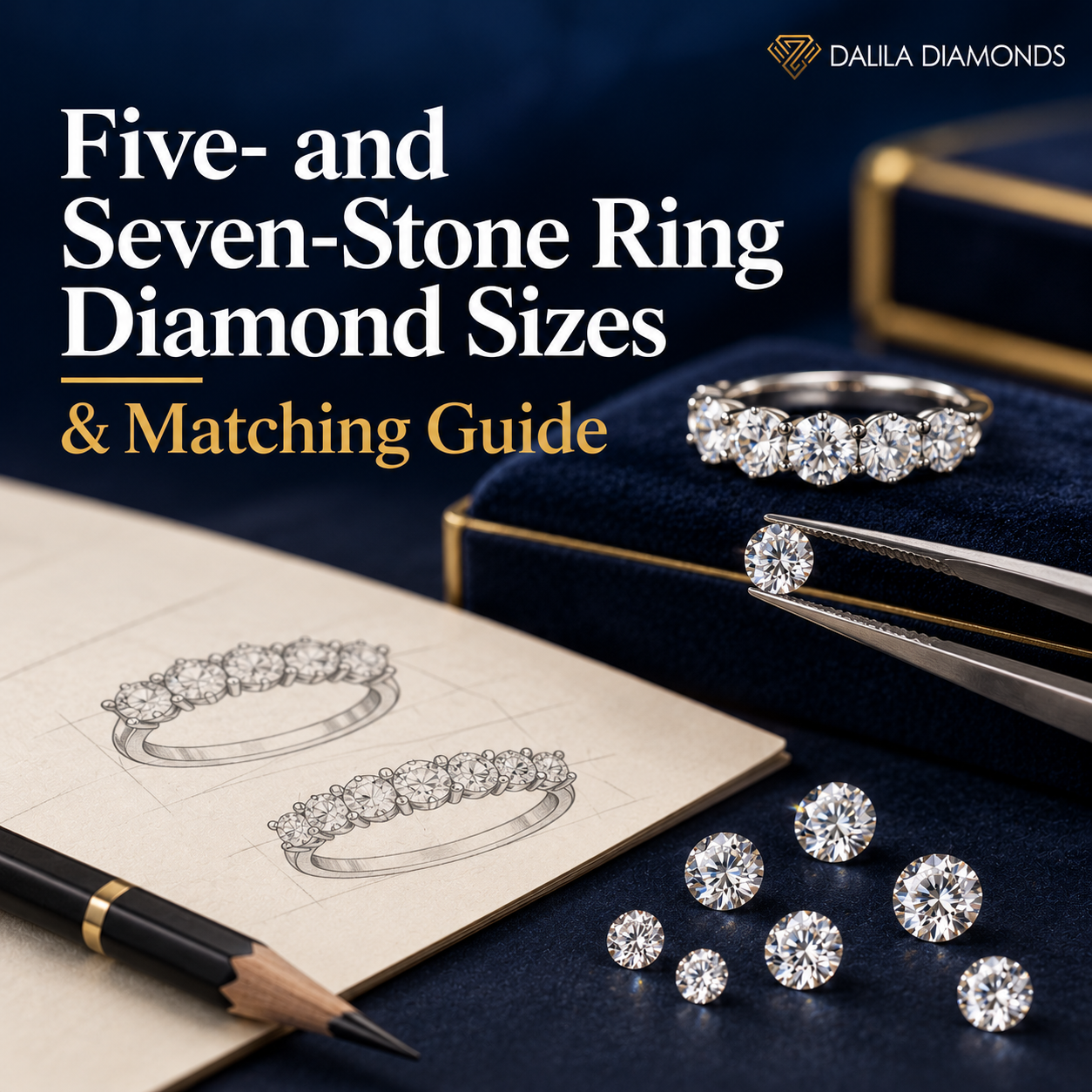
Choosing natural diamonds for a five- or seven-stone ring is not simply a matter of selecting five or seven diamonds with attractive laboratory grades. The stones must work together as a complete design, with the right individual dimensions, face-up proportions, colour and sparkle.
A five-stone diamond ring can use five diamonds of similar size or a graduated arrangement with one larger centre diamond and progressively smaller stones towards the sides.
A seven-stone ring follows the same basic design principles but introduces two additional diamonds. That changes the amount of finger coverage, the individual stone sizes that may be suitable and the way the stones curve around the band.
For example, a five-stone ring containing five 0.10-carat round brilliant diamonds has a total diamond weight of 0.50 carat.
A seven-stone ring using the same individual diamonds contains 0.70 carat in total.
The second ring has a greater combined diamond weight because it contains two additional stones. It does not necessarily use larger diamonds.
However, when seven stones are arranged across a finger, they may extend farther around the sides than a five-stone design.
The best way to choose diamonds for a five- or seven-stone ring is to begin with a visual layout showing the actual stone diameters, then select natural diamonds that match the approved design.
This guide compares equal-sized and graduated arrangements, explains how to calculate individual stone requirements and provides practical examples for buyers and manufacturing jewellers.
It covers five- and seven-stone rings together because both follow the same stone-selection principles. The detailed trade methodology for identifying matched diamond pairs remains in Dalila's separate matched-pair guide.
Five-Stone vs Seven-Stone Diamond Rings: Quick Comparison
Feature | Five-stone ring | Seven-stone ring |
Diamond quantity | 5 | 7 |
Common layout | Equal-sized or graduated | Equal-sized or graduated |
Central stone | Usually one central diamond | Usually one central diamond |
Symmetrical side pairs | 2 pairs | 3 pairs |
Finger coverage | Often concentrates stones across the upper finger | Can extend farther around the finger |
Stone matching | Centre plus two corresponding pairs | Centre plus three corresponding pairs |
Total carat weight | Sum of five stone weights | Sum of seven stone weights |
Manufacturing consideration | Balance, setting height and side coverage | Additional curvature and side-stone positioning |
Suitable designs | Anniversary, wedding, milestone or multi-stone ring | Anniversary, wedding, milestone or multi-stone ring |
The seven-stone ring is not automatically better or more valuable.
A five-stone design with larger individual diamonds can have a greater total carat weight and a more prominent face-up appearance than a seven-stone design using smaller stones.
The decision depends on the desired proportions.
Should All Five Diamonds Be the Same Size?
They can be.
An equal-size five-stone design creates a relatively continuous row of diamonds across the upper finger.
For example, five natural round brilliant diamonds weighing approximately 0.10 carat each may each measure around 3.0 mm in diameter.
Their combined weight would be approximately 0.50 carat.
This design gives each diamond similar visual importance.
Alternatively, a graduated ring can place a larger diamond in the centre and smaller stones towards the ends.
The graduated arrangement creates a central focal point while retaining the distinctive five-stone construction.
Equal-sized five-stone example
Stone position | Approximate diameter | Illustrative weight |
Far left | 3.0 mm | 0.10 ct |
Inner left | 3.0 mm | 0.10 ct |
Centre | 3.0 mm | 0.10 ct |
Inner right | 3.0 mm | 0.10 ct |
Far right | 3.0 mm | 0.10 ct |
Total | — | 0.50 ctw |
Illustrative round brilliant dimensions and weights, not an approved setting or identified natural-diamond parcel.
An equal-size arrangement requires consistent diameter, colour, transparency and face-up brightness.
Identical carat weights alone do not guarantee that the diamonds will look identical.
Graduated Five-Stone Diamond Rings
A graduated five-stone ring normally contains one larger centre stone, two medium-sized adjacent stones and two smaller outer stones.
The general sequence is:
Small → Medium → Large → Medium → Small
This creates a symmetrical appearance around the centre.
For example, a buyer might consider:
Position | Illustrative weight | Approximate round diameter |
Far left | 0.06 ct | 2.5 mm |
Inner left | 0.10 ct | 3.0 mm |
Centre | 0.25 ct | 4.1 mm |
Inner right | 0.10 ct | 3.0 mm |
Far right | 0.06 ct | 2.5 mm |
Total | 0.57 ctw | — |
This layout is an educational example, not live Dalila inventory or a completed ring.
The two inner stones are matched to one another, while the two outer stones form a second matching pair.
The centre diamond is selected for its relationship to both pairs.
What makes graduation attractive?
The important factor is how smoothly the stones decrease in visible size towards the sides.
A large centre diamond with much smaller neighbours creates a stronger focal point.
A subtler graduation can produce a more continuous diamond line.
Neither result is inherently better.
The buyer should decide how prominent the centre should appear before the stones are sourced.
Should Seven-Stone Rings Use Equal or Graduated Diamonds?
Both approaches work.
An equal-size seven-stone ring creates a longer repeating diamond line.
A graduated seven-stone ring uses three pairs of progressively smaller diamonds around a central stone.
The general sequence is:
Smallest → Small → Medium → Large → Medium → Small → Smallest
The additional size group provides more room to create a gradual visual transition.
However, it also introduces another pair that must be matched.
Equal-sized seven-stone example
Seven round brilliants weighing approximately 0.06 carat each may produce:
Specification | Value |
Diamond count | 7 |
Approximate diameter | 2.5 mm each |
Average weight | 0.06 ct each |
Total weight | 0.42 ctw |
Layout | Equal size |
Final finger coverage | Jeweller to confirm |
This arrangement could create a relatively fine diamond line.
Its actual side coverage depends on ring size and setting construction.
Graduated seven-stone example
Position | Illustrative weight | Approximate diameter |
Far left | 0.03 ct | 2.0 mm |
Middle left | 0.06 ct | 2.5 mm |
Inner left | 0.10 ct | 3.0 mm |
Centre | 0.25 ct | 4.1 mm |
Inner right | 0.10 ct | 3.0 mm |
Middle right | 0.06 ct | 2.5 mm |
Far right | 0.03 ct | 2.0 mm |
Total | 0.63 ctw | — |
This is a hypothetical, symmetrical seven-stone arrangement.
The design contains three matched left-right pairs surrounding the centre.
The actual seat geometry, spacing and curvature must be approved by the jeweller.
Original Design Comparison: Five vs Seven Stones
The diagram compares four conceptual arrangements: equal-size five-stone, graduated five-stone, equal-size seven-stone and graduated seven-stone.
The diamond circles are drawn using a consistent relative diameter scale.
They do not show actual ring curvature, prongs, metalwork or setting approval.
The important visual distinction is between an even row of stones and a deliberate progression towards a larger centre.
Five-Stone Diamond Ring Size Chart
For a five-stone ring, different individual diamond sizes create very different total weights.
Individual diamond weight | Approximate round diameter | Five-stone total |
0.03 ct | 2.0 mm | 0.15 ctw |
0.06 ct | 2.5 mm | 0.30 ctw |
0.10 ct | 3.0 mm | 0.50 ctw |
0.15 ct | 3.5 mm | 0.75 ctw |
0.25 ct | 4.1 mm | 1.25 ctw |
0.50 ct | 5.1 mm | 2.50 ctw |
Arithmetic equal-size examples. They do not establish that every combination is practical for a particular finger or ring mounting.
A five-stone design using five half-carat diamonds would require substantially more finger coverage and a different mounting than one using five three-point diamonds.
The manufacturer must evaluate both the face-up span and side-of-finger positioning.
Do not choose a five-stone ring solely by the total carat weight.
Seven-Stone Diamond Ring Size Chart
Individual diamond weight | Approximate round diameter | Seven-stone total |
0.03 ct | 2.0 mm | 0.21 ctw |
0.06 ct | 2.5 mm | 0.42 ctw |
0.10 ct | 3.0 mm | 0.70 ctw |
0.15 ct | 3.5 mm | 1.05 ctw |
0.25 ct | 4.1 mm | 1.75 ctw |
0.50 ct | 5.1 mm | 3.50 ctw |
These are equal-weight calculations, not manufactured designs.
A seven-stone ring with seven 4.1 mm diamonds may extend substantially around the finger.
Its suitability cannot be determined from the weight table alone.
The jeweller should assess the finger circumference, required stone arc and completed setting dimensions.
How Much Finger Coverage Will Five or Seven Diamonds Create?
One of the most important decisions is how far the diamonds should extend around the finger.
Some buyers want all the stones to remain largely visible across the upper surface.
Others prefer the row to continue farther down both sides.
A five-stone ring may provide the desired upper-finger coverage with fewer settings.
A seven-stone ring can offer a longer sequence, but the individual stones may need to be smaller to achieve the intended fit.
Why adding diameters is only a rough estimate
Suppose a five-stone design contains five round diamonds measuring 3.0 mm each.
Adding the face-up diameters produces:
5 × 3.0 = 15.0 mm.
That gives a rough idea of the total diamond diameters.
It is not the exact width of the finished ring.
The setting contributes metal and spacing, and the stones follow a curved surface rather than a perfectly straight line.
The finished face-up span may therefore differ.
Comparative example
Layout | Sum of nominal diamond diameters | Actual finished coverage |
Five × 3.0 mm | 15.0 mm | Setter/CAD confirmation required |
Seven × 2.5 mm | 17.5 mm | Setter/CAD confirmation required |
Five graduated: 2.5, 3.0, 4.1, 3.0, 2.5 mm | 15.1 mm | Setter/CAD confirmation required |
Seven graduated: 2.0, 2.5, 3.0, 4.1, 3.0, 2.5, 2.0 mm | 19.1 mm | Setter/CAD confirmation required |
The figures in the middle column are only sums of diameters, not true measured finished widths.
If the outer diamonds wrap too far down the finger, they may become less visible from above or affect comfort between adjacent fingers.
The correct proportion should therefore be reviewed on the intended ring size.
GIA also recommends considering the wearer's hand and ensuring side stones remain proportionate and do not disappear beyond the sides of the finger.
How Ring Size Affects the Design
The same five-stone or seven-stone layout can appear different on different ring sizes.
For example, a 19 mm nominal row of diamonds may cover a greater proportion of a smaller finger than a larger finger.
The amount of coverage depends on the setting arc and how the stones are positioned.
A design that works on a US size 8 ring should not automatically be copied unchanged for a US size 4 ring.
The jeweller may need to alter the individual stone dimensions, spacing or curvature.
What the manufacturer should confirm
Requirement | Why it matters |
Exact ring size | Establishes the intended finger dimensions |
Finger coverage | Determines how far stones extend around the sides |
Centre diamond position | Keeps the layout visually centred |
Setting height | Affects side profile and wearability |
Stone seat dimensions | Ensures each diamond can be secured |
Prong or bezel positions | Supports each stone appropriately |
Clearance beside adjacent fingers | Helps avoid unwanted contact |
Band structure | Determines the completed ring's strength |
These considerations apply to both equal and graduated designs.
How to Choose the Centre Diamond Size
The centre stone establishes the visual emphasis in a graduated ring.
However, no universal rule requires the centre to weigh twice as much as its neighbouring stones.
Carat weight and apparent diameter scale differently.
For example, consider a 0.25-carat round centre measuring approximately 4.1 mm.
It might be paired with 0.10-carat stones measuring around 3.0 mm.
The centre weighs 2.5 times as much as either adjacent stone, but its diameter is approximately 37% greater.
That can create a noticeable yet relatively smooth graduation.
Another buyer may prefer a centre diameter only slightly greater than the inner side stones.
The preferred relationship depends on the finished design.
Centre-to-side diameter ratio
A useful planning calculation is:
Centre-to-inner-side ratio = centre diamond diameter ÷ adjacent diamond diameter
For a 4.1 mm centre and 3.0 mm adjacent stones:
4.1 ÷ 3.0 = approximately 1.37.
For a 3.5 mm centre and 3.0 mm adjacent stones:
3.5 ÷ 3.0 = approximately 1.17.
The first arrangement has stronger central emphasis.
The second produces a gentler transition.
These ratios are design descriptions, not industry standards or universal recommended limits.
How to Match the Side-Stone Pairs
A five-stone ring usually has two corresponding left-right pairs.
A seven-stone ring usually has three.
The goal is for each pair to look balanced when positioned on opposite sides of the centre.
For example, the two stones directly beside the centre should have compatible face-up dimensions, outline, colour and brightness.
The two outer stones should also match one another.
Matching worksheet
Property | Why it matters |
Shape | Establishes consistent outlines |
Length and width or diameter | Helps corresponding stones look equally sized |
Carat weight | Supports the intended weight distribution |
Colour | Prevents unintended differences between left and right |
Clarity appearance | Avoids one visibly included side stone |
Cut and facet pattern | Helps produce balanced reflections |
Total depth | Affects seating and the finished height |
Girdle thickness | Important for setting security |
Condition | Identifies chips or other damage concerns |
Natural origin | Must meet the agreed sourcing requirements |
An exactly matched carat weight does not guarantee a matched visual appearance.
For example, one 0.10-carat round diamond may have a slightly smaller diameter than another 0.10-carat stone.
If the difference is visible, the two may be unsuitable as corresponding side stones.
The detailed professional selection of matched diamond pairs belongs in Dalila's existing matched-pair resource.
This guide focuses on where those pairs sit in five- and seven-stone ring layouts.
Should Every Diamond Have the Same Colour and Clarity?
Not necessarily identical grades, but the stones should look harmonious.
A five-stone ring with a G-colour centre and H-colour side stones may have an attractive, consistent appearance.
However, this cannot be guaranteed from the grading labels alone.
A warm-coloured outlier beside a cooler stone may be more noticeable because the diamonds are close together.
Similarly, two diamonds with the same VS2 clarity grade can have different visible inclusions.
Practical quality starting points
Characteristic | Starting approach |
Colour | G–H or another intentionally selected consistent range |
Clarity | VS–SI, with actual appearance checked |
Transparency | Reject unacceptable haze |
Cut appearance | Seek compatible brightness and facet character |
Matching | Assess each left-right pair and the complete row |
Natural origin | Use appropriate verification and documentation |
These are practical preferences, not fixed quality requirements.
The appropriate grades depend on stone size, budget, cutting style and desired finished appearance.
Small diamonds do not always have individual grading reports. For natural melee, an agreed parcel specification and screening process may be more appropriate.
Five-Stone vs Seven-Stone Rings With Fancy-Shaped Diamonds
Round brilliant diamonds are relatively straightforward to compare by diameter.
Fancy-shaped diamonds need additional measurements and orientation decisions.
Emerald-cut five-stone rings
Emerald cuts have rectangular outlines with truncated corners.
The jeweller must establish whether the long or short axis follows the ring's band.
A graduated arrangement may use a larger emerald-cut centre and smaller matching rectangular stones.
The widths, corner shapes and step-facet appearance should be coordinated.
Oval five- or seven-stone rings
Ovals can create a softer elongated arrangement.
The jeweller must decide whether the stones are aligned lengthwise or across the finger.
Two ovals with identical carat weights may have different length-to-width ratios.
Outline and bow-tie appearance should therefore be inspected.
Cushion-cut arrangements
Cushions may have rounded square or elongated outlines.
Their corner curvature and facet patterns can differ substantially.
A pair of cushions with the same nominal measurements should still be compared visually.
Mixed-shape rings
A large centre diamond may be surrounded by different shapes, such as baguettes or tapered side stones.
This can create an attractive custom design, but its proportions cannot be calculated using a uniform round-diamond chart.
Each stone's length, width, setting orientation and contact geometry must be specified.
For detailed optical evaluation of individual cuts, use Dalila's dedicated shape guides.
Does a Five- or Seven-Stone Ring Need a Different Setting?
Not necessarily a completely different setting style, but the head arrangement must suit the chosen stones.
Common constructions include shared-prong settings, individual prong heads and other custom mountings.
The appropriate design depends on the individual diamond sizes and desired profile.
Setting considerations
Design factor | Five-stone ring | Seven-stone ring |
Number of stone seats | Five | Seven |
Centre alignment | Essential | Essential |
Left-right matching | Two pairs | Three pairs |
Side curvature | Must be assessed | Often involves a longer stone arc |
Girdle support | Required for every stone | Required for every stone |
Finished height | Jeweller to confirm | Jeweller to confirm |
Band structure | Must support all settings | Must support all settings |
Comfort | Evaluate on intended finger | Evaluate on intended finger |
The choice between five and seven stones should be made before the manufacturer finalises the head geometry.
The jeweller should not be expected to fit seven stones into a design originally engineered for five without checking the layout and structure.
Real Published Five-Stone Design Example
A public five-stone diamond ring specification from AKind demonstrates a real graduated arrangement using emerald-cut stones:
Position | Advertised stone weight |
Outer left | 0.15 ct |
Inner left | 0.25 ct |
Centre | 0.50 ct |
Inner right | 0.25 ct |
Outer right | 0.15 ct |
Total | 1.30 ctw |
The design uses one larger centre diamond, a matched inner pair and a smaller matched outer pair.
It is a useful example of graduated weight distribution.
However, this particular product uses laboratory-grown diamonds, not natural diamonds. It is included only to document a real commercial design layout; it must not be represented as a natural-diamond sourcing example.
Its listed carat weights also do not establish the stones' exact length and width.
Those measurements would be needed to source an equivalent design using natural diamonds.
The design shows how graduation can be structured, not what natural diamonds Dalila currently has available.
Worked Example 1: Selecting Five Equal-Size Natural Diamonds
Suppose a buyer commissions a five-stone natural diamond anniversary ring.
The intended appearance is a continuous row rather than a prominent centre stone.
Initial specification
Field | Requirement |
Stone count | Five |
Diamond shape | Round brilliant |
Target diameter | Approximately 3.0 mm |
Approximate weight per stone | 0.10 ct |
Calculated total weight | 0.50 ctw |
Colour | G–H |
Clarity | VS–SI, subject to appearance |
Ring metal | 18K yellow gold |
Setting | Prong construction, jeweller to approve |
Ring size | Must be specified |
These are hypothetical sourcing requirements.
Selection process
The buyer first confirms the desired ring size and visual coverage.
The jeweller determines whether five diamonds around 3.0 mm will work within the proposed head arrangement.
The supplier then identifies five suitable natural round brilliants with compatible dimensions, colour and sparkle.
The complete row is inspected before setting.
The final total carat weight should be calculated from the actual five stones.
If the stones average slightly less or more than 0.10 carat, the completed ring's weight may differ from the preliminary target.
Worked Example 2: Selecting Five Graduated Natural Diamonds
A buyer prefers stronger centre emphasis.
The proposed design uses:
Position | Target diameter | Approximate weight |
Outer left | 2.5 mm | 0.06 ct |
Inner left | 3.0 mm | 0.10 ct |
Centre | 4.1 mm | 0.25 ct |
Inner right | 3.0 mm | 0.10 ct |
Outer right | 2.5 mm | 0.06 ct |
Total | — | 0.57 ctw |
The jeweller checks the intended arc and centre height.
The supplier searches for one centre diamond, a matched 3.0 mm pair and a matched 2.5 mm pair.
The buyer should view the assembled arrangement at the correct scale before committing to the stones.
If one inner stone appears noticeably brighter or warmer than its counterpart, it may not provide the intended symmetry.
The stones should be approved as a complete five-stone group.
Worked Example 3: Selecting Seven Graduated Natural Diamonds
A buyer wants a longer diamond arrangement around the upper finger.
The design uses three matching side pairs.
Position | Target diameter | Approximate weight |
Outer left | 2.0 mm | 0.03 ct |
Middle left | 2.5 mm | 0.06 ct |
Inner left | 3.0 mm | 0.10 ct |
Centre | 4.1 mm | 0.25 ct |
Inner right | 3.0 mm | 0.10 ct |
Middle right | 2.5 mm | 0.06 ct |
Outer right | 2.0 mm | 0.03 ct |
Total | — | 0.63 ctw |
The seven-stone design has a longer nominal row of diamond diameters than the five-stone graduated example.
This may increase finger coverage, but actual dimensions and comfort depend on the ring's curvature and setting.
The jeweller must also confirm whether the outer stones extend too far down the sides.
Once approved, the supplier can identify the required natural diamonds in the three corresponding pairs and one centre stone.
Which Is Better for an Anniversary Ring: Five or Seven Stones?
Both designs can be appropriate.
A five-stone ring may be preferable if the buyer wants a compact row of diamonds with fewer individual settings.
A seven-stone design may be preferable if the buyer likes a longer diamond line or wants a more gradual size transition.
However, the number of diamonds should not be treated as a quality ranking.
A well-proportioned five-stone ring can be more attractive than a poorly matched seven-stone ring.
The intended finger coverage, centre-to-side relationship and completed jewellery construction matter more than the count alone.
Diamond Sourcing Worksheet: Five- and Seven-Stone Rings
Use this worksheet before requesting actual natural diamonds.
Ring design
Specification | Requirement |
Ring type | Five-stone / Seven-stone |
Layout | Equal / Graduated |
Ring size | ______ |
Intended finger coverage | ______ |
Diamond shape | ______ |
Setting style | ______ |
Metal and alloy | ______ |
Desired setting height | ______ |
Manufacturing jeweller | ______ |
CAD or layout approved | Yes / No |
Stone-by-stone specification
Position | Required dimensions | Weight target | Colour | Clarity |
Centre | ______ mm | ______ | ______ | ______ |
Inner left | ______ mm | ______ | ______ | ______ |
Inner right | ______ mm | ______ | ______ | ______ |
Middle left, seven-stone only | ______ mm | ______ | ______ | ______ |
Middle right, seven-stone only | ______ mm | ______ | ______ | ______ |
Outer left | ______ mm | ______ | ______ | ______ |
Outer right | ______ mm | ______ | ______ | ______ |
Matching approval
Quality check | Result |
Centre diameter or dimensions confirmed | ______ |
Inner pair visually matched | ______ |
Middle pair matched, if applicable | ______ |
Outer pair matched | ______ |
Colour appearance consistent | ______ |
Clarity appearance acceptable | ______ |
Transparency acceptable | ______ |
Cut and brightness consistent | ______ |
Girdle and physical condition approved | ______ |
Natural-origin documentation agreed | ______ |
Stone seating approved by jeweller | ______ |
Actual total carat weight confirmed | ______ |
The worksheet should be completed using identified stones and a manufacturer-approved design.
Do not use approximate chart dimensions as final manufacturing measurements.
Sourcing Natural Diamonds for Five- or Seven-Stone Rings
A useful sourcing request should specify both the total number of diamonds and their required size groups.
For example, asking for five natural diamonds totalling one carat does not establish whether the buyer wants five equal-size stones or one larger centre diamond with four smaller sides.
Those designs can look very different.
Example sourcing brief
Jewellery: Graduated five-stone natural diamond anniversary ring.
Diamond quantity: Five.
Centre diamond: One natural round brilliant, approximately 4.1 mm.
Inner matched pair: Two natural round brilliants, approximately 3.0 mm each.
Outer matched pair: Two natural round brilliants, approximately 2.5 mm each.
Colour: G–H.
Clarity: VS–SI, subject to actual appearance.
Matching: Balanced left-right dimensions, colour and brightness.
Grading and origin: Recognised reports where appropriate and an agreed origin-verification process for smaller stones.
Ring size: Confirmed by the buyer.
Mounting: Manufacturing jeweller to approve the physical dimensions, spacing and stone security.
Budget: To be supplied.
These are example specifications, not current Dalila inventory.
Dalila Diamonds can receive natural loose-diamond sourcing enquiries using the required sizes, weights and quality preferences.
The availability of a complete matched group must be confirmed before purchase.
The manufacturing jeweller remains responsible for the finished ring's construction.
Supplier versus manufacturing jeweller
Task | Diamond supplier | Manufacturing jeweller |
Source natural centre diamond | Yes | May advise |
Source matched side pairs | Subject to availability | Reviews suitability |
Provide measurements and grading information | Yes, where available | Reviews |
Compare group appearance | According to agreed sourcing scope | May inspect |
Establish ring size and coverage | No | Yes |
Approve head and prong positions | No | Yes |
Confirm setting height and structure | No | Yes |
Set all diamonds | Not assumed | Yes |
Inspect finished ring | Not assumed | Yes |
A loose-diamond sourcing quotation should be separated from jewellery manufacturing and setting costs unless a complete service has been expressly confirmed.
Common Mistakes When Choosing Five- or Seven-Stone Diamonds
Selecting by total carat weight alone
The same total weight can be divided across equal or graduated stones.
Assuming seven stones always create a larger-looking ring
A five-stone ring with larger individual diamonds may look more substantial.
Ignoring ring size
The same nominal stone arrangement can cover different proportions of different fingers.
Matching carat weights but not millimetre dimensions
Equal weight does not guarantee equal face-up size.
Creating uneven graduation
Corresponding left-right pairs should be visually balanced unless deliberate asymmetry is intended.
Ignoring the outer diamonds
The outer stones may extend farther down the finger than expected.
Treating a straight-line measurement as finished ring width
The stones sit along a curved structure with prongs or other metal between them.
Selecting all diamonds before confirming the setting
The jeweller must approve their dimensions and layout.
Assuming individual reports exist for every small diamond
Natural melee is often supplied under calibrated parcel specifications rather than separate reports for each stone.
Mixing visibly inconsistent stones
Colour, transparency or brightness outliers can disrupt the visual balance.
Frequently Asked Questions
What diamond sizes are best for a five-stone ring?
There is no universal best size. Five 3.0 mm round diamonds create an equal-size arrangement of approximately 0.50 ctw, while a graduated design may combine a 4.1 mm centre with 3.0 mm and 2.5 mm side pairs. The jeweller must confirm suitability for the ring size.
How many carats should a five-stone diamond ring have?
The total depends on the individual stones. Five 0.10-carat diamonds total 0.50 ctw, while five 0.25-carat diamonds total 1.25 ctw.
What is a graduated five-stone diamond ring?
It uses a larger centre diamond and progressively smaller stones towards the sides, typically arranged symmetrically.
Should all five diamonds have identical carat weights?
Not necessarily. Equal-size designs may use similarly weighted stones, while graduated designs intentionally use different sizes. Actual face-up measurements matter more than identical weight labels.
What is a good centre-to-side ratio for a five-stone ring?
There is no universal ratio. A 4.1 mm centre with 3.0 mm adjacent diamonds produces a centre-to-side diameter ratio of approximately 1.37, offering one possible graduated appearance.
Are five-stone diamond rings suitable for smaller fingers?
They can be, provided the individual diamonds and setting are proportioned for the finger. The jeweller should assess total stone coverage and comfort.
What diamond sizes work for a seven-stone ring?
A seven-stone ring could use seven approximately 2.5 mm diamonds or a graduated layout with a larger centre and progressively smaller side pairs. The final dimensions depend on ring size and design.
Is a seven-stone ring better than a five-stone ring?
Neither is universally better. Seven stones allow a longer row or more graduation steps, while five stones can create a more compact design.
Can a five-stone ring have a larger centre diamond?
Yes. Graduated five-stone rings commonly use a larger centre surrounded by two matching pairs.
Can a seven-stone ring use seven equal diamonds?
Yes. Equal-size seven-stone rings are a valid alternative to graduated designs.
Does a seven-stone ring always cover more of the finger?
Not necessarily. Coverage depends on individual diamond sizes, setting pitch and curvature. Seven small diamonds may occupy a similar span to five larger diamonds.
Do the side diamonds need the same colour?
They should appear compatible with one another and the centre. Exact laboratory grades need not always be identical, but conspicuous visual differences should be avoided.
Is VS2 clarity suitable for a five-stone ring?
Yes. VS2 is a useful starting point, while carefully selected SI stones may also be appropriate. Actual inclusion visibility and transparency should be reviewed.
Do all the diamonds need individual certificates?
Not necessarily. Larger stones may have individual grading reports, while smaller natural diamonds are often sourced using calibrated parcel specifications and appropriate origin documentation.
Can oval or emerald-cut diamonds be used?
Yes. The jeweller must approve their length, width, outline, orientation and setting requirements.
Can five- and seven-stone rings use mixed diamond shapes?
Yes. Mixed-shape designs are possible, but they require individual stone measurements and a purpose-designed layout.
Are graduated diamonds more expensive than equal-size diamonds?
Not automatically. The price depends on the individual stones, their quality, sizes, sourcing requirements and the mounting. The total carat weight alone cannot establish the cost.
Can an existing five-stone ring be converted into seven stones?
Possibly, but not automatically. Additional stones may require a substantially different mounting and structure. A qualified jeweller must assess feasibility.
What should I give Dalila to source diamonds for a five-stone ring?
Provide the ring design, centre diamond measurements, two required matched side-pair sizes, colour and clarity preferences, grading requirements and budget.
Can Dalila source seven matching natural diamonds?
Dalila can receive a specification-led natural-diamond enquiry for the required centre stone and corresponding matched side pairs. Availability and the exact sourcing service should be confirmed.