Tennis Necklace Diamond Sizes and Matching: Uniform vs Graduated Designs
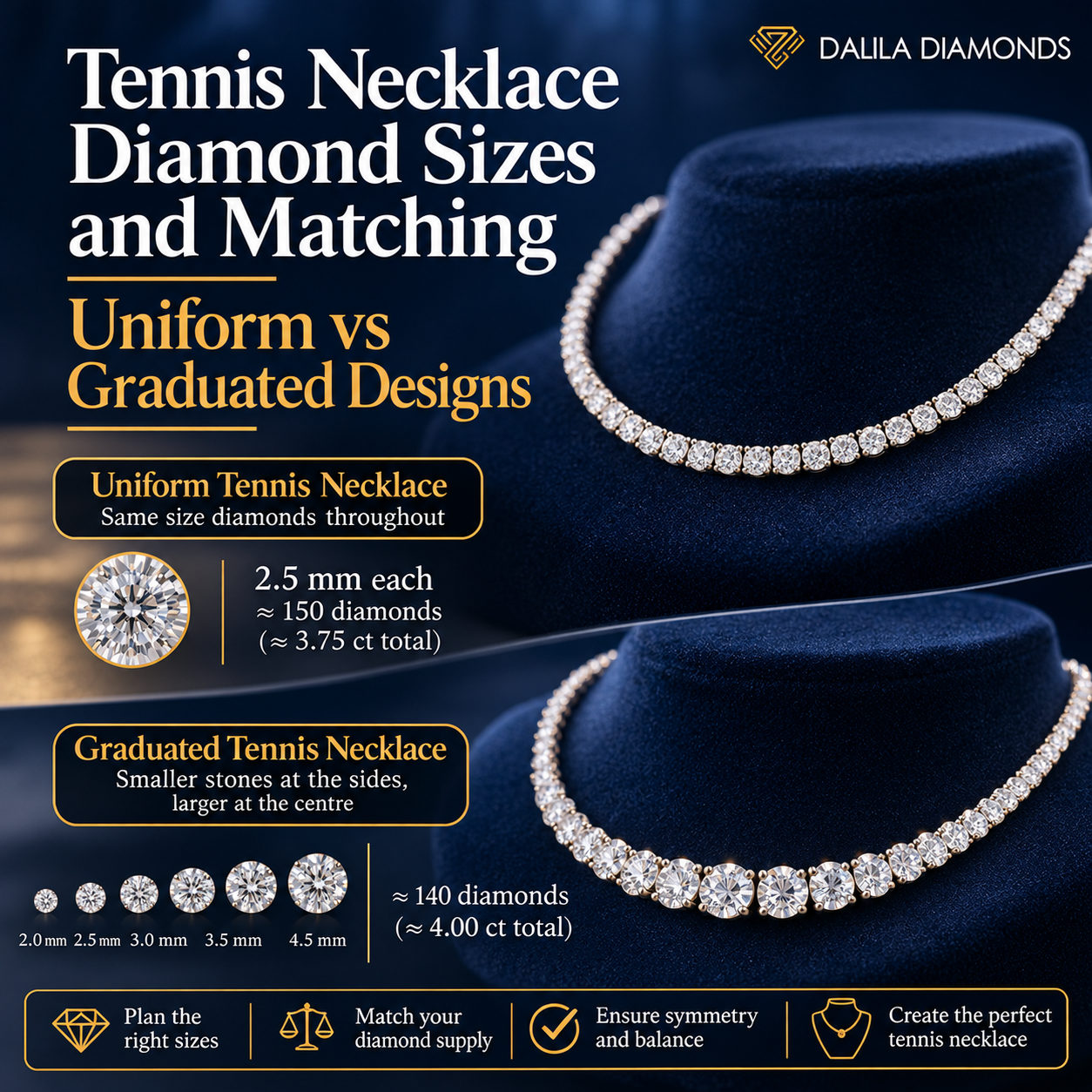
Choosing diamonds for a tennis necklace begins with a different question from selecting a solitaire pendant or tennis bracelet: should every diamond be approximately the same size, or should the stones gradually become larger towards the centre?
A uniform tennis necklace uses a continuous line of similarly sized diamonds. A graduated tennis necklace uses smaller diamonds towards the sides or back, with progressively larger stones forming the centre of the design.
Both can be made with natural diamonds, but the two layouts have different sourcing and matching requirements.
For example, a uniform necklace might use 150 round brilliant diamonds measuring approximately 2.5 mm each.
A graduated necklace could use smaller 2.0 mm diamonds near the back, increase through several matched size groups and finish with a 4.5 mm centre diamond.
The second design does not necessarily have more diamonds or a greater total carat weight. Its weight distribution depends on the number of stones in each size category.
A successful necklace therefore needs more than a carat-weight target. The buyer and manufacturer must establish the individual diamond sizes, stone counts, setting dimensions and desired left-right symmetry.
The best way to source diamonds for a tennis necklace is to begin with a manufacturer-approved millimetre layout and then match the diamonds to that layout.
This guide explains uniform and graduated designs, how many diamonds a necklace may require, how to calculate stone sizes and how to prepare a practical natural-diamond sourcing worksheet.
Uniform vs Graduated Tennis Necklace: Quick Comparison
Buying factor | Uniform tennis necklace | Graduated tennis necklace |
Diamond arrangement | Similar-size stones throughout the diamond line | Smaller stones towards the sides, larger towards centre |
Main visual effect | Consistent diamond line | More pronounced centre emphasis |
Stone sizes | Usually one calibrated range | Several calibrated size groups |
Matching requirement | Consistency across all stones | Consistency within groups and balanced size progression |
Centre diamond | Similar to other diamonds | Usually the largest diamond or centre group |
Left-right balance | Same nominal size on both sides | Corresponding size steps should be balanced |
Stone count | Depends on length and setting pitch | Depends on quantity in each size group |
Total carat weight | Sum of all stones | Sum of all graduated groups |
Sourcing complexity | Primarily uniform parcel selection | Multiple sizes, quantities and visual transitions |
Manufacturing priority | Consistent pitch and necklace flexibility | Smooth graduation and centre alignment |
A graduated layout is not automatically better than a uniform layout.
The correct choice depends on the intended necklace appearance, budget and manufacturing design.
What Size Diamonds Are Used in Tennis Necklaces?
Natural diamond tennis necklaces can use small round brilliant diamonds measuring approximately 1.5–3.0 mm or considerably larger stones in more substantial designs.
Graduated necklaces may combine several sizes, including stones around 2.0 mm near the back and centre diamonds measuring 4.0–5.0 mm or more.
These are broad design possibilities, not universal standards.
For example, a real jewellery-manufacturing catalogue by Aaron & Son documents a graduated necklace with 171 diamonds, including a 3.5 mm centre diamond and numerous 2.0 mm stones.
The published design demonstrates how one necklace can contain different stone sizes while maintaining a coordinated overall appearance.
Approximate round diamond size chart
Round diamond diameter | Illustrative individual weight | Typical design role |
1.5 mm | 0.015 ct | Fine necklace line |
1.8 mm | 0.025 ct | Delicate side sections |
2.0 mm | 0.03 ct | Fine uniform line or graduated ends |
2.2 mm | 0.04 ct | Small graduated step |
2.5 mm | 0.06 ct | Moderate-size necklace diamonds |
2.8 mm | 0.08 ct | More prominent intermediate stones |
3.0 mm | 0.10 ct | Larger uniform line or graduated centre region |
3.5 mm | 0.16 ct | Prominent graduated stones |
4.0 mm | 0.25 ct | Larger centre or statement design |
4.5 mm | 0.35 ct | Significant centre stone |
5.0 mm | 0.50 ct | Substantial centre diamond |
Carat weights are approximate examples, not exact conversions or verified stone inventory. Individual weights vary with cutting proportions, girdle thickness and total depth.
The jewellery manufacturer should order stones according to the required millimetre dimensions and acceptable tolerances.
A diamond described as 0.06 carat does not necessarily measure exactly 2.5 mm.
For the wider carat-to-millimetre conversion, Dalila's existing Diamond Size Chart remains the appropriate reference.
What Is a Uniform Diamond Tennis Necklace?
A uniform tennis necklace uses diamonds of approximately the same face-up size along the intended diamond-set line.
The visual objective is a continuous sequence of similar-looking stones.
For example, a jeweller might specify 2.5 mm natural round brilliant diamonds throughout the necklace.
The diamonds should be closely calibrated so they fit consistently into the selected settings.
However, the stones do not necessarily need identical individual carat weights.
Two natural round brilliant diamonds may have the same face-up diameter but slightly different weights because of variations in depth and girdle proportions.
What must match in a uniform necklace?
Characteristic | Matching objective |
Diamond diameter | Consistent visible size |
Shape and outline | Consistent roundness or selected fancy shape |
Colour | No unintended warm or cool outliers |
Clarity appearance | No distracting inclusions |
Transparency | No visibly cloudy stones |
Brightness | Similar overall light performance |
Girdle condition | Suitable for the intended setting |
Setting pitch | Consistent spacing along the necklace |
Link flexibility | Smooth drape around the neckline |
A uniform necklace with inconsistent diamond diameters may appear irregular even if its total carat weight matches the order.
Likewise, a single significantly warmer diamond may interrupt an otherwise near-colourless line.
The finished necklace should be assessed as one continuous piece.
What Is a Graduated Diamond Tennis Necklace?
A graduated tennis necklace uses deliberately different diamond sizes.
The stones generally become larger towards the centre and smaller towards the sides or back.
This arrangement is often associated with rivière-style diamond necklaces.
For a balanced design, corresponding stones on the left and right sides are normally selected to create similar visual weight.
The centre may contain one largest diamond or a central group of similarly sized stones.
Example graduated progression
A hypothetical necklace could use the following sequence moving from each side towards the centre:
2.0 mm → 2.2 mm → 2.5 mm → 2.8 mm → 3.1 mm → 3.5 mm → 4.0 mm.
This is an example of a size progression, not a requirement that every necklace use those exact steps.
The transition should appear intentional.
A sudden jump from very small diamonds to one extremely large centre stone may be appropriate for a statement design, but it creates a different appearance from a smooth graduation.
The buyer should approve the intended effect before the supplier begins selecting the diamond groups.
A Real Graduated Tennis Necklace: 171 Stones Across Five Sizes
An Aaron & Son manufacturing catalogue provides a documented graduated necklace design identified as N369.
The approximately 16.1-inch version is specified with a total diamond weight of approximately 6.00 carats.
Its published layout includes:
Diamond diameter | Number of stones | Listed weight per stone | Group weight |
3.5 mm | 1 | 0.160 ct | 0.160 ct |
3.1 mm | 2 | 0.115 ct | 0.230 ct |
2.5 mm | 2 | 0.060 ct | 0.120 ct |
2.2 mm | 2 | 0.041 ct | 0.082 ct |
2.0 mm | 164 | 0.033 ct | 5.412 ct |
Total | 171 | — | 6.004 ct |
The calculated sum is 6.004 carats, consistent with the catalogue's rounded 6.00-carat description.
This is a published commercial manufacturing layout, not a Dalila inventory offer.
It illustrates an important design principle: a graduated necklace does not require a long progression of increasingly large stones across its entire length.
In this example, most stones remain relatively small, while a limited group near the centre creates the visual graduation.
The majority of the necklace's total carat weight still comes from the numerous smaller diamonds.
What this example teaches buyers
First, the centre diamond is only one part of the total weight.
Second, the necklace requires several calibrated diamond groups, not one uniform parcel.
Third, the left and right positions must be coordinated around the centre.
Fourth, the published stone count and dimensions are specific to that design and cannot be reused automatically for a different necklace length or setting.
The actual manufacturing specification should always be confirmed before ordering stones.
A Second Real Example: More Graduation, Fewer Stones
The same manufacturing catalogue documents another N369 design with approximately 8.00 carats across 159 stones.
The listed diamond distribution is:
Diamond diameter | Stone count |
4.5 mm | 1 |
4.1 mm | 2 |
3.8 mm | 2 |
3.5 mm | 4 |
3.3 mm | 4 |
3.1 mm | 4 |
2.8 mm | 4 |
2.5 mm | 4 |
2.2 mm | 4 |
2.0 mm | 130 |
Total | 159 |
The approximately 16-inch design uses fewer stones than the 171-stone example, but its stated total carat weight is greater.
That is possible because more weight is allocated to larger centre and intermediate diamonds.
This reinforces why stone count and total carat weight are not interchangeable measurements.
For a new necklace, the manufacturer needs to determine the intended graduation before the final diamond count and weight can be calculated.
How Many Diamonds Are in a Tennis Necklace?
There is no standard diamond count for every tennis necklace.
A full diamond line worn around the neck is substantially longer than a conventional tennis bracelet.
However, its stone count depends on individual diamond size, setting pitch, clasp length and total necklace length.
A necklace using small diamonds may require well over 100 stones.
A design using larger diamonds or substantial metal links may contain fewer.
A graduated necklace requires a more detailed count because different size groups occupy different lengths.
Example planning ranges
Necklace length | Individual diameter | Illustrative count range |
40 cm | 2.0 mm | Approximately 145–175 |
40 cm | 2.5 mm | Approximately 125–145 |
40 cm | 3.0 mm | Approximately 105–125 |
45 cm | 2.0 mm | Approximately 165–195 |
45 cm | 2.5 mm | Approximately 140–165 |
45 cm | 3.0 mm | Approximately 120–140 |
50 cm | 2.0 mm | Approximately 185–215 |
50 cm | 2.5 mm | Approximately 155–185 |
50 cm | 3.0 mm | Approximately 135–155 |
These are broad conceptual ranges for full diamond-set lines, not verified product counts. Actual settings, clasp dimensions and necklace geometry can produce counts outside these ranges.
The buyer should not use these ranges as the final parcel quantity.
They help illustrate why a 45 cm necklace made with 2.0 mm diamonds may require substantially more stones than one made with 3.0 mm diamonds.
A manufacturer-approved layout is required for an accurate count.
How to Calculate Stone Count for a Uniform Tennis Necklace
A preliminary estimate can be made using the usable length of the diamond-set necklace and the effective setting pitch.
Estimated diamond count = Usable diamond-line length ÷ Effective setting pitch
Where:
Usable diamond-line length = Finished necklace length − Clasp and other non-diamond allowances
The setting pitch is the distance between the centres of neighbouring diamonds along the line.
It is affected by the diamond diameter, the mounting head and the link connection.
Worked example: Uniform 45 cm necklace
Suppose the jeweller proposes:
Parameter | Illustrative value |
Finished necklace length | 450 mm |
Clasp and end allowance | 15 mm |
Usable diamond-line length | 435 mm |
Diamond diameter | 2.5 mm |
Effective setting pitch | 2.9 mm |
The calculation is:
435 ÷ 2.9 = 150.
The preliminary layout therefore uses approximately 150 diamonds.
This is a useful starting estimate, but it is not an approved production count.
The manufacturer must confirm how the final link connections, clasp and curvature work together.
What if the necklace length increases?
If the same design is made longer using the same individual stones and setting pitch, additional diamond-set links will usually be required.
For example, increasing the length from 45 cm to 50 cm adds 50 mm.
At a hypothetical 2.9 mm pitch, that represents approximately 17 additional diamond positions, subject to the final layout.
This changes the number of stones and potentially the total carat weight.
How to Calculate a Graduated Necklace Stone Count
A graduated tennis necklace cannot be described by one diamond size.
Its design should be broken into size groups.
Each group has a stone diameter, quantity and corresponding setting dimensions.
For a symmetrical design, most groups will have even counts because they appear on both sides of the centre.
A necklace with one distinct centre diamond will usually have an odd total stone count if all remaining positions form left-right pairs.
However, there are exceptions, including designs with two centre stones or intentional asymmetry.
Graduated necklace planning example
Suppose a jeweller proposes:
Size group | Number of diamonds | Position |
4.0 mm | 1 | Centre |
3.5 mm | 2 | One on each side |
3.0 mm | 4 | Two on each side |
2.8 mm | 8 | Four on each side |
2.5 mm | 20 | Ten on each side |
2.2 mm | 40 | Twenty on each side |
2.0 mm | 100 | Remaining outer sections |
Total | 175 | Symmetrical concept |
This is a hypothetical stone distribution, not a verified finished necklace or approved CAD plan.
The arithmetic total is 175 diamonds.
However, the number of stones alone does not prove the design fits a particular necklace length.
The jeweller must determine how much longitudinal space each size group and setting occupies.
The final design may require changes to the counts or pitch.
Why Graduated Tennis Necklaces Need Left-Right Matching
A graduated tennis necklace usually places its largest stones near the centre.
The corresponding diamonds on either side should have compatible dimensions and appearance.
For example, if the design includes two 3.5 mm diamonds directly beside the centre, they should be selected to look balanced.
Likewise, the 3.0 mm diamonds on the left should complement their counterparts on the right.
What to match within each size group
Characteristic | Matching goal |
Face-up diameter | Compatible visual size |
Colour | No unintended warm/cool imbalance |
Clarity appearance | No distracting outliers |
Transparency | Similar crisp appearance |
Cut pattern | Comparable face-up brightness |
Shape | Consistent outline |
Girdle condition | Suitable for the intended setting |
Depth | Compatible with the proposed head |
Count | Matches left and right layout |
The left and right diamonds do not necessarily need identical carat weights.
Their visible dimensions and optical appearance are often more relevant to visual balance.
However, the actual acceptable dimensional tolerance must come from the jeweller.
How Smooth Should the Diamond Graduation Be?
There is no universally correct millimetre increment between successive groups.
For example, a design could move from 2.0 to 2.2 to 2.5 to 2.8 to 3.1 mm.
Another might use larger or smaller steps.
The result depends on the desired visual appearance and setting geometry.
An important distinction is between a deliberately stepped graduation and an unintended size mismatch.
In a uniform necklace, one 2.8 mm diamond among otherwise 2.5 mm stones may look out of place.
In a graduated necklace, the same change may be intentional if it forms part of a balanced progression.
Why visual inspection matters
GIA's guidance on melee diamonds notes that differences in small-diamond size can become noticeable when jewellery is intended to show uniformity.
For a graduated necklace, the problem is not that stones differ in diameter.
The problem is when the differences do not follow the agreed design.
A successful graduation should look planned and coordinated from the centre towards both ends.
Matching Diamond Colour Across a Tennis Necklace
A tennis necklace may position dozens or hundreds of diamonds close together.
This makes colour consistency important.
For many natural diamond necklaces, G–H colour provides a useful starting specification.
H–I or other ranges can also be appropriate if the buyer prefers the appearance and the diamonds are consistently matched.
A graduated necklace may use different carat sizes, but the colour appearance should remain harmonious across the sections.
For example, a centre group that looks visibly warmer than the smaller diamonds around it may produce an unintended contrast.
Colour matching checklist
The supplier should establish:
The agreed colour range.
Whether the same colour criteria apply to every size group.
How outliers are identified.
Whether colour comparisons are performed across neighbouring groups.
What replacement or rejection terms apply.
A stated average colour grade does not guarantee that every individual diamond appears the same.
The parcel should be assessed visually.
Matching Clarity, Transparency and Cut Appearance
For small natural diamonds in a necklace, carefully selected VS–SI clarity can provide a useful quality starting point.
However, a broad clarity range does not by itself prove that the stones look consistent.
One noticeably dark inclusion may stand out among otherwise clean diamonds.
A cloudy diamond can interrupt the continuous line of brightness.
Different cut proportions may also create variations in face-up size and sparkle.
Why the centre stones deserve attention
In a graduated necklace, the centre stones are often the largest.
As a result, some inclusions or transparency differences may become easier to recognise.
The buyer may choose more selective clarity requirements for the largest centre diamonds while using a broader acceptable range for the small side stones.
However, that should be a deliberate specification.
It should not create an obvious visual difference between the centre and surrounding sections.
For a uniform necklace, consistency across the entire line remains the priority.
Does Every Tennis Necklace Diamond Need a Certificate?
No.
A tennis necklace may contain more than 100 small diamonds.
It is not appropriate to assume every melee diamond comes with a separate GIA, IGI or HRD grading report.
Commercial jewellery production often relies on calibrated diamond parcels supplied to agreed quality specifications.
Larger centre stones in some graduated designs may have individual grading reports, depending on their weight and the sourcing arrangement.
Smaller diamonds may instead be accompanied by parcel-level information and origin-screening documentation.
Natural diamond verification
Natural and laboratory-grown diamonds can be difficult to distinguish reliably by appearance alone.
GIA offers a Melee Analysis Service for eligible small diamonds, helping separate natural diamonds from laboratory-grown diamonds and simulants.
However, this is a screening service, not an individual colour-and-clarity certificate for every stone.
The supplier should explain what screening was performed and which stones or parcels the documentation covers.
A buyer should not assume that one report validates every diamond in a necklace unless its actual scope establishes that conclusion.
Uniform vs Graduated: Which Is Better for a Natural Diamond Necklace?
Neither is universally better.
The uniform design creates a continuous, consistent line of diamonds.
The graduated design concentrates larger diamonds towards the centre, creating more directional visual emphasis.
Choose a uniform design when:
You prefer a consistent diamond size around the necklace.
The jewellery brief calls for a fine, continuous line.
You want the same calibrated setting dimensions throughout.
Your manufacturer has an approved repeat-link design.
Choose a graduated design when:
You want larger diamonds forming a centrepiece.
You prefer a deliberate progression from small to large stones.
The design can accommodate several calibrated size groups.
The manufacturing jeweller can approve the symmetry and transitions.
The decision should be made from actual necklace drawings or real jewellery examples, not only from total carat weight.
Does Necklace Length Affect Diamond Matching?
Yes.
A longer necklace may require additional stones or a different distribution of existing size groups.
For a uniform necklace, the manufacturer may be able to extend the design using more diamonds of the same calibrated size.
For a graduated necklace, the jeweller must decide whether the extra length should come from the smaller outer stones or from adjustments to the graduation.
Adding extra large stones around the centre may change the visual design substantially.
Adding smaller diamonds near the back may preserve the intended centrepiece more effectively, depending on the construction.
There is no universal correct approach.
The final stone-count and symmetry plan should be approved for the requested necklace length.
Setting Pitch, Necklace Flexibility and Fit
A tennis necklace is a flexible articulated structure.
The stones must be supported securely, while the links need sufficient movement to follow the neckline.
The setting pitch determines how much space each diamond-set section occupies.
A design using larger bezels or substantial prong heads may need different spacing from a compact setting.
For graduated necklaces, link sizes also change between diamond groups.
The manufacturer must check how those sections connect.
Manufacturing checks
Requirement | Why it matters |
Stone-seat dimensions | Each diamond must fit correctly |
Link pitch | Determines count and overall length |
Articulation | Allows the necklace to drape |
Centre alignment | Helps graduated design remain visually centred |
Girdle support | Important for diamond security |
Clasp | Must work with the chosen construction |
Finished length | Must meet the intended fit |
Final diamond count | Must match the approved layout |
A loose-diamond supplier's carat chart cannot establish whether the completed necklace will hang correctly.
That is the manufacturing jeweller's responsibility.
Worked Example: Uniform 45 cm Natural Diamond Tennis Necklace
Suppose a manufacturer plans a 45 cm necklace using natural round brilliant diamonds.
The intended design is a uniform diamond line in 18K white gold.
Initial brief
Specification | Hypothetical requirement |
Finished necklace length | 45 cm |
Diamond shape | Round brilliant |
Stone diameter | Approximately 2.5 mm |
Colour | G–H |
Clarity | VS–SI, subject to appearance |
Setting | Compact articulated prong heads |
Effective setting pitch | 2.9 mm, illustrative |
Clasp/end allowance | 15 mm, illustrative |
Diamond origin | Natural |
Calculate the preliminary count
Finished length = 450 mm.
Usable diamond-line length = 450 − 15 = 435 mm.
435 ÷ 2.9 = 150 diamonds.
Calculate an approximate diamond-weight target
If the average individual diamond weighs approximately 0.06 carat:
150 × 0.06 = 9.00 carats total.
This is an illustrative calculation, not a confirmed natural-diamond parcel or actual finished necklace.
The supplier should quote the selected calibrated stones by confirmed quantity and actual parcel weight.
The manufacturer must validate the final count and setting pitch.
What if the actual diamonds weigh less?
Suppose the delivered calibrated stones average 0.055 carat rather than 0.060 carat.
If the approved count remains 150:
150 × 0.055 = 8.25 carats.
The diamonds may still fall within the agreed physical-size range, depending on their proportions.
However, the actual total carat weight would be lower.
This demonstrates why both physical calibration and actual parcel weight must be recorded separately.
Worked Example: Graduated Natural Diamond Tennis Necklace
Now suppose a buyer wants a 45 cm graduated necklace.
The design calls for a 4.0 mm centre diamond with several size groups tapering towards smaller stones.
Proposed diamond layout
Stone diameter | Quantity | Illustrative weight per stone | Group weight |
4.0 mm | 1 | 0.25 ct | 0.25 ct |
3.5 mm | 2 | 0.16 ct | 0.32 ct |
3.0 mm | 4 | 0.10 ct | 0.40 ct |
2.8 mm | 8 | 0.08 ct | 0.64 ct |
2.5 mm | 20 | 0.06 ct | 1.20 ct |
2.2 mm | 40 | 0.04 ct | 1.60 ct |
2.0 mm | 100 | 0.03 ct | 3.00 ct |
Total | 175 | — | 7.41 ct |
This is a hypothetical parcel design for educational purposes.
It does not establish that these stones and settings will produce exactly 45 cm of necklace length.
The effective pitch of every group must be calculated.
What does the jeweller need to approve?
The jeweller must verify that the centre and adjacent sizes create the intended graduation.
The corresponding left-right groups should look balanced.
Each size group must fit the planned head dimensions.
The final arrangement must also provide sufficient flexibility and an appropriate necklace length.
If the layout does not fit the required length, the stone counts or design must be revised before purchasing the parcel.
What does the supplier need to confirm?
The supplier should identify available natural diamonds in each required size group.
The final proposal should document:
Actual diamond quantity for each group.
Calibrated diameter range.
Colour and clarity specifications.
Actual or quoted parcel weight.
Natural-origin verification arrangements.
Availability.
Price.
Delivery requirements.
A single total carat figure does not provide enough information for this type of sourcing order.
Tennis Necklace Millimetre and Stone-Count Worksheet
Use the following worksheet to plan either a uniform or graduated necklace.
General design specification
Field | Requirement |
Necklace style | Uniform / Graduated |
Finished necklace length | ______ cm |
Diamond origin | Natural |
Preferred shape | ______ |
Metal and alloy | ______ |
Setting construction | ______ |
Clasp type | ______ |
Clasp/end length allowance | ______ mm |
Centre orientation | ______ |
Required left-right symmetry | ______ |
Manufacturer layout approved | Yes / No |
Diamond size groups
Group | Diameter (mm) | Quantity | Carat per stone | Group carats |
Centre | ______ | ______ | ______ | ______ |
Group 2 | ______ | ______ | ______ | ______ |
Group 3 | ______ | ______ | ______ | ______ |
Group 4 | ______ | ______ | ______ | ______ |
Group 5 | ______ | ______ | ______ | ______ |
Group 6 | ______ | ______ | ______ | ______ |
Outer stones | ______ | ______ | ______ | ______ |
Totals | — | ______ | — | ______ |
Matching and quality requirements
Attribute | Requirement |
Diameter tolerance for each group | Jeweller to specify |
Colour range | ______ |
Clarity range | ______ |
Visible transparency | ______ |
Cut and brightness consistency | ______ |
Centre-stone quality | ______ |
Girdle condition | ______ |
Natural-origin screening | ______ |
Parcel documentation | ______ |
Replacement/spare stones | ______ |
Quality-control acceptance | ______ |
This worksheet should be completed with the manufacturing jeweller before the final diamond order.
What Should You Ask a Natural Diamond Supplier?
The most useful enquiry is based on a specific size-group layout rather than a request for a certain total carat weight alone.
For example, asking for "10 carats of natural diamonds for a tennis necklace" does not identify how many stones are needed or which sizes should be supplied.
A better request states the calibrated sizes and required quantities.
Example sourcing enquiry
Jewellery: Graduated natural diamond tennis necklace.
Finished length: 45 cm.
Diamond shape: Round brilliant.
Centre diamond: Approximately 4.0 mm.
Graduated groups: 3.5 mm, 3.0 mm, 2.8 mm, 2.5 mm, 2.2 mm and 2.0 mm.
Stone counts: According to the manufacturer-approved worksheet.
Colour: G–H.
Clarity: VS–SI, with acceptable face-up appearance.
Matching: Similar diameter, colour, transparency and brightness within each group.
Natural origin: Supported by an agreed screening and documentation process.
Manufacturing: Separate jewellery manufacturer to approve link pitch, setting and final necklace length.
Commercial requirements: Provide individual size-group prices, actual quantities, parcel weights and availability.
This example is a sourcing brief, not a claim of currently available Dalila inventory.
Sourcing Tennis Necklace Diamonds Through Dalila
Dalila Diamonds accepts natural loose-diamond enquiries based on specific stone requirements.
For uniform necklace production, the buyer should supply the required calibrated diameter and manufacturer-approved count.
For graduated designs, the buyer should provide a full size-group breakdown, including the centre stone and corresponding left-right groups.
The supplier can then assess the availability of suitable natural diamonds and provide a quotation according to the agreed specifications.
The actual availability of calibrated parcels, origin-screening documents and matching services must be confirmed.
Do not assume that a loose-diamond supplier also manufactures finished tennis necklaces unless that service has been expressly agreed.
Supplier and jewellery manufacturer responsibilities
Task | Diamond supplier | Manufacturing jeweller |
Source natural diamonds | Yes | May advise |
Source calibrated size groups | Subject to availability | Defines required sizes |
Supply matched centre candidates | Subject to availability | Reviews suitability |
Confirm parcel count and weight | Yes | Confirms required quantity |
Provide agreed quality evidence | Yes | Reviews |
Define necklace setting pitch | No | Yes |
Establish left-right layout | No | Yes |
Approve necklace flexibility | No | Yes |
Manufacture diamond heads and links | Not assumed | Yes |
Set and inspect diamonds | Not assumed | Yes |
Confirm finished necklace length | No | Yes |
The design should be approved before final diamond procurement.
Common Mistakes When Selecting Tennis Necklace Diamonds
Choosing only by total carat weight
A carat total does not establish how many stones or which sizes are needed.
Using bracelet stone counts for a necklace
A necklace is typically much longer, and the count depends on its own design.
Treating uniform and graduated layouts as interchangeable
The two designs require different sourcing plans.
Ignoring left-right symmetry
Corresponding stones should create a balanced visual progression unless asymmetry is deliberate.
Using approximate carat weights as exact millimetre conversions
Actual stone dimensions must be measured and calibrated.
Ordering diamonds before setting pitch is confirmed
The parcel may not match the final necklace length.
Failing to compare colour between size groups
A warm centre stone or inconsistent side group can disrupt the design.
Assuming every melee stone has an individual certificate
Small diamonds are often supplied using parcel-level specifications and screening arrangements.
Forgetting clasp and end construction
Non-diamond components occupy part of the finished necklace length.
Treating supplier confirmation as manufacturing approval
The jeweller must approve stone seating, articulation and finished construction.
Frequently Asked Questions
What size diamonds are used in a tennis necklace?
Many tennis necklaces use round diamonds approximately 1.5–3.0 mm across, while larger or graduated designs can include significantly bigger stones. The actual size depends on the desired appearance and construction.
What is a uniform diamond tennis necklace?
A uniform tennis necklace uses similarly sized diamonds throughout the diamond-set line, creating a consistent appearance.
What is a graduated tennis necklace?
A graduated necklace uses smaller stones towards the sides or back, with larger diamonds towards the centre.
Is a graduated tennis necklace better than a uniform one?
Neither is universally better. Uniform designs provide a continuous line of similar-size diamonds, while graduated designs create more emphasis near the centre.
How many diamonds are in a 16-inch tennis necklace?
The number depends on diamond diameter, setting pitch and clasp length. Some real graduated manufacturing designs around 16 inches use approximately 150–170 stones, but there is no universal count.
How many diamonds are in an 18-inch tennis necklace?
The count varies considerably. A fine 2 mm full diamond line may use substantially more stones than one made with 3 mm diamonds. The manufacturer should calculate the count using the intended setting dimensions.
Are all the diamonds in a uniform necklace exactly the same carat weight?
Not necessarily. Similar face-up diameters are often more important than identical individual weights.
Do graduated necklaces use different clarity grades?
They can, but the finished appearance should remain harmonious. Any different requirements for larger centre stones should be explicitly specified.
How large should the centre diamond be in a graduated necklace?
There is no universal ideal size. The centre diamond should be selected according to the desired design, surrounding size groups and manufacturing geometry.
Do graduated necklaces need a single centre diamond?
Not always. Some designs have one centre stone, while others use a central group of similarly sized diamonds or different arrangements.
Can I use 2 mm natural diamonds throughout a necklace?
Yes, if the manufacturer approves the design, stone count, settings and flexibility. The required quantity can be substantial.
Does a longer tennis necklace require more diamonds?
Generally, yes, if the individual stone size and setting construction remain unchanged. The count can also change through alterations to the design.
What is setting pitch in a tennis necklace?
It is the distance between the centres of neighbouring diamonds along the articulated line, determined by the stone and setting construction.
How do I calculate total carat weight for a graduated necklace?
Multiply the number of stones in each size group by their actual individual weights, then add the group totals. Use the actual parcel weights for the final specification.
What diamond quality is good for a natural tennis necklace?
Consistently matched G–H colour and carefully selected VS–SI clarity provide useful starting points. Diameter, transparency, brightness, condition and origin verification also matter.
Are tennis necklace diamonds individually certified?
Not necessarily. Many small diamonds are supplied as calibrated melee parcels, while larger individual centre stones may have separate laboratory reports.
Can a graduated necklace use oval or emerald-cut diamonds?
Yes. However, length, width, orientation and setting pitch must be assessed for the selected shapes. Round-diamond count formulas should not be applied without modification.
Should I buy the diamonds before the necklace setting is designed?
The final diamond purchase should follow an approved manufacturing specification. The jeweller must confirm sizes, quantities and setting geometry.
Can Dalila source natural diamonds for a graduated tennis necklace?
Dalila can receive specification-led natural loose-diamond enquiries. The buyer should provide the size-group breakdown and required quantities, subject to sourcing availability and agreed service scope.
What information should I send Dalila?
Provide the necklace length, uniform or graduated design, calibrated diamond sizes, count per size group, colour, clarity, natural-origin verification requirements, manufacturing specification and budget.