Eternity Ring Carat Weight Explained: Total Weight vs Each Stone
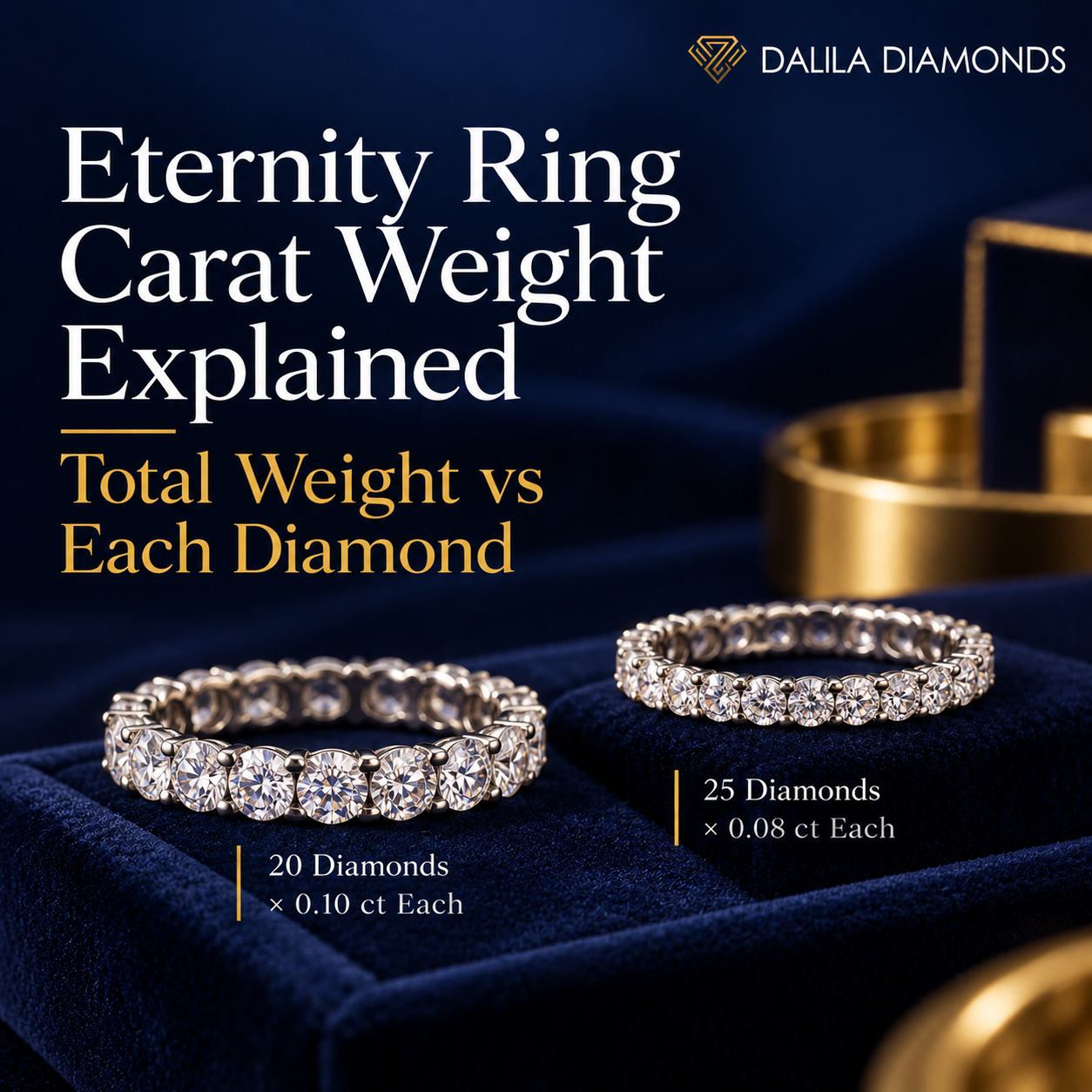
A 2-carat diamond eternity ring does not usually contain one 2-carat diamond. Instead, its total carat weight is distributed across multiple smaller diamonds set along part or all of the ring.
For example, a full eternity ring containing 20 natural diamonds weighing 0.10 carat each has a combined diamond weight of 2.00 carats total (2.00 ctw).
Another eternity ring might contain 25 diamonds weighing 0.08 carat each. That also produces 2.00 carats total, but the individual stones are smaller.
Both rings have the same total diamond weight, yet they may look different on the finger.
The finished appearance depends on four important variables: individual diamond size, stone count, ring size and the proportion of the band covered with diamonds.
A full eternity ring carries diamonds around the entire circumference. A half-eternity ring usually places diamonds across the visible upper section, leaving plain metal underneath.
Consequently, two eternity rings may have different total carat weights while showing very similar diamond sizes from above.
The most useful way to choose an eternity ring is to compare the actual millimetre size of each stone, the number of diamonds and the amount of band coverage—not total carat weight alone.
This guide explains how those factors work together, using practical calculations and real-world design assumptions for natural diamond eternity rings.
It focuses specifically on multi-stone eternity bands. Dalila's general carat-weight guide remains the reference for diamond weight as a measurement, while its solitaire size resources address a single centre stone.
What Does Total Carat Weight Mean in an Eternity Ring?
Total carat weight, abbreviated as TCW or CTW, means the combined weight of all diamonds in the ring.
A ring advertised as 1.00 ctw may contain 20 diamonds averaging 0.05 carat each.
A ring advertised as 3.00 ctw may contain 20 diamonds averaging 0.15 carat each.
The number of diamonds can also vary.
Example ring | Diamond count | Average weight per diamond | Total carat weight |
A | 20 | 0.05 ct | 1.00 ctw |
B | 20 | 0.10 ct | 2.00 ctw |
C | 25 | 0.08 ct | 2.00 ctw |
D | 20 | 0.15 ct | 3.00 ctw |
E | 24 | 0.125 ct | 3.00 ctw |
These are illustrative arithmetic examples, not identified Dalila rings or confirmed manufacturing layouts.
Notice that Examples B and C both contain two carats of diamonds.
However, Example B uses fewer, heavier stones, while Example C uses more, lighter stones.
The final ring's width and visible character cannot be determined from total weight alone.
How to Calculate the Average Weight of Each Diamond
The calculation is:
Average individual diamond weight = Total diamond carat weight ÷ Number of diamonds
For example, a full eternity ring has:
2.00 carats total.
20 natural round brilliant diamonds.
The average weight is:
2.00 ÷ 20 = 0.10 carat per diamond.
One carat equals 100 points, so each stone averages 10 points.
Now consider another two-carat ring with 25 stones:
2.00 ÷ 25 = 0.08 carat, or 8 points per diamond.
The first ring uses larger diamonds by average mass.
However, the exact diameters still depend on their individual proportions.
The calculation also provides an average rather than proving that every natural diamond weighs exactly the same.
In a carefully matched eternity ring, the diamonds may have slightly different individual weights while maintaining similar face-up dimensions.
Eternity Ring Carat Weight Chart: Individual Diamond Size
The following examples show how round brilliant diamonds of different approximate sizes contribute to total carat weight.
Approximate round diameter | Approximate weight per diamond | 10 stones | 15 stones | 20 stones | 25 stones |
1.5 mm | 0.015 ct | 0.15 ct | 0.23 ct | 0.30 ct | 0.38 ct |
2.0 mm | 0.030 ct | 0.30 ct | 0.45 ct | 0.60 ct | 0.75 ct |
2.5 mm | 0.060 ct | 0.60 ct | 0.90 ct | 1.20 ct | 1.50 ct |
3.0 mm | 0.100 ct | 1.00 ct | 1.50 ct | 2.00 ct | 2.50 ct |
3.5 mm | 0.160 ct | 1.60 ct | 2.40 ct | 3.20 ct | 4.00 ct |
4.0 mm | 0.250 ct | 2.50 ct | 3.75 ct | 5.00 ct | 6.25 ct |
Weights are approximate for round brilliants, and totals are arithmetic illustrations rounded to two decimals. These combinations are not guarantees that the listed number of stones will fit on a particular ring size.
For example, 25 stones measuring 4.0 mm cannot automatically be assumed to fit in an ordinary single-row eternity design.
The actual ring circumference, setting pitch and stone orientation must be checked.
The table explains weight multiplication, not mounting feasibility.
Why a 2-Carat Eternity Ring Can Look Different From Another 2-Carat Ring
Consider two hypothetical full-eternity designs.
Specification | Design A | Design B |
Total diamond weight | 2.00 ctw | 2.00 ctw |
Diamond count | 20 | 25 |
Average weight per diamond | 0.10 ct | 0.08 ct |
Approximate diamond diameter | 3.0 mm | 2.8 mm |
Coverage | Full | Full |
Ring size | Must be confirmed | Must be confirmed |
Setting pitch | Must be confirmed | Must be confirmed |
Design A has fewer diamonds, each weighing more.
Design B has more diamonds, each weighing less.
The first may create a slightly wider-looking diamond line, but that conclusion needs confirmation from actual stone measurements and settings.
The second may create a finer, more closely repeated line.
A 3.0 mm stone does not simply occupy 3.0 mm of finished ring circumference: the seat, retaining metal and any spacing also matter.
A manufacturer must approve the ring layout.
Equal total carat weight does not mean equal individual stone size, ring width or appearance.
Full Eternity vs Half Eternity: Why Coverage Changes Carat Weight
The difference between a full and a half-eternity ring is particularly important when comparing carat weights.
A full-eternity ring places diamonds around the complete circumference.
A half-eternity ring uses diamonds across a portion of the band, often approximately the visible upper half.
A three-quarter-eternity design is another option, covering most but not all of the band.
Illustrative coverage example
Suppose a jeweller designs three rings using the same natural round diamonds, each averaging 0.06 carat.
Design | Diamond count | Average weight per diamond | Total weight |
Full eternity | 24 | 0.06 ct | 1.44 ctw |
Three-quarter eternity | 18 | 0.06 ct | 1.08 ctw |
Half eternity | 12 | 0.06 ct | 0.72 ctw |
The examples deliberately keep the diamond size unchanged.
The total weight changes because of the number of stones and extent of coverage.
When viewed from directly above, the full and half versions could appear similar across the diamond-set upper arc if the settings and positions match.
However, they will look different from the underside and some side angles.
The completed metalwork and structural requirements also differ.
Does a half-eternity ring always contain exactly half the carat weight?
No.
The term half eternity does not establish one universally fixed percentage of circumference coverage.
Some designs cover slightly more than half the ring, and the end positions or layout may affect the final count.
For example, a half-eternity design with 13 diamonds and a full-eternity design with 24 diamonds would have a different weight ratio from the simple 12-versus-24 calculation.
The actual count should be confirmed.
Why this matters when shopping
A buyer may compare a 0.75-carat half-eternity ring with a 1.50-carat full-eternity ring and assume the second has much larger diamonds.
That might be false.
If both use similarly sized stones, the difference could come mainly from the additional diamond coverage.
The buyer should compare the actual individual dimensions.
How Ring Size Changes Total Carat Weight
Ring size affects circumference.
A larger finger generally requires a larger ring circumference, which can allow more repeating diamond settings when the individual stone diameter and construction remain constant.
Therefore, the same full-eternity design may require different stone counts at different ring sizes.
For example, a manufacturer may construct one ring with 22 diamonds and a larger version with 24 diamonds, using similarly calibrated natural stones.
If each diamond averages 0.06 carat:
22 diamonds produce approximately 1.32 ctw.
24 diamonds produce approximately 1.44 ctw.
The visible diamond size may remain similar despite the total weight changing.
Illustrative ring-size planning ranges
US ring size | Approx. inner circumference | Possible 2.0 mm diamond count | Possible 2.5 mm diamond count |
5 | 49.3 mm | 21–23 | 17–19 |
6 | 51.9 mm | 22–24 | 18–20 |
7 | 54.4 mm | 23–25 | 19–21 |
8 | 57.0 mm | 24–26 | 20–22 |
9 | 59.5 mm | 25–27 | 21–23 |
The counts are approximate planning possibilities for full-eternity round-diamond designs, not validated counts for each ring size. Actual centreline circumference, setting pitch, ring construction and jeweller tolerances can change them.
A ring's inner circumference does not equal the exact distance travelled by the centres of its diamonds.
The diamond settings sit within a three-dimensional band structure, so the manufacturer must establish the relevant pitch-circle geometry.
For final ordering, use the approved drawing rather than this general table.
How to Calculate Stone Count for a Full Eternity Ring
A preliminary estimate can be made using the circumference of the relevant setting layout and its centre-to-centre diamond spacing.
Approximate stone count = Diamond-setting pitch-circle circumference ÷ Effective setting pitch
The pitch-circle circumference depends on the actual setting geometry, not simply the finger circumference.
For example, suppose the manufacturing jeweller provides the following illustrative specifications:
Parameter | Value |
Setting pitch-circle circumference | 58.0 mm |
Effective setting pitch | 2.9 mm |
Estimated stone count | 20 |
58.0 ÷ 2.9 = 20 diamonds.
If the selected diamonds average 0.10 carat each:
20 × 0.10 = 2.00 ctw.
This illustrates the count-to-weight calculation.
It is not a complete instruction for engineering an eternity ring.
The setter must confirm stone dimensions, seat geometry, prong spacing, structural metal and a workable final ring size.
Does Setting Style Change Eternity Ring Carat Weight?
The setting does not change the weight of a selected diamond.
However, different settings may allow different numbers of diamonds around the ring.
For example, a compact shared-prong design may occupy a different amount of circumference than a bezel design.
A channel-set ring also uses a different metal structure and may require different diamond dimensions.
Setting style | Important stone-count consideration |
Shared prongs | Distance between neighbouring stones and supporting metal |
Individual four-prong heads | Head dimensions and connection geometry |
Bezel | Metal surrounding each stone may affect pitch |
Channel | Seat arrangement, sidewall structure and stone diameter |
Bar setting | Metal separation between stones |
U-prong | Girdle contact, setting pitch and structural support |
A bezel ring does not universally contain fewer diamonds than a shared-prong ring.
Nor does a channel setting automatically require smaller stones.
The actual construction determines the permitted count.
Because setting architecture influences stone quantity, the jeweller should approve the design before the supplier finalises the natural diamond parcel.
How Diamond Shape Changes Eternity Ring Weight
Round brilliant diamonds are common in eternity rings, but other shapes can produce different stone-count relationships.
Princess cuts have square outlines and pointed corners.
Emerald and baguette cuts can be arranged with their long or short dimensions following the circumference.
Oval and marquise diamonds may also be oriented in different ways.
A ring using 4.0 × 2.5 mm elongated stones cannot be calculated as though it uses 2.5 mm rounds.
The layout depends on which dimension follows the ring's circumference and the spacing needed between the stones.
Why shape matters
Shape | Measurement needed | Main layout question |
Round | Diameter | How many repeated circular seats fit? |
Princess | Length, width and corners | How are the corners supported? |
Baguette | Length and width | Which dimension follows the band? |
Emerald | Length, width and clipped corners | How does the setting accommodate geometry? |
Oval | Length and width | Is the long axis along or across the band? |
Marquise | Length, width and points | How are the pointed ends protected? |
The total carat weight should be calculated from the actual number and individual weights of the approved stones.
A round-diamond conversion chart should not be applied unchanged to elongated shapes.
Should You Choose Total Carat Weight or Individual Diamond Size First?
If the goal is a particular visible band width, begin with the approximate individual diamond diameter.
A buyer wanting a delicate line may prefer round diamonds around 1.5–2.0 mm.
Someone seeking more pronounced individual stones may prefer 2.5–3.5 mm diamonds or larger.
These are possible design preferences, not universal recommendations.
Once the desired diamond size is established, the manufacturer can determine how many stones fit within the intended ring size and coverage.
The total carat weight then follows from the selected count and actual individual weights.
Example: A ring with 2.5 mm diamonds
Suppose the buyer wants a full-eternity ring with approximately 2.5 mm round brilliants.
The manufacturer approves 20 stones.
If those stones average 0.06 carat:
20 × 0.06 = 1.20 ctw.
A buyer requesting precisely 1.00 ctw instead may need a different stone-size or count arrangement.
The correct choice depends on whether the priority is visual width, total weight or a particular setting.
Do not reduce or increase stone count arbitrarily without checking that the ring can still be manufactured to the required size.
Are More Diamonds Always Better?
No.
A ring with many small diamonds can produce a refined, continuous visual line.
A ring with fewer larger stones can create more distinct individual points of brilliance.
Neither design is inherently superior.
The correct appearance depends on the buyer's preferences, ring size, band coverage and setting.
The physical condition and consistency of the stones also matter.
A ring containing 25 poorly matched diamonds may be less attractive than one containing 20 carefully selected stones.
Carat weight and stone count should not replace an assessment of colour, clarity appearance, cut consistency and secure mounting.
Matching Natural Diamonds for an Eternity Ring
An eternity ring repeats diamonds across a continuous visible band.
This creates a need for consistent stone dimensions and appearance.
For many designs, matching the individual diameter or outline is more useful than insisting on precisely identical carat weights.
Two natural round brilliants may measure similarly face-up but weigh slightly differently due to cut proportions and girdle thickness.
However, the manufacturer's seats must accommodate the actual stones.
Natural diamond parcel requirements
Specification | Why it matters |
Diamond origin | Confirms the intended natural material |
Exact count | Matches the approved ring layout |
Individual size | Determines visual band width |
Calibrated tolerance | Supports setting compatibility |
Colour range | Prevents conspicuous outliers |
Clarity range | Supports the agreed quality specification |
Transparency | Avoids dull or cloudy stones |
Cut appearance | Creates a coordinated sparkle pattern |
Girdle condition | Important for stone retention |
Actual parcel weight | Determines the final total ctw |
The supplier should confirm the number of stones and the actual total weight.
The manufacturer should independently approve the setting and physical compatibility.
Small calibrated diamonds do not necessarily come with individual GIA, IGI or HRD grading reports.
For natural melee, parcel-level quality specifications and origin-verification processes may be more appropriate, depending on stone size and the agreed service.
Worked Example: One-Carat Half Eternity vs Two-Carat Full Eternity
Suppose a buyer is considering two natural diamond eternity designs.
The first covers approximately the visible upper half of the band.
The second places diamonds around the full circumference.
Both use round brilliants averaging 0.10 carat each.
Specification | Half eternity | Full eternity |
Individual diamonds | 0.10 ct average | 0.10 ct average |
Approximate individual diameter | 3.0 mm | 3.0 mm |
Diamond count | 10 | 20 |
Total diamond weight | 1.00 ctw | 2.00 ctw |
Diamond coverage | Upper section | Full circumference |
Visual size of each diamond | Similar | Similar |
Finished band dimensions | Jeweller to confirm | Jeweller to confirm |
These are hypothetical, feasible-looking arrangements, not actual manufacturer-approved rings.
Both use the same approximate individual diamond size.
The full-eternity ring contains twice the diamond weight because it uses twice as many stones.
When seen directly from above, the central stones could have a similar appearance.
However, the full-eternity version continues around the sides and underside, making it a different piece of jewellery.
The additional total weight does not mean that its individual diamonds are larger.
Worked Example: Why Ring Size Can Change a Full Eternity's TCW
A jeweller offers a design with round natural diamonds averaging 0.06 carat each.
The layout is adjusted for different ring sizes.
Design version | Approved count, hypothetical | Average stone weight | Calculated TCW |
Smaller ring | 18 | 0.06 ct | 1.08 ctw |
Medium ring | 20 | 0.06 ct | 1.20 ctw |
Larger ring | 22 | 0.06 ct | 1.32 ctw |
The stone diameter may remain approximately constant while the count changes.
This means the same commercial eternity-ring design might have a different total diamond weight depending on the finished size.
A product page that advertises one fixed ctw should clarify whether that weight applies to a reference size, all sizes within a tolerance or a specific selected ring.
The actual count and weight should be confirmed for the buyer's ring size.
What Happens if a Buyer Wants the Same TCW in Every Ring Size?
A manufacturer may choose to change individual diamond sizes or alter the design to maintain a target total weight across different ring sizes.
However, that can affect the visible width and setting.
For example, consider two rings both advertised as 2.00 ctw.
One might use 20 diamonds averaging 0.10 carat.
Another might use 22 diamonds averaging approximately 0.091 carat.
They contain similar total weights but different individual stones.
A buyer who expects identical appearance across sizes should ask whether the diamonds remain the same calibrated size.
The product description should explain which variable changes.
Full Eternity Resizing: Why This Matters Before Ordering Stones
A full-eternity ring has diamonds extending around the entire band.
That can make resizing difficult or sometimes impractical without rebuilding part of the ring.
A half-eternity or three-quarter-eternity design may offer more flexibility because it leaves a section of plain metal.
However, resizability cannot be guaranteed solely from the coverage label.
A jeweller must examine the actual band construction, remaining metal and intended size change.
The buyer should confirm ring size before committing to a full-eternity natural diamond parcel.
An incorrect size can make the original stone-count and setting layout unsuitable.
Real Design References: What Published Sizing Data Shows
Published eternity-ring planning resources demonstrate how the diamond count changes with ring size and calibrated stone dimensions.
For example, Carit's eternity-ring calculator gives approximate count estimates around 23 stones for a size-7 ring using 2.0 mm diamonds, compared with approximately 16 stones for 3.0 mm diamonds.
Guru Diam's natural melee guide gives another planning example: approximately 24 round diamonds around 2.0 mm for a size-7 full eternity, resulting in about 0.72 ctw when using stones around 0.03 carat.
These are published planning estimates, not approved Dalila product specifications.
They are useful evidence for the relationship between ring circumference, stone size and count.
They should not be interpreted as guaranteeing that any 24 stones measuring 2.0 mm will fit a particular customer's ring.
The manufacturer's actual setting pitch and CAD or hand-fabricated design must determine the final quantity.
Eternity Ring Carat-Weight Worksheet
Use this worksheet before ordering calibrated natural diamonds.
Ring specification
Requirement | Value |
Intended jewellery | Eternity ring |
Ring size | ______ |
Internal circumference | ______ mm |
Coverage | Full / Three-quarter / Half |
Diamond shape | ______ |
Metal and purity | ______ |
Setting style | ______ |
Band width | ______ mm |
Manufacturer-approved layout | Yes / No |
Diamond parcel specification
Requirement | Value |
Target individual diameter | ______ mm |
Calibrated size tolerance | ______ |
Average individual carat weight | ______ ct |
Required stone count | ______ |
Calculated target total weight | ______ ctw |
Actual parcel weight | ______ ctw |
Colour range | ______ |
Clarity range | ______ |
Cut appearance | ______ |
Natural-origin verification | ______ |
Girdle condition | ______ |
Spare diamonds, if agreed | ______ |
Finished ring count | ______ |
Weight calculation
Target TCW = Approved number of diamonds × Average weight per diamond
For the completed ring, use the combined actual weight of the diamonds that are set.
Additional loose spare diamonds should not be included in the finished jewellery's advertised total diamond weight.
Sourcing Natural Diamonds for an Eternity Ring
A useful sourcing enquiry should specify the stone size, count and manufacturing requirements.
A request for "two carats of diamonds for an eternity ring" does not establish which sizes or quantities the jeweller needs.
For example, the project could require 20 ten-point stones or a different number of slightly smaller diamonds.
Those alternatives cannot necessarily be substituted without changing the design.
Example natural diamond sourcing brief
Field | Requirement |
Jewellery | Full-eternity natural diamond ring |
Ring size | US 7, illustrative |
Diamond shape | Round brilliant |
Target diameter | Approximately 2.5 mm |
Calibrated tolerance | To be specified by setter |
Stone count | To be confirmed by jeweller |
Indicative average weight | Approximately 0.06 ct |
Target TCW | Based on approved count |
Colour | G–H |
Clarity | VS–SI, subject to agreed appearance |
Transparency | No unacceptable haze |
Cut consistency | Closely matched face-up appearance |
Origin | Natural, with agreed verification |
Setting style | Shared prongs |
Manufacturer approval | Required before purchase |
These are illustrative requirements, not current Dalila inventory offers.
Dalila Diamonds can receive specification-led natural loose-diamond sourcing enquiries.
The supplier should receive the final manufacturer-approved count and calibrated measurements before the order is placed.
The manufacturing jeweller remains responsible for determining the ring's setting pitch, finished size, band structure and stone security.
Supplier versus manufacturing jeweller responsibilities
Task | Diamond supplier | Manufacturing jeweller |
Source calibrated natural diamonds | Subject to availability | Defines required sizes |
Quote actual stone quantity | Yes | Confirms needed count |
Supply parcel weight | Yes | Reviews |
Provide available origin documentation | Yes | Reviews |
Assess colour and size matching | According to agreed scope | Inspects before setting |
Establish final ring size | No | Yes |
Determine stone layout | No | Yes |
Confirm setting compatibility | No | Yes |
Set and inspect ring | Not assumed | Yes |
Approve finished TCW disclosure | Supplies stone data | Confirms stones actually set |
A loose-diamond sourcing quotation does not automatically include manufacturing the finished eternity ring.
Common Mistakes When Comparing Eternity Ring Carat Weight
Assuming the total carat weight belongs to one diamond
An eternity ring's advertised ctw normally describes the combined weight of all its diamonds.
Comparing total weights without checking coverage
A full-eternity design may contain more diamonds than a half-eternity design using similarly sized stones.
Assuming two-carat rings have identical individual diamond sizes
Different stone counts can produce the same total weight.
Ignoring ring size
Larger ring sizes may need more diamonds when the individual stone diameter remains unchanged.
Treating a millimetre-to-carat conversion as exact
Actual weight depends on cutting proportions and girdle characteristics.
Ordering diamonds before the setting layout is approved
The selected quantity may not fit the ring.
Assuming every stone requires an individual grading report
Small natural diamonds are often supplied according to calibrated parcel specifications.
Including spare stones in finished jewellery weight
Only the diamonds actually used in the ring should contribute to the finished total.
Ignoring resizability
Full-eternity designs can have substantial resizing limitations.
Frequently Asked Questions
What does total carat weight mean in an eternity ring?
It is the combined weight of all diamonds set in the ring, not the weight of one stone.
Does a two-carat eternity ring contain a two-carat diamond?
Usually not. A conventional two-carat eternity ring distributes that weight across multiple diamonds, such as 20 stones averaging 0.10 carat each.
How many diamonds are in a one-carat eternity ring?
There is no fixed count. For example, 20 diamonds averaging 0.05 carat produce 1.00 ctw, but different sizes and settings can use different counts.
How big are the diamonds in a two-carat eternity ring?
That depends on the number of diamonds. Twenty stones averaging 0.10 carat may measure around 3.0 mm each, but actual dimensions vary.
Is a two-carat full eternity bigger than a one-carat half eternity?
It may contain more diamond mass because of greater coverage, without having larger individual diamonds. Compare stone diameter and the finished band.
Does a half-eternity ring have exactly half the diamonds?
Not necessarily. The actual coverage, setting construction and number of stones determine the count.
What does three-quarter eternity mean?
It describes a ring with diamonds extending around most, but not all, of the band. The exact coverage should be confirmed for the design.
Does ring size affect eternity ring total carat weight?
Yes. Larger sizes may require more diamonds if the stone size and setting remain the same.
Can two eternity rings have the same TCW but different widths?
Yes. They may use different individual stone sizes, stone counts or settings.
What is the best carat weight for an eternity ring?
There is no universal best weight. Choose the desired individual diamond size, coverage and ring design, then calculate the resulting total.
What does 10 points per diamond mean?
Ten points equals 0.10 carat. Twenty ten-point diamonds would total approximately 2.00 carats.
Are all eternity ring diamonds the same weight?
Not necessarily. Stones may have slightly different weights while being matched for face-up dimensions and appearance.
What is more important: Individual diamond size or total weight?
For the visible width of a ring, individual stone dimensions and setting construction are particularly useful. Total weight describes the combined diamond mass.
Are larger diamonds always better for eternity rings?
No. Larger stones create a different visual and structural design. Smaller stones may produce a finer, more continuous line. Suitability depends on the ring and wearer.
Does a bezel eternity ring use fewer diamonds?
It may, but not always. The actual setting pitch determines how many diamonds fit around the ring.
Can a full-eternity ring be resized?
Resizing can be difficult because diamonds surround the entire band. A jeweller must assess the specific construction and required size change.
Do eternity ring diamonds need GIA certificates?
Not every small diamond has an individual laboratory report. Calibrated natural melee may instead be supplied with agreed parcel specifications and origin-screening information.
Can Dalila source natural diamonds for an eternity ring?
Dalila can receive natural loose-diamond sourcing enquiries based on the required dimensions, quantity, colour, clarity and origin specifications, subject to availability.
What should I send Dalila to source an eternity-ring parcel?
Provide the approved ring size, coverage, diamond shape, calibrated diameter, count, quality range, natural-origin requirements and jeweller's manufacturing specifications.