Resetting an Inherited Diamond into a New Ring or Pendant: A Complete Guide
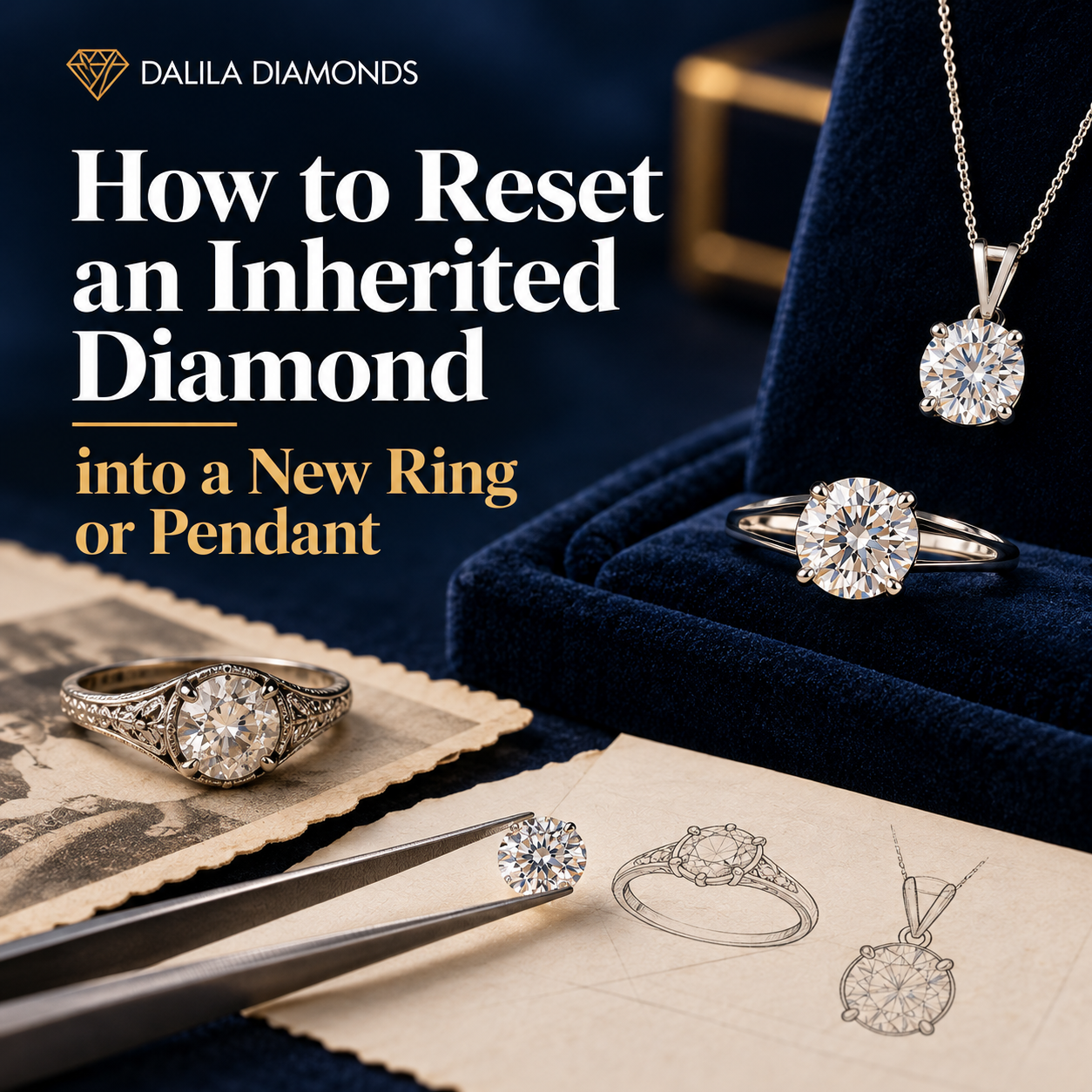
An inherited diamond can often be reset into a new ring or pendant, allowing you to keep the original stone while creating jewellery that suits your personal style. However, before removing a diamond from an older setting, it is important to verify what the stone is, inspect its condition and understand the risks involved in resetting it.
For example, you may have inherited your grandmother's diamond engagement ring. The diamond itself is meaningful, but the existing ring may be too large, worn, outdated or unsuitable for everyday use.
You could keep the original diamond and have it mounted in a modern solitaire ring.
Alternatively, you could turn the same diamond into a pendant, preserving its connection to your family while creating jewellery you may wear more frequently.
Both options can work.
But the original stone must be examined before a manufacturing jeweller can determine which designs are suitable.
An inherited diamond may not have a modern grading report. Its exact carat weight, cut, natural origin or condition may be uncertain. Older settings can also conceal chips, girdle damage or previous repairs.
Removing the diamond without properly documenting its condition can create unnecessary risk.
The safest approach is to identify and inspect the inherited diamond first, then choose a new setting based on its actual measurements and physical condition.
This guide explains how to verify an inherited diamond, compare ring and pendant resetting options, protect the stone during the process and prepare a complete handoff document for the jeweller.
Can You Reset an Inherited Diamond?
Yes. Many inherited diamonds can be removed from their original jewellery and mounted into new designs.
A natural diamond from an older ring may potentially become:
A modern solitaire engagement ring.
A right-hand ring.
A bezel-set diamond ring.
A solitaire pendant.
A vintage-inspired pendant.
Part of a new custom jewellery design.
However, the fact that a stone is a diamond does not automatically mean it is safe to remove and reset.
The jeweller must inspect the stone and its current mounting.
A chip near the girdle, a feather reaching the surface or an unusually thin part of the stone may influence how it should be handled.
The diamond's dimensions can also limit the settings available.
Some inherited diamonds are old European cuts, old mine cuts, rose cuts or other older cutting styles. These may have different proportions from modern round brilliant diamonds.
A new setting must accommodate the actual stone, not a standard modern-diamond size assumption.
Should You Keep the Original Ring or Reset the Diamond?
Before commissioning a new piece, decide whether preserving the complete original jewellery is important.
Resetting is not the only option.
In some cases, repairing or resizing the existing ring may be more appropriate.
In others, removing the diamond and creating a new piece may allow it to be worn more comfortably.
Compare the main choices
Option | What happens | Best reason to consider it |
Preserve the original jewellery | Keep the diamond in its existing setting | Original piece has significant sentimental or historical value |
Restore the existing setting | Repair worn prongs, metal or other damage | Original design is still desirable |
Reset into a new ring | Remove diamond and manufacture another ring | Prefer a different style, size or setting |
Reset into a pendant | Move diamond into a necklace mounting | Prefer jewellery that does not require ring sizing |
Preserve the original and source a new diamond | Keep heirloom intact and commission separate jewellery | Avoid altering an important family piece |
A historic or antique ring may have value beyond the loose diamond.
Its original metalwork, craftsmanship, hallmarks and design may be part of what makes the object significant.
Before dismantling an unusual, signed or potentially valuable antique piece, consider an independent appraisal or specialist assessment.
Removing the stone can be an irreversible change to the original jewellery.
Step 1: Identify What You Have Inherited
The first step is to establish the jewellery's basic characteristics.
A family may describe an inherited stone as a one-carat natural diamond, but the description might be based on an estimate made many years ago.
The stone could have a different weight, shape or cutting style.
It may also be accompanied by an old appraisal that does not include modern laboratory grading.
Initial inherited jewellery checklist
Information | What to record |
Jewellery type | Ring, pendant, brooch or other |
Number of diamonds | One or several |
Apparent centre diamond shape | Round, oval, cushion or other |
Approximate diamond dimensions | To be measured professionally |
Metal | Gold, platinum or another alloy |
Hallmarks or maker's marks | Photograph and record |
Existing grading report | Available or not |
Previous appraisal | Available or not |
Known repairs | Record if known |
Visible damage | Document before handling |
Ownership documents | Keep available |
Intended new jewellery | Ring, pendant or undecided |
These details form the starting point for professional examination.
A previous owner may have known the original jeweller or purchase date. Any existing documents should be preserved even if their grading terminology is outdated.
However, family descriptions are not a substitute for gemmological verification.
Step 2: Verify That the Stone Is a Diamond
Do not assume a stone is a natural diamond simply because it has been in the family for several generations.
A jeweller or qualified gemmologist should first establish whether it is a diamond and, where required, whether it is natural or laboratory-grown.
Other materials, including diamond simulants, can resemble diamonds to an untrained observer.
Older jewellery may also contain replacement stones installed during previous repairs.
What needs verification?
Verification item | Purpose |
Diamond identification | Establishes whether the stone is diamond |
Natural or laboratory-grown origin | Confirms the material category |
Shape and cutting style | Identifies its physical form |
Approximate weight | Supports initial planning |
Measurements | Helps evaluate new settings |
Treatments, where relevant | Influences disclosure and handling |
Condition | Identifies damage or vulnerabilities |
Existing report identity | Connects stone with documentation |
A professional assessment can begin while the diamond remains mounted.
However, a setting may obstruct some observations.
The jeweller should explain any limitations before offering definitive conclusions.
Step 3: Check Whether the Diamond Has a Grading Report
An inherited diamond may come with a report from GIA, IGI or HRD Antwerp.
If a report is available, record the laboratory and report number.
The report can provide important information about the stone's weight, dimensions, colour, clarity and cut-related characteristics.
Depending on the report, it may also contain an inscription reference or a clarity-characteristic plot.
How to verify an existing report
Use the issuing laboratory's official verification system.
For example:
GIA Report Check.
IGI's official report-verification system.
My HRD Antwerp.
Compare the report details with the inherited diamond.
Where an inscription is present, a qualified jeweller may inspect it under appropriate magnification.
The existence of a valid laboratory record does not by itself prove that the physical stone in the inherited ring matches that record.
The connection between the diamond and documentation should be checked.
What if the diamond has no certificate?
A diamond can be genuine and valuable without a modern grading report.
The absence of a report is not, by itself, proof of a problem.
However, obtaining an independent report may help clarify the stone's characteristics before it is reset.
For example, a GIA Diamond Grading Report can establish important information about an eligible loose natural diamond.
It is also useful documentation when discussing insurance or future resale.
Does the diamond need to be removed for grading?
For a standard GIA Diamond Grading Report, yes.
GIA requires the diamond to be loose because a mounting can interfere with grading and accurate weight determination.
A jeweller should therefore inspect the stone and discuss removal risks before arranging grading.
Some mounted-jewellery assessment services exist, but they may provide estimated information rather than the same results as a complete loose-diamond grading report.
Not every inherited diamond requires a new laboratory report before resetting.
The decision should depend on the stone, its existing documents, its value and the intended project.
Step 4: Inspect the Diamond for Chips, Fractures and Wear
Diamonds are exceptionally hard, but they are not indestructible.
A diamond can chip or fracture under an impact, particularly around vulnerable areas.
Older jewellery may also have been repaired several times.
A diamond that appears undamaged from above may have a chip concealed by a prong or bezel.
Removing the stone may expose that damage.
Pre-removal condition checklist
Area | What the jeweller should inspect |
Table | Surface damage or abrasion |
Crown facets | Chips and visible wear |
Girdle | Chips, abrasions and extremely thin sections |
Culet | Damage, where applicable |
Corners or points | Vulnerable areas on fancy shapes |
Existing feathers | Whether they extend towards the surface |
Inclusions near prongs | Potential setting concerns |
Polish | Existing surface condition |
Previous repairs | Any evidence of intervention |
Setting contact areas | Damage concealed by metal |
The jeweller should document the condition before removal.
Photographs and, where appropriate, magnified images can be useful.
Why condition checks matter
Suppose an inherited princess-cut diamond has a small chip near one corner.
The original prong may conceal it.
A new four-prong design could place pressure near the same vulnerable area.
The jeweller must assess whether the proposed setting can protect the corner safely.
The correct solution may require adjusting the design or selecting another mounting.
A pre-existing chip should not automatically be treated as damage caused during resetting.
This is why documentation before removal is important.
Step 5: Measure the Inherited Diamond Correctly
A new ring or pendant should be designed around the diamond's actual dimensions.
Carat weight is not enough.
Two diamonds with the same carat weight may have different measurements because of their cut proportions.
This is particularly important with older diamond cuts.
Important measurements
Measurement | Why it matters |
Minimum diameter or width | Establishes face-up dimensions |
Maximum diameter or length | Determines outline and setting fit |
Total depth | Helps establish pavilion clearance |
Girdle characteristics | Important for secure mounting |
Crown profile | Affects seating and visual height |
Pavilion profile | Affects space required below the girdle |
Culet size and position | May matter for older cuts |
Corner or point geometry | Important for fancy shapes |
Symmetry and outline | Helps manufacturer plan the setting |
The jeweller should record the measurements that can be obtained while mounted and identify any values that require removal to establish accurately.
Why old-cut diamonds need special attention
An old European-cut diamond may have different proportions from a modern round brilliant.
An old mine-cut diamond may have a cushion-like outline and distinctive facet arrangement.
A rose-cut diamond may have a much flatter profile than a modern brilliant.
A standard ready-made mounting designed around a modern round diamond may not be appropriate for these stones.
Customisation may be necessary.
For detailed cut identification and comparison, use Dalila's dedicated old mine, old European and rose-cut diamond resources.
Step 6: Choose Between a New Ring and a Pendant
Once the diamond has been verified and inspected, the owner can decide how it should be worn.
The two most common choices are a ring and a pendant.
Both have advantages and limitations.
Ring vs pendant comparison
Consideration | New ring | New pendant |
Ring size required | Yes | No |
Contact during daily activities | Often greater | Depends on design and wear |
Setting profile | Important for finger comfort | Important for pendant balance |
Chain required | No | Yes |
Diamond orientation | Based on ring design | Must align with pendant design |
Stone protection | Depends on setting and wear | Depends on setting and wear |
Metal requirements | Band, head and supports | Head, bail and possibly chain |
Design flexibility | Wide range | Wide range |
Main technical priority | Fit, security and finger clearance | Security, suspension and balance |
Neither option is universally safer or more appropriate.
A ring may preserve the emotional connection to an engagement-ring tradition.
A pendant may be more practical for someone who does not regularly wear rings.
The choice should reflect how the owner intends to use the jewellery.
Design Path A: Resetting an Inherited Diamond into a New Ring
A new ring can preserve the inherited diamond while changing the jewellery's appearance.
For example, an inherited yellow-gold ring with a high-profile setting could be redesigned as a lower-profile solitaire.
Alternatively, the owner may prefer a bezel design, a vintage-inspired setting or a new ring with side diamonds.
However, the diamond's condition determines what is feasible.
Option 1: Solitaire ring
A solitaire ring keeps attention on the inherited diamond.
The jeweller should select the appropriate head, prong arrangement and setting height for the actual stone.
Option 2: Bezel-set ring
A bezel can provide a continuous metal perimeter around the stone.
It may be worth discussing for a diamond whose outline or intended wear benefits from that type of protection.
However, a bezel is not automatically suitable for a chipped diamond.
The jeweller must assess the location and severity of any damage before applying setting pressure.
Option 3: Vintage-inspired ring
An inherited diamond with an older cutting style may suit a design inspired by historical jewellery.
The mounting could use appropriate decorative details and a metal profile chosen to complement the stone.
The jeweller should not force an irregular old-cut diamond into a standard modern head.
Option 4: Ring with side diamonds
A new ring may incorporate additional natural side stones.
If new diamonds are sourced, they should be selected for appropriate dimensions, colour harmony and overall design balance.
The inherited diamond's appearance should remain the basis for the project.
Ring-resetting technical checklist
Requirement | What must be confirmed |
Diamond dimensions | Actual length, width and depth |
Existing damage | Full documented condition |
Ring size | Professionally measured |
Metal and alloy | Chosen for design |
Head geometry | Designed for the stone |
Prong or bezel support | Approved by setter |
Pavilion clearance | Sufficient |
Setting height | Appropriate for wear |
Side stones, if any | Matched to intended design |
Final band profile | Comfortable and structurally suitable |
A completed drawing or CAD model should be approved before manufacture where the design requires it.
Worked Example: Turning Grandmother's Diamond into a New Ring
Suppose someone inherits a diamond ring believed to contain an approximately 0.80-carat old European-cut diamond.
The ring is too large and the original prongs are visibly worn.
The recipient wants a modern ring while keeping the original stone.
Initial assessment
Item | Illustrative finding |
Diamond type | Believed natural |
Cutting style | Old European cut |
Carat weight | Estimated, not confirmed |
Existing report | None |
Setting | Older prong head |
Prong condition | Worn |
Diamond condition | Requires examination |
Owner's preference | New low-profile ring |
This is a hypothetical example, not a documented Dalila customer project.
The jeweller's process
First, the ring is photographed and inspected.
The jeweller evaluates the visible diamond condition and explains the risks associated with removing it.
If the owner wants independent loose-stone grading, the jeweller plans that step after a safe removal.
The diamond is then measured accurately and assessed for damage.
Only after the stone's dimensions and condition are known can the new mounting be specified.
Possible design outcome
A new solitaire head may be developed around the old-cut diamond.
The ring can be made in the owner's chosen metal and appropriate size.
If the diamond has an irregular outline, the head must accommodate it.
The final result should be inspected for security and comfort.
The example does not guarantee that every inherited old European-cut diamond can be reset into a low-profile ring.
That decision depends on the actual stone.
Design Path B: Resetting an Inherited Diamond into a Pendant
A pendant is another way to preserve an inherited diamond.
It may suit someone who rarely wears rings or prefers jewellery that does not require finger sizing.
An inherited engagement-ring diamond can potentially become a solitaire pendant.
However, the design must account for the diamond's actual shape, depth, setting requirements and orientation.
Option 1: Prong-set pendant
The diamond is held in a head using appropriately positioned retaining metal.
The jeweller should confirm the setting's security and the relationship between the head, bail and chain.
Option 2: Bezel-set pendant
A bezel surrounds the diamond's perimeter and can create a relatively clean visual outline.
The jeweller must design the bezel around the actual diamond.
A damaged girdle or vulnerable point may require special consideration.
Option 3: Vintage-style pendant
An old-cut inherited diamond may be incorporated into a design that complements its historical appearance.
This could include a decorative frame or metal details inspired by the original jewellery.
The exact design should be based on the stone's measurements and condition.
Pendant-resetting technical checklist
Requirement | What must be confirmed |
Diamond shape | Correctly identified |
Face-up dimensions | Measured |
Depth | Confirmed |
Girdle or corner condition | Inspected |
Setting type | Prong, bezel or other |
Bail attachment | Secure |
Pendant orientation | Approved |
Weight and balance | Comfortable |
Chain compatibility | Appropriate |
Necklace length | Recipient preference |
Final movement | Pendant hangs as intended |
A pendant should be evaluated as a complete piece of jewellery.
The diamond head, bail and chain all contribute to wearability.
Worked Example: Turning an Inherited Diamond Ring into a Pendant
Suppose an owner inherits a 0.60-carat natural round brilliant diamond ring.
The original ring belonged to a relative, but the recipient does not wear rings.
They would like to create a solitaire pendant.
Initial information
Specification | Illustrative detail |
Original jewellery | Diamond solitaire ring |
Diamond weight | 0.60 ct |
Shape | Round brilliant |
Diamond origin | Natural, subject to documentation |
Approximate diameter | Around 5.4 mm |
Desired jewellery | Solitaire pendant |
Metal preference | 18K yellow gold |
Setting preference | Bezel |
Chain | To be selected separately |
The diamond's real dimensions and condition must be confirmed.
Planning the reset
The jeweller inspects the old ring before removing the diamond.
The original setting is documented.
The diamond is then removed under agreed conditions and examined.
If suitable for the intended design, the jeweller creates a bezel sized to the actual girdle.
The pendant's bail and chain attachment are planned.
The owner selects an appropriate chain length and design.
Important considerations
The diamond may be suitable for a pendant, but the actual bezel construction requires setter approval.
The original ring's metal may or may not be suitable for reuse.
Any proposal to melt or incorporate the original metal should be discussed separately.
The chain and bail may represent additional costs beyond the diamond setting.
This is an illustrative design process, not a completed service offered by Dalila.
Can You Reuse the Gold From the Original Inherited Ring?
Sometimes, but not automatically.
An owner may want to preserve both the diamond and the original gold.
However, remelting jewellery metal introduces questions about alloy composition, contamination, solder, wear and manufacturing suitability.
A jeweller may recommend refining the old metal or using new metal of a specified alloy.
Some manufacturers do not accept customer-supplied metal for certain types of production.
If retaining the original gold is important, ask whether it can be reused and how that process is documented.
Questions to ask
Is the original metal suitable for reuse?
Will it be physically incorporated into the new jewellery?
Will it be refined or mixed with new metal?
Is there a minimum metal quantity?
How will the original metal be tracked?
Will any unused metal be returned?
What happens if the original metal is unsuitable?
Do not assume the entire new ring or pendant can be manufactured solely from the old ring's gold.
The jeweller must confirm the feasibility.
Step 7: Understand the Risks of Removing an Old Diamond
Removing a diamond from an older setting requires care.
The diamond may have existing chips, surface-reaching inclusions or vulnerable corners.
The retaining metal may be worn, distorted or difficult to open safely.
The risk depends on the stone and construction.
Possible complications
Risk | Why it matters |
Previously concealed chip | May become visible after removal |
Fragile corner or point | Could be vulnerable during handling |
Worn or rigid prongs | Removal may require additional work |
Old repairs | Can complicate dismantling |
Irregular girdle | Requires careful setting planning |
Damaged original mounting | May not survive intact |
Unusual historical construction | May need specialist handling |
The jeweller should explain the likely process before beginning.
In particular, the owner should understand whether removing the diamond could permanently alter the original mounting.
A ring that is dismantled for resetting may not be restorable to its previous condition.
Step 8: Arrange Insurance and Agree Responsibility Before Handover
An inherited diamond may have financial and sentimental value.
Before handing it over for removal, grading or resetting, clarify how it will be protected.
Do not assume that the jeweller's general business insurance covers every customer-owned diamond under every circumstance.
The actual policy may have exclusions or limits.
Likewise, a household jewellery insurance policy may have conditions concerning shipping, loose stones and work performed by third parties.
Insurance questions to ask
Question | Why it matters |
Is the inherited jewellery currently insured? | Establishes existing protection |
Is there a recent appraisal? | May support insurance discussions |
Does insurance cover stone removal? | Confirm scope |
Is accidental damage during setting covered? | Critical liability issue |
Who is responsible during transport? | Establishes transit arrangements |
Is the stone insured while loose? | Coverage may differ from mounted jewellery |
Does laboratory submission require separate cover? | Confirm |
What happens if the stone is lost? | Claims process |
What happens if the stone breaks? | Liability and exclusions |
Is the completed jewellery insured? | Update coverage after resetting |
An appraisal and a laboratory grading report serve different purposes.
A grading report describes diamond characteristics.
An insurance appraisal estimates value for a defined purpose.
GIA does not provide monetary appraisal values through its standard diamond grading reports.
If the jewellery is valuable, an independent appraisal may be appropriate before substantial work begins.
Step 9: Create a Photographic Condition Record
Before the jeweller accepts the inherited jewellery, record its condition.
The documentation should include the complete item and close-up views of the diamond and setting.
Recommended photographs
Photograph | Purpose |
Entire original ring or pendant | Records received jewellery |
Front face-up view | Shows diamond and design |
Side view | Shows setting height and metalwork |
Back or underside | Records head and gallery |
Hallmarks | Documents metal markings |
Existing damage | Records visible condition |
Girdle and corner areas | Useful where accessible |
Grading-report number | Connects documentation |
Item with intake reference | Helps avoid identification errors |
The jeweller should provide an intake record with a reference number.
The owner should retain a copy.
If the diamond is removed and sent for laboratory analysis, the stone should remain traceable throughout the process.
Step 10: Prepare a Secure Jeweller Handoff
A professional handoff document is particularly important when an inherited diamond is moved between multiple parties.
For example, one jeweller may remove the diamond, an independent laboratory may grade it and another manufacturing jeweller may create the finished ring.
Each transfer creates an additional point of responsibility.
Custody and handoff checklist
Field | Required information |
Owner | ______ |
Jewellery description | ______ |
Intake date | ______ |
Item reference | ______ |
Diamond description | ______ |
Current setting condition | ______ |
Visible stone condition | ______ |
Existing documents | ______ |
Estimated or known weight | ______ |
Estimated or measured dimensions | ______ |
Removal authorised | Yes / No |
Removal risks explained | Yes / No |
Insurance arrangements | ______ |
Person responsible during removal | ______ |
Laboratory submission required | Yes / No |
Stone custody after removal | ______ |
Next delivery destination | ______ |
Transport responsibility | ______ |
Final setting design approved | Yes / No |
Completion and return terms | ______ |
This should be signed or otherwise formally acknowledged according to the jeweller's normal intake process.
The document should not merely state that a diamond was received.
It should identify the jewellery, the specific work authorised and the condition of the item at handover.
Step 11: Compare the Cost of Resetting Into a Ring vs Pendant
Resetting an inherited diamond can involve several separate charges.
The diamond may already be owned, but the new jewellery is not free to manufacture.
Cost breakdown
Cost component | New ring | New pendant |
Original jewellery inspection | Possible | Possible |
Diamond removal | Possible | Possible |
Laboratory grading | Optional, as appropriate | Optional, as appropriate |
Appraisal | May be needed | May be needed |
New metal | Band and head | Head and bail |
Ring sizing | Required | Not applicable |
Custom design | Depends on project | Depends on project |
Stone setting | Required | Required |
Additional diamonds | Optional | Optional |
Chain | Not applicable | Usually separate |
Finishing | Required | Required |
Shipping and insurance | As agreed | As agreed |
Taxes | Applicable | Applicable |
There is no universal rule that a pendant reset will always cost less than a ring reset.
A simple pendant may require less metalwork than a complex ring.
However, a custom bezel, decorative pendant frame or expensive chain can significantly change the total.
Obtain an itemised quotation for both paths.
Can You Add New Natural Diamonds to an Inherited Stone?
Yes, if the jeweller approves the design and the existing stone can be set safely.
An owner might use an inherited centre diamond with two new side stones.
Another might surround an old-cut diamond with a halo of small natural diamonds.
The new stones should complement the inherited diamond's dimensions, colour, outline and optical appearance.
For example, a slightly warm old European-cut diamond may look noticeably different beside very high-colour melee.
That contrast might be desirable or undesirable depending on the planned design.
The buyer should compare actual diamonds rather than assume the highest colour grade automatically produces the best match.
What the diamond supplier needs
Specification | Requirement |
Existing centre diamond | Verified measurements |
Centre cutting style | Identified |
Centre colour appearance | Recorded |
New diamond quantity | Confirmed |
New diamond shape | Specified |
Size and tolerance | Approved by jeweller |
Colour and clarity | Agreed |
Natural origin | Required if specified |
Matching objective | Consistent or intentionally contrasting |
Budget | Provided |
Intended setting | Approved drawing |
This is where a natural loose-diamond supplier may support the project.
However, sourcing new stones is not the same as accepting the original inherited diamond for resetting.
Worked Example: Inherited Centre Diamond With Two New Side Stones
Suppose an owner inherits a natural round diamond of approximately 0.75 carat.
They want a three-stone anniversary ring.
The original centre diamond will be retained.
Two new natural diamonds will be placed on either side.
Initial brief
Component | Illustrative specification |
Original centre | Natural round brilliant, approximately 0.75 ct |
Centre diameter | Around 5.8 mm, to be measured |
New side stones | Two natural round brilliants |
Target side diameter | Approximately 3.5 mm each |
Side weight | Approximately 0.15 ct each |
Colour | Visually compatible with centre |
Clarity | Visually suitable |
New mounting | Custom three-stone ring |
Ring size | Professionally measured |
The two side diamonds should be selected as a visually balanced pair.
The actual centre's colour, cut appearance and size must be evaluated before finalising the side-stone requirements.
The manufacturing jeweller should approve the three-stone proportions and head geometry.
The new stones can then be sourced according to the approved dimensions.
This is an illustrative design, not a documented Dalila order.
For the detailed trade procedure for matching two stones, use Dalila's matched diamond pairs guide rather than treating this page as a complete pair-sourcing manual.
What if the Inherited Diamond Is Damaged?
A damaged diamond may still be usable, but its resetting options can be limited.
The jeweller should assess the location and extent of the damage.
A small chip in one position may influence the choice of prongs or bezel.
A more serious fracture could make the stone unsuitable for the proposed setting.
In some cases, a specialist may discuss recutting or repolishing.
However, recutting can reduce carat weight and alter the stone's appearance.
It may also affect historical features that are important to the owner.
Possible outcomes
Condition | Possible next step |
Minor surface wear | Professional assessment; setting may still be possible |
Small girdle chip | Evaluate location and mounting suitability |
Chipped corner | Review protection and resetting risk |
Surface-reaching fracture | Specialist gemmological assessment |
Significant damage | Consider whether resetting is appropriate |
Historically important old cut | Assess preservation before altering the stone |
The appropriate decision must come from examination of the actual diamond.
Do not attempt to conceal damage by applying pressure with a new setting.
A bezel or prong arrangement is not a substitute for proper condition assessment.
What if the Inherited Jewellery Is Antique?
Some inherited jewellery is older than the diamond itself.
Other pieces contain original settings and old-cut diamonds that together form a historically meaningful object.
The original design may have value to collectors or the family.
Before changing an antique ring or pendant, consider whether preservation is preferable.
Reasons to seek a specialist assessment
Unusual hallmarks or maker's marks.
Signed jewellery from a recognised manufacturer.
Intricate historical workmanship.
Old mine, old European or rose-cut diamonds.
Original period settings.
Unusual diamond shapes or proportions.
Significant family documentation.
Potential collectible or historical value.
The resetting project should focus on practical jewellery decisions.
A separate heirloom or provenance guide can cover the original piece's history, ownership records and family legacy in greater depth.
This distinction is important because a diamond's provenance and its physical suitability for resetting are related but different subjects.
Can Dalila Diamonds Reset an Inherited Diamond?
Dalila Diamonds publicly offers specification-led natural loose-diamond sourcing through services such as DS4U — Diamond Source For You.
It also provides professional sourcing support through S2S — Secure To Source.
However, I could not verify that Dalila accepts customer-owned inherited diamonds for removal, repair, resetting, appraisal or finished jewellery manufacturing.
These services should not be advertised without direct confirmation.
Dalila's verified sourcing role is more relevant when a project requires new natural diamonds.
For example, a jeweller resetting an inherited centre stone into a three-stone ring may need two matching natural side diamonds.
A custom pendant may require additional small diamonds for a surrounding design.
In such cases, the buyer or manufacturing jeweller can prepare a specification-led natural-diamond sourcing enquiry.
What Dalila can be approached about
Sourcing a new natural diamond to an approved specification.
Finding matched natural side stones.
Identifying calibrated melee for a halo or decorative setting.
Supplying available grading-report and stone details.
Quoting natural loose diamonds according to agreed requirements.
Availability, matching services and transaction terms must be confirmed for the individual request.
What should not be assumed
Dalila will receive the original inherited jewellery.
Dalila will remove the inherited diamond.
Dalila will issue an insurance appraisal.
Dalila will manufacture the ring or pendant.
Dalila will insure a customer-owned heirloom during third-party work.
Dalila will buy back or trade in the inherited diamond.
Dalila will guarantee that an old diamond can be reset.
Those responsibilities belong with qualified specialists unless Dalila explicitly confirms otherwise.
Supplier and Manufacturing Jeweller Responsibilities
Task | Diamond supplier | Qualified jeweller or specialist |
Inspect inherited jewellery | Not assumed | Yes |
Verify stone identity | Not assumed for customer-owned stones | Arrange appropriate examination |
Assess existing damage | Not assumed | Yes |
Discuss appraisal and insurance | Not assumed | As agreed |
Remove original diamond | Not assumed | Yes |
Obtain laboratory grading | Not assumed | Coordinate if required |
Design new ring or pendant | Not assumed | Yes |
Confirm mounting compatibility | No | Yes |
Source additional natural diamonds | Subject to availability | Defines requirements |
Manufacture new setting | Not assumed | Yes |
Set inherited diamond | Not assumed | Yes |
Inspect completed jewellery | Not assumed | Yes |
The owner should establish one clearly responsible party for each stage.
Inherited Diamond Resetting Worksheet
Use the following worksheet before authorising removal or manufacturing.
A. Existing jewellery
Field | Information |
Owner | ______ |
Project reference | ______ |
Existing jewellery type | ______ |
Metal and purity | ______ |
Hallmarks | ______ |
Number of stones | ______ |
Existing report | Yes / No |
Existing appraisal | Yes / No |
Current insured value, if any | ______ |
Photographs taken | Yes / No |
Visible damage recorded | Yes / No |
Historical assessment needed | Yes / No |
B. Inherited centre diamond
Field | Information |
Diamond identity confirmed | Yes / No / Pending |
Natural origin confirmed | Yes / No / Pending |
Shape | ______ |
Cutting style | ______ |
Carat weight | ______ |
Estimated or actual dimensions | ______ mm |
Total depth | ______ mm |
Girdle condition | ______ |
Corner or point condition | ______ |
Culet | ______ |
Clarity observations | ______ |
Visible chips | ______ |
Surface-reaching features | ______ |
Laboratory | ______ |
Report number | ______ |
Laser inscription | ______ |
Pre-removal condition approved | Yes / No |
C. Proposed ring design
Requirement | Value |
Ring size | ______ |
Metal and alloy | ______ |
Setting style | ______ |
Centre head dimensions | ______ |
Girdle support | ______ |
Pavilion clearance | ______ |
Prong or bezel design | ______ |
Side diamonds | Yes / No |
New stone measurements | ______ |
Expected setting height | ______ |
CAD or drawing approved | Yes / No |
D. Proposed pendant design
Requirement | Value |
Pendant style | ______ |
Metal and alloy | ______ |
Setting type | ______ |
Centre diamond orientation | ______ |
Bail design | ______ |
Chain type | ______ |
Chain length | ______ |
Pendant balance reviewed | Yes / No |
Girdle support approved | Yes / No |
CAD or drawing approved | Yes / No |
E. Insurance and custody
Requirement | Status |
Pre-work appraisal considered | ______ |
Insurance provider consulted | ______ |
Removal-related liability agreed | ______ |
Setting-related liability agreed | ______ |
Item intake receipt issued | ______ |
Photographs attached | ______ |
Original jewellery reference recorded | ______ |
Diamond identity tracked | ______ |
Laboratory transport arranged | ______ |
Insurance during transport confirmed | ______ |
Custody transfers documented | ______ |
Unused original metal return agreed | ______ |
Original mounting return agreed | ______ |
Completion date confirmed | ______ |
Final inspection documented | ______ |
This sheet should be retained with the jeweller's work order and any grading or appraisal reports.
Common Mistakes When Resetting an Inherited Diamond
Removing the stone before examining the original jewellery
The original mounting may have historical or collectible value.
Assuming the inherited stone is natural without verification
Professional identification should be arranged where origin is uncertain.
Assuming the original appraisal is a modern grading report
An appraisal and laboratory grading report serve different purposes.
Ignoring pre-existing diamond damage
Chips or fractures should be documented before removal.
Using a standard setting based only on carat weight
Old-cut diamonds may have unusual dimensions and require custom work.
Assuming the original gold can automatically be reused
Metal suitability and tracking must be confirmed.
Forgetting insurance during removal and transport
Coverage and liability should be agreed before the jewellery is handed over.
Choosing a pendant or ring without considering daily wear
The final design should reflect the owner's preferences and the stone's condition.
Failing to document who holds the diamond
Every handoff should have a clear custody record.
Assuming Dalila performs jewellery resetting
Its publicly described services focus on sourcing loose natural diamonds, not confirmed customer-owned jewellery repair or manufacture.
Frequently Asked Questions
Can you reset an inherited diamond?
Yes, in many cases. A qualified jeweller should first verify the stone, inspect its condition and determine whether it is suitable for the proposed new setting.
Can I turn my grandmother's diamond ring into a new ring?
Potentially. The jeweller can examine the existing diamond and design a mounting suited to its actual measurements and condition.
Can I turn an inherited diamond ring into a pendant?
Yes, if the diamond is suitable for the planned pendant setting. The jeweller must approve its dimensions, mounting and suspension design.
Is it safe to remove a diamond from an old ring?
It may be, but removal carries risks that depend on the diamond's condition and the original setting. A professional should inspect the piece first.
Can old diamonds chip during resetting?
Yes. Diamonds can chip or fracture under certain stresses. Existing chips and vulnerabilities should be documented before removal.
Do inherited diamonds need a GIA certificate?
Not necessarily. However, a suitable laboratory grading report can help establish the stone's characteristics and support appraisal or future transactions.
Can GIA grade an inherited diamond while it is still set?
GIA's standard Diamond Grading Reports require loose stones. Mounted-jewellery services may provide different, more limited information depending on the item.
What if my inherited diamond has no certificate?
Arrange professional identification and consider laboratory grading where appropriate. A diamond does not become inauthentic simply because the original documentation is missing.
Can you reset an old European-cut diamond?
Potentially. Its actual proportions, girdle and condition must be checked, and the mounting may require custom construction.
Can an old mine-cut diamond fit a modern setting?
Sometimes, but standard modern mountings may not fit its distinctive outline and proportions.
Can a rose-cut diamond be reset into a ring?
Potentially. Rose cuts have different profiles from modern brilliants, so the setting must be designed accordingly.
Is a bezel setting better for an inherited diamond?
It may be useful for certain designs, but it is not universally superior or safe for every damaged diamond. The setter must assess the specific stone.
Can a chipped inherited diamond still be used?
Possibly. The severity and location of the chip will influence the acceptable mounting options.
Can an inherited diamond be recut?
In some cases, specialist recutting is possible, but it may reduce carat weight and change the stone's historic appearance. Obtain professional advice before authorising it.
Should I preserve the original antique ring?
Consider an independent assessment before dismantling signed, rare or historically significant jewellery.
Can I reuse the old ring's gold?
Sometimes. A jeweller must assess the alloy and explain whether the metal can be reused, refined or returned.
Is resetting an inherited diamond expensive?
The cost depends on inspection, removal, grading, metalwork, setting design, labour and insurance. Obtain an itemised quotation.
Is resetting a diamond cheaper than buying a new diamond?
It may avoid purchasing a new centre stone, but substantial design or manufacturing costs can still apply.
Do I need insurance before resetting an inherited diamond?
You should review available insurance and liability arrangements before handing over the piece. Do not assume all risks are covered automatically.
Who is responsible if the diamond is damaged during setting?
Responsibility depends on the jeweller's agreement, applicable law and insurance terms. Clarify this in writing before work begins.
Can I add new diamonds around the inherited centre?
Yes, if the jeweller approves the design. The new stones should be selected to complement the inherited diamond's dimensions and appearance.
Does Dalila reset inherited diamonds?
A customer-owned diamond resetting service has not been verified. Dalila should not be represented as providing that service without direct confirmation.
Can Dalila source natural side diamonds for an inherited centre stone?
Dalila publicly provides specification-led natural loose-diamond sourcing. A suitable enquiry can include the intended design and manufacturer-approved stone requirements, subject to availability.
What should I give the jeweller before resetting?
Provide the original jewellery, available documentation, any appraisal, photographs, known repair history, design preferences and a clear agreement about removal risks, insurance, custody and return of unused components.
Final Checklist: Preserve the Diamond, Protect the History and Plan the New Jewellery
Resetting an inherited diamond can turn jewellery that is rarely worn into a ring or pendant that becomes part of everyday life.
However, the process should begin with verification rather than design.
The owner should understand what the stone is, whether it is natural, what condition it is in and whether the original jewellery has significance beyond the diamond.
A qualified jeweller should document the piece before removing the stone and explain the associated risks.
The new ring or pendant should then be designed around the diamond's actual measurements and condition.
If additional natural diamonds are required, they can be sourced separately according to the manufacturing jeweller's approved specifications.
The recommended sequence is: document the original jewellery → verify the diamond → inspect and agree removal risks → confirm insurance and custody → measure the loose stone → choose ring or pendant → approve the setting → complete and inspect the finished piece.
This approach helps preserve what matters about the inherited diamond while making it possible to create jewellery suited to the next generation.