How Many Diamonds Are in a Tennis Bracelet? Stone Count by Size and Length
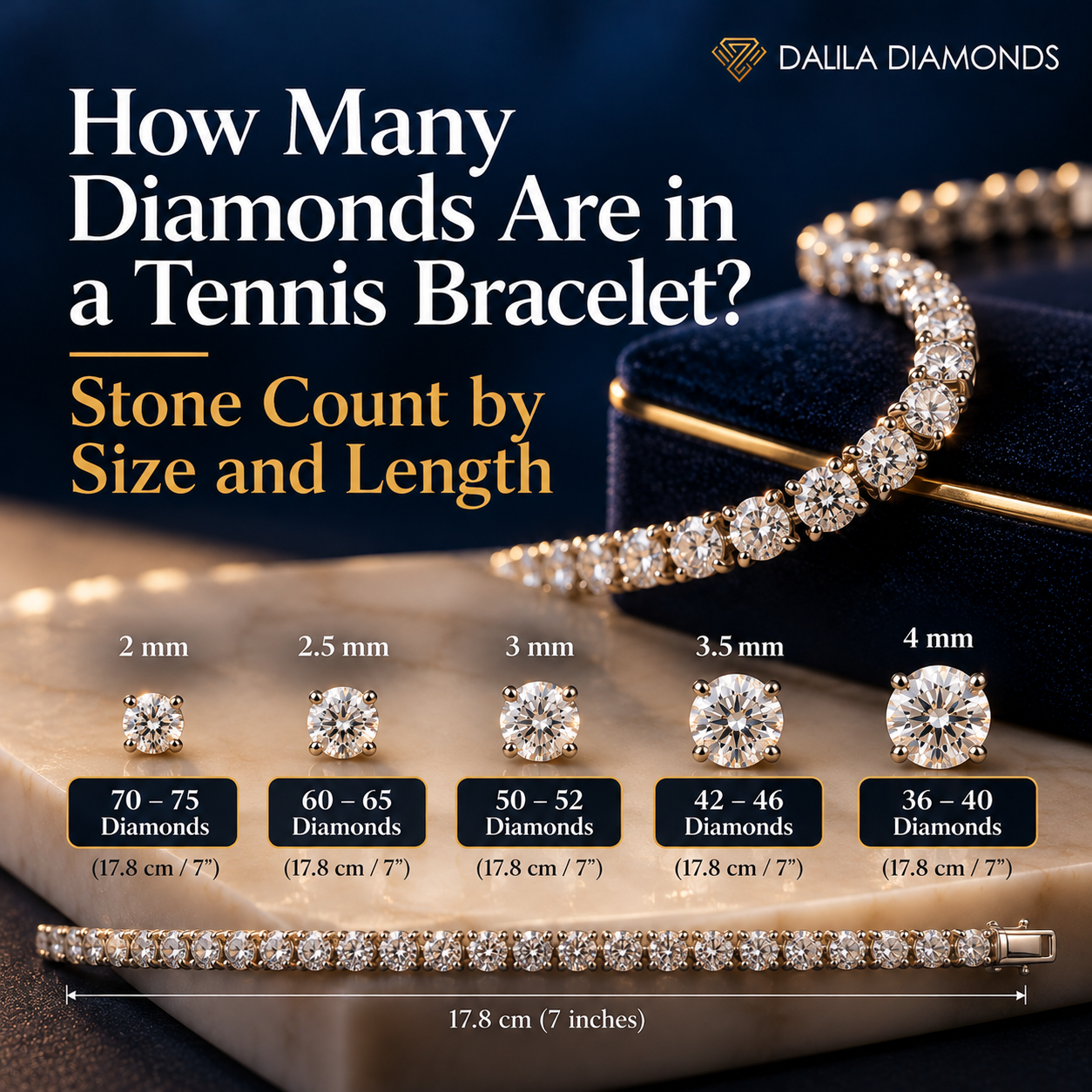
A tennis bracelet can contain anywhere from around 30 to more than 100 diamonds, depending on the bracelet's length, the dimensions of the individual stones and the setting design.
For a typical 7-inch (17.78 cm) single-row bracelet, a design using approximately 2 mm round diamonds might contain around 70–75 stones. A design using approximately 3 mm diamonds might contain around 50–52 stones.
These are planning examples, not universal manufacturing standards.
Two bracelets with the same length and total carat weight can contain different numbers of diamonds if their settings, stone sizes or link spacing differ.
For example, a publicly listed 7-inch natural diamond tennis bracelet from James Allen contains 52 round brilliant diamonds with a combined weight of approximately 3.00 carats.
The number of diamonds is therefore not determined simply by whether the bracelet is described as 2, 3 or 5 carats.
The correct stone count depends on four measurements: finished bracelet length, individual diamond size, setting pitch and the length occupied by the clasp.
This guide explains how to estimate that count before sourcing natural loose diamonds, using practical calculations, real published bracelet examples and manufacturing checks.
How Many Diamonds Are in a Tennis Bracelet? Quick Answer
For a conventional single-row tennis bracelet, these are useful illustrative ranges for a 7-inch finished design.
Round diamond diameter | Illustrative number of diamonds | General appearance |
1.5 mm | Approximately 85–95 | Very fine diamond line |
2.0 mm | Approximately 65–75 | Delicate, closely spaced |
2.5 mm | Approximately 55–65 | Moderate stone size |
3.0 mm | Approximately 48–53 | More individually visible diamonds |
3.5 mm | Approximately 42–47 | Substantial diamond line |
4.0 mm | Approximately 37–42 | Larger individual diamonds |
These ranges are indicative, not guaranteed counts. They assume a single-row construction with relatively compact diamond settings. The actual number must be established from the selected bracelet design, clasp and manufacturing drawing.
A bezel bracelet with substantial metal between the stones may hold fewer diamonds than a compact prong-set bracelet of the same finished length and stone diameter.
Likewise, a bracelet with a relatively long clasp may require fewer diamond links.
The buyer should use the table to understand the approximate relationship—not to place a final diamond parcel order.
The Four Factors That Determine Diamond Count
A tennis bracelet is made from repeating diamond-set sections connected into a flexible structure.
The number of diamonds depends on how much space each section occupies.
1. Finished bracelet length
A longer bracelet generally requires more diamond-set links when using the same stone size and setting construction.
For example, an 18 cm bracelet will usually need more links than a 16 cm bracelet if everything else remains consistent.
2. Individual diamond diameter
Larger diamonds normally require larger settings.
If the usable bracelet length remains fixed, fewer large diamond links fit into that space.
A 3.5 mm round diamond generally occupies more of the line than a 2.0 mm round diamond.
3. Setting pitch
Setting pitch is the distance along the bracelet from one diamond's centre to the next.
It includes the space occupied by the stone and the additional longitudinal spacing created by its setting and connection.
Two settings designed for the same diamond diameter can have different pitches.
4. Clasp and non-diamond sections
The clasp occupies part of the finished bracelet length.
Some designs also contain safety components or decorative sections.
Those sections reduce the length available for repeating diamond-set links.
Together, these four factors determine the approximate count.
How to Calculate the Number of Diamonds in a Tennis Bracelet
For an early design estimate, use:
Estimated diamond count = Usable diamond-row length ÷ Effective setting pitch
Where:
Usable diamond-row length = Finished bracelet length − Length reserved for the clasp and other non-diamond sections
The result is a planning estimate.
A manufacturer must account for the end links, connection geometry, tolerances and the chosen clasp.
Worked example: 18 cm bracelet with 2.5 mm diamonds
Suppose the jeweller proposes:
Design measurement | Illustrative value |
Finished bracelet length | 180 mm |
Length reserved for clasp and end construction | 12 mm |
Usable diamond-row length | 168 mm |
Round diamond diameter | 2.5 mm |
Effective setting pitch | 2.9 mm |
The approximate count is:
168 ÷ 2.9 = 57.93
That suggests approximately 58 diamonds.
However, the jeweller may need to adjust the exact link arrangement to achieve the required length and flexibility.
This is not a final approved CAD layout.
The difference between 57, 58 or 59 stones must be resolved using the actual setting design.
Tennis Bracelet Diamond Count by Length
Bracelet length changes the number of diamonds required.
The following table applies one consistent hypothetical design method across several lengths.
Assumptions: 12 mm of finished length reserved for clasp/end construction; effective pitch equals individual diamond diameter plus 0.4 mm.
Finished length | 2.0 mm diamonds | 2.5 mm diamonds | 3.0 mm diamonds | 3.5 mm diamonds |
16 cm | ~62 | ~51 | ~44 | ~38 |
17 cm | ~66 | ~54 | ~46 | ~41 |
18 cm | ~70 | ~58 | ~49 | ~43 |
19 cm | ~74 | ~61 | ~52 | ~46 |
20 cm | ~78 | ~65 | ~55 | ~48 |
Values are rounded estimates from a simplified model. They are not verified product specifications. An actual setting could have a different pitch, clasp allowance and diamond count.
The table illustrates that an increase in bracelet length does not necessarily require larger diamonds.
Using the same 2.5 mm stones and link geometry, a 20 cm bracelet requires more stones than a 16 cm version.
A buyer who wants the same appearance in two different bracelet lengths should therefore focus on individual diamond diameter and setting design, not insist that both pieces contain identical numbers of stones.
How Many Diamonds Are in a 16 cm Tennis Bracelet?
A 16 cm tennis bracelet may require approximately 51 diamonds measuring 2.5 mm or approximately 44 diamonds measuring 3.0 mm under the illustrative model above.
The exact number changes when the setting pitch or clasp differs.
A relatively compact prong head can provide a different count from a design with larger bezels or decorative links.
Before requesting diamonds, the manufacturer should confirm the final bracelet's dimensions and the proposed stone count.
How Many Diamonds Are in an 18 cm Tennis Bracelet?
For an 18 cm finished bracelet, the illustrative model suggests:
Stone diameter | Estimated count |
2.0 mm | Around 70 |
2.5 mm | Around 58 |
3.0 mm | Around 49 |
3.5 mm | Around 43 |
These estimates are suitable for preliminary planning.
However, a real bracelet can differ because its clasp, stone settings and link connections have their own measured dimensions.
A supplier should not present an estimated count as the final purchase quantity without manufacturer confirmation.
How Many Diamonds Are in a 20 cm Tennis Bracelet?
A longer 20 cm bracelet typically requires more stones if the individual diamonds and setting design remain unchanged.
In the same illustrative model, 2.5 mm stones produce a count around 65, while 3.0 mm stones produce a count around 55.
This does not mean every 20 cm bracelet must contain those numbers.
It means the stone count should be calculated from the construction rather than copied from a shorter bracelet's product listing.
Real Product Example: A 7-Inch Bracelet With 52 Diamonds
A published James Allen natural diamond tennis bracelet provides a useful real-world reference.
The product specifications identify:
Product characteristic | Published specification |
Bracelet type | Single-row diamond tennis bracelet |
Diamond origin | Natural |
Length | 7 inches |
Diamond shape | Round brilliant |
Diamond quantity | 52 |
Total diamond weight | 3.00 ctw |
Average colour | H–I |
Average clarity | SI1–SI2 |
Metal | 14K yellow gold |
Setting | Prong |
Clasp | Box clasp |
The count is a real published specification, not the result of a generic count calculator.
The bracelet contains 52 diamonds across a finished length of seven inches.
That provides a practical reference for a relatively substantial prong-set design.
However, the listing does not establish a complete manufacturing pitch specification or the exact measured diameter of every individual diamond.
Those details should not be inferred from the product's total carat weight.
What can we calculate?
The average diamond weight is:
3.00 ÷ 52 = 0.0577 carat per diamond.
That is approximately 5.77 points.
It helps describe the average mass, but not the exact diameter of every stone.
The physical size and setting spacing must still be confirmed independently.
Why Two 7-Inch Tennis Bracelets Can Have Different Stone Counts
Suppose two tennis bracelets both measure seven inches.
The first uses approximately 2 mm round diamonds and compact settings.
The second uses approximately 3 mm stones and larger settings.
The first bracelet can contain substantially more diamonds even though the finished lengths are identical.
Illustrative design comparison
Specification | Design A | Design B |
Finished length | 7 inches | 7 inches |
Diamond diameter | 2.0 mm | 3.0 mm |
Indicative count | ~74 | ~52 |
Setting style | Compact prong example | Compact prong example |
Actual CAD count | Must be approved | Must be approved |
The difference is caused primarily by the length occupied by each repeating diamond link.
The larger 3 mm diamonds consume more longitudinal space.
Neither bracelet is necessarily more valuable or visually attractive.
The total diamond weight, individual quality, metal and finished construction would need to be assessed separately.
Does a Prong Setting Hold More Diamonds Than a Bezel Setting?
Sometimes, but not as a universal rule.
A compact shared-prong or three-prong design may use relatively little visible metal between neighbouring stones.
A bezel wraps metal around the diamond's outline and can create a larger repeating link.
However, not all bezels are equally thick, and prong designs can also include substantial metal.
The number of diamonds depends on the actual centre-to-centre pitch.
Example: Same stone size, different pitches
Suppose an 18 cm bracelet has 168 mm of usable diamond-row length.
Both proposed designs use 2.5 mm round diamonds.
Specification | Compact prong concept | Larger-link bezel concept |
Diamond diameter | 2.5 mm | 2.5 mm |
Effective pitch | 2.9 mm | 3.2 mm |
Usable row length | 168 mm | 168 mm |
Calculated approximate count | 58 | 53 |
These are invented design parameters used for calculation, not validated engineering tolerances.
The example shows why setting design can alter the required diamond count even when bracelet length and stone diameter remain unchanged.
A manufacturing jeweller must confirm the actual construction.
Does Clasp Length Change the Diamond Count?
Yes.
The clasp is part of the finished bracelet length but generally is not another diamond-set repeating link in a conventional design.
Suppose two otherwise similar bracelets both measure 18 cm.
One design reserves 10 mm for the clasp and its end connections.
Another reserves 16 mm.
Measurement | Design A | Design B |
Finished length | 180 mm | 180 mm |
Clasp/end allowance | 10 mm | 16 mm |
Diamond-row length | 170 mm | 164 mm |
Effective pitch | 3.0 mm | 3.0 mm |
Approximate count | 57 | 55 |
The difference in available row length changes the calculated stone count.
However, a manufacturer must define exactly how finished length is measured.
A clasp may overlap components or connect through end sections with geometry not represented by a simple straight subtraction.
For that reason, these calculations are planning tools rather than final manufacturing instructions.
Do All Tennis Bracelet Diamonds Have to Be the Same Size?
For a conventional single-row bracelet, diamonds are commonly selected to create a consistent visible line.
That usually requires close matching of diameter or other face-up dimensions.
However, the stones do not necessarily have identical individual carat weights.
For example, two round diamonds can have similar diameters but slightly different weights due to differences in depth or girdle thickness.
The jeweller may approve both for a calibrated setting layout if they meet the agreed dimensional and quality requirements.
Why matching matters
An undersized diamond can interrupt the visible sequence.
A noticeably larger stone may affect setting fit or create an unintended focal point.
A warm-coloured or relatively dull stone may also stand out among otherwise consistent diamonds.
For a bracelet containing 60 or more stones, such variations can become noticeable across the full line.
The parcel should therefore be selected according to actual diameter, quality and manufacturing specifications—not simply total mass.
What If the Bracelet Uses Graduated Diamonds?
Some tennis bracelets intentionally use larger diamonds near the centre and smaller diamonds towards the ends.
Other designs alternate round and fancy-shaped stones.
In those cases, a single uniform stone diameter or setting pitch cannot describe the entire layout.
The calculation must be performed for each section.
Example: Graduated bracelet concept
Suppose a jeweller proposes:
Bracelet section | Number of diamonds | Diamond size |
Central section | 9 | 3.5 mm |
Adjacent sections | 20 | 3.0 mm |
Outer sections | 24 | 2.5 mm |
Total | 53 | Mixed sizes |
The total is 53 diamonds.
However, this does not establish a completed bracelet length.
The manufacturer must calculate the pitch and connecting geometry for each section.
This example illustrates why graduated bracelets require a specific layout rather than a generic 7-inch stone-count chart.
Does Diamond Shape Change the Number of Stones?
Yes.
Round diamonds are commonly described by diameter.
Emerald, oval, baguette and other elongated stones have different length and width dimensions.
Their orientation also changes how much space they occupy along the bracelet.
For example, an elongated diamond measuring 4.0 × 2.5 mm can be positioned with either its long or short axis following the bracelet's length.
Those arrangements create different repeating pitches.
The buyer therefore needs to know both the actual stone dimensions and the intended orientation.
A count calculated using 2.5 mm round diamonds should not be applied to a bracelet using 4.0 × 2.5 mm baguettes.
For a multi-shape or east-west layout, the jeweller should use a dedicated technical drawing.
How Diamond Count Affects Total Carat Weight
The number of diamonds influences total carat weight, but count alone cannot establish the total.
The individual stone weights also matter.
For example:
Count | Average weight per diamond | Calculated total |
50 | 0.04 ct | 2.00 ctw |
50 | 0.06 ct | 3.00 ctw |
50 | 0.10 ct | 5.00 ctw |
60 | 0.05 ct | 3.00 ctw |
75 | 0.04 ct | 3.00 ctw |
All five rows are arithmetic illustrations.
The same total carat weight can come from different combinations of stone count and individual weight.
For the full explanation of total carat weight, use Dalila's article at /blogs/tennis-bracelet-total-carat-weight.
This page specifically owns the count calculation. The separate article owns the weight calculation and how individual stone size affects the advertised total.
Worked Example: Ordering Natural Diamonds for an 18 cm Bracelet
Suppose a jewellery manufacturer wants to produce an 18 cm natural diamond tennis bracelet.
The intended design uses round brilliant diamonds in a compact prong setting.
The buyer supplies this initial brief:
Specification | Initial requirement |
Finished length | 18 cm |
Metal | 18K white gold |
Diamond origin | Natural |
Diamond shape | Round brilliant |
Target diameter | 2.5 mm |
Proposed setting | Four-prong articulated links |
Colour | G–H |
Clarity | VS–SI range, with approved face-up appearance |
Clasp | Box clasp with safety arrangement |
Stone count | To be calculated |
Step 1: Obtain the setting pitch
The jeweller proposes an illustrative effective pitch of 2.9 mm per diamond-set link.
That value must be confirmed from actual manufacturing dimensions.
Step 2: Determine usable length
Assume 12 mm is reserved for clasp and end construction.
The remaining diamond-row length is:
180 − 12 = 168 mm.
Step 3: Estimate diamond count
168 ÷ 2.9 = approximately 57.9.
The preliminary design therefore suggests 58 diamonds.
Step 4: Confirm the actual layout
The jeweller must check whether 58 links can achieve the desired finished length and flexibility with the selected clasp.
The result may require a small design adjustment.
Step 5: Order the calibrated diamond parcel
Once the layout is approved, the supplier can source natural round diamonds meeting the actual diameter and quality requirements.
The parcel should not be finalised before the manufacturer confirms the usable stone count.
The buyer and supplier should also agree in advance whether any additional replacement or spare stones are required.
Such spare stones should be listed separately from those intended for the finished bracelet.
Step 6: Verify the final weight
The supplier should record the actual weight of the selected diamonds.
The finished bracelet's total diamond weight should be based on the stones actually set, not merely the preliminary model.
Should You Order Extra Diamonds for Manufacturing?
Sometimes.
A jeweller may want a small quantity of additional calibrated diamonds in case a stone is rejected during quality control or becomes unsuitable during the manufacturing process.
However, there is no universal spare-stone percentage.
The required additional quantity depends on the project and sourcing arrangements.
For example, if the approved bracelet design requires 58 stones, the buyer may agree to source 60 or another specified quantity so that replacement candidates are available.
That does not mean the completed bracelet contains 60 diamonds.
The order documentation should distinguish:
Approved bracelet count: 58.
Additional loose stones: As separately agreed.
Finished diamond count: Confirmed after manufacture.
This avoids inflating the advertised number of diamonds or total carat weight.
Tennis Bracelet Stone-Count Calculator Worksheet
The following worksheet can be used before requesting diamonds.
Input | Value |
Intended bracelet style | ______ |
Finished length | ______ mm |
Clasp and end allowance | ______ mm |
Usable diamond-row length | ______ mm |
Diamond shape | ______ |
Diameter or length and width | ______ mm |
Intended orientation | ______ |
Setting style | ______ |
Effective setting pitch | ______ mm |
Preliminary calculated count | ______ |
Manufacturer-approved count | ______ |
Additional spare stones | ______ |
Total procurement quantity | ______ |
The key distinction is between the preliminary calculated count and the manufacturer-approved number.
The formula can be used to plan, but it cannot replace approval of the finished layout.
Sourcing Natural Diamonds for a Tennis Bracelet
When requesting natural diamond melee for a tennis bracelet, the most useful information is the required calibrated size and manufacturer-approved quantity.
A request for "diamonds for an 18 cm bracelet" is incomplete.
The supplier also needs to know the shape, dimensions, colour range, clarity requirements and whether the design uses uniform or graduated stones.
Example sourcing brief
Field | Requirement |
Jewellery | Single-row tennis bracelet |
Diamond type | Natural |
Shape | Round brilliant |
Calibrated size | Approximately 2.5 mm |
Required diameter tolerance | Set by manufacturing jeweller |
Approved bracelet count | 58, illustrative |
Extra stones | Separately agreed |
Colour | G–H |
Clarity | VS–SI, subject to approved appearance |
Cut appearance | Visually consistent parcel |
Documentation | Supplier parcel details and origin information |
Finished length | 18 cm |
Setting | Prong-set articulated links |
Manufacturing | Separate jeweller approval |
These are illustrative specifications, not claims of available Dalila stock.
Dalila Diamonds can receive natural loose-diamond sourcing enquiries through its website.
The supplier can provide available calibrated diamond candidates and parcel quotations.
The manufacturing jeweller must establish the final count and confirm whether the individual diamonds are suitable for the bracelet's seats and links.
Supplier versus manufacturer responsibilities
Task | Diamond supplier | Manufacturing jeweller |
Source natural diamonds | Yes | May advise |
Supply calibrated size range | Yes | Defines requirements |
Provide individual or parcel weight | Yes | Review |
Confirm supplied quantity | Yes | Confirm required quantity |
Set link pitch | No | Yes |
Determine clasp allowance | No | Yes |
Approve final bracelet stone count | No | Yes |
Manufacture and set bracelet | Not assumed | Yes |
Inspect final bracelet | Not assumed | Yes |
Do not assume that natural loose-diamond sourcing includes completed tennis bracelet manufacturing.
Common Mistakes When Calculating Tennis Bracelet Diamond Count
Using a fixed stone count for every 7-inch bracelet
Different diamond sizes and settings produce different counts.
Dividing the entire bracelet length by diamond diameter
The clasp and setting spacing must also be considered.
Ignoring centre-to-centre setting pitch
The setting may occupy more longitudinal space than the diamond alone.
Using the same count for different bracelet lengths
Longer bracelets generally require more links when the stone size and construction remain unchanged.
Confusing total carat weight with diamond quantity
The same total weight can be distributed across different numbers of stones.
Treating a preliminary count as an approved CAD layout
The jeweller must confirm final length, flexibility and construction.
Forgetting graduated or mixed-shape sections
Different stone dimensions require different layout calculations.
Including spare diamonds in the finished count
Procurement quantity and finished bracelet quantity are not necessarily identical.
Frequently Asked Questions
How many diamonds are in a typical tennis bracelet?
A conventional single-row tennis bracelet may contain roughly 40–80 diamonds, depending on size and design, with finer styles sometimes using more. The actual count depends on finished length, stone dimensions, clasp and setting pitch.
How many diamonds are in a 7-inch tennis bracelet?
For compact round-diamond settings, a seven-inch bracelet might use approximately 70–75 diamonds measuring 2 mm or around 50–52 diamonds measuring 3 mm. The exact count is design-dependent.
How many diamonds are in a 3-carat tennis bracelet?
There is no fixed number. A real published seven-inch, 3.00 ctw natural diamond bracelet uses 52 stones. Other constructions can distribute the same total weight among more or fewer diamonds.
How many diamonds are in a 5-carat tennis bracelet?
The count depends on individual diamond size and bracelet construction. One illustrative arrangement uses 50 diamonds averaging 0.10 carat each, but that is not a universal 5-carat design.
How many diamonds fit in an 18 cm tennis bracelet?
In one simplified compact-setting model, an 18 cm bracelet could use approximately 58 diamonds measuring 2.5 mm. The actual count must be confirmed by the manufacturer.
How many 2 mm diamonds are in a tennis bracelet?
A seven-inch bracelet may contain around 65–75 such diamonds in a compact setting. The number varies with length, clasp and link dimensions.
How many 2.5 mm diamonds are in a tennis bracelet?
A seven-inch bracelet might contain approximately 55–65 round diamonds of this size, depending on its construction.
How many 3 mm diamonds fit in a seven-inch bracelet?
Around 50–52 is a useful starting estimate for some compact prong-set designs. It is not guaranteed for every setting.
How many 4 mm diamonds fit in a tennis bracelet?
A seven-inch single-row bracelet may contain approximately 37–42 stones in certain designs. A larger setting pitch or clasp can change the result.
Does bracelet length affect the number of diamonds?
Yes. With the same stone size and setting pitch, a longer bracelet generally needs more diamond-set links.
Does a shorter tennis bracelet use fewer diamonds?
Usually, if the stones and setting remain otherwise unchanged. However, a custom design can adjust stone size or link construction.
Do bezel tennis bracelets have fewer diamonds?
They sometimes do because of the space occupied by the metal surrounds, but this is not universal. Compare actual setting pitch rather than setting names alone.
Does a four-prong bracelet always contain fewer diamonds than a three-prong bracelet?
No. The precise head and link dimensions determine the count. Prong count alone is not enough.
Does the clasp reduce the number of diamonds?
The clasp occupies some of the bracelet's finished length, which affects the available length for diamond-set links.
How can I calculate the diamond count?
Subtract the clasp and other non-diamond allowance from the finished length, then divide the usable diamond-row length by the effective setting pitch. Have the manufacturer validate the result.
Are all the diamonds in a tennis bracelet the same size?
Traditional uniform-line bracelets generally use calibrated stones with similar face-up dimensions. Graduated or mixed-shape designs may intentionally use different sizes.
Can I add diamonds to make my tennis bracelet longer?
Possibly, depending on its construction and whether compatible links and diamonds are available. A qualified jeweller must assess the design and resulting fit.
How many extra diamonds should I order for a custom tennis bracelet?
There is no universal percentage. Agree on any spare quantity with the supplier and manufacturer based on the project and quality-control requirements.
Can Dalila source a specified number of natural diamonds for a bracelet?
Dalila can receive a specification-led natural loose-diamond enquiry. Provide the manufacturer-approved quantity, calibrated measurements, shape and quality requirements, subject to availability and service confirmation.
What should I ask the jeweller before ordering loose diamonds?
Ask for the approved stone count, exact calibrated dimensions, acceptable tolerance, setting pitch, clasp allowance, spare-stone requirement and final bracelet layout.