Bezel or Prong Pendant: What Changes for the Diamond?
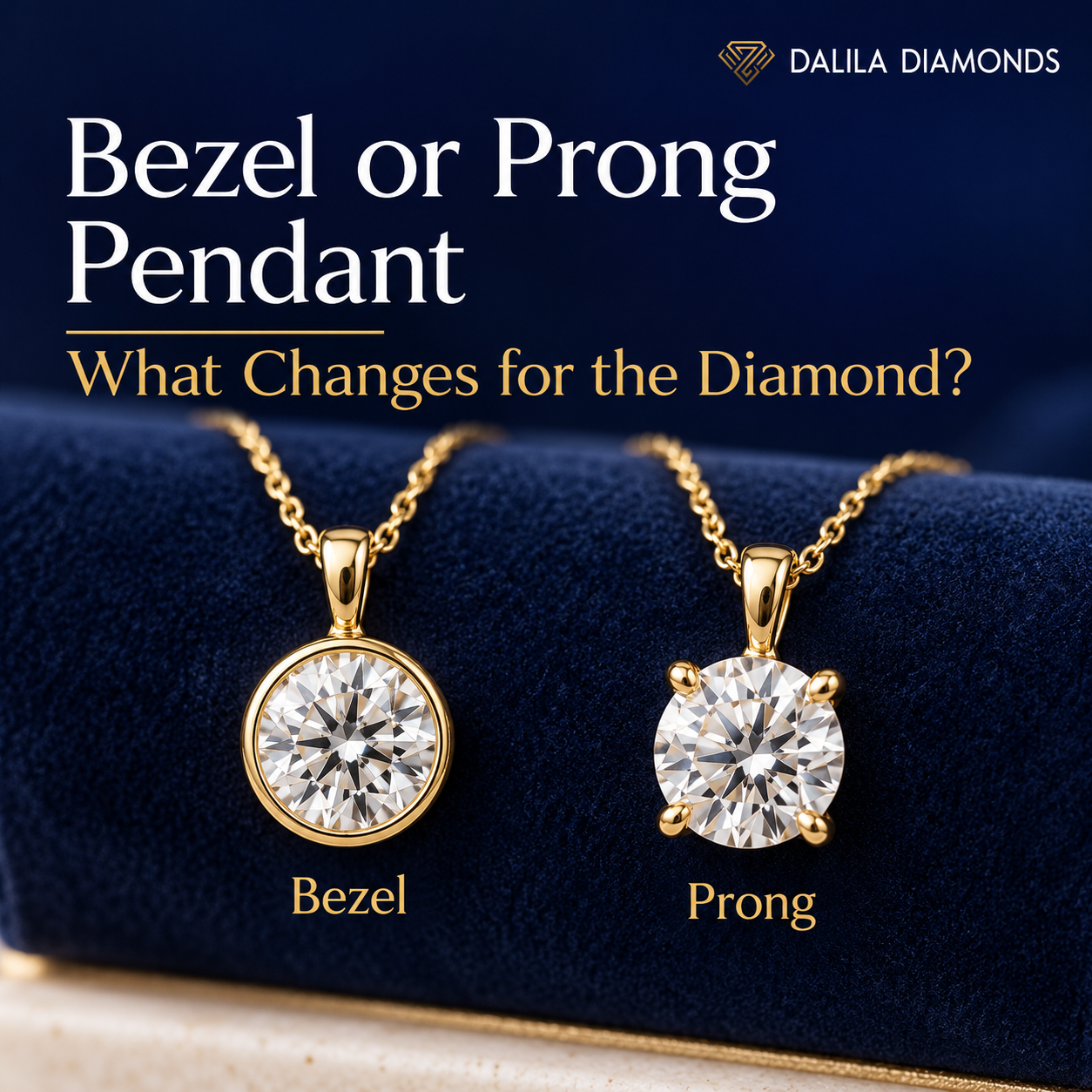
Choosing between a bezel and a prong setting for a natural diamond pendant changes more than the appearance of the finished necklace. It can also affect which loose diamonds are suitable, how their measurements are used and which parts of the stone remain exposed.
A bezel setting surrounds much or all of the diamond's perimeter with metal. Because the metal follows the diamond's outline, its actual diameter or length and width, girdle thickness, corner shape and seating position become important to the fit.
A prong setting secures the diamond at selected points around its girdle. This leaves more of the perimeter visible, but the setter must confirm that the chosen prong locations provide suitable support and do not place inappropriate pressure on vulnerable areas.
For example, two natural round brilliant diamonds may both weigh 1.00 carat but measure 6.32 mm and 6.50 mm in average diameter. A pendant head designed around one stone should not automatically be assumed suitable for the other.
The difference also matters for fancy-shaped stones. Two oval diamonds with identical length and width can have different shoulder curves, making them potentially unsuitable for the same closely fitted bezel.
The main buying principle is to choose the diamond and pendant setting together, using the actual stone's measurements and a setter-approved design.
Neither a bezel nor prongs make a diamond damage-proof. Both can work well when the mounting is properly constructed for the selected stone.
This guide focuses on the technical diamond-selection questions created by the two setting styles, rather than becoming a general comparison of pendant designs.
Bezel vs Prong Diamond Pendant: Quick Comparison
Diamond-selection factor | Bezel pendant | Prong pendant |
Diamond outline | Metal follows most or all of the perimeter | Metal contacts selected girdle areas |
Face-up measurements | Exact outline and dimensions are important | Dimensions and support positions are important |
Girdle protection | More perimeter coverage | More exposed girdle between prongs |
Girdle thickness | Setter assesses the full seating and retention area | Setter assesses thickness at contact points and exposed areas |
Fancy-shaped corners | Bezel must fit the actual corner geometry | Prongs must be placed to protect vulnerable corners |
Pear or marquise points | Metal may surround the points | Protective point prongs may be needed |
Pavilion depth | Must clear the underlying structure | Must clear the head and gallery |
Visible diamond outline | Metal can obscure part of the edge | More of the outline is generally visible |
Diamond replacement | Closely fitted bezels may require substantial modification | Some prong heads offer more adjustment possibilities |
Final compatibility | Qualified setter approval required | Qualified setter approval required |
A bezel is not always better for every diamond. A particular prong design may be more suitable for a stone with unusual girdle characteristics, while another stone may benefit from the more extensive edge coverage of a bezel.
The correct decision requires assessment of the individual diamond.
Why Diamond Measurements Matter Before Choosing a Setting
Carat weight measures mass, not the physical dimensions needed to manufacture a setting.
A round brilliant diamond is usually described by its minimum diameter, maximum diameter and total depth.
Fancy-shaped diamonds require length, width and depth. Their actual outlines also matter.
Consider two hypothetical one-carat round brilliant diamonds.
Specification | Diamond A | Diamond B |
Weight | 1.00 ct | 1.00 ct |
Minimum diameter | 6.46 mm | 6.29 mm |
Maximum diameter | 6.54 mm | 6.35 mm |
Average diameter | 6.50 mm | 6.32 mm |
Total depth | 3.96 mm | 4.08 mm |
Girdle | Medium, illustrative | Slightly thick, illustrative |
These are hypothetical specification examples, not verified inventory.
Diamond A has the larger face-up diameter.
Diamond B has a smaller diameter despite weighing the same amount.
For a bespoke bezel, the inside seat and surrounding metal must be designed around the selected diamond.
For a prong pendant, the head and prong positions must also be appropriate for the actual diameter, girdle and depth.
Neither diamond is automatically the better choice. Its cut performance, condition, appearance and mounting requirements must be reviewed.
Dalila's Diamond Girdle Guide explains how girdle thickness, face-up dimensions and setting contact interact. <Cite ref="turn495979search0"/>
Bezel Pendants: Why the Actual Outline Matters
A bezel is a metal border that surrounds the diamond's perimeter and secures it within a fitted setting.
Because it follows the stone's outline, dimensional compatibility is particularly important.
A bezel designed for a generic 7.0 × 5.0 mm oval may not fit every oval with those reported dimensions.
One diamond may have broad, rounded shoulders. Another may have straighter sides and narrower ends.
Those differences affect the relationship between the stone and retaining metal.
What the setter needs to know
The jeweller should examine the following before approving a bezel:
Actual minimum and maximum diameters for a round diamond.
Length and width for a fancy-shaped diamond.
Face-up outline, including shoulder fullness and corner geometry.
Girdle thickness and variation.
Existing chips, abrasions or other girdle characteristics.
Crown geometry near the perimeter.
Pavilion profile and space needed beneath the girdle.
Seating and metal-coverage requirements.
Whether the proposed bezel allows an appropriate final setting height.
The bezel should not be manufactured solely from an assumed carat-to-diameter conversion.
For a precisely fitted mounting, the actual diamond should guide the final dimensions.
Does a bezel make every diamond more secure?
No setting guarantees complete protection.
A properly constructed bezel can reduce exposure of the diamond's edge, but excessive or inappropriate setting pressure can still damage a vulnerable girdle.
The surrounding metal can also deform after impact.
Dalila's girdle guide notes that bezels cover more of the stone's perimeter but still require professional assessment of thin areas and existing damage. <Cite ref="turn495979search0"/>
Prong Pendants: Why Contact Points Matter
A prong setting holds the diamond at selected locations around its girdle.
The amount of visible metal depends on the number, size and shape of the prongs.
For round solitaire pendants, four-prong and six-prong arrangements are common design options.
For fancy-shaped diamonds, prong placement must account for the actual outline.
The setter must establish whether each support contacts a suitable region of the girdle and whether the diamond remains secure within the head.
What the setter examines
Area | Technical question |
Prong location | Does the support contact the intended region of the diamond? |
Girdle thickness | Is the local edge suitable for setting? |
Girdle condition | Are chips or fractures present near a contact point? |
Prong geometry | Is the retaining metal appropriately shaped and dimensioned? |
Diamond depth | Will the pavilion clear the surrounding head structure? |
Diamond outline | Do all planned contact points align with the actual stone? |
Exposed edges | Are vulnerable portions of the girdle left unprotected? |
Final retention | Can the stone be secured without movement? |
A prong pendant does not automatically provide more sparkle than a bezel pendant.
Light performance depends on the actual diamond, the lighting environment and the mounting's effect on the stone.
The design should not be selected on the unsupported assumption that a particular prong count guarantees greater brilliance.
How Bezel and Prong Settings Change the Visible Diamond Outline
A bezel and a prong pendant may contain the same physical diamond yet look different when viewed face-up.
A bezel places a continuous metal border around the stone, potentially making the complete pendant head wider while covering part of the diamond's perimeter.
A prong mounting generally leaves more of the outline visible between its supports.
This distinction is important when a buyer is choosing a loose diamond based on a desired face-up size.
Example: One Diamond, Two Pendant Heads
Suppose a natural round brilliant measures 6.50 mm in diameter.
The buyer is considering a minimal four-prong head and a full bezel.
Measurement | Four-prong concept | Full-bezel concept |
Actual diamond diameter | 6.50 mm | 6.50 mm |
Stone weight | Unchanged | Unchanged |
Metal coverage | Selected contact points | Most or all perimeter |
Finished outside width | Jeweller to confirm | Jeweller to confirm |
Visible diamond edge | Generally more exposed | More extensively covered |
Total finished height | Jeweller to confirm | Jeweller to confirm |
Structural approval | Required | Required |
The bezel might increase the outside dimensions of the pendant, but that extra width comes from metal.
It does not mean the diamond itself has become larger.
Likewise, a prong setting can reveal more of the diamond's outline without increasing its physical diameter.
Buyers should request both the stone's exact measurements and the finished head's outside dimensions.
Which Diamond Shapes Need More Attention in a Bezel?
Round diamonds have a comparatively regular circular outline.
Fancy-shaped diamonds may introduce more complex fit requirements.
Oval diamonds
Ovals differ in shoulder fullness, end curvature and overall symmetry.
Two 8.0 × 5.6 mm ovals can have different actual outlines.
A closely fitted bezel should be designed around the chosen stone rather than a generic oval profile.
A prong setting also needs appropriate contact points, particularly where the stone narrows towards its ends.
Pear-shaped diamonds
A pear has one pointed tip that can be vulnerable to damage.
A bezel may provide metal coverage around the point if designed appropriately.
A prong design may use a suitable V-shaped support.
The setter must inspect the point, shoulders, wings and girdle.
The orientation of the pear—point up or point down—must also be confirmed before the pendant head is manufactured.
Emerald-cut diamonds
Emerald cuts have truncated corners, but the corner dimensions and angles vary.
A bezel needs to accommodate the actual rectangular outline and clipped corners.
A prong setting requires supports aligned with the stone's corner geometry.
A generic rectangular opening is not sufficient evidence of compatibility.
Cushion-cut diamonds
Cushions can have different shoulder shapes and corner radii.
Some are close to square, while others are elongated.
A bezel following a tight cushion outline may therefore be particularly dependent on the actual stone.
For prongs, contact points and the girdle's local geometry remain important.
Why Girdle Thickness Matters in Both Settings
The girdle is the boundary between the diamond's crown and pavilion.
It is commonly the region used to secure a diamond in jewellery.
A very thin girdle may be more vulnerable to chipping, particularly if the relevant section is exposed or subjected to concentrated pressure.
A very thick girdle may change how the stone sits in a mounting and can contribute to weight without equivalent face-up spread.
However, there is no single girdle-thickness grade that automatically makes every diamond suitable or unsuitable for a pendant.
Bezel-specific girdle questions
The setter should check whether thin or uneven girdle sections can be accommodated safely along the retaining perimeter.
A bezel can conceal existing damage after mounting, so pre-setting inspection is essential.
The jeweller also needs sufficient appropriate metal to retain the stone without damaging its edge.
Prong-specific girdle questions
The setter should examine the areas where each prong contacts the diamond.
Particular attention is needed where a prong would sit near an existing chip, feather or exceptionally thin section.
The girdle between prongs should also be assessed because portions of the perimeter may remain exposed.
Practical comparison
Girdle feature | Bezel assessment | Prong assessment |
Very thin local section | Review metal coverage and setting pressure | Review contact-point location and edge exposure |
Thick local section | Assess seat and bezel geometry | Assess prong fit and stone elevation |
Existing chip | Inspect before enclosure | Check whether the area is supported or exposed |
Surface-reaching feather | Assess suitability for setting | Avoid unsuitable pressure points |
Uneven outline | Adapt bezel to actual stone | Verify all support positions |
For detailed girdle terminology and durability considerations, use Dalila's Diamond Girdle Guide rather than treating this pendant article as another general girdle-grading resource.
Does Diamond Depth Affect Bezel and Prong Pendants Differently?
Diamond depth matters in both settings because the pavilion must have adequate space beneath the girdle.
The exact depth requirements depend on where the diamond is seated and what metal structure sits below it.
A relatively deep stone may require a different head or a higher seating position.
However, a deeper diamond does not automatically make a bezel or prong mounting unsuitable.
The jeweller must evaluate the full profile.
Illustrative depth comparison
Suppose two round diamonds have similar average diameters.
Specification | Diamond A | Diamond B |
Average diameter | 6.50 mm | 6.48 mm |
Total depth | 3.95 mm | 4.15 mm |
Crown geometry | Candidate-specific | Candidate-specific |
Pavilion geometry | Candidate-specific | Candidate-specific |
Bezel compatibility | Setter to confirm | Setter to confirm |
Prong compatibility | Setter to confirm | Setter to confirm |
These are hypothetical stones.
Diamond B is approximately 0.20 mm deeper than Diamond A.
That does not mean the finished pendant will necessarily sit exactly 0.20 mm farther from the wearer.
Total depth includes multiple components, including crown, girdle and pavilion.
The required head clearance depends on how that depth is distributed.
The setter should review the stone's actual side profile before approving either design.
Dalila's diamond table-and-depth resource provides the wider explanation of these measurements. This article concentrates on how they inform the pendant choice.
Stone Security Versus Pendant Movement
A pendant is suspended from a chain, so its orientation and movement matter.
However, the choice between bezel and prongs does not independently establish whether the pendant will hang straight.
A perfectly secure diamond can still be positioned in a head that tends to rotate sideways.
The bail position, attachment geometry, metal distribution and overall centre of mass influence how the pendant behaves.
These are manufacturing considerations, but they are relevant to stone selection when the diamond has a directional shape.
For example, a pear-shaped diamond may require the point to face upwards.
An emerald cut may be intended to hang vertically.
If the jeweller is designing a bespoke pendant, the actual stone's length, width and depth should be available before finalising the attachment.
The head must support the diamond while allowing the pendant to hang in the desired orientation.
Worked Setter Example: A 1-Carat Oval for Two Pendant Designs
Consider a hypothetical natural oval brilliant weighing 1.00 carat.
The stone has the following illustrative specifications:
Property | Example specification |
Shape | Oval brilliant |
Carat weight | 1.00 ct |
Length | 8.00 mm |
Width | 5.60 mm |
Total depth | 3.50 mm |
Length-to-width ratio | 1.43 |
Girdle | Medium to slightly thick, illustrative |
Setting orientation | Vertical |
Condition | Requires inspection |
The buyer is considering either a custom full bezel or a four-prong pendant.
These are conceptual design options, not approved manufacturing drawings or a verified Dalila stone.
Option A: Full Bezel Pendant
The jeweller measures the actual oval outline.
The setting must accommodate the stone's rounded ends and shoulder curvature.
The setter also checks the girdle thickness along the intended retaining perimeter.
The pavilion must clear the underlying head structure.
If the bezel is closely fitted, its final shape should follow the selected diamond rather than a generic 8.0 × 5.6 mm oval template.
Before approval, the jeweller confirms the metal coverage, finished profile and mounting method.
Option B: Four-Prong Pendant
The jeweller identifies suitable contact points around the oval's girdle.
The prong positions must correspond with the actual stone and provide appropriate support.
The setter also examines the exposed girdle sections between the prongs.
The pavilion and stone seating position must be compatible with the head.
Finally, the jeweller checks that the pendant hangs in the intended vertical orientation.
What changes for diamond selection?
The selected oval may be suitable for both mounting styles.
However, the two designs use different information about its geometry.
The bezel depends heavily on the complete outline and perimeter fit.
The prong design depends on selected contact regions and the way the diamond is supported between them.
Both need the correct length, width, depth, girdle information and professional inspection.
Setter's approval record
Technical check | Full bezel | Four-prong |
Exact dimensions reviewed | Required | Required |
Outline/shoulders reviewed | Required | Required |
Girdle condition reviewed | Required | Required |
Seat or prong geometry approved | Pending | Pending |
Pavilion clearance checked | Pending | Pending |
Mounting height confirmed | Pending | Pending |
Hanging orientation confirmed | Pending | Pending |
Stone security approved | Pending | Pending |
No numerical setting tolerance has been assigned because the acceptable values depend on the actual mounting design and its construction.
A setter must complete the approval using the physical diamond or sufficiently reliable measurements and design information.
Can the Same Loose Diamond Work in Either a Bezel or Prong Pendant?
Often, yes.
Many natural diamonds can be mounted in either style when a suitable head is designed for the stone.
However, this does not mean an existing prong head can simply be exchanged for a bezel without reviewing the diamond.
For a newly manufactured pendant, the jeweller can design the chosen mounting around the selected stone.
For an existing pendant head, the available dimensions and construction may be more restrictive.
A diamond with unusual girdle geometry, damaged corners or an irregular outline may require specialist handling.
The buyer should distinguish the stone's suitability for a newly designed setting from its compatibility with an existing standard component.
Should You Choose the Diamond or Pendant Setting First?
Both sequences are possible, but the final dimensions must be coordinated.
If the buyer already owns a natural diamond, the jeweller can design a bezel or prong head around the actual stone.
If the buyer has selected a particular pendant design, the supplier should be given the jeweller's dimensional requirements before sourcing candidates.
A sensible process is:
Establish the intended shape, size and visual appearance.
Decide whether a bezel or prong design is preferred.
Shortlist natural loose diamonds using actual measurements.
Ask the setter to evaluate the selected candidate and proposed head.
Confirm girdle condition, retention and pavilion clearance.
Finalise the pendant design and manufacturing quote.
Avoid committing to a finished head solely on the assumption that a particular carat weight will fit.
Which Diamond Characteristics Should Influence the Decision?
The strongest reasons to favour one mounting style over another relate to the actual diamond.
Diamond characteristic | Selection implication |
Regular round outline | Generally straightforward to design for either mounting |
Irregular fancy outline | May require a closely customised bezel or carefully positioned prongs |
Vulnerable pear point | Protective point treatment essential |
Truncated emerald corners | Bezel and prong contact geometry must match actual corners |
Very thin local girdle | Professional setting-risk assessment needed |
Existing girdle chip | Condition must be evaluated before mounting |
Relatively deep pavilion | Head clearance must be confirmed |
Unusual crown profile | Can affect appearance and retaining-metal geometry |
Inclusions near the girdle | Relevant to contact-point and durability decisions |
Existing loose diamond documentation | Useful, but physical condition still needs review |
A diamond should not automatically be rejected because it has a feature requiring specialist setting assessment.
Equally, an attractive diamond should not be forced into a mounting that the setter considers unsuitable.
A Diamond-Selection Worksheet for Bezel and Prong Pendants
Specification | Requirement or finding |
Intended jewellery | Natural diamond solitaire pendant |
Preferred mounting | Bezel / Prong / Undecided |
Diamond shape | ______ |
Carat-weight range | ______ |
Actual length or diameter | ______ mm |
Actual width | ______ mm |
Total depth | ______ mm |
Minimum and maximum diameter, if round | ______ mm |
Face-up outline reviewed | Yes / No |
Girdle thickness | ______ |
Girdle condition | ______ |
Point or corner vulnerabilities | ______ |
Crown characteristics | ______ |
Pavilion clearance requirement | ______ |
Grading laboratory | ______ |
Report number | ______ |
Intended orientation | ______ |
Metal and alloy | ______ |
Bezel-seat or prong arrangement | Jeweller to confirm |
Finished head dimensions | Jeweller to confirm |
Bail and chain attachment | Jeweller to confirm |
Setter approval | Pending / Approved |
For a particular candidate, the supplier should provide the available grading and measurement information.
The jeweller should establish whether the selected mounting can securely accommodate the stone.
Sourcing Brief: A Natural Diamond for a Bezel or Prong Pendant
A useful sourcing brief should identify the intended setting so that suitable stones can be prioritised.
A buyer who wants a tightly fitted oval bezel, for example, may need especially accurate outline information.
Someone planning a pear-shaped prong pendant should mention the intended point orientation and protective setting requirement.
Example sourcing request
Field | Requested specification |
Jewellery | Natural diamond solitaire pendant |
Preferred shape | Oval brilliant |
Carat range | Approximately 0.90–1.10 ct |
Preferred length | Approximately 7.8–8.3 mm |
Preferred width | Approximately 5.4–5.9 mm |
Colour | G–H |
Clarity | VS1–VS2, subject to appearance |
Optical performance | Attractive brightness and acceptable bow-tie contrast |
Girdle | Appropriate condition for the intended setting |
Setting options | Full bezel or four-prong |
Orientation | Vertical |
Documentation | GIA, IGI or HRD as agreed |
Manufacturing | Jeweller to approve the actual stone and head |
Budget | ______ |
These specifications are illustrative and do not establish current inventory availability.
Natural loose-diamond enquiries can be made through Dalila Diamonds.
When enquiring, include the proposed mounting style and any specific dimensional requirements supplied by the manufacturing jeweller.
Dalila's existing Diamond Girdle Guide can support the interpretation of edge characteristics, but it does not replace an examination of the selected diamond.
Supplier and jeweller responsibilities
Task | Diamond supplier | Manufacturing jeweller |
Source candidate natural diamonds | Yes | May advise |
Provide actual measurements | Yes | Review |
Provide available grading reports | Yes | Review |
Supply stone images or videos | Where available | Use for design assessment |
Determine bezel-seat geometry | No | Yes |
Determine prong positions | No | Yes |
Inspect the setting fit | Not automatically included | Yes |
Approve point and corner protection | No | Yes |
Confirm pavilion clearance | No | Yes |
Confirm bail and chain compatibility | No | Yes |
Manufacture and set pendant | Only if separately agreed | Yes |
Inspect finished pendant | Not automatically included | Yes |
The loose diamond should be quoted separately from setting, manufacturing, chain and finishing costs unless a complete jewellery service is expressly offered.
Common Mistakes When Choosing Between Bezel and Prong Pendants
Assuming a bezel fits every diamond of the same carat weight
Bezel compatibility depends on actual dimensions, outline and girdle geometry.
Assuming prongs require less measurement precision
Prongs need correct support positions, seating and clearance.
Choosing a fancy-shaped diamond from a generic outline
Ovals, cushions, pears and emerald cuts can vary substantially within the same shape category.
Ignoring the diamond's girdle condition
Both setting styles contact or retain the stone around the girdle.
Believing a bezel makes a diamond damage-proof
Additional edge coverage may reduce exposure, but the setting and diamond can still be damaged.
Assuming more exposed diamond always means more sparkle
Optical performance depends on the stone and the complete light environment, not only visible metal coverage.
Confusing pendant outside width with diamond diameter
A bezel may increase the finished head's width without increasing the actual size of the gemstone.
Ignoring pavilion depth
Both settings require appropriate clearance below the girdle.
Selecting a standard head before choosing the stone
A nominal carat category is not a sufficient manufacturing specification.
Frequently Asked Questions
Is a bezel or prong setting better for a diamond pendant?
Neither is universally better. A bezel provides more perimeter coverage and requires accurate outline fit. A prong setting holds the diamond at selected points and generally exposes more of its edge. The appropriate choice depends on the actual stone and the intended design.
Does a bezel setting make a diamond look bigger?
A bezel adds a metal border, which can increase the outside dimensions of the completed pendant. It does not increase the diamond's actual diameter or carat weight.
Does a prong setting make a diamond sparkle more?
Not automatically. A prong setting can expose more of the stone, but cut quality, lighting and diamond characteristics determine its actual optical performance.
Can the same diamond fit a bezel and a prong pendant?
Often, yes, if both settings are designed for the actual stone. Compatibility cannot be assumed for pre-existing or standard heads.
Is a bezel more secure than four prongs?
A bezel provides extensive perimeter coverage, but no setting is universally secure regardless of workmanship. The jeweller must assess construction, diamond contact and intended wear.
Can a bezel damage a diamond's girdle?
Improper fitting or excessive setting pressure can damage a vulnerable edge. A qualified setter should inspect the girdle and approve the setting procedure.
Can a very thin girdle diamond be used in a prong pendant?
Possibly, but the location and extent of the thin sections matter. The setter must assess contact points and exposed edges before approving the stone.
Does a pear-shaped diamond need a bezel?
Not necessarily. A pear can be mounted with an appropriate protective prong arrangement or a well-designed bezel. Its point and girdle require individual assessment.
Are emerald-cut diamonds suitable for bezel pendants?
Yes. Their rectangular geometry can work well with bezels, but the actual truncated corners and full outline must be measured.
Why does my oval diamond need an exact bezel fit?
Ovals vary in shoulder shape and end curvature. Two stones with the same length and width may not have identical outlines, so the retaining metal should be fitted to the selected stone.
Does diamond depth matter for a pendant bezel?
Yes. The pavilion must clear the underlying structure, and the girdle must sit at an appropriate elevation. Total depth is part of the assessment but does not independently determine the finished height.
Can a four-prong pendant hold a one-carat diamond?
Potentially, if the mounting is designed for the actual diamond and approved by a qualified jeweller. Carat weight alone does not establish security or fit.
Is a bezel easier to maintain than a prong pendant?
A bezel may avoid some exposed-prong issues, but it still requires inspection and cleaning. Maintenance depends on construction, wear and the condition of the jewellery.
Can I change my prong pendant to a bezel?
Possibly. The jeweller must inspect the diamond and existing mounting to determine whether a new bezel head can be manufactured or fitted appropriately.
What diamond measurements should I give a jeweller for a bezel pendant?
Provide the exact diameter or length and width, depth, girdle information, shape outline and available grading documentation. The jeweller may also need direct access to the stone for final fitting.
What measurements matter for a prong pendant?
Actual length, width or diameter, depth, girdle condition and the locations where supports will contact the diamond.
Is an SI1 diamond suitable for a bezel pendant?
It can be, but the clarity characteristics must be assessed individually. An inclusion near the girdle or setting contact area may deserve closer examination.
Does the pendant metal affect how the diamond looks?
Yes. Yellow, white and rose metals can contribute different reflections. The diamond's laboratory colour grade does not change.
Should I choose the loose diamond before the pendant setting?
Either sequence can work. However, the final head must be approved for the exact selected diamond rather than a generic carat size.
Can Dalila source a natural diamond for a bezel or prong pendant?
Dalila can receive natural loose-diamond enquiries with specific shape, weight, dimensions and grading requirements. Mounting design and setting suitability must be confirmed with the manufacturing jeweller.
.