How to Upgrade the Diamond in a Solitaire Pendant
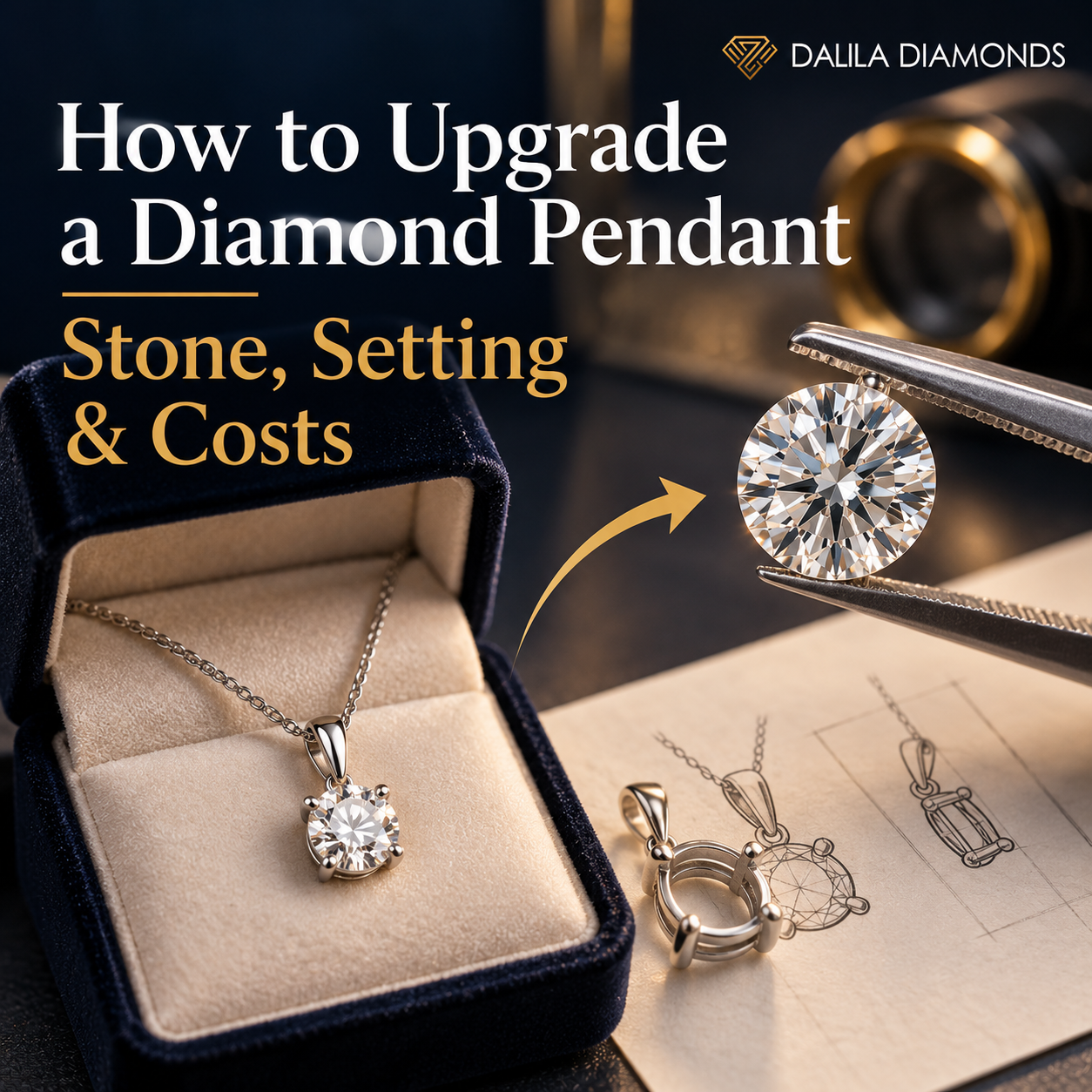
You may be able to upgrade the natural diamond in an existing solitaire pendant without replacing the entire necklace. However, the process depends on the original diamond, the size and shape of the proposed new stone, and whether the current mounting can safely accommodate it.
For example, a pendant holding a 0.50-carat round brilliant may contain a diamond measuring approximately 5.1 mm in diameter. Upgrading to a typical one-carat round brilliant could mean selecting a stone measuring around 6.5 mm.
That represents an increase of approximately 1.4 mm in diameter.
Although the difference may sound small, it is substantial for a setting engineered around the original stone.
The larger diamond may not fit the existing prongs or bezel. The jeweller might need to replace the head, alter the pendant construction or recommend an entirely new mounting.
The safest starting point is to have the existing pendant inspected before purchasing a new loose diamond.
The aim is to establish what can be preserved, what must be modified and which new stones are technically suitable.
An upgrade can also involve better colour, clarity or cut quality without increasing carat weight. In that situation, a replacement closer to the original diamond's dimensions may be easier to consider, although suitability still requires professional confirmation.
This guide explains how to assess the existing mounting, select a suitable upgrade diamond, compare setting options and review seller terms before spending money.
Can You Replace a Pendant Diamond With a Bigger One?
Potentially, yes.
A larger diamond can sometimes be incorporated into an existing pendant design, but this does not mean the existing setting head can always be reused.
The important distinction is between preserving the complete mounting and preserving only selected parts of the jewellery.
For example, a jeweller may be able to retain the original chain and pendant attachment while manufacturing a new diamond head.
Another pendant may have an integrated design that makes changing the centre stone much more complex.
Three possible upgrade routes
Upgrade route | What happens | When it may be suitable |
Reuse the existing head | Original head is retained or professionally adjusted | Replacement fits within setter-approved dimensions |
Replace the diamond head | New head is manufactured or fitted; other components may be retained | Larger stone or different geometry requires new seating |
Manufacture a new pendant | Original diamond and/or other components are retained separately | Existing construction is unsuitable for the desired upgrade |
There is no universal carat increase that guarantees one route will work.
The jeweller must examine the original piece and proposed stone.
Step 1: Inspect the Existing Pendant Before Buying a Diamond
The first stage is a physical assessment of the current jewellery.
Even if the buyer knows the original diamond's carat weight, the mounting may have features that limit the available replacement options.
A professional should inspect the head, stone seat, prongs or bezel, bail, chain attachment and overall metal condition.
What the jeweller needs to check
Existing pendant feature | Why it matters |
Diamond head | Establishes the current mounting dimensions |
Prongs or bezel | Determines retention method and possible modification |
Stone seat | Must accommodate the new diamond's actual girdle geometry |
Head depth | Determines space beneath the diamond |
Gallery and base | May restrict pavilion clearance |
Metal thickness | Important for safe adjustment or head replacement |
Bail or attachment | Must support the finished pendant |
Chain | Must be suitable for the completed construction |
Previous repairs | May affect modification feasibility |
Existing wear or damage | Should be addressed before reuse |
A pendant with worn prongs should not simply receive a larger diamond without correcting the existing condition.
Likewise, a damaged bezel may require replacement even when the proposed diamond is close in size to the original.
GIA's jewellery workmanship guidance emphasises the importance of correctly fitted prong seats and secure contact with the diamond. A poorly fitted stone can become loose even when the visible metal appears substantial.
Step 2: Obtain the Original Diamond's Actual Measurements
Before defining the upgrade, record the existing stone's physical dimensions.
For a round brilliant diamond, useful measurements include:
Minimum diameter.
Maximum diameter.
Total depth, where available.
Girdle thickness and condition.
Carat weight.
Crown and pavilion characteristics where relevant.
For fancy-shaped diamonds, the jeweller also needs length, width and the actual outline.
A grading report can provide valuable original measurements.
However, the stone should still be inspected for any damage that may have occurred after grading.
What if the original diamond has no certificate?
A qualified professional may be able to measure visible portions of the mounted stone.
Some details, including exact carat weight or total depth, may be difficult to establish without removing it.
Any estimate should be clearly identified.
The buyer should not instruct a supplier to source a replacement from an estimated weight alone.
Step 3: Decide What Kind of Upgrade You Want
An upgrade does not necessarily mean increasing carat weight.
There are several different objectives.
A larger diamond
The buyer wants a more prominent pendant.
Actual face-up dimensions become particularly important.
Better cut quality
The buyer wants improved brilliance, fire or scintillation.
The new diamond may have the same or similar carat weight but different proportions and optical characteristics.
Higher colour grade
The buyer wants a less noticeably warm diamond or a particular laboratory colour grade.
The final choice should consider the intended mounting metal.
Higher clarity grade
The buyer wants fewer or less visible inclusions.
However, moving from VS2 to VVS2 does not necessarily produce a noticeable appearance improvement when worn.
A different diamond shape
The buyer wants to replace a round with an oval, pear or another shape.
This is usually a more substantial mounting decision because the outline and support positions change.
The desired result should be described before selecting the diamond.
Step 4: Compare Carat Weight and Face-Up Dimensions
Carat weight cannot establish whether a new diamond will fit the current head.
A larger weight generally means a larger stone, but the exact diameter depends on cutting proportions.
For round brilliants, the following measurements provide approximate planning references.
Round diamond weight | Typical face-up diameter | Increase versus 0.50 ct |
0.50 ct | 5.1 mm | Reference |
0.60 ct | 5.4 mm | +0.3 mm |
0.75 ct | 5.8 mm | +0.7 mm |
0.90 ct | 6.2 mm | +1.1 mm |
1.00 ct | 6.5 mm | +1.4 mm |
1.25 ct | 6.9 mm | +1.8 mm |
1.50 ct | 7.4 mm | +2.3 mm |
Approximate size references, not measurements of actual Dalila inventory or guaranteed compatibility limits.
The difference between a 5.1 mm and 5.4 mm stone may be enough to make the original head unsuitable.
Conversely, a larger change may be accommodated by a newly designed head while allowing other parts of the necklace to be retained.
Only the jeweller can establish the actual allowable difference.
Does upgrading from 0.50 to 0.75 carat require a new mounting?
It may.
A typical 0.75-carat round measures around 5.8 mm, versus approximately 5.1 mm for a half-carat round.
That change can exceed the dimensions for which an existing head was designed.
The buyer should not assume the prongs can simply be stretched or bent to accept the new diamond.
The original head's construction and remaining metal must be evaluated.
Step 5: Check Pavilion Depth, Not Just Visible Diameter
A new diamond can have a suitable face-up outline yet still be incompatible with the existing head.
The pavilion extends below the girdle and requires adequate space within the mounting.
If the replacement stone is deeper, it may contact the gallery or other underlying components.
A diamond that does not seat correctly should not be forced into the head.
Illustrative comparison
Suppose two candidate round diamonds have nearly identical diameters.
Specification | Candidate A | Candidate B |
Carat weight | 0.75 ct | 0.75 ct |
Average diameter | 5.80 mm | 5.78 mm |
Total depth | 3.54 mm | 3.72 mm |
Shape | Round brilliant | Round brilliant |
Existing head compatibility | Unknown | Unknown |
These are hypothetical examples.
The deeper stone may need a different seating arrangement.
However, a greater total depth does not prove that Candidate B is unsuitable.
The jeweller must examine how the crown, girdle and pavilion contribute to the stone's profile.
The original head must then be checked for clearance and appropriate support.
Step 6: Understand the Difference Between Prong and Bezel Upgrades
The feasibility of an upgrade depends partly on the existing setting style.
Upgrading a prong-set diamond pendant
A prong head holds the diamond at selected points around its girdle.
A slightly different stone may sometimes be accommodated through professional adjustment, provided the head has suitable geometry and adequate remaining metal.
However, a significant diameter change may require a new head.
Old prongs can be worn, previously cut or too short for safe reuse.
The setter must ensure the new diamond seats correctly and is held securely.
GIA notes that poorly prepared prong bearings or insufficient contact can create stone-retention problems.
Upgrading a bezel-set diamond pendant
A bezel surrounds the stone's perimeter with metal.
Because the bezel is fitted around the existing diamond, it can be less adaptable to a significantly larger replacement.
A custom bezel generally needs to be manufactured around the new stone's actual outline and girdle.
Removing the original diamond may also require alteration or destruction of parts of the existing bezel.
That can make head replacement the more appropriate solution.
Comparison
Upgrade issue | Prong pendant | Bezel pendant |
Small dimensional change | Setter must assess adjustment feasibility | Closely fitted perimeter may restrict changes |
Larger diamond | New head may be required | New bezel often worth evaluating |
Different shape | Existing support positions may be unsuitable | Existing outline usually unsuitable |
Diamond removal | Existing prongs require careful handling | Metal perimeter may require significant alteration |
Girdle condition | Important at contact points and exposed edges | Important around retained perimeter |
Final approval | Setter required | Setter required |
Neither mounting type has a universal permitted size increase.
For detailed stone-setting requirements, see Dalila's Bezel vs Prong Pendant Guide at /blogs/diamond-for-bezel-vs-prong-pendant.
Step 7: Can You Change Diamond Shape During an Upgrade?
Yes, potentially—but it may require a new head or a new pendant.
For example, a buyer may own a round brilliant solitaire and prefer an oval diamond.
The oval will have a different length, width and perimeter shape.
The existing round prong head is not automatically suitable for an elongated oval.
Similarly, a pear requires suitable protection of its pointed end, while an emerald cut has truncated corners and a different facet profile.
A change of shape should therefore be considered a jewellery-design modification, not merely a stone substitution.
The jeweller must establish whether the desired new head can be attached to the original bail or pendant structure.
Common shape-change decisions
Original diamond | Upgrade diamond | Main question |
Round | Larger round | Can the original or replacement head fit? |
Round | Oval | Can the pendant be redesigned for the elongated outline? |
Round | Pear | How will the point be oriented and protected? |
Oval | Larger oval | Does the new shoulder and pavilion geometry suit the head? |
Round | Emerald cut | Will the design accommodate the rectangular outline and corners? |
For broader shape preferences, Dalila's guide at /blogs/diamond-shapes-for-solitaire-pendant compares how round, oval, pear and emerald diamonds hang in a solitaire pendant.
Worked Example: Upgrading a 0.50-Carat Pendant to One Carat
Consider a hypothetical pendant containing one natural round brilliant diamond.
The buyer wants a more noticeable centre stone but hopes to retain the original necklace chain and general design.
Existing pendant
Specification | Original |
Diamond shape | Round brilliant |
Carat weight | 0.50 ct |
Diamond diameter | Approximately 5.1 mm |
Setting | Four-prong |
Metal | 18K white gold |
Bail | Simple integrated attachment |
Chain | Existing white-gold chain |
Condition | To be professionally inspected |
Proposed upgrade
Specification | New diamond |
Shape | Round brilliant |
Carat weight | Approximately 1.00 ct |
Target diameter | Around 6.4–6.5 mm |
Colour | G–H |
Clarity | VS1–VS2, subject to appearance |
Cut | Strong round brilliant cut quality |
Grading | Individual recognised laboratory report |
Availability | To be confirmed |
These are illustrative specifications, not actual stock or a completed customer project.
Option A: Reuse the original head
The jeweller measures the existing head and reviews its prongs and seating.
The proposed one-carat diamond is approximately 1.4 mm wider than the original.
The jeweller may determine that the existing head cannot securely accommodate it.
In that case, reuse must not be assumed.
Option B: Replace the head and retain the chain
The jeweller evaluates whether a new head designed around the larger diamond can work with the original bail and chain.
This route may preserve much of the necklace while allowing the centre stone to become larger.
However, the finished pendant's weight, attachment and balance must be checked.
Option C: Make a new pendant and retain the original diamond
If the original pendant cannot be adapted economically or safely, a new setting may be the better solution.
The buyer could keep the original diamond for sentimental reasons or arrange for it to be reset separately.
The seller should not assume ownership of the old stone without a specific agreement.
Which option is best?
The answer depends on the original jewellery's construction and actual quotations.
For a substantial increase in stone dimensions, a newly fitted head is a reasonable option to investigate, but only the manufacturing jeweller can approve it.
Worked Example: Upgrading Quality Without Increasing Size
Suppose a buyer likes the visible size of a 0.75-carat pendant but is unhappy with the diamond's optical appearance.
The original diamond has an average diameter of approximately 5.8 mm.
Instead of increasing the weight, the buyer may look for another stone with closely matched dimensions and more attractive cut or transparency characteristics.
Specification | Original | Proposed replacement |
Approximate weight | 0.75 ct | 0.73–0.78 ct |
Preferred diameter | 5.8 mm | Around 5.8 mm |
Colour | I | G–H |
Clarity | SI2 | VS2 |
Optical appearance | Buyer dissatisfied | Must be examined |
Mounting | Existing prong head | Reuse subject to approval |
This example does not prove that the replacement will automatically fit.
Even a diamond with matching face-up diameter may have a different depth, girdle or crown profile.
The setter must check actual compatibility.
Likewise, higher colour and clarity grades do not independently guarantee better sparkle.
The new candidate should be evaluated for the particular appearance improvement the buyer wants.
Should You Keep, Sell or Trade In the Original Diamond?
This is both a financial and sentimental decision.
Some owners prefer to keep the original stone because of its personal significance.
Others may want to sell it and apply the proceeds towards the new purchase.
A trade-in or upgrade-credit arrangement is possible only when a seller explicitly offers it under agreed terms.
Do not assume that the original supplier must repurchase the diamond or provide credit against an upgrade.
A diamond's original retail purchase price is not necessarily its current resale value.
The amount someone is willing to pay for the stone may depend on its grading, condition, documentation, market demand and the buyer's commercial requirements.
Options for the original diamond
Option | What it means | What to confirm |
Keep the original stone | Retain ownership after resetting | Safe removal and return |
Reset into another piece | Use it in a new jewellery design | Separate manufacturing quote |
Sell independently | Obtain a purchase offer from a third party | Valuation, fees and payment |
Trade in | Apply an agreed credit toward a new diamond | Explicit written programme terms |
Leave in original pendant | Keep the original necklace intact | New pendant quoted separately |
A buyer should obtain written terms before giving up the original stone.
Does Dalila Have a Diamond Pendant Upgrade or Trade-In Programme?
Dalila Diamonds publicly describes DS4U — Diamond Source For You as a custom natural-diamond sourcing service for buyers with precise requirements.
That service includes requests involving diamonds intended for an existing setting.
However, its published sourcing information does not establish that Dalila provides a dedicated pendant-upgrade programme, buys back the original diamond, credits its value against a larger stone or performs the physical resetting work.
Those services require separate confirmation.
A buyer can enquire about sourcing a new natural loose diamond with the dimensions required by their jeweller.
The buyer should not assume that Dalila will accept the existing pendant for inspection, remove the old stone or provide an all-inclusive upgrade service.
The correct service description is custom sourcing of a replacement or upgrade diamond, subject to specification, availability and written terms.
How Much Does It Cost to Upgrade a Diamond Pendant?
The total cost depends on the chosen stone and the necessary jewellery work.
A buyer may have to pay for a new diamond, removal of the original stone, modification or replacement of the head, setting labour, additional metalwork and any applicable taxes or shipping.
The existing diamond's resale or trade-in value should only be subtracted when a binding offer has been made.
Upgrade cost checklist
Cost item | What to ask |
New natural loose diamond | Exact report, price and availability |
Existing jewellery inspection | Fee and scope |
Old diamond removal | Cost and risk |
Existing head adjustment | Feasibility and cost |
New head, if needed | Metal, dimensions and price |
Bail or attachment modification | Required or not |
Chain review or replacement | Required or not |
New diamond setting labour | Included or separate |
Finishing and inspection | Included or separate |
Shipping and insurance | Amount and responsibility |
Taxes | Applicable amount |
Old diamond credit | Only if confirmed in writing |
Total upgrade cost | Final documented quote |
A loose diamond price alone cannot establish the complete upgrade expense.
For more detail about how loose diamond and setting costs should be separated, see /blogs/natural-diamond-pendant-price.
Can You Upgrade Without Changing the Chain?
Often, retaining the original chain is worth investigating, but compatibility cannot be guaranteed.
The chain must be suitable for the finished pendant's weight and construction.
The bail must also accept the chain without creating inappropriate wear or restricted movement.
A heavier setting or more substantial diamond head may alter the pendant's balance.
The jeweller should therefore inspect the chain and attachment even when the buyer wants to preserve them.
Retaining the original chain may be possible while replacing the complete diamond head.
Alternatively, the jeweller may recommend a different chain or attachment.
Can a Larger Diamond Make the Pendant Hang Differently?
Yes.
Increasing the stone size and changing the head can change the distribution of mass in the pendant.
The resulting piece may sit differently against the body.
A new head may also have a different height or bail position.
The jeweller should assess whether the diamond faces forward as intended and whether the pendant twists or tilts.
This is especially relevant for oval, pear and rectangular stones, where orientation is visually obvious.
A larger diamond is not automatically better if the new setting causes the pendant to hang awkwardly.
What Seller Terms Should You Confirm Before an Upgrade?
The written agreement should distinguish the loose-diamond transaction from any jewellery-remodelling work.
Essential questions
Is the diamond available? A listing alone may not guarantee stock.
Is the diamond reserved? Confirm whether any deposit is refundable and whether reservation terms apply.
Is the existing jewellery accepted for inspection? Do not ship it before receiving instructions.
Who is responsible for removing the old diamond? The removal process can carry risk.
Who owns the old diamond afterwards? Confirm it remains yours unless separately sold or traded.
Does the jeweller accept an externally sourced stone? Some jewellers have specific policies.
What happens if the new diamond does not fit? Establish inspection and return conditions in advance.
Who bears responsibility if a diamond chips during setting? Obtain the jeweller's policy.
What warranties apply? Ask which parts of the finished jewellery are covered.
When is the order final? Understand cancellation, payment and delivery terms.
For international transactions, clarify insured shipping, customs, VAT and the return of the original pendant.
The buyer should avoid relying on informal assurances for a valuable upgrade project.
How to Request a Suitable Natural Diamond for an Upgrade
The sourcing brief should begin with information supplied by the manufacturing jeweller.
This is particularly important if the buyer hopes to retain the original pendant head.
Example sourcing brief
Field | Requirement |
Intended use | Upgrade existing solitaire pendant |
Diamond origin | Natural |
Shape | Round brilliant |
Existing stone | Approximately 0.50 ct |
Existing diameter | Approximately 5.1 mm |
Desired new size | Approximately 0.90–1.00 ct |
Target diameter | Around 6.2–6.5 mm |
Colour | G–H |
Clarity | VS1–VS2, subject to appearance |
Cut preference | Strong cut quality |
Grading laboratory | GIA, IGI or HRD, as agreed |
Existing head | Jeweller to assess |
New head required | Pending |
Maximum loose-diamond budget | ______ |
Delivery destination | ______ |
Required date | ______ |
These specifications are illustrative, not live inventory or a confirmed Dalila upgrade project.
Where the original head must be retained, replace the broad target dimensions with the precise requirements approved by the setter.
Who is responsible for each part?
Task | Natural diamond supplier | Manufacturing jeweller |
Source a replacement natural diamond | Yes | May advise |
Provide grading and measurements | Where available | Review |
Quote the new loose diamond | Yes | May quote own stock |
Inspect original pendant | Only if expressly agreed | Yes |
Remove original diamond | Not assumed | Yes |
Determine head compatibility | No | Yes |
Adjust or replace head | Not assumed | Yes |
Set new diamond | Not assumed | Yes |
Assess chain and bail | No | Yes |
Inspect finished pendant | Not assumed | Yes |
The diamond supplier's acceptance of a sourcing enquiry should not be described as approval of the existing pendant's mounting.
Upgrade Decision Worksheet
Existing pendant | Findings |
Original diamond shape | ______ |
Carat weight | ______ |
Face-up dimensions | ______ mm |
Total depth | ______ mm |
Grading report | ______ |
Metal and alloy | ______ |
Setting type | ______ |
Head condition | ______ |
Bail condition | ______ |
Chain condition | ______ |
Old diamond retention preference | Keep / Sell / Trade if offered |
Jeweller inspection completed | Yes / No |
New diamond | Requirement |
Desired shape | ______ |
Carat range | ______ |
Diameter or length and width | ______ mm |
Depth and profile requirements | ______ |
Colour | ______ |
Clarity | ______ |
Cut quality | ______ |
Grading documentation | ______ |
Budget | ______ |
Actual candidate stock reference | ______ |
Quotation date | ______ |
Final approval | Status |
Original head reusable | Yes / No / Unknown |
New head required | Yes / No / Unknown |
Existing chain reusable | Yes / No / Unknown |
Stone compatibility approved | Pending / Approved |
Old diamond handling agreed | Pending / Approved |
Setting cost confirmed | Pending / Approved |
Seller terms confirmed | Pending / Approved |
Total upgrade quotation approved | Pending / Approved |
Common Mistakes When Upgrading a Diamond Pendant
Buying the larger diamond before the setting is checked
The new stone may be unsuitable for the current head.
Assuming equal shape means compatible geometry
Two round diamonds can have different diameters, girdles and depths.
Believing prongs can always be stretched
Existing prongs may be too short, worn or unsuitable for safe modification.
Assuming a bezel can be expanded for any larger stone
A closely fitted bezel may need to be replaced.
Ignoring the pavilion depth
The replacement must clear the underlying setting structure.
Treating better clarity as better sparkle
Optical performance depends on cut and transparency, not clarity grade alone.
Assuming a trade-in credit exists
An upgrade or buyback arrangement requires express written confirmation.
Forgetting the value of the original diamond
The owner should decide whether to retain, reset or sell the original stone.
Comparing only the new stone's price
Head replacement, labour, chain changes and other charges can materially affect the total.
Frequently Asked Questions
Can I upgrade the diamond in my existing pendant?
Potentially. A larger or higher-quality natural diamond may be fitted if the mounting is suitable or can be professionally modified. A jeweller should inspect the existing pendant first.
Can I put a one-carat diamond into a half-carat pendant setting?
Not automatically. A one-carat round may measure approximately 6.5 mm, compared with around 5.1 mm for a half-carat round. The existing head may need replacement.
How much bigger does a 0.75-carat diamond look than a 0.50-carat diamond?
A typical 0.75-carat round measures around 5.8 mm, compared with about 5.1 mm for a half-carat round. Actual stones vary, so compare their documented diameters.
Can a jeweller enlarge the prongs for a bigger diamond?
Sometimes a head can be adjusted, but there is no guarantee. Prong dimensions, existing seats, metal condition and the replacement diamond's geometry must be evaluated.
Do I need a new bezel for a larger diamond?
A larger diamond may require a new bezel because the existing metal closely follows the original stone's perimeter. The jeweller should assess whether modification is practical or appropriate.
Can I upgrade the quality without increasing carat weight?
Yes. A buyer may replace a diamond with another of similar visible size but preferred colour, clarity, cut quality or optical appearance. Setting compatibility still needs approval.
Can I upgrade from a round to an oval diamond?
Potentially, but the change of outline usually requires a different head or significant redesign. The jeweller must assess the complete pendant.
Will a larger diamond make the pendant heavier?
Yes, the diamond itself weighs more. The new head may also add weight. The jeweller should review the complete pendant and chain.
Can I keep the original chain?
Possibly. The chain and bail must be suitable for the final construction and weight.
Can I keep my old diamond after upgrading?
You can request to retain it. The removal, condition and return arrangements should be agreed in writing before work begins.
Does a diamond upgrade include a trade-in credit?
Only if the seller explicitly offers that programme. Do not assume your original diamond will be repurchased or credited.
Is the original diamond's retail price its trade-in value?
Not necessarily. Resale or trade-in value depends on the buyer's offer, the stone's characteristics, current demand and the commercial terms.
Can Dalila buy back my original pendant diamond?
That cannot be assumed from Dalila's published custom-sourcing service. A buyback or trade-in offer requires separate explicit confirmation.
Can Dalila source a larger natural diamond for my pendant?
Dalila's DS4U service publicly accepts custom natural-diamond sourcing enquiries, including precise dimensions and replacement stones intended for existing designs. It does not automatically include pendant modification or setting work.
Is it cheaper to upgrade the existing pendant than buy a new one?
Not always. The answer depends on whether the old mounting can be reused, the cost of the new diamond and the necessary manufacturing work.
What should I check before shipping my pendant for an upgrade?
Confirm that the recipient accepts jewellery for inspection, along with insured shipping, valuation, liability, customs, handling of the original stone and return conditions.
How do I know whether the replacement diamond will fit?
A qualified setter should review the selected diamond's exact dimensions, profile, girdle and physical condition against the mounting or proposed new head.
What details should I send to Dalila?
Provide the desired natural diamond's shape, carat range, exact jeweller-approved dimensions, colour, clarity, grading preferences, budget and delivery destination. Explain whether the original head is expected to be retained.