Diamond Studs or Solitaire Pendant: Which Makes a Better First Diamond Gift?
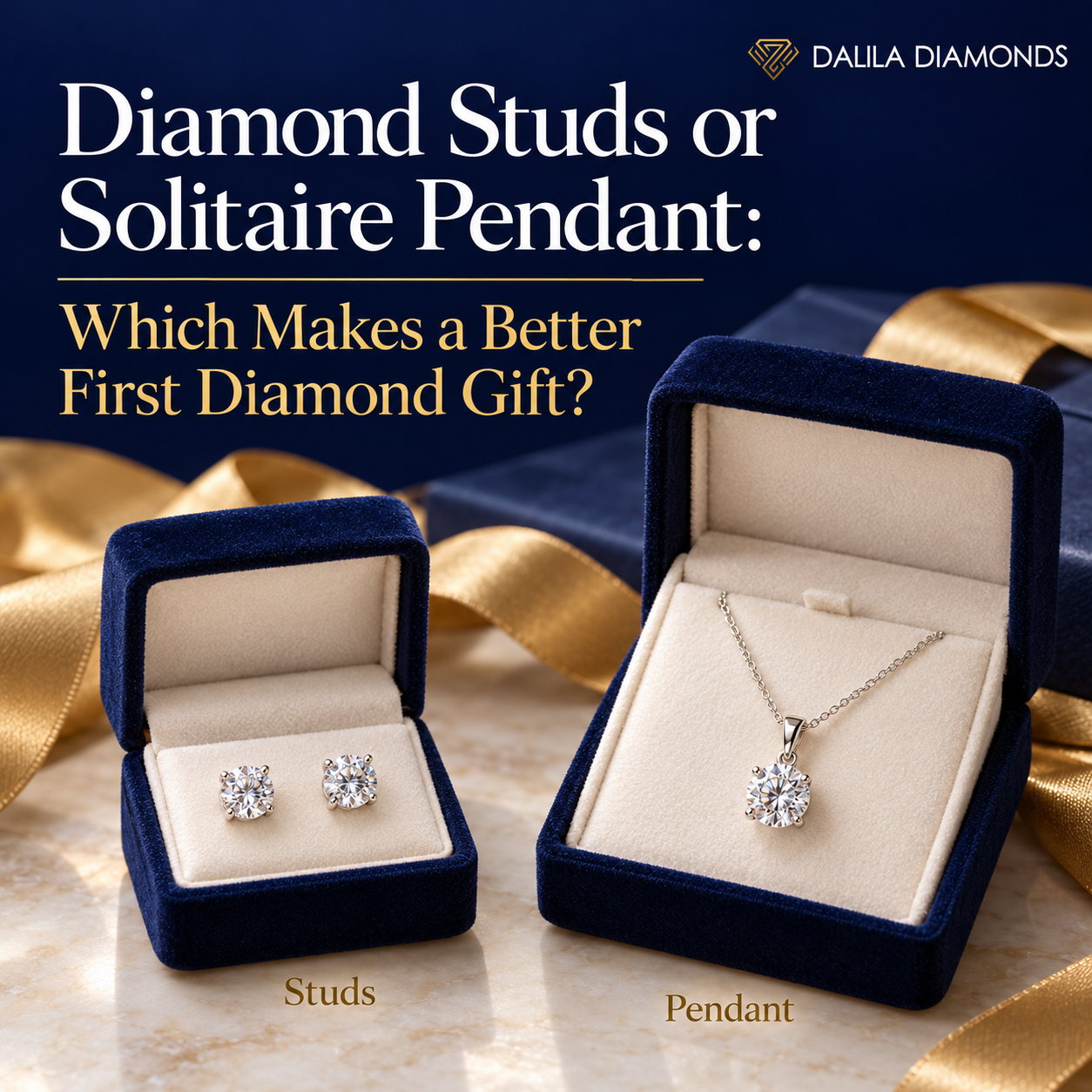
A solitaire diamond pendant is often the easier first diamond gift when you are unsure of the recipient's jewellery preferences. Diamond stud earrings are an excellent alternative when the recipient has pierced ears and regularly wears studs.
Neither choice is universally better. The right gift depends on what the recipient already wears, whether they prefer earrings or necklaces, the desired diamond size and whether a completed piece of jewellery will be ready for the occasion.
There is also an important difference in how the diamond budget is distributed.
A pair of solitaire diamond studs normally requires two diamonds selected to look harmonious together. A solitaire pendant generally requires one centre diamond.
For example, a pair of 1.00-carat-total diamond studs usually contains two approximately 0.50-carat diamonds, one in each ear. A 1.00-carat solitaire pendant contains one diamond weighing approximately one carat.
Both options contain the same combined diamond weight, but their visual appearances and purchasing requirements are very different.
The studs distribute the diamond weight between two earrings. The pendant concentrates it into one larger stone.
The best first diamond gift is the finished piece the recipient is most likely to wear—not simply the option with the highest carat weight.
This guide compares natural diamond studs and solitaire pendants as gifts, including appearance, matching requirements, setting costs, recipient preferences and purchasing timelines.
Diamond Studs vs Solitaire Pendant: Quick Comparison
Gift consideration | Diamond studs | Solitaire pendant |
Diamonds required | Usually two | Usually one |
First thing to confirm | Pierced ears and preference for studs | Preference for necklaces and chain style |
Visual appearance | Two diamonds framing the face | One centre diamond at the neckline |
Carat terminology | Often advertised in total carat weight | Usually refers to the single centre stone |
Size comparison | Diameter of each diamond | Diameter or length and width of one diamond |
Diamond matching | Two stones must look balanced | No second centre diamond to match |
Jewellery components | Two heads, posts and backs | One head, bail and chain |
Fit considerations | Earlobe comfort and earring backs | Chain length and pendant position |
Manufacturing | Two coordinated settings | One pendant setting and chain attachment |
Gift readiness | Depends on completed pair availability | Depends on completed pendant availability |
Best suited to | Someone who already enjoys earrings | Someone who already enjoys necklaces |
A pendant is not automatically cheaper because it uses one stone, and studs are not automatically more expensive because they require two.
The actual diamond weights, grades, manufacturing components and quotations determine the total cost.
When Diamond Studs Make the Better First Gift
Diamond studs are a strong choice when the recipient regularly wears earrings and appreciates understated jewellery.
A classic pair of natural round brilliant studs can work with a wide range of outfits, including workwear, casual clothing and more formal styles.
Their visual impact comes from the two diamonds framing the face rather than from one central focal point.
Choose diamond studs when:
The recipient has pierced ears and regularly wears stud earrings.
They prefer simple jewellery rather than necklaces.
They already own a favourite necklace that they seldom remove.
Their existing earrings suggest a preferred metal colour and size.
You want to give a coordinated pair rather than a single gemstone.
A verified, finished pair is available within the delivery deadline.
Studs also avoid the question of necklace length.
However, the recipient's earlobes, piercing position, preferred backing type and sensitivity to heavier earrings can affect comfort.
A large pair should not be chosen solely because the budget allows it.
The finished earring design should be appropriate for the intended wearer.
When a Solitaire Pendant Makes the Better First Gift
A solitaire pendant is particularly suitable when the recipient already enjoys necklaces or when you want one diamond to be the centrepiece of the gift.
A simple pendant can be worn alone or layered with other jewellery.
It may also be easier to personalise through the choice of diamond shape, setting metal and chain position.
Choose a solitaire pendant when:
The recipient wears necklaces more often than earrings.
You are uncertain whether they have pierced ears.
You want one prominent natural diamond rather than two smaller ones.
Their jewellery collection already includes studs but few necklaces.
You can identify their preferred chain length or choose an adjustable design.
A suitable complete pendant can be obtained before the occasion.
The pendant still needs a suitable chain and mounting.
A loose diamond on its own should not be represented as a ready-to-wear gift unless that presentation is specifically intended and understood by the recipient.
Dalila's existing solitaire-pendant guides can support the choice of stone size, shape and setting after the gift category has been selected.
What Looks More Impressive: Two Stud Diamonds or One Pendant Diamond?
The answer depends on how the diamond weight is distributed and where the jewellery is worn.
Consider two gift options containing approximately one carat of natural diamonds in total.
Measurement | Diamond studs | Solitaire pendant |
Number of diamonds | Two | One |
Weight per diamond | 0.50 ct | 1.00 ct |
Combined diamond weight | 1.00 ctw | 1.00 ct |
Approximate round diamond diameter | 5.1 mm per ear | 6.5 mm centre |
Number of visible focal points | Two | One |
Position | Each earlobe | Centre of neckline |
These dimensions are approximate examples of round brilliant diamonds, not current inventory or completed jewellery offers.
The studs show two distinct 5.1 mm diamonds.
The pendant shows one larger 6.5 mm diamond.
Neither presentation is categorically more impressive.
Stud earrings may attract attention through movement near the face. A pendant may create a stronger single focal point.
The best visual choice depends on the recipient's style and the actual finished jewellery.
Why equal total carat weight is not an equal visual comparison
Carat measures mass rather than visible diameter.
A one-carat round diamond does not appear twice as wide as a half-carat round.
The pendant's single stone may have a larger face-up area than either individual stud, but the earrings display two stones at once.
Do not compare gift options by total carat weight alone.
Instead, compare how they look when worn.
For detailed size guidance, see Dalila's Diamond Stud Size Guide at /blogs/diamond-stud-size-per-ear-total-carat and Diamond Pendant Carat Size Guide at /blogs/diamond-pendant-carat-size-guide.
Choosing a Diamond Gift When You Do Not Know the Recipient's Preferences
The strongest clue is usually the jewellery the recipient already wears.
If they wear small gold studs almost every day, a natural diamond stud pair in a similar style may be an appropriate gift.
If they regularly wear fine chains and delicate pendants, a solitaire necklace may be a better choice.
If they never wear earrings, purchasing diamond studs creates an obvious risk.
Similarly, someone who dislikes necklaces around their neck may not appreciate a pendant regardless of its quality.
Recipient-preference decision table
What you know about the recipient | More promising gift |
Wears small studs every day | Diamond studs |
Wears necklaces but rarely earrings | Solitaire pendant |
Does not have pierced ears | Solitaire pendant |
Loves matching jewellery sets | Studs or pendant, depending on existing pieces |
Prefers one noticeable centre stone | Solitaire pendant |
Prefers small, symmetrical accents | Diamond studs |
Likes layered fine chains | Solitaire pendant |
Is sensitive to heavier earrings | Pendant may be preferable |
Does not like anything around the neck | Diamond studs may be preferable |
Preferences are completely unknown | Consider a consultation or flexible gift arrangement |
These are practical preference indicators, not rules.
When the occasion allows it, involving the recipient in the final jewellery choice can avoid an expensive mistake.
How to Choose a First Pair of Natural Diamond Studs
For a first diamond stud gift, round brilliant solitaire earrings are a useful starting point because their circular outline and familiar appearance suit many styles.
However, the preferred size should come from the recipient's existing jewellery rather than an arbitrary carat target.
A buyer considering a delicate gift might begin with approximately 0.25 carat per ear.
Someone who prefers more visible earrings may appreciate approximately 0.50 carat per ear.
Larger options can also work, but the complete mounting and comfort should be assessed.
Illustrative stud gift sizes
Total pair weight | Weight per ear | Approximate round diameter per ear |
0.50 ctw | 0.25 ct | 4.1 mm |
1.00 ctw | 0.50 ct | 5.1 mm |
1.50 ctw | 0.75 ct | 5.8 mm |
2.00 ctw | 1.00 ct | 6.5 mm |
The chart provides initial size references only.
Actual diamonds vary in face-up measurements.
For a more precise choice, compare the intended diameter with earrings the recipient already owns.
The Extra Requirement for Studs: Matching Two Natural Diamonds
Unlike a solitaire pendant, studs require two diamonds that work together as a pair.
Even when they have identical carat weights, two natural diamonds may have different diameters, colour appearances, inclusion patterns or brightness.
For example, two 0.50-carat round brilliant diamonds might measure 5.05 mm and 5.20 mm in average diameter.
That difference could affect the visual balance of the completed pair.
A suitable pair should therefore be assessed for matching face-up size and overall appearance.
What should be checked?
Characteristic | Why it matters |
Individual carat weight | Establishes total pair weight |
Diameter or length and width | Determines visual balance |
Colour appearance | Avoids unintended warmth differences |
Clarity appearance | Avoids one visibly included stone |
Brightness and sparkle | Helps both earrings look harmonious |
Diamond shape and outline | Important for round and fancy-shaped studs |
Mounting dimensions | Ensures the two finished earrings look coordinated |
Reports and identity | Documents the actual stones being purchased |
The diamonds do not necessarily have to weigh exactly the same.
A 0.49-carat and a 0.51-carat round may form a convincing pair if their dimensions and appearance are compatible.
For the consumer selection process, see Dalila's guide at /blogs/buy-matching-loose-diamonds-for-studs.
For professional matching tolerances and procurement specifications, use the existing Matched-Pair Diamonds Buying Guide.
How to Choose a First Solitaire Diamond Pendant
A first solitaire pendant generally begins with one natural diamond.
The buyer can focus on the preferred face-up size, shape, quality and setting appearance without having to find a second visually compatible centre stone.
A round brilliant is a versatile choice, but oval, pear and emerald-cut diamonds can create different pendant silhouettes.
For example, a round looks balanced and circular, while an oval provides a longer outline.
A pear creates a directional teardrop, and an emerald cut offers geometric step-facet reflections.
The buyer should consider how the diamond will hang before choosing a fancy shape.
Illustrative pendant gift sizes
Diamond weight | Approximate round diameter | Visual direction |
0.25 ct | 4.1 mm | Delicate |
0.50 ct | 5.1 mm | Compact everyday solitaire |
0.75 ct | 5.8 mm | More prominent |
1.00 ct | 6.5 mm | Substantial focal point |
1.50 ct | 7.4 mm | Strong statement |
These descriptions are subjective.
The recipient's preferred necklace length and setting style may be more important than moving to the next carat category.
For a pendant-specific shape decision, see /blogs/diamond-shapes-for-solitaire-pendant.
Which Gift Is Easier to Get Right Without Exact Measurements?
Neither option is completely free from fit and comfort considerations.
Diamond studs do not require a necklace length, but their size, weight, post and backing must be suitable for the wearer.
A pendant avoids earlobe and piercing concerns, but its chain length determines where the diamond sits.
A short chain may place the pendant near the collarbone.
A longer chain may move the stone lower on the chest.
Neither location is automatically preferable.
Practical fit comparison
Detail | Diamond studs | Solitaire pendant |
Finger size required | No | No |
Pierced ears required | Usually yes | No |
Necklace length required | No | Yes |
Earring back preference | Relevant | Not applicable |
Setting weight and comfort | Relevant | Relevant |
Metal preference | Relevant | Relevant |
Adjustment options | Depend on backing and construction | Adjustable chain may offer flexibility |
When buying as a surprise, examine the recipient's existing jewellery for clues.
If practical, an adjustable necklace can provide some flexibility, but the jeweller must confirm its available positions and suitability for the pendant.
Colour and Clarity: Do Studs or Pendants Need Higher Grades?
Neither type of jewellery automatically requires D colour or flawless clarity.
The best grade combination depends on the actual diamond, desired appearance and budget.
For many natural diamond purchases, G–H colour and VS2 clarity provide useful starting points.
Carefully selected SI1 or lower-colour candidates may also be appropriate where their visible appearance and transparency meet the buyer's expectations.
However, a stud pair introduces an additional requirement: the two diamonds should look harmonious together.
A pendant needs only one centre diamond, so there is no second stone to match.
How to approach the quality decision
For studs, examine the two stones together for face-up colour, brightness and visible cleanliness.
For a pendant, examine the individual diamond and its appearance beside the intended metal and neckline.
Neither decision should be made solely from laboratory grade labels.
For more detailed advice, Dalila's separate stud and pendant colour-and-clarity guides retain their respective quality-selection questions.
What Costs More: Diamond Studs or a Solitaire Pendant?
There is no universal answer.
A pair of studs requires two diamonds and two earring settings.
A pendant usually requires one centre diamond, one head, a chain attachment and an appropriate chain.
The jewellery components differ, and diamond prices do not increase linearly with carat weight.
A one-carat natural diamond may cost considerably more than one half-carat diamond of comparable quality. However, the exact difference depends on the stones and current market quotations.
Compare a completed gift, not only the loose stones
Cost component | Stud earrings | Solitaire pendant |
Loose natural diamonds | Two | One |
Diamond matching or sourcing | May be needed | No pair matching |
Setting heads | Two | One |
Posts and backs | Required | Not applicable |
Chain | Not applicable | Required |
Bail or chain attachment | Not applicable | Required |
Setting and finishing labour | Required | Required |
Delivery and packaging | Confirm | Confirm |
Taxes | Confirm | Confirm |
Do not assume a loose-diamond quotation includes the finished gift.
For current pricing, request a quote for identified stones and a complete setting or manufacturing quotation.
Dalila's natural diamond stud price guide at /blogs/natural-diamond-stud-pair-price covers pair-level price considerations in more detail.
Worked Example: Two First Diamond Gifts With a €2,000 Budget
Suppose a buyer has an illustrative total budget of €2,000.
The buyer wants natural diamonds and must include the finished jewellery within that amount.
The recipient regularly wears both small earrings and necklaces.
Two possible gift briefs are prepared.
Specification | Gift A: Studs | Gift B: Pendant |
Diamond quantity | Two | One |
Approximate weight | 0.30 ct per ear | 0.60 ct |
Total diamond weight | 0.60 ctw | 0.60 ct |
Approximate round diamond size | 4.3 mm each | Around 5.4–5.6 mm |
Quality preference | G–H, VS2 | G–H, VS2 |
Setting preference | Four-prong studs | Simple solitaire pendant |
Metal preference | 14K white gold | 14K white gold |
Additional components | Posts and backs | Chain and bail |
Actual loose-diamond price | Quote required | Quote required |
Actual setting cost | Quote required | Quote required |
Can be completed within €2,000? | Unconfirmed | Unconfirmed |
These are hypothetical specifications, not available Dalila offers or evidence that either finished gift fits the stated budget.
Gift A: Matching Diamond Studs
Two approximately 0.30-carat natural round brilliants would need to be sourced.
The supplier should identify a coordinated pair with similar face-up dimensions, colour and brightness.
The manufacturing jeweller then needs to confirm appropriate matching heads, posts and backs.
The buyer must obtain the combined loose-diamond price and completed-earring quotation.
Gift B: Solitaire Diamond Pendant
One approximately 0.60-carat natural round brilliant would be required.
The selection can concentrate on the stone's individual appearance and the desired neckline size.
The jeweller must quote the pendant head, chain, attachment and setting work.
Which is the better gift?
If the recipient wears earrings more frequently, Gift A may be preferable.
If the recipient prefers necklaces or does not wear studs, Gift B is the stronger choice.
The fact that both options contain 0.60 carat of diamonds in total does not establish equal price, equal visible effect or equal sentimental value.
The final decision should be made using actual diamond and manufacturing quotations, the recipient's preferences and the completion date.
Availability: Is the Finished Gift Ready for the Occasion?
This is one of the most important considerations when purchasing natural diamonds separately from the finished jewellery.
A diamond supplier may have a suitable loose stone available without offering completed stud earrings or necklaces.
A matched stud pair may also require additional time to source.
If a birthday, anniversary, graduation or other occasion is approaching, establish the delivery requirements before buying.
Three availability situations
Situation | What the buyer should verify |
Completed studs or pendant in stock | Finished jewellery specification, availability and delivery |
Loose diamond available, mounting not completed | Jeweller acceptance, production schedule and total price |
Diamond must be sourced to specification | Stone availability, approval timeline and manufacturing feasibility |
A statement that a loose diamond is in stock is not proof that a finished pendant or matching stud pair is ready to ship.
What if the date is too close?
The buyer should not assume that custom sourcing and manufacturing can be completed on an arbitrary deadline.
If suitable finished jewellery is unavailable, a consultation or a clearly described future-selection arrangement may be preferable, provided the recipient is comfortable choosing the finished piece later.
Any deposit, cancellation or return terms should be confirmed with the seller.
A Gift-Purchasing Checklist
Use this worksheet before choosing between natural diamond studs and a solitaire pendant.
Question | Answer |
Does the recipient wear earrings regularly? | ______ |
Does the recipient wear necklaces regularly? | ______ |
Are the ears pierced? | Yes / No / Unknown |
Preferred jewellery metal | ______ |
Existing preferred stud size | ______ mm / Unknown |
Existing preferred chain length | ______ cm / Unknown |
Preferred jewellery style | Minimal / Classic / Statement |
Desired occasion | ______ |
Deadline | ______ |
Total gift budget | ______ |
Diamond type | Natural |
Grading documentation required | ______ |
Finished jewellery available? | Confirmed / Unconfirmed |
Manufacturing required? | Yes / No |
Complete quote received? | Yes / No |
Delivery confirmed? | Yes / No |
The checklist should lead to a gift decision before detailed diamond sourcing begins.
If the recipient's preferences are uncertain, do not use carat weight as a substitute for understanding what they would actually enjoy wearing.
Sourcing Natural Diamonds for a First Diamond Gift
Dalila Diamonds offers natural loose-diamond inventory and customised sourcing through DS4U — Diamond Source For You.
That service can help identify a suitable single stone for a pendant or a matched pair of natural diamonds for studs, subject to the buyer's specifications and availability.
The service should not be described as a ready-made gift catalogue or a guaranteed finished-jewellery manufacturing service.
Example request: Diamond studs
Intended jewellery: Solitaire diamond stud earrings.
Quantity: Two natural round brilliant diamonds.
Carat preference: Approximately 0.25–0.40 carat per ear.
Colour and clarity: G–H, VS2 or other approved visually suitable alternatives.
Matching: Similar face-up measurements, colour and brightness.
Documentation: Individual grading details where available.
Budget: State whether the amount covers loose stones only or the complete gift.
Required date: Include the deadline, subject to confirmation.
Manufacturing: Separate jeweller to confirm earring settings and finished delivery.
Example request: Solitaire pendant
Intended jewellery: Natural diamond solitaire necklace.
Quantity: One natural round brilliant diamond.
Carat preference: Approximately 0.50–0.75 carat.
Colour and clarity: G–H, VS2, subject to visual assessment.
Dimensions: Compare actual face-up diameter.
Setting: Prong or bezel pendant, to be confirmed with a jeweller.
Budget and deadline: Clearly specified.
Manufacturing: Pendant head, chain and setting costs to be confirmed separately.
These examples are purchasing briefs, not current available products.
Supplier versus jeweller responsibilities
Task | Loose-diamond supplier | Manufacturing jeweller |
Source one natural diamond | Yes | May advise |
Source a coordinated pair | Yes, where service accepted | May advise |
Provide grading and measurements | Where available | Review |
Provide candidate photographs | Where available | Review |
Design earring or pendant mounting | Not assumed | Yes |
Confirm chain or earring backs | Not assumed | Yes |
Set the diamond securely | Not assumed | Yes |
Confirm finished-jewellery availability | Only if expressly offered | Yes, for their service |
Approve final construction | No | Yes |
Ask for separate quotations unless a provider explicitly supplies the entire completed jewellery piece.
Common Mistakes When Choosing a First Diamond Gift
Choosing solely by total carat weight
One carat distributed across two earrings produces a different visual result from a one-carat solitaire pendant.
Buying earrings without confirming pierced ears
This is an avoidable gift risk.
Assuming a pendant does not require sizing considerations
Chain length and neckline position affect the finished appearance.
Selecting two stud diamonds independently
The stones need to look harmonious as a pair.
Treating a loose diamond as ready-to-wear jewellery
The mounting and other components must be sourced or manufactured.
Ignoring the gift deadline
Custom sourcing, inspection and manufacturing may take additional time.
Comparing only the stone prices
The complete gift includes setting components, labour and applicable delivery charges.
Paying for higher grades without checking visual appearance
A higher colour or clarity grade does not automatically create a more attractive finished gift.
Frequently Asked Questions
Are diamond studs or a solitaire pendant better as a first diamond gift?
A pendant is often a useful choice when jewellery preferences are uncertain, while studs are an excellent option for someone with pierced ears who regularly wears them. The better gift depends on the recipient's habits and the availability of suitable finished jewellery.
Is a diamond pendant a safer surprise gift than earrings?
It may be if you do not know whether the recipient has pierced ears. However, necklace preferences, metal choice and chain length still matter.
Are diamond studs a good birthday gift?
Yes, particularly for someone who regularly wears small earrings. Choose the size and metal based on their existing jewellery rather than assuming bigger diamonds are automatically preferable.
Are diamond pendants good anniversary gifts?
Yes. A solitaire pendant can be a meaningful anniversary gift, especially for someone who enjoys necklaces. The diamond shape and setting can be selected to suit their preferences.
Which looks bigger: One carat of studs or a one-carat pendant?
A 1.00 ctw stud pair usually contains two approximately 0.50-carat diamonds, around 5.1 mm each for typical rounds. A one-carat round pendant may contain a single diamond approximately 6.5 mm across. The appearances differ because of size distribution and wearing position.
Is it better to give one larger diamond or two smaller diamonds?
Neither is inherently better. One larger diamond creates a single focal point, while two smaller diamonds create a coordinated pair framing the face.
Do diamond studs need matching diamonds?
Yes, they should look intentionally coordinated. The diamonds need not have identical carat weights, but their visible size, colour and appearance should be compatible.
Do diamond pendants need a chain?
A ready-to-wear pendant necklace requires a suitable chain or another explicitly specified wearing arrangement. Confirm whether a chain is included when comparing quotations.
What carat size is good for first diamond studs?
Approximately 0.25–0.50 carat per ear provides useful starting options, depending on the recipient's preferred earring size. Compare actual diameters and the completed mountings.
What carat size is good for a first diamond pendant?
Approximately 0.25–0.75 carat provides useful options for a delicate to more prominent solitaire. The best choice depends on desired millimetre size and wearing position.
Are diamond studs more expensive than a pendant?
Not necessarily. Studs require two stones and two settings, while a pendant uses one centre stone and a chain. The actual prices depend on weight, quality and manufacturing.
Is G colour and VS2 clarity suitable for a diamond gift?
Yes. G colour and VS2 clarity are practical starting specifications for many natural diamond gifts. Actual brightness, colour and visible cleanliness should still be assessed.
Are round diamonds the best choice for a first diamond gift?
Round brilliants are versatile and familiar, but oval, pear, cushion and emerald cuts can also suit the recipient's preferences. Shape is a design decision rather than a universal quality ranking.
Should I buy the loose diamond or finished jewellery?
For a time-sensitive gift, confirmed ready-to-wear jewellery may be simpler. Buying loose diamonds provides greater control over stone selection but requires separate setting arrangements unless a complete service is expressly offered.
Can I get custom diamond studs before a particular date?
Possibly, but the availability of a suitable pair, inspection requirements, manufacturing schedule and shipping must all be confirmed. Do not assume a loose-diamond listing establishes the completed delivery date.
Can Dalila supply finished diamond stud earrings?
Dalila publicly describes natural loose-diamond inventory and custom sourcing services. Finished earring manufacture or retail stock should be confirmed directly rather than assumed.
Can Dalila source a natural diamond for a pendant gift?
Dalila's custom natural-diamond sourcing service accepts specification-led enquiries for loose stones. The finished pendant setting, chain and delivery requirements must be separately confirmed.
Can Dalila source two matching diamonds for earrings?
Yes. Its DS4U service publicly describes sourcing matched natural-diamond pairs according to specified requirements, subject to availability and agreed commercial terms.
What if I do not know whether the recipient prefers studs or pendants?
Check their existing jewellery or involve them in the choice. If neither preference can be established, avoid committing to an expensive custom piece without a clear return or approval arrangement.
What should I send Dalila when enquiring about a first diamond gift?
State whether you need one loose diamond for a pendant or two matching stones for studs. Include shape, carat range, quality preferences, budget, delivery location and deadline, and clarify that finished jewellery will be arranged separately unless confirmed otherwise.