Natural Diamond Pendant Price: Stone and Setting Costs Explained
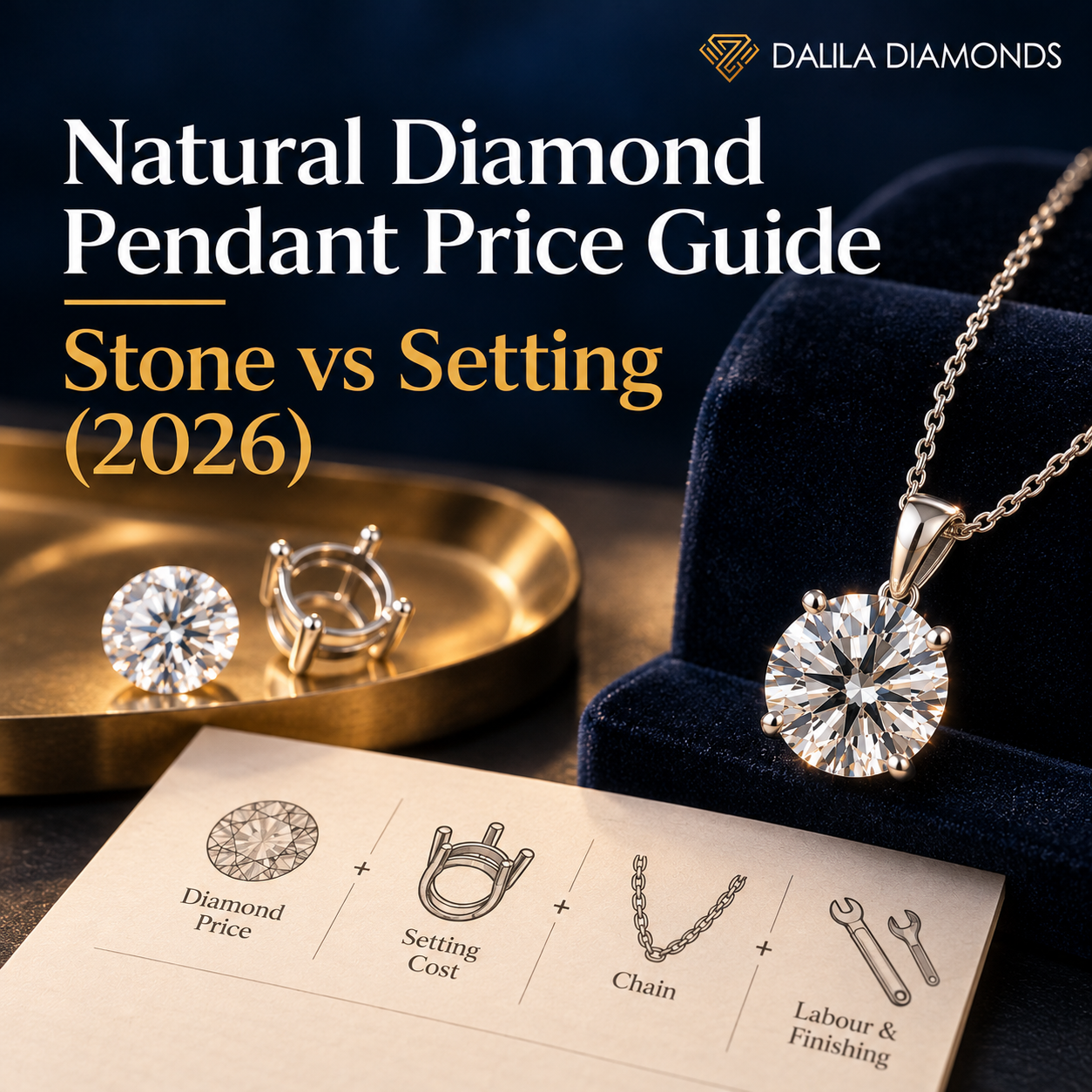
A natural diamond solitaire pendant has two principal costs: the loose natural diamond and the setting that turns it into wearable jewellery. A completed necklace may also require a chain, bail, stone-setting labour, polishing, insured shipping and taxes.
For example, a retailer has publicly listed a 0.50-carat natural round brilliant diamond at $729. That figure describes the loose diamond—not a completed solitaire pendant with a gold mounting and chain.
A separate supplier lists 14K gold diamond-setting baskets, but these are individual manufacturing components rather than complete necklaces. Adding the lowest basket price to the diamond price would therefore produce a misleading total.
Ritani
+1
The correct way to calculate a natural diamond pendant price is to obtain a current quotation for one identified diamond and a separate, fully specified jewellery-manufacturing quotation.
This guide compares real publicly advertised loose-diamond prices, verified setting-component listings and the additional costs buyers should confirm before commissioning a pendant.
Natural Diamond Pendant Price: Quick Comparison
Component | Available price evidence | What it covers |
0.50 ct G/VS2 natural diamond, example A | US$729 | One identified loose diamond |
0.50 ct G/VS2 natural diamond, example B | US$747 | A different identified loose diamond |
0.50 ct G/VS2 natural diamond, example C | US$689 | Another individual loose diamond |
14K white-gold round wire basket | US10.18–695.32 | Size-dependent range for one basket component |
14K yellow-gold oval wire basket | US27.06–671.86 | Size-dependent range for one oval basket component |
Chain, bail and setting labour | Separate quotation required | Remaining manufacturing components and work |
Prices were found in public listings during research on 14 October 2026. Diamond listings are individually identified historical/public offers; present availability and checkout prices have not been confirmed. Setting ranges cover multiple sizes, not a quoted mounting for any particular diamond.
Ritani
+4
These examples show why a useful pendant price guide must avoid presenting an arbitrary all-in estimate as a confirmed selling price.
Real Natural Diamond Price Examples
The following diamond records provide more meaningful information than an unsupported generic price range.
Each example identifies one natural diamond, including its laboratory report reference.
Example | Carat | Colour | Clarity | Measurements | Advertised loose price |
A — GIA 2566029037 | 0.50 | G | VS2 | Approximately 5.1 mm diameter | $729 |
B — GIA 6561234849 | 0.50 | G | VS2 | Approximately 5.1 mm diameter | $747 |
C — GIA 7562189377 | 0.50 | G | VS2 | Approximately 5.1 mm diameter | $689 |
Individual Ritani natural-diamond listing observations; the prices are not contemporaneously confirmed transactions.
Ritani
+2
All three are natural round brilliant diamonds with the same headline carat, colour and clarity grades.
Yet the listed prices differ.
That difference is important: a shopper should not assume every half-carat G/VS2 natural diamond has one standard market price.
Actual cutting proportions, measurements, grading details, fluorescence, supplier terms and availability can influence the quotation.
What these examples do not establish
They do not establish Dalila's selling prices.
They do not establish that the stones remain available today.
They do not establish the cost of a completed pendant.
And they should not be used as a fixed market-wide price range. They are three identifiable examples from one retailer.
For a purchase, request a current price for the exact diamond and verify the report number.
Why the Same Carat Weight Can Have Different Prices
Carat measures the diamond's weight, not its precise face-up size or optical performance.
Two natural diamonds can weigh 0.50 carat yet have different diameters.
One may have more weight distributed into its depth, while another shows a wider face-up outline.
For a pendant, this matters because buyers primarily see the diamond from the front.
A stone with a desirable colour and clarity grade but a small face-up appearance may not meet the buyer's desired size.
Other differences include:
Cut quality and optical performance.
Colour and clarity characteristics beyond the headline grades.
Fluorescence.
Laboratory documentation.
Supplier pricing and availability.
Actual measured diameter or length and width.
A more expensive diamond is not automatically more attractive in the completed pendant.
The individual stone should be compared against the buyer's intended visual and technical requirements.
How Diamond Size Affects Pendant Price
Natural diamond prices generally do not increase in direct proportion to carat weight.
Moving from a half-carat to a one-carat diamond doubles the diamond mass, but it does not necessarily double the purchase price.
Larger stones with desirable combinations of characteristics may attract a higher price per carat.
The visible size difference is also less dramatic than the weight difference.
Round brilliant weight | Approximate face-up diameter | Intended pendant appearance |
0.25 ct | 4.1 mm | Delicate solitaire |
0.50 ct | 5.1 mm | Compact everyday centre |
0.75 ct | 5.8 mm | Noticeable centre diamond |
1.00 ct | 6.5 mm | More prominent solitaire |
1.50 ct | 7.4 mm | Larger centrepiece |
2.00 ct | 8.1 mm | Statement-sized solitaire |
Diameters are indicative; the descriptions are subjective. These are not live-priced inventory categories.
The key decision is whether the additional cost produces a visible size difference the buyer values.
For exact size comparisons, use Dalila's Diamond Size Chart and the pendant-specific guide at /blogs/diamond-pendant-carat-size-guide.
What Does a 0.50-Carat Natural Diamond Pendant Cost?
A 0.50-carat natural round brilliant typically measures around 5.1 mm.
As the dated examples above demonstrate, publicly listed loose stones of this category have been advertised at different prices.
But the completed pendant requires more than the diamond.
For a 0.50-carat solitaire, the buyer should request:
The exact loose-diamond price.
A compatible prong or bezel head.
The required bail or chain attachment.
A suitable chain.
Stone-setting, assembly and finishing.
Delivery, insurance and tax details.
A setting advertised for a nominal 5 mm round diamond is not necessarily suitable for every 0.50-carat stone.
The jeweller should approve the actual diamond dimensions before ordering the mounting.
What Does a 0.75-Carat Natural Diamond Pendant Cost?
A typical 0.75-carat round brilliant measures around 5.8 mm in diameter.
It can offer a visible increase over a half-carat pendant without automatically requiring a full one-carat stone.
However, its actual price depends on the particular diamond.
There is no verified current 0.75-carat Dalila quotation in this research, so a numeric Dalila price should not be published.
A buyer should request two or three individual candidates within the preferred specifications.
For example:
Specification | Candidate A | Candidate B |
Weight | 0.70–0.80 ct | 0.70–0.80 ct |
Colour | G–H | I |
Clarity | VS2 | Inspected SI1 |
Cut | Attractive cut quality | Attractive cut quality |
Actual dimensions | Supplier to confirm | Supplier to confirm |
Current price | Quote required | Quote required |
This is a comparison framework, not an inventory representation.
The buyer may find that a slightly warmer but attractive natural diamond provides the preferred appearance for less money.
That decision should be based on actual optical quality, transparency, face-up colour and quoted price.
What Does a 1-Carat Natural Diamond Pendant Cost?
A one-carat round brilliant commonly measures approximately 6.5 mm across.
Its price depends on the specific stone's colour, clarity, cut quality, proportions and availability.
A retailer's asking price for an individual one-carat diamond should not automatically be converted into a completed-pendant quotation.
The buyer should first identify the exact stone and confirm its current price.
Then a jeweller should verify that the chosen head accommodates its diameter, girdle and pavilion depth.
An approximately one-carat diamond may be compatible with a nominal 6.5 mm mounting, but only after the dimensions and setting geometry have been checked.
The quote should then separately cover the chain and all remaining manufacturing services.
How Much Does a 14K Gold Diamond Pendant Setting Cost?
A significant source of pricing confusion is the word setting.
It can describe a small basket or head, a complete unset pendant mounting, or a larger jewellery manufacturing service.
These are not interchangeable products.
A verified public supplier, Findings Outlet, lists a 14K white-gold round four-prong wire basket across different sizes at 10.18–695.32. Its listing expressly identifies the product as one basket per order.
Findings Outlet
That is a real advertised component-price range.
It is not a quotation for the finished setting of a particular diamond.
Similarly, Stuller lists a 14K white-gold bezel slide mounting sized for a 5.2 mm round stone and explicitly treats the diamond and matching chain as separately selectable components. Its public product page does not disclose a usable setting price without the appropriate account access.
Stuller
Setting costs that must be distinguished
Part | Definition | Price status |
Basket or head | Structure that directly retains the diamond | Public component listings exist |
Bail | Connection between pendant and chain | May be separate or integrated |
Chain | Necklace supporting the pendant | Obtain item-specific quote |
Setting labour | Securing the diamond | Jeweller quote required |
Assembly | Joining head, bail and other components | Jeweller quote required |
Finishing | Polishing and quality inspection | Confirm inclusion |
The price of a single basket should never be presented as the price of a complete wearable solitaire pendant.
Is a Bezel Pendant More Expensive Than a Prong Pendant?
Not necessarily.
A bezel uses retaining metal around much of the diamond's perimeter.
A prong setting supports the stone at selected contact points.
The relative price depends on the actual metal weight, design, whether stock components are suitable, and the work required to fit the diamond.
For example, an oval with unusual shoulders may require a more carefully fitted bezel than a common round brilliant.
But a complex handmade prong head may also cost more than a standard bezel component.
The only reliable comparison is a quote for both alternatives using the same identified diamond.
Consideration | Prong setting | Bezel setting |
Actual stone dimensions needed | Yes | Yes |
Girdle condition reviewed | Yes | Yes |
Setting-head price | Quote required | Quote required |
Labour | Quote required | Quote required |
Outside finished dimensions | Jeweller to confirm | Jeweller to confirm |
Chain and bail | Additional where not included | Additional where not included |
For diamond selection and setting compatibility, see /blogs/diamond-for-bezel-vs-prong-pendant.
Does the Gold Chain Make a Significant Difference to the Price?
It can.
A finished solitaire pendant necklace needs a chain or another agreed attachment. If a jeweller quotes only the pendant head, the chain cost may remain completely separate.
Chain prices depend on their exact specifications.
Chain specification | What to confirm |
Metal purity | 14K, 18K or other specified metal |
Colour | White, yellow or rose gold |
Length | 40, 45, 50 cm or another size |
Construction | Cable, box, wheat or other chain |
Weight | Actual gold weight |
Clasp | Included type |
Bail compatibility | Approved by jeweller |
Price | Dated individual quotation |
Tax | Included or excluded |
A longer chain is not always proportionally more expensive than a shorter chain because designs, widths and weights vary.
For a fair comparison, request the exact chain price rather than estimating it from the pendant's diamond carat weight.
Worked Example: Separating the Stone and Setting Costs
Suppose a buyer is considering the previously identified natural round brilliant diamond with GIA report 2566029037, advertised at $729.
The buyer wants a 14K white-gold, four-prong solitaire pendant on a 45 cm chain.
The purchasing worksheet would look like this:
Component | Amount | Status |
Natural loose diamond | $729 | Historical public listed price; reconfirm |
Suitable 14K white-gold head | — | Size-specific quote needed |
Bail/attachment | — | Quote or inclusion needed |
45 cm gold chain | — | Quote needed |
Setting labour | — | Quote needed |
Finishing and inspection | — | Quote or inclusion needed |
Shipping and insurance | — | Confirm |
Applicable tax | — | Confirm |
Finished pendant total | Not established | Await complete quotation |
This is an evidence-based breakdown, not a completed sale or Dalila offer.
A confirmed final price requires an available diamond at a current price and an approved, fully priced finished-jewellery specification.
Can Buying the Diamond Separately Save Money?
Possibly, but it is not guaranteed.
Buying a natural loose diamond separately can provide greater control over carat weight, proportions, colour, clarity and grading documentation.
The buyer can compare individual stones before commissioning a pendant.
However, custom manufacturing, setting and chain costs must also be considered.
A finished pendant retailer may have different purchasing terms or bundle the manufacturing work into one retail price.
Therefore, compare equivalent offerings:
Comparison factor | Loose stone + custom pendant | Ready-made pendant |
Exact stone selection | Buyer chooses specific stone | Depends on seller |
Grading documentation | Request for chosen stone | Confirm what is supplied |
Setting work | Must be arranged | Usually already completed |
Chain | May be additional | Confirm included |
Delivery date | Depends on sourcing and manufacture | Depends on stock |
Full price | Sum of confirmed quotations | Retail selling price |
Return conditions | May vary between suppliers | Retailer terms |
The lower advertised starting number does not establish the cheaper final outcome.
How to Avoid Overpaying for a Natural Diamond Pendant
Start with the appearance you want rather than choosing a fixed carat and the highest grades.
For many buyers, the most useful comparisons involve:
Face-up size: Compare actual millimetre dimensions, not only weight.
Cut quality: Prioritise attractive brightness and optical performance.
Colour: Compare G–H stones alongside selected alternatives.
Clarity: Consider visually clean VS2 and carefully assessed SI1 diamonds.
Setting: Obtain a design-specific quote instead of assuming that all gold heads cost the same.
Manufacturing: Confirm what is included in the jeweller's labour price.
A stone with a slightly lower carat weight may produce the desired pendant size at a different price.
However, reducing cost should not come at the expense of unacceptable transparency, damage risks or poorly executed setting work.
For more detailed stone-quality guidance, see /blogs/diamond-quality-for-solitaire-pendant.
How to Request a Natural Diamond Pendant Price From Dalila
Dalila Diamonds can receive enquiries for natural loose diamonds meeting specific buying requirements.
A useful enquiry identifies the intended pendant and the precise loose-diamond specifications.
Example sourcing brief
Requirement | Specification |
Jewellery | Natural diamond solitaire pendant |
Diamond quantity | One |
Preferred shape | Round brilliant |
Carat range | 0.70–0.90 ct |
Desired diameter | Approximately 5.7–6.1 mm |
Colour | G–H |
Clarity | VS2, with visually acceptable alternatives |
Cut | Attractive round-brilliant cut quality |
Grading | GIA, IGI or HRD, as agreed |
Quotation currency | EUR |
Budget | Specify loose-diamond budget |
Setting | Jeweller-approved 14K or 18K gold |
Availability | Confirm for identified stone |
Delivery destination | Specify country |
These are illustrative sourcing preferences, not a claim about Dalila's current inventory.
A natural loose-diamond quote should identify the actual stone, report number, dimensions, price and availability.
The buyer can then seek a separate manufacturing quotation for the pendant.
Do not assume Dalila supplies completed pendants, chains or setting labour unless it explicitly confirms those services.
Complete Natural Diamond Pendant Price Worksheet
Loose diamond | Information |
Supplier | ______ |
Stock reference | ______ |
Grading laboratory | ______ |
Report number | ______ |
Natural origin confirmed | Yes / No |
Shape | ______ |
Carat weight | ______ |
Measurements | ______ mm |
Colour | ______ |
Clarity | ______ |
Cut and optical assessment | ______ |
Quoted stone price | ______ |
Currency | ______ |
Quote date | ______ |
Availability | Confirmed / Pending |
Finished jewellery | Information |
Manufacturing jeweller | ______ |
Setting design | ______ |
Metal and purity | ______ |
Head price | ______ |
Bail price or inclusion | ______ |
Chain specifications | ______ |
Chain price | ______ |
Setting labour | ______ |
Assembly and finishing | ______ |
Shipping and insurance | ______ |
Tax | ______ |
Total finished quotation | ______ |
Delivery date | ______ |
Written approval | ______ |
For international transactions, make sure prices are compared in the same currency with exchange conversion and taxes stated explicitly.
Avoid adding taxes twice when they are already included.
Frequently Asked Questions
How much does a natural diamond solitaire pendant cost?
The cost is the combined price of an identified natural loose diamond, its mounting, chain, setting labour and applicable charges. There is no reliable universal price because both the stone and finished construction vary.
How much does a 0.50-carat natural diamond pendant cost?
Public listings have shown individual 0.50-carat G/VS2 natural diamonds at prices such as $689, $729 and $747. These were loose stones, not complete pendant necklaces, and require current price and availability confirmation.
How much does a one-carat natural diamond pendant cost?
It depends on the exact diamond's quality, measurements and selling price, plus the setting and chain. Request a current quotation for the chosen stone and a separate jewellery quote.
Is a diamond pendant setting included when buying a loose diamond?
Not unless the seller expressly includes it. Loose-diamond listings generally need to be distinguished from completed jewellery listings.
Does a solitaire pendant price include the chain?
Not always. Setting components and unfinished pendant mountings may exclude the chain, so confirm the scope of the quote.
How much is a 14K gold pendant mounting?
Prices vary by product type, size and supplier. Publicly advertised component ranges do not establish the cost of a completed pendant. A size-specific mounting and labour quotation is needed.
Is a bezel setting more expensive than prongs?
Not universally. Metal use, head design, stone outline and setting labour determine the difference.
Does 18K gold cost more than 14K gold?
It may for otherwise comparable designs, but the actual difference depends on the metal weight and manufacturing quotation.
Are oval diamond pendants cheaper than round ones?
Sometimes, but there is no fixed relationship. Compare actual stones with comparable characteristics and account for their different setting requirements.
Why do two half-carat natural diamonds have different prices?
Cut proportions, dimensions, colour and clarity characteristics, fluorescence, grading details, availability and seller pricing can all contribute.
Can I buy a diamond separately and have a jeweller make the pendant?
Yes. The manufacturing jeweller should inspect the actual stone and approve the head, bail, chain and setting work before accepting the project.
Does higher clarity always make a better pendant?
No. Higher clarity can be valuable, but it does not automatically improve cut quality, brightness or visible beauty.
How can I get an accurate finished pendant quote?
Provide the jeweller with the identified diamond's complete measurements and the desired metal, head, chain and attachment design. Ask for a written quote covering all services and applicable charges.
Does Dalila's natural diamond price include a completed pendant?
That should not be assumed. A Dalila loose-diamond quotation should be treated separately from the finished necklace unless the company explicitly confirms a complete jewellery service.
Can Dalila help source a natural diamond for a pendant?
Dalila accepts natural loose-diamond enquiries. Provide the preferred stone specifications and request individual pricing and availability for suitable candidates.