Which Diamond Shape Works Best in a Solitaire Pendant?
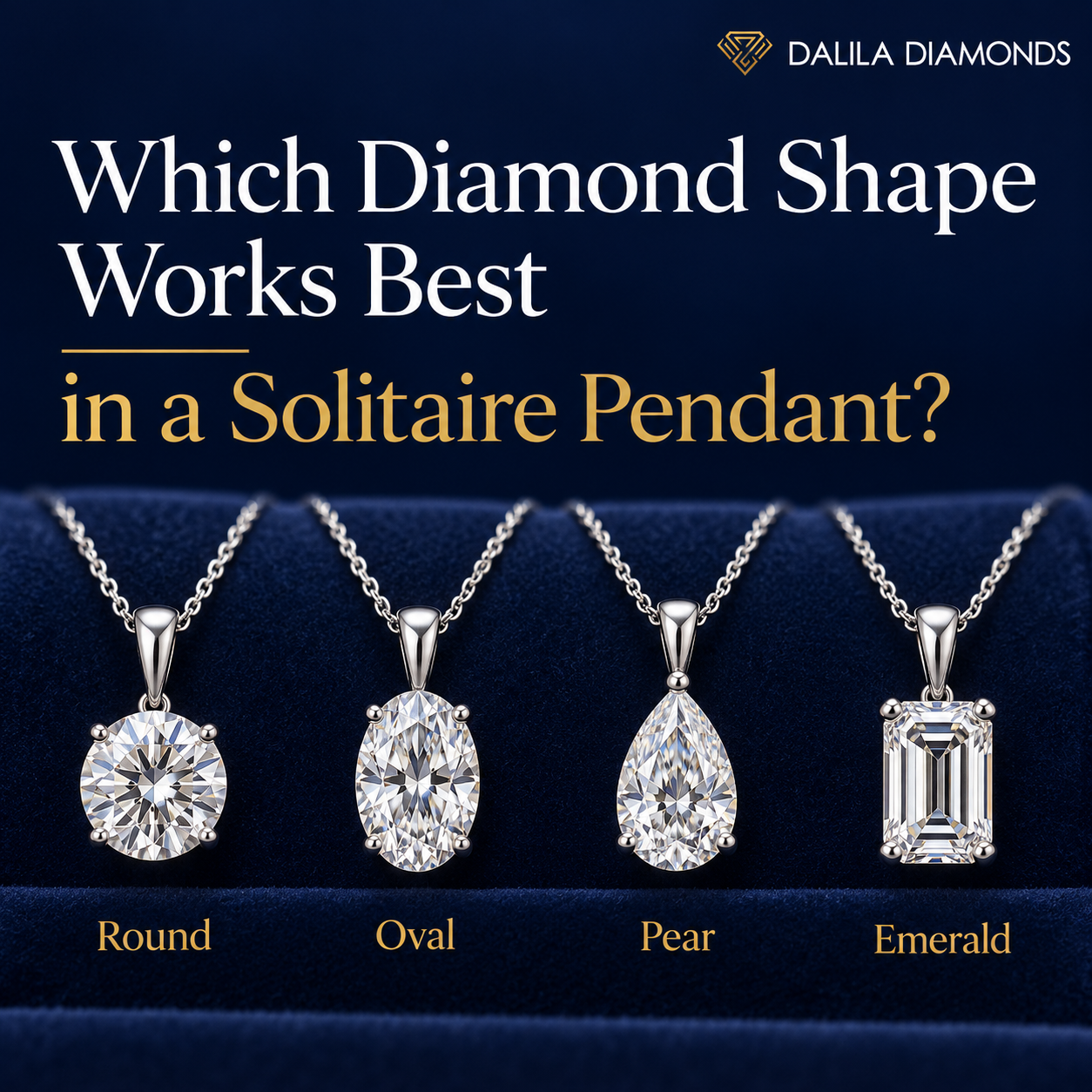
The best diamond shape for a solitaire pendant depends on how the stone looks when suspended, how its outline works with the chain and how securely the setting holds it. Round brilliant diamonds are a versatile starting point because their circular outline looks balanced in almost any orientation. Oval diamonds create a softer, elongated drop. Pear diamonds produce a distinctive teardrop silhouette, while emerald cuts offer clean geometric lines and broad, step-cut reflections.
However, no diamond shape is automatically the best choice for every pendant.
A beautifully proportioned pear-shaped diamond may look disappointing if its point faces the wrong direction or the pendant repeatedly turns sideways. An attractive emerald cut may lose some of its intended geometric character if the setting obscures its corners. Even a classic round brilliant requires a correctly positioned attachment and secure mounting.
The most useful buying decision is therefore not simply which shape is most popular.
It is which natural diamond gives you the desired visible outline, optical appearance and finished pendant design.
For example, a one-carat round brilliant may measure approximately 6.5 mm in diameter. An oval of similar weight might measure around 8.0 × 5.6 mm, giving it more length along the necklace.
Neither stone is necessarily visually larger in every sense. Their outlines and proportions are different.
This guide compares round, oval, pear and emerald-cut diamonds specifically for solitaire pendants, focusing on the stone's orientation, hanging behaviour, setting design and actual dimensions.
For the wider comparison of diamond shapes independent of jewellery type, see Dalila's Diamond Shape Comparison Chart.
Which Diamond Shape Is Best for a Pendant? Quick Comparison
Diamond shape | Pendant appearance | Typical orientation | Main setting consideration | Best starting point for |
Round brilliant | Balanced, circular and brilliant | Circular; rotation is visually less significant | Secure girdle support and pendant attachment | Classic solitaire |
Oval brilliant | Soft, elongated and elegant | Vertical or east-west | Outline fit and balanced hanging | Elongated everyday pendant |
Pear brilliant | Directional teardrop | Point-up or point-down | Protection of pointed tip | Distinctive drop silhouette |
Emerald cut | Rectangular and architectural | Vertical or horizontal | Cut corners, step-facet appearance and setting fit | Minimal geometric pendant |
These are design differences, not a ranking of diamond quality.
A well-selected stone in any of the four shapes can create an attractive solitaire pendant.
The better question is whether the specific loose diamond works with the intended mounting and wearing position.
How Diamond Shape Changes the Appearance of a Solitaire Pendant
A pendant is viewed differently from a diamond ring.
A ring's centre stone is seen against the hand and frequently examined from close range.
A pendant is usually viewed against the neck, upper chest or clothing, often from a greater distance.
The diamond may also move with the chain as the wearer walks or turns.
For this reason, its orientation and the way it hangs are particularly important.
A round diamond has a relatively consistent circular outline regardless of rotation.
An oval becomes noticeably different when turned from vertical to horizontal.
A pear creates two distinct visual effects depending on whether the point faces upwards or downwards.
An emerald cut may look like a conventional vertical drop or a more contemporary horizontal rectangle.
These differences should be considered before selecting the stone.
Face-up dimensions matter more than carat weight alone
Carat weight measures mass.
It does not specify the actual face-up dimensions or shape of the diamond.
The following measurements are illustrative examples of natural diamonds in approximately the one-carat category.
Shape | Illustrative dimensions | Length-to-width relationship | Pendant impression |
Round brilliant | 6.5 mm diameter | Circular | Compact, balanced centre |
Oval brilliant | 8.0 × 5.6 mm | 1.43 | Elongated and softly rounded |
Pear brilliant | 8.8 × 5.6 mm | 1.57 | Longer directional teardrop |
Emerald cut | 7.0 × 5.0 mm | 1.40 | Rectangular geometric centre |
These are realistic illustrative measurements, not verified available Dalila inventory. Individual diamonds may have different dimensions because of their proportions, cutting style and depth.
The pear has the greatest end-to-end length in this example.
That does not establish that it has the greatest face-up area or the strongest sparkle.
For choosing a pendant, compare the actual outline and desired orientation rather than simply selecting the longest stone.
Round Brilliant Diamond Pendants: The Classic Solitaire Choice
Round brilliant diamonds are a practical option for buyers seeking a timeless solitaire pendant.
The circular outline creates a balanced appearance, and the stone can be incorporated into many prong and bezel designs.
A round brilliant does not have a visually significant long axis, so small changes in its rotational orientation do not alter its basic silhouette.
That makes it relatively straightforward to position beneath a chain.
Why round diamonds work well in pendants
A well-cut round brilliant can deliver strong brightness, fire and scintillation.
Its circular geometry also works naturally with symmetrical settings.
A four-prong head may create a compact appearance, while a bezel can form a smooth circular frame around the diamond.
A six-prong design provides another visual and structural arrangement.
However, no prong count automatically guarantees security.
The prongs must be appropriately designed for the actual stone and checked for correct contact with its girdle.
Does a round pendant always hang straight?
The outline itself is rotationally symmetrical, but the completed pendant can still tilt or turn.
The position of the bail or chain attachment, setting weight and suspension geometry affect how the pendant hangs.
A poorly balanced head may rotate sideways, causing the diamond to face away from the viewer.
For a custom solitaire, the jeweller should inspect the complete head and attachment rather than assuming a round shape solves every orientation problem.
Round brilliant pendant setting options
Setting | Visual effect | Practical check |
Four-prong | Open circular diamond outline | Girdle support and prong dimensions |
Six-prong | More visible metal around centre | Prong spacing and stone retention |
Full bezel | Continuous circular metal frame | Actual diamond diameter and seating |
Integrated chain attachment | Minimal visual interruption | Chain passage and hanging stability |
Fixed bail | Distinct attachment above the stone | Bail alignment and pendant orientation |
A round solitaire is often the easiest shape to compare using a diameter-based size chart.
However, the selected diamond's actual measurements still determine the setting requirements.
Oval Diamond Pendants: A Soft Elongated Appearance
An oval diamond creates more length than a typical round brilliant of similar carat weight.
For a solitaire pendant, this can produce a graceful vertical silhouette without necessarily requiring a much heavier stone.
The outline has two rounded ends, making it less directional than a pear.
An oval pendant can also be designed horizontally for a more contemporary appearance.
Dalila's Round vs Oval Diamond Guide explains the broader differences between these shapes in faceting, face-up dimensions and light performance.
The pendant-specific decision is how the selected oval is oriented and supported beneath the chain.
Vertical oval pendants
A vertical oval places the long axis in line with the drop of the chain.
For example, an oval measuring 8.0 × 5.6 mm produces approximately 8.0 mm of face-up diamond length in the vertical direction.
The result is a longer centre than a round measuring 6.5 mm across.
The actual difference in finished pendant length depends on the head and bail.
Horizontal oval pendants
An east-west oval places its long axis horizontally.
The same 8.0 × 5.6 mm diamond now spans approximately 8.0 mm across the necklace and 5.6 mm vertically.
This creates a wider, lower-looking silhouette in face-up view.
However, horizontal orientation does not necessarily produce a lower-profile setting in the three-dimensional sense.
The diamond's actual depth and the mounting geometry remain unchanged.
Oval outline and bow-tie appearance
Oval diamonds vary in shoulder fullness, end curvature and bow-tie contrast.
Some have fuller ends and a relatively broad centre.
Others are narrow and elongated.
A strong bow tie may create a dark contrast band across the middle of the stone.
The buyer should inspect the actual diamond in motion, ideally through a high-quality video or direct examination.
Rotating the stone into a pendant does not remove the bow-tie pattern.
The selected oval should have an attractive outline and reasonably balanced light performance before the setting is finalised.
Pear-Shaped Diamond Pendants: Point-Up or Point-Down?
Pear-shaped diamonds create one of the most distinctive solitaire pendant silhouettes.
Their outline combines a rounded end with a pointed tip.
This gives the jeweller two principal orientation choices.
A pear can be suspended with its point towards the chain or with its point facing downwards.
Neither orientation is automatically better.
Point-up pear pendants
In the classic teardrop arrangement, the point faces upwards towards the chain while the rounded portion hangs below.
This creates a familiar drop-shaped silhouette.
The upper mounting or bail may be designed around the pointed end.
However, the point still requires appropriate protection.
The chosen setting must account for the actual tip geometry, girdle and any condition concerns.
Point-down pear pendants
With the point facing downward, the rounded end sits closer to the chain.
The diamond produces a sharper visual termination at the bottom of the pendant.
This can work in a contemporary or deliberately unconventional design.
However, the exposed lower point may be more vulnerable to certain accidental contacts.
A suitable protective setting should be considered.
Pear symmetry matters
A pear should have a visually balanced outline.
The point should align appropriately with the rounded head, and the two wings should look harmonious.
If the point is visibly off-centre, that characteristic may become noticeable when the stone is suspended vertically.
For a detailed assessment of pear outline, length-to-width ratio, bow tie and girdle condition, use Dalila's Pear-Shaped Diamond Guide.
Why the pear's point needs protection
The pointed tip is a particular setting concern.
A suitable V-prong or bezel arrangement may reduce its exposure, depending on the intended design.
However, no setting makes a diamond damage-proof.
The jeweller must inspect the actual point and approve the retaining metal.
A generic pendant head designed for a nominal pear shape may not fit every pear of the same carat weight.
Emerald-Cut Diamond Pendants: A Geometric Alternative
Emerald-cut diamonds provide a different optical and visual experience from the brilliant-style shapes discussed above.
Their step facets create broad reflections and more architectural patterns of light and dark.
The face-up outline is rectangular or nearly square, with truncated corners.
For a solitaire pendant, this can create a clean, understated design.
Vertical emerald-cut pendants
A vertical emerald cut places the diamond's longer dimension along the necklace.
For example, a stone measuring 7.0 × 5.0 mm creates a rectangular drop approximately 7.0 mm long in face-up view.
This arrangement can suit a minimalist pendant.
The setting should complement the geometry rather than obscure it unnecessarily.
Horizontal emerald-cut pendants
An east-west emerald cut places its length across the necklace.
The same 7.0 × 5.0 mm diamond becomes approximately 7.0 mm wide and 5.0 mm tall in face-up orientation.
This can produce a distinctive horizontal bar-like centre.
However, the jewellery designer should confirm how the bail or chain connects to the head.
The intended orientation should remain stable when worn.
Corner geometry and setting fit
Emerald-cut diamonds have clipped corners, but their exact size and angle vary.
Two stones with identical length and width may have different corner truncations.
A bezel or prong setting designed for one emerald cut may therefore require adjustment for another.
The actual outline must be supplied to the jeweller.
Clarity and transparency in emerald-cut pendants
Because emerald cuts have broader step facets, inclusions may be more apparent than in some brilliant-style diamonds.
For this reason, visually clean stones deserve particular attention.
However, a fixed minimum clarity grade is not necessary for every pendant.
The buyer should evaluate the location and visibility of actual inclusions and the stone's overall transparency.
An emerald cut should not be judged using the same sparkle expectations as a round brilliant.
The desired aesthetic is different.
Comparing Stone Orientation in Solitaire Pendants
The most important shape-related distinction often emerges when the diamond is positioned beneath the chain.
Shape | Conventional position | Alternative position | Design question |
Round | Circular centre | Similar circular appearance | Does the head face forward consistently? |
Oval | Long axis vertical | Long axis horizontal | Which direction complements the neckline? |
Pear | Point up | Point down | Which end should form the bottom of the drop? |
Emerald | Long axis vertical | Long axis horizontal | Should the silhouette be elongated or wide? |
A pendant's intended orientation should be established before commissioning the setting.
Changing the orientation later may require a different head or attachment structure.
A horizontal oval setting, for example, cannot always be produced by rotating a head designed for a vertical oval.
The jeweller needs to confirm the attachment points and final balance.
What Makes a Solitaire Pendant Hang Correctly?
A diamond's shape does not independently determine how the finished pendant hangs.
The result depends on the position of the chain attachment, the distribution of mass and the construction of the metal head.
A pendant may tilt forward, rotate sideways or settle at an unexpected angle if its geometry is not correctly balanced.
Three factors that matter
Attachment position: The bail or chain connection determines how the pendant is suspended.
Centre of mass: The combined diamond and metal setting have a particular distribution of weight.
Movement allowance: The pendant must have enough clearance to move as intended without becoming caught against the chain or its own setting components.
For a custom design, the jeweller should assess the completed pendant rather than relying only on the loose diamond's grading information.
A practical hanging test
The finished pendant should be suspended from the intended chain.
Observe whether the diamond naturally faces forward.
Then move the chain gently and allow the pendant to settle.
Check whether it repeatedly twists to one side or presents its profile instead of its face.
Repeat the test under realistic wearing conditions where appropriate.
This is a design assessment, not a universally standardised laboratory test.
Prongs or Bezel: Which Setting Works Best for Each Shape?
Both prongs and bezels can work well for solitaire pendants, but they provide different appearances and contact with the diamond.
Shape | Prong-setting consideration | Bezel-setting consideration |
Round | Symmetrical girdle supports | Continuous circular surround |
Oval | Prongs should follow the actual outline | Bezel must fit shoulders and rounded ends |
Pear | Protective treatment at the point | Bezel must accommodate point and wing geometry |
Emerald | Cut-corner positions must be considered | Rectangular outline and corner cuts must fit precisely |
A bezel surrounds more of the diamond's perimeter, potentially reducing exposure of vulnerable edges.
However, bezel construction does not guarantee security.
A prong setting may expose more of the diamond, but it can also be appropriate when properly designed and maintained.
The jeweller should confirm the actual seating position, contact points and available metal.
For a particular loose stone, do not assume a standard pendant mounting based only on its carat weight will fit correctly.
How Diamond Depth Affects a Pendant Setting
Two diamonds of identical carat weight and face-up dimensions may have different total depths.
This matters because the pavilion must fit into the proposed pendant head.
A relatively deep stone may require more space beneath its girdle.
A shallower candidate may sit differently within the same construction.
However, total depth alone does not tell the jeweller everything about the pavilion and crown.
The exact geometry must be assessed.
Illustrative comparison
Specification | Diamond A | Diamond B |
Shape | Oval | Oval |
Length | 8.0 mm | 8.0 mm |
Width | 5.6 mm | 5.6 mm |
Total depth | 3.4 mm | 3.8 mm |
Intended pendant | Vertical solitaire | Vertical solitaire |
Head compatibility | Requires approval | Requires approval |
These are hypothetical examples rather than measured inventory stones.
The deeper stone may require a different seating position or head construction.
The mounting should be designed or approved around the actual diamond.
Does the Setting Change How Large the Diamond Looks?
A setting can change the finished pendant's outside dimensions and visual impression.
A bezel adds a metal border around the stone.
Prongs can introduce visible metal at selected points.
A decorative bail may also contribute to the overall length.
For example, a round diamond measuring 6.5 mm in diameter may produce a finished head wider than 6.5 mm once the setting is included.
That does not change the diamond's actual diameter.
When comparing pendant options, request both the loose diamond's face-up dimensions and the finished setting's outside dimensions.
Do not describe the complete bezel width as though it were the diamond's size.
For detailed round-diamond size comparisons at consistent necklace positions, see Dalila's Diamond Pendant Carat Size Guide at /blogs/diamond-pendant-carat-size-guide.
What About Chain Length?
Chain length determines where the pendant rests on the wearer.
The same round or pear-shaped diamond may look different near the collarbone compared with a lower chest position.
However, chain length does not change the diamond's physical size.
A 40 cm chain and a 45 cm chain may produce different wearing positions, depending on the wearer's neck and body proportions.
For a shape comparison, photograph the four pendant options at the same intended position.
Changing chain lengths between shapes makes the comparison less reliable.
The jeweller should confirm that the pendant's attachment works with the intended chain dimensions.
Does Diamond Shape Affect Pendant Durability?
Yes, in the sense that different outlines have different potentially vulnerable areas.
A round brilliant does not have sharp external points.
An oval also lacks pronounced pointed ends.
A pear has one pointed tip that requires particular attention.
An emerald cut has truncated corners and straight edges that must be accommodated by its setting.
However, none of these shapes is damage-proof.
A round diamond can chip at the girdle after a hard impact.
A properly protected pear may be suitable for ordinary pendant wear.
The actual condition of the stone and the mounting construction matter more than assigning a universal durability ranking.
For the pear, inspect the point and girdle.
For the emerald cut, inspect the corner geometry and any relevant clarity characteristics.
For all shapes, the jeweller should confirm adequate support and ongoing maintenance requirements.
Worked Example: Choosing One Natural Diamond for a Solitaire Pendant
Suppose a buyer wants a natural diamond pendant to be worn on an 18K yellow-gold chain.
The intended style is minimal, with one centre diamond and no surrounding accent stones.
The buyer has shortlisted four hypothetical one-carat natural diamonds.
Specification | Round | Oval | Pear | Emerald |
Approximate weight | 1.00 ct | 1.00 ct | 1.00 ct | 1.00 ct |
Face-up dimensions | 6.5 mm | 8.0 × 5.6 mm | 8.8 × 5.6 mm | 7.0 × 5.0 mm |
Intended orientation | Circular | Vertical | Point up | Vertical |
Desired setting | Four-prong | Four-prong | Protective point setting | Four-prong or bezel |
Appearance | Classic brilliant | Soft elongated brilliant | Teardrop brilliant | Geometric step-cut |
Main inspection priority | Cut appearance | Outline and bow tie | Point, wings and bow tie | Transparency and corner fit |
These are illustrative specifications, not four verified Dalila inventory stones.
Candidate A: Round brilliant
The buyer chooses the round if they want a balanced circular appearance and prefer the familiar reflection pattern of a round brilliant.
The jeweller should confirm the head and chain attachment.
Candidate B: Oval
The oval is suitable if the buyer prefers a longer, softer silhouette.
The actual stone should be examined for shoulder shape and bow-tie appearance.
Candidate C: Pear
The pear offers the most directional design of the four candidates.
The buyer must decide whether its point faces up or down.
The setter must inspect the point and approve the protective mounting.
Candidate D: Emerald cut
The emerald cut creates a different optical character with broad, geometric reflections.
The buyer should assess the stone's step-facet appearance, transparency and the intended corner-compatible setting.
Which option should the buyer choose?
If classic brilliance and circular balance are priorities, begin with round.
If elongated softness is preferred, compare oval candidates.
If a distinctive teardrop silhouette is the objective, consider pear diamonds.
If geometric styling and broad step-facet reflections appeal more, consider emerald cuts.
The final choice should be based on actual stones, not shape labels alone.
Natural Diamond Pendant Selection Worksheet
Use this worksheet to record the requirements before requesting loose diamond quotations.
Selection field | Requirement |
Intended jewellery | Natural diamond solitaire pendant |
Preferred shape | Round / Oval / Pear / Emerald |
Carat-weight range | ______ |
Actual length or diameter | ______ mm |
Actual width | ______ mm |
Total depth | ______ mm |
Preferred outline | ______ |
Intended orientation | ______ |
Colour range | ______ |
Clarity range | ______ |
Grading laboratory | ______ |
Grading report number | ______ |
Optical appearance | ______ |
Bow-tie assessment, if relevant | ______ |
Point or corner condition | ______ |
Proposed setting | ______ |
Metal and alloy | ______ |
Chain length | ______ cm |
Intended wearing position | ______ |
Bail or attachment | Jeweller to confirm |
Finished head dimensions | Jeweller to confirm |
Hanging behaviour | Jeweller to confirm |
Setter approval | Pending / Approved |
For a specific project, complete the worksheet using measurements from actual candidate diamonds.
A generic CAD model should not be assumed compatible with every stone of the same shape and weight.
Sourcing a Natural Diamond for a Solitaire Pendant
A clear sourcing brief should describe the desired diamond appearance and the proposed pendant orientation.
For example, a request for "a one-carat pear diamond" may produce several visually different candidates.
A more useful enquiry specifies the preferred face-up length and width, point condition, optical appearance and intended point orientation.
Example sourcing brief
Field | Requested specification |
Jewellery | Solitaire pendant |
Diamond type | Natural |
Preferred shapes | Oval or pear |
Weight | Approximately 0.90–1.10 ct |
Oval dimensions | Around 7.7–8.3 × 5.3–5.9 mm |
Pear dimensions | Around 8.4–9.1 × 5.3–5.9 mm |
Colour | G–H |
Clarity | VS1–VS2, subject to actual appearance |
Optical performance | Attractive brightness and acceptable bow-tie behaviour |
Outline | Balanced and aesthetically suitable |
Orientation | Vertical, pear point up |
Metal | 18K yellow gold |
Setting | Jeweller-approved prong or bezel |
Documentation | GIA, IGI or HRD, as agreed |
Manufacturing | Separate jeweller to approve pendant design |
These are illustrative search preferences and not an assertion that specific stones are available.
Dalila Diamonds can receive natural loose-diamond sourcing enquiries through its website.
The supplier can provide candidate stones, available measurements and grading information.
The manufacturing jeweller remains responsible for the pendant head, chain attachment, orientation, setting security and finished behaviour.
Supplier versus jeweller responsibilities
Task | Diamond supplier | Manufacturing jeweller |
Source candidate natural diamonds | Yes | May advise |
Provide dimensions and documentation | Yes | Review |
Provide visual material where available | Yes | Review |
Recommend suitable stone candidates | Yes | May advise on feasibility |
Design pendant head | Not assumed | Yes |
Approve prong or bezel geometry | No | Yes |
Protect pear point or emerald corners | No | Yes |
Confirm attachment and balance | No | Yes |
Manufacture and set pendant | Separate service if arranged | Yes |
Test finished hanging behaviour | No | Yes |
Loose-diamond quotations should be distinguished from the costs of pendant design, manufacturing, chain and setting work.
Common Mistakes When Choosing a Solitaire Pendant Diamond
Selecting shape based only on carat weight
Round, oval, pear and emerald diamonds can have very different face-up dimensions at the same weight.
Ignoring intended orientation
An east-west oval or point-down pear creates a different visual result from a conventional vertical design.
Assuming all ovals and pears have attractive bow ties
The pattern varies between stones and requires actual visual inspection.
Using a generic emerald setting
Cut-corner geometry and actual length and width need to be checked.
Forgetting pear tip protection
The pointed end requires appropriate support and condition assessment.
Assuming a pendant automatically hangs straight
Attachment geometry and the complete centre of mass influence orientation.
Comparing finished settings as if they were diamond dimensions
The outside head can be wider or longer than the actual diamond.
Choosing the shape before considering mounting feasibility
The preferred stone and intended setting must be evaluated together.
Frequently Asked Questions
What is the best diamond shape for a solitaire pendant?
Round brilliant is a versatile starting point for a classic solitaire pendant. Oval creates a softer elongated look, pear offers a directional teardrop and emerald creates a geometric appearance. The best shape depends on personal preference and the intended setting.
Are round diamonds better than oval diamonds for pendants?
Neither is universally better. Round diamonds provide a circular silhouette and standardised cut evaluation, while ovals provide an elongated outline. Compare actual stones for appearance and mounting suitability.
Do oval diamond pendants look bigger than round pendants?
An oval may have greater end-to-end length at the same carat weight, but that does not necessarily mean a larger face-up area. Compare actual length and width rather than weight alone.
Should a pear diamond pendant point up or down?
Either orientation can be used. Point-up creates a familiar teardrop arrangement, while point-down produces a different design. The jeweller should confirm suitable point protection and the intended hanging position.
Are emerald-cut diamonds good for solitaire pendants?
Yes. Their rectangular outline and step facets can create an elegant geometric pendant. The individual stone's transparency, corner geometry and setting fit deserve careful attention.
Which diamond shape sparkles most in a pendant?
A well-cut round brilliant is a strong starting point for lively brilliance, fire and scintillation, but actual performance varies. Oval and pear brilliants can also be highly lively, while emerald cuts produce a different pattern of broad reflections.
Can an oval pendant be worn horizontally?
Yes. An east-west oval can create a modern horizontal silhouette. The attachment and head must be designed for that orientation.
Can an emerald-cut pendant be set east-west?
Yes. The stone's long axis can run horizontally across the necklace, provided the setting and suspension are designed appropriately.
Are pear-shaped diamonds fragile in pendants?
Pear points require special attention because they can be vulnerable to impact. Appropriate setting protection can reduce exposure, but no diamond is damage-proof.
Do emerald-cut pendants need higher clarity?
Not necessarily, but inclusions can be more apparent in step-facet diamonds. Evaluate the actual stone's clarity appearance and transparency rather than relying on one fixed grade threshold.
Do pendants need a specific diamond colour?
No single colour grade is necessary for all pendants. The buyer should consider the actual diamond's face-up colour, desired metal and budget.
Does a bezel make a diamond pendant look larger?
A bezel may increase the finished pendant's outside footprint by adding metal around the diamond. It does not change the stone's physical size or carat weight.
Can the same loose diamond be set vertically or horizontally?
Potentially, yes. However, the mounting must be designed for the chosen orientation. Simply rotating an existing head may not produce a suitable finished pendant.
Does a diamond's depth affect the pendant setting?
Yes. The jeweller must ensure sufficient pavilion clearance and appropriate seating. The total depth should be considered alongside the actual stone geometry.
Why does my diamond pendant keep turning sideways?
The behaviour may be related to attachment position, weight distribution, chain interaction or head geometry. A jeweller should inspect the complete pendant to determine the cause.
Is a one-carat oval or pear better for a pendant?
Choose an oval if you prefer a soft, symmetrical elongated outline. Choose a pear if you want a more directional teardrop. Evaluate actual dimensions, brightness and setting requirements before deciding.
Can I buy a loose natural diamond and have a solitaire pendant made separately?
Yes. The diamond can be sourced separately, while a manufacturing jeweller approves the head, bail, chain compatibility and setting construction.
What should I ask Dalila for when sourcing a solitaire pendant diamond?
Provide your preferred shape, carat range, actual dimensions, colour, clarity, intended orientation, mounting reference and budget. Request photographs or videos of the specific candidate stones where available.