Three-Stone Ring Diamond Sizes and Proportions
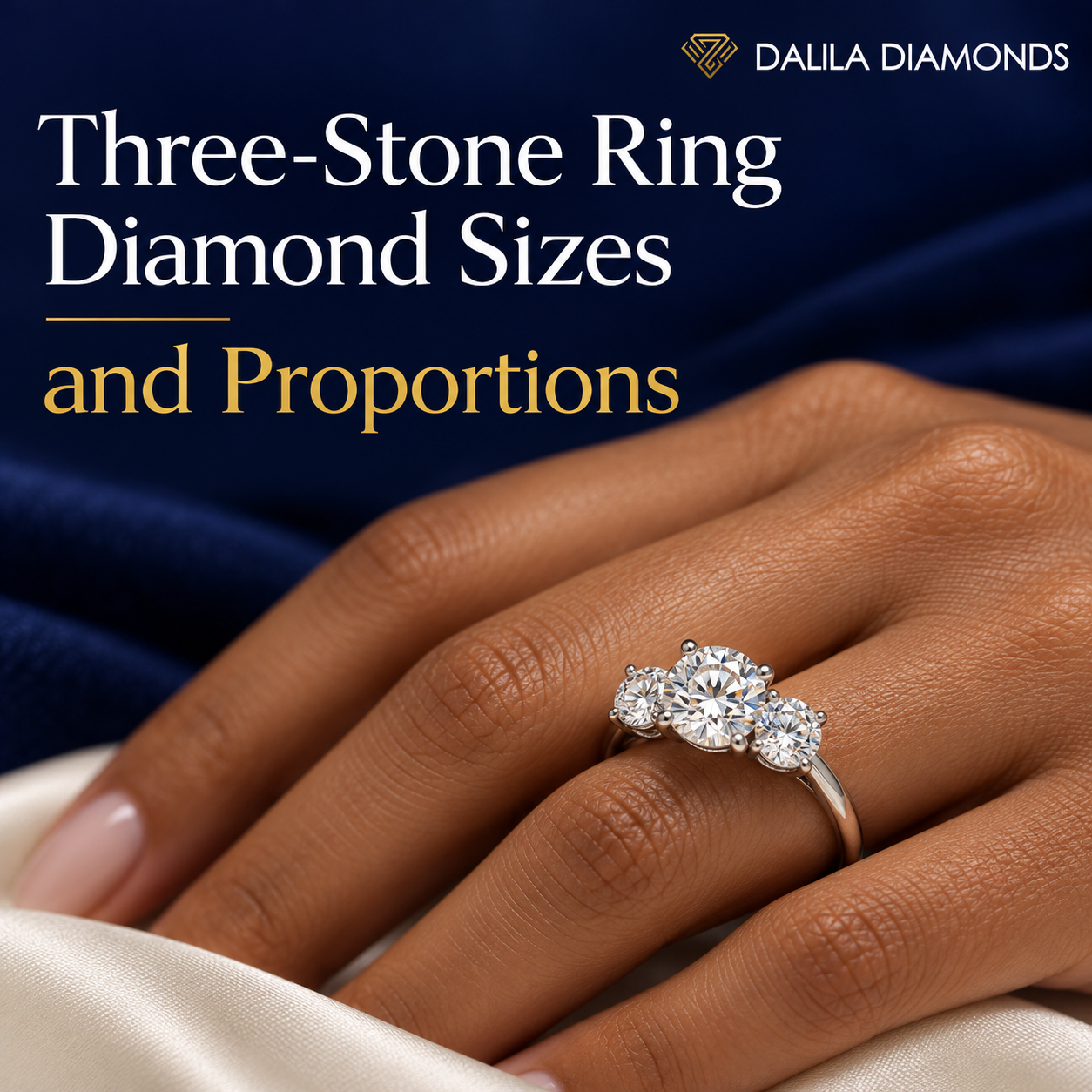
Choosing three stone ring diamond sizes means deciding how much visual emphasis the centre diamond should have, how substantial the two side diamonds should appear and how all three stones will fit across the finger. Start with the actual face-up measurements, then use carat weight, colour and setting details to refine the combination.
A 1.00-carat round centre diamond, for example, might be paired with two 0.20-carat, 0.30-carat or 0.50-carat side diamonds. Each arrangement produces a different result. The smaller stones give the centre more prominence, while larger sides produce a wider design in which all three diamonds are immediately noticeable.
There is no universal centre-to-side ratio. The right proportions depend on the selected shapes, the dimensions of the individual diamonds and the intended mounting. GIA's guide to buying a three-stone engagement ring similarly explains how side-stone shapes, colour and mounting choices influence the completed ring.
This guide focuses on choosing the size and proportions of the complete three-stone arrangement. For the detailed trade process of selecting two sufficiently similar side diamonds, use Dalila's Matched-Pair Diamonds Buying Guide.
What Is a Good Centre-to-Side Diamond Size Ratio?
A useful starting point is to compare the visible width of each side stone against the centre, rather than relying only on their carat weights.
For a design using three round diamonds, you can express the relationship as:
Side-to-centre diameter ratio = side-stone diameter ÷ centre diameter × 100
Consider a round centre diamond measuring 6.50 mm across, accompanied by two round side diamonds measuring 4.30 mm each.
The side-to-centre diameter ratio is approximately 66%.
If the side diamonds are instead 5.10 mm, the ratio increases to approximately 78%. That difference changes the visual balance considerably, even though the centre diamond remains the same.
Approximate side-to-centre diameter ratio | Appearance to compare |
50–60% | Small accents and strong centre emphasis |
60–70% | Clearly graduated proportions |
70–80% | More substantial side diamonds |
80–100% | Three increasingly similar-looking stones |
These are illustrative design categories, not industry-prescribed ratios. For fancy shapes, one diameter ratio may be insufficient to describe the arrangement.
Three Size Combinations With the Same 1-Carat Centre
The following illustration compares three hypothetical combinations using a 6.50 mm round centre. The circle diameters are drawn to their stated relative sizes.
The separate original measurement-accurate diagram prepared for this article is available below as a PNG file.
The important difference is not simply the additional total carat weight. As the side stones grow, the arrangement becomes more continuous across the finger, leaving less visual separation between the centre and its neighbours.
Three-Stone Ring Diamond Size Chart: Practical Combinations
The following table uses approximate dimensions for round brilliant diamonds. These are realistic illustrative examples, not measurements taken from current Dalila Diamonds inventory. Individual diamonds of the same weight can vary in diameter because their proportions and depth differ.
Centre diamond | Centre diameter | Each side diamond | Side diameter | Three-stone total |
0.75 ct | 5.8 mm | 0.15 ct | 3.4 mm | 1.05 ctw |
1.00 ct | 6.5 mm | 0.20 ct | 3.8 mm | 1.40 ctw |
1.00 ct | 6.5 mm | 0.30 ct | 4.3 mm | 1.60 ctw |
1.00 ct | 6.5 mm | 0.50 ct | 5.1 mm | 2.00 ctw |
1.50 ct | 7.4 mm | 0.40 ct | 4.8 mm | 2.30 ctw |
1.50 ct | 7.4 mm | 0.60 ct | 5.4 mm | 2.70 ctw |
2.00 ct | 8.1 mm | 0.50 ct | 5.1 mm | 3.00 ctw |
2.00 ct | 8.1 mm | 0.75 ct | 5.8 mm | 3.50 ctw |
Here, ctw means combined carat weight. A 2.00 ctw three-stone ring containing a 1.00 ct centre and two 0.50 ct side diamonds does not contain a two-carat centre diamond.
The table is most useful for shortlisting proportions. Once actual diamonds are available, replace every approximate diameter with the measurements shown in the individual grading information or confirmed by inspection.
How Face-Up Width Changes the Finished Ring
Three-stone rings can appear considerably wider than solitaire rings because the side diamonds extend the arrangement across the finger.
For round diamonds aligned approximately in one row, adding their diameters gives a preliminary indication of the total space occupied by the stones.
For example:
Left diamond: 4.30 mm
Centre diamond: 6.50 mm
Right diamond: 4.30 mm
The sum is 15.10 mm.
That is a nominal sum of face-up diameters, not the guaranteed finished width of the ring.
In the actual mounting, the side diamonds may angle away from the centre, sit slightly lower, overlap in top-view projection or have visible gaps between them. Prongs, bezels and other metalwork can also affect the outside dimensions.
Comparing Nominal Face-Up Widths
Three-stone combination | Sum of approximate diameters |
1.00 + 0.20 + 0.20 ct | 14.1 mm |
1.00 + 0.30 + 0.30 ct | 15.1 mm |
1.00 + 0.50 + 0.50 ct | 16.7 mm |
1.50 + 0.40 + 0.40 ct | 17.0 mm |
2.00 + 0.50 + 0.50 ct | 18.3 mm |
A difference of only 0.50 mm in each side diamond's diameter adds 1.00 mm to the nominal sum. This is why choosing side-stone proportions using weight alone can produce an unexpected finished appearance.
The jeweller should confirm the actual width from the intended stone positions, not from this table.
Choosing Side Diamonds for a 1-Carat Centre Diamond
A one-carat round centre is a useful reference because changing only the side diamonds makes the difference between graduated designs easy to understand.
With two 0.20-carat sides, the composition has a strong central emphasis. The smaller stones contribute additional brilliance without competing heavily with the centre. This may be suitable for someone who likes the appearance of a solitaire but wants additional diamonds on both sides.
Two 0.30-carat side stones produce a more substantial graduated arrangement. Each stone is clearly visible while the centre remains the dominant element.
Increasing each side to 0.50 carat creates a noticeably broader ring. The side diamonds now have much greater visual importance. Although their individual weights are half the centre's weight, their diameters are much closer to the centre's diameter than that weight comparison might suggest.
None of these combinations is a universally correct choice. They are alternatives for different visual objectives.
A useful way to make the decision is to compare scaled top-view drawings of the three arrangements before requesting specific side diamonds.
Choosing Side Diamonds for a 2-Carat Centre Diamond
With a 2.00-carat round centre measuring approximately 8.1 mm, half-carat side diamonds can provide a graduated appearance.
The approximate diameter of a 0.50-carat round diamond is 5.1 mm, or about 63% of the centre's diameter.
Two 0.75-carat side diamonds, at approximately 5.8 mm each, would increase the ratio to about 72%.
The second combination creates a broader visual arrangement and places more emphasis on the two side diamonds.
However, the additional spread must be considered against finger size and mounting construction. A very wide three-stone design can cause the outer stones to approach the sides of the finger, changing both their visibility and the practical design requirements.
GIA's guidance on selecting diamond side stones specifically recommends considering the size of the wearer's hand and avoiding side stones that disappear beside the neighbouring fingers.
GIA 4Cs
Why Carat Weight Alone Cannot Determine Three-Stone Proportions
Carat weight describes diamond mass, not its face-up area or overall diameter.
Two round diamonds of equal carat weight may have different average diameters because one carries more mass in its depth, girdle or other proportions.
For a three-stone design, this means that selecting three weights does not fully establish the finished appearance.
Ask for the full measurements of each stone. A round diamond's report commonly records minimum diameter, maximum diameter and depth; fancy shapes are generally described using length, width and depth.
For example, when evaluating a centre recorded as 6.46–6.53 × 3.97 mm, retain the actual minimum and maximum diameters instead of treating the stone as an exact 6.50 mm circle.
A diagram may use the average for simplicity, but the jeweller should work from the full measurements and actual stone.
The proportion decision should also not override diamond cut quality. A wider-looking diamond is not automatically more attractive if its proportions reduce its optical performance.
How Diamond Shape Changes the Proportions
Three round diamonds can be compared mainly through their diameters, but rings combining fancy shapes require more detailed dimensional assessment.
Round Centre With Round Side Diamonds
This is one of the simplest arrangements to evaluate. The three circular outlines produce a graduated design when the centre is larger.
The centre and sides can be compared by diameter, while the mounting determines how closely the stones sit together and how they angle around the finger.
Oval Centre With Round or Half-Moon Sides
An oval diamond's length and width create different design possibilities.
An illustrative oval centre measuring 8.0 × 5.8 mm might be accompanied by two round side diamonds of approximately 4.0 mm diameter. The apparent balance depends on the oval's orientation, shoulder shape and the position of the rounds.
Half-moon diamonds can create a different effect because their curved edges may follow the central diamond's outline.
GIA discusses oval centres with half-moon and other side-stone shapes in its oval diamond guide.
GIA 4Cs
Emerald-Cut Centre With Tapered Baguette Sides
An emerald-cut centre with tapered baguette sides has a geometric appearance, but it cannot be specified using only carat-weight ratios.
The baguettes' lengths, wider ends, narrower ends and orientation affect the visible transition from the centre into the band.
The design should be assessed through a scaled top-view drawing that uses the actual measurements and outlines of the proposed stones.
Radiant or Princess Centre With Trillion Sides
Triangular side diamonds produce another distinctive silhouette. Their orientation can make a design appear wider or more angular, even when their carat weights are similar to side diamonds of another shape.
For this arrangement, the exact triangle outline and relationship to the centre's corners matter more than a general percentage of centre-stone weight.
Three Oval Diamonds
Three oval diamonds can create a flowing, graduated composition. However, matching their proportions involves more than assigning a centre and side weight.
The individual lengths, widths and oval outlines determine how they work together. A narrow oval and a fuller oval may not appear balanced merely because they have similar carat weights.
The purpose of these shape comparisons is to choose an overall arrangement. The separate matched-pair assessment should then determine which individual side diamonds can fulfil that design.
Colour Matching in a Three-Stone Diamond Ring
Colour matching deserves particular attention because all three diamonds are viewed beside one another.
If the intention is a continuous colourless appearance, diamonds with similar colour grades are a sensible starting point. A noticeably whiter side diamond may make warmth in the centre more apparent, while warmer side diamonds may reduce the overall impression of colourlessness.
GIA's three-stone engagement ring guide recommends considering side-stone colour grades that are identical or close to the centre.
GIA 4Cs
+1
Centre colour | Initial side-stone comparison | Main consideration |
D | D–F | Consistent colourless appearance |
F | E–G | Avoiding noticeable contrast |
G | F–H | Maintaining a harmonious near-colourless look |
H | G–I | Assessing warmth face-up |
I | H–J | Checking contrast under realistic lighting |
These are practical comparison ranges rather than guaranteed matches.
Two stones carrying the same colour grade may still appear different in the finished design because of shape, cutting style, size and surrounding metal.
For example, an emerald-cut centre paired with brilliant-cut sides may show colour differently because of the contrast between their facet patterns. Compare the stones together under consistent lighting rather than treating identical letters on reports as conclusive.
A deliberate colour contrast is also possible. The objective is to establish whether contrast is intended, not to assume that every three-stone ring must look uniformly colourless.
Do the Clarity Grades Need to Match?
The three diamonds do not need identical clarity grades.
For a balanced ring, the more relevant question is whether any inclusion is distracting when the diamonds are viewed in the intended arrangement.
A VS1 centre might work visually with VS2 side diamonds. Other combinations may also be appropriate after inspection.
Step-cut diamonds deserve particular attention because their broad facets can reveal certain inclusions differently from brilliant-cut stones.
Clarity should therefore be evaluated against the individual diamonds' appearance rather than forcing all three stones into the same report category.
For a fuller examination of side-stone comparison and selecting visually similar pairs, use Dalila's matched-pair diamond resource. This article does not duplicate that trade-pairing method.
Check the Setting Before Finalising the Diamond Sizes
The proportions that look balanced on paper must also work within a practical mounting.
A three-stone ring has three settings that need to function together. The centre may sit higher than the sides, while the outer stones can angle down toward the band.
Ask the jeweller to confirm how the selected dimensions affect the finished ring's top view and side profile.
In particular, check the position of the outer diamonds relative to the finger, their distance from the centre, and whether the proposed arrangement gives the diamonds appropriate support.
The selected setting style also matters. Prong and bezel settings can produce different outside dimensions and different levels of edge coverage.
GIA's ring-setting guide explains the distinction between these styles and their practical design implications.
GIA
If the three diamonds are being sourced before the ring is manufactured, the jeweller should approve the actual stone dimensions before the setting is finalised.
If the mounting already exists, its specific stone-size allowances should be assessed before purchasing replacement or additional diamonds.
No generic carat combination guarantees compatibility with an existing setting.
A Three-Stone Diamond Specification Brief for Your Supplier and Jeweller
For a custom three-stone ring, a clear sourcing brief should describe the target proportions as well as the individual stones.
The diamond supplier can provide candidate stones and their specifications. The jeweller responsible for the finished ring must establish whether those particular stones can be mounted securely in the intended design.
Information | What to provide or confirm |
Intended design | Three-stone graduated ring, with reference image or drawing |
Centre diamond | Natural diamond shape, target carat weight, colour, clarity and grading preference |
Centre measurements | Full length, width and depth, or minimum–maximum diameter and depth |
Side-stone sizes | Desired carat range and target face-up dimensions for each side |
Side-stone shape | Round, oval, trillion, half-moon, tapered baguette or another specified outline |
Colour relationship | Matching appearance or intentional contrast |
Side-pair suitability | Assessment of the two proposed stones as a visually balanced pair |
Available documents | Relevant grading reports and identification references |
Setting information | Proposed metal, stone orientation and mounting reference |
Finished ring width | Jeweller's confirmation from the actual proposed layout |
Mounting compatibility | Jeweller's assessment of supports, clearances and seating |
Quote structure | Distinguish centre stone, side diamonds and separate setting/manufacturing costs |
Example Sourcing Request
A buyer looking for a traditional graduated ring could use the following illustrative brief.
Requirement | Requested specification |
Centre | Natural round brilliant, approximately 1.50 ct |
Centre diameter | Target around 7.4 mm, subject to cut quality |
Side stones | Two natural round brilliants, approximately 0.40 ct each |
Side diameter | Target around 4.8 mm each |
Colour | G centre, visually compatible sides |
Clarity | No distracting visible inclusions in the intended viewing conditions |
Design objective | Centre visibly larger, with balanced side diamonds |
Manufacturing | Separate jeweller to confirm final mounting and fit |
This is a hypothetical request, not an offer of specific available diamonds.
When using a sourcing service, provide the centre's actual measurements and the intended ring reference wherever possible.
Dalila's DS4U — Diamond Source For You service accepts specification-driven natural diamond enquiries, including requirements involving dimensions, shape and coordinated stones. Candidate availability and suitability still need confirmation for each request.
DS4U by Dalila
Ask quotations to identify the individual diamonds separately from the mounting and setting work. This avoids confusion between centre-stone weight, combined diamond weight and the cost of producing the finished jewellery.
Frequently Asked Questions
What size should the side diamonds be in a three-stone ring?
There is no mandatory size. For a graduated design, begin by comparing side-stone face-up diameters of around 60–75% of a round centre's diameter, then evaluate other sizes if a more delicate or more substantial arrangement is preferred.
What size side diamonds go with a 1-carat centre?
Two round side diamonds of approximately 0.20, 0.30 or 0.50 carat each provide useful visual alternatives. The preferred combination depends on how much emphasis the centre should retain and the intended overall ring width.
What size side stones go with a 2-carat diamond?
Two 0.50-carat round sides are one reasonable starting option for a 2.00-carat round centre. Larger side diamonds, such as 0.75 carat each, create a more prominent three-stone appearance. Confirm the face-up dimensions of the actual stones.
Is a 1-carat centre with two half-carat side diamonds balanced?
It can be. With illustrative diameters of 6.5 mm for the centre and 5.1 mm for each side, the side diamonds are about 78% of the centre's diameter. This produces a substantial arrangement rather than a strongly graduated one.
How do I calculate the total carat weight of a three-stone ring?
Add the weight of the centre and both side diamonds. For example, a 1.00-carat centre with two 0.30-carat sides has a combined weight of 1.60 carats. Additional accent diamonds elsewhere in the ring would contribute to the complete ring's total diamond weight.
Do the three diamonds need the same colour grade?
No. Similar grades are a helpful starting point when the goal is a harmonious appearance, but actual face-up colour should also be assessed. GIA advises considering side diamonds within approximately one or two colour grades of the centre for a coordinated look.
Can I combine different diamond shapes in a three-stone ring?
Yes. Oval centres can be paired with rounds or half-moons, while emerald cuts are often considered with tapered baguettes. The dimensions and geometry of the complete arrangement matter more than simply matching carat weights.
Is the sum of the three diamond diameters the finished ring width?
No. It provides only a nominal starting estimate for roughly aligned round diamonds. Actual width depends on angles, spacing, projected overlap and setting construction.
Should the side diamonds be selected before the setting?
They can be, provided the jeweller confirms the intended design can accommodate the actual diamonds. For an existing mounting, compatibility should be established before committing to the stones.
How can I request diamonds for a custom three-stone ring?
Provide the centre's shape and measurements, desired side-stone dimensions, colour and clarity preferences, grading requirements and a reference for the finished ring. Dalila's DS4U sourcing service can use such specifications to search for natural diamond options, while the jeweller must approve mounting compatibility.