Matching a New Earring Diamond to an Existing Stone
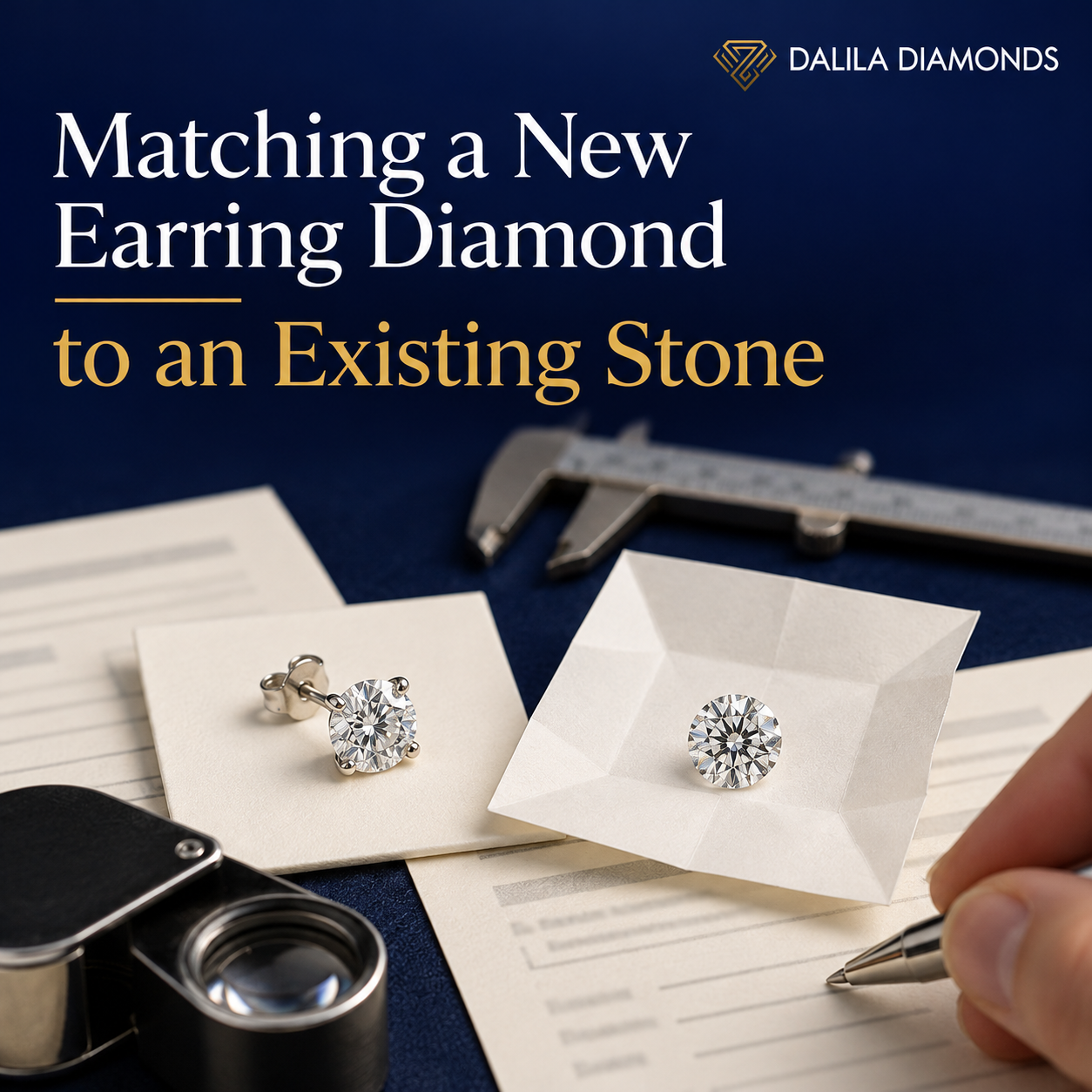
Matching a new diamond to an existing earring is different from buying two matching loose diamonds at the same time. One stone has already been selected, purchased and mounted. The replacement must be evaluated against that specific diamond rather than against a general description of what a matched pair should look like.
For example, a surviving natural round brilliant weighing 0.50 carat may measure 5.06–5.12 mm. A replacement weighing 0.49 carat may have nearly identical visible dimensions, while another 0.50-carat diamond could be noticeably smaller.
The closer match may therefore be the slightly lighter stone.
However, face-up diameter is only the beginning. The replacement must also be compared for colour, clarity appearance, brightness, facet pattern and compatibility with the intended earring setting.
The most reliable matching process combines three types of evidence: the surviving diamond's documentation, physical measurements and direct comparison with the proposed replacement.
A laboratory grading report describes important characteristics of a diamond, but it does not certify that the stone will look identical to another diamond when mounted beside it.
Likewise, physical dimensions can establish a promising shortlist without proving that the stones sparkle similarly.
The final decision should involve both the diamond specialist evaluating the match and the jeweller responsible for the finished earring.
This guide explains that comparison process using a worked example, a report-versus-physical-assessment checklist and the information required before sourcing a replacement.
It is specifically about matching a new stone to an existing earring. Dalila's separate guide to buying two matching loose diamonds for new studs covers the different situation where both stones are selected together from the beginning.
Why Matching an Existing Diamond Is More Difficult Than Buying a New Pair
When buying two loose diamonds together, the supplier may have flexibility to choose both stones for compatible measurements and appearance.
With an existing earring, that flexibility is limited.
The surviving diamond establishes the reference.
Its size, outline, colour and optical characteristics are already fixed.
The task is to find a second stone that produces a satisfactory match while remaining suitable for the intended mounting.
This creates several practical constraints.
The existing diamond may not have an individual grading report.
It may be difficult to measure fully while mounted.
Its original setting can alter how its colour appears.
The diamond may also have unusual cutting characteristics or older proportions that are difficult to reproduce using currently available stones.
A successful search therefore begins by documenting what is actually known about the survivor.
Two buying situations that should not be confused
Question | Buying two new diamonds | Matching an existing earring |
Reference stone | Neither stone is fixed initially | Surviving diamond is fixed |
Size selection | Both sizes can be adjusted | Replacement follows the survivor |
Colour selection | Both grades can be chosen together | Replacement compared with existing colour |
Facet appearance | Pair selected together | Must complement an established appearance |
Documentation | Request records for both stones | Existing records may be incomplete |
Setting | New coordinated design | May need to match an existing mounting |
Final approval | New pair compared together | Replacement compared with physical survivor |
The second process requires more emphasis on inspection, evidence and managing realistic expectations.
Step 1: Identify the Surviving Diamond
Before looking at replacement inventory, identify the stone already owned.
The ideal situation is that the survivor has a laboratory report, an identifiable report number and documented measurements.
For a GIA-graded round brilliant, the report may provide the minimum and maximum diameters, total depth, carat weight, colour, clarity and applicable cut grade.
Depending on the report type, it may also include polish, symmetry, fluorescence and other details.
GIA's official grading report guidance explains how these characteristics are recorded.
Information to collect
Surviving diamond information | Why it matters |
Report issuer and number | Identifies grading documentation |
Natural diamond confirmation | Establishes the intended material |
Shape and cutting style | Defines the search category |
Individual carat weight | Helps identify possible candidates |
Minimum and maximum diameter | Establishes visible size for rounds |
Length and width | Establishes outline for fancy shapes |
Total depth | Supports mounting review |
Colour and clarity | Starting points for appearance matching |
Cut, polish and symmetry | Useful for evaluating the stone |
Fluorescence | Additional characteristic to review |
Inclusion information | May assist identification and condition checks |
Girdle and culet | Relevant to setting and cutting characteristics |
An original sales invoice describing a pair as "1.00 ctw, G–H, VS" is not equivalent to individual grading reports.
It may establish the commercial specifications of the original pair without identifying the exact weight, measurements or grades of the surviving diamond.
If an individual report is unavailable, an in-person assessment becomes especially important.
Step 2: Verify the Grading Report Against the Actual Stone
A report should be checked before it becomes the basis of the replacement search.
For a diamond with a GIA report, the report number can be checked using GIA's official Report Check service.
The archived report details should be compared with the document provided.
Where appropriate and accessible, a qualified professional can also compare available laser inscriptions and other identifying characteristics with the physical diamond.
However, a report number alone does not prove the mounted diamond is the one described in that report.
The identity of the actual surviving stone must be established.
What the report can and cannot prove
Report information | What it supports | What it does not guarantee |
Carat weight | Recorded mass at grading | Same apparent size as a candidate |
Measurements | Original loose-stone dimensions | Current setting compatibility |
Colour grade | Standardised grading assessment | Identical face-up colour |
Clarity grade | Assessment of clarity characteristics | Identical visible cleanliness |
Cut grade, where applicable | Laboratory cut-quality assessment | Identical sparkle pattern |
Fluorescence | Laboratory-observed fluorescence category | Same appearance in all lighting |
Plot or inclusion details | Documentation and possible identification | Absence of later damage |
Report number | Retrieval of archived information | Physical identity without verification |
A report is a critical part of the evidence, but it is not a substitute for seeing the actual surviving diamond.
Step 3: Measure the Survivor While Accounting for the Mounting
An existing earring often prevents complete access to the diamond.
Prongs or a bezel may obscure sections of the girdle. The basket may limit access to the pavilion, making total depth difficult to measure accurately.
A qualified jeweller or gemmologist should record which measurements are directly observed, which are taken from a report and which remain uncertain.
For a round brilliant, minimum and maximum diameter are particularly useful.
For an oval, princess, cushion or emerald cut, record the length, width and actual outline.
Mounted-diamond assessment worksheet
Measurement | Recorded value | Evidence |
Shape | ______ | Direct inspection / Report |
Minimum diameter or length | ______ mm | Measured / Report / Estimated |
Maximum diameter or width | ______ mm | Measured / Report / Estimated |
Total depth | ______ mm | Measured / Report / Unknown |
Carat weight | ______ ct | Report / Estimated |
Girdle characteristics | ______ | Inspected / Report / Obscured |
Facet appearance | ______ | Direct observation |
Visible colour | ______ | Direct observation |
Visible inclusions | ______ | Direct observation |
Current condition | ______ | Professional inspection |
Do not treat a diameter estimated from a photograph as equivalent to a calibrated physical measurement.
Do not remove the surviving diamond from its mounting solely to obtain full measurements without discussing the procedure and its risks with the jeweller.
Step 4: Shortlist Replacement Diamonds by Actual Dimensions
The surviving diamond's actual dimensions should guide the initial shortlist.
For round brilliant diamonds, compare minimum and maximum diameter, not just rounded average diameter.
For fancy shapes, assess length, width and the complete outline.
Consider a hypothetical surviving 0.50-carat round brilliant measuring 5.06–5.12 mm.
The supplier identifies two candidate natural diamonds.
Characteristic | Survivor | Candidate A | Candidate B |
Carat weight | 0.50 ct | 0.49 ct | 0.50 ct |
Minimum diameter | 5.06 mm | 5.05 mm | 4.93 mm |
Maximum diameter | 5.12 mm | 5.11 mm | 5.01 mm |
Average diameter | 5.09 mm | 5.08 mm | 4.97 mm |
Colour | G | G | G |
Clarity | VS2 | VS2 | VS2 |
Overall cut grade | Excellent | Excellent | Excellent |
Physical match | Reference | Not yet assessed | Not yet assessed |
These are hypothetical specifications designed to explain the evaluation process. They are not Dalila inventory, real grading reports or a completed replacement order.
Candidate A is closer in diameter to the survivor despite its slightly lower weight.
Candidate B matches the original carat weight but has a smaller face-up outline.
That makes Candidate A a more useful initial choice for physical comparison.
However, neither candidate is approved based on these numbers.
The next stage is to compare their actual appearance.
Step 5: Compare Face-Up Colour Under Consistent Lighting
A candidate with the same laboratory colour grade is a sensible starting point, but it may not look identical to the survivor.
A round brilliant's face-up colour can be influenced by its cutting characteristics and surrounding reflections.
The metal of the surviving earring can also affect apparent colour.
For example, a G-colour diamond mounted in yellow gold may display warmer reflections than a loose G-colour candidate viewed against a neutral background.
This can make an otherwise reasonable replacement look different.
Whenever practical, compare both stones under the same controlled lighting and account for whether one is mounted.
If direct inspection is not possible, obtain carefully documented images, acknowledging that separate photographs provide weaker evidence.
Can different colour grades still work?
Potentially.
A G-colour survivor and an H-colour candidate may appear harmonious in some cases.
Conversely, two G-colour stones might show slight visual differences.
The buyer and supplier should decide whether the actual colour difference is acceptable, rather than insisting that identical letter grades automatically establish a match.
The aim is an attractive finished pair.
Step 6: Check Clarity Appearance and Transparency
Two diamonds with the same clarity grade can have different visible characteristics.
For example, two VS2 diamonds may contain different types of inclusions in different locations.
One might have small, relatively unobtrusive characteristics near the perimeter. Another could contain a darker feature that becomes more noticeable when viewed face-up.
The grade alone does not describe the complete visual effect.
Transparency also matters.
A replacement should not appear hazy or dull beside a bright surviving diamond.
When comparing the stones, record whether either has distracting inclusions or differences in transparency that remain noticeable under agreed viewing conditions.
A higher clarity grade is not necessarily a better match.
A VS1 candidate is not automatically preferable to a VS2 candidate if its optical appearance is less compatible with the survivor.
Step 7: Compare Brightness, Facet Patterns and Movement
Physical comparison is especially important for diamonds with different cut proportions or older cutting styles.
Two round diamonds may both have Excellent overall cut grades but display different patterns of bright and dark reflections.
For fancy shapes, the differences may be more pronounced.
Ovals can show different bow-tie patterns, cushions can have different facet arrangements, and emerald cuts can vary in their broad step-facet reflections.
The surviving diamond is the reference point.
The replacement should complement its appearance.
A practical comparison sequence
First, inspect the stones face-up together under consistent neutral lighting.
Next, tilt them gently through comparable angles and assess whether one becomes noticeably darker or less lively.
Then view them from an ordinary social distance to determine whether differences remain perceptible.
If the candidate appears similar close-up and at normal viewing distance, it may qualify for further consideration.
Finally, have the jeweller confirm that its three-dimensional geometry works with the intended mounting.
A visually matched diamond is not automatically a setting-compatible diamond.
Case Study: Report Comparison Versus Physical Approval
The following example shows how a professional replacement evaluation should be documented.
It is an illustrative case, not a completed Dalila customer order. A genuine case study must use an identified survivor, an identified replacement candidate and recorded inspection findings.
The original earring
A client owns one surviving natural round brilliant diamond stud.
The assumed original grading report records a weight of 0.50 carat, G colour, VS2 clarity and an Excellent overall cut grade.
Its recorded measurements are 5.06–5.12 mm.
The client wants the replacement earring to look as close as practical to the original.
Report-based shortlist
The initial shortlist contains two candidates.
Candidate A weighs 0.49 carat and measures 5.05–5.11 mm.
Candidate B weighs 0.50 carat and measures 4.93–5.01 mm.
All three stones are assumed to have G colour and VS2 clarity for the purposes of the example.
At this stage, Candidate A looks more promising dimensionally.
Candidate B is not automatically disqualified, but its smaller face-up diameter is a meaningful difference.
Physical inspection required
A qualified professional must next compare Candidate A with the survivor.
The review should document:
Whether the actual diameter appears consistent.
Whether the two stones show compatible face-up colour.
Whether their brightness and scintillation are reasonably balanced.
Whether either has distracting inclusions or transparency issues.
Whether the candidate has damage or setting-relevant girdle characteristics.
Whether the new earring can be manufactured to match the surviving mounting.
The case cannot be described as successful without recording these findings.
Possible final outcome
If Candidate A passes the visual and condition checks, and the jeweller approves the new mounting, it could become the preferred replacement.
If it appears noticeably different under physical comparison, the search should continue.
The outcome cannot be determined from grading information alone.
What a genuine Dalila case study must document
Required evidence | What should be recorded |
Surviving stone | Verified identity and relevant report |
Replacement candidate | Actual inventory reference and report |
Original measurements | Confirmed length, width and depth where available |
Candidate measurements | Confirmed values |
Condition inspection | Findings for both stones |
Direct comparison | Who performed it and under what conditions |
Images or video | Genuine photographs of both identified stones |
Colour and clarity result | Observations and limitations |
Optical result | Actual side-by-side findings |
Mounting approval | Jeweller's confirmation |
Final outcome | Accepted, rejected or further sourcing required |
Customer approval | Recorded where appropriate and with consent |
Without this evidence, the example should remain educational rather than being presented as first-hand proof of Dalila's replacement matching service.
What If the Surviving Diamond Has No Grading Report?
A replacement may still be possible, but there is more uncertainty.
The surviving diamond should be assessed by a qualified professional.
Where the stone remains mounted, it may not be possible to assign exact loose-stone grading information or measure all dimensions.
An estimated colour or clarity range should be identified as an estimate.
GIA offers jewellery reports with grading information limited by what the mounting allows, whereas its standard natural diamond grading reports apply to qualifying loose stones.
The distinction matters when comparing documentation.
Example without an individual report
Assessment | Finding |
Shape | Round brilliant |
Visible diameter | Approximately 5.1 mm |
Individual weight | Estimated around 0.50 ct |
Colour | Estimated G–H range |
Clarity | Estimated VS range |
Total depth | Not established while mounted |
Facet appearance | Documented by physical examination |
Replacement specification | Provisional until specialist review |
These findings can support an initial search.
They should not be misrepresented as exact independent laboratory grades.
The supplier may need to present several candidates for direct assessment before a final match can be approved.
Matching Fancy-Shaped Diamonds to Existing Earrings
Matching round diamonds is often relatively straightforward because the circular outline can be compared using diameter.
Fancy-shaped diamonds require additional outline checks.
Oval diamonds
Compare length, width, shoulder fullness, rounded ends and bow-tie appearance.
Two ovals with the same ratio may still have different silhouettes.
Princess cuts
Compare length, width, square proportions, corner geometry and facet appearance.
The jeweller must inspect the corners of the replacement before setting.
Cushion cuts
Compare rounded corners, shoulder fullness and whether the overall outline is square or elongated.
Different cushion facet patterns can also create noticeably different sparkle.
Emerald cuts
Compare length, width, truncated corners, step-facet appearance and transparency.
A similar grading report does not establish matching broad reflections.
Pear-shaped diamonds
Check the point, wings, rounded end and orientation.
For earrings that use a deliberate mirrored design, left-right orientation should be documented before approval.
The more unusual the survivor's outline, the less likely it is that another diamond can be assumed compatible using only its shape name and carat weight.
What Does the Existing Earring Mounting Change?
The replacement diamond may appear closely matched as a loose stone, but the finished earring can still look different.
Differences in prong size, head height, basket construction, metal colour and post position can affect the final appearance.
If the complete original earring was lost, the manufacturing jeweller must determine whether its setting can be reproduced.
If an empty original head survives, the setter must inspect it for wear or damage.
A replacement diamond cannot be approved solely because its dimensions seem close to the original.
Mounting comparison checklist
Feature | Surviving earring | Replacement design |
Metal and alloy | ______ | ______ |
Prong or bezel style | ______ | ______ |
Finished outer dimensions | ______ | ______ |
Diamond seating height | ______ | ______ |
Basket shape | ______ | ______ |
Post location | ______ | ______ |
Backing type | ______ | ______ |
Surface finish | ______ | ______ |
Setting security | Inspected | To be approved |
If the original setting cannot be reproduced closely enough, replacing both earring heads while retaining the surviving diamond may produce a more consistent finished pair.
That decision belongs to the jewellery manufacturing process, not the loose-diamond grading report.
How Much Matching Difference Is Acceptable?
There is no universal amount of dimensional, colour or optical difference that guarantees an acceptable replacement.
The final decision depends on stone size, shape, setting, viewing conditions and the buyer's preferences.
A small diameter difference may be difficult to notice in modestly sized round studs.
A similar numerical difference could be more apparent in a pair of precisely rectangular step-cut diamonds.
A minor colour difference may be acceptable to one buyer and undesirable to another.
Rather than promising an exact replacement, the seller should identify the intended matching criteria and describe how they will be checked.
Three practical outcomes
Outcome | Meaning |
Approved visual match | The buyer and relevant specialists accept the demonstrated result |
Conditional match | Some differences remain and must be explicitly accepted |
Rejected candidate | Differences or setting constraints make the candidate unsuitable |
These are practical decision categories, not official grading-laboratory classifications.
A written approval record can help avoid disagreements after the replacement has been set.
Why a Replacement May Still Look Different After Setting
Even a carefully selected replacement may not look identical in every environment.
Natural diamonds have individual optical behaviour.
The existing and replacement settings may also have small differences in metal coverage or finish.
Furthermore, the two earrings are worn on opposite sides of the face, where lighting and viewing angles may differ.
The goal should therefore be a visually harmonious pair within an agreed inspection standard, not the claim that another natural diamond is a perfect physical duplicate.
An especially rare antique cut or unusual fancy-shaped diamond may be difficult to match closely.
Where no satisfactory single candidate can be sourced, the alternatives include commissioning a new coordinated pair or resetting the survivor into another piece of jewellery.
Matching Worksheet: Survivor Against Replacement Candidate
Specification | Surviving diamond | Proposed replacement |
Diamond identity | ______ | ______ |
Natural origin | ______ | ______ |
Shape/cutting style | ______ | ______ |
Carat weight | ______ | ______ |
Minimum diameter or length | ______ | ______ |
Maximum diameter or width | ______ | ______ |
Total depth | ______ | ______ |
Colour | ______ | ______ |
Clarity | ______ | ______ |
Cut grade, if applicable | ______ | ______ |
Polish and symmetry | ______ | ______ |
Fluorescence | ______ | ______ |
Girdle condition | ______ | ______ |
Report issuer | ______ | ______ |
Report number | ______ | ______ |
Report identity verified | ______ | ______ |
Face-up outline | ______ | ______ |
Colour appearance | ______ | ______ |
Brightness and contrast | ______ | ______ |
Visible inclusions | ______ | ______ |
Transparency | ______ | ______ |
Physical inspection date | ______ | ______ |
The final decision should be recorded separately.
Decision item | Outcome |
Dimensional shortlist accepted | Yes / No |
Physical stones compared together | Yes / No |
Colour match accepted | Yes / No |
Optical appearance accepted | Yes / No |
Condition approved | Yes / No |
Mounting approved by jeweller | Yes / No |
Buyer accepts remaining differences | Yes / No |
Replacement approved | Yes / No / Pending |
The worksheet prevents measurements, grading and physical appearance from being treated as the same type of evidence.
Sourcing Brief: A Diamond to Match an Existing Earring
A sourcing request should describe the survivor before stating the desired replacement characteristics.
A useful brief includes the actual diamond's documentation and measurements, rather than just requesting another stone of the same carat weight.
Example enquiry
Application: Natural loose diamond to match one existing stud earring.
Surviving stone: Round brilliant, approximately 0.50 ct.
Original reported measurements: 5.06–5.12 mm.
Colour and clarity: G/VS2, subject to report verification.
Cutting character: Standard round brilliant with an attractive face-up appearance.
Replacement priority: Similar visible diameter, colour and brightness.
Documentation: Recognised laboratory report preferred.
Physical assessment: Candidate to be evaluated against the surviving stone before final acceptance.
Mounting: Manufacturing jeweller to confirm a coordinated head, post and backing.
Commercial conditions: Price, inspection arrangements, return policy and delivery requirements to be confirmed before ordering.
These specifications are illustrative and do not represent an available replacement stone.
Dalila Diamonds can be contacted through its website regarding natural loose-diamond enquiries. Whether the business accepts one-stone replacement matching projects, including inspection of a customer's existing diamond, should be confirmed directly.
The supplier should not be assumed to provide earring repair or manufacturing services unless those services have been expressly agreed.
What Should a Replacement Matching Quote Include?
A complete quote must identify the proposed diamond and any other services necessary to deliver the intended result.
Quote item | What to verify |
Diamond reference | Exact proposed stone |
Natural origin | Documentary support |
Grading report | Issuer, number and verification |
Individual measurements | Full available dimensions |
Diamond price | Quote for the specific candidate |
Matching/inspection fee | Whether direct comparison is included |
Physical survivor examination | Who performs it and where |
Setting compatibility | Who approves it |
Replacement head | Required or not required |
Metal and finishing | Matches the existing earring |
Post and backing | Included or separately charged |
Setting labour | Cost and responsibility |
Shipping and insurance | Coverage, value and conditions |
Taxes/customs | Applicable to the destination |
Rejection/return conditions | What happens if the match fails |
Quote validity | Period for price and availability |
Final acceptance | How and when approval occurs |
Do not assume that the cost of replacing one diamond equals half the original pair's purchase price.
The new stone's market price, sourcing difficulty and jewellery work can change the overall economics.
Supplier Versus Jeweller: Who Approves the Match?
A natural diamond sourcing specialist can help identify candidates, review specifications and arrange whatever visual comparison services have been agreed.
A qualified gemmologist or appraiser may be needed to document the surviving diamond's characteristics.
The manufacturing or repair jeweller determines whether the candidate can be safely mounted and whether the finished earring can be made to resemble the survivor.
Task | Diamond supplier | Gemmologist/appraiser | Jeweller/setter |
Source natural diamond candidates | Yes | No | May advise |
Supply candidate grading documents | Yes | Review | Review |
Assess surviving mounted stone | Only if expressly offered | Yes, as appropriate | May inspect |
Compare visible diamond appearance | If expressly included | May perform | May assist |
Confirm existing earring condition | No | May assist | Yes |
Approve head and stone seating | No | May advise | Yes |
Manufacture or repair mounting | Not assumed | No | Yes |
Secure new diamond | Not assumed | No | Yes |
Inspect finished earring | Not assumed | May assess | Yes |
The scope of each party's work should be agreed before payment or shipment of valuable jewellery.
Common Mistakes When Matching a New Diamond to an Existing Earring
Searching by carat weight only
Two stones of identical weight can have noticeably different visible dimensions.
Assuming the grading reports prove an exact match
Grades provide useful standardised data but do not establish identical appearance.
Treating mounted estimates as exact laboratory grades
The setting can prevent complete measurement and grading.
Ignoring the existing diamond's condition
An old chip, abrasion or unusual girdle may affect the comparison and mounting decisions.
Using unrelated photography
Different lighting, scale and white balance can make stones appear more similar or different than they are.
Approving a loose stone without checking the finished mount
Head height, prongs and metal finish may create an unintended difference between the earrings.
Promising a perfect natural diamond replacement
Natural diamonds have individual dimensions and optical characteristics. A close match can be targeted, but an exact duplicate cannot be guaranteed.
Publishing a hypothetical case as an actual order
A credible case study needs identifiable source records, comparison observations and a documented outcome.
Frequently Asked Questions
Can a new diamond be matched to an existing earring?
Yes, potentially. The surviving diamond must be measured and assessed so candidate stones can be compared for size, colour, clarity appearance and optical characteristics. The final replacement also needs jeweller approval.
Does the replacement need exactly the same carat weight?
No. A slightly lighter or heavier stone may have a closer face-up diameter and better visual appearance than one with identical weight.
Is a G-colour VS2 diamond guaranteed to match another G-colour VS2?
No. The grades do not guarantee identical visible dimensions, inclusions, brightness or facet patterns. Direct comparison remains important.
What is the first step in matching an existing earring diamond?
Identify and document the surviving stone, including available grading records, physical measurements and mounted condition.
Can I match a diamond using only its grading report?
A report can support shortlisting, but final appearance and setting compatibility need additional assessment.
What if my surviving stud has no certificate?
A qualified professional may be able to provide useful measurements and a mounted-stone assessment. Some details may remain estimates.
Can two diamonds with different colour grades make matching earrings?
Potentially. The actual face-up appearance determines whether the difference is acceptable.
Does fluorescence have to be identical?
Not necessarily. Differences may be relevant under some lighting conditions, but matching should consider actual appearance rather than require identical labels without evidence.
How closely do the two diamonds need to match in diameter?
There is no universal acceptable tolerance. The appropriate difference depends on size, shape, finished setting and buyer expectations.
Can an old diamond cut be matched with a modern one?
Sometimes, but different facet patterns, proportions and outlines may make close matching difficult. The actual stones should be examined together.
Can a mounted diamond be graded accurately?
A qualified professional may assess a mounted stone to the extent its setting allows. Some precise measurements and grades may require the diamond to be loose.
Who decides whether the replacement is a satisfactory match?
The buyer should approve the agreed visual result, supported by appropriate professional comparison. The jeweller separately approves mounting suitability and security.
What if no satisfactory match can be found?
The buyer may revise the accepted specifications, source further candidates, replace both diamonds or use the surviving diamond in another piece.
Does matching the diamond also guarantee matching earrings?
No. The heads, prongs, metal finish, post position and backing must also be considered.
Can Dalila source one natural diamond to match an existing earring?
Dalila should first confirm that it accepts single-stone replacement matching enquiries and establish the available inspection and sourcing arrangements. A custom sourcing enquiry should not be treated as a guarantee of acceptance or an exact match.
What should I include in a replacement matching enquiry?
Provide the surviving stone's shape, measurements, report details, colour, clarity, photographs, earring setting information, budget and whether professional physical comparison can be arranged.