Replacing One Lost Diamond Stud: How to Match the Surviving Earring
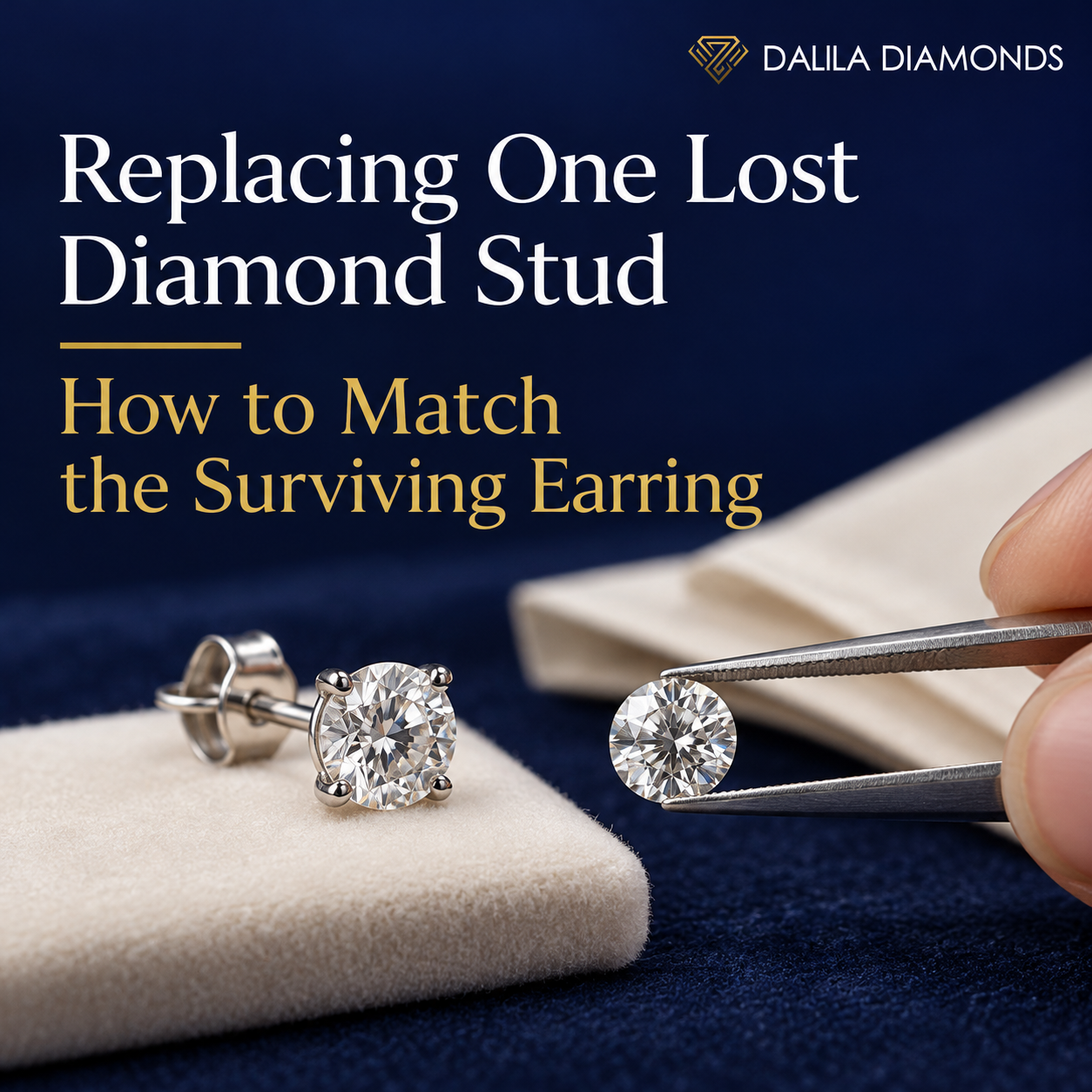
Losing one diamond stud earring does not necessarily mean you need to buy an entirely new pair. If the surviving stud contains a natural diamond, it may be possible to source another stone with similar dimensions, colour, clarity and face-up appearance.
However, replacing one diamond is more complicated than buying another stone with the same carat weight.
Two 0.50-carat round brilliant diamonds can have slightly different diameters, cutting proportions and patterns of brightness. Even if their grading reports list the same colour and clarity, they may not look identical when worn together.
The original earring setting also matters. If the new diamond is going into a matching mount, the jeweller must confirm its exact measurements and suitability for that head. If the entire earring was lost, a matching post, basket, backing and metal finish may need to be recreated or replaced.
The most reliable approach is to measure and document the surviving diamond first, then search for a replacement that matches its visible appearance and can be securely mounted.
An exact match may be impossible, especially for unusual natural diamonds, older cuts or discontinued earring designs. Nevertheless, a well-selected replacement can sometimes create a visually balanced pair.
This guide explains what to measure, how to compare candidate stones and what to include in the quotation before committing to replacement work.
Can You Replace Just One Diamond Stud Earring?
Potentially, yes.
A replacement may be practical when the surviving diamond can be measured and a sufficiently similar natural stone is available.
There are two different situations:
One complete earring, including its diamond and mounting, has been lost.
The diamond has fallen out of one stud, but the empty mounting remains.
These situations require different work.
If the complete earring is missing, the buyer may need a replacement loose diamond and a newly manufactured earring mount.
If the diamond alone is missing, a qualified jeweller may be able to reuse the empty head, although the prongs, seats and surrounding metal must first be inspected.
In both cases, the replacement stone should be matched to the surviving diamond rather than chosen solely from a generic product description.
What exactly needs replacing?
Situation | What may be required | Who should assess it |
Entire stud lost | New diamond, head, post and backing | Diamond supplier and manufacturing jeweller |
Diamond lost, empty setting survives | Replacement diamond and possible head repair | Setter |
Backing alone lost | Suitable replacement backing | Jeweller |
Surviving stud damaged | Inspection and possible repair before matching | Jeweller |
Both earrings present but visibly mismatched | Assessment of the existing pair | Jeweller and diamond specialist |
This article addresses the first two situations, where a replacement natural diamond may be required.
Why the Same Carat Weight Does Not Guarantee a Match
Carat measures a diamond's weight, not its diameter.
A 0.50-carat round brilliant might measure approximately 5.1 mm across, but the exact diameter depends on the diamond's cut proportions, girdle and depth.
For example, consider a hypothetical surviving stud with a natural diamond weighing 0.50 carat.
Measurement | Surviving diamond | Candidate A | Candidate B |
Carat weight | 0.50 ct | 0.49 ct | 0.50 ct |
Minimum diameter | 5.06 mm | 5.05 mm | 4.93 mm |
Maximum diameter | 5.12 mm | 5.11 mm | 5.01 mm |
Average diameter | 5.09 mm | 5.08 mm | 4.97 mm |
Colour | G | G | G |
Clarity | VS2 | VS2 | VS2 |
Hypothetical specifications, not currently available diamonds.
Candidate A is slightly lighter but has a face-up diameter very close to the survivor.
Candidate B has identical carat weight but a smaller diameter.
That makes Candidate A a more promising starting point for visual-size matching, assuming the shape, brightness, colour and condition are also compatible.
It does not prove that Candidate A is an acceptable final match.
This is why a request to replace one diamond stud should include exact measurements wherever available.
Step 1: Find the Surviving Diamond's Documentation
Before arranging a new search, collect any records relating to the original earrings.
Useful documentation may include:
Original purchase invoice or product specifications.
Independent diamond grading report.
Insurance valuation or appraisal.
Diamond report number or laser inscription.
Supplier stock reference.
Previous photographs of the complete pair.
Ring or earring manufacturing records, if available.
A grading report may record the surviving stone's exact measurements, colour, clarity, polish, symmetry and other characteristics.
However, not all diamond studs are sold with individual laboratory reports.
Smaller commercial diamonds may have been supplied with a pair-level description such as 1.00 ctw, G–H colour and SI clarity.
That provides useful general information but may not establish the individual surviving stone's precise characteristics.
If no detailed records are available, a qualified jeweller or gemmologist can inspect the surviving earring directly.
Can an old appraisal identify the original diamond?
Sometimes, but the information may be approximate.
For example, an appraisal might describe the earrings as:
Pair of natural round brilliant diamond studs, approximately 1.00 carat total weight, G–H colour, VS–SI clarity.
This does not prove that the surviving stone weighs exactly 0.50 carat or measures 5.1 mm.
A detailed individual grading report is more informative, but the physical diamond still needs identification and condition checks.
Step 2: Measure the Diamond in the Surviving Stud
The most useful measurement for a round stud is its actual face-up diameter.
A qualified professional can use suitable measuring instruments to establish the dimensions as accurately as the mounting allows.
The following information should be recorded.
Measurement or characteristic | Why it matters |
Diamond shape | Establishes which outline to source |
Minimum diameter | Helps identify the round stone's actual size |
Maximum diameter | Identifies variation in face-up dimensions |
Average diameter | Useful visual-size comparison |
Estimated or documented carat weight | Helps define the search range |
Colour | Important for face-up harmony |
Clarity | Helps avoid visible mismatch |
Facet appearance | Influences sparkle and contrast |
Girdle condition | Important for setting safety |
Diamond depth, where known | Helps assess mounting requirements |
Existing setting metal | Important for matching the finished earrings |
Finished stud dimensions | Useful if a complete earring must be recreated |
Measurements taken while a diamond remains mounted may be incomplete.
The setting can hide portions of the girdle or pavilion, preventing precise measurement of total depth or other features.
A jeweller should state which measurements are directly observed, which come from an original report and which are estimates.
Do not remove a diamond from its mounting solely to obtain measurements without discussing the risks and costs with the jeweller.
What if the diamond has no grading report?
An independent assessment may still provide the relevant shape, measured visible dimensions and an estimated quality description.
However, a mounted diamond's exact weight may remain uncertain.
The supplier should not present an estimated carat weight as a verified laboratory measurement.
The replacement search can begin with the confirmed face-up dimensions and appearance, while any unresolved specifications remain clearly identified.
Step 3: Match the Shape and Outline
The replacement diamond should have the same intended shape as the surviving stone.
For round brilliant studs, the key outline comparison is diameter and roundness.
For fancy-shaped studs, matching becomes more complex.
Round brilliant diamonds
Record the minimum and maximum diameters and compare the actual face-up appearance.
Round diamonds often provide a relatively straightforward starting point, but their cutting characteristics can still differ significantly.
Princess-cut diamonds
Compare length, width, square proportions and corner geometry.
The replacement should create a compatible square silhouette.
The jeweller should inspect its corners before approving the mounting.
Oval diamonds
Compare length, width, shoulder fullness and the shape of both ends.
Two ovals with identical ratios may still have noticeably different outlines.
Cushion-cut diamonds
Pay particular attention to rounded corners and shoulder shape.
Some cushions look square and compact while others are more elongated.
Emerald-cut diamonds
Compare the rectangular proportions, cut-corner geometry and step-facet appearance.
Two emerald cuts with similar dimensions may have quite different visual patterns.
Pear-shaped diamonds
The point, wings and rounded head should be compared.
The orientation of the replacement earring must also match the intended left-right design.
For detailed trade pairing methodology, Dalila's existing Matched-Pair Diamonds Buying Guide should remain the technical reference. This page focuses on the practical single-replacement decision.
Step 4: Compare Diamond Colour
A replacement diamond should appear sufficiently close in colour to the surviving stone when viewed in the intended setting.
If the surviving diamond is documented as G colour, another G-colour stone is a useful starting point.
However, identical colour grades do not guarantee identical face-up appearances.
A G and H combination may sometimes look acceptable, while two G-colour stones could still have subtle visual differences.
The buyer should therefore request a side-by-side colour comparison, preferably under neutral and consistent lighting.
Does the earring metal matter?
Yes.
Yellow gold, white gold, rose gold and platinum create different surrounding reflections.
If one earring is mounted and the replacement is being photographed loose, the comparison may not isolate the stones' intrinsic appearance.
Where practical, use consistent viewing conditions or clearly explain the limitations of comparing mounted and loose diamonds.
The goal is for the finished pair to look harmonious, not necessarily for every grading abbreviation to match.
Step 5: Match Clarity and Visible Cleanliness
Clarity grades provide useful information, but they do not determine whether the two earrings look identical.
For example, a surviving VS2 diamond may be paired successfully with another VS2 or an appropriately selected VS1 diamond.
A carefully inspected SI1 may also be considered if its visible appearance is compatible.
The relevant questions include whether either stone has a distracting inclusion, whether both appear suitably transparent and whether either looks noticeably hazy.
A replacement that is technically identical in carat, colour and clarity may still be a poor choice if its inclusions or transparency make it visibly different from the survivor.
The buyer should avoid paying automatically for a much higher clarity grade when that upgrade does not improve the visual match.
Step 6: Compare Sparkle and Facet Appearance
Two diamonds may match in diameter, colour and clarity but show different patterns of brightness.
One might have broad, distinct flashes while the other displays a more fragmented appearance.
This difference can be especially important with fancy-shaped diamonds or older cutting styles.
A direct comparison is preferable to evaluating two unrelated inventory videos.
How to request a useful comparison video
Ask for the surviving stone and candidate replacement to be examined under the same lighting where feasible.
The video should show a consistent face-up angle and gentle movement.
Look for differences in brightness, dark contrast, facet pattern and any persistent haze.
If the survivor cannot be transported to the diamond supplier, a local professional can provide measured observations and standardised images.
However, separate images remain less conclusive than examining the stones together.
A supplier should not promise a perfect optical match based solely on two grading reports.
Step 7: Inspect the Existing Earring Setting
A diamond replacement also requires the intended mounting to be suitable.
If the original setting is still present, the jeweller should examine the head before buying the stone.
A diamond may have been lost because of a damaged or worn prong.
Replacing the stone without correcting the problem could create another loss risk.
Setting inspection checklist
Inspection | Why it matters |
Prong condition | Identifies wear, deformation or missing metal |
Seat geometry | Determines whether the replacement can be held correctly |
Head dimensions | Establishes the allowable stone dimensions |
Basket construction | Affects pavilion clearance and overall appearance |
Girdle support | Important for stone security |
Metal condition | Identifies cracks or previous repairs |
Post attachment | Confirms earring integrity |
Backing compatibility | Affects secure wear |
Finished appearance | Needs to match the surviving stud |
If the entire earring has been lost, the new mount should be compared with the survivor's setting.
Even if both diamonds are closely matched, the earrings can look different if their heads, prongs or basket heights are not coordinated.
What If the Original Earring Design Is Discontinued?
When the original manufacturer no longer supplies the setting, recreating one earring may require bespoke work.
A jeweller can assess whether the surviving mount can be reproduced closely enough using available measurements and photographs.
However, an exact reproduction is not always possible.
Differences in prong style, manufacturing method, metal alloy or finishing may remain visible.
The alternatives include:
Recreating the missing mount as closely as practical.
Replacing both mounts while retaining the surviving diamond.
Purchasing a new pair if matching costs or limitations become excessive.
The buyer should compare these routes before paying for a replacement stone.
The availability of a suitable diamond alone does not guarantee the availability of an identical setting.
Can the Replacement Diamond Be a Slightly Different Carat Weight?
Yes, potentially.
The replacement may weigh slightly more or less than the surviving diamond while having a similar visible size.
For example, an approximately 0.49-carat candidate might have a very similar diameter to a 0.50-carat survivor.
That can be preferable to purchasing another 0.50-carat stone with a noticeably smaller diameter.
However, the weight difference should not be treated as proof of compatibility.
The diamond's outline, visible colour, brightness and physical fit all matter.
The final candidate should receive professional approval.
Can You Achieve an Exact Diamond Match?
Sometimes a very close match is possible, particularly when the surviving diamond has a clear grading report and belongs to a relatively common shape and size category.
However, an exact natural diamond replacement cannot be guaranteed.
Every natural diamond has individual characteristics.
Even when another diamond shares the same carat, colour, clarity and cut grades, differences in dimensions, inclusions, fluorescence or facet proportions may remain.
Exact matching becomes more difficult when the survivor is an antique cut, an uncommon fancy shape or a diamond with distinctive optical features.
A supplier should distinguish between three outcomes:
Match outcome | What it means |
Strong visual match | The pair looks well coordinated under agreed viewing conditions |
Approximate match | Minor differences remain but are acceptable to the buyer |
Unsuitable match | Visible or technical differences exceed the agreed requirements |
These terms are descriptive, not official laboratory grades.
The buyer and supplier should agree on the inspection method and acceptable result before finalising the order.
When Should You Replace Both Diamonds Instead?
Replacing both diamonds may be worth considering when a convincing single replacement cannot be found at a reasonable total cost.
For example, if the surviving diamond has an unusual outline or discontinued cut, searching for a close match could prove difficult.
A new coordinated pair may offer a better visual result.
However, replacing both diamonds may be more expensive, and the buyer may prefer to retain the sentimental value of the survivor.
A third option is to preserve the remaining diamond for a pendant or another piece of jewellery while commissioning a new pair of studs.
The right decision depends on budget, the condition of the survivor and the importance of maintaining the original pair's appearance.
Do not assume replacing one diamond is always the cheaper solution.
Worked Example: Replacing One Half-Carat Round Stud
Suppose a buyer has lost one complete natural diamond stud.
The surviving earring contains a round brilliant with an individual grading report.
Its hypothetical specifications are:
Specification | Surviving diamond |
Shape | Round brilliant |
Carat weight | 0.50 ct |
Diameter | 5.06–5.12 mm |
Average diameter | 5.09 mm |
Colour | G |
Clarity | VS2 |
Cut grade | Excellent |
Setting | Four-prong white gold |
Condition | To be professionally checked |
The buyer receives two hypothetical sourcing suggestions.
Specification | Candidate A | Candidate B |
Carat weight | 0.49 ct | 0.50 ct |
Diameter | 5.05–5.11 mm | 4.93–5.01 mm |
Average diameter | 5.08 mm | 4.97 mm |
Colour | G | G |
Clarity | VS2 | VS1 |
Cut grade | Excellent | Excellent |
Side-by-side appearance | Not yet verified | Not yet verified |
Candidate A: Closer dimensional match
Candidate A weighs slightly less but has almost the same face-up diameter as the survivor.
It would be a useful initial candidate for comparison.
However, it must still be checked for colour, brightness, transparency, condition and setting compatibility.
Candidate B: Same weight, smaller appearance
Candidate B has the same reported carat weight as the survivor.
However, its average diameter is smaller.
It could still be a desirable diamond individually, but it is less promising for matching the surviving stud's visible size.
Its higher VS1 clarity grade does not automatically make it a better replacement.
Preliminary conclusion
Candidate A is the more relevant provisional shortlist option based on measurements.
A final purchase should only proceed after confirming its actual identity, availability, visual compatibility and the jeweller's mounting approval.
This illustrates why replacing a lost stud should begin with the surviving diamond's physical measurements rather than its weight alone.
Original Diagram: Comparing the Surviving Stud With Two Replacement Candidates
Download the Diamond Stud Replacement Comparison Diagram (PNG)
Original dimension-based illustration using hypothetical stones. The circles show proportional face-up diameters, not real diamond photography or verified Dalila inventory. Candidate A has a closer diameter to the surviving diamond despite a small difference in carat weight.
How Much Does Replacing One Diamond Stud Cost?
The price of replacing a lost diamond stud depends on the replacement stone, the availability of a suitable match and the work needed to recreate or repair the earring.
The replacement cost should not be estimated simply as half the original pair's retail price.
The original purchase may have included a matched-pair premium, jewellery manufacturing, retail overheads and other costs.
A newly sourced single diamond may have a different price from the original stones.
Similarly, reproducing a discontinued earring mount may cost more than purchasing a standard replacement component.
Replacement quotation checklist
Cost item | Questions to ask |
Replacement loose diamond | Which exact stone is being offered? |
Individual carat weight | What is its verified weight? |
Actual dimensions | How closely does it match the survivor? |
Colour and clarity | What grading or assessment supports the description? |
Grading report | Is an individual report included or available? |
Sourcing charge | Is there a separate search or matching fee? |
Inspection | Who assesses the replacement against the survivor? |
Setting head | Is a matching head available, or must one be manufactured? |
Post and backing | Are they included in the quotation? |
Metal specification | Does it match the surviving earring? |
Setting labour | Who will mount and secure the diamond? |
Finishing | Is polishing or matching of metal finish included? |
Shipping and insurance | What costs and liabilities apply? |
Taxes and customs | What applies to the buyer's location? |
Quotation validity | How long is the proposed price available? |
Return conditions | What happens if the stone is unsuitable? |
Final inspection | Who checks the completed earring? |
For an international order, clarify whether the surviving earring must be sent to the supplier, jeweller or independent appraiser.
Insured shipment, customs arrangements and the risk of transporting sentimental jewellery should be discussed before sending anything.
How to Request a Quote Without the Original Diamond Report
If the surviving diamond has no grading report, obtain a professional assessment first.
The report or assessment supplied to a sourcing specialist should distinguish confirmed information from estimates.
For example:
Characteristic | Example finding | Status |
Diamond shape | Round brilliant | Confirmed by inspection |
Visible diameter | Approximately 5.1 mm | Measured while mounted |
Carat weight | Estimated near 0.50 ct | Not independently verified |
Colour | Estimated G–H | Professional estimate |
Clarity | Estimated VS range | Professional estimate |
Cut grade | Unknown | Not established |
Setting metal | 18K white gold, subject to verification | To confirm |
Diamond condition | No obvious damage identified | Subject to full inspection |
These are illustrative findings, not a real jewellery assessment.
An estimate should not be described as a laboratory grade.
The diamond supplier can use the information to decide whether a meaningful search is possible.
If the surviving stud cannot be measured adequately or the estimates are too uncertain, further examination may be needed before sourcing begins.
Single Diamond Stud Replacement Worksheet
Complete this worksheet before contacting a diamond supplier.
Surviving diamond | Information |
Natural diamond confirmed | Yes / No / Pending |
Shape | ______ |
Individual carat weight | ______ ct / Estimated |
Minimum diameter or length | ______ mm |
Maximum diameter or width | ______ mm |
Total depth | ______ mm / Unknown |
Colour | ______ |
Clarity | ______ |
Cutting style | ______ |
Grading laboratory | ______ |
Report number | ______ |
Report verified | Yes / No / Not available |
Face-up appearance | ______ |
Fluorescence, if known | ______ |
Existing chips or damage | ______ |
Photographs available | Yes / No |
Record the surviving earring's construction separately.
Existing earring | Information |
Metal and alloy | ______ |
Setting type | ______ |
Number and style of prongs | ______ |
Diamond seating position | ______ |
Setting outside diameter | ______ mm |
Overall earring height | ______ mm |
Post style and dimensions | ______ |
Backing type | ______ |
Original brand or manufacturer | ______ |
Existing mount available for inspection | Yes / No |
Matching mount available | Yes / No / Unknown |
Finally, record the desired commercial outcome.
Replacement requirement | Decision |
Replacement diamond only | Yes / No |
Complete replacement earring | Yes / No |
Approximate visual match acceptable | Yes / No |
Strict grade requirements | ______ |
Maximum budget | ______ |
Delivery destination | ______ |
Required date | ______ |
Inspection arrangement | ______ |
Return conditions confirmed | Yes / No |
Jeweller approval | Pending / Approved |
The worksheet reduces ambiguity and helps the supplier establish whether a search is commercially and technically realistic.
Sourcing a Natural Diamond to Match One Surviving Stud
A custom natural-diamond sourcing enquiry should clearly explain that the requested stone must complement an existing diamond.
The surviving diamond is the reference point.
A generic requirement such as "one 0.50-carat G/VS2 diamond" is not sufficient because it does not capture the original stone's actual visible size and optical character.
Example sourcing request
Jewellery: Replacement for one lost natural diamond stud earring.
Surviving stone: Round brilliant, approximately 0.50 carat.
Measurements: 5.06–5.12 mm diameter, based on the original report.
Colour: G preferred, with face-up colour compatibility required.
Clarity: VS2 preferred, subject to visual appearance.
Cut: Attractive round brilliant with a comparable brightness pattern.
Documentation: Individual laboratory report preferred.
Matching: Direct comparison with the surviving stone or a documented professional visual assessment.
Mounting: Separate jeweller to reproduce or approve a matching white-gold stud setting.
Budget: To be confirmed.
Purchase condition: Candidate subject to availability, visual review and setter approval.
This brief is illustrative.
A sourcing provider may not be able to find a satisfactory match within the requested budget or deadline.
Can Dalila Diamonds help source a single replacement?
Dalila Diamonds' DS4U — Diamond Source For You service publicly describes custom natural-diamond sourcing for precise specifications and replacement stones.
However, single-stud replacement requests should only be promoted as an available Dalila service after the business confirms that it accepts them.
If accepted, the scope should be clearly defined: sourcing a candidate natural diamond, supplying available documentation and coordinating any agreed comparison requirements.
Any physical earring examination, setting repair, head reproduction or mounting work must be separately arranged with an appropriately qualified jeweller unless Dalila expressly confirms that it offers those services.
A sourcing enquiry does not guarantee an exact replacement or that a proposed candidate will be accepted.
Supplier and Jeweller Responsibilities
Task | Diamond sourcing provider | Manufacturing or repair jeweller |
Review desired replacement specifications | Yes | May advise |
Measure surviving mounted diamond | Only if explicitly arranged and qualified | Usually appropriate |
Search for loose natural diamond | Yes | May assist |
Provide available diamond reports | Yes | Review |
Present candidate images and dimensions | Yes | Assess suitability |
Compare optical appearance | If service includes comparison | May assist directly |
Assess original setting condition | Not automatically included | Yes |
Reproduce or repair earring head | Separate service | Yes |
Set the replacement stone | Separate service | Yes |
Check post and backing | Not automatically included | Yes |
Approve finished earring security | No | Yes |
The roles should be agreed before the diamond is purchased.
A stone that appears well matched does not guarantee that a replacement earring can be manufactured identically.
Common Mistakes When Replacing One Diamond Stud
Buying the same carat weight without measuring the survivor
Equal weight does not guarantee equal diameter or appearance.
Relying on a pair-total weight description
A pair sold as 1.00 ctw does not necessarily contain two diamonds weighing exactly 0.50 carat each.
Assuming identical colour and clarity grades create an exact match
Two natural diamonds with the same laboratory grades may differ visually.
Ignoring the setting
A new stone can look mismatched if the replacement head, prongs or post differ from the surviving earring.
Accepting separate photographs as proof of matching
Different lighting or magnification can make unrelated diamonds appear more similar than they are.
Treating an appraisal estimate as an exact laboratory measurement
Mounted diamonds may not be fully measurable or gradable.
Forgetting inspection and return arrangements
A specially sourced diamond may have different purchasing terms from ordinary inventory.
Assuming a replacement will be cheaper than a new pair
The cost of sourcing, matching and recreating a mount can change the financial comparison.
Frequently Asked Questions
Can I replace only one lost diamond stud earring?
Potentially. A replacement natural diamond may be sourced to match the surviving stone, and a jeweller may be able to recreate the missing mounting. Exact appearance, availability and cost are not guaranteed.
How do I match a lost diamond stud to the remaining one?
Start with the surviving diamond's actual measurements, shape, colour, clarity and face-up appearance. Then compare shortlisted replacement candidates directly where possible.
Does the replacement diamond need the same carat weight?
No. A slightly lighter or heavier diamond can potentially provide a closer visual match if its face-up dimensions and appearance are compatible.
What if I do not know the original diamond's carat weight?
A qualified jeweller or gemmologist can examine the surviving stud and record available measurements and estimates. Exact weight may remain uncertain while the stone is mounted.
Can a jeweller determine diamond colour while it is mounted?
A professional may be able to provide an informed estimate or assessment, but mounting metal and viewing conditions can affect colour appearance. The result should not automatically be presented as an independent laboratory grade.
Can I replace a diamond stud without its certificate?
Yes, potentially. Documentation helps, but a professional assessment of the surviving diamond can provide useful information for a replacement search.
Can a G-colour diamond match an H-colour diamond?
Sometimes. Actual face-up appearance is more important than assuming adjacent grades must always look different. The stones should be assessed together.
Can a VS1 diamond match a VS2 diamond?
Yes. A difference in clarity grade does not automatically prevent visual matching. The important considerations include inclusion visibility, transparency and overall appearance.
Is replacing a round diamond easier than replacing an oval or cushion?
Round diamonds may be simpler to compare by diameter. Fancy shapes introduce additional outline and facet-pattern considerations, but individual compatibility still needs assessment in every case.
Can a lost princess-cut stud be replaced?
Potentially. The surviving diamond's dimensions, outline, facet appearance and corners should be documented. The replacement mounting must provide suitable protection for the new stone's corners.
What if the original earring was discontinued?
A jeweller may be able to reproduce the design or recommend replacing both mounts. Exact reproduction cannot be assumed, particularly when original components or specifications are unavailable.
Can the surviving diamond be reset into a new matching pair?
Yes, potentially. A jeweller can assess whether the surviving stone is suitable for a new mounting and whether a compatible second diamond can be sourced.
What if no suitable replacement diamond can be found?
Options include revising the acceptable matching criteria, replacing both stones, commissioning a new pair or using the surviving diamond in another piece of jewellery.
Is it cheaper to replace one diamond stud or buy a new pair?
It depends on the diamond, matching difficulty and mounting work. Request complete quotations for both options before deciding.
Can I send my surviving earring to a diamond supplier?
Only after confirming that the supplier accepts physical jewellery for inspection and agreeing on shipment, insurance, customs, responsibility and return arrangements. Do not assume a loose-diamond supplier offers that service.
Can Dalila Diamonds replace my lost diamond stud?
Dalila's published sourcing service includes custom natural-diamond requirements and replacement-stone searches. Whether it accepts individual lost-stud replacement projects must be confirmed directly before this service is advertised.
What should I include in a replacement-diamond enquiry?
Provide the surviving diamond's shape, actual measurements, colour, clarity, report or appraisal, photographs, setting details, budget and whether a replacement diamond alone or a complete new earring is required.